What Happens If You Don't Pay Taxes A Complete Guide
Discover what happens if you don't pay taxes. Our complete guide covers the IRS timeline, steep penalties, and the resolution options available to you.

In this article
- The First Consequences of Not Paying Your Taxes
- How Penalties and Interest Compound Your Debt
- Understanding the Initial Penalties for Unpaid Taxes
- The First Official Communication: The IRS Notice
- Navigating The IRS Collection Process Timeline
- The Standard Notice Series
- The Final Warning Before Seizure
- The Statute of Limitations on Collections
- Understanding IRS Enforcement: Liens and Levies
- What Is a Federal Tax Lien?
- How an IRS Levy Seizes Your Assets
- The Real-World Impact of Liens and Levies
- Special Risks for Business Owners
- The Dangers of Unpaid Payroll Taxes
- Understanding the Trust Fund Recovery Penalty
- Who Is Considered a Responsible Person?
- Proactive Solutions to Stop IRS Collections
- Set Up an IRS Installment Agreement
- Settle for Less with an Offer in Compromise
- Qualify for Currently Not Collectible Status
- Request Penalty Abatement
- Comparing Your Tax Debt Resolution Options
- Your Top Questions About Unpaid Taxes, Answered
- Can I Go to Jail for Not Paying My Taxes?
- How Long Does the IRS Have to Collect Unpaid Taxes?
- Will the IRS Just Take Money from My Bank Account Without Warning?
- What Is a Free Tax Debt Analysis and How Does It Actually Help?
When a tax deadline passes and you haven't paid, the first consequences aren't dramatic.There’s no immediate knock on the door or aggressive phone call. Instead, a quiet, automated process kicks off deep inside the IRS, and it’s designed to get more expensive the longer you wait.
This initial phase is all about the numbers. The IRS system flags your account and immediately starts tacking on penalties and interest. It’s a bit like a credit card bill you forgot to pay—the balance starts to creep up automatically, turning a manageable problem into a much bigger one over time.
The First Consequences of Not Paying Your Taxes
The moment a tax deadline like April 15th passes, the clock starts ticking. This isn't about punishment, at least not yet. The IRS's initial goal is simple: to encourage you to pay what you owe. The growing balance is meant to be a powerful motivator.
Think of it this way: your original tax bill is the principal, but from day one, it starts accruing its own "debt" in the form of penalties and interest. The process is gradual, but it’s relentless.
How Penalties and Interest Compound Your Debt
Two key charges start growing right away, working together to increase what you owe.
- The Failure-to-Pay Penalty is a monthly charge for not paying on time. It adds 0.5% of the unpaid taxes for each month (or even part of a month) the bill remains unpaid.
- Interest on Underpayment is charged on top of everything—the original tax, and even the penalties. The rate changes quarterly but is based on the federal short-term rate plus 3 percentage points.
At first glance, half a percent a month might not sound like much. But these costs compound, and a $5,000 tax debt can quickly swell into something far more daunting. If you also didn't file your return on time, you'll want to get a handle on understanding late tax return penalties, as those are a separate, and often steeper, cost.
To make this clearer, let's break down these initial costs.
Understanding the Initial Penalties for Unpaid Taxes
This table breaks down the immediate penalties and interest that begin to accumulate as soon as a tax deadline is missed, helping you understand the escalating costs.
| Penalty Type | What It Is | How It's Calculated |
|---|---|---|
| Failure-to-Pay Penalty | A penalty for not paying the tax you owe by the due date. | 0.5% per month on the unpaid balance, capped at a maximum of 25% of your total unpaid tax. |
| Interest | A charge for the "use" of the government's money that you didn't pay on time. | Federal short-term rate + 3%. This is calculated on the underpayment and any unpaid penalties. |
These two charges are the foundation of your tax debt. Ignoring them is what leads to bigger problems down the road.
The First Official Communication: The IRS Notice
A few weeks or months after the deadline, you’ll get a letter in the mail. It's not an audit notice or a threat—it’s usually a CP14 Notice, which is essentially the IRS’s first official bill. This notice formally states what you owe, including the first round of penalties and interest.
You can dive deeper into what this specific letter means in our detailed guide on the IRS Notice CP-14.
This first notice is your best chance to get ahead of the problem. It’s a formal request for payment, not an accusation. Responding to it is the key to preventing the situation from escalating into forced collection actions.
Ignoring this letter is the mistake that triggers the next, more serious phase of the IRS collections process. And this isn't a small problem. The IRS estimates the annual gross "tax gap"—the difference between what's owed and what's paid on time—hit a staggering $696 billion for the 2022 tax year. That’s a massive figure, larger than the entire economy of many countries, which shows just how many people find themselves in this exact situation.
Navigating The IRS Collection Process Timeline
When that first IRS notice shows up, it's tempting to set it aside and hope the problem solves itself. Unfortunately, that's the one thing that will never happen. Ignoring the letter just kicks off a very predictable, and largely automated, sequence of events.
The key is to understand this timeline. Once you know what’s coming and when, you can turn that paralyzing fear of the unknown into a manageable process. The system is designed to move from gentle reminders to more forceful actions over several months, giving you plenty of chances to get things back on track.
The initial notice, usually a CP14, is just the opening bell. The immediate financial hit from penalties and interest is what gets the ball rolling, as you can see below.
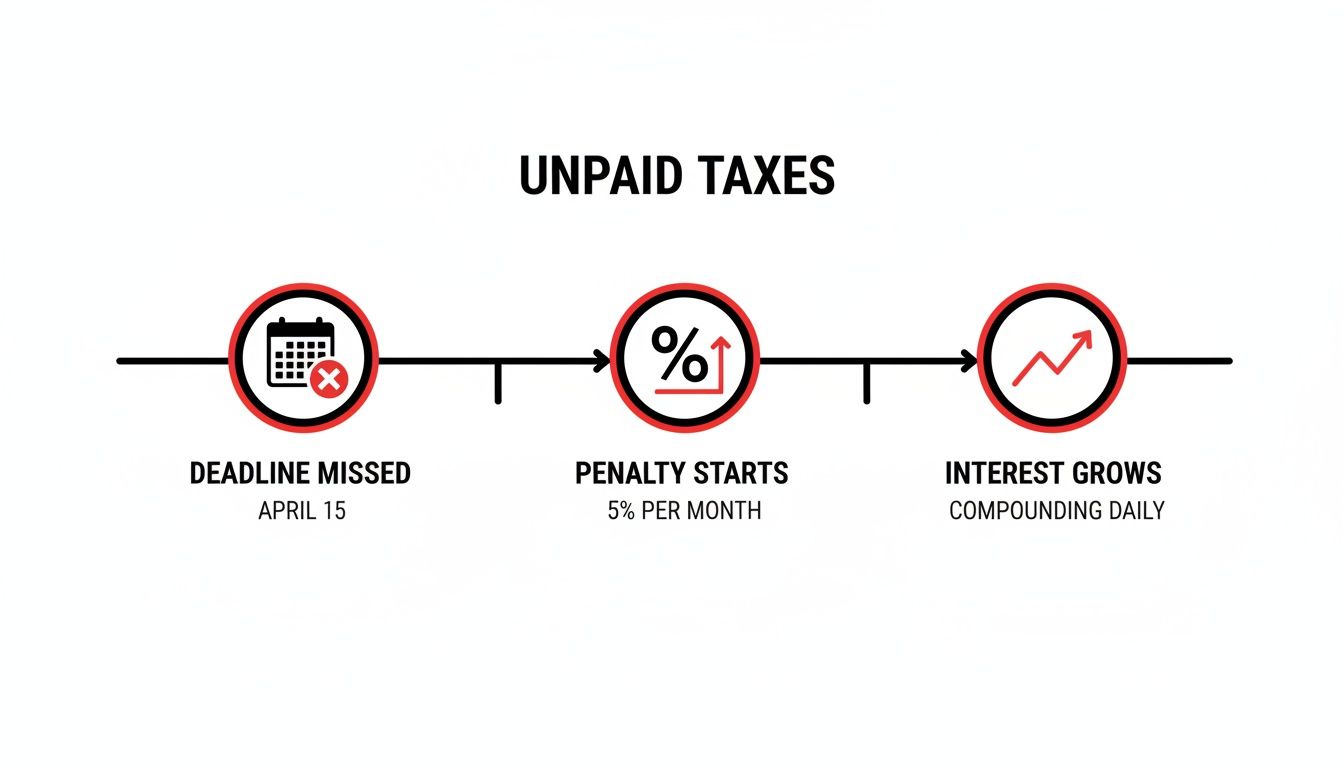
This visual shows how quickly the debt grows from day one. That escalating balance is precisely why the collection notices start arriving.
The Standard Notice Series
If the tax bill isn't paid after that first CP14 notice, a series of letters will start appearing in your mailbox. Think of them as escalating alerts. While the exact notices can sometimes vary, the progression is usually the same, with each letter raising the stakes.
CP501 - Reminder Notice: This is the first official nudge. It simply restates the outstanding balance, which now includes the penalties and interest that have been tacked on. It’s a clear sign the IRS hasn't forgotten.
CP503 - Second Reminder Notice: The tone here gets a bit more serious. This letter reiterates the amount you owe and starts warning about potential actions, like filing a federal tax lien, if you don't respond.
CP504 - Notice of Intent to Levy: This is where things really start to escalate. The CP504 is a legally required warning that the IRS plans to take—or "levy"—your state tax refund and put it toward your federal tax debt. It’s the first sign they're moving toward direct collection.
Each one of these notices is a roadmap, telling you exactly where you stand in the process and what’s likely to happen if you continue to wait.
The Final Warning Before Seizure
The single most important letter in this entire process is the Final Notice of Intent to Levy and Notice of Your Right to a Hearing. It often arrives as a Letter 1058 or LT11. Seeing this in your mail is a major red flag—it’s the IRS's last required step before they can legally start seizing your property and money.
What makes this notice so different is that it gives you critical legal rights. It clearly states you have 30 days to appeal the proposed levy by requesting a Collection Due Process (CDP) hearing.
This 30-day window is your last, best chance to formally stop the collection machine and negotiate a solution. If you let that deadline pass, you've given the IRS the green light to garnish your wages, clean out your bank accounts, and take other assets.
The good news is that this timeline isn't sudden. From the first notice to this final warning, several months will usually have passed. The system is designed to give you time to get your bearings and take action.
The Statute of Limitations on Collections
While the IRS is incredibly persistent, its power to collect doesn't last forever. The agency generally has a 10-year period to collect a tax debt, starting from the date the tax was officially assessed. This deadline is known as the Collection Statute Expiration Date (CSED).
For anyone with long-standing tax debt, understanding this clock is a crucial part of the big picture. You can dive deeper into this critical deadline in our guide on the IRS collection statute expiration date.
But don't make the common mistake of thinking you can just hide and wait out the 10 years. Certain actions—like filing for bankruptcy, submitting an Offer in Compromise, or even living abroad—can pause, or "toll," the clock, extending the time the IRS has to collect. Knowing each step in the collection timeline allows you to anticipate what's coming next and make smart, proactive decisions to finally resolve your tax debt.
Understanding IRS Enforcement: Liens and Levies
When the initial flurry of IRS collection notices goes unanswered, the process gets serious. The agency stops just asking for the money and starts taking action. This is when the IRS deploys its most powerful collection tools: liens and levies.
It's easy to confuse the two, but they are very different phases of enforcement. Think of a tax lien as the government putting a public "dibs" on everything you own. A levy, on the other hand, is the government actually showing up to collect on that claim. The lien secures their interest; the levy is the seizure.

What Is a Federal Tax Lien?
A federal tax lien is a legal claim the government places on all your assets—current and future—when you have an unpaid tax debt. This isn't just about your house; it covers your car, your investments, your personal property, and even your business assets.
Before a lien is filed, the IRS has to assess your liability, send you a bill (the formal Notice and Demand for Payment), and then you have to neglect or refuse to pay the debt in full. Once those conditions are met, the lien is filed publicly. This puts all other creditors on notice that the IRS gets first priority to your property.
What does that mean in practice? If you try to sell your home, the IRS gets paid out of the proceeds before you see a dime. If you're a business owner, it can attach to your accounts receivable, effectively hijacking your incoming cash flow. It also makes getting new credit nearly impossible.
How an IRS Levy Seizes Your Assets
If a lien is the government's claim, a levy is the actual seizure. A levy is an enforcement action that gives the IRS the legal power to take your property and sell it to satisfy your tax debt. This is a much more aggressive and immediate step, but it doesn't come out of the blue. It only happens after you’ve received a "Final Notice of Intent to Levy" and failed to resolve the issue.
The IRS can levy a surprisingly wide range of assets. The most common targets are:
- Wages and Salaries: The IRS can force your employer to send a significant portion of every paycheck directly to them. This is often called a wage garnishment.
- Bank Accounts: They can order your bank to freeze your account and turn over all the funds, up to the amount you owe. We cover this in detail in our complete guide to IRS levies on bank accounts.
- Social Security Benefits: Yes, even a portion of your federal benefits can be intercepted.
- Physical Property: The IRS has the authority to seize and sell your house, car, boat, or other valuable physical property.
A levy is never a surprise attack. It’s the final step in a long process of ignored notices. That Final Notice gives you a critical 30-day window to respond before the IRS can legally start taking your property.
The distinction is critical: a lien secures the debt by attaching to your property, damaging your credit and ability to transact. A levy actively takes that property from you to pay the debt. Both are serious consequences of what happens if you don't pay taxes.
The Real-World Impact of Liens and Levies
These aren't just abstract legal concepts; their real-world consequences can be devastating. A tax lien can absolutely wreck your credit score, making it impossible to get a mortgage, refinance your home, or even get a car loan.
A levy is even more disruptive. Imagine waking up to find your bank account completely empty, with no money for rent, groceries, or your car payment. A wage garnishment can shrink your paycheck so dramatically that you can no longer cover your basic living expenses. These actions are designed to be powerful, and they have an immediate and severe impact on your daily life.
Special Risks for Business Owners
For individuals, owing back taxes is a serious financial headache. But for a business owner with employees, it can become a personal nightmare. The danger lies in a specific category of taxes the IRS takes more seriously than almost any other: trust fund taxes.
This isn't about your business's income tax. We're talking about the Social Security and Medicare taxes you withhold from your employees' paychecks. The government's view is simple: that money isn't yours. You're just holding it "in trust" before passing it along to the U.S. Treasury.
The Dangers of Unpaid Payroll Taxes
When cash flow gets tight, it's incredibly tempting to dip into that payroll tax money to cover rent, make payroll, or buy inventory. The thought process is almost always, "I'll catch up next quarter." This is a catastrophic mistake. From the IRS's perspective, you aren't just borrowing—you're spending money that never belonged to you in the first place.
That one distinction is the key to understanding why this is so dangerous. Because that money belongs to your employees and the government, the IRS has a weapon in its arsenal that completely ignores the legal protection of your LLC or corporation.
Understanding the Trust Fund Recovery Penalty
That weapon is the Trust Fund Recovery Penalty (TFRP). The TFRP gives the IRS the power to make individuals personally liable for the business's unpaid trust fund taxes. It essentially pierces the corporate veil, taking a business debt and pinning it directly on you.
This means if the company can't pay up, the IRS will start seizing your personal assets—your house, your savings, your future wages. It’s one of the most potent tools the IRS has for collecting from business owners.
Think of it this way: The government will not let you use your employees' tax withholdings as a personal, interest-free loan to keep your business afloat. The TFRP is designed to get that money back from the people who had the power to pay it.
Once a TFRP is assessed, it's your personal debt, completely separate from the business. Worse, this kind of tax debt is often not dischargeable in bankruptcy, meaning it can haunt you for a decade or more. To see how this penalty works in detail, check out our in-depth guide to the Trust Fund Recovery Penalty.
Who Is Considered a Responsible Person?
The reach of the TFRP is surprisingly long. The IRS isn't just looking for the owner listed on the paperwork; they're looking for any "responsible person"—anyone who had the authority and duty to make sure those taxes got paid. This definition is intentionally broad and can easily rope in people you wouldn't expect:
- Owners and Partners: The most obvious targets.
- Corporate Officers: A CEO, CFO, or Treasurer is squarely in the crosshairs.
- Managers with Financial Authority: A general manager who signs checks or directs how bills are paid could be held responsible.
- Bookkeepers or Accountants: Even an employee without an ownership stake can be found liable if they had significant control over the company's finances.
To determine who gets hit with the penalty, the IRS asks two fundamental questions:
- Responsibility: Did this person have the effective power to pay the taxes? They don't have to be the final decision-maker, just someone with influence and authority over the funds.
- Willfulness: Did they know the taxes were due and deliberately allow other bills to be paid first? "Willful" doesn't mean malicious—it just means it was a conscious choice.
If the IRS can answer "yes" to both, they can assess the Trust Fund Recovery Penalty against that individual. This is how a business problem explodes into a devastating personal financial crisis, and it's why unpaid payroll taxes must be the number one priority for any struggling business.
Proactive Solutions to Stop IRS Collections
Getting a collection notice from the IRS is enough to make anyone's stomach drop, but it’s not the end of the road. Instead of letting the situation spiral into liens and levies, you can get in front of it. The IRS has several official programs designed to help people get back on track and settle their debt.
These aren't some secret loopholes; they're established tools the IRS offers to handle different financial predicaments. The key is figuring out which tool fits your specific problem, which is often where a tax professional can make all the difference. Choosing the right path stops the aggressive collection actions and gives you a clear, manageable plan to finally put this debt behind you.

Set Up an IRS Installment Agreement
The most common and direct way to resolve tax debt is through an Installment Agreement (IA). Think of it as a formal payment plan. You agree to make consistent monthly payments until the entire debt is cleared. The best part? It immediately halts collection actions like wage garnishments and bank levies, as long as you make your payments on time.
To qualify, you first have to be current on filing all your required tax returns. If your total debt—including tax, penalties, and interest—is under $50,000, you can often set up a streamlined agreement right on the IRS website without drowning in financial paperwork. This is a great option if you have a reliable income and can pay off the full balance within the 72-month (six-year) timeframe.
Just remember one important catch: interest and penalties don’t stop. They continue to pile up on your remaining balance until it’s paid in full, meaning your total payout will be higher than the original tax you owed.
Settle for Less with an Offer in Compromise
But what if you can’t possibly pay the full amount, even with a payment plan? For taxpayers in a tough financial spot, the Offer in Compromise (OIC) can feel like a godsend. An OIC is a formal agreement with the IRS to settle your tax debt for less than the total amount you owe.
This isn’t a simple negotiation, though. The IRS only accepts an OIC when they’re convinced it’s the most they could ever hope to collect from you. You’ll have to prove that paying the full amount would cause a genuine "economic hardship" or that there’s a legitimate "doubt as to liability" (a real reason to believe you don’t actually owe the tax).
The OIC application process is intense. The IRS will put your finances under a microscope, examining your:
- Ability to pay based on current cash flow
- Monthly income
- Allowable living expenses
- Equity in any assets you own (home, cars, savings)
They use this information to calculate what they call your Reasonable Collection Potential (RCP). To have a shot at acceptance, your settlement offer needs to meet or beat that number. It’s a powerful tool, but the eligibility rules are incredibly strict.
Qualify for Currently Not Collectible Status
Sometimes, life hits so hard that making any payment towards tax debt is impossible without forgoing basic necessities like food and rent. In these extreme cases, the IRS might place your account in Currently Not Collectible (CNC) status. This is essentially a temporary time-out on collections.
CNC status doesn’t make the debt disappear. It’s the IRS officially acknowledging that, for now, you can't afford to pay your basic living expenses and your tax bill. The debt remains, and interest and penalties keep growing.
While you're in CNC status, the IRS won't garnish your wages or levy your bank accounts. But they don't forget about you. They’ll periodically check in on your financial situation, usually every year or two. If your income goes up, they’ll take you out of CNC and expect you to start paying again.
Request Penalty Abatement
The penalties the IRS tacks on can sometimes be as large as the original tax bill itself. Fortunately, under certain circumstances, the IRS will agree to remove—or "abate"—these penalties. This won't reduce the core tax you owe, but it can slash your total balance dramatically.
The most common argument for penalty removal is showing reasonable cause. This means you had a good reason for failing to file or pay on time. We're not talking about forgetting or being too busy; we mean things like a death in the immediate family, a serious illness, or having your records destroyed in a fire or flood. You have to prove you acted with ordinary care but were still unable to meet your deadline.
Another path is the First-Time Abatement (FTA) waiver. If you have a squeaky-clean track record for the previous three years (no penalties), the IRS may waive the penalty as a one-time courtesy. Getting those penalties removed can make the remaining tax debt far less intimidating to tackle.
Comparing Your Tax Debt Resolution Options
Choosing the right strategy depends entirely on your financial reality. This table breaks down the main options to help you see which path might make the most sense for your situation.
| Resolution Option | Who It's For | Key Benefit | Main Drawback |
|---|---|---|---|
| Installment Agreement | Taxpayers with a steady income who can pay the full debt over time. | Stops collections immediately with a predictable monthly payment. | Interest and penalties continue to accrue until the debt is fully paid. |
| Offer in Compromise | Those in significant financial hardship who cannot pay the full debt. | Allows you to settle your tax debt for a fraction of what you owe. | Very strict eligibility rules and an invasive financial review process. |
| Currently Not Collectible | Individuals with no disposable income after covering basic living expenses. | Temporarily pauses all IRS collection activity, including levies. | The debt doesn't go away and continues to grow with interest/penalties. |
| Penalty Abatement | People who had a legitimate reason for filing/paying late. | Can significantly reduce the total amount owed by removing penalties. | Doesn't reduce the original tax debt, only the add-on penalties. |
While this gives you a starting point, every case is unique. The best first step is to get a clear, professional assessment of where you stand.
Your Top Questions About Unpaid Taxes, Answered
When you’re staring down a tax debt, your mind is probably racing with "what if" scenarios. It's completely normal to feel overwhelmed and have urgent questions about what might happen next.
Let's cut through the noise and get you some straight answers. Getting a clear picture of the situation is always the first step toward making a solid plan and taking back control.
Can I Go to Jail for Not Paying My Taxes?
For the vast majority of people, the answer is a firm no. The IRS isn't in the business of jailing people who have fallen on hard times. They treat most unpaid tax situations as a civil matter, not a criminal one, because they understand that financial hardship is a real and common problem.
Jail time is reserved for cases involving willful and intentional tax evasion. This isn't about an honest mistake or an inability to pay; it's about deliberate fraud. We're talking about things like:
- Creating and using phony financial documents to lie about income.
- Stashing assets in offshore accounts specifically to hide them from the IRS.
- Using a fake Social Security number to fly under the radar.
- Purposefully not filing returns for years on end as a form of protest or to conceal income.
For the average person who made a mistake or simply can't afford to pay, the consequences are purely financial—penalties, interest, and eventually, liens and levies. The real danger comes from completely ignoring the IRS for years. If you don't respond to notices or make any effort to communicate, the risk of a criminal investigation, while still small, does go up. The key is to be transparent and show you're making a good-faith effort to fix the problem.
How Long Does the IRS Have to Collect Unpaid Taxes?
Thankfully, the IRS doesn't have forever to collect a tax debt. There is a 10-year statute of limitations on collections, which is a powerful protection for taxpayers. This countdown officially begins on the date your tax liability was "assessed"—basically, the day it was formally recorded in the IRS's books.
This deadline is officially known as the Collection Statute Expiration Date (CSED).
But here’s where you have to be careful. It's a dangerous myth that you can just hide out and wait for the clock to run out. Certain actions can "toll" or pause that 10-year countdown, giving the IRS more time.
Think of it like pausing a stopwatch in a race. If you file for an Offer in Compromise, request an Installment Agreement, declare bankruptcy, or even live outside the country for an extended period, the CSED clock can stop ticking. It's absolutely crucial to know if any of these events have happened in your case before assuming a debt is too old to collect.
Will the IRS Just Take Money from My Bank Account Without Warning?
No, absolutely not. The IRS can’t and won’t just reach into your bank account out of the blue. A bank levy is one of their most serious collection tools, and it’s treated as a last resort. There's a very clear, legally required process they must follow first.
Before a levy can ever happen, you will have received a series of letters and notices in the mail, likely over a period of many months. The most critical one is the "Final Notice of Intent to Levy and Notice of Your Right to a Hearing," which is often a Letter 1058 or LT11.
This official document is your final warning. It gives you a 30-day window to either pay what you owe or formally appeal their intent to levy. Only after that 30-day period passes with no response from you can the IRS legally command your bank to freeze and surrender your funds. You will have plenty of warning.
What Is a Free Tax Debt Analysis and How Does It Actually Help?
A Free Tax Debt Analysis is a no-cost, no-commitment consultation where you get to speak with an experienced tax professional about your specific problem. It's the opposite of being asked for a huge retainer fee just to find out if someone can even help you. The entire point is to diagnose the problem first.
During this analysis, a professional will review your IRS notices, understand the total amount you owe, and ask about your current financial situation. Their goal is to figure out two things: if they can help you and how they can help you.
You'll walk away with a realistic assessment of your options, whether that's an Installment Agreement, an Offer in Compromise, or something else entirely. It’s all about creating a clear, actionable plan that’s tailored to your unique case, saving you from a world of stress and wasted money.
At Attorney Stephen A Weisberg, we believe in solving problems, not selling fear. If you're struggling with IRS or state tax debt, you don't have to face it alone. We start every potential case with a no-obligation Free Tax Debt Analysis to give you clarity and a path forward. Find out how we can help you regain control by visiting https://weisberg.tax today.


