What Happens If You Can't Pay Taxes A Guide to IRS Actions
Worried about what happens if you can't pay taxes? This guide explains IRS penalties, liens, and levies, plus the relief options available to you.

In this article
- What Happens Right After You Miss a Tax Payment
- The Initial IRS Contact Timeline
- Initial IRS Contact A Quick Overview
- Why You Cannot Ignore These Notices
- The Escalating Cost of Unpaid Taxes
- How Penalties Compound Your Tax Debt
- The Unrelenting Growth of Interest
- A Look at a Growing Tax Bill
- Is There a Way to Reduce These Penalties?
- Understanding Liens, Levies, and Garnishments
- The Critical Difference Between a Lien and a Levy
- How a Federal Tax Lien Paralyzes Your Finances
- When the IRS Moves from Lien to Levy and Garnishment
- The Unique Risks for Business Owners
- The Dangers of the Trust Fund Recovery Penalty
- Who Can Be Held Personally Responsible?
- A Debt That Follows You Everywhere
- Finding Your Path to Tax Resolution
- The First Step: Always File Your Returns
- Option 1: The Installment Agreement
- Option 2: The Offer in Compromise
- Option 3: Currently Not Collectible Status
- How a Tax Attorney Can Navigate the IRS Maze for You
- The Strategic Edge an Attorney Provides
- Why a Personalized Strategy Matters
- Common Questions About Unpaid Taxes
- Can I Go to Jail for Not Paying Taxes?
- Will the IRS Really Seize My Home?
- How Long Does the IRS Have to Collect a Tax Debt?
So, you've missed the tax deadline and can't pay what you owe. The first thing to know is that this doesn't make you a criminal, and IRS agents aren't going to show up at your door tomorrow. Instead, a very predictable, automated process kicks into gear, starting with a letter in your mailbox.
This first official notice, usually a CP14 Notice, is the starting gun. It's the IRS's way of saying, "Hey, our records show you owe us money, and the meter is now running on penalties and interest." Ignoring it is the worst thing you can do, because it’s your best chance to get ahead of the problem.
What Happens Right After You Miss a Tax Payment
That feeling of dread when you realize you can't pay your tax bill is completely normal. But what actually happens next isn't as dramatic as you might think. The IRS collection machine is slow, bureaucratic, and follows a set script.
Knowing that script is your advantage. It turns a scary, unknown situation into a series of predictable steps. You have opportunities at each stage to step in, communicate, and find a solution before things get truly serious.
The Initial IRS Contact Timeline
Once the tax deadline passes, the IRS computer system flags accounts with a balance due. This automatically triggers a series of letters sent directly to your last known address. Each one gets a little more serious.
- The Clock Starts: The moment Tax Day passes, any unpaid balance starts racking up penalties and interest.
- The First Bill Arrives (CP14): A few weeks later, you'll get the CP14 Notice of Tax Due and Demand for Payment. This is your official bill, breaking down the tax, penalties, and interest calculated so far.
- The Reminders Get Sterner: If you don't respond, you'll get a follow-up, like the CP501. Ignore that, and you'll get the CP503. The final one in this initial series is the CP504, which is an official Notice of Intent to Levy. This is a serious warning that they plan to start taking your assets.
This process is methodical. As you can see, doing nothing guarantees the situation will escalate.
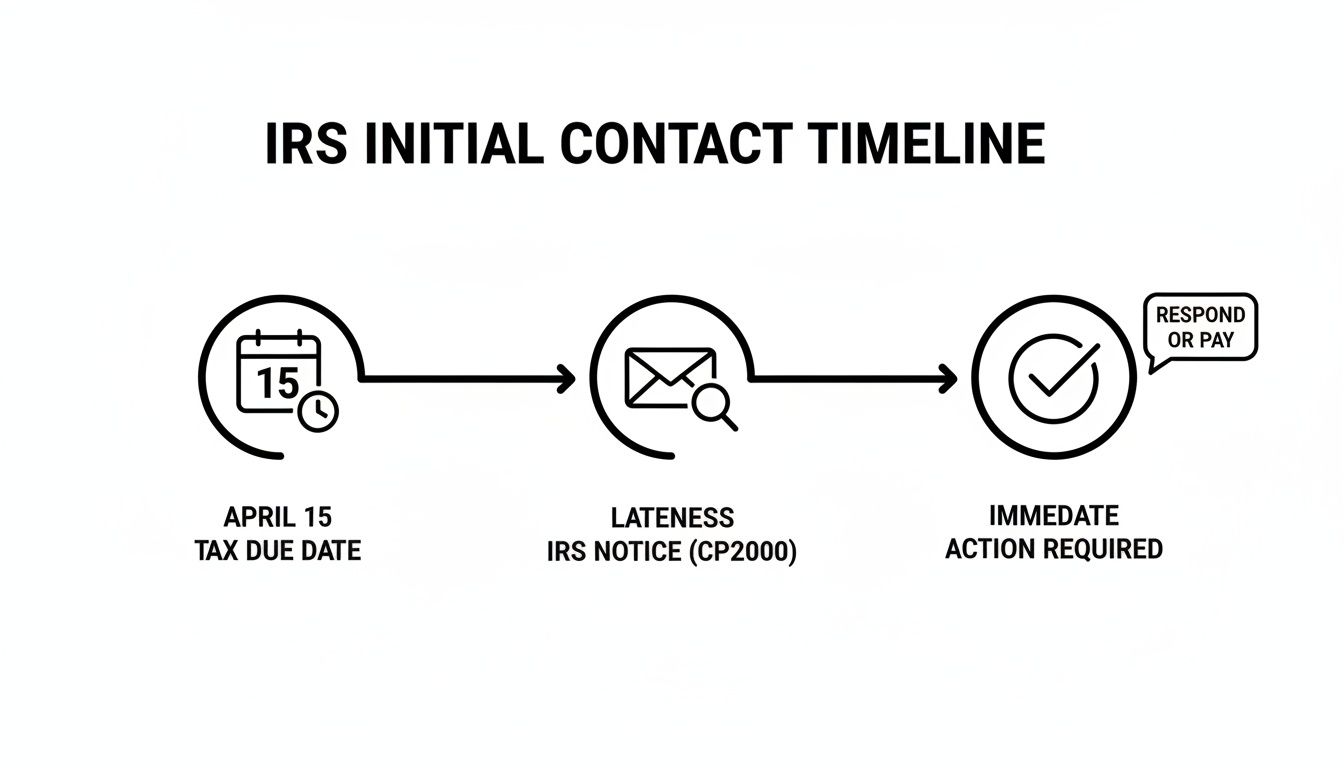
This timeline makes it clear: inaction is the most expensive choice you can make. The key is to respond to that very first letter.
This table breaks down the first steps in the IRS collection process, helping you understand where you are and what to expect.
Initial IRS Contact A Quick Overview
| IRS Notice or Action | What It Really Means | Typical Timeframe | Your Recommended First Step |
|---|---|---|---|
| Tax Due Date Passes | Your tax bill is now officially late. | April 15 (or filing deadline) | If you haven't filed, file immediately to minimize penalties. |
| CP14 Notice | The first official bill from the IRS. | 3-4 weeks after Tax Day | Don't ignore it. Review the notice for accuracy and explore your payment options. |
| CP501 / CP503 | These are follow-up reminder notices. | 4-6 weeks after the previous notice | The situation is getting more urgent. Contact the IRS or a tax professional now. |
| CP504 Notice | A formal warning that the IRS intends to seize assets. | 4-6 weeks after the CP503 | This is your last chance to act before enforced collection begins. Seek professional help immediately. |
As the table shows, there’s a clear pattern of escalation. The sooner you engage, the more options you'll have.
Why You Cannot Ignore These Notices
Tossing those IRS letters in a drawer and hoping they go away is a recipe for disaster. The debt doesn't vanish; it just grows. Every day, more interest and penalties are piled on top, making a manageable problem much, much worse. The process for handling unpaid taxes is a universal headache; for instance, understanding what happens if you don't lodge a tax return in a country like Australia shows similar principles of compounding problems.
The most crucial takeaway is this: the first IRS notice is an opportunity. It is your chance to engage with the IRS on your terms, explore payment options, and prevent the severe collection actions that will inevitably follow if you do nothing.
When you respond, you show the IRS you're taking this seriously. This opens the door to resolutions like payment plans or other relief programs. If you're struggling to make sense of what the government is telling you, learning how to read the various IRS letters and notices is the first step toward taking back control.
The Escalating Cost of Unpaid Taxes

The number on your tax return is just the beginning. Once a tax bill goes unpaid, it starts to grow, acting a lot like a high-interest credit card balance you never signed up for. The IRS has a robust system of penalties and interest specifically designed to motivate payment, and these additions can cause your total debt to skyrocket.
This isn’t to scare you, but to lay out a critical financial reality: the longer you wait, the more this problem will cost you. Getting a handle on how these costs stack up is the first step to stopping the financial bleed and finding a solution.
How Penalties Compound Your Tax Debt
The two most common penalties the IRS levies are for failing to file and failing to pay. They can hit you separately or at the same time, creating a powerful one-two punch that quickly inflates your balance.
- Failure-to-File Penalty: This is what you get for not filing your tax return by the deadline. It’s a steep 5% of the unpaid taxes for each month (or part of a month) the return is late, maxing out at 25% of your tax bill.
- Failure-to-Pay Penalty: This penalty applies when you file but don't pay what you owe by the due date. It’s calculated at 0.5% of your unpaid taxes for each month the bill remains unpaid, and it also caps out at 25%.
Notice the massive difference? The failure-to-file penalty is ten times higher. That's why it's always, always better to file your return on time, even if you can't pay a dime. This single step can save you a huge amount of money right out of the gate.
The Unrelenting Growth of Interest
On top of those penalties, the IRS charges interest on your entire unpaid balance. That means you’re paying interest on the original tax, plus the failure-to-file penalty, and the failure-to-pay penalty. The interest rate itself changes every quarter and is calculated as the federal short-term rate plus 3%.
This is how a manageable tax issue snowballs into a daunting financial crisis. You’re being charged interest on your penalties, which only adds to the balance that interest is charged on next month. It’s a vicious cycle. And it’s a massive problem—in fiscal year 2023 alone, individual income tax debt assessments shot past $500 billion, landing 10 million taxpayers in the IRS collections system.
The combination of penalties and compounding interest means your tax debt is a moving target that never stops growing. The only way to minimize the long-term damage is to tackle it head-on, and quickly.
Let's put this into perspective with a real-world example.
A Look at a Growing Tax Bill
Imagine you owe $20,000 in federal income taxes. You were responsible and filed on time, but just couldn't pay it. Here’s a simplified look at how that debt could escalate over time with penalties and interest.
| Year | Starting Debt | Failure-to-Pay Penalties | Interest (Approx.) | Ending Debt |
|---|---|---|---|---|
| Year 1 | $20,000 | $1,200 (6%) | $1,484 | $22,684 |
| Year 2 | $22,684 | $1,200 (6%) | $1,672 | $25,556 |
| Year 3 | $25,556 | $1,200 (6%) | $1,873 | $28,629 |
| Year 5 | $32,126 | $1,200 (6%) | $2,333 | $35,659 |
As you can see, in just five short years, that original $20,000 debt has swollen by more than 78%. This is the destructive power of letting a tax problem sit unresolved.
Is There a Way to Reduce These Penalties?
Thankfully, these added costs aren't always set in stone. The IRS has a process called penalty abatement, which essentially allows for the forgiveness of certain penalties. To get it, you have to show you had a valid reason—what the IRS calls "reasonable cause"—for not filing or paying on time.
This can be a game-changer. If you can successfully make your case, the IRS could wipe away thousands of dollars in penalties, making your total balance much more manageable. Understanding your eligibility for penalty abatement due to reasonable cause is a critical step for anyone facing a ballooning tax bill. It’s a real opportunity to push back against the escalating costs and start fresh.
Understanding Liens, Levies, and Garnishments
If you’ve been ignoring those IRS notices, you’re about to enter a much more serious phase. The letters will stop, and the IRS will shift from asking for money to actively taking it. This is where unpaid taxes move from being a problem on paper to a very real and disruptive force in your life.
To know what you're up against, you first have to understand the government's two primary collection tools: liens and levies. People often use these terms interchangeably, but in the world of tax debt, they are two very different things with very different consequences.
The Critical Difference Between a Lien and a Levy
Think of a tax lien as the government calling "dibs" on everything you own. It's a legal claim filed against all your assets—your house, car, investments, and even property you acquire in the future. It doesn't mean they're showing up with a moving truck tomorrow; instead, it’s a passive but powerful move that secures their spot as a creditor.
A tax levy, on the other hand, is the action. This is the IRS actually seizing your property to pay off the debt. A lien is the warning shot that craters your financial flexibility; a levy is the direct hit.
To put it simply: A lien secures the government's right to your property, while a levy is the action of taking that property. You can have a lien without a levy, but the IRS must issue a levy notice before it can seize anything.
This distinction is crucial because each one impacts your daily life in a fundamentally different way.
Here’s a quick overview from the IRS website about what a federal tax lien really means for a taxpayer.
As the screenshot shows, a lien attaches to all your assets and broadcasts your tax debt to the world, making it almost impossible to get credit. It’s a bright red flag for any potential lender.
How a Federal Tax Lien Paralyzes Your Finances
A federal tax lien isn’t just some internal government filing. The IRS files a Notice of Federal Tax Lien (NFTL), making your debt a public record. This notice instantly shows up on your credit report and can have a devastating impact.
Suddenly, you’ll find it incredibly difficult, if not impossible, to:
- Sell or refinance property: No one will buy your home or refinance your mortgage without a clear title, and the lien prevents that until the IRS gets paid.
- Get a loan: Banks see the U.S. government as a creditor that gets paid first, so they won’t be eager to lend you a dime.
- Secure business financing: For a business owner, a lien can be a death sentence, cutting off the lines of credit needed to make payroll or buy inventory.
In some cases involving delinquent state or property taxes, things can get even worse. A property can be forced into foreclosure and sold at a trustee's sale, meaning you could lose your real estate entirely. This is why a tax lien can’t be ignored.
When the IRS Moves from Lien to Levy and Garnishment
If filing a lien doesn't result in payment, the IRS will escalate to a levy. This is when things get truly painful. A levy gives the IRS legal authority to seize your money and property directly from the people and institutions that hold it.
The most common types of IRS levies include:
- Bank Levy: The IRS instructs your bank to freeze your accounts and send them every dollar, up to the amount you owe.
- Wage Garnishment: They order your employer to take a large chunk of your paycheck and send it directly to them. This happens before you ever see the money.
- Property Seizure: In more severe situations, the IRS can seize and sell physical assets like a second home, a boat, or a car.
- Seizure of Other Payments: This isn't limited to wages. The IRS can take your Social Security benefits, retirement distributions, or payments from clients if you're an independent contractor.
Don't mistake these for empty threats. The IRS files NFTLs on roughly 2.5 million accounts every year. For a more detailed breakdown, you can check out our guide on understanding the IRS notice of levy to prepare for what's ahead. These collection actions are incredibly effective; in 2022 alone, the IRS collected $14 billion from 8 million cases through these methods.
The Unique Risks for Business Owners

If you're an individual with tax debt, you have plenty to worry about. But if you’re a business owner, you’re in a whole different league of trouble. The most dangerous threat revolves around payroll taxes—that is, the money you withhold from your employees' paychecks for Social Security, Medicare, and income tax. This isn't just any debt; it comes with its own brutal penalty that can have life-altering consequences.
The most important thing to understand is that this money was never yours. You're simply holding it "in trust" for the U.S. Treasury. Think of yourself as a courier who's been given a package to deliver. You can't just open it up and use the contents to pay your own bills. It doesn't belong to you.
The Dangers of the Trust Fund Recovery Penalty
When a business fails to hand over these trust fund taxes, the IRS unleashes one of its most powerful weapons: the Trust Fund Recovery Penalty (TFRP). This penalty gives the government the authority to bypass the business entirely and hold individuals personally responsible for the entire unpaid amount.
What makes the TFRP so terrifying is that it "pierces the corporate veil." In other words, your personal assets are suddenly on the line, and your business structure offers zero protection.
- LLC Protection? Gone. The liability shield of a Limited Liability Company won't save you from the TFRP.
- S-Corp Status? Doesn't Matter. The IRS can still come after you, personally.
- C-Corp? Still Exposed. Corporate protections mean absolutely nothing when it comes to unpaid trust fund taxes.
This isn't just some slap on the wrist. The TFRP is a direct, one-to-one assessment. If your business owed $150,000 in payroll taxes, the IRS can turn around and assess a $150,000 penalty directly against you. Your home, your car, your personal savings account—it’s all fair game for collection.
Who Can Be Held Personally Responsible?
The IRS casts a surprisingly wide net when deciding who is a "responsible person" for the TFRP. It's not always just the owner. Anyone who had the authority and the duty to make sure the taxes were paid can be held liable.
This could easily include:
- Corporate officers and directors
- A controller or bookkeeper with check-signing authority
- A business partner, even a silent one
- Sometimes even a volunteer board member of a non-profit organization
The IRS simply looks at who had control over the company's money. If you had the power to sign checks or decide which creditors got paid, you could be deemed a responsible person—even if you weren't the one who ultimately decided to skip the tax payment.
The IRS defines responsibility broadly: a responsible person is anyone with significant control over the business's finances. Willfulness is simply knowing the taxes were due and paying other creditors instead.
Unpaid payroll tax is the silent killer of small businesses. It's estimated that delinquent trust fund taxes in the U.S. reach $20 billion annually, impacting over 300,000 employers. The TFRP is assessed against more than 25,000 individuals each year, with the average assessment climbing to $150,000. Non-payment can trigger swift, automated levies that seize up to 70% of a business's revenue, forcing many to shut their doors almost overnight. For more on this, you can review some of the global tax collection trends on oecd.org.
A Debt That Follows You Everywhere
Unlike many other forms of debt, the TFRP is notoriously difficult to shake. It is non-dischargeable in bankruptcy. You can't just file for Chapter 7 and wipe the slate clean. This personal assessment will follow you relentlessly until it's paid in full.
Because of the extreme personal risk and the sheer complexity of TFRP cases, this is one area where getting professional help is absolutely critical. The IRS moves fast and aggressively on these matters. Understanding your rights and options from the very start is the only way to protect your personal financial future.
Finding Your Path to Tax Resolution
Staring down the consequences of unpaid taxes is daunting, but this is where you start to regain control. After understanding the steep penalties and the IRS's collection arsenal, it's time to shift from problem to solution. The most important step, the one that changes everything, is simple: communication.
Ignoring the problem is a guaranteed way to make it worse. On the other hand, reaching out to the IRS and getting your tax returns filed—even if you can't pay a dime right now—is the single most critical first move. It signals you're ready to fix the situation and opens the door to powerful relief programs designed to help taxpayers get back on solid ground.
The First Step: Always File Your Returns
Before you can even think about a resolution, you have to get into tax compliance. In plain English, that means every single one of your required tax returns must be filed. The IRS won’t even entertain a conversation about a payment plan or settlement if they don't have the full picture of what you owe.
Filing those back taxes does two things right away:
- It slams the brakes on the punishing Failure-to-File penalty, stopping it from growing any larger.
- It proves to the IRS that you're making a good-faith effort to meet your obligations.
Once you're compliant, you can start exploring the main routes to tax relief.
Option 1: The Installment Agreement
The most straightforward solution is an Installment Agreement. Think of it just like a payment plan for any other bill. You and the IRS agree on a fixed monthly payment that you’ll make until the entire tax debt, plus all the penalties and interest, is paid off.
This is often the best fit for taxpayers with a steady income who can realistically pay their full tax bill over time, usually over a period of up to 72 months. While penalties and interest will keep adding up until the balance hits zero, an approved agreement immediately halts more aggressive collection actions like levies and wage garnishments.
Option 2: The Offer in Compromise
But what if you simply can't pay the full amount, even with a monthly plan? For people facing real financial hardship, an Offer in Compromise (OIC) can be a lifeline. An OIC is an agreement that allows certain taxpayers to settle their tax liability with the IRS for less than the full amount they originally owed.
Imagine your tax debt is a mountain you have no hope of climbing. An OIC is like the IRS agreeing to meet you part of the way up, accepting that you can only get so far. This isn't a casual negotiation, though. The IRS uses a strict formula based on your income, expenses, and the value of your assets to calculate what they call your "reasonable collection potential."
You might be a candidate for an OIC if:
- There's serious doubt you could ever pay the full debt.
- Paying the full amount would create a significant economic hardship for you and your family.
- There are unique, exceptional circumstances that justify a compromise.
An Offer in Compromise is a chance for a fresh start, but it requires a deep dive into your finances. The IRS has to be completely convinced that the amount you're offering is truly the most they could ever hope to collect from you.
The potential payoff is huge. Here's a crucial point: over 70% of tax debt cases can be resolved through offers in compromise or installment agreements, often slashing penalties by up to 50% if you act quickly. Waiting, however, invites disaster—think liens on your property, passport revocation for debts over $62,000 (as of 2025), and a credit score hit of 100+ points that can block you from loans for years. You can see more on these global debt trends on imf.org.
To learn more about this powerful tool, you can get a deeper look into how to settle tax debt with the IRS and see if it might be the right path for you.
Option 3: Currently Not Collectible Status
In cases of severe financial distress, the IRS might place your account in Currently Not Collectible (CNC) status. This is essentially a temporary timeout on all collection efforts. If your income is so low that making tax payments would leave you unable to cover basic necessities like housing, food, and healthcare, the IRS can put your account on hold.
It's critical to understand that CNC is not forgiveness. The debt doesn't vanish, and penalties and interest keep piling up. The IRS will also periodically review your finances, and as soon as your situation improves, they’ll be back to collect. It’s a temporary shield for those in the toughest spots, not a permanent solution.
How a Tax Attorney Can Navigate the IRS Maze for You

Knowing your resolution options is one thing, but actually getting the IRS to agree to one is a whole different ballgame. Trying to handle it yourself can feel like walking into a high-stakes legal battle without a lawyer—it’s incredibly easy to miss a critical deadline, misunderstand a form, or agree to a payment plan you can't truly afford. This is where bringing in a professional isn't just a cost, but an investment in your financial future.
An experienced tax attorney is your personal advocate, strategist, and most importantly, your shield. They live and breathe the tax code, understand the internal processes of the IRS, and know exactly how to frame your situation to build the strongest possible case for relief.
The Strategic Edge an Attorney Provides
When you hire a tax attorney, the power dynamic instantly shifts. You’re no longer an individual up against a massive federal agency; you have an expert in your corner who ensures the IRS follows its own rules.
This professional representation gives you several immediate advantages:
- They Protect Your Rights: An attorney makes sure your rights as a taxpayer are upheld, preventing IRS agents from overstepping their authority.
- They're Expert Negotiators: They take over all the intimidating calls and letters, speaking the IRS's language to negotiate more favorable terms for payment plans or settlement offers.
- They Build a Winning Case: They know precisely which financial documents matter most and how to present them to maximize your chances of getting approved for a relief program.
- The Harassment Stops: Once you have official representation, the IRS is required to direct all communication through your attorney. The stressful, nonstop calls and threatening letters come to an immediate halt.
Ultimately, an attorney manages the entire process—the deadlines, the complex paperwork, and the difficult conversations. This frees you up to focus on your work and family, providing peace of mind that your tax problem is finally being handled the right way.
Why a Personalized Strategy Matters
When you start researching what happens if you can't pay taxes, you’ll likely come across huge national "tax resolution" companies that make big promises. Be careful. These places often treat you like a case number, passing your file from a salesperson to a junior-level associate. The approach is cookie-cutter, not customized.
Working directly with a dedicated tax attorney is a completely different experience. It all begins with a deep dive into your unique financial situation—your income, your essential living expenses, your assets, and what caused the tax debt in the first place.
A true tax attorney doesn't offer a one-size-fits-all fix. They craft a specific plan of attack designed to get the best possible result for your circumstances, giving you a clear roadmap and a single point of contact you can trust.
This hands-on approach is crucial. For example, an attorney can pinpoint whether you qualify to have penalties waived due to a "reasonable cause," find errors in the IRS's initial assessment that could reduce your debt, or build a compelling argument for a lower settlement in an Offer in Compromise. It's this detailed, expert work that often separates a rejected application from a life-changing resolution that puts your tax problems behind you for good.
Common Questions About Unpaid Taxes
Staring down a tax bill from the IRS can kick off a whirlwind of frightening "what-if" scenarios. Let's cut through the noise and tackle some of the most common questions head-on. The goal here is to replace fear with facts so you have a clear picture of what really happens when you can't pay.
Can I Go to Jail for Not Paying Taxes?
This is the big one, the question that keeps people up at night. The short answer is: it's extremely unlikely. Jail time is reserved for criminal tax evasion, which is very different from simply not being able to pay.
To prove tax evasion, the government has to show you willfully tried to defraud them. Think hiding offshore accounts or creating fake social security numbers. For the vast majority of people who have a debt because they just can't afford it, the consequences are purely financial. The IRS wants its money, not to put you behind bars.
Will the IRS Really Seize My Home?
Losing your home is another top-tier fear, but it's an absolute last resort for the IRS and happens very rarely. Their much more common tactic is to place a tax lien on your property.
A lien is just a legal claim against your property to secure the debt. It ensures the IRS gets paid if you sell or refinance, but it doesn't mean they're coming to kick you out. Levying bank accounts and garnishing wages are their go-to collection tools long before they'd ever consider seizing a primary residence.
How Long Does the IRS Have to Collect a Tax Debt?
Believe it or not, the IRS doesn't have forever. They generally have a ten-year statute of limitations to collect what you owe, which starts from the date your tax was officially assessed. This deadline is known as the Collection Statute Expiration Date (CSED).
It's a crucial date to know, but be aware that certain actions can pause or "toll" that ten-year clock. Things like filing for an Offer in Compromise or declaring bankruptcy can extend the collection period. Understanding your specific CSED is a critical piece of any long-term resolution strategy.
Figuring out the answers to these questions and building a plan can feel overwhelming. Attorney Stephen A Weisberg offers a free, no-obligation Tax Debt Analysis to evaluate your specific situation and lay out your options in plain English. Find out how you can protect yourself and finally resolve your IRS issues by visiting https://weisberg.tax.


