what happens if irs audits you: Quick Guide to the Process
what happens if irs audits you: A concise overview of the audit steps, rights, timelines, and likely outcomes to help you respond confidently.

In this article
- That First IRS Notice: What It Really Means
- What the Initial Notice Contains
- Quick Guide to IRS Audit Types
- The Three Flavors of IRS Audits
- Unpacking the Three Types of IRS Audits
- The Correspondence Audit: An Inquiry by Mail
- The Office Audit: A Face-to-Face Meeting
- The Field Audit: An On-Site Examination
- Your Step-by-Step Guide Through the Audit Process
- Phase 1: The Initial Notice Arrives
- Phase 2: Gathering Your Documents
- Phase 3: The Examination and Review
- The IRS Audit Process Timeline
- Phase 4: The Final Resolution
- Understanding Your Rights as a Taxpayer
- The Right to Be Informed and Receive Quality Service
- The Right to Challenge the IRS and Be Heard
- The Right to Retain Representation
- So, What Are the Three Possible Audit Outcomes?
- Outcome 1: No Change
- Outcome 2: Agreed Changes
- Outcome 3: Disagreement and Appeal
- When Should You Hire a Professional for an IRS Audit?
- Key Signs You Need an Expert on Your Side
- The Different Kinds of Tax Professionals
- Common Questions We Hear About IRS Audits
- What Are the Biggest Red Flags That Trigger an IRS Audit?
- How Long Does an IRS Audit Typically Take?
- Can I Handle an IRS Audit Myself Without a Professional?
- What Happens If I Ignore an IRS Audit Notice?
So, you've received that dreaded envelope from the IRS. The first question that probably pops into your head is, what happens if the IRS audits me? It’s a nerve-wracking experience, but it’s important to know that an audit is simply a review of your financial information to make sure everything lines up with the tax laws. It doesn't automatically mean you're in trouble.
The process is essentially the IRS double-checking your numbers. It can end in a few different ways: with no changes, an agreement that you owe more tax, or a disagreement that leads to an appeals process.
That First IRS Notice: What It Really Means

Seeing that official IRS letterhead can make anyone's heart skip a beat. But take a breath. Understanding what's happening is the first step to handling it with confidence. This first notice isn't an accusation; it's more like a request from the IRS to see your homework.
Often, this letter arrives via certified mail, and it’s packed with crucial details about the audit. Our guide to handling IRS certified mail breaks down why you should never ignore these notices. The letter will tell you exactly which tax year is being looked at and what documents the agency needs to see.
What the Initial Notice Contains
Think of your audit notice as a roadmap for what’s ahead. It will clearly state how the audit will be handled. The vast majority of audits fall into one of three buckets, each with a different level of scrutiny.
Before we dive into the details of each, here's a quick overview to help you understand where you might stand.
Quick Guide to IRS Audit Types
| Audit Type | What It Is | How It's Conducted | Common Triggers |
|---|---|---|---|
| Correspondence Audit | The most common and least invasive audit. It focuses on a specific, simple issue. | Entirely by mail. You send requested documents back to the IRS. | Mismatched income (1099/W-2), simple math errors, or questions about specific credits. |
| Office Audit | A more involved audit where you meet an examiner at an IRS office. | In-person meeting. The scope is usually limited to a few specific items. | Unusually high itemized deductions, small business expenses, or rental property losses. |
| Field Audit | The most serious and comprehensive audit, typically for businesses or complex returns. | An IRS agent comes to your home, business, or accountant's office to review all records. | High income with complex investments, significant business losses, or suspected tax fraud. |
Now, let's unpack what each of these means for you.
The Three Flavors of IRS Audits
Correspondence Audit: This is by far the most common type and it's all handled through the mail. You’ll never see an agent in person. It’s usually triggered by a specific, minor issue, like a 1099 form from a client that doesn't match the income you reported.
Office Audit: This one steps it up a notch. You (or your representative) will need to go to a local IRS office and meet with an auditor. The scope is still fairly narrow, though. They might want to dig into your claimed business expenses or a large charitable donation.
Field Audit: This is the most serious audit. An IRS revenue agent will come to you—either at your home, business, or accountant's office—to conduct a deep dive into your financial records. These are usually reserved for complex returns or businesses.
No matter what, the golden rule is to never ignore an IRS notice. Responding in a timely, organized way shows you're cooperative and can stop things from getting worse. If you ignore the letter, the IRS will make a decision without your input, and that almost never goes well for the taxpayer.
By figuring out which type of audit you’re facing, you can start gathering the right documents and building a plan. Whether it’s a simple request for a few receipts or a full-blown examination of your business, your preparation starts the moment you open that envelope.
Unpacking the Three Types of IRS Audits

The word "audit" is enough to make anyone nervous, often conjuring images of stern-faced agents combing through every financial detail of your life. But the reality is that most audits are far less dramatic.
The IRS uses a few different methods to examine tax returns, each with its own level of scrutiny. Knowing which type of audit you're facing is the first step in getting organized and tackling the issue head-on. Let's break down the three main categories, from the most common to the most intensive.
The Correspondence Audit: An Inquiry by Mail
This is by far the most common type of audit you could face. In fact, more than 70% of all IRS audits are handled entirely through the mail, which means you'll likely never have to speak with an agent directly.
Think of a correspondence audit as a fact-checking exercise. The IRS's automated systems have flagged a potential discrepancy, and they're simply sending you a letter to ask for more information or clarification. It's usually focused on one or two specific items.
Here are some common reasons you might receive a letter:
- Mismatched Income: A Form 1099 from a client shows you earned $25,000, but your tax return only reports $22,000.
- Math Errors: A simple mistake in a calculation that changed your final tax amount.
- Documentation for Credits or Deductions: The IRS wants proof that you qualify for something you claimed, like the Earned Income Tax Credit or significant charitable donations.
The notice will tell you exactly what the IRS needs. A clear, timely response with the right documents can often close the case quickly.
The Office Audit: A Face-to-Face Meeting
A step up in seriousness is the office audit. This is exactly what it sounds like: you (and ideally, your representative) will need to go to a local IRS office for an in-person meeting with an examiner.
These audits are still targeted, but they often involve issues that are a bit too complex for a simple letter. For instance, the IRS might want to review the business expenses you claimed as a sole proprietor or dig into the details of a property sale. For business owners, this is a very real possibility. You can find more targeted advice in our guide to surviving a small business IRS audit.
An office audit is not a wide-ranging fishing expedition. The IRS notice will specify the exact issues under review, allowing you to gather the precise documentation needed without bringing your entire financial history.
The key here is preparation. The auditor will be asking specific questions, and you need to have your records—receipts, bank statements, mileage logs—organized and ready to support the figures on your return.
The Field Audit: An On-Site Examination
Finally, we have the field audit. This is the most comprehensive and serious type of examination, and it's what most people picture when they hear the word "audit."
In a field audit, an IRS agent comes to you—at your business, your home, or your accountant's office—to conduct a deep dive into your financial records. These are typically reserved for more complex cases, like larger businesses or individuals with multifaceted finances, or when the IRS suspects more significant tax issues.
The scope of a field audit is much broader. The agent may review multiple years of returns and examine nearly every aspect of your financial life to get a complete picture of your operations. This is the highest level of scrutiny, and having expert representation is absolutely critical.
Your Step-by-Step Guide Through the Audit Process
Facing an IRS audit can feel like you've been asked to navigate a maze blindfolded. But once you understand the path, each step becomes clearer and far less intimidating. Knowing what to expect from start to finish is the key to handling the process with confidence, not fear.
It all starts with a single piece of paper from the IRS.
Phase 1: The Initial Notice Arrives
The process officially kicks off the moment you get a letter in the mail. This isn't just some generic form letter; it's a specific notice explaining why the IRS is getting in touch. It will clearly state the tax year they're looking at and pinpoint the exact items on your return they want to examine, like your reported business expenses, rental income, or charitable donations.
This notice also tells you what kind of audit you're facing—correspondence, office, or field—which really sets the tone for everything that comes next. Your first move is simple but absolutely critical: read the letter carefully and make sure you respond by the deadline. If you ignore it, the IRS will simply make decisions on its own, and you can bet they won't be in your favor.
Phase 2: Gathering Your Documents
Once you know what the IRS is looking for, it's time to get prepared. Think of yourself as a financial detective building a case file to prove your numbers are solid.
Your main job here is to collect clear, organized proof for everything the IRS is questioning.
- Receipts and Invoices: Dig up every receipt for those claimed business expenses, charitable gifts, or medical deductions.
- Bank and Credit Card Statements: These are crucial for showing where the money went and verifying transaction details.
- Mileage Logs: If you claimed vehicle expenses, a detailed, contemporaneous log is your best friend. It's non-negotiable.
- Legal Documents: This might include things like property closing statements, contracts, or divorce decrees if they’re relevant to the items under review.
Organize everything logically. You can sort it by category or by date—whatever makes the most sense. A well-organized file not only makes your life easier but also shows the auditor you're professional and cooperative. This is your best chance to build a strong foundation for a good outcome.
Phase 3: The Examination and Review
With your documents ready, the real audit work begins. For a correspondence audit, you’ll simply mail your documents in. If it’s an office or field audit, you'll meet with an IRS examiner who will go through your information and ask you questions.
The agent's job is to match the documents you provide with the numbers on your tax return. They're hunting for discrepancies or claims you can't back up. It’s important to answer their questions honestly and directly, but don't volunteer extra information they didn't ask for. Stick to the script—the scope of the audit laid out in that first letter.
An important detail to remember is the timeframe the IRS can review. Generally, the IRS can include returns filed within the last three years, with most audits targeting returns from the last two. However, if a substantial error is found, this window can extend up to six years. You can discover more about how the IRS selects returns for audit and the statutes of limitation.
Let's break down how this process typically unfolds over time.
The IRS Audit Process Timeline
An audit isn't a single event but a series of connected steps. Knowing the general timeline helps you understand where you are in the process and what’s likely coming next.
| Phase | What Happens | Your Action Items |
|---|---|---|
| Notice | You receive an official audit letter (e.g., Letter 2205 or CP2000) from the IRS by mail. | Read the notice immediately. Note the deadline and what information is being requested. |
| Preparation | You (or your representative) gather all necessary documents, receipts, and records. | Organize your documents logically. Do not send originals unless specifically asked. |
| Interaction | You respond to the IRS by mail, phone, or in-person meeting. The examiner reviews your documentation. | Answer questions directly and provide only the information requested. |
| Findings | The auditor analyzes the information and develops proposed changes (if any). | Wait for the examiner to complete their review. You can ask for status updates if needed. |
| Resolution | The IRS issues a report of their findings, outlining any proposed adjustments. | Review the findings. Decide whether you agree or disagree with the proposed changes. |
| Closure | You either agree and pay, or you disagree and move to the appeals process. | Sign the agreement form or file a formal protest to begin the appeals process. |
This timeline can vary from a few months for a simple correspondence audit to over a year for a complex field audit.
Phase 4: The Final Resolution
After the examiner finishes their review, the audit reaches its conclusion. The agent will present their findings, which usually lead to one of three outcomes. First, they might find no problems, which means you’ll get a "no change" letter. That’s the best-case scenario.
Second, they may propose adjustments to your tax return. If you agree with the changes, you'll sign an agreement form and eventually get a bill for any extra tax, penalties, and interest you owe. This is the most common result.
Finally, if you disagree with the findings, you don't have to just accept them. You have the right to appeal the decision. And if you find yourself in this spot after the audit is already closed, you might be able to get a second look through an IRS audit reconsideration request. This is a crucial step that allows you to present new information or argue your case to a different part of the IRS.
Understanding Your Rights as a Taxpayer
Getting that audit notice in the mail can feel like the ground has just dropped out from under you. It’s easy to feel like the IRS holds all the power, but that couldn't be further from the truth. The law provides you with a Taxpayer Bill of Rights, a set of fundamental protections to ensure you’re treated fairly from start to finish.
Remember, an audit isn't an accusation of wrongdoing; it's simply a review. Knowing your rights changes the entire dynamic. It allows you to engage with the process confidently, making sure the IRS stays within its legal boundaries.
This visual breaks down the typical audit journey into three main stages.
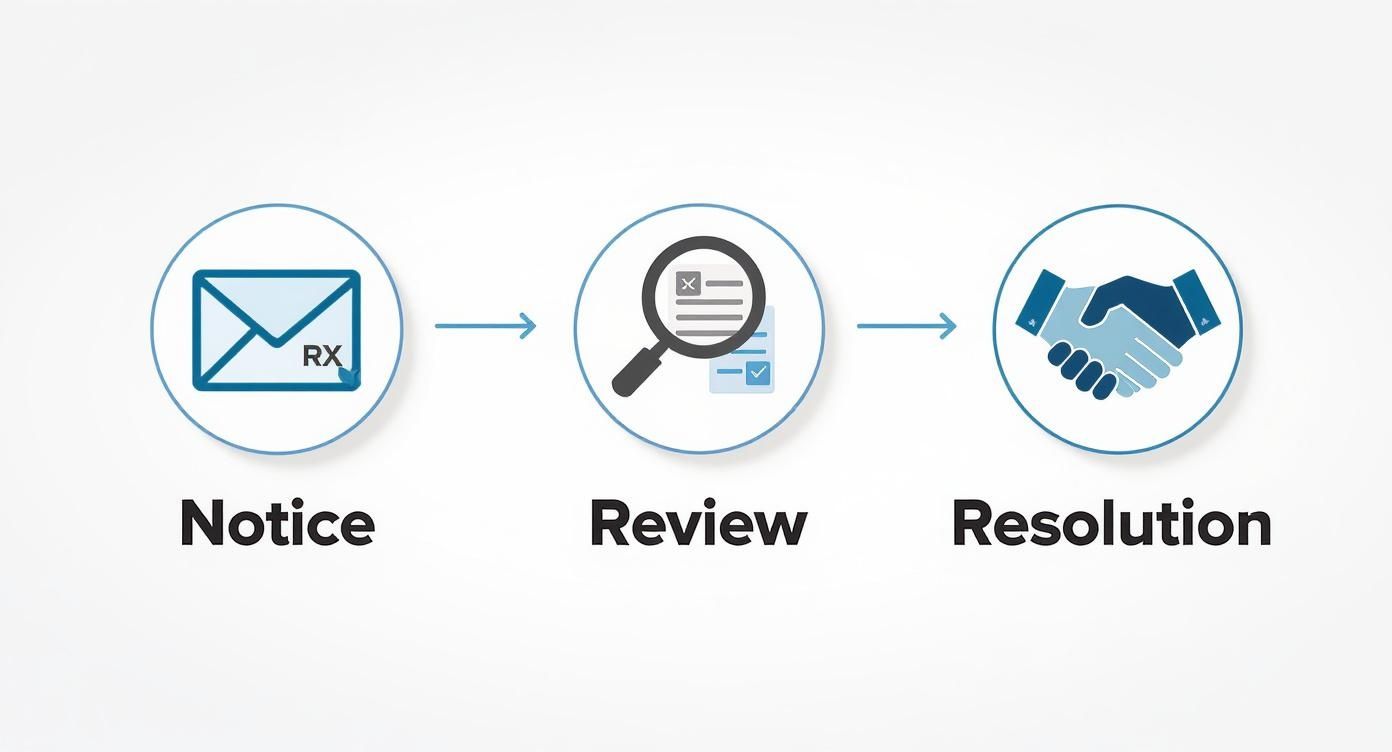
As you can see, there's a clear, structured path. It’s a methodical process, not some random attack on your finances.
The Right to Be Informed and Receive Quality Service
Two of the most basic protections you have are the Right to Be Informed and the Right to Quality Service. Think of this as the IRS’s version of a customer service promise. You are entitled to clear explanations of the law and the audit process.
If an audit notice is confusing or you're not sure what an agent is asking for, you have every right to ask for clarification. The IRS is obligated to provide prompt, professional, and courteous assistance. You should never feel pressured or intimidated into making a decision before you fully understand what’s happening.
The Right to Challenge the IRS and Be Heard
So, what if you disagree with the auditor's findings? This is where your Right to Challenge the IRS's Position and Be Heard becomes critical. You can, and should, object to conclusions you believe are wrong and provide additional evidence to back up your position.
This right guarantees the audit isn't a one-way conversation. If you have a valid disagreement backed by records, the IRS has to listen and fairly consider your evidence. It’s this right that serves as the foundation for the entire appeals process.
Key Takeaway: Just because an IRS auditor says something doesn't make it automatically correct. You are entitled to present your side of the story and have it heard. Cooperation is essential, but it doesn't mean you have to blindly agree with everything the examiner says.
The Right to Retain Representation
This might be the single most important protection you have during an audit: the Right to Retain Representation. You do not have to go through this alone. You are legally allowed to hire an authorized professional—like a tax attorney, CPA, or Enrolled Agent—to represent you.
Once you formally authorize someone to represent you, the IRS must direct all communications to them, not you. This is a game-changer. Your representative can handle every meeting, phone call, and piece of correspondence, acting as a shield between you and the auditor.
Hiring a professional isn't an admission of guilt. It's a smart, strategic decision to level the playing field and protect your interests. To dig deeper, you can learn about how the IRS can sue and what legal rights you have in our detailed guide. An experienced pro knows the rules inside and out and can advocate for the best possible outcome on your behalf.
So, What Are the Three Possible Audit Outcomes?
After all the back-and-forth—the document requests, the probing questions—the audit finally wraps up. This is the moment of truth when the IRS examiner presents their findings. Your case will land in one of three buckets.
Think of it like getting a final grade. You might ace the test, lose a few points you can live with, or feel the need to argue for a better score. Each outcome sets you on a different path.
Outcome 1: No Change
This is the home run, the best-case scenario every taxpayer dreams of. A "no change" audit means the IRS reviewed everything and concluded your return was accurate as filed. They’ll send you a "no change letter" to make it official, and that's that.
Essentially, the examiner checked your work and gave it a thumbs-up. You don't owe more tax, you won't face any penalties, and you don’t have to do anything else. You can finally breathe a huge sigh of relief. The audit is over.
Outcome 2: Agreed Changes
Frankly, this is where most audits end up. The examiner will propose adjustments to your return, which means you owe more tax. These changes will be laid out in a report explaining precisely what they adjusted and why.
For instance, maybe the auditor disallowed a chunk of your business meal expenses because the receipts were missing, or they added income from a 1099-NEC you forgot about. On top of the additional tax, the IRS will tack on interest and, more often than not, penalties.
If you review the report and agree with the examiner’s logic, you'll sign an agreement form. A bill for the full amount will follow shortly after.
Don't underestimate the financial impact here. The IRS closed hundreds of thousands of audits last fiscal year, resulting in billions in recommended additional tax. Even automated programs that flag reporting mismatches, like the Automated Underreporter Program, generated billions in extra tax assessments on their own. You can dig into the official IRS compliance statistics to see the full breakdown.
Outcome 3: Disagreement and Appeal
But what if you’re looking at the auditor's report and you know they've got it wrong? You absolutely do not have to roll over and accept their proposed changes. This third outcome is a disagreement, and it means you’re ready to fight the IRS's findings.
This is a critical turning point. If you disagree, you have to formally let the IRS know you intend to appeal. Doing so kicks your case up a level, moving it from the examiner to the IRS Independent Office of Appeals.
This isn't a decision to make on a whim. The appeals process is a more formal affair. You'll be presenting a structured, evidence-based argument to an Appeals Officer who has had no prior involvement with your case. Their entire job is to take a fresh, impartial look at the facts and the law to see if the dispute can be settled without heading to court.
Ignoring a final determination from the IRS is the worst thing you can do. If you don't file a formal appeal and just refuse to pay, the IRS will pivot to aggressive collection actions. This can get serious, fast, and may include:
- Federal Tax Liens: A legal claim against all your property, both what you own now and what you acquire in the future.
- Bank Levies: The IRS can legally seize money directly from your bank accounts.
- Wage Garnishments: Your employer will be ordered to send a portion of every paycheck straight to the IRS.
Successfully navigating a disagreement requires a solid grasp of tax law and IRS procedure. When you choose this path, you're gearing up for a formal battle, and having an experienced professional in your corner is almost always essential for a good result.
When Should You Hire a Professional for an IRS Audit?
Going into an IRS audit alone can feel like walking into a final exam for a class you never took. You might be able to handle a simple mail audit yourself if it's just about a small, clear-cut issue you have the paperwork for. But knowing when to tag in an expert is a game-changing decision.
Think of it like a home repair. You can probably fix a leaky faucet on your own with a wrench and a YouTube video. But would you try to rewire your entire house without calling an electrician? Of course not. Certain red flags during an audit are your signal to stop guessing and get real help from a tax attorney, CPA, or Enrolled Agent.
Key Signs You Need an Expert on Your Side
The moment an audit moves beyond a simple letter asking for a missing document, the stakes get higher. It's time to seriously think about hiring a professional if you find yourself in any of these situations:
- You're Facing a Field or Office Audit: An in-person audit, whether at an IRS office or your place of business, is a huge sign that the IRS is digging deep. An agent will be asking pointed questions, and a pro knows how to answer them accurately without accidentally opening up new lines of inquiry.
- There's a Lot of Money on the Line: If the IRS is proposing a tax bill that makes your stomach drop, the financial risk is just too high to handle it solo.
- The Audit Covers Multiple Years: When the IRS starts looking at several years of your tax history, it usually means they suspect a recurring or systemic problem. This isn't just a simple mistake; it's a pattern they're investigating.
- You Own a Business: Business audits are a different beast entirely. They involve a maze of records for income, expenses, payroll, and assets, and the rules are far more complex.
- You Don't Understand What the IRS is Asking For: If the notices you receive are full of jargon you can't decipher, you need a translator who speaks fluent "IRS."
- You're Missing Records or Time: Let's be honest—if your records are a mess or you simply don't have the hours to dedicate to this, a professional can take that entire burden off your shoulders.
The Bottom Line: If at any point you feel confused, intimidated, or completely in over your head, that's your cue to get representation. A good tax pro acts as a shield between you and the IRS, managing all communication and making sure your rights are protected every step of the way.
The Different Kinds of Tax Professionals
Once you decide to get help, you have three main choices. Each has a unique skill set, so picking the right one depends entirely on your specific audit situation.
- Certified Public Accountant (CPA): CPAs are the masters of accounting and tax preparation. They are your best bet for audits centered on complex financial statements, where you need to prove the numbers on your return are solid.
- Enrolled Agent (EA): Think of EAs as tax specialists licensed directly by the IRS. They live and breathe tax law and have the authority to represent you before the IRS on any matter.
- Tax Attorney: A tax attorney becomes absolutely essential when an audit has the potential to turn criminal, involves a serious legal battle, or looks like it's headed for Tax Court. For specialized legal support during a complex audit, services like lawyers on demand can connect you with experienced legal experts.
Keep in mind, the IRS is doubling down on enforcement. They've publicly announced plans to ramp up audit rates for high-income earners and large corporations through 2026, while keeping rates historically low for taxpayers earning under $400,000. You can read the IRS statement on updated audit rates to see exactly where they're focusing their attention. If you're in one of those higher-risk groups, getting professional guidance isn't just a good idea—it's a crucial defensive strategy.
Common Questions We Hear About IRS Audits
Even with a roadmap of the process, it's natural to have lingering questions about what an IRS audit actually looks like. Let's tackle some of the most common concerns we hear from clients to clear up any confusion and give you some real-world perspective.
What Are the Biggest Red Flags That Trigger an IRS Audit?
While it’s true that a small number of audits are purely random, most are triggered by something specific on a tax return. Think of the IRS's computer systems as constantly scanning for returns that stand out from the norm. Waving one of these red flags can definitely get you noticed.
Some of the most common triggers we see are:
- Unusually High Deductions: Claiming deductions that seem way out of proportion to your reported income is a classic flag. If your income is $60,000 but you’re claiming $40,000 in business expenses, the IRS is going to want a closer look.
- Claiming 100% Business Use of a Vehicle: This is almost always a red flag because it’s so rare to be true. The IRS knows that most people use a vehicle for at least some personal errands, and a 100% claim suggests you might not have the meticulous mileage logs to back it up.
- Running a Cash-Intensive Business: If you own a restaurant, a salon, a bar, or a construction company, you’re already on the IRS's radar. These businesses are watched more closely because of the temptation to underreport cash income.
- Failing to Report All Income: This one is almost a guaranteed audit. The IRS receives copies of all your W-2 and 1099 forms. If the income you report doesn't perfectly match what they've been told you were paid, their system will automatically flag the discrepancy.
Ultimately, the IRS uses a powerful scoring system to compare your return against statistical averages for people in similar financial situations. The further your return deviates from that average, the higher the chance it gets pulled for review.
How Long Does an IRS Audit Typically Take?
There’s no one-size-fits-all answer here; the timeline really depends on the type of audit and how complex your situation is.
A simple correspondence audit, where everything is handled through the mail, is the fastest. You might have it all wrapped up in a few months. An in-person office audit, where you meet an agent at an IRS office, usually takes a bit longer, maybe three to six months. The most intensive type, a field audit at your home or business, can easily drag on for a year or more, especially if it covers multiple tax years or a complicated business structure.
A big factor in the timeline is you. The more organized your records are and the more promptly you (or your representative) respond to requests, the smoother and quicker the process will be.
Can I Handle an IRS Audit Myself Without a Professional?
Legally, you have every right to represent yourself before the IRS. For something very minor—like a mail audit asking for a receipt for a $500 charitable donation that you have—you might be able to handle it on your own just fine.
But for anything more serious, going it alone is a huge gamble.
If the audit involves your business, a significant amount of money, spans multiple years, or if you simply feel in over your head, hiring an experienced tax professional isn't just a good idea—it's a critical investment. They know the rules inside and out, they understand how to talk to auditors, and they act as a buffer to protect your rights. More often than not, this leads to a far better result than you could achieve on your own.
What Happens If I Ignore an IRS Audit Notice?
Doing nothing is, without a doubt, the worst possible move. Ignoring the IRS doesn't make the problem vanish; it just gives them complete control over the outcome, and it will not be in your favor.
If you don't respond, the IRS will simply close the audit without any of your input. They will assess what they think you owe, and you can bet it will be the highest possible amount. From there, the situation snowballs. They’ll tack on hefty penalties and interest, and then the real trouble begins: aggressive collection actions like garnishing your wages, levying your bank accounts, and placing a federal tax lien on your property.
Always respond. Even if all you do is ask for more time to get your documents together, it shows you’re engaging with the process.
Navigating an IRS audit is a complex and often stressful process. But you don't have to face it alone. At Attorney Stephen A Weisberg, we begin with a FREE Tax Debt Analysis to determine if and how we can help before you ever pay a fee. If you're facing an audit or have other tax problems, let us find the best possible outcome for you.