Understanding Consequences: what happens if i don't pay taxes
Learn what happens if i don't pay taxes, including IRS notices, penalties, liens, and relief options.

In this article
- The Snowball Effect of Unpaid Taxes
- The Initial Financial Penalties
- Visualizing the Growth of Tax Debt
- How Unpaid Tax Debt Grows Over Time
- From Private Debt to Public Record
- The Federal Tax Lien: A Public Claim on Everything You Own
- How a Tax Lien Destroys Your Financial Credibility
- When the IRS Seizes Your Assets and Income
- Wage Garnishment: Your Paycheck Shrinks
- Bank Levies: Your Accounts Are Frozen
- Seizure of Physical Property and Business Assets
- The Unique Dangers of Unpaid Payroll Taxes
- The Trust Fund Recovery Penalty Explained
- Personal Liability That's Nearly Impossible to Escape
- Finding Your Path to Tax Debt Resolution
- IRS Installment Agreements
- The Offer in Compromise Program
- Getting Penalties Waived with Penalty Abatement
- Currently Not Collectible Status
- Take the First Step Toward Tax Relief
- Get Your Bearings with a Tax Debt Analysis
- An Expert Can Stop the Bleeding
- Common Questions About Unpaid Taxes
- Can I Go to Jail for Not Paying Taxes?
- How Long Does the IRS Have to Collect Unpaid Taxes?
- What Should I Do First If I Cannot Pay My Taxes?
If you don’t pay your taxes, the IRS doesn't just wait patiently. The moment your tax deadline passes, an automated system kicks in, and your debt immediately starts to grow. This isn't a simple late fee; it's a relentless combination of penalties and interest that compounds daily.
What starts as a manageable issue can quickly spiral into a major financial crisis. The longer you wait, the bigger and faster that problem gets.
The Snowball Effect of Unpaid Taxes

Ignoring a tax bill is one of the costliest financial mistakes you can make. Think of your initial unpaid tax amount as a small snowball at the top of a hill. It might not seem too threatening at first. But the second it starts rolling, it begins picking up more snow—in this case, penalties and interest—getting bigger and moving faster every single day.
The IRS collection process is built for this kind of escalation. From the day after your taxes are due, two powerful forces start working against you, ensuring that doing nothing is the most expensive option.
The Initial Financial Penalties
First up is the Failure-to-Pay penalty. This penalty is charged for each month, or even part of a month, that your taxes go unpaid. It’s calculated at 0.5% of your unpaid taxes and keeps getting added until it hits a maximum of 25% of your total tax bill. This isn’t a one-off charge; it’s a recurring hit that steadily inflates your debt.
The core principle of the IRS collection system is escalation. Penalties and interest are not just punishments; they are mechanisms designed to make ignoring the problem financially unsustainable over time.
On top of that, the IRS charges interest. But here's the real kicker: you're charged interest on the original unpaid tax and on the penalties that have been added. This is compounding interest, and it’s what really makes the debt spiral. The rate changes quarterly, set at the federal short-term rate plus 3%, and it compounds daily. You are literally paying interest on your interest.
This is how a debt that seemed manageable can balloon into something overwhelming. To get a better handle on these charges, you can learn more about the steps for dealing with unpaid back taxes.
Visualizing the Growth of Tax Debt
To see how this works in the real world, let's track how a tax debt grows over time. The table below shows what happens to an initial $10,000 tax bill when left unpaid for two years, factoring in both the standard penalties and estimated interest.
How Unpaid Tax Debt Grows Over Time
| Time Elapsed | Initial Debt | Failure-to-Pay Penalty (Cumulative) | Estimated Interest (Cumulative) | Total Amount Owed |
|---|---|---|---|---|
| 6 Months | $10,000 | $300 | $405 | $10,705 |
| 1 Year | $10,000 | $600 | $830 | $11,430 |
| 2 Years | $10,000 | $1,200 | $1,750 | $12,950 |
As you can see, that $10,000 debt can jump by nearly 30% in just two years without you doing a thing. This initial stage is just the financial warm-up. If the debt continues to go unpaid, the IRS will move on to much more aggressive enforcement actions.
From Private Debt to Public Record
At first, your tax debt is a private matter between you and the IRS. But after the initial penalties and interest start their relentless climb, the agency's strategy changes. The issue is about to go public, and it all starts with a series of official letters showing up in your mailbox.
Think of notices like the CP501 or the more serious CP504 as documented warning shots. They aren’t just friendly reminders; they are formal steps in the IRS collection process, signaling that much harsher actions are on the horizon if you don’t engage. Ignoring them is like ignoring the smoke detector—the fire is coming.
The Federal Tax Lien: A Public Claim on Everything You Own
When those notices go unanswered, the IRS brings out one of its most powerful collection weapons: the Notice of Federal Tax Lien. This is the exact moment your private tax trouble becomes a public problem.
So, what is a tax lien? It’s a legal claim the government files against all your assets—everything you own now and everything you acquire in the future—to secure its position as a creditor. It's like the government putting a legal clamp on your house, your car, your business, and even your financial accounts. They haven't seized anything yet, but they've publicly staked their claim, putting them first in line to get paid.
This public filing is a devastating blow to your financial life. Once recorded, the lien is visible to anyone who pulls a public record search, including banks, lenders, and credit reporting agencies.
How a Tax Lien Destroys Your Financial Credibility
The most immediate and painful hit is to your credit score. It’s not unusual to see a score plummet by 100 points or more almost instantly after a lien is filed.
A federal tax lien effectively handcuffs your assets. It publicly declares your tax debt, making it nearly impossible to sell property, secure a loan, or refinance existing debt without first satisfying the IRS.
This credit score crater has serious, real-world consequences:
- Selling Property: Forget selling your home with a clear title. The IRS must be paid out of the proceeds before you see a dime.
- Getting a Loan: Lenders will see the lien and immediately flag you as an extreme credit risk. Getting a mortgage, a car loan, or even a new credit card becomes next to impossible.
- Business Financing: For entrepreneurs, a lien can be a death sentence. It chokes off access to the lines of credit and capital needed to run the business, pay employees, and grow.
For business owners with payroll tax debts (like S Corps or LLCs), the fallout is especially brutal. A government report recently noted that of the 500,000 liens filed in 2022, a shocking 40% directly crippled a small business's ability to get financing. You can get a much deeper look into how this works in our guide on the Notice of Federal Tax Lien.
By making your debt public, the IRS ensures they get paid before almost anyone else. And while the lien itself doesn't take your property, it's the legal foundation that paves the way for the next, even more aggressive step: the levy.
When the IRS Seizes Your Assets and Income
If a federal tax lien is the legal claim the IRS puts on your assets, a tax levy is the actual seizure. This is where the warning letters stop and the government starts actively taking your property to pay off your debt.
Think of it this way: a lien is like a boot on your car's wheel, stopping you from selling it. A levy is the tow truck hauling your car away.
This isn’t some surprise attack out of the blue. It’s the final stage of a long process that only kicks off after you’ve received—and ignored—a stack of notices, including a “Final Notice of Intent to Levy.” That letter is your absolute last chance to get things sorted out before the IRS starts taking action that can immediately and painfully disrupt your life.
The whole collection process, from the first notice to a lien and eventual seizure, can feel overwhelming. This graphic breaks down how ignoring those initial warnings leads straight to serious credit damage.
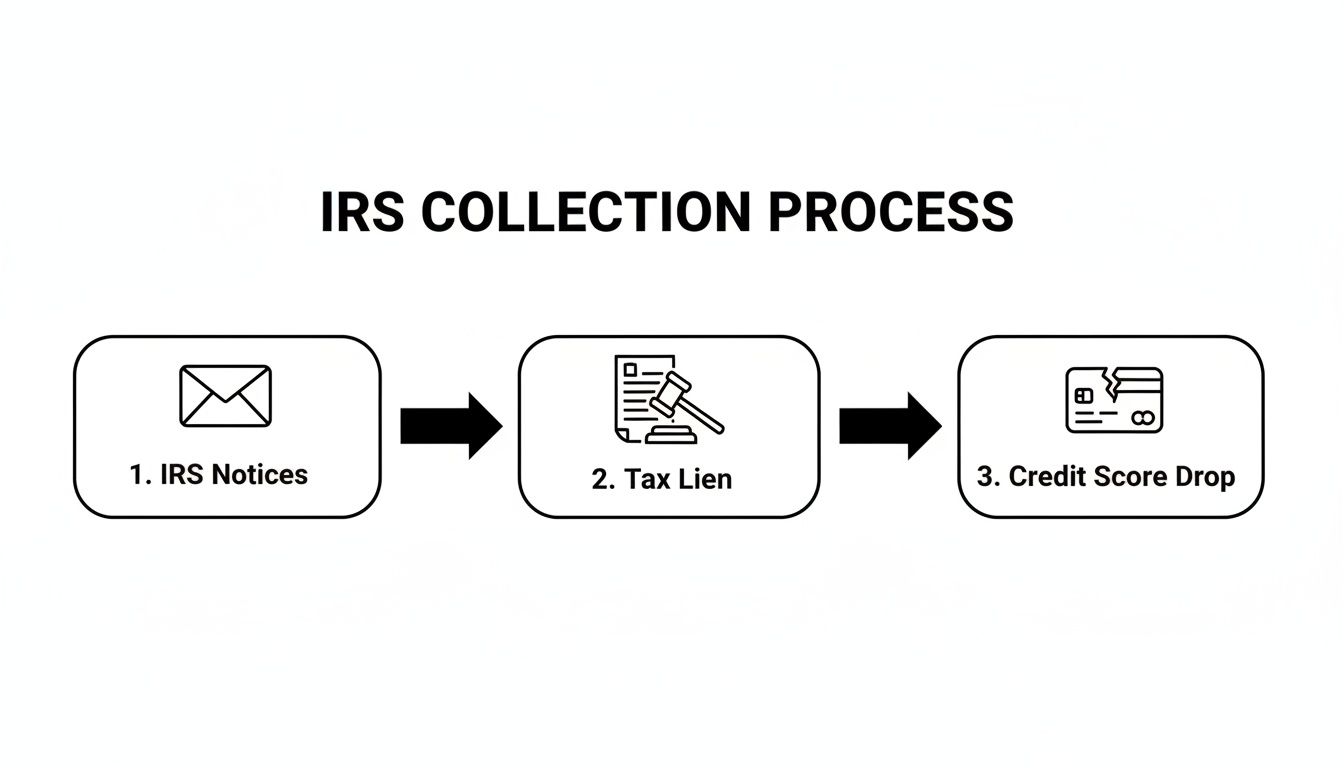
As you can see, there’s a direct line from those early notices to a damaged financial reputation, which can make it incredibly difficult to get a loan, sell property, or even open a new bank account.
Wage Garnishment: Your Paycheck Shrinks
One of the most common and jarring forms of a levy is a wage garnishment. The IRS doesn't need to wait for you to write a check; they go straight to the source of your income—your employer.
Once a wage garnishment is in place, your employer is legally forced to send a huge chunk of your paycheck directly to the IRS before you ever lay eyes on it. The amount they can snatch is significant, often leaving you with just a small, legally protected amount to cover all your living expenses. This continues, paycheck after paycheck, until the entire tax debt, plus all the penalties and interest, is paid in full.
Suddenly, the money you count on for rent, groceries, and car payments is gone. It's an incredibly effective tool for making your tax debt an unavoidable, top priority.
Bank Levies: Your Accounts Are Frozen
Another powerful weapon in the IRS arsenal is the bank levy. When the IRS issues a levy to your bank, the institution is required to freeze your account on the spot for 21 days. During this holding period, you are completely locked out of your funds.
After those 21 days are up, the bank must send the money—up to the full amount of your tax debt—directly to the IRS.
A bank levy is a form of financial paralysis. It freezes your ability to pay bills, make purchases, or manage your finances, demonstrating the IRS's direct access to your liquid assets.
This means the money you had saved for an emergency, set aside for payroll, or planned to use for your mortgage can vanish overnight. It’s a shocking experience, and you can learn more about how to navigate it in our guide on what to do when the IRS levies bank accounts.
Seizure of Physical Property and Business Assets
While it's less common for the average taxpayer, the IRS absolutely has the authority to seize physical property. This can include just about anything of value:
- Real Estate: Your primary home, a vacation property, or rental units.
- Vehicles: Cars, trucks, boats, or motorcycles.
- Personal Property: High-value items like jewelry or art collections.
For business owners, the situation is even more dangerous. The IRS can hit you with an accounts receivable levy, which means they intercept payments from your own clients. Instead of paying you for your hard work, your customers are legally required to send that money straight to the IRS.
This tactic can choke off your company’s cash flow and bring operations to a grinding halt. It’s a go-to move for the IRS, especially with payroll tax debts. In unresponsive cases, IRS data shows bank accounts are levied 20% of the time, and a staggering $15 billion was collected through 1.8 million levies in 2022 alone.
The Unique Dangers of Unpaid Payroll Taxes
For business owners, the question of "what happens if I don't pay taxes?" gets a lot more personal—and a lot scarier—when payroll taxes are involved. While any tax debt is a serious problem, the IRS treats unpaid payroll taxes with a unique level of aggression. This isn't just seen as a business failing to pay a bill; it's considered a profound breach of trust.
Here's why: when you run payroll, you withhold money from your employees' paychecks for things like Social Security and Medicare. That money was never yours. The government views you as a temporary caretaker for those funds, which are legally considered "trust funds". If you use that cash to pay the rent or cover another business expense, you're not just borrowing—in the eyes of the IRS, you're spending money that belongs to the U.S. Treasury.
The Trust Fund Recovery Penalty Explained
Because these are trust funds, the IRS has a special weapon to collect them: the Trust Fund Recovery Penalty (TFRP). This is arguably the most powerful collection tool in the IRS arsenal because it’s designed to completely bypass the liability shield of your LLC or corporation and go directly after individuals.
Think of it as an invisible personal guarantee on your business's payroll taxes—one you never even signed. The TFRP allows the IRS to "pierce the corporate veil" and pursue the personal assets of anyone they determine to be a "responsible person."
So, who qualifies as a "responsible person"? The definition is much broader than most people think. It’s not just the owner. It can be:
- Officers and Directors: The CEO, CFO, and President are the most obvious targets.
- Partners and Members: Anyone with a significant say in how the company's money is spent.
- Key Employees: A bookkeeper or controller with the power to decide which bills to pay can be held personally liable.
- Board Members: Even a volunteer on a non-profit's board can find themselves in the crosshairs.
This means the IRS can legally seize your personal home, drain your bank accounts, and even take your retirement savings to settle the company's payroll tax debt.
Personal Liability That's Nearly Impossible to Escape
The TFRP is a total game-changer. It turns a business liability into a personal one that will follow you no matter what. This penalty is notoriously difficult to get rid of, even through bankruptcy, making it one of the most persistent and dangerous types of tax debt you can face. You can dive deeper into how this works in our guide on the Trust Fund Recovery Penalty.
The IRS pursues these cases so aggressively because it considers the non-payment of payroll tax a direct theft from your employees' future Social Security and Medicare benefits.
The Trust Fund Recovery Penalty effectively makes you the personal collateral for your business's payroll tax obligations. The IRS doesn't care if the business is struggling; if you had control over the funds and didn't remit them, you are personally on the hook.
This isn't just a theoretical threat. In 2022 alone, the IRS initiated over 10,000 cases involving the TFRP. These penalties can easily climb to 100% of the original unpaid tax, holding the responsible individuals personally liable for the employee's portion of Social Security and Medicare. To avoid these severe outcomes, it’s critical to maintain meticulous payroll operations, as even common payroll mistakes can snowball into major compliance issues.
Finding Your Path to Tax Debt Resolution

When you're staring down the barrel of an IRS lien or levy, it’s natural to feel overwhelmed and trapped. But here's the good news: the scary consequences we've discussed aren't the end of the story. The IRS actually has several well-defined programs designed to help people get back on their feet.
These aren't secret loopholes for the well-connected; they're official, structured solutions available to taxpayers who qualify. The real key is figuring out which path makes sense for your specific situation. Let's break down the most common and effective options you have.
IRS Installment Agreements
For most people, the most straightforward route is an Installment Agreement. You can think of it as a payment plan negotiated directly with the IRS. It turns a massive, intimidating lump-sum debt into a series of predictable monthly payments that you can actually manage.
Once an Installment Agreement is in place, the IRS typically backs off on more aggressive collection tactics like bank levies and wage garnishments. It’s the perfect strategy if you know you can pay the full debt over time—you just can't possibly pay it all at once. This option brings a sense of control back to a situation that feels anything but.
The Offer in Compromise Program
But what if you can't afford the full amount, even if it's broken into monthly payments? That's where the Offer in Compromise (OIC) program enters the picture. An OIC allows certain taxpayers to settle their tax liability for less—sometimes much less—than the original amount owed.
It’s an incredibly powerful tool, but you have to be realistic. The IRS doesn't hand these out like candy.
An Offer in Compromise isn't about negotiating a number you feel is fair. It's a cold, hard calculation based on what the IRS believes you can pay after a deep-dive into your income, assets, and living expenses.
To even be considered, you have to prove that paying in full would cause you significant economic hardship. The application is exhaustive and requires you to lay your entire financial life on the table. While only a fraction of offers get accepted—historically, the acceptance rate hovers around 40%—a successful OIC can be a life-changing fresh start for those who meet the very strict criteria.
Getting Penalties Waived with Penalty Abatement
Sometimes, the original tax bill is manageable, but the mountain of penalties the IRS has tacked on makes it impossible to pay. This is where Penalty Abatement comes in. It’s a formal process where you ask the IRS to remove specific penalties from your account.
The IRS will consider this for a couple of key reasons:
- First-Time Abatement: If you’ve been a model taxpayer for the last three years (filed and paid on time), the IRS may grant you a one-time pass and waive the common Failure-to-File and Failure-to-Pay penalties.
- Reasonable Cause: You can also get penalties removed if you can prove you had a legitimate, unavoidable reason for not filing or paying. Think serious illness, a death in the immediate family, a natural disaster, or even getting bad advice from a tax professional.
Making a "reasonable cause" case requires thorough documentation and a clear, compelling story. But if you're successful, wiping out thousands of dollars in penalties can shrink your debt down to a much more manageable size.
Currently Not Collectible Status
What about when your financial situation is truly dire? If you're dealing with unemployment, a disability, or an income so low it barely covers food and rent, there's another safety net: Currently Not Collectible (CNC) status.
Being placed in CNC status is the IRS's way of acknowledging that you simply cannot afford to pay them anything right now. They will pause all collection actions—no levies, no garnishments. It gives you critical breathing room to get back on your feet.
But it’s important to know this isn't a get-out-of-jail-free card. Your debt doesn't go away. In fact, interest and penalties keep adding up in the background. The IRS will also check in on you periodically to see if your financial situation has improved. Think of CNC as a temporary pause button, not a permanent stop.
Take the First Step Toward Tax Relief
Knowing what happens when you don't pay your taxes can feel like standing at the bottom of a mountain, looking up. You see the penalties, the interest, and the threat of liens and levies, but the path to the top is completely hidden. Understanding the problem is one thing; figuring out what to do next is the real challenge. That next move is everything.
This is exactly where professional guidance makes all the difference. Trying to navigate the labyrinth of IRS procedures, negotiation tactics, and resolution programs on your own is a recipe for frustration and costly mistakes. A seasoned tax professional is more than just an advisor—they're your advocate and your strategist, shielding you from aggressive collection actions while building the strongest possible case for you.
Get Your Bearings with a Tax Debt Analysis
Before you even think about an Installment Agreement or an Offer in Compromise, you need a clear, unbiased diagnosis of your situation. That's what a Tax Debt Analysis provides. Think of it less as a sales pitch and more as a strategic deep-dive into your specific case to map out the best possible route forward.
A proper analysis accomplishes a few critical things right away:
- It ends the guesswork. A professional will pull your official IRS records, review your complete financial picture, and determine which resolution programs you can actually qualify for—no more hoping or guessing.
- It gives you a strategic advantage. When you understand all your options before you speak with the IRS, you hold the cards. It keeps you from getting pushed into a payment plan you can't realistically afford.
- It delivers immediate peace of mind. Just having a clear, actionable plan from someone who knows the system can lift a massive weight off your shoulders.
This initial assessment is the bedrock of a successful resolution. It’s about shifting from a reactive state of worry to a proactive position of control. You get a crystal-clear picture of what can be done before committing to anything.
An Expert Can Stop the Bleeding
One of the most immediate benefits of bringing in a professional is their ability to step in and halt aggressive IRS collections in their tracks. Once an expert is formally representing you, they can often prevent new levies or wage garnishments from hitting, protecting your paycheck and bank accounts while a permanent solution is being negotiated.
Confronting tax debt isn't just about settling a bill; it's about reclaiming your financial future. The right expert doesn't just fix a tax problem—they create a pathway back to stability.
You don't have to go through this stressful process alone. The consequences of unpaid taxes are serious, but they are absolutely not the end of the road. By getting a professional assessment, you take the single most powerful step toward protecting your assets, stopping the cycle of penalties, and finally putting this issue behind you for good.
Take control of your situation today by scheduling a free, no-obligation Tax Debt Analysis. It’s your first step toward a lasting solution.
Common Questions About Unpaid Taxes
When you're facing tax debt, a million questions can race through your mind. Let's cut through the noise and tackle some of the most common—and stressful—concerns with straight, clear answers.
Can I Go to Jail for Not Paying Taxes?
This is often the biggest fear, so let's be clear: going to jail for simply being unable to pay your taxes is extremely rare.
Criminal charges, like tax evasion, are reserved for willful and fraudulent acts. Think intentionally hiding income, creating fake documents, or filing a return you know is false. For the vast majority of people who have simply fallen behind, the consequences are financial, not criminal. The IRS will pursue civil penalties like liens and levies, but their goal is to collect the money, not put you behind bars. The key is to face the problem head-on, not try to hide from it.
How Long Does the IRS Have to Collect Unpaid Taxes?
You might have heard about a 10-year statute of limitations, and that's true—sort of. The IRS generally has ten years from the date your tax was assessed to collect what you owe.
But this isn't a simple "wait it out" scenario. The 10-year clock can be paused or even reset by certain actions. Filing for bankruptcy, submitting an Offer in Compromise, or even living outside the country for an extended period can stop the clock, giving the IRS more time. Never assume the debt will just disappear on its own.
Don't mistake the 10-year collection statute for a simple waiting game. The IRS is actively working to collect during that window, and various actions you take can reset or pause the clock, extending their collection period indefinitely.
What Should I Do First If I Cannot Pay My Taxes?
Whatever you do, don't just ignore the notice from the IRS. That's the one mistake that makes things worse, faster.
Your first step is to open the letter and understand exactly what it says—what you owe and what the deadline is. Your very next step should be to contact a tax resolution professional. They can immediately get between you and the IRS, preventing aggressive collection actions like a bank levy while they help you map out the best path forward.
A crucial first step in gaining control over your financial situation and navigating potential tax issues is to effectively learn how to organize receipts for taxes.
Facing IRS collections can be overwhelming, but you don't have to navigate it alone. Attorney Stephen A Weisberg offers a free, no-obligation Tax Debt Analysis to assess your situation and find the best path forward. Take the first step toward peace of mind and contact us today at https://weisberg.tax.


