What Happens If I Can't Pay My Taxes? An Unfiltered Guide
Worried about what happens if I can't pay my taxes? This guide breaks down the IRS process, your payment options, and how to resolve tax debt for good.
In this article
- The First Consequences When You Can't Pay Your Taxes
- Penalties and Interest Begin Immediately
- The First Wave of IRS Notices
- What Really Happens When the IRS Comes Calling
- From Automated Letters to Serious Warnings
- When Collection Actions Become Real
- Levies and Garnishments: When the IRS Seizes Your Assets
- Your Proactive Options for Resolving Tax Debt
- Comparing Your Tax Debt Resolution Options
- The Installment Agreement: A Structured Payment Plan
- The Offer in Compromise: A Fresh Start
- Currently Not Collectible Status: A Temporary Pause
- Penalty Abatement: Forgiving the Extras
- Special Risks for Business Owners with Payroll Taxes
- The Trust Fund Recovery Penalty
- Who Is Considered a "Responsible Person"?
- Escalated Consequences for Businesses
- Knowing When You Need Professional Tax Help
- Clear Signs It's Time to Call an Expert
- Understanding Your Professional Options
- The Unique Advantage of a Tax Attorney
- It’s Time to Take Control of Your Tax Situation
- Your Immediate Action Plan
- Frequently Asked Questions About Unpaid Taxes
- Can the IRS Take My Passport If I Owe Taxes?
- Will I Go to Jail for Not Being Able to Pay My Taxes?
- Does Tax Debt Ever Expire or Go Away?
Staring at a tax bill you can’t pay is a sinking feeling, and it’s a situation far more common than you might think. The moment you miss that payment deadline, the IRS system automatically starts tacking on penalties and interest. It’s a lot like the late fees on a credit card, but with much higher stakes.
Simply ignoring the problem is the worst, and most expensive, mistake you can make. What starts as a manageable bill can quickly spiral out of control.
The First Consequences When You Can't Pay Your Taxes
The second your tax payment is officially late, a predictable and automated process kicks into gear. This isn't some revenue agent targeting you personally; it’s just the government’s computer system doing what it’s programmed to do—adding penalties and interest to your account.
Think of it as a loan you never asked for. The original tax you owe is the principal, and the government immediately starts charging you for the "privilege" of being late. Understanding how this works is the first step toward getting things under control.
Penalties and Interest Begin Immediately
The first financial hits you’ll take are the Failure-to-Pay penalty and interest charges. These two work together to make your debt grow, and they start adding up right away.
To get a clearer picture of how quickly your debt can grow, let's break down these initial charges.
A Quick Look at Initial Penalties and Interest
| Penalty or Interest Type | How It's Calculated | What This Means for You |
|---|---|---|
| Failure-to-Pay Penalty | 0.5% of the unpaid tax, charged each month (or part of a month) the debt is outstanding. It's capped at 25% of your total unpaid tax. | This penalty adds up steadily. On a $10,000 debt, it starts at $50 per month and keeps growing until it hits the $2,500 cap. |
| Interest | The rate is the federal short-term rate plus 3%. It's calculated on your unpaid tax and on the penalties that have been added. | Interest compounds daily, which means you’re paying interest on your interest. This causes the debt to snowball much faster than a simple interest calculation would suggest. |
As you can see, this combination can make a $10,000 tax debt balloon into something much larger in just a few short months.
If there’s one thing to take away from this, it’s that proactive communication is your best defense. The IRS is almost always more willing to work with you if you file on time (even when you can’t pay) and are upfront about your financial hardship.
The First Wave of IRS Notices
It won't be long before the IRS starts sending automated letters. The first one you'll likely see is the CP14 notice. Don't panic—it's essentially just an official bill for the amount you owe, plus the first round of penalties and interest. This letter is your formal notification that the collections process has begun.
Ignoring these notices is a critical mistake. Each letter that follows will get progressively more serious, escalating from a simple bill to a warning of more severe collection actions.
This is the phase where you still have the most control. Letting it go further can lead to aggressive enforcement, like an IRS bank levy, where the government can freeze and seize funds directly from your accounts, often without any further warning.
What Really Happens When the IRS Comes Calling
Once you miss the tax deadline and the first IRS notice shows up in your mailbox, a very predictable process kicks into gear. It’s important to understand that in the beginning, you aren't dealing with a person; you're dealing with an automated system. Think of it as a series of computer-generated dominos, set to fall in a specific order.
Knowing this sequence is your biggest advantage. It tells you exactly where you are in their timeline and, crucially, how much time you have to get ahead of the problem before things get serious.
This first wave of communication is all about getting your attention. The IRS is basically saying, "Hey, we see you owe us, and this is what will happen if you ignore us." Each letter that arrives carries a little more weight than the last.
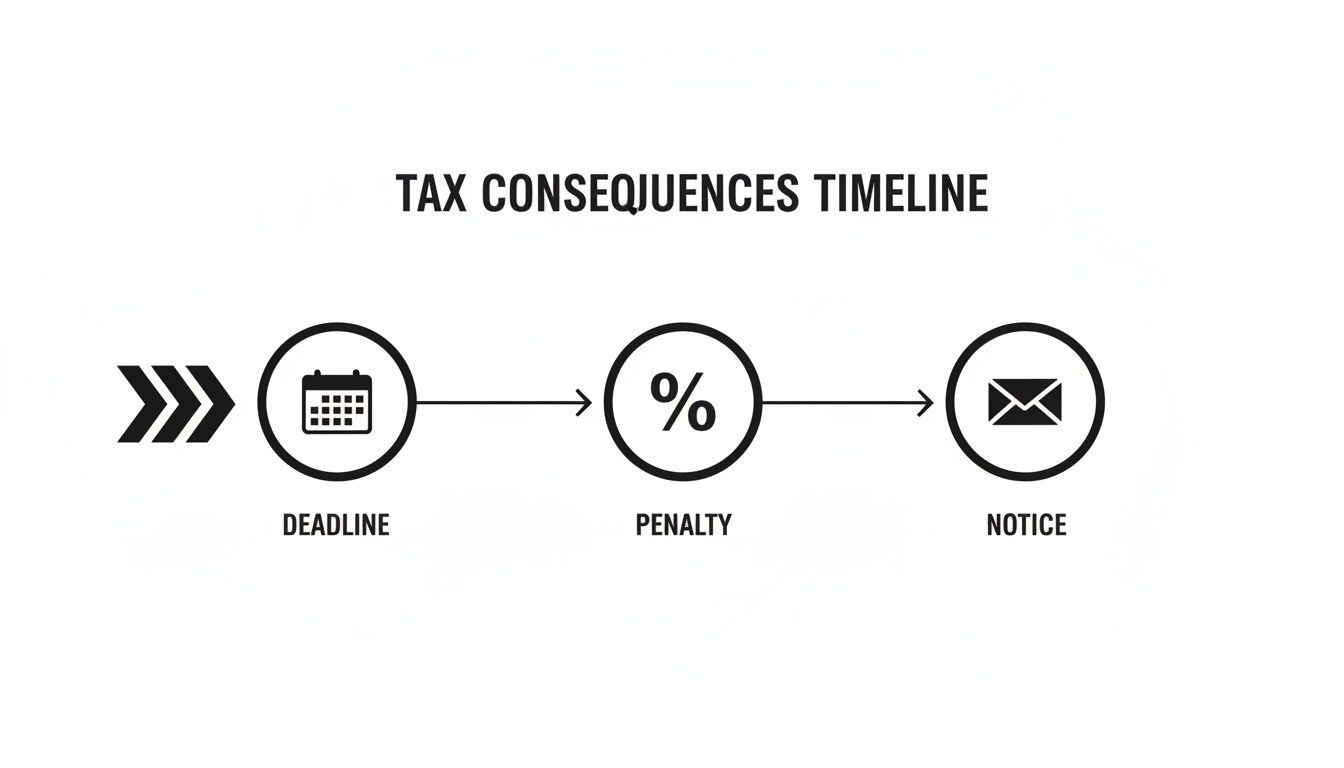
As you can see, there’s no grace period. The system automatically starts adding penalties and firing off notices right after the deadline passes.
From Automated Letters to Serious Warnings
The collection process always starts with a string of letters sent by mail. The first one you'll likely see is the CP14 notice, but if the debt isn't paid, it's just the first of many.
You can expect to see a few more notices in this sequence:
- CP501: This is a gentle nudge, a reminder that your tax bill is overdue. It looks a lot like the first notice, just reinforcing the message.
- CP503: The tone starts to shift here. This letter is more firm, stating your account is delinquent and warning that the IRS is preparing to take action.
- CP504: This one is a big deal. The CP504 is an official Notice of Intent to Levy. It’s a final warning that the IRS is about to start seizing your assets, like your state tax refund.
I can't stress this enough: open every single piece of mail from the IRS. Ignoring them won't make the problem disappear; it just guarantees the situation will escalate without you having any say in the matter.
When Collection Actions Become Real
If those initial notices go unanswered, the IRS stops sending letters and starts taking your property. This is the point where the consequences become very real and disruptive. The IRS has two main tools in its arsenal: liens and levies.
A Federal Tax Lien is a legal claim against everything you own and will own in the future—your house, your car, your retirement accounts. It’s filed publicly, putting all your creditors on notice that the government gets paid first.
A Federal Tax Lien is like a ghost that haunts your finances. It doesn’t take your property right away, but it makes it incredibly difficult to sell anything or get a loan until the tax debt is settled.
With a lien on your record, getting a mortgage, a car loan, or even a credit card becomes nearly impossible. It’s the IRS’s way of securing its interest in your assets. To get a handle on this, the IRS will want a full picture of your finances. You can learn more about this process in our comprehensive guide on Form 433-F, which is central to resolving an IRS collection case.
Levies and Garnishments: When the IRS Seizes Your Assets
After a lien is in place, the IRS can move on to a levy. A levy is the actual seizure of your property. While a lien is just a claim, a levy is the IRS actively taking what's yours to pay off the debt.
The most common types of levies are:
- Bank Levy: The IRS can instruct your bank to freeze your account. After 21 days, the bank is required to send the IRS whatever money is in there, up to the amount you owe.
- Wage Garnishment: This is a legal order sent to your employer, forcing them to withhold a large chunk of your paycheck and send it straight to the IRS before you ever see it.
These aren't just scare tactics; this is standard procedure for the IRS when a tax debt goes unresolved. And with governments everywhere feeling the pressure of rising debt—global public debt is on track to hit 100 percent of global GDP this decade—you can bet that tax agencies are more motivated than ever to collect every dollar they're owed.
Your Proactive Options for Resolving Tax Debt
Staring down a stack of IRS notices can feel paralyzing, but it's important to know you're not powerless here. At its core, the IRS is a collection agency, and their main goal is getting paid. Because of that, they've established several official programs to help people get back on track without resorting to harsh tactics like seizing your assets or garnishing your wages.
Knowing what happens when you can't pay your taxes is one thing, but understanding your options is how you take back control. These aren't secret loopholes; they're formal, established paths to getting right with the IRS. The trick is finding the one that fits your real-world financial situation.

This is the moment you switch from playing defense to offense, actively choosing a strategy instead of just reacting to whatever the IRS sends next.
Comparing Your Tax Debt Resolution Options
To get a clearer picture, it helps to see these common solutions side-by-side. Each one is designed for a different financial reality, so understanding the core differences is the first step toward finding your best path forward.
| Resolution Option | Best For Who | Primary Benefit | Key Consideration |
|---|---|---|---|
| Installment Agreement | Individuals who can afford monthly payments and will eventually pay the full debt. | Stops aggressive collections and provides a predictable payment schedule. | Interest and penalties keep growing until the entire balance is paid off. |
| Offer in Compromise | Those with a large debt and no realistic way to pay it in full now or in the future. | Allows you to settle your tax debt for a fraction of the original amount. | Involves a very complex application and requires deep financial disclosure. |
| Currently Not Collectible | People facing severe financial hardship (e.g., unemployment, illness). | Pauses all collection activity, providing immediate relief from levies. | It's a temporary fix; interest and penalties continue to accrue. |
| Penalty Abatement | Taxpayers with a good reason for their late filing/payment or a clean prior history. | Can significantly reduce the total amount owed by removing penalties. | Requires a compelling "reasonable cause" or a spotless 3-year compliance record. |
Choosing the right option depends entirely on your specific circumstances—your income, your assets, and your ability to make payments. Now, let's break down exactly what each of these means for you.
The Installment Agreement: A Structured Payment Plan
The most common and straightforward path is the Installment Agreement (IA). It’s exactly what it sounds like: a payment plan. You agree to pay the IRS a set amount every month until your entire tax bill, plus all the accrued interest and penalties, is paid off.
This is the perfect route for people who can afford to settle their debt over time but just don't have a lump sum of cash on hand. If you owe less than $50,000 in combined tax, penalties, and interest, you can often set up an agreement online in a few minutes, no phone call necessary.
The big catch, however, is that interest and penalties don’t stop. They continue to pile up until the very last payment is made, meaning you’ll end up paying much more than the original tax you owed.
The Offer in Compromise: A Fresh Start
But what if the debt is so overwhelming there’s simply no realistic path to paying it all back? That’s where the Offer in Compromise (OIC) comes into play. An OIC is a formal program that lets taxpayers who qualify settle their tax liability for less—sometimes much less—than the full amount they owe.
This isn't a simple negotiation. It's an intensive application process where you have to open up your books and prove to the IRS that you truly cannot pay the full amount, either now or in the foreseeable future. They will scrutinize your income, living expenses, assets, and overall financial health.
The core idea behind an OIC is that the IRS would rather collect a smaller, achievable amount now than receive nothing at all by forcing a taxpayer into financial ruin.
Getting an OIC approved is tough, and the process is complicated. But for those who do qualify, it’s a life-changing opportunity for a true financial fresh start.
Currently Not Collectible Status: A Temporary Pause
For taxpayers going through a period of extreme financial hardship, Currently Not Collectible (CNC) status can be a lifeline. If the IRS agrees that you can’t afford to pay your basic living expenses and your tax debt, they will place your account in CNC status.
This doesn't make the debt disappear. CNC status is a temporary hold on all collection actions—no levies, no wage garnishments—but the debt itself remains. Penalties and interest keep growing, and the IRS will check in on your financial situation periodically to see if you can start paying again.
Think of it as hitting the "pause" button. It’s designed for devastating situations like a job loss, a serious illness, or homelessness, where making any payment would cause an impossible burden. Proactively using tax and business services can also help manage your finances to prevent these situations in the future.
Penalty Abatement: Forgiving the Extras
Sometimes, the penalties are what turn a manageable tax bill into a mountain of debt. Penalty Abatement is the formal process of asking the IRS to remove certain penalties from your account.
To have a shot at this, you typically need to demonstrate "reasonable cause" for why you couldn't file or pay on time. Valid reasons might include:
- A serious illness or a death in your immediate family.
- Your home or business records being destroyed in a fire, flood, or another disaster.
- Relying on incorrect advice you received from a tax professional.
There's another way, too. If you have a clean tax record for the last three years, you might qualify for First-Time Penalty Abatement. Getting penalties removed can drastically shrink your total balance, making the remaining tax much easier to pay off. Our guide on tax debt relief options explores these strategies in much greater detail.
Special Risks for Business Owners with Payroll Taxes
If you're an individual, falling behind on your income taxes is a serious problem. But for a business owner, getting behind on payroll taxes is a whole different level of trouble. It's a genuine financial crisis in the making.
When you run a business, you withhold taxes from your employees' paychecks for things like Social Security, Medicare, and federal income tax. The critical thing to understand is that this money isn't yours. Not for a single second. You are simply holding it in trust for the U.S. government.
That's why the IRS doesn't see unpaid payroll tax as just another debt. They see it as theft. And they pursue it with an intensity you won't see with other tax issues.

This isn’t just about the business, either. The consequences can bypass your company's legal structure and come crashing down directly on you, the individual.
The Trust Fund Recovery Penalty
The IRS has a powerful tool specifically for this situation: the Trust Fund Recovery Penalty (TFRP). This is how they "pierce the corporate veil"—the legal shield that normally separates your personal assets from your company's debts.
This means that even if your business is an LLC or a corporation, the IRS can come after your personal bank accounts, your car, your home, and even garnish your wages to settle the company's payroll tax debt. The TFRP turns the business's problem into your personal nightmare.
The TFRP isn't just some percentage-based fine. It’s a 100% penalty. This means you can be held personally responsible for every single dollar of the trust fund taxes the business failed to turn over.
A lot of business owners are blindsided by this. They assume their corporate status protects them, but the TFRP is designed to completely erase that protection for unpaid payroll taxes. To get a handle on this, you can read our detailed article about the Trust Fund Recovery Penalty and its implications.
Who Is Considered a "Responsible Person"?
The IRS can slap the TFRP on anyone it considers a “responsible person.” This definition is intentionally vague and can pull in a lot more people than just the owner listed on the paperwork.
The IRS considers you a responsible person if you:
- Had the duty to collect and pay the taxes.
- Willfully failed to do so. "Willfully" just means you knew the taxes were due and you chose to pay someone else (like a supplier, or even yourself) instead of the government.
This net can catch officers, directors, shareholders, and even employees like a bookkeeper or office manager if they had significant control over the company’s finances. If you had the authority to sign checks or decide which bills got paid, you could find yourself on the hook.
It often comes as a shock, but the IRS frequently assesses the TFRP against multiple people for the same tax debt. They’ll then collect from whoever is the easiest target.
Escalated Consequences for Businesses
Beyond the personal liability of the TFRP, a business with unpaid payroll tax is on a fast track to disaster. The IRS moves much quicker to levy company bank accounts, seize assets, and effectively shut down operations. In the most dire situations, financial pressures can threaten personal assets like your home; if that's a concern, it's vital to learn how you can stop foreclosure.
Payroll tax debt is particularly dangerous because it snowballs with every single payroll period you miss. It can get out of control faster than any other tax liability. For these reasons, unpaid payroll taxes should be treated as a five-alarm fire for your business that requires immediate and expert help.
Knowing When You Need Professional Tax Help
Forgetting to pay a small tax bill is one thing. That's usually a pretty straightforward fix. But when the problem gets bigger—with threatening letters from the IRS and a balance that keeps climbing—trying to handle it yourself is like trying to navigate a minefield without a map. It’s incredibly risky, and one wrong move can have serious consequences.
Knowing when your tax issue has escalated from a simple debt to a complex legal problem is the key. Certain letters and notices from the IRS aren't just reminders; they're official warnings that the government is about to start using its power to collect, and that can upend your entire financial life.
Clear Signs It's Time to Call an Expert
If you're seeing any of the following, the time for DIY tax solutions is over. These are serious legal and financial tripwires that need an expert to disarm.
- You've received a Notice of Intent to Levy. This isn't just another bill. It’s the final warning shot before the IRS can legally seize money from your bank accounts or garnish your paycheck.
- You're facing a Trust Fund Recovery Penalty (TFRP). For a business owner, this is a five-alarm fire. It means the IRS is about to hold you personally responsible for the company's unpaid payroll taxes, effectively piercing the corporate veil.
- You have multiple years of unfiled returns. The process of getting caught up isn't as simple as just filing the old forms. One misstep can lead to much bigger penalties or, in some cases, even trigger a criminal investigation.
- The tax debt feels completely overwhelming. If you look at the total amount you owe and see no possible way to pay it off, you need a pro. They can explore powerful solutions like an Offer in Compromise that you likely can't navigate on your own.
Ignoring these signals is like hearing the smoke alarm blare and just rolling over in bed. The problem isn't going away—it's getting worse, and you need to bring in a professional immediately to prevent catastrophic financial damage.
Understanding Your Professional Options
Once you decide to get help, you'll run into a few different types of tax professionals. They might all work with taxes, but they play very different roles and, most importantly, offer different levels of protection.
Choosing the right professional is the single most important decision you'll make in this process. It’s not just about finding someone who knows the tax code; it’s about finding the right advocate to have in your corner, especially when legal trouble is brewing.
Let's break down the main players:
- Certified Public Accountant (CPA): A CPA is your go-to expert for tax preparation, bookkeeping, and general financial planning. They can represent taxpayers before the IRS, but at the end of the day, they aren't lawyers.
- Enrolled Agent (EA): EAs are tax specialists, pure and simple. They've passed a rigorous IRS exam and are federally authorized to represent taxpayers. They are deeply knowledgeable about tax rules and regulations.
- Tax Attorney: A tax attorney is a lawyer who specializes in tax law. They can do everything a CPA or EA can, plus one critical thing the others cannot: provide attorney-client privilege.
The Unique Advantage of a Tax Attorney
When your tax problem could potentially become a legal one—like with a TFRP assessment or serious non-filing issues—the confidentiality of attorney-client privilege is non-negotiable. It means anything you discuss with your lawyer is protected and cannot be used against you.
A tax attorney is also trained in legal strategy, negotiation, and litigation. They know how to build a case, formally challenge IRS actions, and argue on your behalf in ways that non-attorneys simply aren't equipped for. They look at your situation through both a tax lens and a legal one to find the most protected path forward.
Your first step should never be a high-pressure sales pitch. It should be a straightforward, no-risk evaluation of your case so you can get a clear picture of what you're facing and what all your options really are.
It’s Time to Take Control of Your Tax Situation
Facing down a big tax bill is stressful, there's no doubt about it. But the good news is, a solution is always possible with the right plan. Getting from where you are now—worried and uncertain—to a financial fresh start begins with one single, informed step. This is the moment you stop asking, "What happens if I can't pay my taxes?" and start solving the problem.
The key is to swap that fear and uncertainty for deliberate action. Ignoring those letters from the IRS doesn’t make the problem go away; it just lets penalties and interest pile up, shrinking your options day by day. Taking back control starts with looking at the situation head-on.
Your Immediate Action Plan
You don't need all the answers right this second. All you need is a simple, logical process to get organized and figure out exactly where you stand. This checklist will walk you through those critical first moves.
- Open Every Piece of Mail from the IRS: Stop letting those envelopes pile up. You absolutely have to know where you are in the IRS collection process.
- Gather Your Paperwork: Get all your tax notices, old returns, and any other relevant financial documents together in one spot.
- Create a Quick Financial Snapshot: Be honest with yourself. Jot down your current monthly income and your essential living expenses.
- Review Your Options: Think back on the solutions we've covered, like an Installment Agreement or an Offer in Compromise. Which one sounds like it might fit your life?
- Get a Professional Assessment: This is the most important step. You need an expert to look at the specifics of your case.
A resolution is always possible, but the path forward must be based on your unique financial circumstances. An expert analysis is the fastest way to identify the best strategy and avoid costly mistakes.
Feeling overwhelmed is completely normal. The good news is, you don't have to go through this alone. Schedule a free, confidential Tax Debt Analysis to have a professional evaluate your situation. It's your chance to get clarity and a personalized roadmap from a specialist who knows how to protect your rights and find the best possible outcome. Take that first step today.
Frequently Asked Questions About Unpaid Taxes
It's one thing to hear about tax debt, but it's another thing entirely to be staring at an IRS notice with a balance you can't possibly pay. That's when the questions start swirling, and they’re usually urgent. What’s going to happen to my bank account? My job? My passport?
Let's cut through the noise and tackle some of the most pressing concerns head-on. This is your quick guide to understanding what's real and what's just rumor when it comes to the IRS.
Can the IRS Take My Passport If I Owe Taxes?
Yes, they can, but it’s not their opening move. The IRS only takes this drastic step for what it calls a "seriously delinquent tax debt." This isn't a vague threat; it's a specific legal threshold. Right now, that means you owe more than $59,000 in combined taxes, penalties, and interest (a figure that's adjusted for inflation each year).
Even then, they don't just flip a switch. Before your passport is in jeopardy, the IRS would have already taken other major collection actions, like filing a federal tax lien or issuing a levy. If you cross that debt threshold and they’ve already started formal collections, the IRS can then notify the State Department. From there, the State Department has the power to deny your passport application or even revoke the one you have. It's a heavy hammer, but they only swing it after other tools have failed.
Will I Go to Jail for Not Being Able to Pay My Taxes?
This is probably the biggest fear people have, and thankfully, it's almost always unfounded. There’s a huge difference between being unable to pay and actively trying to cheat the system.
Simply not having the money to pay your tax bill is a civil matter. The IRS’s goal in this case is simple: to collect the money. Their tools are financial—liens, levies, and wage garnishments—not criminal.
Jail time is reserved for criminal offenses like tax evasion. That requires willful intent to defraud the government. We're talking about things like intentionally hiding offshore accounts, filing a return with knowingly false information, or using a fake Social Security number. For the average person who just fell behind, prison isn't on the table.
The critical distinction is intent. The IRS collection process is designed for people who owe money, not for people who are actively trying to defraud the government.
Does Tax Debt Ever Expire or Go Away?
It does, but it's a very long road. The IRS generally has a 10-year window to collect what you owe, a period known as the Collection Statute Expiration Date (CSED). The clock on those 10 years starts ticking from the date your tax liability was officially assessed. Once that decade is up, the debt is legally uncollectable.
But—and this is a big but—trying to "wait out the clock" is a terrible strategy. The 10-year countdown can be paused or "tolled" by several actions you might take to resolve your debt. Things that stop the clock include:
- Submitting an Offer in Compromise
- Applying for an Installment Agreement
- Filing for bankruptcy
- Living outside the U.S. for an extended time
All the while, penalties and interest keep piling up, and the IRS can make those 10 years incredibly difficult with its collection powers. It’s far better to face the problem proactively than to hope it simply fades away.
When you're facing a complex tax situation, you don't have to navigate it alone. Attorney Stephen A Weisberg provides a clear, no-pressure path to understanding your options. Start with a free Tax Debt Analysis to get a professional assessment of your case and discover the best strategy for moving forward. Take the first step toward resolving your tax issues today.


