What Are State Tax Liens: A Quick Guide (what are state tax liens)
Learn what are state tax liens, how they affect your property and credit, and practical steps to resolve them and protect your assets.

In this article
- Demystifying the State Tax Lien
- What Triggers a State Tax Lien?
- Key Components of a Lien
- The Lien Lifecycle: From Missed Payment to Public Record
- Stage 1: Assessment and Initial Notices
- Stage 2: The Lien Becomes a Public Record
- How a State Tax Lien Impacts Your Financial Life
- The Stranglehold on Your Property
- Damaging Your Credit and Borrowing Power
- Disrupting Your Business Operations
- State Tax Liens vs Federal Tax Liens
- The Critical Question of Lien Priority
- A Head-to-Head Comparison
- State Tax Lien vs Federal (IRS) Tax Lien
- Your Roadmap to Resolving a State Tax Lien
- How to Confirm a State Tax Lien
- Your Primary Options for Lien Resolution
- Navigating Payment Plans and Settlement Offers
- Advanced Strategies: Lien Withdrawal and Subordination
- Why You Need a Tax Attorney on Your Side
- The Power of Professional Negotiation
- Common Questions We Hear About State Tax Liens
- How Long Does a State Tax Lien Stick Around?
- Can the State Actually Take My House Because of a Lien?
- Will Filing for Bankruptcy Make a State Tax Lien Go Away?
Ever had a debt collector put a "reserved" sign on your stuff? That's pretty much what a state tax lien is. It’s a legal claim the state government slaps on your property when you’re behind on your taxes.
This isn’t about seizing your property—at least, not yet. Instead, it’s a public notice that secures the government's place in line to get paid. The lien attaches to everything you own: your house, your car, even the money in your bank accounts. It’s a powerful move designed to make sure the state gets its money before most other creditors do.
Demystifying the State Tax Lien
So, how does it get to this point? When you owe the state for income, sales, or other taxes and ignore their bills, they need a way to protect their interest. Filing a tax lien is their go-to method. It makes the state’s claim to your assets official and, importantly, a matter of public record.
Once that lien goes public, the consequences hit hard and fast. Suddenly, you might find you can't sell or refinance your home. Your credit score takes a nosedive, and getting a new loan becomes nearly impossible. For business owners, it’s even worse—a lien can attach to business assets and accounts, effectively hamstringing your operations.
What Triggers a State Tax Lien?
A state doesn't just jump straight to filing a lien. It’s a step they take after you’ve had a chance to pay up but haven't. The process usually follows a clear, predictable path:
- Tax Assessment: The state calculates what you owe and officially records it.
- Notice and Demand for Payment: They send you a bill (or several) demanding payment.
- Failure to Pay: You miss the payment deadline, and the debt remains outstanding.
Only after these steps have been exhausted does the state have the legal right to file a lien. It's a crucial tool for them. State governments rely on tax revenue to fund everything from schools to roads, and liens ensure they can collect what they're owed. This is a big deal, especially as the national tax lien market has ballooned to over $5 billion in sales, a staggering jump of over 30% in recent years.
A quick but important distinction: people often confuse a lien with a levy. A lien is just the legal claim against your property. A levy is the actual seizure of that property—like draining your bank account or garnishing your wages. The lien always comes first.
If you want to dig deeper into how this impacts real estate specifically, it’s worth understanding what is a tax lien property and the chain of events it can set off for homeowners and investors.
Key Components of a Lien
To really get a handle on how a state tax lien works, it helps to break it down into its basic parts. Here’s a quick rundown of the key players and pieces involved.
State Tax Lien at a Glance
| Component | Simple Explanation |
|---|---|
| Debtor | The person or business who owes the back taxes. |
| Creditor | The state tax agency (like the Department of Revenue) that is owed the money. |
| Property | Everything the debtor owns—real estate, vehicles, bank accounts, you name it. |
| Public Record | The lien is filed with a county office, making it a public document for anyone to see. |
Each of these components plays a critical role in the lien’s power and its impact on your financial life. Knowing them is the first step to figuring out how to deal with one.
The Lien Lifecycle: From Missed Payment to Public Record
A state tax lien doesn't just appear overnight. It's the final, predictable outcome of a process that unfolds over time, and frankly, it gives you several opportunities to get things right before the situation gets serious. Knowing this timeline is critical, especially for business owners who need to spot the red flags early and act fast.
The whole thing starts with a simple, common problem: an unpaid tax bill. This could be anything from income and sales tax to payroll taxes. Once a deadline is missed, the state’s collection machine whirs to life, and the first official step is taken.
Stage 1: Assessment and Initial Notices
First, the state performs a tax assessment. This is just the official jargon for them recording your tax debt on their books. It’s the moment they legally establish what you owe, which includes the original tax plus any penalties and interest that are already starting to pile up.
Right after the assessment, you’ll receive a Notice and Demand for Payment in the mail. Think of this as the state’s official bill, sent to your last known address. It will spell out exactly how much you owe and give you a firm deadline to pay it. Most states don’t just send one; you’ll likely get a series of these notices over a few weeks or months, with the tone getting more urgent each time.
This early period is your golden opportunity. It’s the best time to handle the debt without facing the heavy-duty consequences. Ignoring these letters is what forces the state’s hand and pushes you into the next, much more serious phase.
The timeline below breaks down this progression from a simple unpaid bill to the state locking in its claim with a lien.
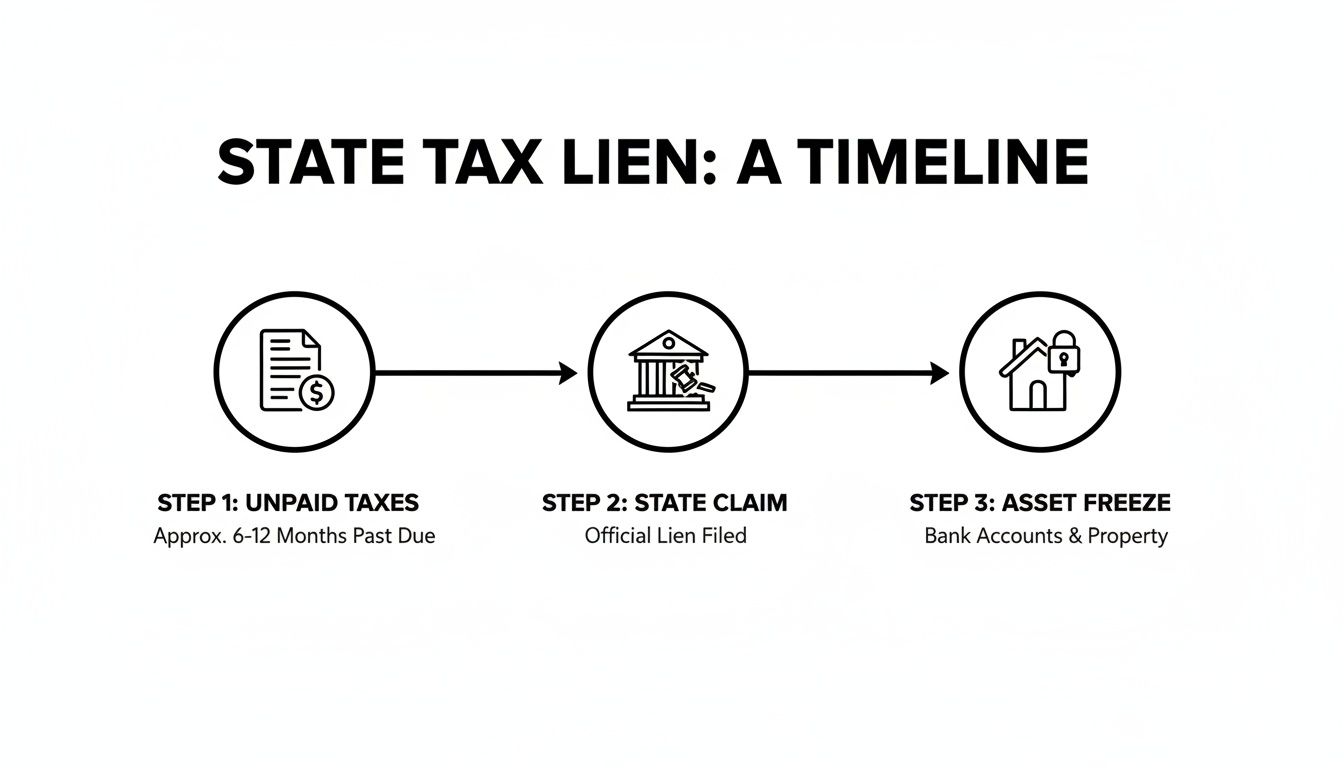
As you can see, a lien is a consequence of inaction. It only happens after the debt goes unpaid and the state has to formalize its legal claim to your assets.
Stage 2: The Lien Becomes a Public Record
If you don't pay what the state demanded in its notices, they have to protect their financial interest. They do this by filing a Notice of State Tax Lien. This document is filed with a public office, typically your local county recorder or the clerk of court.
This is the moment of truth. Your private tax problem just went public. Once that lien is filed, it legally attaches to all your property and your rights to property—we’re talking everything from your house and car to your business equipment and accounts receivable.
By making the lien a public record, the state is essentially planting its flag for all other creditors to see. It signals that the government gets first dibs on your assets, meaning it gets paid before most other lenders or creditors if you sell your property.
This public filing triggers immediate and painful consequences. It can torpedo your ability to sell property, crater your credit score, and throw a wrench into your day-to-day business operations. The specific rules and timelines are different in every state. For instance, understanding how Michigan state agency collections work gives you a glimpse into one state's playbook.
The only way to avoid these damaging public consequences is to be proactive during the notice phase and prevent the lien from ever being filed in the first place.
How a State Tax Lien Impacts Your Financial Life

Think of a state tax lien as more than just a piece of paper in a government file. It’s a heavy financial anchor that can seriously weigh down your personal and professional life. Once that lien becomes public record, the ripple effects start spreading, touching almost every part of your financial world.
The lien is the state’s legal way of saying, "We have first dibs on everything you own." This claim creates massive roadblocks that can stop major life plans—like buying a car, selling your house, or launching a business—dead in their tracks. Let's break down exactly how it can turn things upside down in three key areas: your property, your credit, and your business.
The Stranglehold on Your Property
The most immediate—and often most painful—punch a state tax lien delivers is to your property. While the lien attaches to all your assets, you really feel its power when it comes to real estate. It places a "cloud" on the title to your home, making it almost impossible to sell or refinance.
Picture this: you’ve found a buyer for your house, and everything is moving along smoothly. But then, the title search happens, and the lien pops up. Just like that, the deal is off. No lender will give your buyer a mortgage, and no title insurance company will touch the sale until that lien is paid off.
This isn't just a hypothetical. Property tax delinquency, a common trigger for state tax liens, is a nationwide issue, with national averages hovering over 5%. For professionals like real estate agents and financial planners, dealing with clients who can't close deals because of title issues is a recurring headache. You can get a deeper look at the data in the 2025 Property Tax Delinquency Report.
Even if you aren’t planning to sell, the threat remains. The state has the legal power to enforce its lien by seizing and selling your property to cover the debt. While foreclosure is usually a last resort, that possibility hangs over your head until the tax bill is settled. We explain more about how to navigate this in our guide on how to sell a home with a lien.
Damaging Your Credit and Borrowing Power
When a state tax lien gets filed, it's entered into public records. While the big three credit bureaus (Equifax, Experian, and TransUnion) stopped including most tax lien data on consumer credit reports back in 2018, don't assume it's hidden.
Lenders, especially for big-ticket items like a mortgage or a business loan, do their homework. They run deep background checks that go far beyond a simple credit report, and that includes searching public records. A state tax lien showing up on that search is a huge red flag.
A state tax lien tells a story to potential lenders. It says you have a history of not meeting major financial obligations, immediately labeling you as a high-risk borrower.
As a result, getting new credit can become a nightmare. You're likely to face:
- Outright Loan Denials: Many lenders won't even consider your application.
- Sky-High Interest Rates: If you do get approved, expect to pay a premium. Higher interest rates can cost you thousands of dollars over the life of a loan.
- Trouble Renting: Landlords often check public records, too. An unpaid tax lien can be grounds for denying your rental application.
Disrupting Your Business Operations
For any business owner, a state tax lien is a potential knockout blow. The lien doesn't just attach to your personal assets; it clamps down on everything the business owns—your equipment, inventory, and even your accounts receivable.
Suddenly, your day-to-day operations can grind to a halt. Need a line of credit to manage cash flow or buy new inventory? A lien will make that nearly impossible to secure.
If you’re thinking about bringing on investors or selling the company, a tax lien is a deal-breaker. Nobody wants to buy a business that comes with the state as its top creditor. In the worst-case scenario, the state can levy your business bank accounts, freezing your funds and making it impossible to meet payroll or pay your suppliers. A tax problem quickly spirals into a full-blown operational crisis.
State Tax Liens vs Federal Tax Liens
It’s easy to think a tax problem is just a tax problem, but that’s a dangerous oversimplification. When a tax lien hits your property, the first question you need to ask is: who filed it? The answer—state or federal—changes everything.
While both a state tax lien and a federal tax lien act as a legal claim against your property for unpaid taxes, they come from entirely different playbooks. A federal lien is the handiwork of the IRS, usually for things like federal income or payroll taxes. A state lien, however, is filed by your state's own tax authority—like the Franchise Tax Board or Department of Revenue—for state-level debts like sales tax or state income tax.
This isn't just a matter of semantics. It has massive real-world implications for how the lien is enforced, how it impacts your credit, and most importantly, how you can get rid of it.
The Critical Question of Lien Priority
So, what happens when you have multiple creditors, including the government, all making a claim on your house? This is where lien priority comes in, and it’s all about who gets paid first if the property is sold. The general rule of thumb is "first in time, first in right," meaning the first lien recorded gets first dibs.
But, as with all things tax-related, there are exceptions. This is where state and federal liens really start to diverge. While an IRS lien’s place in line is set when they file a Notice of Federal Tax Lien, some state liens have a special power to cut the line.
Watch out for state "superpriority" statutes. Some states have laws that allow certain liens, especially for property taxes, to jump ahead of everything—even a mortgage or a previously filed IRS lien. This is a game-changer for lenders and anyone involved in a real estate deal.
This unique power makes it absolutely crucial to know your state’s specific laws. You can't just assume the IRS lien will behave the same way a state one does.
A Head-to-Head Comparison
To really nail down the differences, let's put them side-by-side. Seeing the key features compared directly makes it clear where the lines are drawn.
State Tax Lien vs Federal (IRS) Tax Lien
| Feature | State Tax Lien | Federal (IRS) Tax Lien |
|---|---|---|
| Originating Authority | A state government agency (e.g., Department of Revenue, Franchise Tax Board). | The Internal Revenue Service (IRS), a federal agency. |
| Types of Taxes | State-specific taxes like income, sales, use, and property taxes. | Federal taxes, primarily income, payroll, and estate taxes. |
| Scope of Attachment | Attaches to all of the taxpayer's property and rights to property located within that state. | Attaches to all of the taxpayer's property and rights to property, nationwide. |
| Priority Rules | Governed by state law; some states grant "superpriority" status to certain tax liens. | Governed by the Internal Revenue Code; generally follows the "first in time" rule but has some exceptions. |
| Resolution Process | Negotiated directly with the state tax agency, with options like payment plans or Offers in Compromise specific to that state. | Handled through IRS channels, with established programs like Installment Agreements and Offers in Compromise. |
The biggest takeaway for most people is the geographic reach. A state tax lien is powerful, but its authority usually stops at the state line. An IRS lien, on the other hand, has a nationwide grip. It will follow you and attach to any property you own, no matter where you move in the U.S.
Your Roadmap to Resolving a State Tax Lien

Finding out there’s a state tax lien attached to your name can be a gut-punch moment. It feels overwhelming, but I can tell you from experience: this is a solvable problem. The trick is to act deliberately and with the right information, not to let fear paralyze you. Think of this as your strategic guide—a clear plan to tackle the lien head-on and start reclaiming your financial footing.
The very first step isn't to panic; it's to confirm. Before you can even think about a solution, you have to get your hands on the lien itself and understand exactly what it says.
How to Confirm a State Tax Lien
A state tax lien is a public document. That’s a good thing, because it means you can—and absolutely should—verify it yourself. The official "Notice of State Tax Lien" is usually filed with your local county recorder, clerk of court, or a similar office that handles public records.
You can typically track this down by:
- Searching County Records Online: Most counties have online databases where you can search for public records by name.
- Visiting the County Office: You can always go down to the county courthouse or administrative building and request a search of the public records in person.
- Contacting the State Tax Agency: The agency that filed the lien can provide you with a copy and break down the details of the tax debt behind it.
Once you have the document, you’ll see the critical information: the filing date, the exact amount of the tax debt, and which state agency filed it. This is your starting point for picking the right way forward.
Your Primary Options for Lien Resolution
With the facts in hand, you can start exploring your options for handling the tax debt and, ultimately, the lien. Each path has its own rules and results, so understanding them is key to choosing the best strategy for your situation.
The most direct route is simply paying the debt in full. Once the state gets every penny of the taxes, penalties, and interest owed, it will issue a Certificate of Release of Tax Lien. This document officially kills the state’s claim on your property. It gets filed in the same public records office as the original lien, clearing that cloud from your title.
Of course, paying in full isn't always possible. The good news is that states have other ways to work with you. When dealing with tax problems, it helps to know all the available IRS or State tax resolution options.
Navigating Payment Plans and Settlement Offers
If a lump-sum payment is off the table, the two most common alternatives are installment agreements and Offers in Compromise.
Installment Agreement (Payment Plan): This lets you pay off your tax debt through manageable monthly payments over a specific timeframe. As long as you stick to the plan, the state will back off from more aggressive collection tactics, like seizing funds from your bank account. The lien itself usually stays put until you make that final payment.
Offer in Compromise (OIC): An OIC is a formal deal with the state to settle your tax debt for less than you actually owe. Be warned: this isn't an easy win. It’s generally for people facing true financial hardship who have no realistic way of ever paying the full amount. You'll need to open up your books and provide detailed financial proof to make your case.
Key Takeaway: An installment agreement makes the debt manageable, while an OIC can reduce the total debt owed. The best choice depends entirely on your financial reality.
For a deeper dive into the mechanics of getting a lien removed after you've resolved the debt, you can check out our detailed guide on how to remove a tax lien.
Advanced Strategies: Lien Withdrawal and Subordination
Beyond paying or settling, there are a couple of other strategic tools we can use in specific situations to manage a lien’s impact.
A lien withdrawal removes the public Notice of State Tax Lien from the record, making it look like it was never filed. This is very different from a release, which shows the lien existed but was paid. Withdrawals are rare, but they can sometimes be granted if the lien was filed by mistake or if doing so is somehow in the state’s best interest.
A lien subordination, on the other hand, doesn’t get rid of the lien. Instead, it allows another creditor, like a mortgage lender, to jump ahead of the state in the priority line. This is most often used when you're trying to refinance a property to pull out cash specifically to pay the tax debt. The state agrees to take a backseat because it improves their odds of getting paid in the end.
Why You Need a Tax Attorney on Your Side
When you get hit with a state tax lien, it can feel like you're lost in a maze with no map. It's tempting to think, "I can handle this myself and save some money." But that's a risky bet. Every state has its own labyrinth of tax laws, strict deadlines, and unwritten rules of engagement. This isn't just about paperwork; it's a high-stakes negotiation where one wrong move can cost you dearly.
Think of an experienced tax attorney as your personal guide and advocate through this mess. Their first step is always a deep dive into your situation—they'll scrutinize your finances, the details of the lien itself, and the original tax debt that started it all. They know what to look for, spotting the subtle details and potential defenses that most people would completely miss.
This initial analysis is everything. It's the foundation for your entire game plan. A good attorney can quickly pinpoint the best path forward, whether that means setting up a simple payment plan, negotiating a complex Offer in Compromise, or even getting the lien subordinated so you can sell your house or refinance a loan.
The Power of Professional Negotiation
Here's where a tax attorney really earns their keep: they're seasoned negotiators who speak the state's language. They often have established professional relationships with the very revenue agents you're up against. They understand the internal pressures these agencies face and know exactly what it takes to get a deal across the finish line.
This creates an invaluable professional buffer between you and the tax agency. It takes the emotion out of the equation and stops you from accidentally saying something that could hurt your case. Instead of you taking stressful, intimidating calls, your attorney handles all communication. They frame your situation in the best possible light and work methodically to find a solution that protects your assets and your peace of mind.
An attorney's job isn't just to cut a deal on the debt. They're there to make sure your rights as a taxpayer are protected every step of the way and to hold the state accountable to its own laws and procedures.
Hiring an expert isn't giving up—it’s taking back control. The right professional will save you an incredible amount of time and stress. And in many cases, they can save you a substantial amount of money by securing a much better outcome than you could on your own. They turn a scary, overwhelming fight into a manageable process with a clear finish line.
Common Questions We Hear About State Tax Liens
When you get hit with a state tax lien, a hundred questions probably race through your mind. After you get past the initial shock, you start thinking about the practical, long-term consequences. What does this really mean for my house? For my credit? For my future?
Let's cut through the legalese and tackle some of the most common—and stressful—questions people have. These aren't just technicalities; they're the real-world worries that keep you up at night.
How Long Does a State Tax Lien Stick Around?
A state tax lien has serious staying power. It will dog your public records and cast a shadow over your property title until the tax debt is paid in full. Only then will the state issue a "Certificate of Release," which officially clears their claim.
But even after it's released, its ghost can linger. While the major credit bureaus stopped including tax lien data on consumer reports back in 2018, don't get a false sense of security. Lenders, title companies, and anyone doing a thorough background check can still easily find it in public property records.
The most critical thing to know is that every state has a statute of limitations for collecting on that debt—often 10 years or more. In some places, they can even renew it. This isn't a problem that just goes away with time; you have to face it head-on.
Can the State Actually Take My House Because of a Lien?
This is a huge point of confusion, so let's be crystal clear: a lien is a claim, not a seizure. When the state files a lien, they aren't showing up with a moving truck the next day. Think of it as them calling "dibs" on your property—they're just securing their place in line to get paid if the property is sold.
But that claim has some serious muscle behind it. If you continue to ignore the debt, the lien gives the state the legal right to force a sale of your property through a levy or foreclosure. It's their way of getting their money from the proceeds.
The good news? This is truly a last resort. States would much rather get paid without the hassle of seizing property. They will almost always give you plenty of notice and opportunities to get on a payment plan or find another solution. The absolute worst thing you can do is nothing.
Will Filing for Bankruptcy Make a State Tax Lien Go Away?
This is one of the most dangerous myths out there. A lot of people think bankruptcy is a get-out-of-jail-free card for tax liens, but it’s just not that simple.
Here’s the breakdown:
- Your Personal Debt: A bankruptcy (like a Chapter 7) might wipe out your personal liability for the tax debt. That means the state can no longer come after you with wage garnishments or bank account levies.
- The Lien on Your Property: The lien itself, however, usually survives the bankruptcy. It stays firmly attached to your property because it's a secured debt.
So, what does that mean in the real world? It means that if you ever try to sell or refinance your home, that lien is still there and has to be paid off from the proceeds before you see a dime. This is where tax law and bankruptcy law collide, and you absolutely need an attorney who's an expert in both to guide you.
If you're staring down a state tax lien and feel completely stuck, you don't have to figure it out on your own. At Attorney Stephen A Weisberg, we start every client with a free, no-obligation Tax Debt Analysis to map out the best strategy for your unique circumstances. Visit us at https://weisberg.tax to get started on a solution today.


