Warrant in Washington State: Your Rights & How to Respond
Facing a warrant in Washington State? Understand arrest, bench, and search warrants, your rights, and how to resolve them. Clear, actionable guidance.

In this article
- What It Means to Have a Warrant in Washington
- Why the type of warrant matters
- What you should do first
- The Three Main Types of Washington Warrants
- Arrest warrants
- Bench warrants
- Search warrants
- A quick comparison
- How to Find Out If You Have an Active Warrant
- Don't rely on statewide search tools alone
- A better way to check
- Useful secondary resources
- Your Immediate Rights and First Steps
- Do this
- Don't do this
- The fastest way people create new problems
- A simple script
- How to Resolve or Quash a Washington Warrant
- What quashing a warrant actually means
- What to do right now
- Where people make expensive mistakes
- When a lawyer makes the biggest difference
- When Warrants Complicate Tax and Civil Matters
- Why tax problems get harder fast
- The tribal warrant issue people overlook
You missed a court date. Or a traffic case slipped through the cracks. Or someone told you your name came up in a warrant search. That's enough to ruin your day, and for good reason.
A warrant in Washington State is serious. But panic helps no one. The right move is to identify what kind of warrant you're dealing with, stop talking more than necessary, and get in front of the court before the court gets in front of you.
Individuals often make this worse in one of three ways. They ignore it. They trust an incomplete online search. Or they call around and start explaining facts that prosecutors or police didn't have before. Don't do that. Handle this in a deliberate order.
What It Means to Have a Warrant in Washington
A warrant is a judge's order. That's the simple version. It gives legal authority for something specific to happen, usually an arrest, a court appearance problem being enforced, or a search for evidence.
For most readers, the issue is a bench warrant tied to a missed court date, unpaid obligation, or failure to follow a court order. That's common, and it's fixable. What matters is speed and precision.
Why the type of warrant matters
Not every warrant creates the same problem.
An arrest warrant usually starts with an accusation that police say supports taking someone into custody. A bench warrant usually starts with something that happened in court, especially failing to appear. A search warrant isn't about hauling you into court. It authorizes officers to search a place or property for evidence.
If you don't know which one exists, you can't choose the right response.
Practical rule: Treat every suspected warrant as active until you confirm otherwise with the issuing court or through counsel.
What you should do first
Use this order:
- Identify the court involved. Start with the court where the ticket, criminal case, or hearing likely originated.
- Find out the warrant type. Don't assume a missed traffic matter is “minor.”
- Stop discussing case facts casually. Friends, clerks, and police aren't your strategy team.
- Prepare to resolve it directly. Warrants rarely fix themselves.
A lot of stress around a warrant in Washington State comes from uncertainty. People don't know whether they'll be arrested at work, during a traffic stop, or while trying to clean up another legal issue. That uncertainty is exactly why delay is a bad strategy.
The Three Main Types of Washington Warrants
Warrants do different jobs. If you misread the type, you can make the problem worse fast.
A missed court date can lead to a bench warrant. That same bench warrant can spill into civil problems you did not see coming, especially if you are already dealing with state tax debt, license issues, or a payment dispute. People often focus only on the arrest risk. That is too narrow. A warrant can also stall your ability to clean up the rest of your legal and financial mess.
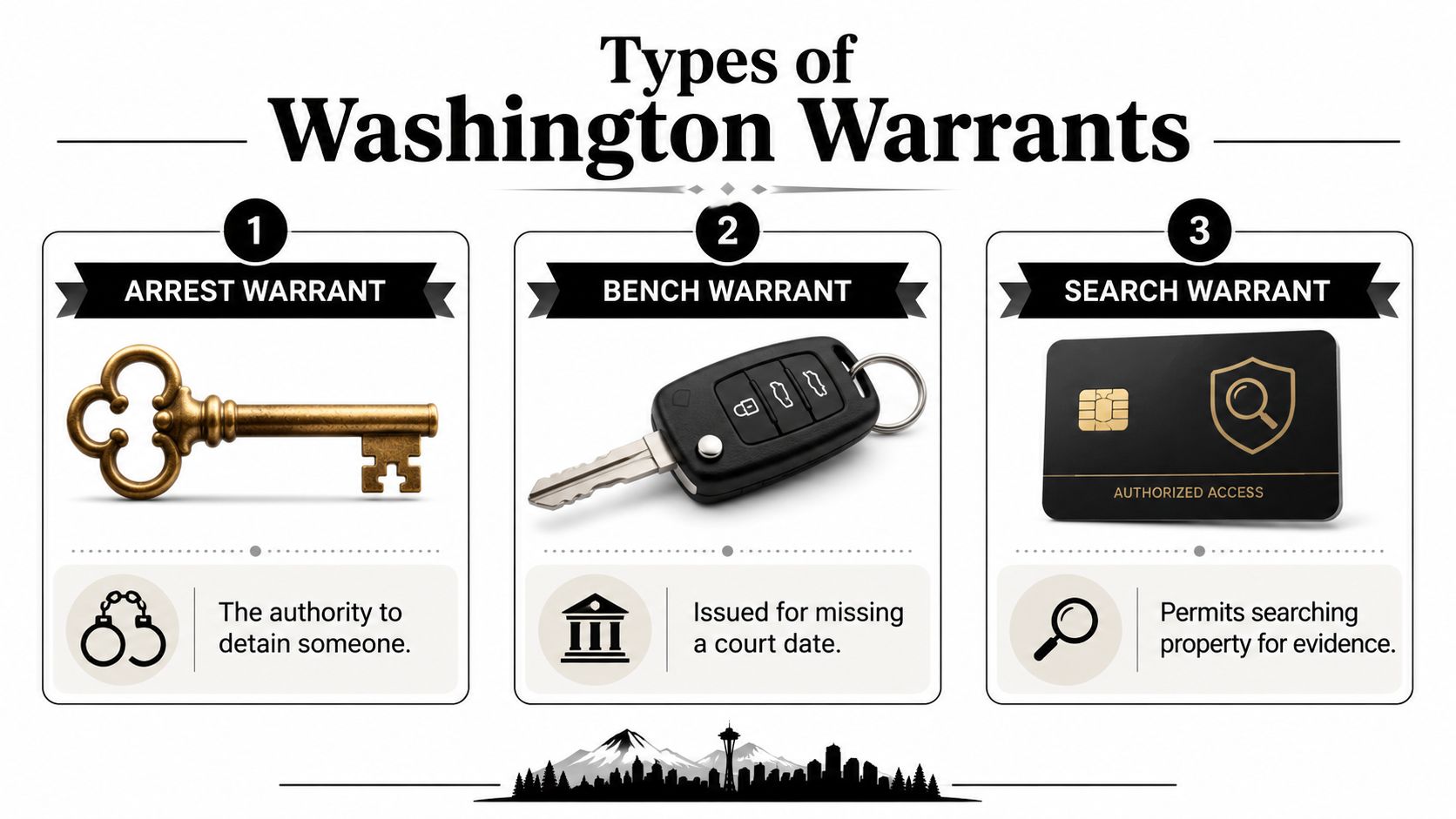
Arrest warrants
An arrest warrant allows law enforcement to take a person into custody. It usually follows a criminal investigation and a judge's finding that there is a legal basis to arrest you.
This type creates the most obvious risk. You can be arrested during a traffic stop, at home, or during contact with police on a completely separate issue. If you are also trying to resolve tax debt or another civil matter, an arrest warrant can interrupt every part of that process. Meetings get missed. Deadlines pass. Payment plans fall apart.
Bench warrants
A bench warrant comes from the court's power to enforce its own orders. In Washington, this is the warrant many people get after missing a hearing, skipping a required appearance, or failing to comply with what the judge ordered.
This is also the warrant type that tends to escalate into other problems. A person may be trying to fix Department of Revenue debt, respond to a garnishment, or hire counsel for a business tax issue, while a bench warrant sits in the background waiting to blow up a routine court or agency appearance. If that sounds familiar, get coordinated help early, especially if your criminal issue and tax problem are colliding. Start by learning how to choose a good tax attorney for a case with court and debt overlap.
Washington courts explain that district and municipal courts may issue bench warrants for failure to appear or failure to comply, and that these warrants stay in effect until the court recalls or quashes them through the proper process, as described by the Washington Courts guidance on warrants and related court records.
Search warrants
A search warrant gives officers authority to search a person, home, vehicle, device, or other property for evidence described in the warrant. It is not an order to arrest you or make you come to court.
It still matters. A search can produce evidence that leads to charges, and those charges can later produce an arrest warrant or bench warrant if the case is ignored. Under Washington law, a search warrant also has execution rules and time limits. The Washington Legislature sets out those requirements in RCW 10.79.035.
A quick comparison
| Warrant type | Main purpose | Typical trigger | Practical risk |
|---|---|---|---|
| Arrest warrant | Take a person into custody | Alleged criminal conduct | Arrest during everyday police contact |
| Bench warrant | Force compliance with court orders | Missed hearing, missed payment, or violation of a court order | Arrest plus damage to related civil or tax matters |
| Search warrant | Authorize a search for evidence | Judge approves a request tied to an investigation | Search of property, then possible criminal charges |
If you want a plain-language comparison of related warrant categories that people often mix up, Bada Bing Bail Bonds' warrant guide is a useful supplemental read.
The right move is simple. Identify the warrant type first, then match your response to that specific problem.
How to Find Out If You Have an Active Warrant
Start with the court, not with rumors.
A friend's warning, an old letter, or an online search result may point you in the right direction, but none of those should be your final answer. If you're trying to confirm a warrant in Washington State, the central question is not whether some database mentions your name. The question is whether the issuing court shows an active warrant right now.

Don't rely on statewide search tools alone
Washington's public court search tools are helpful, but they are not a live warrant database. The Administrative Office of the Courts says users should contact the court directly because “there is a time delay” before warrant information appears in searchable records, as explained in the Washington courts guidance on finding warrants and traffic matters.
That one point changes the whole strategy. If you trust the public search and it's behind, you may think you're clear when you're not.
A better way to check
Use a layered approach:
- Start with the originating court: If this began as a traffic case, misdemeanor, or missed hearing, contact that specific court clerk first.
- Ask narrow questions: Confirm the case number, whether a warrant exists, and what court process applies to clear it.
- Avoid oversharing: You're verifying status, not giving a statement.
- Use counsel if privacy matters: An attorney can often check status while planning the next move at the same time.
For readers trying to organize the legal and financial fallout at once, this is also a good moment to think carefully about representation. If your warrant issue overlaps with state tax debt, business records, or compliance problems, choosing the right lawyer matters. This guide on how to find a good tax attorney is a practical place to start.
Useful secondary resources
If you want a consumer-level overview of basic warrant checking methods before contacting the court, Express Bail Bonds' resources for warrants can help you understand the process in plain English.
Call the court that issued the case. That's the authority that matters.
Your Immediate Rights and First Steps
If police confront you about a warrant, your job is not to talk your way out of it. Your job is to protect yourself from making it worse.
People hurt their cases because they confuse politeness with cooperation in questioning. Be polite. Be calm. But don't start explaining where you were, why you missed court, or what “really happened.”
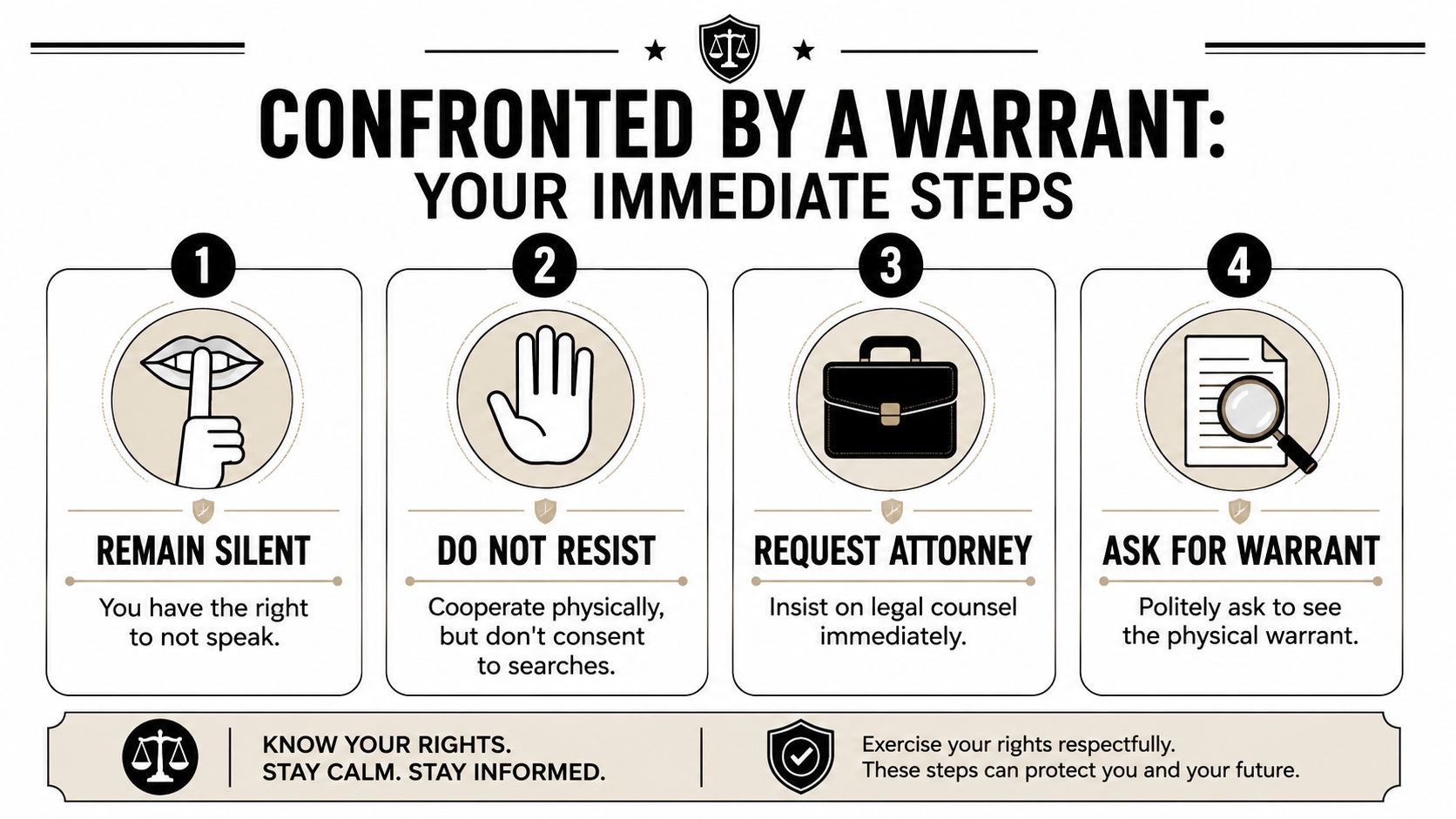
Do this
- State identifying information if required: Give your name and basic identifying details if lawfully requested.
- Say you want a lawyer: Use clear words. Keep it simple. “I want an attorney.”
- Stay physically compliant: Don't pull away, argue physically, or resist.
- Ask what court issued the warrant: That information matters later.
Don't do this
- Don't explain the case: Your explanation won't cancel the warrant on the sidewalk.
- Don't consent to extra searches: Don't volunteer access to your phone, car, or property.
- Don't guess or fill silence: Silence protects you. Nervous talking doesn't.
- Don't discuss tax or business issues casually: If there are parallel civil problems, loose statements can spill into them.
The fastest way people create new problems
They start talking because they think silence looks guilty. That's backwards. Silence is discipline.
A warrant encounter can also expose other unresolved issues. Someone with unpaid taxes, unfiled returns, payroll trouble, or ignored government notices often assumes those are separate from a criminal matter. In real life, they collide. One law enforcement contact can force immediate attention on records, addresses, missed deadlines, and government correspondence. If you've also been ignoring tax notices, get organized fast. Start by understanding IRS letters and notices so you know what else may be escalating while you focus on the warrant.
A simple script
Use something like this:
I want to remain silent. I want an attorney. I will comply physically, but I don't consent to searches.
That script is short because short is safer.
How to Resolve or Quash a Washington Warrant
You miss a court date, assume you can clean it up next week, and then life keeps moving. Meanwhile, the warrant stays active. That can block much more than a criminal case. It can interfere with work, licensing, business records, and your ability to deal with state tax debt before it gets worse.
If you have a Washington warrant, your job is simple. Get in front of the right court the right way, as fast as possible.
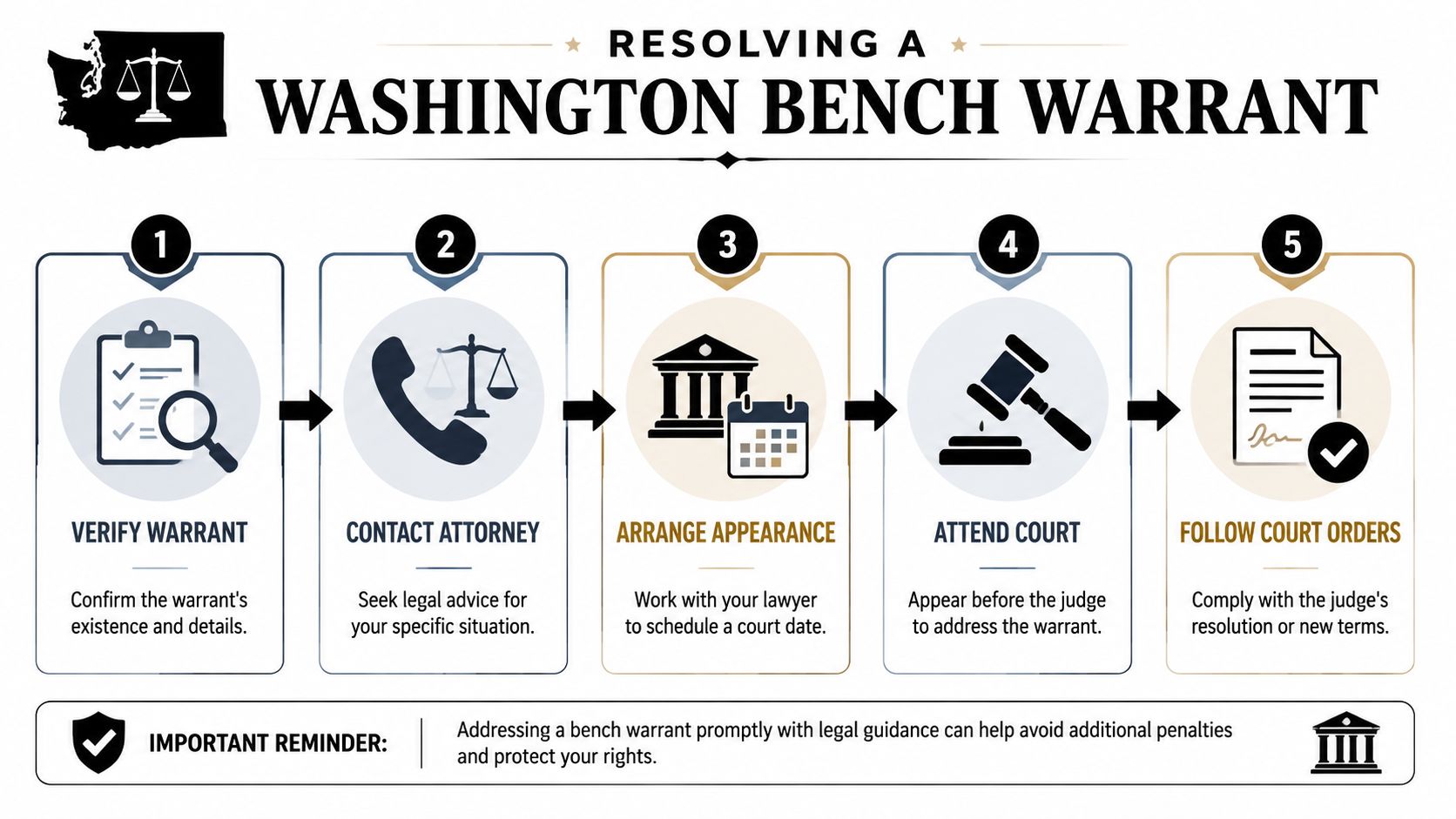
What quashing a warrant actually means
To quash a warrant means the judge withdraws it. Until that happens, treat the warrant as live.
Do not confuse progress with resolution. Calling the court, learning the case number, or even getting a hearing date does not automatically clear the warrant. In some courts, you may be allowed to appear and get a later date to address the warrant, but the warrant can remain active until the judge formally recalls it.
That point matters because people relax too early. Then they get stopped, arrested, or miss another deadline while assuming the issue was already being handled.
What to do right now
The usual process looks like this:
- Confirm exactly which court issued the warrant.
- Find out that court's procedure for recalling or quashing it.
- Decide whether a lawyer should appear, contact the court, or arrange your appearance.
- Appear as required, in person if necessary.
- Follow every condition the judge sets next, immediately.
That is the path. The risk is in doing the steps out of order or assuming your county handles warrants the same way another county does.
Where people make expensive mistakes
They wait for a convenient time.
That is a mistake.
Bench warrants tied to missed hearings usually do not disappear on their own. Delay increases the chance of arrest and makes the judge less sympathetic when you finally appear. It also creates collateral damage people overlook. If you are already behind on Washington tax obligations, business filings, or agency notices, an active warrant makes it harder to gather documents, show up to appointments, and respond on time. A criminal warrant often becomes the reason a civil problem turns into a collection problem.
When a lawyer makes the biggest difference
A lawyer helps most when the warrant is tied to a missed appearance, bail conditions, or a case that overlaps with money problems outside criminal court.
Good counsel can:
- Coordinate the safest return to court
- Present the missed court date in the best possible light
- Reduce the chance of unnecessary custody
- Protect related interests involving tax debt, business operations, or licensing
If the warrant is already affecting your finances or exposing unresolved government debt, read when to hire a tax attorney for matters that are spilling into collections, compliance, or business risk.
One more blunt point. If you have both a warrant and state tax trouble, do not treat the warrant as a side issue. Clear it fast. Until you do, it can keep sabotaging your ability to fix the civil side too.
A future hearing helps. A quashed warrant solves the problem. Treat those as different things.
When Warrants Complicate Tax and Civil Matters
This is the part most legal guides miss.
A warrant doesn't stay neatly in a criminal file. It bleeds into ordinary life. It interferes with your ability to show up consistently, respond to agencies on time, gather records, meet with accountants, and keep business operations steady. For a self-employed person or small business owner, that's not a side issue. That's the whole game.
Why tax problems get harder fast
Tax controversies depend on follow-through. Deadlines matter. Mail matters. Meetings matter. If you're worried about being picked up on a bench warrant, you're less likely to walk into a courthouse, a government office, or even a licensing appointment. People start avoiding everything. That avoidance is exactly how civil problems grow teeth.
Here's where I'm blunt. If you have a warrant and tax debt, stop pretending these are separate projects. They are now one operational problem. The warrant can disrupt your income, your records, your mobility, and your ability to negotiate with taxing authorities. If levy risk is already on the table, learn how an IRS levy can escalate pressure while you're distracted by the criminal side.
The tribal warrant issue people overlook
Jurisdiction is also getting more complicated. A recent development in Washington is the Tribal Warrants Act, which allows state officers to enforce tribal court warrants, creating different enforcement and legal procedures than typical county warrants, as reported in this coverage of Washington's tribal warrant enforcement changes.
That matters for people and businesses operating across county, tribal, and state lines. A contractor, driver, consultant, or owner who moves across jurisdictions can get blindsided if they assume every warrant follows the same rules.
If your life includes court issues on one side and tax debt on the other, you need a coordinated response. Handle the warrant. Protect the civil case. Don't let one unresolved file wreck the other.
If you're dealing with a warrant and tax debt at the same time, talk to Attorney Stephen A Weisberg. He has over 10 years of experience helping individuals, business owners, and professionals resolve tax debt issues involving the IRS and the state. He offers a free Tax Debt Analysis to determine whether he can help and what the right path looks like before charging for representation.