W8 Form Tax Guide: A Complete Explanation for 2026
Confused by the W8 form tax request? Our guide explains each W-8, who needs one, how to complete it, and how to avoid costly withholding mistakes.

In this article
- An Introduction to the W8 Tax Form
- Where confusion usually starts
- Why the IRS Requires W8 Forms
- Think of the W-8 as a foreign status pass
- Why the form goes to the payer, not the IRS
- What the IRS is really trying to solve
- Choosing the Correct W8 Form for Your Situation
- The short version
- W-8 form comparison
- How to choose without overcomplicating it
- A practical screening checklist
- How to Complete Form W8BEN Step by Step
- Part I starts with identity, not tax theory
- The address issue causes more trouble than people expect
- Part II is where treaty claims live
- Signature and delivery matter
- A clean completion checklist
- Claiming Tax Treaty Benefits Explained
- What a treaty claim actually does
- A simple example
- When not to force a treaty claim
- Common Mistakes and Withholding Risks to Avoid
- The mistakes I see most often
- Why expiration creates real withholding exposure
- What withholding agents usually do when a W-8 has a problem
- A better way to reduce the risk
- Frequently Asked W8 Form Tax Questions
- How often do I need to submit a new W-8 form
- What is an FTIN
- What if I become a U.S. person later
- When should I get professional help
A U.S. client is ready to pay you. Or your brokerage platform has paused withdrawals. Or your bank has sent a message that says: “Please complete a W-8 form.”
Upon receiving that request, many immediately ask the same questions. Is this a U.S. tax return? Am I about to owe tax in the United States? Why am I being asked for an IRS form if I don't live there?
That confusion is normal. The W-8 system is one of those tax processes that sounds simple on the surface but has real financial consequences if you choose the wrong form, leave out a key certification, or let it expire. In practical terms, the issue isn't paperwork for paperwork's sake. The issue is whether your payer has enough documentation to classify you correctly before money goes out the door.
An Introduction to the W8 Tax Form
A U.S. payer is ready to send money, but the payment stalls because one question has not been answered on paper: who are you for U.S. tax withholding purposes?
That is the practical starting point for the W8 form tax issue. A freelance designer with a U.S. client, a foreign company licensing software to an American customer, and an investor receiving dividends through a U.S. platform can all face the same request. Complete a W-8 before funds are released or before the account can be fully used.
The W-8 works like an identity document for the withholding process. It tells the payer whether the recipient is a foreign individual, a foreign entity, an intermediary, or another type of non-U.S. recipient. The IRS describes the W-8 series as forms used by foreign persons to certify status and, in some cases, claim treaty benefits or other reduced withholding treatment in the IRS instructions for Form W-8BEN.
That function is easy to underestimate. The form is not just administrative paperwork. It is often the document that stands between correct treatment and default withholding, delayed payments, or a request to start over with a new form.
A useful way to view the W-8 system is as a classification tool. Before money leaves the payer's hands, the payer needs a file that supports the tax treatment being applied. If the classification is wrong, the result is not merely a technical error. It can mean excess withholding, rejected treaty claims, or an account marked for follow-up by compliance staff.
Where confusion usually starts
Many readers hear “W-8” and assume there is one standard form for everyone outside the United States. There is not. The W-8 family includes different forms for different legal roles, and choosing the right one is part of the tax analysis.
A few misunderstandings come up repeatedly:
- “I'm self-employed, so the individual form always applies.” Often that is correct, but the answer can change if the income is paid to an entity or if the recipient is acting in another capacity.
- “My foreign company can submit any W-8 form that mentions foreign status.” Entity classification matters. The wrong form can be treated as invalid.
- “Once I submit a W-8, the issue is finished.” W-8 forms expire under set renewal rules, and some forms become invalid earlier if your facts change.
- “If I make a small mistake, the payer will sort it out.” Many withholding agents will not correct the form for you. They will reject it, hold payment, or apply default withholding until proper documentation is provided.
This is why the W-8 deserves more attention than its short format suggests. In cross-border tax practice, it often acts as the first control point. If you get the form choice, certifications, and renewal timing right, you reduce friction and protect cash flow. If you get them wrong, the cost usually shows up before you ever file a return.
For readers dealing with broader cross-border compliance, related documentation habits often surface in other reporting areas as well, including foreign bank disclosure obligations.
Why the IRS Requires W8 Forms
The W-8 system exists because the United States puts the first compliance burden on the payer, not just the payee. If a U.S. business, bank, platform, or other withholding agent sends certain U.S.-source payments to a foreign person, it has to determine what withholding rules apply before payment is made.

Without valid documentation, the payer often has to default to the common 30% U.S. federal withholding rate on certain U.S.-source payments made to foreign persons, and W-8 forms are generally given to the withholding agent rather than filed with the IRS and are typically valid for three years, as described in Stripe's explanation of Form W-8BEN.
Think of the W-8 as a foreign status pass
A useful analogy is a visitor pass at a secure office building.
The security desk does not know you. Until you show valid credentials, they treat you under the default rules. In the tax world, the withholding agent is that security desk. The W-8 is the document that says, in effect, “I am a foreign person, here is my status, and here is why the standard default treatment may not apply to me.”
Practical rule: The W-8 protects both sides. It helps the payee avoid unnecessary withholding, and it helps the payer justify the treatment it applies.
Why the form goes to the payer, not the IRS
This is one of the biggest misconceptions. Many people think they must “file” a W-8 with the IRS. In most ordinary situations, that's not how it works.
Instead:
- The payer keeps it on file. The form serves as documentary support for the payer's withholding decision.
- The payer reviews it before payment. If the form is incomplete or inconsistent, the payer may reject it.
- The payer carries risk. If the payer under-withholds without valid support, the problem can come back to the payer.
That's why large platforms and financial institutions can seem strict. They aren't being difficult for no reason. They are trying to document their withholding position. If you work with U.S. payers regularly, these IRS withholding tips help explain why their onboarding teams ask repetitive questions.
What the IRS is really trying to solve
At bottom, the system answers three questions:
- Who is receiving the income?
- What type of person or entity are they?
- What withholding treatment can the payer support with documentation?
If the payer can't answer those questions confidently, it will usually choose the safer path. That safer path is often withholding first and sorting it out later.
Choosing the Correct W8 Form for Your Situation
The W-8 isn't one form. It's a family of forms built for different kinds of foreign payees. That is why “just send a W-8” is incomplete advice.
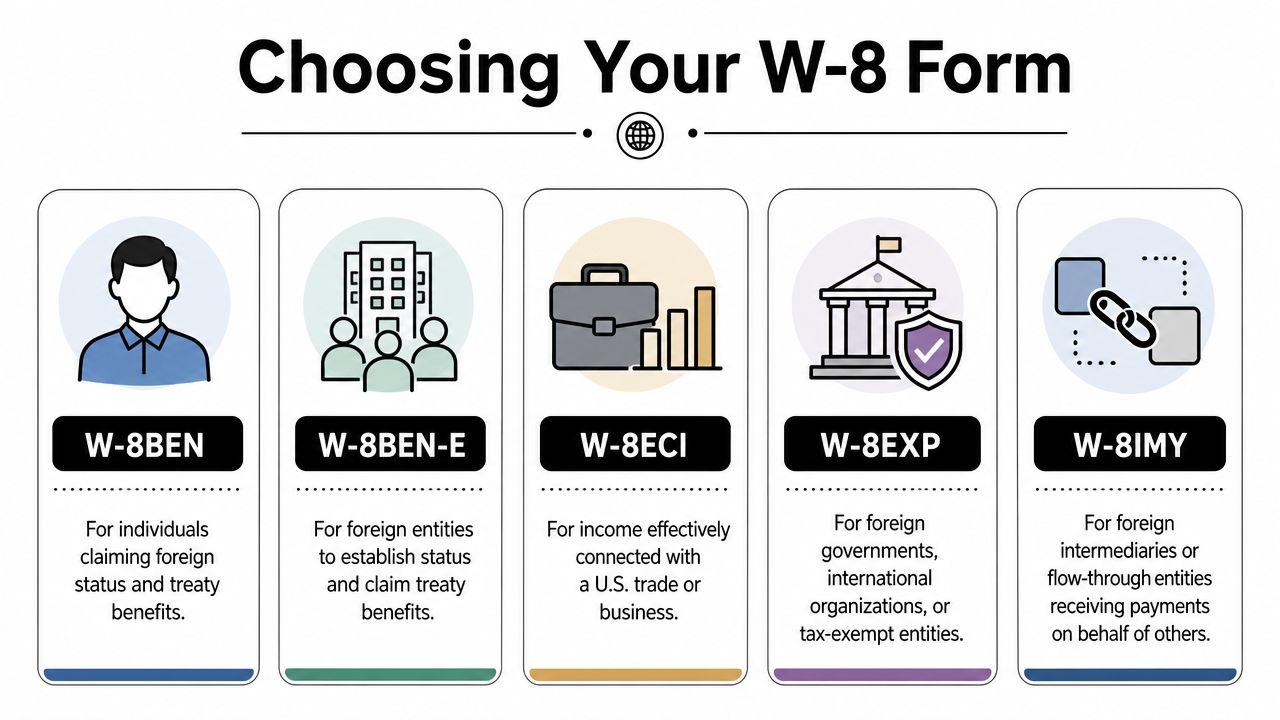
The IRS updated the W-8 series to align with tax-reporting requirements, and form selection affects both withholding and reporting. W-8BEN is for foreign individuals, while W-8BEN-E is for foreign entities. Using the wrong form can invalidate treaty claims or trigger withholding until corrected, as discussed in PwC's review of the updated W-8 series.
The short version
If you remember nothing else, remember this:
- W-8BEN usually fits foreign individuals.
- W-8BEN-E usually fits foreign entities.
- W-8ECI is for income effectively connected with a U.S. trade or business.
- W-8IMY is for intermediaries or flow-through arrangements.
- W-8EXP is for certain governments and exempt organizations.
W-8 form comparison
| Form Name | Who Files It | Primary Use Case |
|---|---|---|
| W-8BEN | Foreign individual | Certifies foreign status and may claim treaty benefits |
| W-8BEN-E | Foreign entity | Certifies entity status and may claim treaty benefits |
| W-8ECI | Foreign individual or entity with qualifying income | Used when income is effectively connected with a U.S. trade or business |
| W-8IMY | Foreign intermediary or certain flow-through entity | Used when receiving payments on behalf of others or passing income through |
| W-8EXP | Foreign government or qualifying exempt organization | Used to certify exempt or special status |
How to choose without overcomplicating it
Start with the legal recipient of the payment.
If the contract is in your own personal name, your first instinct is usually W-8BEN. If the contract is with a foreign corporation, partnership, or other entity, your first instinct is usually W-8BEN-E.
But income type can change the analysis. For example:
- A foreign consultant working personally may still need a different form if the payment is classified in a way that doesn't belong on W-8BEN.
- A foreign business with U.S.-connected operations may need W-8ECI instead of a treaty-based form.
- A platform or intermediary collecting for others may need W-8IMY because it isn't the final beneficial owner.
The most expensive W-8 mistake is often not a typo. It's choosing a form that doesn't match the legal recipient or the income category.
A practical screening checklist
Before you sign anything, ask:
- Who legally earns the income? You personally, or your company?
- What is the payment for? Dividends, royalties, platform income, services, or something else?
- Are you the beneficial owner? Or are you receiving funds for someone else?
- Is the income connected to a U.S. trade or business? If yes, standard treaty logic may not be the whole story.
Tax teams that build those questions into onboarding reduce rework later. If you follow IRS form updates closely, this IRS form changes archive is useful context for why old assumptions about “the right form” can age badly.
How to Complete Form W8BEN Step by Step
For many freelancers, investors, and sole proprietors outside the United States, Form W-8BEN is the form they'll touch. It looks short. That can be misleading. Short forms often create confidence that isn't earned.
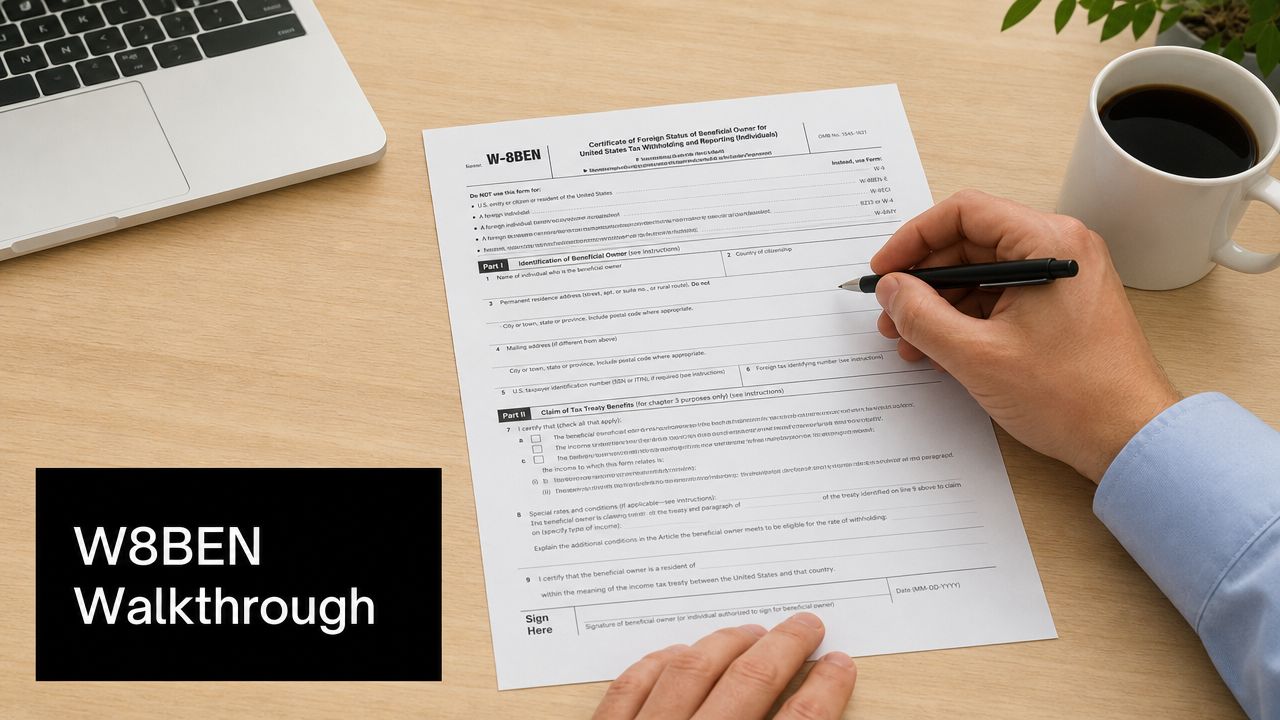
The IRS explains that Form W-8BEN is given to the withholding agent, not the IRS, to establish that the individual is the foreign beneficial owner of income, and without it the payer must assume a 30% withholding rate applies under Chapter 3, as stated on the IRS page for Form W-8BEN.
Part I starts with identity, not tax theory
Part I asks for the identification of the beneficial owner. That phrase matters.
“Beneficial owner” generally means the person who owns the income for tax purposes, not just the person receiving the funds mechanically. If the income belongs to your company, don't use your personal details on an individual form.
Pay close attention to these items:
- Name: Use your legal name as it appears in your official records.
- Country of citizenship: Don't guess based on residence or work location.
- Permanent residence address: This should reflect where you reside for tax purposes, not a temporary mailing convenience.
- Mailing address: Use only if different.
- Foreign tax identifying number: This is your non-U.S. tax ID if your jurisdiction issues one.
The address issue causes more trouble than people expect
A mailing address can receive documents. A permanent residence address supports status. Those are not the same thing.
If a form suggests one country while your other records point to another, the payer may pause and ask follow-up questions. Payers look for internal consistency. They are asking whether the form tells one coherent story.
Part II is where treaty claims live
If you are claiming tax treaty benefits, Part II becomes the heart of the form. People often overreach in this section.
Do not claim a treaty rate just because you've heard your country “has a treaty with the U.S.” That is not enough. You need the right country of residence, the right income type, and the right treaty article for the payment at issue.
A practical way to think about Part II is this:
- Confirm you are a resident of the treaty country for treaty purposes.
- Match the income type to the treaty article.
- State the reduced rate or exemption only if the treaty supports it.
A valid W-8BEN is less like filling blanks and more like building a factual statement that your payer can rely on.
Signature and delivery matter
An unsigned or undated form is often as useful as no form at all. The certification is part of the legal weight of the document.
Once completed, deliver it to the payer or platform that requested it and keep a copy of the exact version you sent. That sounds basic, but it saves time when a payer later asks why line entries differ from a prior submission.
If you're used to domestic tax paperwork and need a quick baseline on electronic signing practices, this guide on how to sign W9 online helps frame the broader documentation workflow, even though the W-9 and W-8 serve different taxpayers.
A clean completion checklist
Before you submit, confirm:
- The form matches the payee. Individual form for an individual, not an entity.
- The legal name is complete. No nicknames or shortened business labels.
- The residence details are coherent. Country, address, and tax residency should not contradict each other.
- The treaty claim is supportable. Country, article, income type, and rate should fit together.
- The signature is present. Review date and capacity if required by the payer.
Claiming Tax Treaty Benefits Explained
A tax treaty is an agreement between countries that can reduce or eliminate withholding on certain types of income so the same income isn't taxed in an unnecessarily harsh way across borders. In W-8 practice, treaty claims are where documentation stops being generic and becomes strategic.
The confusion usually starts when people treat every U.S. payment as if it belongs on Form W-8BEN. That's not always correct. Guidance commonly misses the fact that W-8BEN is distinct from Form 8233 for independent personal services and from W-8BEN-E for entities, and using the wrong form can lead to unnecessary withholding for cross-border contractors and small businesses, as noted by the University of Richmond's international payroll guidance.
What a treaty claim actually does
A treaty claim tells the payer: “I qualify for a rate different from the default treatment for this specific type of income.”
That is narrower than many people think. A treaty does not automatically cover every payment you receive from the United States. It applies by category and by conditions.
For Part II of Form W-8BEN, focus on these questions:
- Are you personally the treaty resident?
- What type of income is being paid?
- Which treaty article addresses that income type?
- Do any extra conditions apply before the reduced rate is available?
A simple example
Suppose a non-U.S. individual licenses intellectual property to a U.S. customer and believes the payment qualifies as royalties under the treaty between the United States and that person's country of residence.
The treaty claim has to line up across several moving parts:
- Country of residence for treaty purposes
- Treaty article and paragraph
- Type of income
- Reduced rate or exemption claimed
- Reason the person meets the treaty conditions
If any of those pieces are mismatched, the payer may reject the claim. That's why many businesses ask their tax team or outside advisors to review treaty language before onboarding begins. If you need help locating qualified reviewers, directories of CPAs can be useful starting points, especially when the issue blends treaty interpretation with payment operations.
When not to force a treaty claim
Sometimes the smartest move is not to claim treaty benefits on the initial submission until you can support them cleanly.
You should slow down if:
- The income is really compensation for personal services
- The payment is made to an entity, not you personally
- You're unsure whether you are a treaty resident under the treaty rules
- The payer's classification of the income seems different from yours
If you deal with payments that may be treated differently from ordinary taxable receipts, these non-taxable payment discussions can help you frame the issue before putting treaty language on a signed certification.
Common Mistakes and Withholding Risks to Avoid
A common scenario looks harmless at first. A non-U.S. payee submits a W-8, the payer files it away, and payments begin. Months later, an address changes, the form expires, or the treaty claim turns out to rest on the wrong article. The next payment is withheld at the default rate, and only then does everyone realize the form was acting as a shield. Once that shield fails, cash flow is usually the first thing affected.

That is why errors on a W-8 matter more than many clients expect. The form is not just paperwork for onboarding. It is the payer's support for applying a reduced withholding rate, or no withholding where the rules allow it. If that support is missing, inconsistent, or no longer valid, the payer often protects itself first and sorts out the facts later. Stripe explains this practical problem in its discussion of invalid or expired W-8 forms.
The mistakes I see most often
Some mistakes are easy to spot. Others look minor on the page but create the same result: the payer cannot rely on the form with confidence.
- Wrong form type: An individual sends Form W-8BEN, while a foreign entity should have used W-8BEN-E, or the reverse.
- Inconsistent facts: The legal name, country of residence, permanent address, and treaty position do not fit together.
- Unsigned certification: The form may look complete, but without a valid signature it does not do its job.
- Expired documentation: A payer continues processing payments even though the prior W-8 is no longer current.
- Unsupported treaty claim: The reduced rate is claimed, but the income type, treaty article, or residency analysis does not match the facts.
A useful way to view these errors is to compare the W-8 to a passport presented at a border checkpoint. If the document is expired, belongs to the wrong person, or contains conflicting details, the officer does not wave the traveler through and promise to sort it out later. The withholding agent usually takes the same approach.
Why expiration creates real withholding exposure
Expiration is not a filing technicality. It is the point where a previously usable certification may stop protecting the payment.
Once the form is no longer valid, the payer may have no reliable basis for continuing reduced withholding treatment. Finance and accounts payable teams are rarely rewarded for being generous in that moment. They are rewarded for avoiding underwithholding liability. As a result, they may apply default withholding immediately or hold the payment until updated documentation is in hand.
This catches foreign payees off guard because the economic effect feels sudden, even though the problem started earlier.
Put renewal dates on a calendar well before the next payment cycle. Correcting a W-8 before a payment is processed is usually far easier than trying to recover excess withholding afterward.
What withholding agents usually do when a W-8 has a problem
When documentation is weak, stale, or contradictory, withholding agents generally choose the safer path. In practice, that often means one or more of the following:
- Reject the form and request a corrected version
- Pause payment while tax or legal personnel review the file
- Apply default withholding until valid documentation is received
From the payer's side, this is risk control. From the payee's side, it feels like an unexpected reduction in funds. Both reactions make sense. The problem is that the W-8 system places real weight on getting the form right before money moves, not after.
A better way to reduce the risk
The safest approach is to treat the W-8 as a live compliance record, not a one-time onboarding task. Review it the way you would review wiring instructions or bank account details. A small mismatch can have an outsized effect.
For recurring U.S.-source payments, that usually means:
- Keep the signed version you submitted
- Track changes in residence, entity classification, and beneficial ownership facts
- Confirm that the legal recipient on the contract matches the person or entity on the form
- Refresh documentation before expiration or before a material change takes effect
If the problem has already grown into a larger withholding dispute, IRS notice issue, or cross-border classification question, attorney review may be appropriate. Attorney Stephen A Weisberg handles IRS disputes and tax compliance matters for individuals and businesses.
Frequently Asked W8 Form Tax Questions
A common problem looks like this. A non-U.S. payee sends a form, assumes the paperwork is finished, and then a later payment is reduced or delayed because the form has expired, the tax status changed, or a required identifying number does not match the named recipient. That is why these questions matter. A W-8 is not just an intake document. It is part of the file that protects the payment stream from avoidable withholding.
How often do I need to submit a new W-8 form
A W-8 does not stay valid indefinitely. Under IRS instructions, many W-8 forms remain in effect starting on the date signed and ending on the last day of the third succeeding calendar year, unless a change in circumstances makes the form incorrect earlier. The IRS explains these validity rules in its Instructions for the Requester of Forms W-8BEN, W-8BEN-E, W-8ECI, W-8EXP, and W-8IMY.
Calendar-year validity trips up many filers. If you sign in June, the clock does not run for three years from June. It runs to the end of the third following calendar year, unless your facts change sooner.
A useful way to view it is like an identification badge for tax withholding. It works only while the information on it remains current. If your residence, entity classification, beneficial owner details, or treaty claim changes, review the form immediately and update it before the next payment cycle.
What is an FTIN
An FTIN is a foreign tax identifying number. It is the taxpayer identification number issued by the country where the person or entity is resident for tax purposes, if that country issues one.
The definition is simple. The practical risk is matching.
The FTIN should line up with the same legal person or entity named elsewhere on the form and, where relevant, with the account and contract records held by the payer. If those records point in different directions, the payer may stop and ask for clarification before releasing funds.
What if I become a U.S. person later
If you later become a U.S. person for tax documentation purposes, the W-8 on file may no longer be correct. The payer will usually need U.S. documentation instead, often Form W-9.
This change matters because the W-8 system and the W-9 system answer different questions. A W-8 tells the payer, in effect, "treat me as a non-U.S. person and apply the rules that go with that status." A W-9 says the opposite. Using the old form after your status changes is like giving a bank your previous passport after you have legally changed your name. The document may still exist, but it no longer proves the right facts.
When should I get professional help
Professional review makes sense when the form is doing more than confirming a straightforward foreign status. That often includes cases where:
- You are unsure which W-8 form matches the payment and recipient
- The income involves services, licensing, partnership allocations, or other facts that are not simple passive income
- You want to claim treaty benefits but cannot identify the correct article or limitation
- A payer has rejected the form, frozen payment, or applied withholding
- Your structure includes multiple entities, disregarded entities, agents, or intermediaries
The form itself is short. The legal consequences sit behind the checkboxes and certifications.
If a W-8 issue is delaying payments, causing withholding problems, or raising broader IRS compliance questions, Attorney Stephen A. Weisberg offers a free tax debt analysis through his tax law practice to help identify the issue, whether it can be corrected, and what next steps make sense.


