Guide To Use Tax Washington For Businesses 2026
Master use tax washington for businesses. Learn what it is, who pays, calculate rates, and comply with 2026 digital tax rules. Stay compliant easily.

In this article
- What Is Washington Use Tax and Why It Matters
- The core rule
- Why businesses get tripped up
- Understanding the Difference Between Sales Tax and Use Tax
- A simple way to think about it
- Why this matters in day-to-day accounting
- Same tax base, different collection path
- Determining Your Use Tax Obligations as a Business
- Transactions that should trigger a review
- Why nexus still matters
- A practical way to assign responsibility
- What doesn't work
- How to Calculate Report and Pay Washington Use Tax
- Start with transaction detail, not the general ledger label
- Rate selection turns on where the item or service is used
- A short example
- Reporting and payment controls
- What usually works, and what usually breaks
- Navigating Use Tax Exemptions and New Digital Tax Rules
- Traditional exemptions still matter
- The newer problem with digital and IT services
- Why the distinction is so confusing
- A better review method for modern businesses
- Audit Risks and Penalties for Unpaid Washington Use Tax
- What makes use tax vulnerable in an audit
- Internal controls that actually help
- The practical consequence of waiting too long
- When to Contact a Tax Attorney for Use Tax Issues
- When self-help becomes risky
- What legal help should do
You buy equipment online from an out-of-state vendor. The invoice looks clean. No Washington sales tax appears, so the bookkeeper posts it and moves on.
That's the moment use tax washington problems usually start.
Most business owners don't ignore use tax on purpose. They miss it because the purchase process feels ordinary. A laptop order, office furniture, replacement parts, a software bill, a web services invoice. If the seller doesn't collect Washington tax, many businesses assume the transaction isn't taxable. That assumption is often wrong.
The older version of this issue was mostly about tangible goods. The newer version is harder. Washington's recent expansion into digital advertising and certain IT and high-tech services changed the compliance situation in a way many businesses still haven't fully absorbed. If your company buys search marketing, custom website work, technical support, or data processing, your use tax review can't stop with physical purchases anymore.
I approach this as a practical risk-management problem. The question isn't whether tax law can get technical. It can. The question is where businesses make mistakes, how those mistakes show up in an audit, and what systems keep the problem contained.
What Is Washington Use Tax and Why It Matters
Washington use tax is the buyer-side counterpart to sales tax. If a seller doesn't collect the tax when you buy a taxable item or service for use in Washington, the obligation can shift to you.
That catches businesses in common situations. You order desks from an online retailer. You buy equipment from a supplier outside Washington. You purchase a taxable service from a provider that doesn't collect Washington tax. The transaction may still be taxable even though the invoice shows no sales tax line.
The core rule
Use tax exists so a taxable purchase doesn't escape tax because it was bought from outside the state or from a seller that didn't collect at checkout. In practice, it protects against a competitive mismatch between sellers who collect tax and sellers who don't.
For a business owner, the issue is less about theory and more about internal process. If accounts payable only reviews whether tax was charged, that's not enough. The correct review is whether tax should have been paid on a taxable Washington use.
Practical rule: If your business uses taxable property or a taxable service in Washington and the seller didn't collect the right tax, assume the transaction needs review before you close the books.
Why businesses get tripped up
Use tax washington problems usually come from one of three habits:
- Invoice-only review: Staff check whether tax appears, not whether taxability exists.
- Vendor reliance: The company assumes the seller “would have charged it if it applied.”
- Old mental models: Teams still think use tax is mostly about equipment and supplies, not modern digital services.
That last point matters more now than it used to. A lot of businesses built their compliance habits around goods. Washington's newer tax treatment of certain digital and IT-related services changed the types of transactions that deserve attention.
If you run a small business, a single-member LLC, an S corporation, or a multi-state operation with Washington activity, use tax isn't an edge issue. It belongs in routine purchasing, bookkeeping, and return review.
Understanding the Difference Between Sales Tax and Use Tax
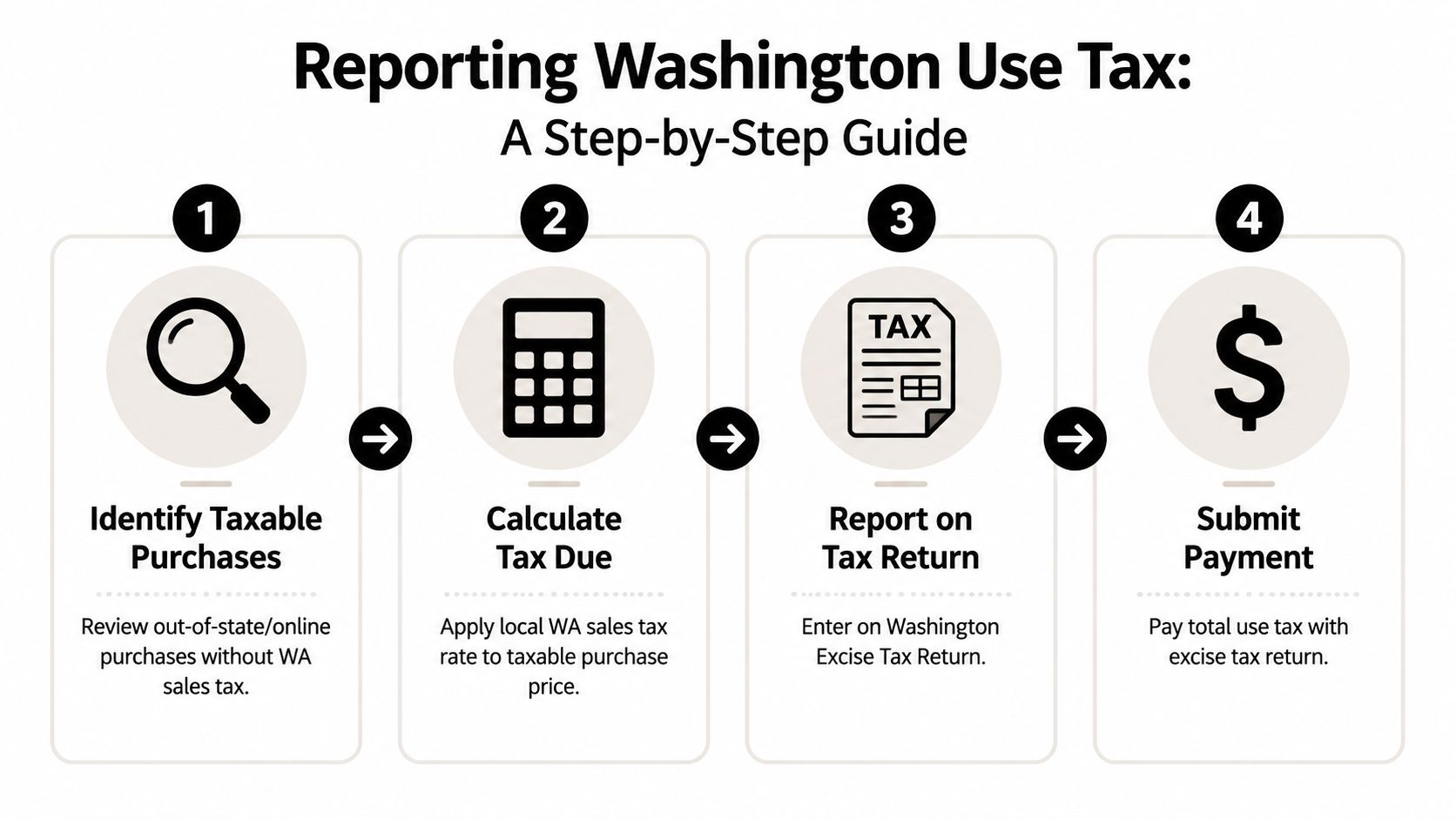
Sales tax and use tax are functionally the same kind of tax. The difference is who collects and remits it.
Sales tax is the widely recognized version. You buy something taxable, the seller charges tax at the checkout counter, and the seller sends that tax to the state. Use tax steps in when the checkout counter didn't do that job.
A simple way to think about it
Think of sales tax as the tax collected during the sale. Think of use tax as the tax the buyer self-assesses afterward when the taxable purchase ends up being used in Washington.
That distinction sounds small, but it changes who has to catch the error. With sales tax, the seller's system usually does the work. With use tax, your business has to detect the missing tax, calculate it, report it, and pay it.
Why this matters in day-to-day accounting
The practical problem isn't defining the taxes. It's identifying the transaction that slipped through.
Typical examples include:
- Online purchases from remote sellers: The invoice arrives without Washington tax.
- Out-of-state vendor relationships: A long-time supplier may not be collecting Washington tax on every transaction.
- Taxable service invoices: The service category may not have been coded correctly in your accounting system.
A lot of businesses need a simple review tool, not a complicated legal memo. If your team needs a quick way to calculate sales tax accurately, that can help with the math side once you've decided the purchase is taxable. It doesn't replace legal analysis on taxability, but it does reduce basic calculation errors.
Same tax base, different collection path
Here's the cleanest comparison:
| Issue | Sales tax | Use tax |
|---|---|---|
| Who usually charges it | Seller | Buyer self-assesses |
| When it appears | At purchase | After purchase if seller didn't collect |
| Why it exists | Tax retail transactions | Capture tax on taxable Washington use when sales tax wasn't paid |
| Common failure point | Seller setup error | Buyer never reviews untaxed purchases |
If the seller didn't collect tax, that doesn't answer the taxability question. It only tells you who may have to deal with it next.
That's why use tax washington compliance belongs inside the accounting workflow. It isn't a rare exception. It's part of how Washington ensures taxable transactions are taxed even when the seller doesn't handle collection.
Determining Your Use Tax Obligations as a Business
The businesses most likely to owe use tax are the ones that buy across state lines, buy online, or buy services from vendors with inconsistent Washington tax handling. That covers a large share of modern companies.

A sole proprietor buying a new computer for the business can trigger the same kind of issue as a larger company purchasing servers, office fixtures, cloud-related support, or marketing services. The scale changes. The analysis often doesn't.
Transactions that should trigger a review
Start with the purchases your team is most likely to overlook:
- Office and operational equipment: Furniture, tools, machines, electronics, and similar items bought from out-of-state sellers.
- Supplies and replacement items: Recurring orders often get less scrutiny than one-time capital purchases.
- Software and tech-related buys: Not every software-related invoice creates use tax, but many deserve a closer look.
- Service invoices with no tax charged: This category matters much more now than many businesses realize.
For individuals, there are also personal-use scenarios. But for most readers, the bigger issue is business purchasing volume. A few missed transactions can be manageable. A pattern repeated over several filing periods can become expensive fast.
Why nexus still matters
Businesses often hear the word nexus and assume it only affects the seller. That's too narrow.
Nexus is the legal connection that can require a seller to collect tax in a state. If a remote seller has Washington nexus, it may have a duty to collect Washington sales tax. If the seller doesn't have that duty, or doesn't fulfill it correctly, your business may still owe use tax on a taxable Washington transaction.
That means your use tax responsibility doesn't disappear just because the vendor is located elsewhere. The buyer's use in Washington is what keeps the issue alive.
A practical way to assign responsibility
Use this internal decision path:
- Did we buy something taxable?
- Was Washington tax charged correctly on the invoice?
- Will the item or service be used in Washington?
- If yes, has someone on our side reviewed whether use tax is due?
If your accounting team can't answer all four quickly, the process needs tightening.
Businesses usually don't have a use tax knowledge problem first. They have a workflow problem first.
That's why I tell clients to stop treating use tax as a year-end cleanup item. It belongs in purchasing and accounts payable.
What doesn't work
A few habits consistently fail:
- Trusting vendor defaults: Vendor tax settings are often inconsistent across products, entities, or service lines.
- Relying on account codes alone: “Software,” “marketing,” or “professional services” is often too broad to determine tax treatment.
- Reviewing only large invoices: Smaller untaxed purchases add up, and auditors often look for patterns, not just headline items.
The companies that handle use tax washington well usually assign one person or team to own the review. Not because every invoice needs a lawyer, but because scattered responsibility usually becomes no responsibility.
How to Calculate Report and Pay Washington Use Tax
A common failure point looks like this. An out-of-state vendor invoices your company for software, cloud support, or digital ad services, no Washington tax appears on the bill, and AP books the expense without another review. Months later, the spend is sitting in your records, but the use tax was never self-assessed. Under Washington's newer rules, especially after SB 5814 broadened the tax base for certain digital advertising and IT-related services, that omission can affect far more than equipment purchases.
Start with transaction detail, not the general ledger label
Use tax is calculated correctly only after the underlying purchase is classified correctly. “Software,” “marketing,” or “outside services” is not enough. The invoice, statement of work, and where the benefit is used in Washington matter.
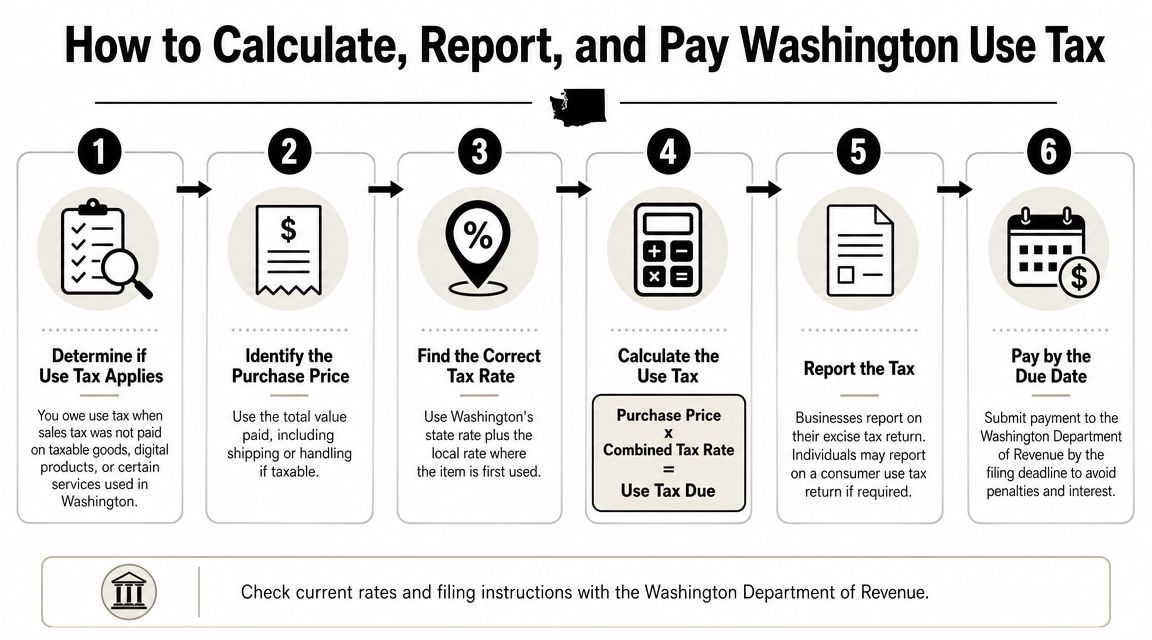
A workable monthly process usually includes five steps:
- Pull untaxed and partially taxed transactions from accounts payable, purchasing cards, expense reports, and fixed-asset records.
- Review the invoice description and contract terms to determine what was purchased.
- Identify the Washington use location for the property or service.
- Apply the correct combined state and local rate to the taxable amount.
- Report the tax through the Washington excise tax return and keep the support with the filing workpapers.
That process matters more now because service spend is harder to classify than tangible property. A server purchase is usually obvious. A bundled invoice for hosting, implementation, data processing, and digital ad management is not.
Rate selection turns on where the item or service is used
Washington use tax follows the place of use. Businesses often default to the vendor address, billing address, or headquarters location. Those shortcuts create filing errors.
The same sentence that gives the rate data should carry the source. Washington use tax guidance from the University of Washington notes that Washington imposes a 6.5% state sales tax, local taxes apply on top of that, combined rates vary by location, and as of 1/1/2026 the use tax rate was 10.3% in Bothell and Tacoma and 10.55% in Seattle, with rate changes generally taking effect each April 1.
Here is the practical point. If equipment is delivered for use in Seattle, use the Seattle rate. If software access or a taxable digital service is used by personnel assigned to Tacoma, that Tacoma use location may control instead. For businesses with remote employees or multi-site operations, sourcing is often where clean theory breaks down in practice.
A short example
A Washington company buys network equipment from an out-of-state seller. No Washington tax is charged. The equipment is installed in Seattle.
The company should calculate use tax using the Seattle rate applicable to that location of use and report it on its excise tax return. If the same purchase is shipped to a warehouse in Bothell for use there, the rate may change. The same sourcing question is now showing up with newer service categories too, which is why digital advertising and IT invoices should not be waved through as “just services.”
Reporting and payment controls
Most businesses report Washington use tax as part of their regular excise tax filing cycle. The return itself is only part of the job. True protection comes from the file behind it.
Keep:
- Invoices and contracts showing what was purchased
- Shipping, deployment, or user-location records showing where the item or service was used
- Internal taxability notes for judgment calls, especially for bundled service invoices
- A monthly reconciliation between untaxed purchases and amounts reported
If your team is tightening process controls, a list of 2026 tax software recommendations may help with workflow and review tools. For a broader method of organizing calculations and support, this step-by-step guide to calculating tax liability is a useful framework.
What usually works, and what usually breaks
| Approach | Usually works when | Usually fails when |
|---|---|---|
| Monthly AP review | One person or team owns untaxed purchase review and follows a written checklist | Review responsibility is split across AP, procurement, and operations with no final owner |
| Vendor tax coding | Codes are tested against actual invoices and updated as services change | Staff assume a vendor is always taxable or always exempt |
| Service invoice review | Contracts are checked for taxable digital advertising, software, data, and IT components | Bundled invoices are posted from summary descriptions alone |
| Year-end cleanup | Purchase volume is low and documentation is complete | Records are thin, locations changed, or SB 5814 expanded the tax treatment midstream |
For some businesses, a disciplined controller or bookkeeper can handle this internally. For others, the harder issue is not math but classification, especially where technology, digital advertising, and mixed service invoices are involved. Attorney Stephen A Weisberg handles tax controversy, audits, tax debt, and related state tax issues. That kind of help is usually most useful after missed filings, inconsistent sourcing, or unresolved audit questions appear in the records.
Navigating Use Tax Exemptions and New Digital Tax Rules
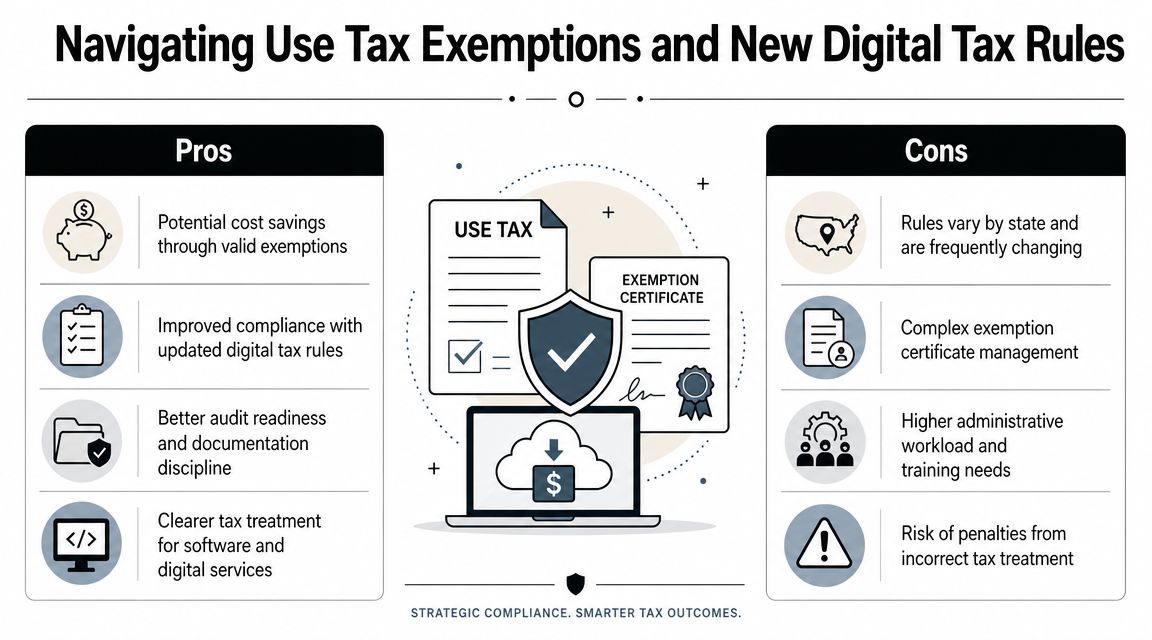
Older guidance frequently falls short. Many businesses know enough to ask whether a purchase is taxable, but they don't separate two very different questions.
First, is there a traditional exemption that removes the purchase from tax? Second, if the item is a service, has Washington newly brought that service into the sales and use tax base?
Traditional exemptions still matter
Businesses often focus so heavily on the compliance risk that they overpay. That's a mistake too.
Common examples that frequently require exemption analysis include:
- Purchases for resale: If the business is buying inventory or other qualifying items for resale, the tax treatment can differ from a business-use purchase.
- Certain manufacturing-related items: Depending on the transaction and the applicable rules, some machinery or production-related property may require separate analysis.
- Special-purpose transactions: Not every purchase used in the business is taxed the same way.
The practical point is simple. Don't assume “untaxed” means “noncompliant,” and don't assume “business use” means “taxable.” Exemptions are legitimate, but they need documentation.
The newer problem with digital and IT services
A major change arrived with Washington's SB 5814, effective October 1, 2025, which expanded the sales and use tax base to include digital advertising and certain high-tech and IT services, including online referrals, search engine marketing, web campaign planning, custom website development, IT technical support, and data processing, as discussed in this analysis of Washington SB 5814.
That change matters because many businesses historically treated these invoices as outside the normal sales and use tax framework. That assumption is no longer safe.
Why the distinction is so confusing
For years, a lot of use tax washington guidance centered on tangible goods. Buy equipment out of state, bring it into Washington, self-assess if tax wasn't collected. That framework is still important, but it's no longer enough.
Now the business may need to ask:
- Is this an out-of-state taxable acquisition that triggers ordinary use tax principles?
- Or is this a service that is itself newly taxable under the expanded Washington tax base?
- If the invoice bundles multiple items, which parts are taxable and which are not?
- If an exemption might apply, do we have the paperwork to support it?
Those are not bookkeeping trivia questions. They affect taxability, sourcing, documentation, and exposure.
Older use tax checklists can miss the new service categories entirely. That's where businesses get blindsided.
A better review method for modern businesses
If your company buys digital marketing, custom development, IT support, or data-related services, don't route those invoices through the same old “professional services” bucket and move on.
Instead:
- Review service descriptions line by line. Broad invoice labels hide taxable categories.
- Separate exempt logic from tax-base-expansion logic. They are different analyses.
- Escalate unclear contracts early. The best time to evaluate tax treatment is before filing, not during an audit.
- Track developments in state and local tax issues. This State and Local Taxes newsletter archive is one example of a resource businesses can monitor for changing guidance.
This is the area where practical compliance has changed the most. If your internal process still treats use tax as mainly a furniture-and-equipment issue, it's outdated.
Audit Risks and Penalties for Unpaid Washington Use Tax
Unpaid use tax is attractive to auditors because businesses often miss it in predictable ways. Auditors know where to look. Fixed asset additions, untaxed vendor invoices, expense accounts with recurring out-of-state purchases, and service payments with no tax charged are common starting points.
The risk isn't limited to a single missed invoice. Once an auditor sees that the company lacks a review process, the issue can spread across multiple periods and multiple transaction categories.
What makes use tax vulnerable in an audit
Use tax failures usually leave a paper trail. The invoice exists. The payment exists. The item or service was used in the business. What's missing is the tax treatment and supporting review.
That's why weak internal controls create more trouble than one bad judgment call. A business can defend a thoughtful position. It has a much harder time defending no process at all.
Internal controls that actually help
The businesses that reduce audit exposure usually do a few practical things consistently:
- Review untaxed purchases regularly: Don't wait until year-end.
- Train AP and bookkeeping staff: They need to recognize when missing sales tax is a tax question, not just a vendor billing detail.
- Keep supporting records together: Invoice, contract, exemption support, and taxability note should live in the same file path.
- Use spot checks on coded expenses: Especially categories like software, advertising, web services, and outside support.
- Escalate uncertain items: Ambiguous service contracts shouldn't be guessed through closing entries.
Compliance costs less when the records are still easy to find and the people involved still remember what was bought.
The practical consequence of waiting too long
Once a business discovers a backlog of unreviewed untaxed purchases, the cleanup gets harder fast. Records may be incomplete. Vendors may have changed. Staff may no longer be with the company. The legal issues are still manageable in many cases, but they become more expensive and time-consuming to sort through.
If you're trying to prepare your files before a government review, this article on how to prepare for an IRS audit offers a useful mindset on documentation, process discipline, and avoiding reactive mistakes. The agency is different, but the preparation habits carry over.
The basic point is simple. Use tax washington problems are usually easier to prevent than to defend after an audit notice arrives.
When to Contact a Tax Attorney for Use Tax Issues
A common trigger is simple. The controller reviews vendor spend, sees years of untaxed charges for software support, cloud tools, ad placement, or outsourced IT work, and realizes the issue is not just arithmetic. Under Washington's newer rules, especially the 2025 expansion under SB 5814, the hard question is often whether those digital advertising and technology services were taxable in the first place, how far the exposure reaches, and what to do before the state asks first.
Some use tax questions can stay with accounting. Others carry legal judgment, record-creation risk, and audit consequences.
When self-help becomes risky
Contact a tax attorney if any of these facts are on the table:
- You received a Washington audit notice and use tax is listed as an issue.
- An internal review found a backlog of untaxed purchases and no one is confident the sample is complete.
- Your business buys bundled digital advertising, data, SaaS, managed IT, or implementation services and the invoices do not clearly separate taxable and nontaxable items.
- You operate in several states and Washington's use tax position overlaps with sales tax collection, sourcing, or apportionment questions elsewhere.
- You are relying on an exemption but the contract, resale support, or customer documentation is thin.
- You need to correct past filings and want to avoid casual emails or narratives that make the later defense harder.
The last two years have made this more important for service-heavy businesses. Many companies were trained to look for missing tax on equipment and other tangible items. They did not build review procedures for digital ad buys, platform services, data access, or outside IT support. That gap is where I now see preventable Washington use tax exposure.
What legal help should do
Legal help should do more than confirm a rate. Counsel should identify the periods at risk, separate strong positions from weak ones, help preserve useful facts, and decide whether disclosure, amendment, or a narrower response makes sense. In a mixed digital-services file, that often means reading contracts and statements of work line by line, because tax treatment can turn on what was delivered, not what the vendor called it.
Timing matters.
Once a business starts gathering records after an audit notice, options tend to narrow. Before that point, there is usually more room to assess exposure carefully, fix filing gaps in an orderly way, and avoid overstating liability out of panic. If you are vetting counsel, this guide on how to find a good tax attorney is a useful starting point.
If you're dealing with Washington use tax questions, especially older untaxed purchases or newer digital and IT service issues under SB 5814, Attorney Stephen A Weisberg handles tax debt, audit, and tax problem matters involving businesses and individuals. A direct review can help determine whether the issue is a filing fix, a broader exposure problem, or a documentation problem that should be addressed before the state raises it.


