United States Tax Court Guide: Deadlines and Filing Steps
Learn how the United States Tax Court works, which deadlines apply, the case types it hears and when to hire a tax attorney.

In this article
- Deadlines and Filing Routes at a Glance
- Counting the days correctly
- Jurisdiction and the Types of Cases the Court Hears
- Why the Article I label matters
- The categories and what triggers each
- Small Tax Cases Versus Regular Cases
- Where the two tracks actually differ
- Three questions to answer before you elect
- How to File a Petition and Move the Case Forward
- The eight steps in order
- Trial, Evidence and Appeal Routes
- What the appeal route depends on
- Decide Whether to Hire a Tax Attorney Before You File
In fiscal year 2024, 19,093 cases filed at the United States Tax Court, or 91.2% of its entire docket, were deficiency cases (Tax Court FY 2026 congressional budget justification). That single line explains the court's pull on ordinary taxpayers. It's the one federal forum where a person can argue about a proposed income, estate, gift, or excise tax bill before paying it, and petitioners who walk through the door are typically there over exactly that kind of notice.
The date decides more of those cases than the merits do. The petition window is set by statute, the Court has no authority to extend it, and a petition that lands late lets the IRS assess the tax and start collecting while a solid defense dies in a drawer.
So the order of operations here is deliberate. Read the notice. Classify it. Calendar the deadline. Only then think about strategy, because access to this court is inexpensive and mostly self-directed, and the procedural risk that comes with it is neither.
Deadlines and Filing Routes at a Glance
A filing fee of $60 does not make a Tax Court petition low-risk. The deadline depends on the notice, and missing it can end the chance to challenge the IRS determination in this court. Start by identifying the notice and its mailing date.
| Case route | Trigger notice | Petition deadline | Filing fee |
|---|---|---|---|
| Income, estate, gift or excise deficiency | Notice of deficiency | 90 days after mailing, or 150 days if the notice is addressed outside the United States | $60 |
| Collection due process | Notice of determination | 30 days after mailing | $60 |
| Innocent spouse review | Notice of determination | 90 days after mailing | $60 |
| Partnership adjustment proceedings | Notice of final partnership administrative adjustment | 90 days after mailing | $60 |
For a deficiency case, the petition generally lets a taxpayer challenge the proposed tax before paying it. The deadline is 90 days from the notice's mailing date, extended to 150 days if the notice is addressed outside the United States (Tax Court guidance for petitioners starting a case). The Court cannot extend this statutory window. A petition filed after it closes may leave the IRS free to assess and collect the tax without the Tax Court hearing the challenge.
Counting the days correctly
Use the mailing date printed on the notice, not the day it arrives or is opened. Check how weekends and District of Columbia legal holidays affect the final day, and keep proof of filing, such as an electronic acceptance or a mailing receipt.
Write down the deadline as soon as you read the notice. Then set a calendar reminder well before it arrives.
Before considering the merits, take three steps:
- Identify the notice by its title. A notice of deficiency, a collection due process notice of determination, and a final partnership administrative adjustment each point to a different filing route.
- Calendar the applicable deadline. Use the notice's mailing date and allow time to prepare and file the petition.
- Check which IRS office sent it. The office and notice type help identify the route that applies.
For a deficiency notice, the IRS notice of deficiency and what it means can help you understand the figures before deciding how to respond.
Jurisdiction and the Types of Cases the Court Hears
The United States Tax Court is a federal court, but it isn't an Article III court, and that distinction shapes everything it can and can't do. Congress created its predecessor, the Board of Tax Appeals, through the Revenue Act of 1924 (Public Law 68-176) as an independent agency in the executive branch. The Revenue Act of 1942 renamed it the Tax Court of the United States, and the Tax Reform Act of 1969 (Public Law 91-172) established the modern court as an Article I court (Indiana courts summary of the 2025 Tax Court annual report).
The docket splits into distinct categories, and each one has its own trigger document and its own procedural personality.

Why the Article I label matters
Because the court's authority comes from congressional statute rather than Article III of the Constitution, its jurisdiction is limited to the federal tax matters Congress specifically assigned. You can't bring a contract dispute here, or a state refund claim, or a general grievance about how an audit felt. What you can do is unusual and valuable: deficiency jurisdiction lets an eligible taxpayer litigate an IRS determination before paying, unlike ordinary refund litigation, which typically requires payment first. Judges decide the facts; there's no jury to persuade.
The categories and what triggers each
A sole proprietor whose Schedule C expense deductions were disallowed after an examination gets a notice of deficiency and lands in the largest category. A restaurant owner whose bank account was levied after the IRS issued a notice of determination lands in collection due process, where the issues are narrower and the review is different. A spouse who signed a joint return without knowing about unreported income asks for innocent spouse relief. An LLC or partnership with an entity-level adjustment works through partnership proceedings, and the entity-level mechanics can decide who is even a party, as a Tax Court decision on limited partner status illustrates.
| Case category | Typical trigger |
|---|---|
| Deficiency (income, estate, gift, certain excise) | Notice of deficiency |
| Collection due process | Notice of determination |
| Innocent-spouse relief | Notice of determination |
| Partnership proceedings | Notice of final partnership administrative adjustment |
| Interest abatement | Notice of determination |
| Whistleblower award review | Notice of determination |
| Passport certification | Certification notice |
The smaller categories still matter to the people inside them. Interest abatement, whistleblower award review, passport certification, certain declaratory judgments, and worker-classification disputes all run on their own statutes and their own timing.
The category decides more than the paperwork. It decides the record you'll build, who carries the burden, whether a settlement is realistic, and where an appeal goes. Only a small share of disputes ends in a published opinion, which is why the administrative record, the stipulations, and the settlement posture usually matter more than the brief you imagine writing.
Small Tax Cases Versus Regular Cases
A small-case election can make Tax Court procedures less formal, but it does not make the case risk-free. The petition deadline remains the first concern: assess the IRS notice and the filing window before weighing which track fits. The choice affects how the dispute is handled and whether the decision can guide future cases.
Where the two tracks actually differ
A small tax case is available when the amount in dispute is $50,000 or less, and the taxpayer elects this procedure when filing the petition. The process is simplified, formal evidence rules are relaxed, and the decision does not serve as precedent. That trade-off may suit a dispute that can be presented clearly without a full formal record.
A regular case follows the full Tax Court Rules of Practice and Procedure. Formal evidence rules apply, and the case may involve more extensive briefing. Written opinions can serve as precedent, and regular cases carry appeal rights that small cases do not.
| Feature | Small tax case | Regular case |
|---|---|---|
| Amount in dispute | $50,000 or less | Above $50,000 or no election |
| Procedure | Simplified and less formal | Full Tax Court Rules of Practice and Procedure |
| Evidence | Relaxed formal evidence rules | Formal evidence rules apply |
| Precedential effect | Decision does not serve as precedent | Written opinions can serve as precedent |
Three questions to answer before you elect
Start with the shape of the dispute. How many years are involved, and how closely are the issues connected? A single year with one clearly defined issue may be easier to present under the small-case procedure. Several years with overlapping theories may require a more extensive record.
Next, consider whether the legal issue could matter beyond your own case. If the dispute turns on a question that affects other taxpayers or involves several related business entities, a regular case's potential precedential effect may be worth considering. Finally, ask whether you can organize the evidence into a clear record. Relaxed rules do not eliminate the need to support your position with documentation.
The election is difficult to undo once the case is underway. Compare the procedural demands and likely professional time for each track, but do not let that choice distract from the more immediate risk: missing the petition deadline.
How to File a Petition and Move the Case Forward
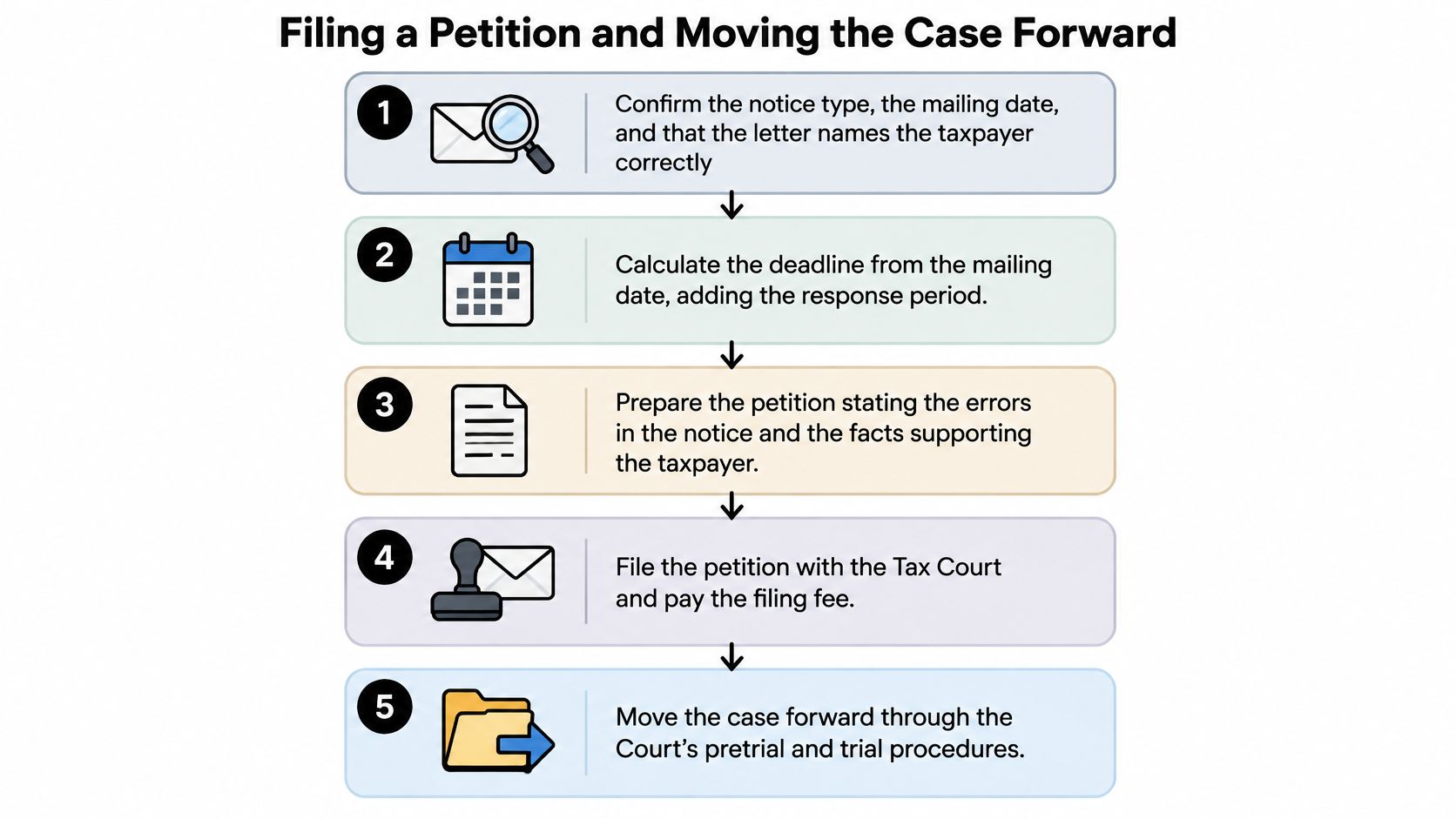
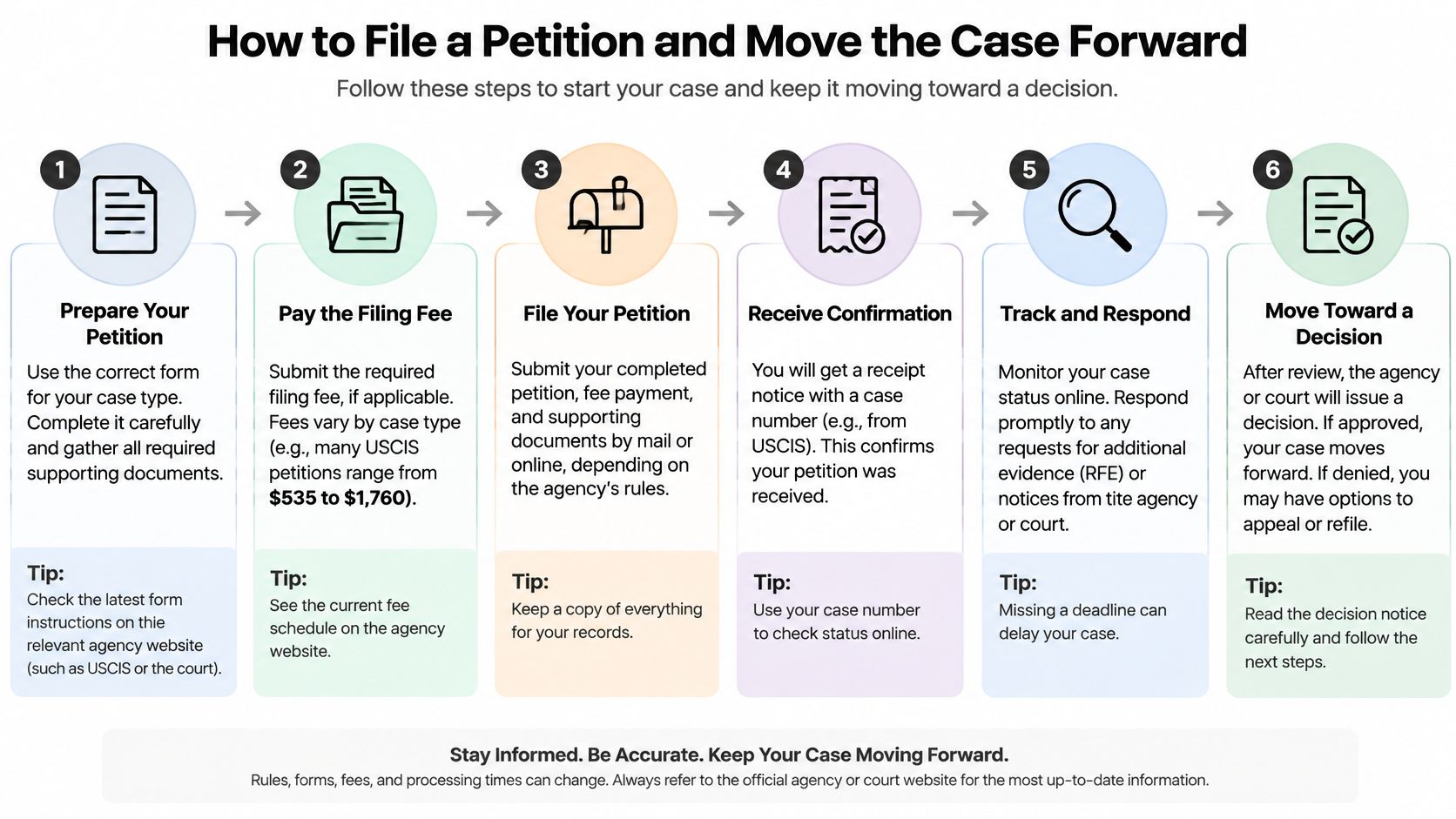
The petition itself is a short document. What surrounds it, the notice check, the deadline math, the track election, and the fee, is where cases are decided before anyone argues a fact. The sequence below is the one to walk through on every file.
The eight steps in order
- Confirm the notice. Check the title, the mailing date, and that the letter names the right taxpayer and identification number. A petition identifying the wrong party creates a problem that can eat the entire statutory window.
- Do the date math. Start from the mailing date, add the response period for that notice type, apply the weekend and District of Columbia holiday rules to the final day, and convert everything to Eastern Time if you'll file electronically.
- Choose the track. Elect the small-case procedure where the amount in dispute qualifies, or accept regular procedures where the issue needs a full record and a written opinion. This is a strategy decision, not clerical housekeeping, because it changes discovery and briefing.
- File and pay. Submit through DAWSON or by mail with the $60 filing fee, and note that electronic petitions must generally be received by 11:59 p.m. Eastern Time on the final filing date (Tax Court guidance for taxpayers). Keep the acceptance record.
- Read the answer. The IRS files an answer stating the positions it intends to defend. That document tells you which adjustments are in play and which may fall away.
- Exchange documents and stipulate. Stipulations of fact remove undisputed items from the trial and cut both cost and risk. Build the exhibit list early, because late documents invite objections you don't need.
- Attend the session or settle. Many cases resolve through negotiation before the calendar date, and the Court expects the parties to have talked.
- Receive the decision. The decision becomes the document that fixes the liability and starts any appeal clock.
What filing does not do: collection of a deficiency is ordinarily postponed while the case is pending, but not every IRS collection action stops automatically. Confirm whether a levy or a lien is running on a separate track and address it directly.
That last point is where self-represented filers get hurt. A petition answers the deficiency. It does not necessarily stop a levy notice, and it certainly doesn't substitute for negotiating a collection alternative.
Deadline discipline is a case management problem as much as a legal one. When several matters run at once, IamVera.AI on litigation control is worth reading for how firms keep filings, dates, and document sets from slipping.
Trial, Evidence and Appeal Routes
Trial in the Tax Court is scheduled rather than requested. The Court sets a session in a designated city, publishes the calendar, and the case moves on that date, which is why a file that isn't trial-ready six weeks out usually settles on the IRS's terms.
The burden generally sits with the taxpayer, so the evidence has to do the arguing. Bring original records rather than summaries: bank statements and deposit slips, invoices, payroll registers, general ledgers, loan documents, and the people who can explain how each entry was recorded. Stipulations of fact then remove everything both sides agree on, which shortens the session and lowers the cost of getting there.
Say a contractor is facing payroll-tax assessments after the IRS treated payments to several workers as wages. The defense usually turns on documentation: bank deposits showing which transfers were draws rather than compensation, 1099s, written agreements, and testimony about how the crew was supervised. None of that can be assembled in the corridor outside the courtroom.
| Case track | Appeal route | Deadline |
|---|---|---|
| Regular case | Court of appeals for the circuit where the taxpayer lived or had its principal place of business | Generally 90 days after the decision is entered |
| Small tax case | Not appealable; the decision is final | Not applicable |
| Collection due process case | Follows the track it was assigned to, so a regular-case decision goes to the same circuit court | Generally 90 days after the decision is entered |
What the appeal route depends on
A regular-case decision can be appealed to the court of appeals for the circuit where the taxpayer lived or had its principal place of business, and the notice of appeal is generally due within 90 days after the decision is entered. Small-case decisions are final and carry no appeal, which is the trade taxpayers accept for simplified procedure.
Play the endgame early: if a small-case loss cannot be appealed, the record has to be complete before the session, not reconstructed afterward.
Three steps keep the ending clean. Prepare and index the evidence before the session, decide in advance whether the case could support an appeal and which track gets you there, and calendar the appeal deadline the day the decision is entered. The mechanics of challenging an adverse outcome are set out in this guide to how to appeal an IRS decision.
Decide Whether to Hire a Tax Attorney Before You File
A petition deadline can be the greatest risk in a Tax Court case. Self-representation is common: the Court reported that approximately 80% of filers represented themselves in fiscal year 2024 and approximately 78% in fiscal year 2025 (Tax Court reports and statistics). Filing without a lawyer is allowed, but it does not reduce the need to prove facts, preserve arguments, respond to IRS motions, or address a separate collection matter.
Handling a straightforward case yourself may be reasonable when it involves one notice, one tax year, a modest amount, clear records, and no parallel collection activity. More complex circumstances call for careful review before you file:
- Payroll tax and trust fund exposure. A trust fund recovery penalty can affect individual owners and officers.
- Entity-level issues. S corporations, partnerships, and multi-member LLCs can raise questions about who the taxpayer is and where an adjustment belongs.
- Multiple tax years. Each year may involve a separate notice, deadline, and set of evidence.
- Parallel collection activity. A levy or lien may require a separate strategy alongside the deficiency dispute.
- Bankruptcy or divorce. Either can affect the timing and responsibility for a tax liability.
Bankruptcy does not clear every tax debt. More recent tax debts and trust fund liabilities, such as payroll taxes, may remain.
A Tax Court petition also does not resolve every IRS account problem or replace collection negotiations. A tax attorney can represent clients in U.S. Tax Court and federal court. Consider getting legal help if you owe more than $5,000, face a criminal investigation or an IRS revenue officer, have complex finances or foreign accounts, risk losing valuable assets, or have potential liability over $1,000,000. For more guidance on when to hire a tax attorney, consider how the notice, collection activity, and financial exposure fit together.
If your deadline is within 30 days, check the notice's mailing date, gather the notice and your recent tax returns, and get qualified advice promptly. The notice date should guide the first conversation.
Tax Attorney Stephen A Weisberg represents individuals, businesses, and business owners in IRS and state tax matters, including audits, Tax Court petitions, penalties, and tax debt. The practice begins with a paid Tax Debt Analysis to review the situation and identify possible next steps. If you have a notice with a deadline, bring it to the conversation. Visit Tax Attorney Stephen A Weisberg to discuss the deadline and your options.


