Trust Fund Recovery Penalty Interview: What to Expect
Learn how the IRS trust fund recovery penalty interview works, what Form 4180 asks, your rights, and how to prepare before you answer.

In this article
- What the Penalty Is and Who Can Be Assessed
- Personal liability isn't limited to owners
- What the Interview Covers in Form 4180
- Explain what each permission let you do
- Identify decisions and dates
- How Responsibility and Willfulness Are Judged
- Responsibility concerns practical power
- Build a period-by-period authority matrix
- Prepare Records Before the Revenue Officer Calls
- Gather evidence before drafting explanations
- Handle missing records honestly
- How the Interview Runs, Step by Step
- Keep the conversation tied to documents
- Check the record before closing the file
- Your Rights, Appeal Deadlines and Costly Mistakes
- Correct facts without losing the appeal window
- When to Bring in a Tax Attorney Before You Answer
- What representation changes
You've received a call from an IRS revenue officer about unpaid payroll taxes. You expected questions about the business's balance, but the officer wants to discuss your job duties, bank access, and who decided which bills got paid. You may be wondering why your personal role matters when the company owes the money.
A trust fund recovery penalty interview is an evidence-gathering meeting about possible personal liability. Preparation doesn't mean memorizing defensive answers. It means separating what you controlled, what you knew, and when those facts changed, then finding the records that support your account.
What the Penalty Is and Who Can Be Assessed
Say you own a small company and receive an interview request concerning Form 4180. Your first reaction might be that the company's payroll provider handled the taxes, so the request must be routine. Before answering, you need to understand what the IRS is investigating.
Under Internal Revenue Code section 6672, the potential Trust Fund Recovery Penalty equals 100% of the unpaid trust-fund tax, plus applicable interest, according to the IRS explanation of the Trust Fund Recovery Penalty. This isn't a reduced percentage charged for paying late. It can make an individual personally liable for the unpaid amounts withheld from employees.
Those amounts include federal income-tax withholding and the employees' shares of Social Security and Medicare taxes. Think of the employer as temporarily holding someone else's money for delivery to the Treasury, rather than receiving extra working capital.

Personal liability isn't limited to owners
Potentially affected people include officers, partners, sole proprietors, employees, trustees, agents, and payroll-service providers with relevant authority. A corporation or LLC doesn't prevent this separate personal assessment.
- Your position matters through your duties. The IRS examines financial authority, not whether your name appears on ownership documents.
- Your personal assets may be exposed. The investigation concerns liability separate from the employer's debt.
- Bankruptcy isn't a dependable escape route. Many tax debts aren't discharged, particularly recent tax debts and trust-fund liabilities such as payroll taxes.
Our explanation of what the Trust Fund Recovery Penalty is provides additional context for that distinction.
For ongoing business management, Nexist's resource on cash flow planning for tax bills can help you think about reserving tax money rather than treating it as available cash. It isn't guidance on defending a US penalty assessment.
An interview request isn't a finding of liability. It means the IRS wants evidence about responsibility and willfulness. Your task is to provide an accurate account, not assume the outcome has already been decided.
What the Interview Covers in Form 4180
Interview factual areas and the evidence to bring
| Factual area | What the revenue officer checks | Evidence to bring |
|---|---|---|
| Check-signing authority | Whether you could sign checks and for which periods | Signature cards and bank resolutions |
| Bank account access | Who could view and move funds | Bank portal permissions and account statements |
| Payroll duties | Who ran payroll, approved it, or filed returns | Payroll registers and vendor agreements |
| Hiring and firing power | Whether you could hire, fire, or set pay | Board minutes, offer letters, and organizational charts |
| Payment decisions | Who chose which creditors were paid and when | Payment logs, emails, and canceled checks |
| Knowledge of unpaid taxes | When you learned payroll taxes were unpaid | Tax notices, accountant correspondence, and EFTPS confirmations |
| Dates of control | When your authority began and ended | Resignation letters and role-change records |
Form 4180, titled “Report of Interview with Individual Relative to Trust Fund Recovery Penalty or Personal Liability for Excise Taxes,” records facts about your authority and conduct; the IRS employment-tax guidance explains that the investigation addresses whether a person was responsible and willful.
Explain what each permission let you do
Check-signing authority needs context. Being able to sign a check doesn't describe who selected the payee, approved the amount, or could override a payment decision. Bring records showing those distinctions rather than answering only from your job description.
Bank access also needs a practical explanation. Viewing transactions, uploading a payment file, and releasing funds are different activities. Identify which functions your login allowed and whether another person's approval was necessary.
Payroll work can be similarly divided. A clerk might enter hours, a manager approve payroll, and an owner decide whether tax deposits are funded. Describe the actual handoffs, including who could change instructions to the payroll provider.
Hiring authority helps explain your broader management role. Distinguish recommending an applicant from approving an offer, setting compensation, or dismissing staff.
Identify decisions and dates
For payment decisions, the key question is what happened when there wasn't enough cash for everything. Emails directing payment to a supplier may tell a different story from a general statement that the accounting department handled bills.
For knowledge, identify what you learned and how you learned it. An accountant's warning, a tax notice, and a failed deposit confirmation may establish different points in the chronology. Don't merge them into a vague recollection that everyone knew things were tight.
Responsibility is period-specific. Someone may have authority during certain quarters but not others, and several people may be assessed for the same unpaid trust-fund amount. Officers may also interview employees who aren't responsible but understand the payment process.
A short interview doesn't establish that you've been cleared. The significance lies in the facts recorded, not the meeting's length.
Before the interview, list every quarter in which you had relevant control and attach supporting records. Flag missing documents instead of filling the gaps with assumptions.
How Responsibility and Willfulness Are Judged
Consider a hypothetical bookkeeper, Dana. She signed payroll checks during the early part of the year, but management removed her bank access in July. She later received an email about unpaid payroll taxes, although she could no longer release payments.
That sequence raises separate questions. What authority did Dana have before access ended? When did she learn about the delinquency? Did she direct payments after learning about it, and what documents show when her control stopped?
Responsibility concerns practical power
The IRS Internal Revenue Manual instructions for TFRP investigations direct officers to examine both responsibility and willfulness, including practical financial authority and intentional disregard or reckless indifference toward unpaid trust taxes.
Responsibility isn't determined solely by job title or ownership percentage. The relevant facts include control over payroll, bank accounts, hiring, tax decisions, and payment instructions. Dana's signature matters, but it needs to be evaluated alongside evidence of who authorized the transactions.
Willfulness doesn't require an evil motive. Knowing, or having reason to know, that trust taxes are unpaid and intentionally disregarding the obligation can satisfy the standard. Directing vendor payments while those taxes remain unpaid can support that conclusion, even if the person hoped to keep the business operating.

Build a period-by-period authority matrix
Create a worksheet organized by tax quarter. For each period, identify:
- Signatory rights and bank permissions, including restrictions and approval requirements.
- Payroll access and duties, separating data entry from funding decisions.
- Notices and accountant conversations, showing what you learned and when.
- Payment instructions, identifying who selected creditors and approved disbursements.
- Changes in control, supported by access-removal records, resignation letters, or management correspondence.
For Dana, the matrix should distinguish the period when she could sign checks from the period after her access ended. A resignation letter alone may not resolve the question if other records suggest she continued directing payments.
Knowledge and authority aren't interchangeable. Receiving a warning doesn't by itself establish that Dana could remedy the delinquency. Equally, losing access later doesn't erase her earlier conduct.
Use the matrix to test each proposed answer against a document. If your recollection and the records disagree, identify the conflict before the interview rather than selecting whichever version sounds more favorable.
Prepare Records Before the Revenue Officer Calls
Organize your preparation file around the authority matrix, with separate folders for each disputed period. Keep original documents intact and use copies for annotations.
The IRS overview of trust-fund recovery liability provides context for distinguishing employee trust-fund amounts from the employer's non-trust portion. Keep those components separate when reviewing the business's balance. An abbreviated interview may be used for a simple structure or an apparently sole responsible party, but it still addresses the core questions.
Gather evidence before drafting explanations
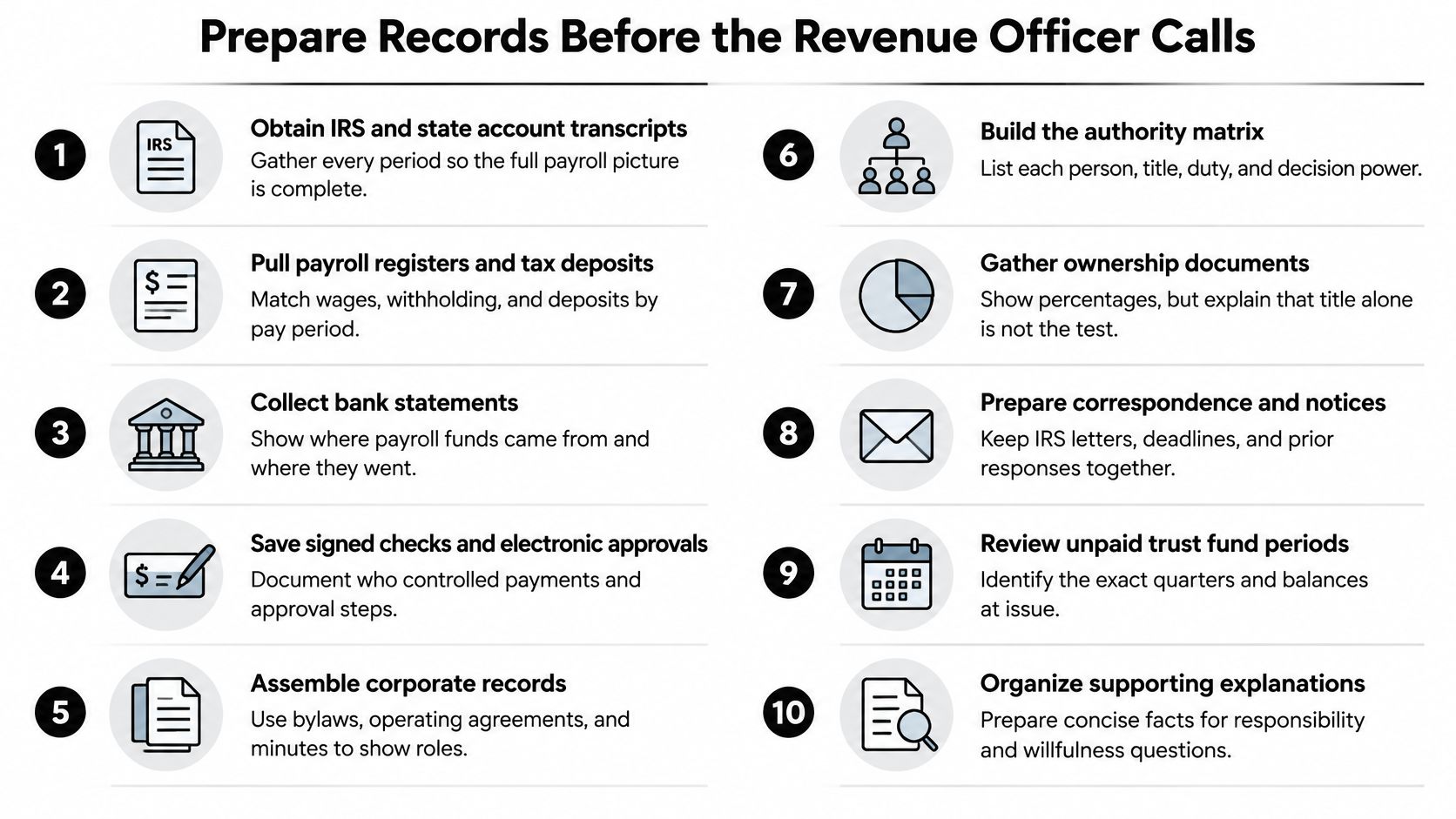
Obtain IRS and state account transcripts. We obtain these to review the debt's history, including penalties, payments, and how long remains before applicable collection periods expire. Match the accounts to the periods under investigation.
Gather payroll registers and EFTPS confirmations. Compare withholding records with deposit confirmations. A payroll calculation and an actual tax deposit aren't the same event.
Pull canceled checks and bank signature cards. Include account statements so individual transactions can be understood in context.
Collect corporate resolutions and appointment records. These help identify formal authority and any written limits on it.
Export accounting-system permission logs. Preserve records showing who could enter, approve, change, or release payroll and other payments.
Assemble tax notices and accountant correspondence. Keep envelopes, attachments, and email dates where available. They may help establish when information reached you.
Search for payment instructions. Preserve messages about creditor priorities, delayed deposits, funding shortages, and warnings. Keep complete email threads rather than isolated excerpts.
Gather resignation and role-change records. Look for evidence of implementation, such as bank access removal, not just an announced departure.
Complete the authority matrix. Mark each gap or contradiction between your recollection and the documents. Give unresolved issues their own follow-up list.
Decide who attends and who speaks. Coordinate with your representative and preserve records in their current form. Don't alter source files to make the account appear cleaner.
Handle missing records honestly
If the business has closed or a former employer controls the documents, identify the missing material and request it through appropriate channels. Record what you requested and whether you received it.
Practical rule: A clearly identified gap is better than a reconstructed document presented as an original.
Never create or backdate evidence. If you prepare a current summary from older records, label it as a current summary and identify the records you used.
How the Interview Runs, Step by Step
The revenue officer is gathering facts, not just helping you arrange payment. Understanding the role of an IRS revenue officer helps you keep the interview focused on the requested issues rather than treating it as an informal business conversation.
Keep the conversation tied to documents
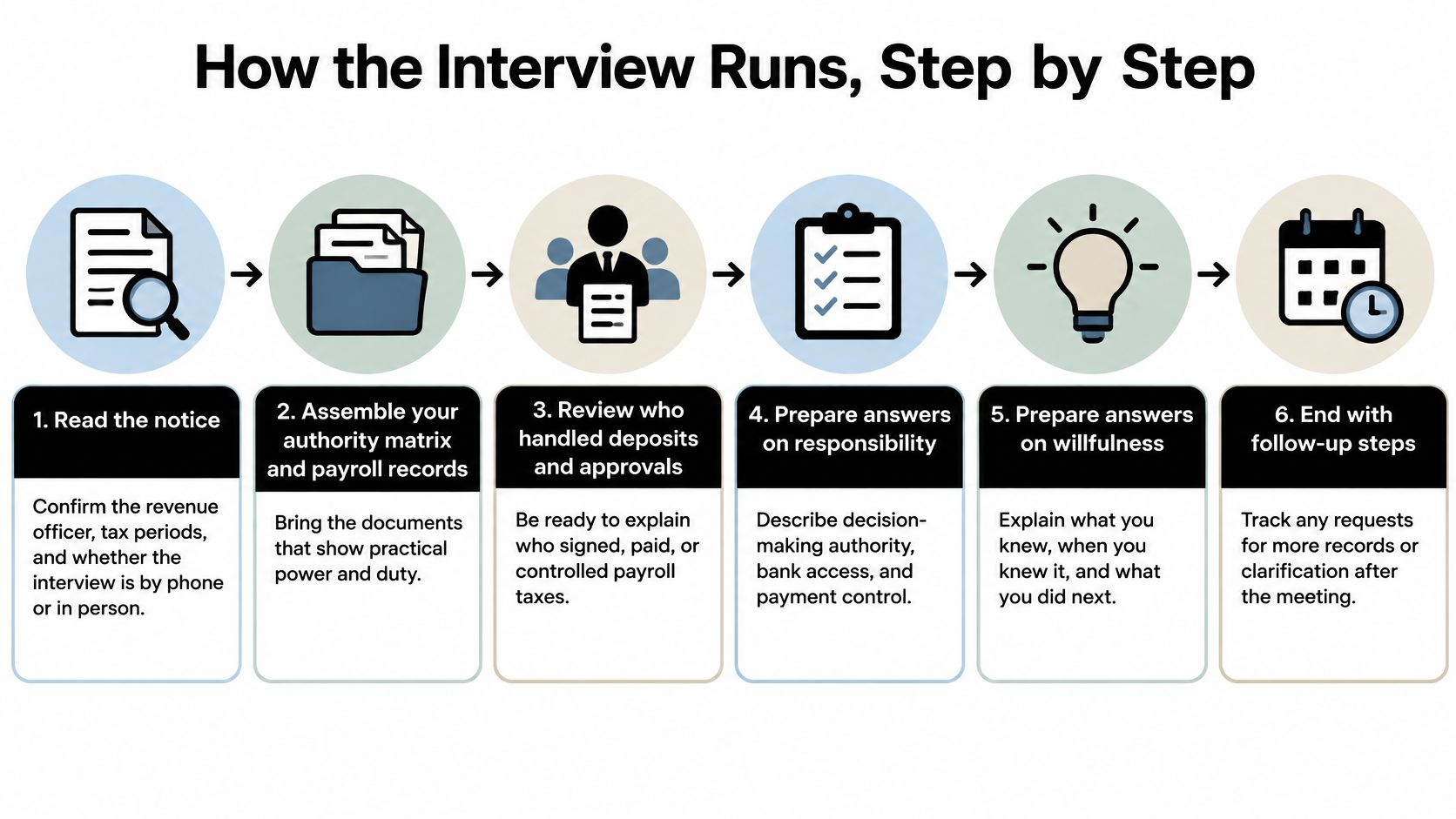
Read the notice and confirm the scope. Confirm the officer's identity, the tax periods, and whether the interview will occur by phone or in person. A common mistake is preparing only for the business's current problems when the request concerns an earlier management period.
Put your matrix and records within reach. Use an indexed file so you can locate bank permissions, notices, and payment approvals without searching through unrelated paperwork. Don't assume you'll remember a role-change date accurately once questioning begins.
Answer chronologically. Explain your role before describing what changed, and distinguish formal authority from tasks you performed. Avoid compressing several different jobs into a broad statement that you handled finances.
Identify uncertainty instead of guessing. If you can't recall when a conversation occurred, say you need to check the correspondence. Offer a concrete follow-up rather than substituting a confident estimate for a documented date.
Ask to see documents being discussed. If the officer refers to a check, notice, or email you haven't reviewed, ask for a copy so you can address it accurately. Don't adopt someone else's summary of a document as your own knowledge.
Review the written Form 4180 before signing. Check dates, titles, descriptions of authority, and any language suggesting you selected creditors or controlled tax deposits. A description can be incomplete even when individual words are technically true.
Confirm follow-up responsibilities. Request the interview record where available, identify outstanding documents, and keep a written list of what you agreed to provide. Track any proposed-assessment notice separately rather than assuming ongoing correspondence preserves your challenge rights.
Check the record before closing the file
A useful interview record identifies which duties you performed, their limits, the periods involved, and the supporting documents. It also distinguishes facts you know personally from information you learned later.
For readers who also operate in the UK, Stewart Accounting Services' HMRC enquiry guidance for business owners offers a separate perspective on organizing responses to a tax enquiry. HMRC procedures don't govern this IRS process, so don't transfer UK deadlines or procedural expectations to your TFRP interview.
The objective isn't to make every answer short. It's to make every answer accurate enough that someone reviewing the file later can understand what happened.
Your Rights, Appeal Deadlines and Costly Mistakes
Appeal deadlines and protest requirements
The following windows and conditions are described in the IRS guidance addressing TFRP proceedings and Appeals: generally 60 days to appeal, 75 days for an address outside the United States, and a formal written protest when a tax period or combined periods exceed $25,000.
| Situation | Deadline or requirement | What it means for you |
|---|---|---|
| Proposed assessment, US address | Standard appeal window stated above | Calendar it from the notice date |
| Proposed assessment, address outside the US | Extended appeal window stated above | Use the window applicable to your address |
| Tax period or combined periods exceeding the threshold above | Formal written protest required | Prepare supporting records with the protest |
| Mediation | May be available only after the interview is completed and requested documents are supplied | It isn't a substitute for the interview |
The choice isn't full agreement or complete refusal. Refusing to engage can leave important facts unexplained, while casually accepting the officer's characterization can make your later position harder to support.
Form 4180 is a Collection document, not a form to be completed during an Appeals conference. Appeals evaluates your position independently, making the quality of the existing record important.
Correct facts without losing the appeal window
Completing the interview form doesn't by itself concede liability. Nevertheless, your statements become part of the record that later reviewers consider.
Avoid these mistakes:
- Signing without reviewing. Read the completed answers, not just the questions.
- Accepting broad descriptions. A statement that you were in charge may omit meaningful restrictions.
- Making sweeping admissions about knowledge. Explain what you learned rather than assuming awareness of every delinquency.
- Missing the notice deadline. A pending correction request doesn't extend the appeal period.
- Treating a title as decisive. Match each disputed conclusion to evidence of actual duties.
If an answer is inaccurate, incomplete, or broader than your personal knowledge, correct it in writing promptly. Identify the statement, explain the correction, attach supporting records, and keep proof of what you sent to the revenue officer.
Correcting the interview record and filing a timely appeal are separate tasks. Don't let attention to one cause you to miss the other.
In a written protest, pair each contested fact with its supporting document and explain why it matters to the proposed assessment. Our discussion of trust-fund penalty abatement and challenges can help you frame questions about the appropriate route for your circumstances.
When to Bring in a Tax Attorney Before You Answer
Personal exposure, rather than the size of the balance alone, is the decision point. Once a revenue officer requests a trust fund recovery penalty interview, your financial role is under examination, and every answer you give becomes part of the record an appeals officer may later read. Casual phrasing recorded in that interview is difficult to walk back, so consider representation before you give substantive answers.
Some circumstances raise the stakes further: a possible criminal investigation, a complicated financial structure, foreign accounts, or valuable assets at risk of seizure. Trust fund liabilities also follow you after the business closes, because payroll taxes are among the tax debts that often survive bankruptcy. Each of these situations calls for coordinated decisions about documents, communications, and the precise wording of your answers.
What representation changes
An attorney can evaluate your records before the interview and distinguish a factual explanation from a broad legal conclusion. Our guide to when to hire a tax attorney explains other circumstances in which legal representation may be appropriate.
- Immediate collection concerns get identified. We review IRS transcripts and flag urgent threats, including levies, garnishments, and liens.
- The interview and protest stay consistent. Your account of duties and dates should match across submissions, with corrections explained rather than concealed.
- Communications have a clear point of contact. With appropriate authorization, counsel can speak with the revenue officer on your behalf and organize requested responses.
Bring the IRS notice, the interview request, and your authority matrix to the initial discussion, and include unfavorable documents alongside favorable ones. Counsel needs the full record to evaluate your position responsibly.
Missing records are a reason to call sooner, not later. A marked gap, an unresolved date, or conflicting instructions is exactly what an attorney should see before you answer.
Tax Attorney Stephen A Weisberg represents clients with business tax problems before the IRS and can help you prepare before a trust fund recovery penalty interview. Visit Tax Attorney Stephen A Weisberg to request a Tax Debt Resolution Plan, and bring your IRS notice, interview request, and authority matrix so we can evaluate your personal exposure and next steps.


