A Guide to Trust Fund Recovery Penalties
Facing Trust Fund Recovery Penalties? Our guide explains who is liable, how the IRS process works, and your defense options. Get clarity and expert help now.

In this article
- What Exactly Is The IRS Trust Fund Recovery Penalty?
- The Two Pillars of a TFRP Assessment
- Key Elements of a Trust Fund Recovery Penalty
- Identifying Who the IRS Considers Responsible
- The "Functional Test": It's About Power, Not Titles
- Real-World Scenarios of Responsibility
- What Does "Willful" Really Mean to the IRS?
- The Bar for Proving Willful Action Is Incredibly Low
- "Reckless Disregard" Is Just as Bad
- Navigating the IRS Assessment Process
- The Critical Form 4180 Interview
- From Proposed Penalty to Formal Assessment
- The Procedural Timeline: A Step-by-Step View
- TFRP Procedural Timeline
- IRS Collection Actions: Liens and Levies
- Building a Defense Against a TFRP Assessment
- Challenging the “Responsible Person” Label
- Proving Your Actions Were Not Willful
- The Unbreakable Rule: Documentation Is Everything
- Exploring Your Resolution Options
- Navigating Settlements and Payment Plans
- The TFRP and Bankruptcy
- Common Questions About the Trust Fund Recovery Penalty
- Can They Really Come After Me if I'm Not an Owner?
- What if I Was Just Following Orders?
- Can I Get Rid of This in Bankruptcy?
When a business falls behind on payroll taxes, the IRS has a powerful tool to collect the debt, and it doesn't stop with the company. It's called the Trust Fund Recovery Penalty (TFRP), and it can be a devastating blow to an individual's personal finances.
This penalty targets the "trust fund" portion of payroll taxes—the money an employer withholds from an employee's paycheck for federal income tax, Social Security, and Medicare. In the eyes of the IRS, this money never belonged to the business in the first place. The company is simply holding it in trust for the government.
What Exactly Is The IRS Trust Fund Recovery Penalty?

Think of the business as a temporary caretaker for these funds. The moment an employee is paid, that withheld money legally belongs to the U.S. Treasury. Problems arise when a struggling business uses that trust fund cash to cover other operating expenses—paying rent, keeping the lights on, or making payroll for the next period.
This is where the TFRP becomes the IRS's go-to enforcement mechanism. It's not a typical penalty calculated as a percentage. Instead, the IRS can hold specific individuals personally liable for 100% of the unpaid amount. The TFRP essentially pierces the corporate veil, allowing the government to bypass the business and pursue the personal assets of those it deems responsible.
Proper payroll management is the first line of defense against this situation. Working with professional payroll bookkeeping services can help ensure you stay compliant and avoid this pitfall entirely.
The Two Pillars of a TFRP Assessment
For the IRS to come after an individual personally with a TFRP, they have to prove two things: Responsibility and Willfulness. If you're facing a potential assessment, understanding these two concepts is your first step toward building a defense.
Responsibility: Who is a "responsible person"? This is a much broader category than most people assume. It's not just for owners or CEOs. Anyone with significant authority over company finances—someone who can sign checks or decide which bills get paid and which don't—can be deemed a responsible person.
Willfulness: This doesn't mean you acted with evil intent. In the IRS's view, willfulness is simply making a conscious, voluntary choice to pay other creditors (suppliers, landlords, even employees' net wages) instead of the government, all while knowing the payroll taxes were due.
To give you a clearer picture, here's a quick breakdown of these core ideas.
Key Elements of a Trust Fund Recovery Penalty
| Concept | Explanation | Example |
|---|---|---|
| Trust Fund Taxes | The portion of payroll taxes withheld from an employee's wages, including federal income, Social Security, and Medicare taxes. | A company withholds $5,000 from employee paychecks for taxes in a quarter. |
| Responsible Person | An individual with significant control over business finances, who has the authority to decide which bills are paid. | A company's bookkeeper with check-signing authority, even if they aren't an owner. |
| Willful Failure | A conscious, intentional act to pay other creditors instead of remitting the trust fund taxes to the IRS. | The owner uses the withheld $5,000 to pay a critical supplier to keep the business running. |
| Penalty Amount | The penalty is 100% of the unpaid trust fund taxes, transferred directly to the responsible person as a personal liability. | The IRS assesses the owner for the full $5,000, which they must pay from personal assets. |
Understanding these elements is crucial because the stakes are incredibly high. The TFRP is a personal assessment, meaning it follows you even if the business shuts its doors. The IRS can place liens on your home, levy your personal bank accounts, and take other aggressive collection actions to get what it's owed.
The Trust Fund Recovery Penalty (TFRP) is a powerful enforcement tool used by the U.S. Internal Revenue Service (IRS) to recoup unpaid payroll taxes, specifically the amounts withheld from employees’ wages. The penalty itself equals 100% of the unpaid trust fund taxes plus interest—essentially doubling the amount owed by transferring liability directly to individuals involved. Learn more about how the TFRP is applied in our guide about trust fund tax liability.
This guide will walk you through every aspect of the TFRP, from how the IRS identifies responsible parties to the strategies you can use to defend yourself against an assessment.
Identifying Who the IRS Considers Responsible
When a business fails to remit its payroll taxes, the IRS doesn't just go after the company. They start looking for a real person to hold accountable, and that's where the Trust Fund Recovery Penalty (TFRP) comes into play. Their first step is to pinpoint a “responsible person.”
This is where many people get into trouble. They assume that because they aren't the owner or the CEO, they're in the clear. Nothing could be further from the truth. The IRS casts a very wide net, and your job title means almost nothing.
The "Functional Test": It's About Power, Not Titles
The IRS couldn't care less if your title was President or Office Manager. They use what’s known as a functional test, which cuts straight through the corporate structure to see who actually had control over the company's money.
It’s not about who owned the business; it’s about who had the power and authority to decide which bills got paid and which didn’t. Think of it this way: if you had the ability to direct funds, you're on the IRS's radar.
This functional approach means liability can snake its way surprisingly deep into an organization. The core question is always the same: who had significant say in how the company's money was spent?
You don't need to have had the final say on every single payment. If you were a key player in the financial decision-making process, you could be deemed responsible. The IRS looks for specific clues to figure out who held this power.
Here are some of the most common red flags the IRS looks for:
- Officers and Directors: This one is pretty straightforward. If you're on the board or hold a corporate officer title, you have a fiduciary duty that the IRS takes very seriously.
- Check-Signing Authority: Can you sign company checks? This is one of the biggest indicators of responsibility. Even if you need a co-signer, having your name on that signature line puts you squarely in the spotlight.
- Managing Daily Finances: People like bookkeepers, controllers, or office managers who handle the day-to-day financial grind—preparing checks, managing accounts payable—are often found to be responsible persons.
- Hiring and Firing Authority: The power to hire and fire staff, especially other financial employees, demonstrates a significant level of control over the business's operations.
- Directing Payments: If you were the one telling the bookkeeper to pay a vendor but to hold off on the IRS, you were exercising precisely the kind of financial control the IRS is looking for.
Courts have consistently backed the IRS on this, expanding the definition of a 'responsible person' over the years. They're looking for anyone with meaningful influence over where the money went. It's also critical to remember this penalty is only for the trust fund portion of the taxes—the money withheld from employee paychecks. If you had the power to pay the IRS and chose to pay other creditors instead, you have a problem. For more on this, Hawkins Ash CPAs provides a great breakdown of the expanded definition of responsibility.
Real-World Scenarios of Responsibility
Let's make this more concrete. Imagine a hands-off business owner who leaves all the financial details to a trusted office manager. That manager has check-signing authority and decides which bills to pay each week. In this case, the owner might skate by, but the office manager is almost certainly going to be hit with the TFRP.
A huge mistake people make is thinking the IRS will only go after the most responsible person. That’s not how it works. The IRS can, and frequently does, assess the TFRP against multiple people for the very same tax debt. They can collect the full amount from any one person, leaving it up to that individual to try and get the money back from the other responsible parties.
Consider a construction company owner who's always out on job sites. He leaves the finances to his office manager, who has the authority to sign checks up to $10,000. Cash flow gets tight, and the owner says, "Just make sure the crew gets paid and our suppliers are happy."
Following those instructions, the manager prioritizes paying the net payroll and the material vendors, letting the IRS payroll tax deposits slide. In this all-too-common scenario, the IRS will likely deem both the owner (for giving the order) and the office manager (for cutting the checks) to be responsible persons.
This is why it is absolutely vital to understand your role and authority within a company. The IRS always looks at substance over form. To see how these situations are analyzed in practice, you can find detailed discussions and case examples of TFRP personal liability that show just how seriously the IRS takes this.
What Does "Willful" Really Mean to the IRS?
Once the IRS pins you as a "responsible person," they only need to clear one more hurdle to hit you with the Trust Fund Recovery Penalty: proving your failure to pay was willful. This is where things get tricky, because the IRS's definition of "willful" is much, much broader than how we use the word in everyday conversation.
In the world of the TFRP, willfulness doesn't mean you had some evil plan to defraud the government. There's no need for malicious intent. The IRS just has to show that you made a voluntary and conscious choice to pay other bills before you paid them.
Imagine you're at a crossroads with your company's bank account. One road leads to paying the IRS the payroll taxes you owe. The other road leads to paying your landlord, your most important supplier, or even your employees' take-home pay. If you knew those taxes were due and you deliberately chose that second road, you've just met the IRS's standard for willfulness.
The Bar for Proving Willful Action Is Incredibly Low
It's almost shockingly simple. If you knew the trust fund taxes hadn't been paid and you used company funds to pay anyone else, your actions are considered willful. This includes paying for absolutely essential business expenses.
- Rent to keep the doors open.
- Utility bills to keep the lights on.
- Inventory from the supplier you can't live without.
- Even the net wages for your employees.
That last one is a gut punch for many business owners. You think you're doing the right thing by making sure your team gets paid, right? But in the eyes of the IRS, paying net wages while the withheld tax portion sits unpaid is a crystal-clear willful act. You consciously chose to pay one creditor (your employee) instead of another (the government).
A willful act is simply a matter of choice. When a responsible person knows trust fund taxes are owed and consciously disregards the duty to pay them—using the money for anything else—they have acted willfully.
"Reckless Disregard" Is Just as Bad
The definition of willfulness gets even wider. You don't even need to have actual knowledge that the taxes were unpaid. The IRS can also establish willfulness by showing you acted with reckless disregard.
What does that mean? It means you should have known something was wrong but failed to look into it. If the warning signs were all there—bounced checks, vendors putting you on C.O.D., your bookkeeper raising red flags—and you chose to bury your head in the sand, the IRS will argue that you willfully ignored your duty. You can't plead ignorance if you deliberately avoided finding out the truth.
Courts have consistently backed the IRS on this broad interpretation, giving them a powerful tool for collection. In one federal appellate case, an officer with check-signing authority was hit with a staggering $680,472 penalty. He didn't own stock or have hiring power, but he knew about the tax debt and kept paying other bills anyway. You can find more details on the risks and consequences of the TFRP on hawkinsash.cpa.
Navigating the IRS Assessment Process
Understanding how the IRS pursues a Trust Fund Recovery Penalty can feel overwhelming, but it's not random. The agency follows a very specific, methodical playbook. Knowing these steps is the first and most critical part of defending yourself.
The process kicks off with an investigation, long before you get a formal bill. A Revenue Officer is assigned to your case, and their sole focus is to identify who qualifies as a "responsible person" and who acted "willfully." This isn't just about looking at corporate records; it involves interviews and digging for evidence to build a case against specific people.
The Critical Form 4180 Interview
The heart of the IRS investigation is the Form 4180, Report of Interview with Individual Relative to Trust Fund Recovery Penalty. This is not a friendly chat. It’s a formal, recorded interview where the Revenue Officer asks very direct questions to pin down your authority, your role, and what you knew about the unpaid payroll taxes.
Every answer you give is recorded under penalty of perjury and becomes a foundational piece of their case. Expect questions like:
- What were your official duties?
- Did you have the authority to sign checks?
- Who had the power to hire and fire employees?
- Who ultimately decided which bills got paid and which didn't?
- When did you first realize the payroll taxes weren't being paid?
This interview is a make-or-break moment. Your words can either hand the IRS the evidence they need or become the bedrock of your defense. It's incredibly risky to go into this meeting without experienced legal counsel by your side.
From Proposed Penalty to Formal Assessment
Once the investigation wraps up, if the Revenue Officer believes they have a case against you, the next shoe drops. You'll receive a Letter 1153, which is often called the "60-day letter."
This letter officially proposes assessing the Trust Fund Recovery Penalty against you personally. It will detail the tax periods in question and the exact dollar amount they believe you owe. Most importantly, it notifies you of your right to appeal their decision within 60 days (or 75 days if the letter is sent to an address outside the U.S.). This is your one real chance to challenge the IRS's findings before the penalty becomes a legally enforceable debt.
If you miss that appeal deadline, the game changes. The IRS will formally assess the penalty, turning a proposal into a real debt. From that point on, they can begin aggressive collection actions against your personal assets.
The logic the IRS uses to prove willfulness—the key to their whole case—is surprisingly simple. It’s not about evil intent; it’s about choice.
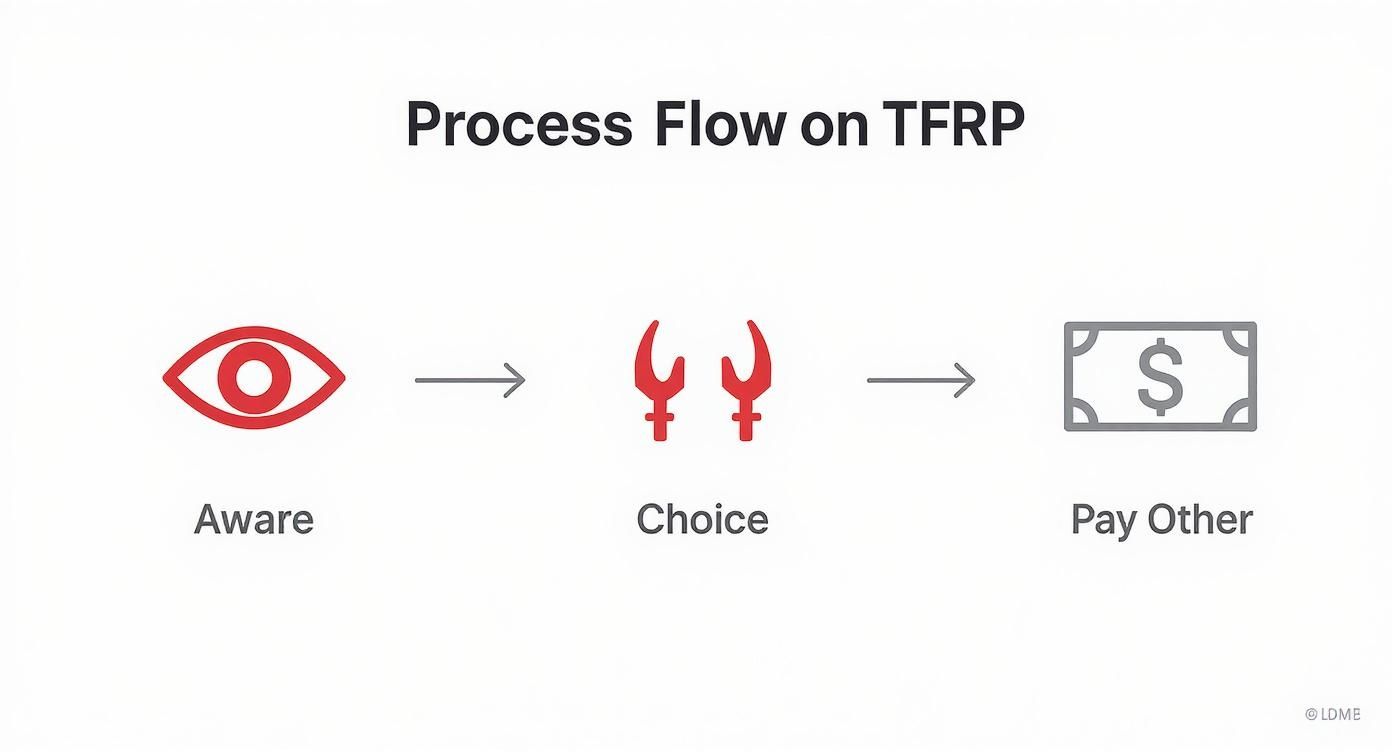
As the diagram shows, it boils down to three things: you were aware of the tax debt, you had the authority (the choice) to pay it, and you paid other creditors instead. That’s it.
The Procedural Timeline: A Step-by-Step View
To give you a clearer picture, this table breaks down the standard progression of a TFRP case from the IRS's initial contact to the final collection efforts.
TFRP Procedural Timeline
| IRS Action | Typical Document/Form | Taxpayer's Response/Rights |
|---|---|---|
| Initial Investigation | Contact Letter, Information Document Request (IDR) | Engage counsel; begin gathering defensive evidence. |
| Responsibility Interview | Form 4180 | Attend with legal representation; answer questions carefully. |
| Proposed Assessment | Letter 1153 (60-Day Letter) | File a formal, timely protest to the IRS Appeals Office. This is crucial. |
| Formal Assessment | Notice and Demand for Payment (CP90/CP504) | The debt is now legally established; collection begins. |
| Collection Enforcement | Notice of Federal Tax Lien; Notice of Intent to Levy | Limited time to request a Collection Due Process (CDP) hearing. |
| Asset Seizure | Levy on Bank Accounts/Wages; Seizure of Property | Last chance to negotiate a resolution like an Offer in Compromise. |
This timeline underscores how critical it is to act at the first sign of trouble. Once the process moves to collection, your options become much more limited.
IRS Collection Actions: Liens and Levies
Once the penalty is assessed, the IRS treats it just like any other personal tax liability. They will unleash their powerful collection tools to get their money.
It usually starts with a Notice of Federal Tax Lien. This is a public document that stakes a claim on all your property—your house, your car, your future assets. A tax lien craters your credit score and makes it nearly impossible to sell property or get a loan.
After the lien comes the levy. A levy isn't a claim; it's the actual seizure of your property. The IRS can:
- Drain your personal bank accounts.
- Garnish a significant portion of your wages.
- Seize and sell your personal property, like vehicles or valuables.
Throughout this process, efficiently and securely distributing information to regulatory authorities is an important part of compliance. Trying to face down these powerful collection tactics alone is a massive risk you shouldn’t take.
Building a Defense Against a TFRP Assessment

Getting that proposed TFRP assessment letter from the IRS feels like a punch to the gut. It's easy to think it's a done deal, but it’s not. In reality, this is the opening bell for a process where you have every right to fight back with a strong, evidence-based defense.
The key is to systematically poke holes in the IRS’s case. Every TFRP assessment stands on two legs: responsibility and willfulness. Your job is to knock one—or both—of them out from under their argument.
This isn't about simply telling your side of the story; it's about proving it with cold, hard facts. You need to show either that you weren't truly a "responsible person" with the authority they claim you had, or that your actions weren't "willful."
Challenging the “Responsible Person” Label
The IRS tends to cast a wide net when identifying who to blame. Your title might have put you on their radar, but a title doesn't always equal power. The best way to challenge this part of their case is to prove you lacked the actual authority to decide which bills got paid and when.
Think about it this way: could you really call the shots? A solid defense often involves showing specific ways your hands were tied.
- No Real Check-Signing Power: Maybe you could sign checks, but only up to a certain amount, or perhaps you needed a co-signer who had the final say. If you couldn't independently write a check to the IRS, that's a huge point in your favor.
- Just Following Orders: Were you explicitly told by a boss or owner not to pay the payroll taxes? If you can show you were acting under a direct order from a superior—and that disobeying would have cost you your job—you can argue that you weren't the one making the call.
- You Left Before the Problem Started: Your responsibility doesn't last forever. If you resigned or were terminated before the tax periods in question, you can't be held liable for debts that accrued after you were gone. The timeline is everything.
Proving Your Actions Were Not Willful
Okay, let's say the IRS proves you were a "responsible person." You're not out of options. They still have to prove you acted willfully. This is often where a strong defense can gain the most traction.
To attack the "willfulness" claim, you need to show you either didn't know about the unpaid taxes or that you did everything in your limited power to get them paid. For instance, if you were kept in the dark by a business partner who was secretly diverting funds, you weren't willfully avoiding the tax payments. The key is proving you had no reason to be suspicious.
Don't underestimate the power of a well-argued appeal. Between 2019 and 2024, while the IRS collected significant amounts through the TFRP program, they also granted major reductions to taxpayers who effectively challenged their assessments. In one powerful example, a company officer facing a multi-million dollar penalty had it completely wiped out after an appeal. You can read the details in this IRS Taxpayer Advocate success story.
The Unbreakable Rule: Documentation Is Everything
When you're up against the IRS, your word alone means very little. They live and die by the paper trail, and so should you. You need to build a fortress of documentation to back up every claim you make.
Here's the kind of evidence that can turn a case around:
- Corporate Bylaws and Meeting Minutes: These official documents can clearly outline who really had financial authority.
- Emails and Memos: Nothing beats a written record. An email from the CEO saying, "Pay our biggest supplier, the IRS will have to wait," is a game-changer.
- Bank Signature Cards: These show exactly who was authorized to move money out of the company's accounts.
- Resignation Letters: A dated letter proves precisely when your connection to the company—and its financial decisions—ended.
Gathering this evidence is your first and most important step. As you build your case, it’s also crucial to understand the path to IRS penalty abatement based on reasonable cause, which can be another vital part of your overall strategy.
Exploring Your Resolution Options
Getting hit with a Trust Fund Recovery Penalty assessment is a serious blow. It can feel like you're personally on the hook for a debt that should have stayed with the business. But even at this stage, you're not out of options. The key is to shift gears from defending against the assessment to actively resolving the debt.
This is where things get tricky. While the IRS has standard programs for handling tax debt, the TFRP isn't standard-issue debt. The IRS considers this money that was held "in trust" for the government, and they take its recovery very seriously. You need to be realistic about what they will—and won't—accept.
Navigating Settlements and Payment Plans
For most people in this situation, the goal is simple: find a way to pay this off without going bankrupt. The two most common routes are an Offer in Compromise (OIC) or an Installment Agreement.
Offer in Compromise (OIC): This is the "settle for less than you owe" option. To even have a chance with an OIC for a TFRP, you have to prove, with extensive financial documentation, that there's no way you can pay the full penalty, either now or in the foreseeable future. The IRS puts these offers under a microscope because, in their eyes, this was never the business's money to begin with.
Partial Payment Installment Agreement (PPIA): If a settlement isn't in the cards, a PPIA might be the next best thing. This is a payment plan, but one where the monthly payments are low enough that the debt won't be fully paid before the ten-year collection statute runs out. Like an OIC, this requires laying your financial life bare to prove what you can truly afford to pay each month.
Getting the IRS to agree to one of these for a TFRP requires a skilled approach. If you're thinking about a settlement, you can check out our complete guide to securing an IRS Offer in Compromise for a deeper dive.
The TFRP and Bankruptcy
Many people mistakenly believe that filing for bankruptcy will make a TFRP disappear. It won't.
Trust fund recovery penalties are almost always non-dischargeable in a Chapter 7 bankruptcy. The law gives this type of debt the same priority as recent income taxes or penalties for fraud, meaning it survives the bankruptcy process.
A Chapter 13 bankruptcy might let you organize the debt into a 3-to-5-year repayment plan, but it doesn't eliminate it. This is why you absolutely need a tax professional who understands the intersection of tax resolution and bankruptcy law before making any moves.
Here's a critical point many people miss: The IRS doesn't have to exhaust its collection efforts against the business before coming after you. Once they assess the penalty against you, you are fair game. You might have the legal right to sue other responsible parties for their share, but the IRS can collect 100% of the penalty from you alone.
This strategy puts enormous pressure on individuals to pay up. The IRS can, and often will, pursue multiple people at the same time for the same debt, making a proactive and coordinated strategy essential. You can find more about the IRS's collection powers on doeren.com and the aggressive legal framework they operate under.
Common Questions About the Trust Fund Recovery Penalty
When you first hear about the Trust Fund Recovery Penalty, it's natural for a lot of questions to pop into your head. It's a confusing and frankly, scary, corner of the tax code. Let's break down some of the most common concerns we hear from clients.
Can They Really Come After Me if I'm Not an Owner?
Yes, absolutely. This is one of the biggest misconceptions about the TFRP. The IRS isn’t looking at your job title or how many shares you own; they’re looking at who had real-world control over the company's money.
They call this a functional test. Did you have the power to decide who got paid? Could you sign checks? Did you direct the bookkeeper? If the answer is yes, the IRS sees you as a responsible person.
- Check-signing authority, even if you needed a co-signer.
- The power to choose which bills to pay (like paying a vendor instead of the IRS).
- Directing how funds were used.
I’ve seen cases where a controller or even a high-level bookkeeper was held personally liable because they had this kind of authority. It's not about ownership—it's about control.
Here's the bottom line: The Trust Fund Recovery Penalty attaches to you personally. This isn't a business debt. The IRS can go after your personal bank accounts, your house, and your wages to collect, long after the business is gone.
What if I Was Just Following Orders?
This argument, sometimes called the "Nuremberg defense," is an incredibly steep uphill battle. It's not impossible to win, but the bar is set extremely high.
To even have a chance, you need rock-solid proof that someone with higher authority explicitly ordered you not to pay the payroll taxes. You also have to show that you had a legitimate fear of being fired if you disobeyed that order. If you had the ability to make the payment on your own but didn't, the IRS will almost always find that you acted willfully, no matter what someone told you to do.
Can I Get Rid of This in Bankruptcy?
In most cases, no. The Trust Fund Recovery Penalty is considered a priority tax debt, which means it is typically not dischargeable in a Chapter 7 bankruptcy. It survives the process.
A Chapter 13 bankruptcy might help you organize the debt into a more manageable payment plan over three to five years, but it won't wipe the slate clean. The underlying liability will still be there. It's crucial to talk to a tax attorney who is well-versed in both tax resolution and bankruptcy law before going down that path.
Facing a proposed Trust Fund Recovery Penalty demands a swift and calculated response. At The W Tax Group, Attorney Stephen A. Weisberg knows the ins and outs of these challenging cases. Before you go up against the IRS alone, start with a FREE Tax Debt Analysis to map out your options and build a solid defense.


