A Complete Guide to the IRS Trust Fund Penalty
Facing an IRS trust fund penalty? Our guide explains what the TFRP is, who's considered a responsible person, and how to defend your personal assets.
In this article
- Demystifying the IRS Trust Fund Penalty
- Piercing the Corporate Veil
- Who Is at Risk?
- Who the IRS Considers a Responsible Person
- The True Meaning of Responsibility
- Common Roles and Indicators of a 'Responsible Person'
- Understanding the Willfulness Standard
- Joint and Several Liability
- Navigating the IRS Investigation and Assessment Process
- The Critical Form 4180 Interview
- Receiving the Letter 1153
- How to Defend Against a Trust Fund Penalty
- Arguing You Are Not a Responsible Person
- Proving Your Actions Were Not Willful
- Navigating the Formal Appeals Process
- Why an Experienced Tax Attorney Is Critical
- Strategic Defense and Expert Representation
- Finding a Resolution and Protecting Your Future
- Common Questions About the Trust Fund Penalty
- Can I Be on the Hook If I'm Not an Owner?
- Does Business Bankruptcy Protect Me Personally?
- What If I Was Just Following Orders?
- Can More Than One Person Be Held Responsible?
The Trust Fund Recovery Penalty, or TFRP, is one of the most aggressive collection tools in the IRS arsenal. It’s designed to do one thing: hold individuals personally responsible for a business’s unpaid payroll taxes.
This isn’t about family trusts or estate planning. It’s all about the taxes a business withholds from an employee's paycheck on behalf of the government—specifically, income tax, Social Security, and Medicare. When a business fails to hand that money over, the IRS can come after the people in charge for 100% of the unpaid amount.
Demystifying the IRS Trust Fund Penalty

Think of it this way: when a business runs payroll, it's essentially acting as a temporary caretaker for its employees' tax money. Those funds never truly belong to the business. They are held "in trust" for the U.S. government.
The problem starts when a company in financial distress uses that withheld money to pay other bills—rent, suppliers, or even making the next payroll. In the eyes of the IRS, that’s not just a failure to pay a debt; it’s spending money that wasn't yours to begin with.
To combat this, the IRS created the Trust Fund Recovery Penalty. This isn't just another bill for the business. It’s a direct, personal assessment against the individuals who had the power to decide where the money went.
Piercing the Corporate Veil
This is where the TFRP gets truly serious. The usual liability protections of an LLC or S Corporation mean nothing here. The IRS can completely bypass that corporate shield and go straight for your personal assets to cover the business's tax debt.
This is a concept known as "piercing the corporate veil," and it’s what makes the trust fund penalty so dangerous. The IRS can legally seize your:
- Personal bank accounts
- Home and other real estate holdings
- Wages and future income streams
- Other valuable personal property
Essentially, your personal financial life is on the line for a business-level mistake. This penalty is a civil one, but it's calculated to be a punishing 100% of the unpaid trust fund taxes. It’s the government’s way of ensuring that the people who controlled the money are held accountable for its disappearance.
Who Is at Risk?
The IRS casts a surprisingly wide net. This isn't just about the CEO or the business owner. Anyone who had significant control over the company's finances could be a target.
These penalties are directly tied to a company's payroll obligations, so understanding the mechanics of FICA taxes is the first line of defense. For a deeper dive, you might find value in our guide on navigating FICA taxes and demystifying your payroll obligations.
Next, we’ll explore exactly how the IRS determines who a "responsible person" is and what it means to have "willfully" failed to pay. The definitions are broader than most people think.
Who the IRS Considers a Responsible Person
When a business fails to pay its payroll taxes, the Trust Fund Recovery Penalty brings the problem directly to the doorstep of the individuals in charge. The entire case the IRS builds against someone hinges on two key ideas: being a responsible person and acting with willfulness. These aren't just legal buzzwords; they have very specific, and often surprisingly broad, meanings.
Forget about job titles. The IRS couldn't care less if you're the CEO, the owner, or an office manager. They cut straight to the chase, focusing entirely on who really had control over the company's money. It all comes down to a single question: who had the power to decide which bills got paid and which didn't?
If you had the status, duty, and authority to make sure those trust fund taxes were paid, you're on the IRS's radar. It's a test of substance, not of the title on your business card.
The True Meaning of Responsibility
To figure out who held the financial reins, IRS agents dig into the day-to-day operations of the business. They're looking for practical control, not just theoretical authority. I've seen cases where an office manager with check-signing authority was found just as liable as the company president.
Some common red flags that point to a "responsible person" include the power to:
- Sign checks for the business without needing a co-signer.
- Hire and fire employees, especially people in financial positions.
- Direct payments to vendors and other creditors.
- Control the company’s bank accounts or manage the payroll process.
- Negotiate with creditors or lenders on the company's behalf.
The term "responsible person" is incredibly broad. It covers anyone who was, in reality, in a position to control how the company's money was spent. The IRS is searching for who had "significant, rather than exclusive, control," which means several people can be found liable for the very same tax debt.
This flowchart paints a stark picture of the simple decision that can lead to devastating personal liability.
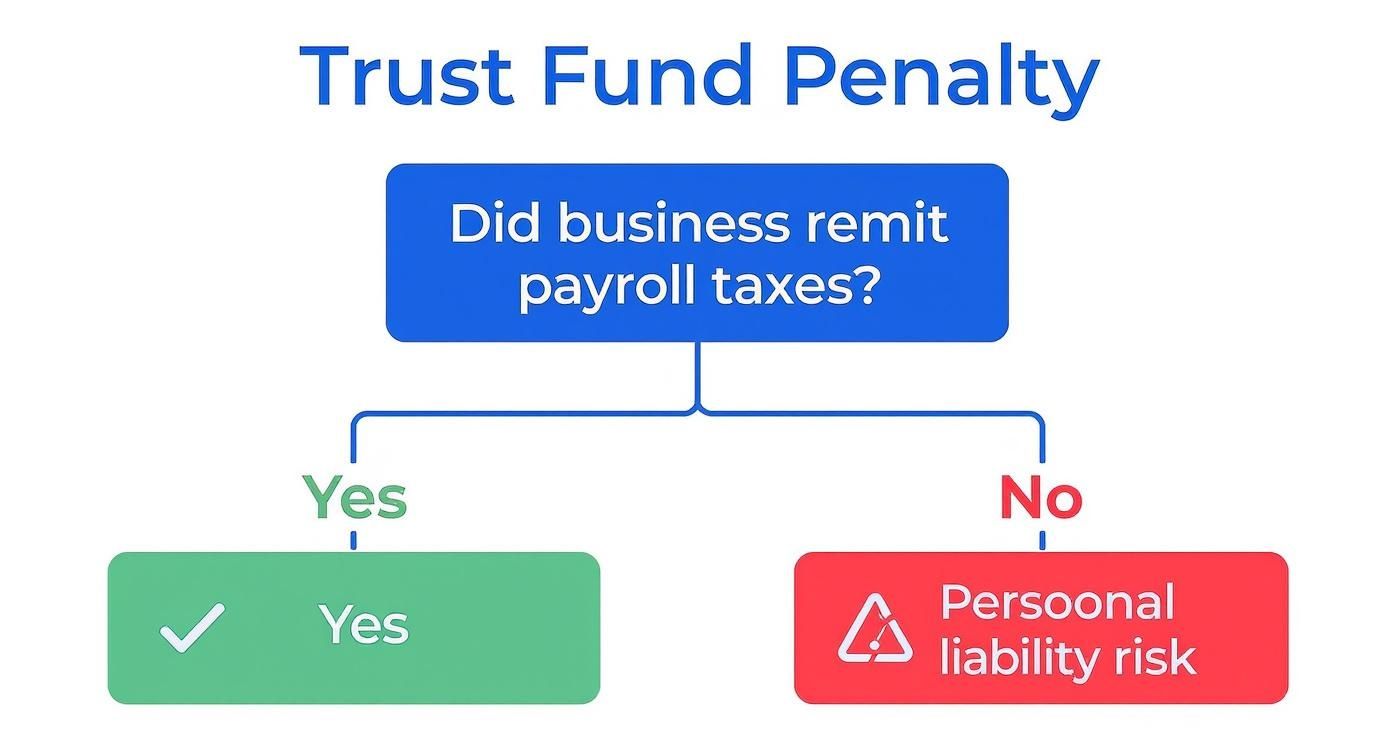
The takeaway here is critical: the moment a business falls behind on payroll taxes, the people in control are immediately exposed to a massive personal financial risk.
To help clarify this, let's look at how the IRS evaluates different roles within a company. The table below breaks down common positions and the specific actions that can lead to being classified as a "responsible person."
Common Roles and Indicators of a 'Responsible Person'
| Role | Indicators of Responsibility | Potential Willfulness Example |
|---|---|---|
| Owner/CEO | Has ultimate authority over finances, signs major contracts, hires/fires key personnel, controls bank accounts. | Knowing payroll taxes are due but deciding to pay a large vendor to keep the supply chain moving. |
| CFO/Controller | Manages daily financial operations, prepares financial statements, oversees payroll, has check-signing authority. | Instructing the bookkeeper to pay rent and utilities before sending the tax deposit to the IRS. |
| Bookkeeper/Office Manager | Has authority to sign checks (even if only up to a certain limit), determines which bills to pay from a stack of invoices. | Paying utility bills to keep the lights on, knowing there isn't enough left in the account for the payroll tax deposit. |
| Board Member | Actively involved in financial decisions, has authority to direct payments or control corporate officers. | Voting in a board meeting to use available cash to pay off a loan instead of the overdue payroll taxes. |
As you can see, responsibility isn't limited to the top of the org chart. It's about who had the functional power to direct funds, regardless of their official title.
Understanding the Willfulness Standard
Once the IRS establishes you're a responsible person, they still have to prove your failure to pay was "willful." This is probably the most misunderstood part of the entire penalty. Willfulness here has nothing to do with evil intent or a deliberate scheme to defraud the government.
The standard is much simpler. An act is considered willful if a responsible person:
- Knew the trust fund taxes were due and unpaid.
- Made a conscious, voluntary choice to pay other creditors (this includes employees' net pay, rent, or suppliers) instead of the IRS.
It's that straightforward. A business owner facing a cash crunch who decides to make payroll to keep employees happy, or pay the landlord to avoid eviction, has just committed a willful act in the eyes of the IRS. Even showing a "reckless disregard" for whether the taxes were being paid is enough to meet the willfulness standard. For a deeper dive, check out our newsletter that explains how you can become personally liable for payroll tax debt.
Joint and Several Liability
Perhaps the most brutal aspect of the TFRP is that the IRS can, and often does, assess it against multiple people for the same tax debt. This triggers a legal concept called "joint and several liability."
What this means is that every single person deemed responsible is on the hook for 100% of the total tax debt. The IRS can chase the full amount from any one individual, or any combination of them, until the debt is paid off once. The agency doesn't get involved in who pays what share; it will simply go after the person with the easiest-to-seize assets to get its money back.
Navigating the IRS Investigation and Assessment Process
When a business falls behind on its payroll taxes, the IRS doesn't just send a polite reminder. It kicks off a serious investigation designed to pinpoint exactly who will be held personally responsible for the debt. If you're facing this situation, understanding how the IRS operates is your first and best line of defense.
It all starts when the IRS systems flag a missed Form 941 filing or an unpaid payroll tax bill. This alert triggers an assignment to an IRS Revenue Officer, a field agent whose entire job is to collect the money. Their investigation has two main goals: to identify who was a "responsible person" and to determine if their failure to pay was "willful." This isn't just paperwork; it’s an intrusive probe into your company's financial operations.
The Critical Form 4180 Interview
The cornerstone of the Revenue Officer’s investigation is the Form 4180 interview. Officially, it's called the "Report of Interview with Individual Relative to Trust Fund Recovery Penalty," and it's far more than a simple chat. Think of it as a formal deposition where every word you say can—and will—be used to build a case against you.
The questions are methodical and designed to box you in. The officer will dig into:
- Your official title versus what you actually did every day.
- Who could sign checks, access the bank accounts, and make deposits?
- Who had the power to hire and fire?
- Critically, who decided which bills got paid and which didn't?
- When did you first know the taxes weren't being paid?
Your answers are the evidence. A seemingly innocent statement like, "I handled the day-to-day finances," can be twisted to mean you had ultimate control, even if you were just following orders. This interview is the make-or-break moment where a slip of the tongue could seal your fate.
The Form 4180 interview is where the IRS lays the foundation for assessing the Trust Fund Recovery Penalty. It is absolutely critical to have experienced legal counsel represent you during this stage. An attorney can help you answer truthfully without inadvertently admitting to responsibility or willfulness.
Receiving the Letter 1153

If the Revenue Officer believes they've made their case, the IRS will make its first official move. You’ll receive Letter 1153, the "Proposed Assessment of Trust Fund Recovery Penalty."
Don't underestimate this document. It's a formal notice that the IRS intends to hold you personally liable for the business's unpaid trust fund taxes. The letter will lay out the specific tax periods and the exact dollar amount of the proposed penalty.
Most importantly, Letter 1153 starts a ticking clock. You have a strict 60-day deadline from the date on the letter to file a formal, written appeal (or 75 days if you're outside the U.S.). Knowing the strategies for responding effectively to income tax notices is vital here, as this is your moment to challenge the IRS's findings.
Miss that deadline, and you've lost your right to appeal. The IRS will automatically assess the penalty, and it instantly becomes a personal debt. From that point on, they can pursue aggressive collections against you—levying your personal bank accounts, garnishing your wages, and filing federal tax liens. Responding to Letter 1153 isn't just a good idea; it's your only chance to fight back before the assessment becomes final.
How to Defend Against a Trust Fund Penalty
Getting a Letter 1153 from the IRS is a stomach-dropping experience. It feels like the final word when the government proposes making you personally liable for business payroll taxes. But it's critical to remember this is just a proposal. You have the right to fight back, and a well-planned defense can protect your personal assets from being seized for a company's debt.
At its core, any defense against the Trust Fund Recovery Penalty comes down to dismantling the two arguments the IRS has to make. You must prove either that you weren't a truly responsible person or that your failure to pay wasn't willful. A successful outcome depends on building a compelling story, backed by solid evidence, that systematically picks apart the Revenue Officer's initial conclusions.
Arguing You Are Not a Responsible Person
This line of defense is all about actual authority and control—or the lack of it. Your job title means nothing to the IRS. What really matters is whether you had the genuine power and ability to direct company funds to pay the payroll taxes.
You aren't a responsible person if you were just a figurehead, or if your signature on the bank account was essentially meaningless because someone else called all the shots.
To build this case, you need to dig up proof that your role was more mechanical than managerial. This isn't about what you say; it's about what you can show.
- Corporate Documents: Look for bylaws or board meeting minutes that specifically limit your financial duties.
- Witness Testimony: Get sworn statements from colleagues, business partners, or even vendors who can confirm that another individual had the final say on every single payment.
- Email and Text Chains: Find messages where you're asking a superior for approval to pay bills or, even better, being directly ordered which creditors to pay and which to ignore.
A classic example is a bookkeeper who prints the checks but has zero authority to sign them or decide who gets paid first. If they can show that the owner reviewed and approved every single disbursement, they can make a powerful argument that they were just an employee following orders, not a responsible party.
Proving Your Actions Were Not Willful
The second pillar of a strong defense is to challenge the idea that you acted willfully. This is a tricky one. Willfulness, in the eyes of the IRS, doesn't mean you acted with evil intent. It simply means you knew the taxes were due and you knowingly paid other creditors—like suppliers or the landlord—instead of the government.
The most common way to fight this is often called the "Nuremberg Defense"—you were just following direct orders from a superior.
This is a tough argument to win, but it’s not impossible. You have to prove that someone above you with ultimate control explicitly told you not to pay the IRS. More than that, you have to show you faced a real threat, like being fired on the spot, if you disobeyed. This can't be a vague suggestion. It requires evidence of a direct command that you were powerless to ignore.
A successful willfulness defense often boils down to proving that another person's control "affirmatively prevented" you from paying the taxes. The IRS needs to be convinced that you truly lacked the power to get the government paid, even if you knew it was the right thing to do.
This intense focus on personal liability is part of a much larger trend. Regulators worldwide are getting more aggressive. In the first half of a recent year, global financial penalties shot up by an astonishing 417% to $1.23 billion. North American penalties alone jumped 565% to $1.06 billion. This global crackdown highlights just how high the stakes are when you're facing a trust fund penalty. You can read more about the dramatic rise in global financial regulatory penalties on Fenergo.com.
Navigating the Formal Appeals Process
If you get that Letter 1153 in the mail, the clock starts ticking. Your first move must be to file a formal, written protest within the 60-day deadline. Don't miss it. This protest is your official ticket to the appeals process and must clearly explain why you disagree with the IRS. A powerful protest lays out a detailed statement of facts, the legal arguments that support your position, and includes copies of all your evidence.
Once your protest is filed, your case is taken away from the Revenue Officer and sent to the IRS Independent Office of Appeals. Here, an Appeals Officer—someone completely new to your case—will give it a fresh look. This is your best chance to make your case to a neutral party whose main job is to resolve disputes and avoid expensive court battles.
This is where negotiation happens. If your evidence is strong, the Appeals Officer might just concede the case and wipe out the proposed penalty. In other situations, they might offer a settlement based on the "hazards of litigation"—a compromise reflecting the risk that either side could lose in court. For some, demonstrating a valid reason for the failure to pay can be part of this strategy. You can learn more about how the IRS defines reasonable cause for penalty abatement in our detailed article.
Why an Experienced Tax Attorney Is Critical
When you're facing a trust fund penalty investigation, it’s not just a business problem—it’s a personal financial crisis in the making. Imagine sitting across from an IRS agent with your home, your savings, and your future earnings all on the line. In that situation, having a professional advocate isn't a luxury; it's the single most important step you can take to protect everything you've worked for.
An experienced tax attorney does much more than shuffle papers. They become a critical buffer between you and the Revenue Officer. They handle all communication, which is crucial because an innocent, off-the-cuff remark can easily be twisted into an admission of guilt. From day one, their mission is to pick apart the IRS's case and stop the assessment from ever happening.
Strategic Defense and Expert Representation
The entire investigation often hinges on one key event: the Form 4180 interview. Going into that alone is a massive mistake. Your attorney will meticulously prepare you for the tough questions, anticipate the officer’s angle, and stand by your side during the interview itself. This guidance is essential for answering truthfully without accidentally admitting to the legal standards of "responsibility" or "willfulness."
If the IRS decides to move forward and propose the penalty, your attorney’s focus shifts to building a rock-solid, evidence-backed appeal. They will:
- Attack the "Responsible Person" Label: They'll dig up corporate bylaws, board minutes, witness statements, and internal emails to demonstrate you didn't have the final say on which bills got paid.
- Disprove the "Willfulness" Finding: They'll build a strong case showing your actions weren't a deliberate choice to ignore tax obligations. Maybe you were just following direct orders from a superior or were misled about the company's financial state.
- Negotiate with IRS Appeals: A skilled attorney knows how to present your case to the IRS Appeals Office—a neutral division within the IRS—to argue for having the penalty reduced or thrown out completely.
Trying to handle the IRS appeals process on your own is a huge gamble. An experienced attorney knows the procedural ins and outs and the specific legal arguments that give you the best shot at winning. This is about protecting your personal assets from a penalty that can be financially devastating.
Finding a Resolution and Protecting Your Future
Even if the penalty gets assessed, a good attorney's job isn't over. They immediately pivot to exploring every possible way to resolve the debt and shield you from aggressive IRS collection tactics. This could mean negotiating an Offer in Compromise to settle the debt for a fraction of what you owe or arranging a formal Installment Agreement with a payment you can actually afford.
One of the most significant benefits of hiring a lawyer is the protection of understanding attorney-client privilege rules. This legal shield keeps your conversations confidential, allowing you to be completely open and honest as you build your defense.
The second you get a call or letter from an IRS Revenue Officer about payroll taxes, the clock starts ticking. Don't wait for the official assessment notice to arrive. The W Tax Group offers a free Tax Debt Analysis to go over the specifics of your situation and map out a clear path forward. Contact us today to start protecting your financial future.
Common Questions About the Trust Fund Penalty
When you're facing a potential Trust Fund Recovery Penalty, the questions can feel overwhelming. Let's cut through the noise and get straight to the answers you need. Understanding these key points is the first step in protecting yourself.
Can I Be on the Hook If I'm Not an Owner?
Yes, absolutely. This is one of the biggest and most dangerous misconceptions about the TFRP. The IRS doesn't care about your official title or whether your name is on the company letterhead. They look at one thing: control.
If you had significant say over how the company's money was spent, you're in their crosshairs. This could mean you signed checks, decided which bills to pay (and which to ignore), or managed payroll. An office manager with check-signing authority can be deemed just as "responsible" as the company president.
Does Business Bankruptcy Protect Me Personally?
Not in the slightest. In fact, it often makes things worse for the individuals involved. The Trust Fund Recovery Penalty is a personal liability, completely separate from the business's corporate obligations.
When the business files for bankruptcy, it basically puts up a shield that stops creditors, including the IRS, from collecting from the company. So, what does the IRS do? They pivot and come after the personal assets of the people they believe are responsible for the unpaid trust fund taxes.
The TFRP attaches to you, the individual. This means even if the business is long gone, the IRS has the full legal authority to collect 100% of the unpaid trust fund taxes directly from your personal bank accounts, wages, and property.
What If I Was Just Following Orders?
This defense, sometimes called the "Nuremberg Defense," is a very tough argument to win. While it can work against the ‘willfulness’ part of the assessment, the IRS is incredibly skeptical of these claims.
You can't just say you were told to pay other bills first. You need solid proof that you were given a direct, explicit order from a superior with the final say, and that you would have faced severe consequences—like being fired on the spot—if you disobeyed. It’s a high bar to clear.
Can More Than One Person Be Held Responsible?
Yes, and the IRS does it all the time. The agency can, and often will, assess the entire penalty against every single person they identify as a "responsible person."
This is a concept called joint and several liability, which is a harsh reality of the TFRP. It means that while the IRS can only collect the total tax amount once, they can pursue the full 100% from any single individual they choose. They typically go after whoever they think has the deepest pockets or the easiest assets to seize.
Navigating a trust fund penalty investigation is not a DIY project. Your personal assets are on the line. The W Tax Group begins with a FREE Tax Debt Analysis to map out the right defense for your unique situation. Don't face the IRS by yourself; find out how we can stand with you at https://weisberg.tax.


