Treasury Department Offset: Guide to Stopping & Resolving Your Debt
Facing a Treasury Department offset? Learn what triggers it, how the process works, and steps to stop it & resolve your debt quickly.

In this article
- What A Treasury Department Offset Means For Your Money
- Quick Guide To Treasury Offsets
- Debts That Can Trigger An Offset
- The Legal Authority Behind Government Offsets
- The Debt Collection Improvement Act of 1996
- What Makes a Debt Eligible for Offset
- Understanding Which Payments Can Be Seized
- Federal Payments Beyond Tax Refunds
- The Risk to Businesses and Contractors
- Your Rights and the Official Notice Process
- The Critical 60-Day Warning
- The Official Offset Notice from the Treasury
- Your Action Plan to Stop a Treasury Offset
- Step 1: Contact the Creditor Agency
- Step 2: Explore Debt-Specific Resolution Paths
- Step 3: Address Special Circumstances
- When You Need to Hire a Tax Attorney
- Navigating High-Stakes and Complex Cases
- Frequently Asked Questions About Treasury Offsets
- How Long Does a Treasury Offset Last?
- Who Do I Call About a Treasury Department Offset?
- Can I Get My Money Back After an Offset?
- Does Bankruptcy Stop a Treasury Offset?
That moment of shock when you check on your expected tax refund, only to find it's gone—or much smaller than you anticipated—is incredibly frustrating. If this has happened to you, you've likely encountered a Treasury Department Offset.
It’s a powerful tool the federal government uses to collect past-due debts you owe to various government agencies by intercepting your tax refund before it ever reaches your bank account.
What A Treasury Department Offset Means For Your Money

Think of the Treasury Offset Program (TOP) as the federal government's master collections hub. It's run by the Bureau of the Fiscal Service, a part of the U.S. Department of the Treasury, and its sole purpose is to make sure outstanding government debts get paid.
The logic is straightforward: if you owe money to one government agency, another government agency can withhold payments owed to you to cover that debt. It's an automated system that cross-references payments and debts across the entire government.
To help you get a clearer picture, here’s a quick breakdown of how the program works and what it covers.
Quick Guide To Treasury Offsets
| Component | Description | Example |
|---|---|---|
| What It Is | A centralized federal program that intercepts government payments to collect delinquent debts. | Your federal tax refund is seized to pay off a defaulted federal student loan. |
| Who Runs It | The Bureau of the Fiscal Service (BFS), part of the U.S. Department of the Treasury. | The BFS coordinates with the IRS (who issues the refund) and the Department of Education (who is owed the money). |
| What Triggers It | A delinquent debt (typically over 120 days past-due) owed to a federal or state agency. | You have an unpaid state income tax bill from three years ago. |
| What Gets Taken | Primarily federal tax refunds, but can also include other federal payments like wages, retirement, and some benefits. | Your tax refund of $2,000 is intercepted to cover a $1,500 child support debt. You receive the remaining $500. |
This table gives you the basics, but the specifics of why your money was taken are what really matter.
Debts That Can Trigger An Offset
A whole range of overdue debts can land you in the TOP database. The program is specifically designed to go after debts that are seriously past-due, usually more than 120 days.
Here are some of the most common reasons your refund might get intercepted:
- Past-Due Federal Taxes: This is the most direct one. If you owe the IRS from a previous year, they’ll almost always take it out of your current refund.
- Defaulted Federal Student Loans: A huge number of offsets happen for this reason, especially with payments and collections back in full swing.
- Unpaid Child Support Orders: TOP is a primary enforcement tool for collecting court-ordered child support, even across state lines.
- State Income Tax Debts: Many states have reciprocal agreements with the Treasury Department to collect overdue state taxes from federal payments.
- Other Federal Non-Tax Debts: This is a catch-all category for things like defaulted SBA loans, overdue FHA mortgage payments, or even overpayments of Social Security benefits.
When the government takes your refund, you won't be left completely in the dark. The Bureau of the Fiscal Service will mail you an official offset notice. This letter is crucial—it details how much was taken, which agency the money was sent to, and that agency's contact information. For a deeper dive into this process, you can learn more about What is a Tax Refund Offset.
The key thing to remember is that the IRS is not the agency you need to contact to resolve the underlying debt. The notice directs you to the specific creditor agency—like the Department of Education for a student loan—because only they can negotiate a resolution.
This is a point of confusion for many people. It feels like an IRS issue because it involves your tax refund, but the IRS is just the middleman here. The offset itself is a separate, government-wide collection action. If you're dealing with direct IRS enforcement, you might also be interested in our guide on how the IRS levies bank accounts.
The Legal Authority Behind Government Offsets
When the government intercepts your tax refund or another federal payment, it’s not a random penalty. This action, known as a Treasury Department offset, is a powerful collection tool backed by a very specific federal law. The government’s ability to do this doesn't come from some hidden rulebook; it’s rooted in legislation designed to make collecting overdue debts far more efficient.
The legal muscle behind this process is the Debt Collection Improvement Act of 1996. This law was a genuine game-changer. Before it passed, each government agency—from the Department of Education to the Small Business Administration—was on its own when it came to collecting debts. It was a messy, inefficient, and often unsuccessful process.
The 1996 Act fixed that by creating a centralized system: the Treasury Offset Program (TOP). Think of it as the government finally creating one powerful, master collections department for all its agencies. This gives the U.S. Department of the Treasury's Bureau of the Fiscal Service the clear authority to withhold your federal money to pay off delinquent debts owed to any participating agency.
The Debt Collection Improvement Act of 1996
The core idea behind this law was simple but powerful: If you owe money to one part of the government, another part shouldn't be sending you a check until that debt is settled. It unified a scattered system and made debt collection an automated, cross-agency function.
This legislation gave rise to TOP, which allows the government to intercept payments like tax refunds and even Social Security benefits to collect on delinquent debts. For a debt to be sent to TOP, it generally has to be at least 180 days past due. The program covers a huge range of obligations, from federal non-tax debts to child support and state income taxes. To grasp its full impact, you can explore a detailed report on the program and see just how much it has changed federal collections.
Key Takeaway: The Treasury Offset Program isn't a temporary measure. It's a permanent, legally established system that has been successfully collecting billions in overdue debt every single year for decades.
This legal framework is so strong that once a debt meets the criteria, the creditor agency is often required to refer it to TOP for collection. They don't have a choice.
What Makes a Debt Eligible for Offset
Not just any outstanding bill can be immediately snatched up through a Treasury Department offset. Specific conditions have to be met, and the most important trigger is delinquency.
Usually, a debt must be past due for a certain period—often 120 days or more—before the creditor agency can even start the process. This is your window of opportunity to work something out directly with the agency before things escalate to the Treasury Department.
Here are the most common types of debts that end up in this powerful program:
- Federal Non-Tax Debts: This is a huge bucket that includes everything from defaulted federal student loans and overdue Small Business Administration (SBA) loans to unpaid FHA mortgage insurance premiums.
- State Income Tax Liabilities: Yes, your state can use the federal government to collect its debts. Many states have reciprocal agreements with the Treasury, allowing them to use TOP to take your federal refund for unpaid state taxes.
- Past-Due Child Support: TOP has become one of the most effective tools for enforcing court-ordered child support, tracking down payments even when parents move across state lines.
- Unemployment Compensation Debts: If a state overpaid you in unemployment benefits and you haven't returned the money, that debt can be sent to TOP to be collected from your federal payments.
Knowing the legal authority here is your first step. It shows that an offset is a formal, structured process—and because it has rules, it also means you have defined rights and procedures you can use to fight back or resolve the situation.
Understanding Which Payments Can Be Seized

When most people hear about a Treasury Department offset, one thing comes to mind: their federal tax refund. And it's true, that's the most common payment the government intercepts. But focusing only on your tax refund is a big mistake—the government’s reach is much, much broader.
You can think of the Treasury Offset Program (TOP) as a centralized collections hub. If you owe a debt to a federal or state agency, your name and Social Security number get flagged in this system. From that point on, nearly any payment scheduled to come out of the U.S. Treasury gets checked against that list before it's sent to you.
Your federal tax refund is the prime target, of course. For millions of people, it’s the only time they ever come face-to-face with the offset program, which is why it gets all the attention. The problem is, the government can collect its debts all year round.
Federal Payments Beyond Tax Refunds
The government’s authority to intercept money isn’t a once-a-year event. Many different federal payments are vulnerable, though some have special rules that protect a portion of your money.
A number of recurring federal payments can be taken, including:
- Federal Employee Salaries: If you're a federal employee, a part of your paycheck can be continuously garnished to chip away at the debt.
- Federal Retirement Payments: Even your retirement income isn't entirely safe. Military retirement pay and federal civilian pensions are on the table, which can be a real shock for those living on a fixed income.
- Social Security Benefits: This one surprises many people. Yes, Social Security benefits can be offset. But there are important limits. For non-tax federal debts (like a defaulted student loan), the government can only take up to 15% of your monthly benefit.
Thankfully, some funds are protected. Supplemental Security Income (SSI) payments, for example, are generally exempt from being offset for these types of debts.
The Risk to Businesses and Contractors
The Treasury Offset Program isn’t just an issue for individuals. It's a serious threat for any business or contractor doing work for the federal government, and this is where I see people get caught completely off guard.
If your company has a federal contract, the government can seize payments for your invoices to cover an outstanding debt. What’s more, the debt doesn't even have to be business-related. A personal state tax bill or an old defaulted federal loan can trigger an offset against your company’s revenue.
This means a Treasury Department offset can create an instant cash flow crisis. The payment you were counting on to make payroll or cover supplies can simply disappear, leaving your business in a sudden and dangerous lurch.
This is especially true for businesses with past-due payroll taxes. The IRS can use TOP to redirect payments from your government contracts to cover those tax liabilities, putting your entire operation at risk. It's also vital to know how different retirement funds are handled in collections; our guide on whether a pension can be garnished covers this in more detail. Knowing the full scope of what's at risk is the first step toward building a real defense.
Your Rights and the Official Notice Process
The thought of the government seizing your tax refund is frightening, but it’s a move that almost never happens out of the blue. Federal law requires a strict notification process, and understanding it gives you a crucial window to defend your money.
It’s a common misconception that the Treasury Department itself initiates this process. The first move actually comes from the agency you owe money to—like the Department of Education for a student loan or a state for back taxes. They are legally required to give you a heads-up before they pass your debt along to the Treasury Offset Program (TOP).
That first letter is, without a doubt, the most important piece of mail you’ll get in this situation.
The Critical 60-Day Warning
Before your debt is sent for collection, the creditor agency must mail you a "Notice of Intent to Offset." This letter officially starts a 60-day clock, which is your prime opportunity to resolve the issue directly with them.
This is your moment to act, before your payments are actually intercepted. The law guarantees you several rights during this period, including the right to:
- Dispute the Debt: If you think the debt is an error, has already been paid, or isn't even yours, you can formally challenge it.
- Negotiate a Payment Plan: You can often work out a repayment agreement with the agency, which will stop them from sending your account to the Treasury.
- Inspect Records: You're entitled to ask for and review all the records the agency has related to your debt.
- Request a Hearing: You can ask for a formal review to argue why your debt shouldn't be subject to an offset.
Ignoring this notice is the single biggest mistake you can make. It’s essentially waving your right to challenge the debt and all but guarantees your file will land on the Treasury's desk for collection.
Key Insight: That 60-day warning is your best chance to stop an offset before it starts. Once your debt is with the Treasury, your options for preventing the seizure shrink dramatically.
If you don't settle the matter within that timeframe, the creditor agency certifies your debt and hands it off to the Treasury's Bureau of the Fiscal Service (BFS).
The Official Offset Notice from the Treasury
The next letter you'll get comes after the fact. Once the BFS intercepts a federal payment—like your tax refund—they will mail you their own official notice.
This letter confirms that a Treasury Department offset has happened. It breaks down the original payment amount, how much was taken for the offset, and which agency received your money. At this point, the BFS is just the processor; they’ve followed instructions and can't negotiate the debt with you. The notice will clearly list the contact information for the creditor agency—they are the only ones you can talk to about the debt itself.
And don't underestimate the program's reach. By Fiscal Year 2017, all 50 states and various territories were already participating, using TOP to collect on overdue debts. The sheer scale is massive, and if you're curious, you can explore the historical Treasury statements to see just how extensive these operations are.
Your Action Plan to Stop a Treasury Offset
Getting that offset notice in the mail can make your stomach drop. It feels so final, but I promise you, it's not. Think of it as a starting pistol, not a finish line. This is your chance to get ahead of the problem.
The absolute first thing you must do—and this is critical—is to contact the creditor agency listed on your notice. Do not call the IRS or the Treasury Department. They are just the collection agents in this scenario; the agency you actually owe is the one holding all the cards and the only one that can work with you to resolve the debt.
Calling the wrong agency, like the IRS about a defaulted student loan, will just waste precious time. You have to go directly to the source.
The flowchart below shows the typical timeline you’re up against once a debt gets flagged for an offset.
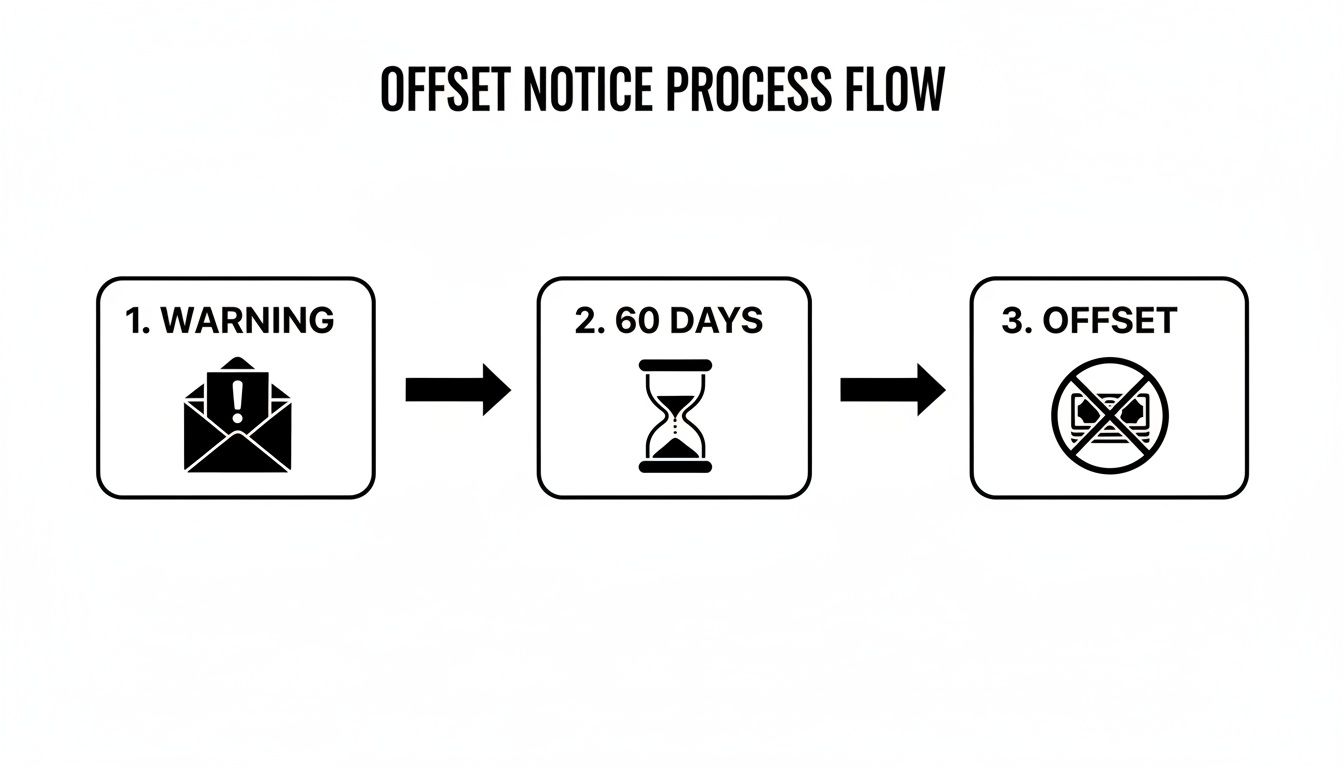
As you can see, that initial 60-day window is your best opportunity to act before the offset kicks in automatically.
Step 1: Contact the Creditor Agency
Grab your offset notice—it has all the contact info you need for the creditor agency. This might be the Department of Education, a state unemployment office, or another government entity. When you call, have that notice right in front of you.
Your goal on this call is to figure out a way to resolve the debt. Here are the most common routes:
- Pay the Debt in Full: This is the fastest and cleanest solution. If you can swing it, paying it off stops all future offsets for good.
- Negotiate a Payment Plan: Most agencies would rather get paid over time than not at all. They are usually willing to set up a formal payment plan. As long as you make your payments, they should stop the offset process.
- Submit an Offer in Compromise: If you're facing genuine financial hardship, some agencies might let you settle the debt for less than you owe.
Whatever you agree to, make sure it’s a formal, documented agreement. A verbal promise over the phone simply won't cut it.
Step 2: Explore Debt-Specific Resolution Paths
While setting up a payment plan is almost always an option, the type of debt you have opens up specific strategies that might be even better for your situation.
The most powerful tools you have are often specific to the type of debt you owe. A strategy for a tax debt won't work for a student loan, and vice versa. Knowing your options is essential.
For example, if you owe a federal tax debt, your path goes directly through the IRS. We have a detailed guide on how to set up a payment plan with the IRS that walks you through it. You can also explore options like requesting Currently Not Collectible (CNC) status, which temporarily halts collections if you can prove you can't afford to pay.
For defaulted federal student loans, your main escape routes are loan rehabilitation or consolidation. Both will get you out of default and stop a future Treasury Department offset, but they are very different programs with their own pros and cons.
Step 3: Address Special Circumstances
Sometimes, an offset isn't straightforward. One of the most common complications I see is when a joint tax refund is seized for a debt that only belongs to one spouse.
If this is your situation, you need to file Form 8379, Injured Spouse Allocation. This form is your way of telling the IRS, "Hey, part of that refund is mine, and it shouldn't be taken for my spouse's separate debt." Filing this form isn't admitting fault; it’s simply a request to split the finances for refund purposes. The sooner you file it, the faster you can get your portion of the money back.
When You Need to Hire a Tax Attorney
You can often handle straightforward offset problems yourself. But some situations are just too complex or high-stakes to go it alone. Knowing when to call in a professional isn't a sign of failure—it's a smart move to protect your financial future. When things get messy, a tax attorney becomes your most valuable player.
There are a few clear red flags that mean you should get an expert on the phone right away. If you're arguing that the debt itself is wrong, either in its amount or its legal basis, you're building a legal case. That's attorney territory. The same goes for a Trust Fund Recovery Penalty (TFRP), which holds you personally liable for a business's payroll taxes and demands a very specific, sophisticated defense.
Navigating High-Stakes and Complex Cases
Some Treasury Department offset actions can cause damage that goes far beyond just one lost tax refund. These are the moments when you need the kind of legal strategy and negotiation skills that only a seasoned attorney brings to the table.
Think about these scenarios where professional help is non-negotiable:
- Your Business is at Risk: Is the Treasury Offset Program seizing payments from your federal contracts? This puts your company's cash flow—and its very survival—in jeopardy. An attorney can negotiate with the IRS or other agencies to find a path forward that keeps your doors open.
- The Debt is Tangled in a Divorce: An offset can throw a wrench into divorce proceedings, particularly when joint tax refunds or shared business assets are on the line. A lawyer can help detangle these liabilities and shield your financial interests.
- You're Juggling Multiple, Overlapping Debts: Trying to manage debts with the IRS, a state agency, and the Department of Education all at once is a complete nightmare. A tax attorney can create a single, coordinated strategy to tackle all of them.
A great tax attorney does more than just make phone calls for you. They know the internal playbook for the IRS and the Bureau of the Fiscal Service. This lets them talk to the right people, file the right legal challenges, and negotiate solutions that simply aren't available to the public.
Stopping a Treasury offset often means exploring every possible remedy. If you're facing a massive tax bill, you might even be looking into whether bankruptcy can clear tax debt as a last resort. An attorney can lay out every option on the table, including ones you've never even heard of.
Ultimately, hiring a professional levels the playing field. When you're up against the government's powerful collection machine, having an expert in your corner ensures your rights are protected and you get the best outcome possible. For more on finding the right person, see our guide on how to find a good tax attorney.
Frequently Asked Questions About Treasury Offsets
When you get hit with a Treasury Department offset, a lot of questions pop into your head. It's natural to feel confused or anxious. Let's walk through some of the most common questions I hear from clients, so you can get the clear answers you need to take back control.
How Long Does a Treasury Offset Last?
This is a big one. Many people hope the offset will just go away after a year or two, but that’s not how it works. A Treasury Offset will keep intercepting your payments until the debt is paid off completely. It doesn't have an expiration date.
As long as the agency you owe reports the debt to the Bureau of the Fiscal Service, the offset will remain active. The only way to stop it for good is to:
- Pay off the entire debt.
- Prove the debt is invalid and have the agency cancel it.
- Get on an approved repayment plan, like an installment agreement or a student loan rehabilitation program.
Simply waiting it out is not a strategy; the problem won't solve itself.
Who Do I Call About a Treasury Department Offset?
This might be the most important question, and it has a surprisingly simple answer: you must call the creditor agency listed on your offset notice.
Think of it this way: The IRS sends out the refund, and the Treasury’s Bureau of the Fiscal Service (BFS) acts like the middleman that intercepts it. Neither of them actually owns the debt. They can't negotiate with you, set up a payment plan, or fix an error.
Your offset notice is your roadmap. It will clearly state which agency took your money and give you their contact information. That is the only place you can get real answers. The BFS hotline at 1-800-304-3107 can tell you if you're on the list, but they can't help you get off it.
Can I Get My Money Back After an Offset?
Getting your money back after it's been taken is tough, but not impossible in a few specific scenarios. A full refund of the offset amount usually only happens if you can prove the whole thing was a mistake.
You might be able to recover your funds if the debt was not legally yours, you had already paid it, or it was otherwise invalid. For couples filing jointly, an "injured spouse" can file Form 8379 to get back their portion of the refund if it was used to pay a debt that only belongs to their spouse.
To succeed, you have to act fast and give the creditor agency solid proof to back up your claim.
Does Bankruptcy Stop a Treasury Offset?
Filing for bankruptcy usually creates an "automatic stay," which is a legal order that temporarily stops most creditors from trying to collect money from you. This includes treasury offsets.
However, this is often just a pause button, not a stop button. Many of the debts that lead to a Treasury Department offset—like child support, recent tax debt, and most federal student loans—are not typically wiped out in bankruptcy. Once the bankruptcy case is over, the offset can start right back up again. This area of law is incredibly complex, and you absolutely need to speak with a qualified attorney to understand how it applies to your situation.
A Treasury Department offset can feel like an impossible mountain to climb, especially when your business or financial stability is on the line. Attorney Stephen A. Weisberg focuses exclusively on helping people resolve these kinds of complex tax and debt problems. Instead of asking for a huge upfront payment, we start with a FREE Tax Debt Analysis to give you a clear understanding of your options. Contact us today at weisberg.tax and let's solve this together.


