Your Guide to the fresh start program for Tax Relief
Discover the fresh start program and how the IRS can help resolve tax debt with offers in compromise, payment plans, and lien relief.
In this article
- Understanding the IRS Fresh Start Program
- Key Components of the Program
- IRS Fresh Start Program Options at a Glance
- Settling Tax Debt with an Offer in Compromise
- Understanding Your Reasonable Collection Potential
- How the Fresh Start Program Changed the OIC
- The Reality of OIC Acceptance Rates
- Making Tax Payments Manageable with Installment Agreements
- The Power of the Streamlined Agreement
- Key Terms and Conditions
- Removing a Federal Tax Lien from Your Credit
- How a Lien Withdrawal Works
- Qualifying for a Lien Withdrawal
- Qualifying for Penalty Abatement and Relief
- The First-Time Abatement Waiver
- Arguing for Reasonable Cause
- How to Begin Your Fresh Start Journey
- Assess Your Situation Accurately
- Develop a Strategic Action Plan
- Your Top Questions About the Fresh Start Program Answered
- Can I Apply for the Fresh Start Program Myself?
- How Long Does a Resolution Typically Take?
- Will a Fresh Start Program Stop IRS Wage Garnishments?
Falling behind with the IRS can feel like you're trapped in quicksand. The more you struggle, the deeper you sink under the weight of penalties, interest, and the constant threat of collection actions. That's where the IRS Fresh Start Program comes in—it’s not a single "get out of jail free" card, but a collection of real, practical solutions designed to throw taxpayers a lifeline.
Understanding the IRS Fresh Start Program
Think of the Fresh Start Program as a significant shift in the IRS's philosophy. Before this initiative, the rules for dealing with tax debt were incredibly strict. Many hardworking people and small business owners found themselves stuck, unable to meet the rigid requirements for relief, and facing harsh collection tactics like wage garnishments and bank account levies.
The Fresh Start initiative changed the game by recognizing that life happens. Financial hardship, health issues, or a business downturn can leave anyone struggling. The program's core goal is simply to get taxpayers back on track. The IRS realized it's far better to work with someone to collect a manageable amount over time than to push them into a financial corner where they can't pay anything at all.
This isn't just one program, but rather an umbrella term for several updated and more flexible relief options. The diagram below shows the four main pillars that form the foundation of this approach.
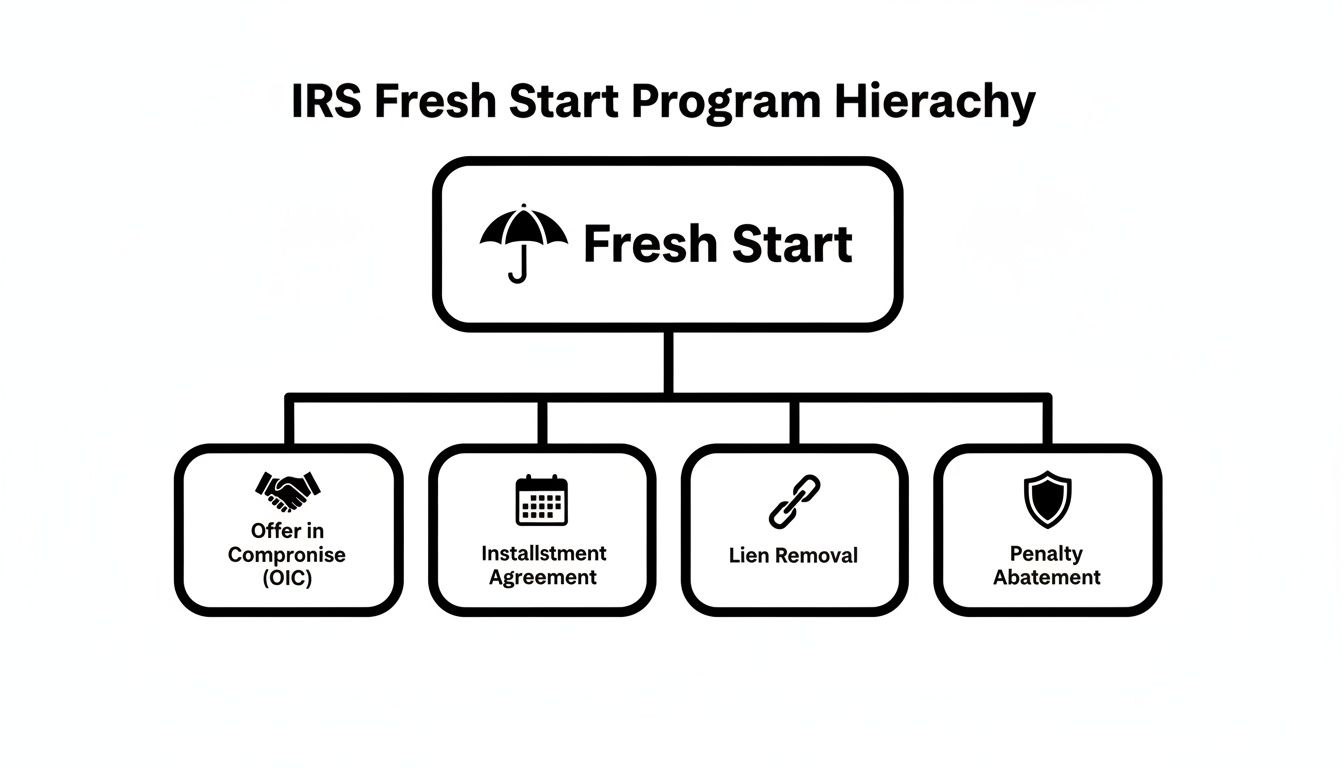
As you can see, it's a toolkit. Each tool—from settling the debt for less to getting penalties waived—is designed to address a different type of financial situation.
The real power of the Fresh Start Program is that it shifts the focus from purely punitive measures to constructive solutions. It provides the tools necessary for taxpayers to clear their debt and regain financial stability without completely upending their lives.
Key Components of the Program
The Fresh Start initiative didn't necessarily invent new relief programs from scratch. Instead, it significantly updated existing ones, expanding eligibility and making them far more accessible. These updated policies are the primary avenues we use today to negotiate with the IRS on behalf of our clients.
Here are the cornerstones of the program:
- Offer in Compromise (OIC): This is the big one. An OIC allows qualifying taxpayers to settle their tax debt for less than the full amount owed. It’s a powerful tool for those with a genuine inability to pay their entire liability.
- Expanded Installment Agreements: The program made it easier to get into a payment plan. It streamlined the process and extended payment terms, often up to 72 months, making the monthly payments much more manageable.
- Tax Lien Withdrawal: The IRS raised the minimum debt threshold before it files a damaging Notice of Federal Tax Lien. It also created clearer paths for getting a lien withdrawn once a taxpayer enters a payment plan, which is a huge relief for anyone trying to repair their credit.
- Penalty Abatement: This provides a way to get certain tax penalties removed. The IRS may grant abatement for a first-time offense or if you can show you had a "reasonable cause" for failing to file or pay on time.
To help clarify which option might fit a particular situation, here's a quick breakdown of these four pillars.
IRS Fresh Start Program Options at a Glance
| Relief Option | What It Does | Ideal For Taxpayers Who... |
|---|---|---|
| Offer in Compromise (OIC) | Settles tax debt for less than the full amount. | Have limited income and few assets, making full payment impossible. |
| Installment Agreement | Sets up a predictable monthly payment plan. | Can't pay in full now but can pay the debt off over time (up to 72 months). |
| Tax Lien Withdrawal | Removes a public tax lien from your record. | Are in a payment plan and need to clean up their credit to secure loans. |
| Penalty Abatement | Waives certain penalties added to the tax bill. | Had a valid reason for their tax issue or have a clean compliance history. |
Each of these avenues has its own set of complex rules and qualifications. But together, they represent a fundamental commitment from the IRS to work with struggling taxpayers, not just against them.
Settling Tax Debt with an Offer in Compromise

When it comes to the tools available through the Fresh Start Program, the Offer in Compromise (OIC) is without a doubt the most powerful. Think of it as a formal agreement that allows you to settle your entire federal tax bill for less—sometimes much less—than the original amount you owed.
If your tax debt feels like an impossible mountain to climb, an OIC is the IRS acknowledging that reality. It’s a practical solution where the government agrees that collecting a smaller, achievable amount now is better than trying to collect a massive debt that you simply can't pay.
This isn't about getting a free pass. It’s a pragmatic business decision based on your financial situation. The IRS has a very specific formula they use to figure out your "reasonable collection potential" (RCP), and this number is the heart and soul of any OIC application.
Understanding Your Reasonable Collection Potential
So, what is your "reasonable collection potential"? In simple terms, it's the amount the IRS believes it could realistically get from you if it used all its collection powers. They arrive at this number by taking a deep dive into your finances.
The calculation considers a few key pieces of your financial puzzle:
- Your Assets: This isn't just cash in the bank. It includes the equity you have in your home, cars, retirement accounts, and other property.
- Your Income: The IRS looks at what you bring in each month from every source.
- Your Allowable Expenses: They subtract a standardized amount for necessary living expenses from your income to see what's actually left over.
The final number they land on is, generally, the minimum amount they will accept to settle your debt. If your RCP ends up being higher than your total tax liability, an OIC isn’t going to be the right fit for you.
How the Fresh Start Program Changed the OIC
Before the Fresh Start initiative kicked in, getting an OIC approved was a much tougher battle. The old rules were notoriously rigid, especially when it came to projecting a taxpayer’s future income.
The IRS used to look at 48 to 60 months of your potential future income, a long-range forecast that often resulted in an inflated RCP. This single factor disqualified countless struggling individuals and business owners who might have otherwise been good candidates.
The Fresh Start changes made a game-changing adjustment here, shrinking the future income calculation to just 12 to 24 months. This one tweak made a world of difference. It dramatically lowered the required offer amount for many taxpayers, finally opening the door to relief for thousands who were previously locked out.
An Offer in Compromise is based on a simple premise: your ability to pay. It’s not about what you wish you could pay, but what your financial reality dictates you can pay. The Fresh Start Program made that reality check more reasonable for everyone involved.
The Reality of OIC Acceptance Rates
While the Fresh Start Program certainly made OICs more accessible, getting one approved is still a serious challenge. The changes were significant—after the new rules were implemented in fiscal year 2012, the acceptance rate hit a high of around 38%.
But the process remains incredibly strict. In 2021, for example, the IRS accepted only 15,154 offers out of 49,285 submitted. That's an approval rate of just over 30%, meaning nearly seven out of every ten people who applied were turned down. For business owners and contractors facing complex tax issues, these numbers show just how risky it is to go it alone. You can explore a complete guide to tax debt settlement with an OIC to better understand these complexities.
A rejected OIC isn’t just a simple "no." It means you've wasted valuable time, lost your non-refundable application fee, and opened the door for the IRS to restart aggressive collection actions. Every line of the application is scrutinized, and a single mistake—a miscalculated expense, a missing document—can sink the entire case. Success requires a perfectly prepared submission that tells a clear and compelling financial story, which is why having an experienced professional in your corner is so critical.
Making Tax Payments Manageable with Installment Agreements
For most people, the biggest shock isn't owing the IRS—it's the size of the bill. The idea of paying tens, or even hundreds, of thousands of dollars in one lump sum is just not realistic for the average taxpayer. This is where another core piece of the Fresh Start Program really makes a difference by making Installment Agreements easier to get and simpler to manage.
Think of an Installment Agreement as a payment plan for your tax debt. Instead of having to come up with the full amount right away, you can break it down into predictable, affordable monthly payments over a number of years. It’s a practical solution that gives you immediate relief and a clear road map to becoming debt-free.
One of the most powerful changes under the Fresh Start initiative was the expansion of the Streamlined Installment Agreement. Honestly, this was a complete game-changer for millions of taxpayers.
The Power of the Streamlined Agreement
Before the Fresh Start changes, getting an IRS payment plan often felt like a full-blown financial audit. You had to provide mountains of paperwork and justify every expense. The streamlined process cuts through a huge amount of that red tape, but only for taxpayers who owe under a certain threshold.
This simplified approach is a lifesaver for:
- Self-employed individuals whose income can be unpredictable month to month.
- Small business owners who need a straightforward way to manage cash flow and tax obligations.
- Independent contractors and gig workers who don't have taxes automatically withheld from a paycheck.
By eliminating the need for a deep dive into your finances, the IRS made it much faster and easier for people to get on the right side of the law and avoid nasty collection actions like bank levies.
The logic behind expanding these agreements is simple: create a solution that actually works. The IRS realizes it's far better to get consistent, affordable payments over time than to push someone into a financial corner where they can't pay anything at all.
This creates the breathing room you need to get back on your feet without the constant stress of IRS enforcement hanging over your head. It turns a mountain of debt into a manageable monthly bill.
Key Terms and Conditions
Under the Fresh Start rules, the streamlined installment agreement threshold was bumped up to cover tax debts up to $50,000. This opened the door for many more individuals and small businesses to set up a plan without intrusive financial disclosures. Many of these plans can be stretched out for as long as six years (72 months), with payments based on what you can truly afford. To give you an idea of the impact, in fiscal year 2012 alone, the IRS brought in about $10.7 billion through these agreements.
But entering into one of these agreements is a serious commitment. To keep your plan active and avoid defaulting, you have to follow two non-negotiable rules.
- Make All Payments on Time: Every single monthly payment must be paid in full, on its due date. No exceptions.
- Stay Current on Future Taxes: You must file all your future tax returns on time and pay any new tax liability in full. If you fall behind on new taxes, the IRS will tear up your old agreement.
Failing on either of these points will get your payment plan terminated, and the IRS will immediately restart aggressive collection actions. It is absolutely critical that you treat this agreement as a top financial priority.
It's also worth knowing that there are different kinds of payment plans. For example, a Partial Pay Installment Agreement (PPIA) might be an option if you simply cannot pay the full debt back before the time limit for collection expires. The nuances matter, and you can check out our guide on the Partial Pay Installment Agreement to learn more. Getting into the right type of agreement for your situation is the key to securing the best possible terms and a resolution you can actually live with.
Removing a Federal Tax Lien from Your Credit
A Federal Tax Lien is one of the most aggressive collection tools in the IRS arsenal. It’s a legal claim against everything you own—your house, your car, your retirement accounts—and even assets you acquire in the future. The moment it becomes public record, your financial life can grind to a halt, making it nearly impossible to sell property, refinance a loan, or get business financing.

The Fresh Start Program recognized how destructive these liens are and fundamentally changed the game. One of the biggest shifts was simply raising the minimum tax debt required before the IRS would file a Notice of Federal Tax Lien (NFTL). This single adjustment meant thousands of taxpayers were spared from having this damaging public notice filed against them in the first place.
This wasn't just a minor tweak; it was a complete overhaul of IRS collection philosophy. Before Fresh Start, the IRS was filing over 1 million NFTLs every single year. After the program raised the filing thresholds, that number plummeted by about 32%. This was a lifeline for countless individuals and business owners who rely on good credit. And the most remarkable part? IRS collection revenue didn't drop, proving that a more humane approach could work without hurting the government's ability to collect. You can read more about these lien policy findings to see the full data.
How a Lien Withdrawal Works
For anyone who already has a lien clouding their financial future, the Fresh Start Program created a clear path to get it removed: a lien withdrawal. A withdrawal essentially makes it as if the NFTL was never filed. It erases the public notice from your records, which can have a massive, immediate impact on your creditworthiness.
This is a world away from a lien release, which only happens after the debt is paid in full. A withdrawal can be granted while you're still paying off your tax bill, giving you a chance to get back on your feet financially much, much sooner.
A lien withdrawal is a proactive step that untangles your assets from the IRS's legal claim, clearing the way for financial recovery long before the underlying debt is fully paid. This is one of the most valuable forms of relief offered by the Fresh Start Program.
Qualifying for a Lien Withdrawal
The Fresh Start Program made getting a lien withdrawal much more accessible, but you still need to meet specific criteria. The most common and direct route is by getting your tax debt into a Direct Debit Installment Agreement (DDIA).
Here’s what the IRS generally requires:
- Your tax debt must be $25,000 or less when you request the withdrawal.
- You must set up a Direct Debit Installment Agreement.
- You must make at least three consecutive direct debit payments on time.
- You must be current on all other tax filing and payment obligations.
Once you’ve checked those boxes, you can file IRS Form 12277, Application for Withdrawal of Filed Form 668(Y), Notice of Federal Tax Lien. If approved, the IRS officially withdraws the notice from the public record, and the lien vanishes.
This provides a clear, predictable process for restoring your good name and credit. If you’re feeling crushed by a public tax lien, it’s critical to know that options exist. While navigating the forms and rules can be a headache, the path is there. To get into the specifics, you can learn more about how to remove a tax lien in our comprehensive guide.
Qualifying for Penalty Abatement and Relief
Tax penalties often feel like salt in the wound. You're already grappling with the original tax bill, and then the IRS tacks on penalties for filing or paying late. These aren't just small fees; they can quickly inflate what you owe, turning a manageable problem into a seemingly impossible one.
Fortunately, the IRS understands that life happens. The same thinking that led to the Fresh Start Program also applies to penalties. People face real challenges—illness, family emergencies, natural disasters—that get in the way of meeting tax deadlines. This is where penalty abatement comes in. It’s the formal process of asking the IRS to forgive and remove these penalties from your account.
Getting the IRS to agree, however, depends on presenting a solid, convincing case. There are two main ways to do this.
The First-Time Abatement Waiver
Think of the First-Time Abatement (FTA) as a one-time "get out of jail free" card from the IRS. It's designed for people who normally do everything right but made a single mistake. It's an administrative waiver that acknowledges even the most responsible taxpayer can slip up.
To get this break, you have to show a history of good behavior. Generally, that means meeting a couple of key requirements:
- A Clean Record: You must have filed all your required tax returns for the past three years and have had no penalties during that time.
- Current Compliance: You've paid, or have set up a plan to pay, any tax you currently owe.
FTA is most often used for failure-to-file, failure-to-pay, and failure-to-deposit penalties. If you check these boxes, the IRS will typically grant the abatement without putting up a fight, which can save you a substantial amount of money.
Arguing for Reasonable Cause
What if you've had penalties before and don't qualify for the FTA waiver? Your other option is to argue that you had Reasonable Cause for not filing or paying on time. This is less black-and-white, but it’s an essential lifeline for taxpayers who have been through genuine hardship.
Reasonable Cause isn't just an excuse for being careless. It's a valid argument that you exercised ordinary care and prudence, but circumstances truly beyond your control made it impossible to comply with the tax laws.
To prove this, you need to do more than just state your case. You have to build an argument backed by solid evidence. The IRS will look at any legitimate reason, but some of the most successful arguments often involve:
- Serious Illness or Incapacitation: A documented medical crisis affecting you or a member of your immediate family.
- Death in the Family: The loss of a spouse or other close relative, especially if it happened around a tax deadline.
- Natural Disasters: Events like fires, floods, or major storms that destroyed your home, business, or critical records.
- Inability to Obtain Records: Situations where you simply could not get the documents you needed, despite trying your best.
- Erroneous Advice: You relied on bad advice from a tax professional you had every reason to believe was competent.
Successfully arguing for reasonable cause for penalty abatement means telling a clear, chronological story. You have to support that story with documentation—things like medical records, death certificates, or insurance claims. You're not just telling the IRS what happened; you're showing them how it directly prevented you from paying or filing. This is where professional guidance can be invaluable, helping you frame your situation in the most persuasive way possible to get the relief you deserve.
How to Begin Your Fresh Start Journey
Knowing the different parts of the IRS Fresh Start Program is one thing, but getting relief only happens when you take action. This is the point where you stop just reading about solutions and start actually pursuing one. The whole process starts with a clear-headed, strategic plan that fits your specific financial situation.
It's easy to feel overwhelmed, but breaking it down into a few core steps makes it manageable. The goal is to take a messy, stressful tax problem and turn it into a structured process with a clear beginning, middle, and end. Taking control right now often brings an immediate sense of relief—you're no longer just reacting to IRS letters, you're starting to set the terms yourself.
Assess Your Situation Accurately
Your first move isn't filling out a form. It's getting a completely honest picture of where you stand with the IRS. This means pulling together all the relevant documents to understand the full scope of what you owe, right down to the last penny in penalties and interest. A simple miscalculation or an overlooked detail here can completely sink your case down the road.
This initial assessment is the bedrock of your entire strategy. It dictates which parts of the fresh start program you might actually qualify for, whether that’s an Offer in Compromise, a Streamlined Installment Agreement, or something else. Without this clarity, you’re flying blind.
The most critical part of this process is identifying the right solution for your specific financial reality. Applying for a program you don't qualify for wastes time, money, and can even trigger more aggressive collection actions from the IRS.
When gathering your financial documents to submit, protecting your privacy is key. It's essential to know how to securely redact information in PDF documents before sending anything to the IRS.
Develop a Strategic Action Plan
Once you have a crystal-clear financial picture, the next step is to build your strategy. This is more than just picking a program off a list; it’s about preparing a convincing case to present to the IRS. For instance, if you're trying to get penalties removed based on Reasonable Cause, you'll need to gather the evidence—like medical records or letters—to back up your claim.
If an Offer in Compromise is your goal, your plan needs to include a perfect presentation of your income, expenses, and assets, all calculated using the IRS's strict, non-negotiable formulas. Every single number has to be justifiable. This is what separates a successful resolution from a frustrating rejection letter.
By taking these first steps, you immediately break the cycle of fear and uncertainty. You gain the peace of mind that only comes from knowing you finally have a clear path forward.
Your Top Questions About the Fresh Start Program Answered
Even when you understand the options on paper, you probably still have a lot of practical questions about how this all plays out in the real world. Let's tackle some of the most common concerns we hear from people and business owners who are finally ready to get the IRS off their backs.
Can I Apply for the Fresh Start Program Myself?
The short answer is yes, you technically can. The IRS makes all the forms and instructions available to the public, so there's nothing stopping you from trying to handle it on your own.
But here's the reality: this process is incredibly complex, and the stakes couldn't be higher. Take the Offer in Compromise, for example. That application requires a flawless, incredibly detailed picture of your entire financial situation, and everything has to be calculated using the IRS's own rigid formulas. One tiny mistake or a single missing document can get your application thrown out immediately.
Considering that the IRS denies nearly 7 out of 10 of these offers, trying to navigate it alone is a huge gamble. Working with a seasoned tax professional isn't just about filling out forms; it’s about strategically building a case that gives you the absolute best shot at getting approved with the most favorable terms.
How Long Does a Resolution Typically Take?
The timeline really depends on which path you take. Some solutions are much quicker than others.
- Streamlined Installment Agreement: This is usually the fastest route. We can often get a payment plan like this locked in within a few weeks, sometimes up to a couple of months.
- Offer in Compromise: This is a marathon, not a sprint. Once you submit the offer, you should realistically expect it to take anywhere from 6 to 12 months for the IRS to complete its investigation and give you a final answer.
The most important thing to remember is that just by starting the process, you can often stop active collections, even while the bigger solution is still in the works.
Will a Fresh Start Program Stop IRS Wage Garnishments?
For most people, the answer is a firm yes. Taking formal, proactive steps to resolve your tax debt is one of the best ways to halt aggressive collection tactics in their tracks.
Once you're officially engaged with the IRS—meaning an Installment Agreement is being set up or an Offer in Compromise is being actively reviewed—they typically have to suspend actions like wage garnishments and bank levies.
This can provide immediate, powerful relief from financial pressure. It's one of the biggest benefits of facing the problem head-on, and a tax professional can often expedite getting that collection hold put in place for you.
Navigating the complexities of the IRS Fresh Start Program requires precision and expertise. Attorney Stephen A. Weisberg and The W Tax Group start with a FREE, no-obligation Tax Debt Analysis to determine the best path forward for your specific situation. Learn more and schedule your free analysis with The W Tax Group today.


