Taxpayer Assistance IRS: A Guide for Business Owners
Taxpayer assistance irs - Navigate your options for taxpayer assistance IRS provides. This guide explains TAS, TACs, and when small business owners should hire
In this article
- Navigating Your First IRS Notice
- What to do before you respond
- What small business owners should flag immediately
- Using IRS Direct Assistance Channels
- What these channels are good for
- Where direct help stops being enough
- A practical way to use direct IRS help
- Getting In-Person Help at Taxpayer Assistance Centers
- What TACs can actually do
- How to make a TAC visit worth it
- Where TACs are not the answer
- Using the Taxpayer Advocate Service When the System Fails
- When TAS is the right tool
- What TAS can’t do for you
- How to ask for TAS help
- Comparing Free and Low-Cost Legal Programs
- What free help usually covers
- IRS taxpayer assistance options compared
- The trade-off nobody likes but should understand
- When to Hire a Tax Attorney for IRS Problems
- Situations where you shouldn’t go it alone
- What giving an attorney power of attorney does
- How to choose the right lawyer
- Your Action Plan for Choosing the Right Help
- Start with the simplest fit
- Use escalation when the system is stuck
- Know the triggers for professional help
The envelope says Internal Revenue Service. Or the notice lands in your online account with a code you’ve never seen before. You read it once, then again, and still can’t tell whether you’re dealing with a simple mismatch, a payment problem, a payroll issue, or the start of something much bigger.
That uncertainty is where most business owners lose time.
The phrase taxpayer assistance irs sounds broad and reassuring, but the practical reality is narrower. A sole proprietor with a missing form can often fix the issue through ordinary IRS channels. A small business owner with payroll tax debt, an audit risk, or a proposed Trust Fund Recovery Penalty usually needs a different roadmap. A lot of official help content centers on individuals, hardship cases, or low-income programs, and there’s a real gap for business owners who are over the income limits for free clinics but still can’t afford mistakes.
If you’re in that middle ground, the right question isn’t “Where can I get any help?” It’s “Which kind of help fits this notice, this deadline, and this level of risk?” That’s the difference between solving the issue early and letting it turn into a collections or liability problem.
Navigating Your First IRS Notice
A self-employed consultant opens an IRS letter on Friday afternoon, sees a balance due, and assumes it is a payment issue. By Monday, the actual problem turns out to be a payroll tax quarter tied to an old EIN, or a proposed assessment that can reach the owner personally. I see that kind of misread often, especially with small business owners who are too large for many free-help programs but still trying to solve the problem on their own.
The first notice is not just paperwork. It sets the timeline, frames the issue, and sometimes limits your options if you respond carelessly or too late.
For individual taxpayers, a notice may be a routine mismatch or a request for missing information. For business owners and independent professionals, the stakes are often higher. A letter about employment taxes, information return penalties, or a business balance can lead to collection action, an examination, or personal exposure if the IRS believes someone was responsible for unpaid trust fund taxes.
What to do before you respond
Read the notice like a file, not like a bill. Start by identifying four basics:
- The notice number. That usually tells you whether you are dealing with a billing matter, return adjustment, collections notice, or audit-related contact.
- The tax period. Many owners focus on the current problem while the letter concerns an older quarter, a prior-year return, or a closed business entity.
- The deadline. Deadlines matter even when the notice is wrong. Missing one can cost you appeal rights or narrow the available response options.
- What the IRS is asking for. Some notices are informational. Others require documents, payment, or a written response.
If you need help identifying what the letter means before taking the next step, this guide to IRS letters and notices is a useful starting point.
One practical rule matters here. Do not send records, call in with explanations, or agree to pay until you know the tax involved, the period at issue, and the consequence of your response.
What small business owners should flag immediately
Some notices can be handled directly. Others should make you stop and assess risk before saying anything to the IRS.
- Payroll tax notices. These can start as a business liability and become a personal liability issue.
- Requests for interviews, signatures, or detailed records. Those often mean the IRS is doing more than routine processing.
- Multiple notices about the same tax period. That can point to a posting problem, an unfiled return issue, or a case that is already moving inside collections.
- References to levy, lien, seizure, or proposed assessment. At that stage, delay usually makes resolution harder and more expensive.
The trade-off is straightforward. If the notice is a simple math correction, missing form, or payment posting issue, many taxpayers can handle it themselves. If it involves payroll taxes, disputed business liabilities, or possible Trust Fund Recovery Penalty exposure, the cost of a wrong first response is much higher than the cost of getting the file reviewed first.
That is why the first step is classification, not reaction. Identify the notice, the deadline, and the risk level before you decide whether ordinary IRS help is enough or whether the matter needs legal analysis.
Using IRS Direct Assistance Channels
The IRS handles taxpayer contact at a huge scale. In Fiscal Year 2024, the agency helped almost 62.2 million taxpayers through correspondence, enterprise-wide telephone helplines, or Taxpayer Assistance Centers, according to IRS service-to-taxpayers data. That tells you two things at once. First, there is real frontline assistance available. Second, the system is built for volume, not for customized legal strategy.
That distinction matters.
What these channels are good for
If your issue is basic and procedural, IRS direct assistance is often the right first step. These channels work best when you need to:
- Confirm a balance or payment posting
- Request or clarify forms and filing instructions
- Understand what a notice is asking for
- Check whether a return or response was received
- Get routed to the right IRS function
For a sole proprietor with a simple mismatch or a taxpayer who just needs to verify account activity, this can be enough.
Where direct help stops being enough
IRS phone support isn’t legal representation. The person on the line can explain account information and process steps, but they can’t become your advocate in a controversy matter. They also won’t redesign the case around your larger goals, such as protecting cash flow, avoiding personal assessment, or sequencing a response so one action doesn’t damage another.
That’s where business owners get tripped up.
A general IRS assistor may help you understand what the system shows. They usually won’t analyze whether responding now is smart, whether a payment arrangement creates problems elsewhere, or whether the issue should be moved into appeals, advocacy, or formal representation.
A practical way to use direct IRS help
Use IRS direct channels as a fact-gathering tool, not as your only strategy. A smart first contact usually looks like this:
- Verify the account status. Confirm the tax type, periods involved, and whether the IRS shows missing returns, balances, or pending action.
- Ask procedural questions. Find out what documents the IRS wants and where they should go.
- Document the call. Keep the date, time, employee identification number, and summary of what you were told.
- Stop if the issue becomes interpretive. If the answer depends on judgment, liability, or negotiation, you’ve likely moved beyond self-service.
Use the IRS to gather facts. Don’t rely on the IRS to build your defense.
That’s especially true for payroll tax matters, multi-owner businesses, and notices that could affect both the company and the individual behind it.
Getting In-Person Help at Taxpayer Assistance Centers
Some problems are easier to solve face to face. If identity verification is blocking your account, original documents need review, or you’re trying to untangle a procedural issue that hasn’t moved by phone or mail, a Taxpayer Assistance Center, or TAC, can be useful.
The in-person network has expanded. The Treasury Department reported that the IRS opened or reopened 54 Taxpayer Assistance Centers by late 2023, creating over 8,000 additional hours of in-person help, as described in this Treasury announcement on taxpayer assistance expansion.

What TACs can actually do
A TAC is most helpful for procedural, identity, and document-driven issues. Examples include:
- Identity verification when the IRS won’t process a return or account action until you appear in person
- ITIN application support, including review of Form W-7 and authentication of certain original documents
- Basic account assistance, such as discussing notices or making payments
- Document review tied to IRS process requirements
For taxpayers who need an ITIN, in-person authentication can solve a very specific problem. Instead of mailing original identity documents and hoping the package is accepted, the TAC can review the paperwork and return originals the same day if the visit is for that service.
How to make a TAC visit worth it
A TAC appointment is not a general “help me with my taxes” meeting. It works best when you arrive with a defined procedural objective.
Bring:
- The IRS notice
- Government-issued identification
- Relevant tax returns or copies
- Any supporting documents tied to the notice
- A written list of the exact issue you need addressed
Call ahead and confirm that your local TAC handles the service you need. Not every office handles every task, and business owners waste a lot of time showing up prepared for a controversy conversation that the TAC staff isn’t authorized to have.
Where TACs are not the answer
TACs are useful. They are not tax controversy counsel.
A TAC can help you authenticate documents, verify identity, and sometimes straighten out an account-processing issue. A TAC won’t build a legal response to a payroll tax examination, defend a responsible person interview, or negotiate an elaborate resolution strategy for a business with layered liabilities.
That line matters because many business owners mistake access for representation. Face-to-face service feels complete. It isn’t. It’s procedural help delivered in person.
Using the Taxpayer Advocate Service When the System Fails
The Taxpayer Advocate Service, or TAS, is one of the most misunderstood IRS-related resources. It is not another customer service desk. It is an independent organization within the IRS structure that steps in when ordinary channels have broken down in a way that harms the taxpayer.
That makes TAS powerful in the right case and disappointing in the wrong one.
The IRS explains that a taxpayer generally qualifies for TAS assistance when the issue meets one of three categories: financial hardship, an IRS system or process failure such as delays beyond 30 days, or an equity or public policy issue requiring intervention, as outlined in the IRS page on the Taxpayer Advocate Service and when to seek its help.

When TAS is the right tool
TAS is often appropriate when the issue isn’t just “I owe the IRS.” It’s “the IRS process itself is preventing normal resolution.”
Examples include:
- An unresolved account problem that has sat past normal processing time
- A levy or other IRS action that creates immediate financial hardship
- Repeated failed contacts where the IRS promised action by a date and didn’t follow through
- A rights problem where standard channels are not treating the issue fairly
If you’re considering that route, this collection of Taxpayer Advocate Service updates and commentary gives useful context on how TAS fits into real-world IRS problems.
TAS is best at breaking logjams. It is not designed to replace legal representation in a controversy case.
What TAS can’t do for you
Expectations must remain realistic in these situations. TAS can help move a stuck case, address a hardship issue, and force attention to a procedural failure. TAS does not function as your negotiator for settlement strategy, and it doesn’t step into the role of a private attorney handling a defense.
For a business owner, that distinction is essential. If your problem is a delayed account correction blocking a filing or payment issue, TAS may help. If your problem is whether you should concede personal liability, how to respond to an interview, or how to structure a defense around payroll tax exposure, TAS is not the endpoint.
How to ask for TAS help
The formal request is Form 911. Before filing it, gather the timeline. TAS cases depend on facts that show hardship, systemic delay, or unfairness. A vague statement that “the IRS is hard to deal with” won’t carry much weight. A documented history of notices, dates, failed responses, and immediate business impact is far more effective.
Business owners should think of TAS as a targeted escalation path. It works best when you can identify the specific system failure that needs intervention.
Comparing Free and Low-Cost Legal Programs
There are legitimate free and low-cost tax help programs. They matter. But many business owners read about them, assume they apply, and then discover too late that the fit isn’t there.
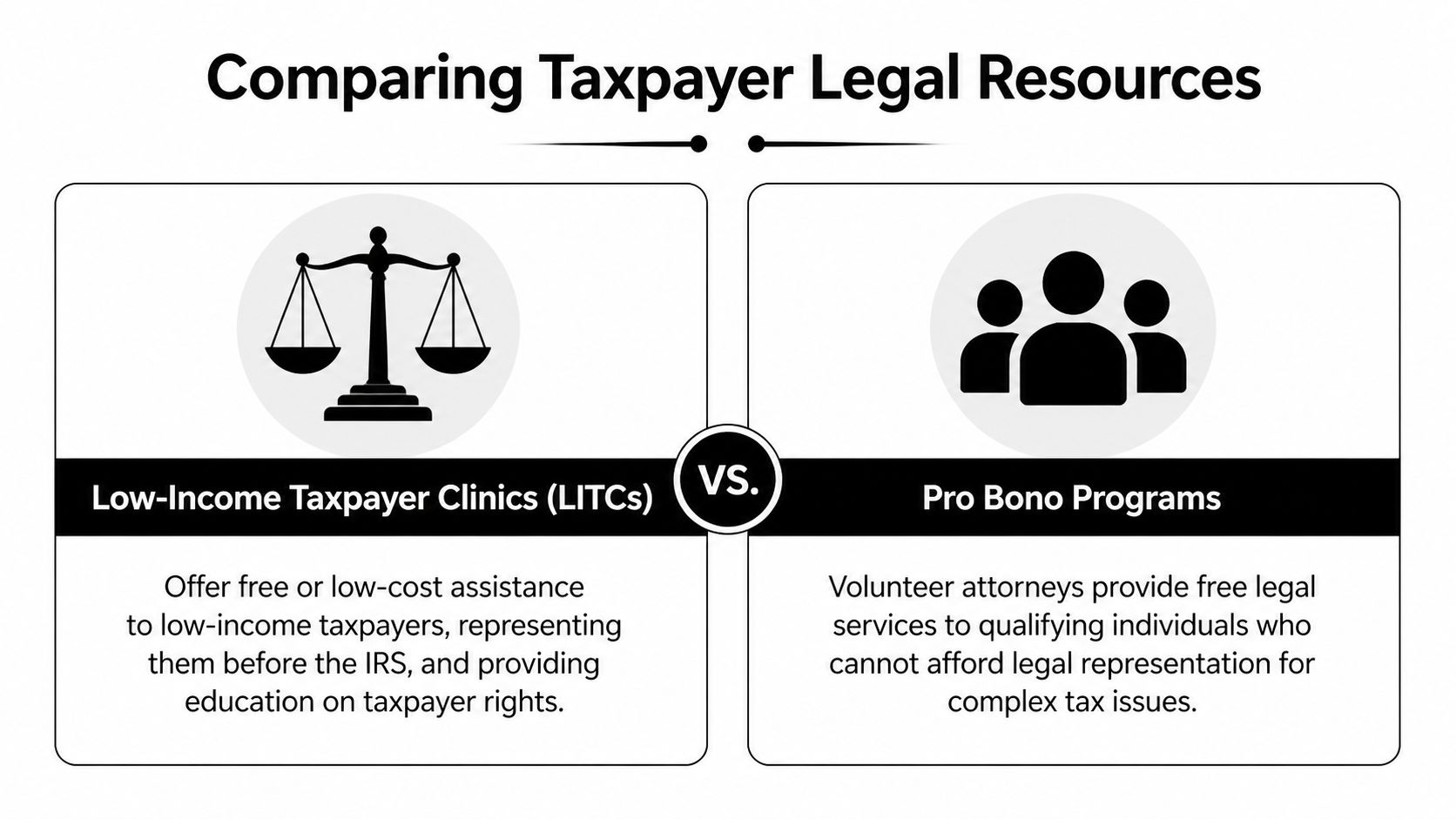
The most commonly cited option is the Low-Income Taxpayer Clinic, or LITC. These clinics provide free or low-cost help to qualifying taxpayers in disputes with the IRS. The problem for many self-employed professionals and business owners is eligibility. The TAS page describing Low Income Taxpayer Clinics makes clear that income limits often screen out the very people who own a small business, have revenue but poor cash flow, or are dealing with business tax liabilities rather than a straightforward individual dispute.
What free help usually covers
Free and low-cost programs tend to work best for:
- Individual disputes involving notices, audits, or collections
- Taxpayers under income thresholds
- Cases where education and limited representation are enough
- Situations with clear procedural needs rather than business strategy
For people who qualify, these programs can be valuable. For a business owner with payroll tax debt, related-entity issues, or personal exposure tied to company operations, they often aren’t built for the job.
IRS taxpayer assistance options compared
| Assistance Type | Best For | Cost | Key Limitation for Businesses |
|---|---|---|---|
| IRS Direct Help | Basic account questions, notices, filing status, payment posting | Free | No legal advice, no strategic defense |
| Taxpayer Assistance Center | Identity verification, document review, ITIN-related process issues | Free | In-person procedural help only |
| Taxpayer Advocate Service | Hardship cases and IRS process failures | Free | Must meet strict eligibility criteria |
| Low-Income Taxpayer Clinic | Qualifying low-income taxpayers in disputes | Free or low-cost | Many business owners won’t qualify |
| Private Tax Attorney | Payroll tax debt, TFRP, audits, appeals, negotiated resolutions | Paid | Cost, but suited for higher-risk matters |
A business owner who needs a broader menu of solutions should understand the main tax debt relief options before deciding whether free programs are enough.
The cheapest form of help is often the most expensive if it addresses only the symptom and not the exposure behind it.
The trade-off nobody likes but should understand
Free help is excellent when your problem matches the program. It becomes a detour when you need business-specific controversy work. That’s especially true if the issue involves payroll taxes, multiple owners, or a dispute that can move from the business account to the individual.
In those cases, cost is only one factor. Scope matters more.
When to Hire a Tax Attorney for IRS Problems
There’s a point where self-help stops being responsible. If the issue can put your business operations, personal finances, or professional license at risk, representation is not a luxury.
That point comes earlier than many owners think.
The IRS itself draws a practical line here. On the agency’s taxpayer help page, the message is clear: Taxpayer Assistance Centers can handle procedural tasks like document authentication, but they are not equipped for tax controversy, and matters such as a Trust Fund Recovery Penalty appeal or negotiating a resolution for a business tax debt require a qualified representative, as reflected in the IRS guidance on getting help from TACs and related IRS services.

Situations where you shouldn’t go it alone
Hire counsel when any of the following is in play:
- Trust Fund Recovery Penalty exposure. This can shift unpaid payroll tax consequences onto individuals the IRS claims were responsible.
- A serious audit. Once the facts may be interpreted against you, every document and statement matters.
- Large or layered tax debt. Business debt often overlaps with personal filings, current compliance, and collection risk.
- Appeals and formal disputes. These require legal framing, not just account explanation.
- Cases touching bankruptcy, divorce, lending, or a pending sale. Tax issues often block other legal or financial transactions.
If you’re sorting through whether bankruptcy even helps, this DebtBusters guide on tax debt is a useful overview of why tax liabilities often survive in ways people don’t expect.
What giving an attorney power of attorney does
Many taxpayers hesitate because they think hiring an attorney means losing control. In practice, signing Form 2848, Power of Attorney and Declaration of Representative, usually does the opposite. It lets your representative speak directly to the IRS, obtain records, manage contacts, and stop you from having to personally handle every call and every letter.
That changes the posture of the case.
Instead of reacting to notices one by one, your representative can analyze transcripts, identify missing returns or procedural defects, and decide whether the right move is response, appeal, collection strategy, or another path. Attorney Stephen A. Weisberg’s practice, for example, offers a free tax debt analysis before representation begins, which is a sensible model when the first question is whether help is needed at all and what kind of help fits the facts.
How to choose the right lawyer
Not every tax professional handles controversy work. Return preparation and IRS defense are different skill sets. If you’re vetting counsel, this guide on how to find a good tax attorney is worth reviewing.
Look for someone who regularly handles:
- IRS collections
- Payroll tax cases
- TFRP matters
- Audit defense
- Appeals and administrative procedure
A business owner does not need more reassurance. They need someone who knows how the case moves inside the IRS.
Your Action Plan for Choosing the Right Help
The right help depends on the type of problem, not just the fact that the IRS contacted you. If you use that filter, the path gets clearer fast.
Start with the simplest fit
If the notice is basic and you only need to confirm what the IRS is asking for, start with direct IRS assistance. Use that contact to gather facts, not to make strategic decisions.
If the problem is identity verification, document review, or another procedural issue that benefits from in-person handling, schedule a TAC appointment.
If your issue is really about bookkeeping or deduction hygiene before it becomes a notice problem, stronger records can prevent a lot of avoidable pain. Independent contractors who need a practical refresher may find this overview on understanding freelance tax write-offs useful as a prevention tool.
Use escalation when the system is stuck
If you’ve done what the IRS asked and the matter still isn’t moving, ask a more specific question: is this now a system failure rather than a tax disagreement?
Use that lens:
- If the IRS missed its own response timeline or your case is stalled past normal processing, TAS may be appropriate.
- If collections or account errors are creating immediate hardship, TAS may also be worth considering.
- If your issue is only that you owe money and want a strategic resolution, TAS is usually not the main solution.
If the problem is process, escalate the process. If the problem is liability, defense, or negotiation, move toward representation.
Know the triggers for professional help
Business owners should stop trying to handle the matter alone when the notice or account history points to legal exposure. Common triggers include:
- Any mention of Trust Fund Recovery Penalty
- Payroll tax debt
- A request for interview about business responsibility
- An audit with records that can be interpreted multiple ways
- A case affecting financing, closing, divorce, or bankruptcy planning
- Repeated notices where no one at the IRS seems able to solve the whole problem
A lot of taxpayers wait for the final warning before hiring help. That usually means the attorney spends time containing damage that could have been avoided earlier.
The better approach is simple. Use free IRS help for factual and procedural tasks. Use TAS when the system itself is failing. Use free or low-cost legal programs if you qualify and the case fits their scope. When the issue involves payroll tax debt, business controversy, or personal exposure, get a serious analysis before you take another step.
Attorney Stephen A Weisberg helps individuals, business owners, and professionals dealing with IRS and state tax problems, including tax debt, audits, payroll tax issues, and Trust Fund Recovery Penalty matters. His approach starts with a free analysis first, so you can understand whether counsel is needed and what resolution paths may be available before committing to representation. Learn more at Attorney Stephen A Weisberg.


