Taxes in Roanoke VA: Your 2026 Resident & Business Guide
Your guide to taxes in Roanoke VA. We cover 2026 property, business, and state tax rates, deadlines, and how to resolve local & IRS tax debt.

In this article
- Your Guide to Navigating Roanoke Taxes
- The Roanoke Tax Landscape Explained
- Three layers that matter
- Where taxpayers get into trouble
- The first issues to sort out
- Understanding Roanoke Real Estate and Property Taxes
- Real estate tax problems usually start with the assessment record
- Personal property tax creates different risks
- Business and Payroll Tax Obligations in Roanoke
- BPOL is often the first local business surprise
- Sales tax and payroll require discipline
- Machinery and tools can affect operating costs
- Key Tax Deadlines and How to Pay
- The deadlines that deserve your attention
- How to pay without creating a recordkeeping problem
- Common Roanoke Taxpayer Problems
- The hidden collision between local relief and IRS debt
- Other problems that tend to cluster
- What people commonly assume, and why it fails
- How to Resolve Roanoke Tax Debt
- Start with the account that can block you first
- Then build the federal strategy around the local reality
- What usually works
- What makes cases worse
The envelope says “City of Roanoke Treasurer” or “Commissioner of the Revenue,” and your first thought is usually the same. Is this routine, or is there a problem? For some people, it's a real estate bill on a home they just bought. For others, it's a personal property tax notice on a vehicle they thought was already handled. For business owners, it might be a BPOL filing, a question about gross receipts, or a local tax issue surfacing at the same time the IRS is already demanding attention.
That mix of city, state, and federal obligations is where confusion turns into risk. A missed local filing can become penalties. An unpaid city tax can become a lien problem. And if you already have federal tax debt, those local issues usually don't stay “local” for long.
Your Guide to Navigating Roanoke Taxes
A new Roanoke client usually walks in with one of two problems. Either they want to plan ahead and avoid surprises, or they're already behind and trying to figure out which notice matters most. Both situations are manageable, but only if you identify what kind of tax you're dealing with and which office controls it.
A homeowner may be trying to budget for annual carrying costs and wondering whether assessed value matches market value. A contractor may be staring at city filings while also worrying about payroll tax deposits. A retiree may believe they qualify for local relief but not realize a federal lien can interfere with that relief. Those are very different problems, even though all of them feel like “Roanoke taxes.”
The practical way to approach taxes in Roanoke VA is to separate them into buckets, then look at how those buckets interact in real life.
Taxes don't become dangerous because they're complicated. They become dangerous when separate problems get treated as if they have nothing to do with each other.
That's the gap many generic guides miss. They'll list rates and departments. They won't tell you what happens when a city tax bill, a late local filing, and an IRS collection issue all hit the same taxpayer at once.
What helps is a working map. You need to know who assesses what, what's based on property versus receipts, where relief exists, when timing matters, and what tends to work once a taxpayer has already fallen behind.
The Roanoke Tax Landscape Explained
A lot of Roanoke tax trouble starts with a simple mistake. A resident gets a notice, sees "Roanoke" on the envelope, and assumes one call will fix everything. In practice, the first question is more specific. Is the issue with the City of Roanoke, Virginia state taxes, or a federal tax account that has now started affecting a local problem?

Roanoke taxes work in layers, but each layer has its own rules, deadlines, and enforcement tools. Virginia controls state income tax and the broader sales tax structure. The City of Roanoke administers several local taxes that hit residents and business owners more directly. The IRS sits above both when the problem involves unpaid income tax, payroll tax, or collection activity.
That division matters because the offices do not share one master file. The Treasurer, the Commissioner of the Revenue, the Virginia Department of Taxation, and the IRS each handle different parts of the process. A payment to one office does not resolve a balance with another. A filing with one agency does not put another agency on notice.
Three layers that matter
At the state level, Virginia sets the rules for individual income tax and the statewide sales tax framework.
At the city level, Roanoke handles taxes and filings that often create the first local dispute:
- Real estate tax on city property
- Personal property tax on vehicles, boats, aircraft, and certain mobile homes
- BPOL tax for businesses, based on classification and gross receipts
- Machinery and tools tax for qualifying business equipment
At the federal level, the IRS deals with income tax, self-employment tax, payroll tax deposits, trust fund recovery exposure, liens, levies, and collection alternatives. That is where a local tax problem can become more serious. A business owner who is already behind with city filings is often also behind on payroll deposits or income tax estimates. Once that happens, the case stops being a simple local billing issue.
Where taxpayers get into trouble
The city-county distinction causes more confusion than it should. "Roanoke" can mean the City of Roanoke, Roanoke County, or a nearby locality. Those are different jurisdictions. Tax rates, local filing obligations, situs rules for personal property, and the correct office to contact can all change based on that line.
I also see taxpayers focus on the wrong number. They look at a tax rate and miss the underlying classification, assessment, or jurisdiction. For example, a property owner may need to challenge assessed value instead of arguing about the nominal rate. If that issue applies, this guide on how to appeal a tax assessment is the right place to start. A homeowner who just wants a rough estimate before digging into the bill can use the BatchData property tax estimator.
One practical rule helps. Before calling any tax office, identify the tax type, the tax year, and the exact office named on the notice.
The first issues to sort out
For residents, the first questions are usually straightforward:
- Do you own taxable real estate inside the City of Roanoke?
- Do you have taxable personal property garaged or located in the city?
- Do you qualify for local relief, exemption, or correction of an assessment?
For business owners, the risk points are different:
| Issue | Why it matters |
|---|---|
| BPOL classification | Classification affects how the city calculates the local business tax |
| Sales tax compliance | Errors can repeat across filing periods and create state exposure |
| Payroll tax deposits | Missed deposits can trigger fast federal collection action |
| Machinery and tools treatment | Equipment may be taxed differently depending on use and location |
That is the part generic tax guides usually miss. They list departments and rates. They do not explain how a city tax issue can sit next to a Virginia filing problem and an IRS collection case at the same time. If you sort the problem by tax type, year, and agency first, the path to a solution gets much clearer.
Understanding Roanoke Real Estate and Property Taxes
A common Roanoke tax problem starts like this. A homeowner opens a bill, assumes the amount must be right because the rate seems reasonable, then learns too late that the issue was the assessment, the situs of a vehicle, or a missed relief application. By the time the taxpayer acts, late charges may already be building, and the same household may also be dealing with a Virginia notice or an IRS balance from a separate tax year.
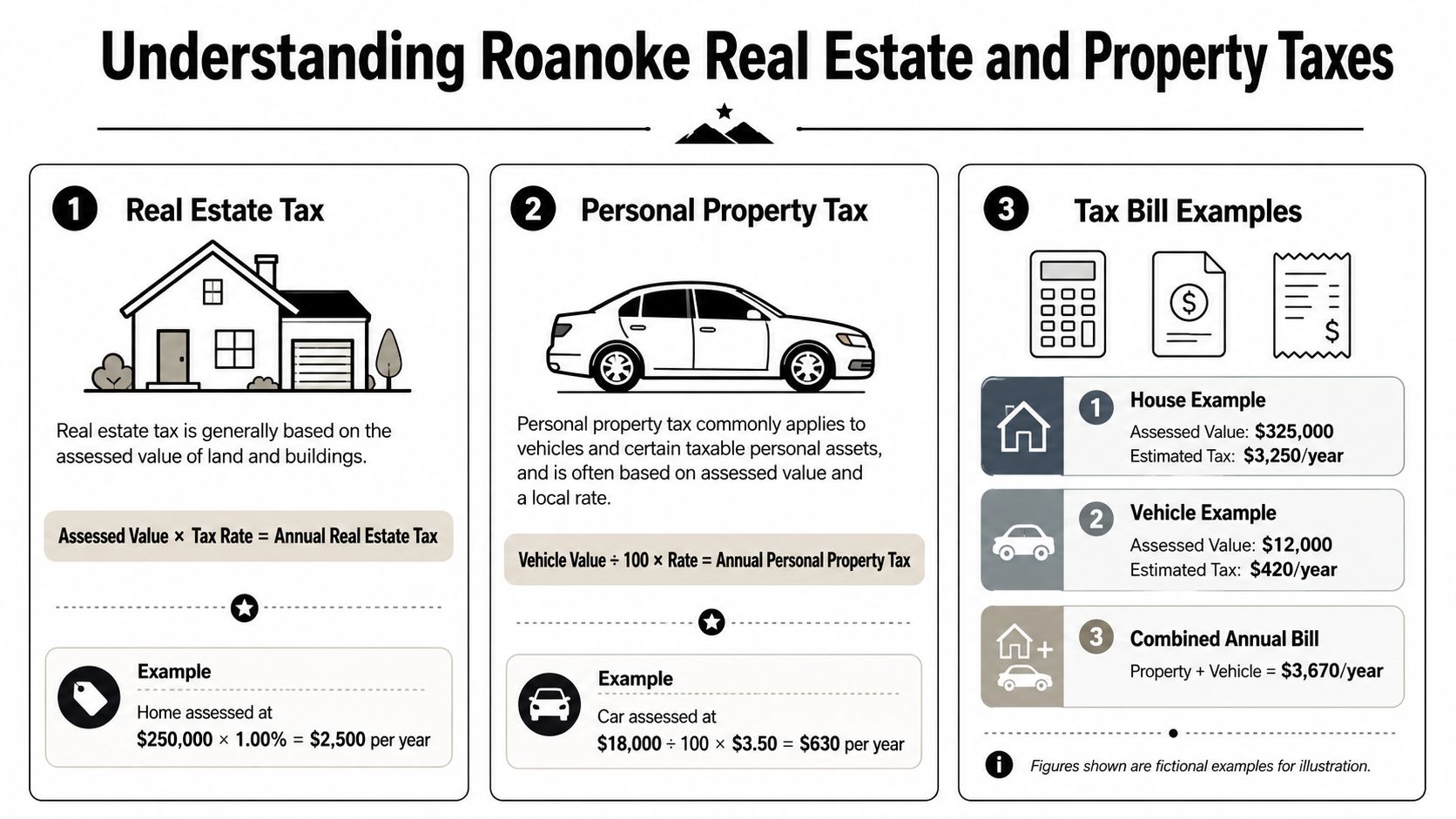
For most residents, local property tax begins with two different questions. What is the city taxing, and how did the city value it? Roanoke's nominal real estate tax rate is $1.22 per $100 of assessed value, and Ownwell's Roanoke property tax data reports an effective property tax rate of 0.79% as of 2026, below the national median of 1.02%, according to Ownwell's Roanoke property tax data.
A lower rate does not guarantee a fair bill.
The amount owed depends on the assessed value the city assigns to the property. If that value is too high, the tax can still be too high. I often tell clients to separate the emotional reaction from the legal question. A house may feel overassessed because the market cooled, but an appeal usually turns on evidence, comparable facts, and whether the city's valuation holds up.
That is why an early review saves money. A rough estimate from the BatchData property tax estimator can help frame the numbers, but the decision to challenge an assessment should rest on the property record, recent sales data, condition issues, and any facts the assessor may have missed. If you are weighing that step, this guide on how to appeal a tax assessment gives the process in practical terms.
Real estate tax problems usually start with the assessment record
Homeowners should read more than the total due. Check the property description, square footage, improvements, and any feature that materially affects value. An incorrect record can produce a tax bill that looks official and still deserves correction.
The trade-off is straightforward. A weak appeal costs time and rarely changes the result. A well-supported appeal filed on time can reduce the bill before the account shifts into collection.
Personal property tax creates different risks
Vehicle and other personal property tax issues catch residents off guard because the dispute is often not about value alone. The first question is frequently whether the property was properly taxable in the city on the relevant date. That can become a real issue for taxpayers who moved, changed garaging location, sold a vehicle, or kept property in another locality for part of the year.
Roanoke taxes personal property such as vehicles, boats, aircraft, and mobile homes. The rate structure can vary by property type, so owners with aircraft or mobile homes should read the classification carefully rather than assuming every item is taxed the same way. In practice, I see more trouble from inaccurate location records, ownership changes that were never updated, and ignored notices than from the rate itself.
A simple check prevents many disputes:
- Confirm the property was located or garaged in Roanoke
- Match the assessment to the correct owner and tax year
- Review whether the property was sold, moved, or disposed of before the assessment date
- Check for any available exemption or relief program and file on time
Relief programs can make a real difference, especially for seniors or homeowners who qualify under city rules. But relief is usually not automatic. It often requires an application, supporting documents, and attention to deadlines. Waiting until collection begins is expensive.
That timing matters beyond the city bill. Local tax debt can lead to liens, collection pressure, and credit strain at the same time a taxpayer is trying to fix a Virginia filing problem or an IRS balance. Generic tax calculators do not explain that overlap. A practical response does. Verify the assessment, correct the record, apply for any relief, and challenge bad valuations early, before a manageable local problem turns into a broader tax debt case.
Business and Payroll Tax Obligations in Roanoke
A common Roanoke business tax problem starts like this. The owner is keeping up with customers, payroll is run through software, sales tax seems handled, and then a city notice arrives for a local business license tax the owner did not budget for. A few months later, late payroll deposits or unfiled returns turn a local compliance issue into a broader state or IRS problem.
That chain reaction is avoidable, but only if the business treats local taxes, payroll taxes, and recordkeeping as connected systems rather than separate tasks.
For many Roanoke businesses, the local tax picture includes BPOL, sales tax collection responsibilities, and sometimes machinery and tools tax exposure. State corporate and sales tax rules matter too, but the local issue that surprises owners most often is BPOL because it applies to the privilege of doing business and can depend heavily on how the city classifies the activity.
BPOL is often the first local business surprise
BPOL liability does not turn on profit. A business can have a thin year or even lose money and still have a filing or payment issue. What matters is the nature of the business, where it is operating, and the measure the city applies to that category.
Classification drives cost. A wholesaler, a professional practice, and a mixed-service company may not be taxed the same way, even if each owner describes the business casually as "consulting" or "sales." I often tell clients to slow down at this step. A rushed description on an application can create a bad tax position that continues year after year.
If the business has more than one revenue stream, review each one carefully. The city may not view all receipts the same way.
Sales tax and payroll require discipline
Sales tax creates problems fast because the business is collecting money on the government's behalf. If that cash gets used to cover rent, vendors, or payroll during a tight month, the shortfall rarely stays local for long.
Payroll tax is even more serious. Once a business withholds from employee wages, failing to deposit and report those amounts can trigger state enforcement and federal trust fund issues. That is the point where an owner who thought they had a bookkeeping problem realizes they may also have personal exposure.
For a practical review of where payroll reporting and deposit failures usually begin, see this guide to small business payroll taxes.
Good books reduce risk. Better process helps even more. These bookkeeping tips for small business owners can help prevent the recordkeeping gaps that make local audits and payroll cleanups more expensive.
Machinery and tools can affect operating costs
Manufacturers and businesses using production equipment need to examine local treatment of machinery and tools early, especially before buying major equipment or choosing a site. The tax result can change depending on the asset, the use, and the locality where the property is sitused.
That is a planning issue, not just a filing issue.
I see businesses make expensive decisions because they compare rent and labor costs but ignore local tax treatment of equipment, licensing, and property location. By the time they catch the problem, the equipment is already in service and the tax bill is no longer hypothetical.
A sound Roanoke business tax review should answer four questions:
- What activities is the business conducting in the city?
- How should those activities be classified for BPOL purposes?
- What equipment or business property may be taxed locally, and where is it sitused?
- Are payroll deposits, filings, and account reconciliations current?
When those answers are documented, local compliance is usually manageable. When they are not, a city tax notice is often the first sign of a larger tax debt case involving Virginia and the IRS too.
Key Tax Deadlines and How to Pay
A Roanoke taxpayer misses a local due date by a few days, sets the notice aside, and plans to catch up after the next paycheck. By the time that file gets attention, late charges have been added, another bill is coming due, and the budget problem has turned into a collection problem. I see that pattern often. The trouble usually starts with timing, not with a complicated tax rule.

In Roanoke, deadlines matter because local taxes do not exist in isolation. A missed city payment can strain the same cash flow needed for Virginia filings or federal estimated taxes. Once a taxpayer falls behind in more than one system, the fix becomes harder and more expensive.
The deadlines that deserve your attention
Roanoke real estate taxes are billed on a semiannual schedule, and late payment triggers added cost. If you own rental property, a home with no mortgage escrow, or inherited property, those dates should already be on your calendar months in advance.
Personal property deadlines matter just as much. If you qualify for relief on a vehicle, the benefit depends on timely filing and current records, as noted earlier. Missing that step can mean losing available relief and owing more than expected.
Business owners need to watch city notices closely, especially for license and local business tax filings. Self-employed taxpayers have a second calendar to manage at the same time. Federal estimates, Virginia obligations, and local bills can land in the same part of the quarter. This overview of quarterly tax payment deadlines is a useful reference if you are trying to line up those dates before one payment knocks out another.
A practical deadline list usually includes:
- Real estate tax due dates: keep both semiannual due dates on your calendar and fund them ahead of time
- Personal property filings: confirm vehicles, garaging location, and any relief-related paperwork are current
- Business tax notices: review city correspondence promptly and match each notice to the correct account
- Federal and state tax dates: coordinate them with local obligations so you do not solve one problem by creating another
How to pay without creating a recordkeeping problem
The method matters less than the proof. Online payment is often fastest, but mailed checks, bank bill-pay, and in-person payment can all work if they are sent through the correct office and documented carefully.
I tell clients to build a repeatable system:
- Open every tax notice the day it arrives.
- Identify the tax type before paying anything. City property tax, BPOL, Virginia tax, and IRS balances are not interchangeable.
- Pay through the official channel tied to that notice.
- Save confirmation screens, canceled checks, and account statements in one folder.
- Check that the payment posted where it was supposed to post.
That last step gets overlooked. A taxpayer may have enough proof to show money left the bank, but still need to prove which bill the payment was meant to satisfy.
Good records lower that risk. If your books are disorganized, clean them up before the next deadline cycle. These bookkeeping tips for small business owners can help you set up a filing and payment routine that supports local compliance instead of undermining it.
The taxpayers who stay current usually do one simple thing well. They stop relying on memory. One calendar, one document system, and one place to verify what was filed, paid, and still outstanding.
Common Roanoke Taxpayer Problems
Most taxpayers assume local tax problems and federal tax problems sit in separate boxes. That assumption is one of the costliest mistakes I see. In Roanoke, the overlap can be direct, especially when property-based relief or collection action enters the picture.

A good example is local real estate tax relief for elderly or disabled residents. On paper, a homeowner may look eligible. In practice, another tax issue can derail the benefit.
The hidden collision between local relief and IRS debt
Roanoke's real estate tax relief programs include a tax freeze for elderly or disabled homeowners, and the income threshold can be $51,200 or less for eligibility under the city program rules. But the city also notes that an IRS lien on the property due to unpaid income or payroll tax can disqualify an otherwise eligible homeowner from receiving local relief, according to the City of Roanoke real estate tax relief program page.
That's where many taxpayers get blindsided. They think they're dealing with one local application, when the actual obstacle is an older federal debt issue that was never fully resolved.
A taxpayer can qualify on income and still lose relief because title and lien issues tell a different story.
This problem shows up in several forms:
- Retirees with old IRS liabilities who assume local relief will operate independently
- Self-employed homeowners whose income tax debt has already attached to the residence
- Business owners facing payroll tax issues that spill into personal property and home ownership concerns
Other problems that tend to cluster
Roanoke taxpayers rarely arrive with just one issue. More often, the pattern looks like this:
| Problem | Why it becomes more serious |
|---|---|
| Unpaid local property tax | It can move toward lien status and complicate refinancing or sale |
| Late personal property filings | Relief is lost, and extra charges can attach |
| BPOL confusion | Wrong classification can mean back tax and disputes |
| Payroll tax debt | Federal collection risk can expand beyond the business |
| Assessment disputes ignored too long | The window for a cleaner challenge may close |
The danger isn't only financial. It's strategic. Taxpayers often spend months negotiating the wrong issue first. They may call the city when the immediate block is federal. Or they may focus on the IRS while ignoring a local bill that is creating separate lien exposure.
What people commonly assume, and why it fails
The biggest false assumptions are these:
- “If I'm on a payment plan somewhere, all agencies will back off.” They won't.
- “A local relief program will override federal collection issues.” It usually won't.
- “If I can't pay in full, there's no point responding.” That's exactly backwards.
- “Bankruptcy will automatically clear tax problems.” Some tax debts and liens create exceptions and complications.
Once taxes in Roanoke VA become a multi-agency problem, you need a coordinated approach. Treating each notice in isolation is what turns a fixable problem into a prolonged one.
How to Resolve Roanoke Tax Debt
A common Roanoke tax case starts like this. A property owner is trying to refinance or sell, then learns a local balance is still open. At the same time, the IRS is sending notices about an older federal debt, and the taxpayer assumes one payment arrangement will calm both problems. It usually does not.
Resolving tax debt in Roanoke requires triage. Identify which agency can do the most immediate harm, which deadlines can still be used, and which account needs to be corrected before any payment terms make sense. Generic tax calculators do not do that work. City websites usually do not connect the local bill on your desk to the federal collection problem developing in the background.
Business owners run into this often. A local property tax problem can interfere with a sale, refinancing, or a broader settlement strategy. An IRS case can do the same. If both are active, handling them in the wrong order costs time and narrows your options.
Start with the account that can block you first
If the notice came from the city, confirm four things before discussing payment:
- Is the tax valid as billed?
- Was an exemption, relief request, or classification issue missed?
- Is the property, business asset, or tax year correctly identified?
- Has collection already advanced to lien or other enforcement action?
That review sounds basic, but it is where many cases turn. I regularly see taxpayers agree to pay a balance that should have been reduced, corrected, or challenged first. Once money is applied to the wrong issue, fixing the account gets harder.
Local tax debt also has consequences outside the tax file. It can delay closings, create title problems, and reduce flexibility when you are also trying to deal with state or IRS liabilities.
Then build the federal strategy around the local reality
If IRS debt is part of the picture, the next question is not which program sounds best. The question is which option fits your actual facts. That may be an installment agreement, penalty relief, currently not collectible status, or an Offer in Compromise. The answer depends on filing compliance, income, assets, business operations, and whether local tax debt is still unresolved.
Taxpayers often lose months in this process. They apply for the federal program they have heard about most often, while a local lien, unfiled return, or active payroll issue keeps undermining the case. A federal resolution can fail for reasons that have nothing to do with the IRS form itself.
For a practical overview of the federal options, see this guide on how to settle tax debt with the IRS.
Good tax resolution usually looks methodical, not dramatic. It starts with accurate filings, fixes the accounts that are wrong, contains active collection risk, and only then sets payment terms that have a real chance of holding.
What usually works
The taxpayers who make steady progress tend to follow the same pattern:
- Get current first. Old debt is easier to negotiate when new debt is not still piling up.
- Collect the records early. Assessments, classifications, payroll filings, and IRS financial disclosures all depend on documents.
- Rank problems by consequence. A lien threat, levy risk, or closing deadline should usually come before a lower-pressure balance.
- Keep one coordinated plan. Local, state, and federal agencies do not automatically respect each other's arrangements.
What makes cases worse
Some responses feel reasonable in the moment but create bigger problems later:
- Paying something small on every notice without a strategy
- Assuming a phone call solved the issue without written confirmation
- Focusing only on the IRS while city tax debt keeps advancing
- Waiting until a sale, divorce, bankruptcy, or payroll crisis forces a rushed decision
Roanoke tax debt is rarely just a billing issue. It is often a timing issue, a records issue, and a strategy issue across more than one agency. Once you see the full picture, the path usually becomes clearer, even if it is not quick.
If you're dealing with taxes in Roanoke VA and the problem goes beyond a simple bill, a focused legal analysis can save time, money, and bad decisions. Attorney Stephen A Weisberg offers a free, no-obligation Tax Debt Analysis to determine whether he can help and how. He represents individuals, business owners, and professionals whose clients are stuck with IRS, state, and related tax debt issues, and he starts by mapping the problem before recommending any paid work.