Taxes and Interest: What You Owe and Why
Understand how taxes and interest affect what you owe, with practical tips to plan payments and avoid surprises in 2026.

In this article
- Why a Tax Balance Keeps Growing After the Notice
- Why self employed taxpayers feel this first
- How the IRS Calculates Interest on Unpaid Tax
- The rate is a formula, not a fixed penalty
- Daily compounding changes the math
- Walking Through a Real $100,000 Example
- How a $100,000 Unpaid Balance Can Grow Across 2026 Quarters
- Read the two engines separately
- Payment Plans, Offers in Compromise, and Abatement Compared
- Installment agreement
- Offer in Compromise
- Reasonable cause abatement
- Common Misconceptions About Penalty and Interest Abatement
- The question to ask instead
- Practical Strategies to Minimize Interest for Individuals and Businesses
- Build the true payoff number by segment
- Putting It Together and Knowing When to Get Help
Here is the rewritten paragraph:
You filed on time. You could not pay in full, so you told yourself you'd catch up next month. Then a new IRS notice arrived, and the balance was higher than the number on your return, higher than last month, and nobody had sent you a new tax bill to explain why. That's how many people meet taxes and interest in real life, not as a theory, but as a moving number.
Why a Tax Balance Keeps Growing After the Notice
Take a self employed consultant who owed tax for the year, filed the return, and paid what cash flow allowed. No employer withheld tax from each paycheck, estimated payments fell short, and the remaining balance sat unpaid after the original due date. The next notice didn't just repeat the original tax. It added a failure to pay penalty and interest that had been accruing in the background.
That surprise is structural, not personal. A tax balance isn't a fixed invoice. Until it's paid in full, the IRS treats the unpaid portion as an amount you still owe the Treasury, and the cost of that delay keeps accumulating. Filing on time helps you avoid a separate failure to file problem, but filing alone doesn't freeze the balance.
Why self employed taxpayers feel this first
Employees see withholding taken out automatically. Independent contractors, sole proprietors, and pass through owners have to create that discipline themselves through estimated payments. When income is uneven, a client pays late, or expenses come in lower than expected, the shortfall often isn't visible until the return is prepared, long after interest exposure has begun.
The wider system makes these gaps consequential. Across OECD countries, the average tax to GDP ratio rose from 24.9% in 1965 to 34.0% in 2022, an increase of 9.2 percentage points, reflecting systems that combine income, payroll, property, consumption, and excise components. For a small business, that means one weak link, missed estimates, late payroll deposits, or a misclassified worker, can create a liability that then carries its own carrying cost.
Don't ask what you owed on the return. Ask what you owe today, and what you'll owe if you wait another quarter.
That's the mindset shift that matters. You need to separate three layers in every notice, the original tax, the penalties added for late payment, and the interest charged over time on unpaid amounts. Each layer has different rules, different relief options, and different urgency. Treat them as one lump sum and you'll make the wrong decision, usually by waiting.
My direct advice is simple. Don't judge affordability by the balance printed weeks ago. Reconstruct the timeline, identify what's still growing, and decide whether paying now, paying over time, or seeking a settlement produces the lowest total cost after interest. Time isn't neutral here. It's a line item.
How the IRS Calculates Interest on Unpaid Tax
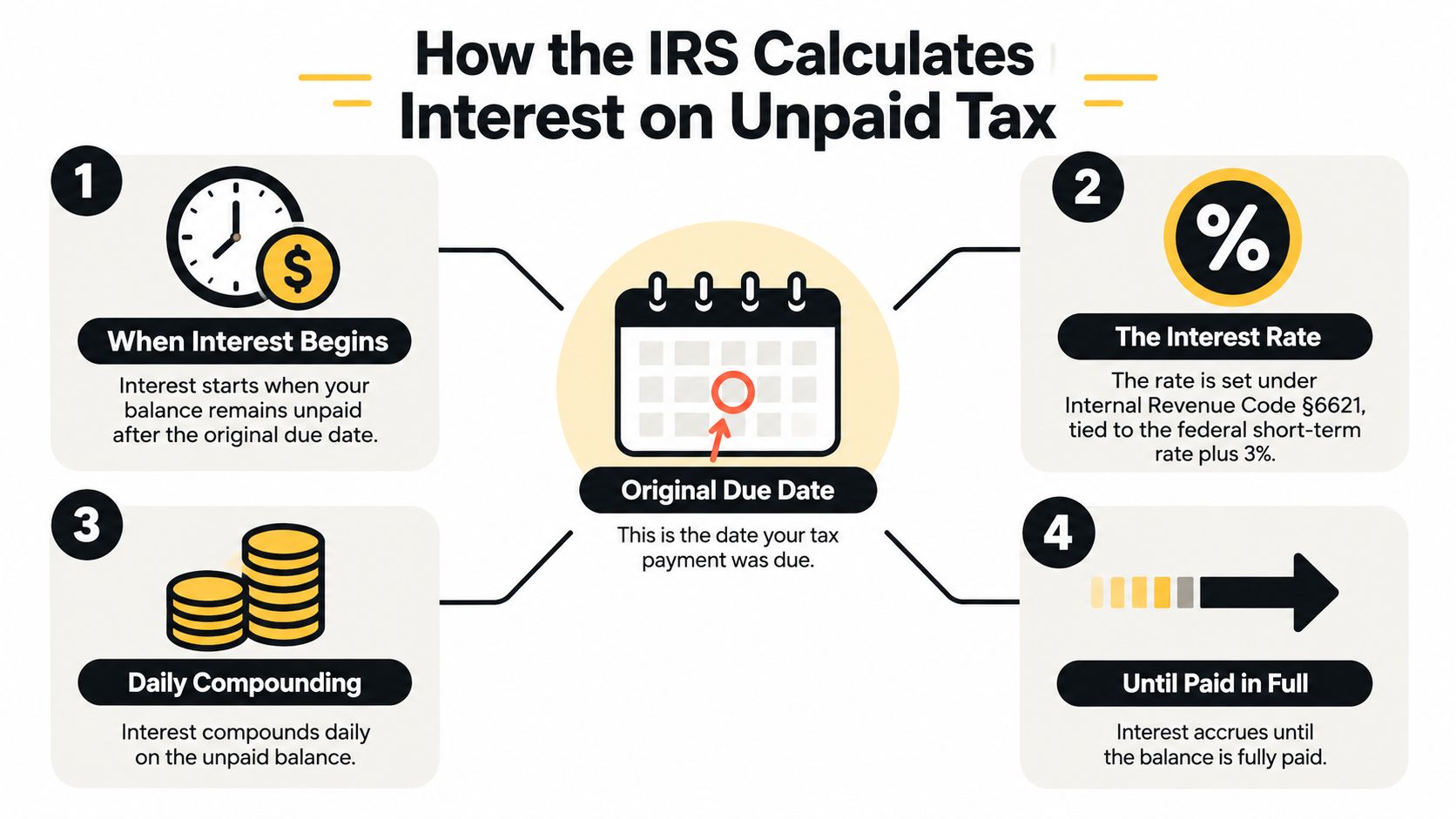
Interest starts because tax wasn't paid by its original due date, not because the IRS later got around to sending a notice. It generally runs from that due date until the liability is paid in full. An extension to file doesn't change that payment deadline, and a late discovered shortfall doesn't restart the clock in your favor.
The rate is a formula, not a fixed penalty
Under Internal Revenue Code §6621, the rate for most individual and noncorporate underpayments is the federal short term rate plus 3 percentage points, and the IRS resets it quarterly while compounding interest daily, as shown in the IRS quarterly interest rate history. That same record shows how much the environment can change, from 3% in several quarters from 2012 through 2016 to 9% in the first quarter of 2001 and 8% throughout 2007.
Don't treat the rate on your first notice as permanent. If your balance survives into a new quarter, a new rate can apply to interest accruing in that quarter. If it survives for years, you'll have a stack of different quarterly rates, each attached to its own slice of time.
Daily compounding changes the math
Compounding daily means yesterday's interest becomes part of the balance that earns interest today. The effect looks small over a week and becomes material over multiple quarters, especially on a large balance. That's why multiplying your original tax by one annual percentage gives you a false sense of precision.
- Start date matters: Interest generally tracks back to the original payment due date.
- Rate segments matter: Each quarter can carry a different rate.
- Payments matter: A partial payment reduces the balance exposed to future compounding from that point forward.
- Penalties matter too: Interest can also accrue on assessed penalties, so the base can grow in two ways at once.
There's also a fairness milestone worth knowing. On January 1, 1999, the interest rate paid on most tax overpayments became the same as the rate charged on underpayments. Before that, from January 1, 1987 through December 31, 1998, the overpayment rate was generally one percentage point lower. That history doesn't reduce your bill today, but it explains the policy logic. Interest is meant to price the time value of money, not punish you, even though it often feels punitive.
If you want to verify what the IRS assessed, learn how to read an IRS transcript before you argue about the total. Transcripts separate tax, penalties, interest, payments, and credits by period. Without that breakdown, you're negotiating against a number you can't audit. With it, you can spot a missing payment, a wrong period, or interest tied to a penalty that shouldn't be there.
Walking Through a Real $100,000 Example
Use a $100,000 unpaid individual balance that remains unpaid through 2026. This is an illustration, not a payoff quote, because exact IRS figures depend on assessment dates, payment application, and daily compounding. Still, the shape of the growth is exactly what catches taxpayers off guard.
The IRS lists a 7% noncorporate underpayment rate for several 2026 quarters, 6% for April through June 2026, and a separate 8% rate for large corporate underpayments in the second quarter of 2026 in its Internal Revenue Bulletin quarterly rate guidance. For this individual example, ignore the corporate rate, but don't ignore the lesson. Entity type and debt category can change the economics.
How a $100,000 Unpaid Balance Can Grow Across 2026 Quarters
| Quarter | Underpayment Rate | Failure-to-Pay Penalty Rate | Approximate Ending Balance |
|---|---|---|---|
| Start of Q1 2026 | Not yet accruing in example | Not yet accruing in example | $100,000 |
| Q1 2026 | 7% | 0.5% per month | $103,226 |
| Q2 2026 | 6% | 0.5% per month | $106,270 |
| Q3 2026 | 7% | 0.5% per month | $109,645 |
| Q4 2026 | 7% | 0.5% per month | $113,080 |
Those ending balances are simplified approximations using quarterly interest on the growing balance plus three months of penalty per quarter. A precise IRS computation compounds daily and can differ modestly. The point isn't the last dollar. It's that waiting through four quarters turns a six figure tax problem into a materially larger one without any new tax being assessed.
Read the two engines separately
The penalty engine is predictable. At the ordinary monthly rate, $100,000 of unpaid tax can add up to $500 in failure to pay penalty for each month or part of a month before the statutory cap becomes relevant. The interest engine is quieter. It applies to a rising base, changes when quarterly rates change, and doesn't care that you're waiting for a bonus, a refinance, or a client to pay you.
Now change one variable. If an approved installment agreement is in effect, the monthly penalty addition on that same $100,000 drops to $250 under the reduced rate described in the next section. You haven't stopped interest, but you've cut one engine in half while you pay. That's a real trade off worth modeling before you choose to do nothing.
Partial payments help for a different reason. Paying principal sooner reduces both future interest exposure and the penalty base tied to unpaid tax. Don't wait until you can pay everything if you can safely pay something now, provided the payment is properly designated and applied. In multi period cases, get advice on designation, because where a voluntary payment lands can affect older periods, newer periods, and collection risk differently.
Payment Plans, Offers in Compromise, and Abatement Compared
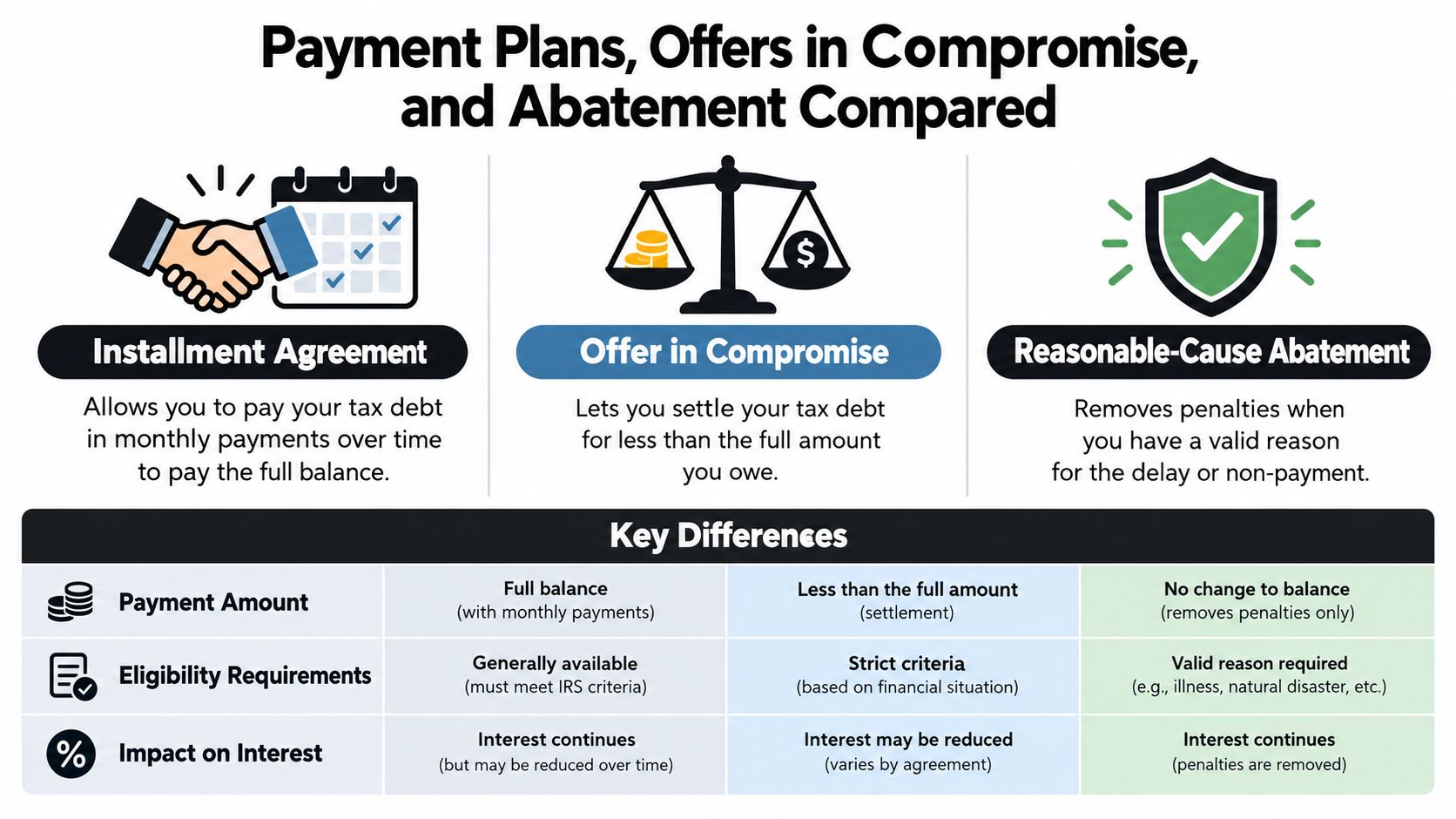
Tax relief isn't one product. It's three different legal levers that attack different dollars. Confusing them leads people to request the wrong relief, reject a workable plan, or chase a settlement they don't qualify for while interest keeps running.
Installment agreement
An installment agreement lets you pay the full balance over time in monthly payments. The IRS states the failure to pay penalty is generally 0.5% of unpaid tax for each month or part of a month, capped at 25%, and generally drops to 0.25% per month when an approved installment agreement is in effect, while interest continues separately, according to IRS payment plan guidance. Read that last clause twice. A plan reduces penalty accrual and can pause aggressive collection, but it's still a loan from the government at a floating rate.
Choose a plan when you can realistically full pay within the collection period and your cash flow supports the monthly amount without creating new tax debt. If you're self employed, that means current estimated taxes come first. A plan that funds old debt by starving current compliance will default. Before you sign, review how to set up a payment plan for taxes and compare the projected after interest total against paying faster.
Offer in Compromise
An Offer in Compromise asks the IRS to settle for less than the full amount. It's not a discount for being stressed or annoyed. The strongest cases usually show doubt about collectibility, meaning your income and assets don't support full payment, or effective tax administration grounds in narrower circumstances.
An offer can be the right move when full payment, even over time, isn't realistic. But it takes time, requires detailed financial disclosure, and interest continues to be part of the liability picture while the IRS evaluates your ability to pay. Don't file a weak offer just to delay collection. A rejected offer can leave you older, still owing, and with a larger accrued balance.
Reasonable cause abatement
Abatement targets penalties, not the underlying tax, and as the next section explains, it usually doesn't erase interest either. It's best used surgically, identify the specific penalty, the specific period, and the specific facts showing you exercised ordinary business care and prudence but still couldn't comply.
Practical rule: Ask which dollar you're trying to reduce. Tax, penalty, or interest each requires a different mechanism.
My recommendation is blunt. If you can pay in full without destroying working capital, pay and stop the meter. If you can't, get into a compliant installment posture early enough to reduce penalty accrual, and pursue compromise or abatement only where the legal grounds fit. Hope isn't a resolution strategy.
Common Misconceptions About Penalty and Interest Abatement
The most expensive misconception I hear is this, I had a good reason, so the IRS should remove the interest. Illness, a disaster, a preparer's mistake, a divorce, or a business downturn may be entirely real. They may also support penalty relief. They don't automatically erase underpayment interest.

IRS guidance states reasonable cause may support penalty relief yet isn't a basis for abating underpayment interest, and interest relief is narrower, potentially applying when an amount was illegally or erroneously assessed, when an IRS employee caused an unreasonable error or delay, or in limited circumstances involving errors on IRS prepared returns, with employment taxes excluded from the employee error provision, as detailed in the Internal Revenue Manual interest abatement guidance. That distinction should drive your whole request.
The question to ask instead
Don't start with, did I have a good reason. Start with, what legal category applies, and can the interest be isolated to an IRS caused or erroneous period. For employee error relief, the IRS generally looks for an unreasonable ministerial or managerial delay after written contact, no significant taxpayer contribution to the delay, and an open limitations period. Vague frustration with slow processing won't carry that burden.
- Misconception one: Penalty abatement and interest abatement are the same request. They're not, and mixing them weakens both.
- Misconception two: Inability to pay is itself interest relief. It explains nonpayment, but it doesn't reclassify interest as erroneous.
- Misconception three: If the penalty falls, all related interest disappears automatically. If a penalty is removed, interest tied to that penalty should be recomputed, but interest on the underlying tax is a separate issue.
- Misconception four: Reliance on an adviser always works. For penalties, the facts, the adviser's competence, and what you provided still matter.
Before you write a heartfelt letter, read what penalty abatement actually covers and separate your evidence by period. Attach records, dates, correspondence, and proof of corrective action. A clean, narrow penalty request has a better chance than a broad plea asking the IRS to erase every charge because the year was hard.
There's a second, quieter trap. Taxpayers chasing interest relief often overlook calculation errors that are fixable, a payment posted to the wrong year, a credit not applied, or interest continuing after a liability was corrected. Audit the arithmetic and the assessment first. If the underlying amount was wrong, challenge that. Correcting the base can reduce the interest that legally follows from it.
Practical Strategies to Minimize Interest for Individuals and Businesses
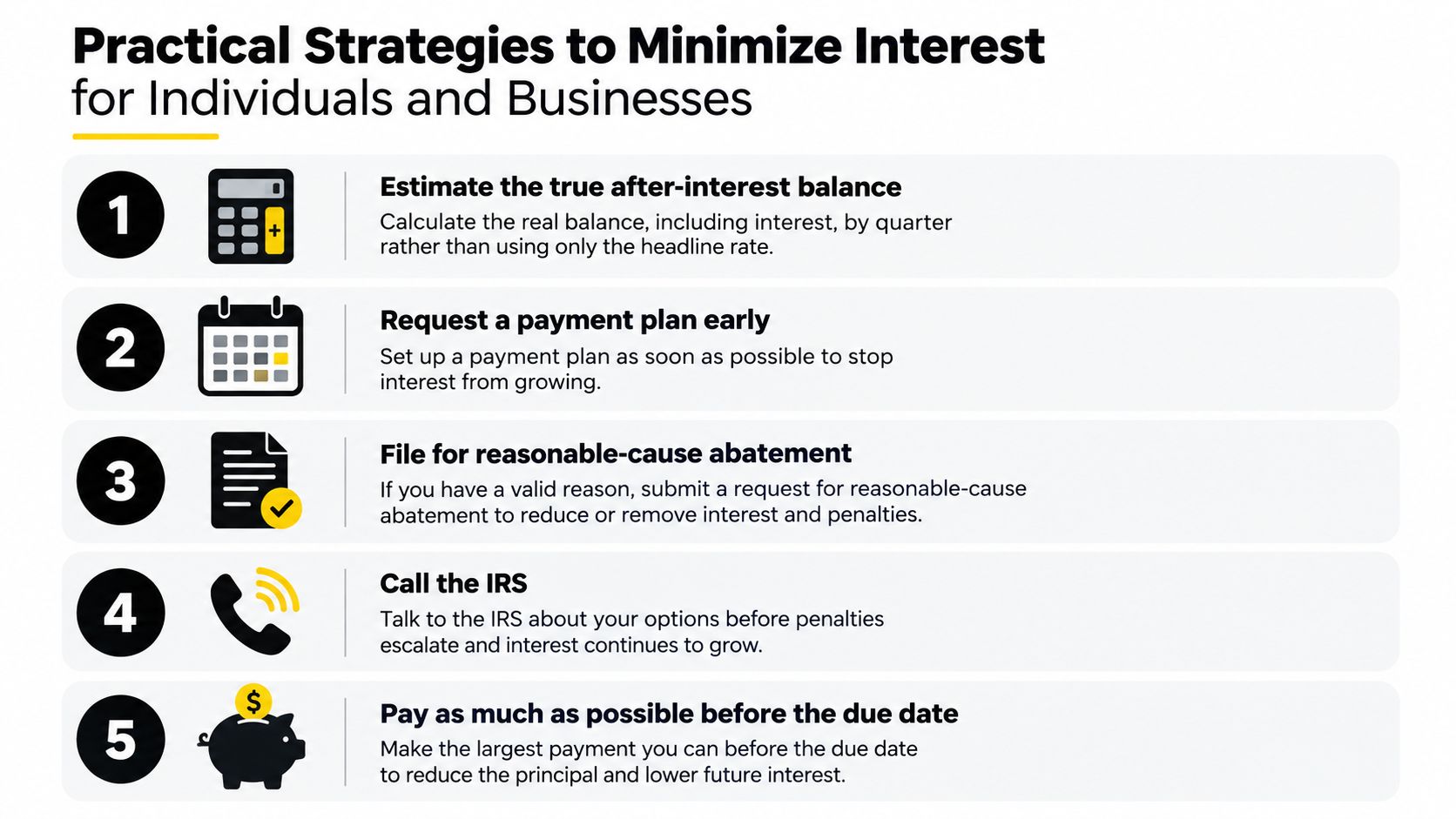
You can't negotiate the statutory rate. You can control the balance exposed to it, the number of quarters it survives, and whether penalties stack on top. That's where strategy lives.
Build the true payoff number by segment
IRS guidance states interest compounds daily, each quarter's rate applies to interest accruing during that quarter, and rate changes don't retroactively alter prior periods, so older balances should be modeled by time segment rather than by multiplying original tax by the current rate, consistent with the IRS quarterly interest rates page. Build a simple timeline for each tax period, original tax, each penalty assessment, each payment, and each quarterly rate. Then project three outcomes, pay now, install, or compromise, using after interest totals.
- Stop new debt first: Fund current withholding or estimates before throwing extra cash at old years.
- Pay principal early where possible: Even partial payments shrink future compounding, but confirm proper designation and application.
- Use an installment agreement deliberately: Enter it to reduce penalty accrual and stabilize collection, not as permission to pay slowly forever.
- Request penalty relief narrowly: Tie each request to a period, a penalty, documented facts, and corrective steps.
- Recheck the assessment: Missing credits and misapplied payments are cheaper to fix than months of unnecessary interest.
For self employed readers, prevention is cheaper than cleanup. Review IRS estimated tax strategies to avoid tax debt penalties and set estimates from actual year to date profit, not last year's memory. If income spikes late in the year, adjust the next estimate. If it drops, document why you reduced it.
Businesses with payroll exposure need a harder line. Payroll taxes withheld from employees aren't working capital, and trust fund exposure can reach responsible individuals personally. Don't rob payroll deposits to fund an installment payment on an older income tax balance. Sequence matters, current payroll compliance, current estimates, then structured resolution of older periods with professional input where multiple periods overlap.
The cheapest looking monthly payment can be the most expensive total cost.
Compare total dollars, not monthly comfort. A slower plan may feel easier and still cost far more because interest runs longer on a larger balance. If borrowing privately is cheaper after all fees and risks, analyze it carefully, but don't trade IRS debt for high cost debt that endangers your home or business without independent advice. Speed has value here, but reckless speed can create a second crisis.
Putting It Together and Knowing When to Get Help
Use this checklist before you sign anything. Separate tax, penalties, and interest by period. Rebuild the balance by quarter, confirm every payment and credit posted correctly, and project the after interest cost of paying now, installing, or compromising. Then decide which relief request, if any, fits the legal category, penalty abatement for documented reasonable cause, interest correction for an erroneous or IRS caused amount, or an offer where collectibility is doubtful.
Handle a single period balance yourself if the math is clear and you can pay or install without creating new debt. Get help when you face multiple periods, payroll or trust fund exposure, an open audit, liens or levies, or a balance large enough that a small modeling error changes the decision. In those cases, professional analysis often pays for itself by preventing a defaulted plan, a weak offer, or an unsupported abatement request.
Don't wait for the next notice to teach you the same lesson at a higher price.
If your balance spans multiple quarters and you can't tell how much is tax, penalty, or interest, get a free tax debt analysis that reconstructs the timeline and compares paying, installing, and compromising on an after interest basis. Visit Tax Attorney Stephen A Weisberg to find out whether he can help and how, before you commit to a plan or pay for resolution.


