Taxation of Royalties: A Guide for Creators & Businesses
Understand the taxation of royalties in the US. Our guide covers reporting on Schedule E/C, self-employment tax, 1099s, nonresident rules, and common pitfalls.

In this article
- That Unexpected 1099 What Royalty Income Means for Your Taxes
- What Exactly Is Royalty Income
- The main categories of royalties
- Why the label alone isn't enough
- How the IRS Taxes Your Royalty Income
- When royalties look like business income
- When royalties look more like investment income
- A practical comparison
- Partnerships, LLCs, and K-1 issues
- What works and what doesn't
- Reporting Royalties A Guide to Key Tax Forms
- The usual paper trail
- Where the income goes
- Royalty income reporting quick reference
- Two reporting habits that prevent trouble
- Navigating Cross-Border and State Tax Rules
- Non-U.S. recipients and withholding risk
- Why governments watch royalty payments closely
- State tax issues that get missed
- What cross-border payers should do
- Common Pitfalls and Strategic Tax Planning
- Royalty monetization isn't automatically a sale
- Other mistakes that cause audits and notices
- Planning that actually helps
- Your Next Steps for Royalty Tax Compliance
- A working checklist
You open your mail or tax software and see a Form 1099-MISC with an amount in Box 2 for royalties. Maybe it came from a publisher, a music platform, an oil and gas operator, a software licensee, or a company that paid for the right to use your name, image, code, or content. The amount may be welcome. The tax treatment usually isn't.
Taxpayers often don't get tripped up because they forgot royalties are taxable. They get tripped up because royalty income doesn't fit neatly into the categories they already know. It isn't wages. It isn't always the same as freelance income. It isn't always passive. It also isn't always a clean capital asset transaction just because someone called it a license or a sale.
That confusion matters. The wrong reporting position can create self-employment tax problems, missed deductions, state filing exposure, or withholding issues if a foreign person is involved. And if you try to simplify too aggressively, the IRS may decide you took the wrong path.
That Unexpected 1099 What Royalty Income Means for Your Taxes
A common version of this starts with someone who wasn't expecting to be in the royalty business at all. An author gets a statement from a distributor. A photographer licenses an old image archive. A landowner signs papers years ago and suddenly starts receiving checks tied to production. A software developer puts code into a licensing arrangement and later gets a 1099-MISC that doesn't look like the rest of their income records.
The first questions are usually practical, not technical.
- Is this business income or something else
- Do I owe self-employment tax
- Where does it go on the return
- What if the form is wrong
- What if I already filed and missed it
Those are the right questions. Royalty taxation depends less on the label on the check and more on the facts behind it. What asset produced the payment? Who owns it? Are you actively exploiting that asset as part of a trade or business, or are you passively receiving income from rights you already hold?
The 1099 is just the starting point. The real tax answer comes from the underlying arrangement.
That distinction is why two taxpayers can receive royalty payments and report them differently. One may belong on Schedule C because the royalties are tied to an active business. Another may belong on Schedule E because the income is passive or investment-like. The forms may look similar at first glance, but the tax consequences can be very different.
If you're already sorting through payer forms and trying to match them to the right reporting path, it helps to understand broader information return issues too, especially when payers use inconsistent reporting categories. This practical piece on IRS reporting confusion around third-party forms shows why taxpayers can't rely on the form alone.
What Exactly Is Royalty Income
Royalty income is easiest to understand if you think of it as rent for the use of valuable property, except the property often isn't a building. It may be a copyright, patent, trademark, image library, software code base, mineral right, or another legal right that someone else pays to use.
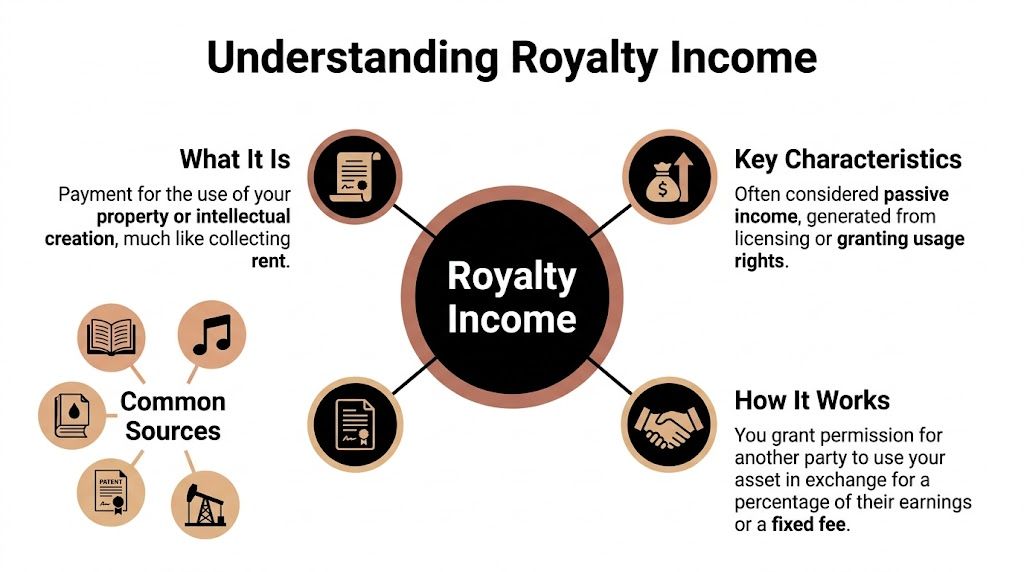
The payment structure can vary. Some deals pay a percentage of revenue. Others pay per unit sold, streamed, extracted, or licensed. Some use minimum guarantees, advances, or hybrid formulas. The tax issue starts with the same basic question: are you being paid because someone is using property or rights that you own or control?
The main categories of royalties
Most royalty income for small businesses and creators falls into one of these buckets:
Intellectual property royalties
These come from patents, trademarks, software, formulas, brand rights, or proprietary processes. A developer licensing software to another company may receive royalty payments based on usage or subscriptions.Creative work royalties
Authors, musicians, photographers, actors, designers, and video creators often see royalties here. A book publisher may pay based on copies sold. A music platform may pay when a work is used or performed. Influencer and creator income can overlap with this category, especially when compensation is tied to ongoing use of content, likeness, or licensed assets. If you're comparing royalties with sponsorships, affiliate arrangements, and licensing deals, this overview of how influencers get paid is a useful business-side reference.Natural resource royalties
These arise when someone has the right to extract oil, gas, coal, or other resources and pays the owner based on production or lease terms. In the public resource context, the federal government has collected natural resource royalties for nearly a century, with foundational laws including the Mineral Leasing Act of 1920, and those royalties averaged $11.7 billion annually from fiscal years 2003 to 2012 according to the Bipartisan Policy Center analysis of natural resource royalties.Franchise and licensing style royalties
A business may pay for the right to operate under a brand, use systems, or exploit protected know-how. These payments are often called royalties in the contract even when the arrangement includes other services.
Why the label alone isn't enough
Calling a payment a royalty doesn't settle the tax result. Contracts often bundle multiple items together. One agreement may include a license, consulting, implementation help, and marketing support. Another may call something a royalty even though the economics look more like service income.
That matters because the reporting position has to match substance. If the payment is really compensation for services, the tax treatment can shift. If it's in fact for the use of rights or property, royalty rules are more likely to apply.
Practical rule: Read the agreement before you read the tax form. The contract usually tells you more than the 1099 does.
How the IRS Taxes Your Royalty Income
The biggest fork in the road is whether the royalties are treated as business income or investment-type income. This isn't just a paperwork detail. It affects where you report the income, what expenses you can offset against it, and whether self-employment tax becomes part of the problem.

A lot of online summaries stop at the basic question of whether royalty payments are taxable. They are. The harder issue is how they're taxed in your specific facts.
When royalties look like business income
If you're actively creating, producing, promoting, managing, or exploiting the asset as part of your trade or business, the royalty stream often belongs in the business bucket. That tends to be the case for working creators, inventors, software developers, and brand owners who regularly monetize their rights as part of ongoing operations.
In that setting, royalties are often reported on Schedule C. The upside is that business expenses connected to generating that income are generally easier to match against it. The downside is that the IRS may view the income as part of self-employment activity, which raises the cost of getting the classification wrong.
Examples where this issue comes up:
- A musician who actively records, promotes, tours, and licenses songs
- A consultant who licenses a proprietary training system as part of an operating business
- A software founder who continuously develops and licenses code
- A creator whose licensing deals are part of their regular commercial activity
If you're trying to sort out the wider consequences of being treated as self-employed, this guide to tax rules for self-employed taxpayers helps frame the broader compliance picture.
When royalties look more like investment income
Some taxpayers own rights but aren't actively operating a business around them. They may have inherited mineral interests, assigned rights years ago, or hold copyrights that continue producing income without much current business activity. In those cases, the income often fits better on Schedule E.
That distinction can be valuable because Schedule E treatment is often associated with passive or investment-style reporting rather than self-employment treatment. But it also means you shouldn't assume every cost you incur belongs there. The deduction rules are narrower, and taxpayers sometimes overstate what counts as a royalty-related expense.
If your involvement is limited to owning the right and collecting checks, the IRS is more likely to see the income differently than it would for someone actively operating a licensing business.
A practical comparison
| Reporting issue | Business-style royalty income | Investment-style royalty income |
|---|---|---|
| Typical form | Schedule C | Schedule E |
| Common fact pattern | Ongoing active licensing or exploitation as part of business operations | Ownership of rights with limited current business activity |
| Expense treatment | Broader business-expense framework may apply | More limited and fact-dependent |
| Self-employment tax risk | Higher | Often lower, depending on facts |
| Audit concern | Underreporting business activity | Overstating passive treatment |
Partnerships, LLCs, and K-1 issues
Royalty income becomes more complicated when it runs through a partnership or multi-member LLC. The entity may receive the royalty payments and then pass them through on a Schedule K-1. At that point, the owner still has to analyze the character of the income and their own role in the activity.
Individuals often make expensive assumptions. They think the label on the K-1 settles everything. It doesn't. If the underlying activity is active and tied to a business you materially participate in, you still have to address the consequences correctly on your own return.
What works and what doesn't
What works is matching the tax position to the actual activity.
- Keep the agreement that created the royalty.
- Track the asset that generated the payment.
- Document your involvement in developing, promoting, or managing it.
- Separate services from license income when both exist in one contract.
What doesn't work is choosing Schedule E because it feels cheaper, or choosing Schedule C automatically because the payer sent a form that resembles contractor income. The IRS can challenge either shortcut.
Reporting Royalties A Guide to Key Tax Forms
Most royalty reporting problems come from mixing up the payer's paperwork with the recipient's filing job. Those are related, but they aren't the same.
The payer may issue an information return. You still have to put the income on the right part of your own return. If the payer uses the wrong form, that doesn't give you permission to report it incorrectly.
The usual paper trail
For many domestic royalty payments, the payer uses Form 1099-MISC, usually with the amount shown in Box 2 for royalties. Sometimes taxpayers instead receive a Form 1099-NEC, especially when the payer viewed the payment as compensation connected to services or used the wrong form category.
That mismatch is common in practice. A platform, startup, or small business payer may not understand the difference between a royalty and nonemployee compensation. The recipient still has to classify the income based on substance, not on the payer's convenience.
Where the income goes
The income generally ends up in one of two places on the recipient's federal return:
- Schedule C if the royalties are part of an active trade or business
- Schedule E if the royalties are passive or investment-like
If an entity receives the income first, the owner may instead pick it up through a K-1 and then determine how it flows through on the individual return.
Keep a copy of the agreement, the statements showing how the royalty was calculated, and any correspondence that explains whether the payment was for rights, services, or both. That's the file you want if a notice arrives later.
Royalty income reporting quick reference
| Form Name | Who Issues It | Who Receives It | Where to Report Income |
|---|---|---|---|
| Form 1099-MISC | Payer | Recipient of royalty payment | Usually Schedule C or Schedule E, depending on facts |
| Form 1099-NEC | Payer | Recipient, often where payer treated amount as nonemployee compensation | Still depends on substance. Often requires review to determine if Schedule C is appropriate |
| Schedule C | Taxpayer files it with return | IRS | Used when royalties are tied to an active trade or business |
| Schedule E | Taxpayer files it with return | IRS | Used when royalties are passive or investment-type income |
| Schedule K-1 | Partnership, S corporation, or trust/estate | Owner or beneficiary | Recipient reports according to the character and activity of the income |
Two reporting habits that prevent trouble
First, reconcile every payer statement to your books. Don't assume the annual form is accurate. If there were chargebacks, reserves, advances, recoupments, or split payments, the gross number on the form may not tell the whole story.
Second, don't force the paperwork to match software defaults. Tax software often nudges users toward one schedule or another based on the form entered. That's useful for simple returns. It's dangerous when the legal character of the payment is debatable.
If the reporting path isn't obvious, resolve the classification first. Then enter the form.
Navigating Cross-Border and State Tax Rules
Cross-border royalty issues create two kinds of problems at once. Federal withholding rules are strict, and state sourcing issues often get ignored until a notice shows up. Small businesses, creators, and payers run into both.

Non-U.S. recipients and withholding risk
Under U.S. law, royalties paid to non-resident aliens are subject to a flat 30% withholding tax on the gross amount unless a treaty reduces the rate, and the payer must remit it on Form 1042-S. If the payer fails to withhold and remit properly, the payer can become liable for the tax and penalties, as described in the IRS exempt organizations technical guidance discussing royalty withholding under Section 1441.
That rule surprises both sides of the transaction. The foreign recipient may assume the U.S. payer will handle everything automatically. The U.S. payer may assume no withholding is needed because the recipient is a business, not an individual. Both assumptions can be wrong.
The usual first document to review is the payee's Form W-8BEN or W-8BEN-E. If treaty benefits are available, the form needs to be completed correctly before or with payment administration, not after the fact when everyone is trying to undo a withholding problem.
Why governments watch royalty payments closely
Royalty payments are one of the tools multinational groups use to move profit from one jurisdiction to another. A 2023 study by Lejour and van 't Riet estimated that at least 18% of cross-border royalty payments between companies are motivated by tax evasion, and the study noted US$25 billion in 2018 bilateral flows between Ireland and the Netherlands, and the Netherlands to Bermuda, associated with structures often described as the double Irish-Dutch sandwich, according to the university resource discussing international royalty payments and profit shifting.
Most small businesses aren't building offshore royalty structures. But the reason for the compliance pressure is the same. Governments know royalty payments are easy to relabel, easy to shift, and easy to under-withhold if no one checks the details.
Cross-border royalty compliance is one of those areas where a small paperwork mistake can become the payer's tax bill.
State tax issues that get missed
State royalty taxation is less standardized and often more frustrating than the federal rules. A nonresident may receive royalties tied to property, exploitation rights, or market activity in a particular state and discover that the state claims taxing jurisdiction. That can happen even if the taxpayer never set foot there during the year.
Common trouble spots include:
- Source-state filings when royalties are tied to property or rights used in a state
- Resident-state overlap when your home state also taxes the same income
- Withholding mismatches when federal forms don't answer the state reporting question
- Entity-level confusion when an LLC or partnership has multistate royalty activity
In practice, taxpayers often focus on the federal return and ignore the state issue until a matching notice arrives. By then, records are harder to reconstruct and credits are harder to optimize.
Foreign recipients who also have U.S. filing obligations should pay attention to related disclosure and offshore compliance risks too, especially when the royalty arrangement is connected to foreign accounts or entities. This overview of foreign bank and information reporting issues is a useful checkpoint.
What cross-border payers should do
A careful payer should have a repeatable process:
- Identify the payee's status before payment.
- Collect the right withholding certificate and review treaty claims.
- Confirm the payment is a royalty and not a service fee or mixed payment.
- Issue the correct information return and keep support in the file.
- Review state sourcing separately instead of assuming the federal answer solves it.
That process isn't glamorous, but it prevents the usual mess: under-withholding, incorrect reporting, and an audit file built from guesswork.
Common Pitfalls and Strategic Tax Planning
The most dangerous royalty tax trap for small businesses isn't the obvious one. It's the deal marketed as a smart cash-flow move.
A business owner with future royalty income gets offered upfront money in exchange for assigning the stream. The pitch sounds simple. Sell tomorrow's income, get cash today, and maybe report it more favorably. That's where taxpayers walk into trouble.
Royalty monetization isn't automatically a sale
Small businesses often fall into a trap when monetizing royalty streams for upfront cash. The IRS may view the deal not as a sale eligible for capital gains treatment but as an acceleration of future ordinary income, a principle affirmed in P.G. Lake, as discussed in RSM's analysis of tax treatment of royalty monetization transactions.
That doctrine matters because the tax hit can arrive immediately and at ordinary income rates rather than under the treatment the seller expected. The problem gets worse when the owner already used the cash for operations, debt service, or distributions before understanding the tax result.
If the transaction only converts future income into present cash, the IRS may care less about the paperwork label and more about the economic substance.
Other mistakes that cause audits and notices
Royalty taxation also goes wrong in quieter ways.
Misclassifying active income as passive
Taxpayers sometimes put royalties on Schedule E because they want to avoid self-employment treatment, even though they're still actively running the licensing activity.Blurring royalties with services
A contract may pay for consulting, implementation, appearances, and IP rights in one bundle. If no one allocates the pieces, reporting gets sloppy fast.Poor expense records
People either deduct too little because they don't track costs, or too much because they throw unrelated expenses into the royalty bucket.Ignoring advances and upfront payments
If a publisher, platform, or financing company pays an advance, the tax treatment may not match the taxpayer's cash assumptions.
Planning that actually helps
The best planning usually isn't aggressive. It's organized.
Start with the contract. Identify what was transferred, what was licensed, what services were promised, and whether the other party has meaningful rights or only a claim on future income. Then match your books to that structure.
A sound royalty file should include:
- The signed agreement and any amendments
- Statements showing how amounts were calculated
- Evidence of your activity level, especially if business treatment is appropriate
- Expense support tied directly to the royalty-producing asset
- Any correspondence about advances, recoupment, assignments, or buyouts
If you're considering a monetization deal, model the tax consequences before signing, not after funding. The right question isn't just how much cash you'll receive. It's what the IRS is likely to call the transaction once it's on paper.
Your Next Steps for Royalty Tax Compliance
If royalty income showed up on your return for the first time, or if it's grown into a meaningful part of your business, keep the process simple and disciplined.
A working checklist
Identify the royalty type
Know whether the payment comes from creative rights, software, trademarks, natural resources, franchise rights, or a mixed arrangement.Decide whether the activity is active or passive
This is the key classification issue. It often determines whether Schedule C or Schedule E is the better fit.Track expenses by asset or agreement
Don't wait until filing season to reconstruct what was spent to create, maintain, or protect the royalty stream.Review every form against the contract
A 1099 can be wrong. A K-1 can be incomplete. The legal nature of the payment still controls.Check for state or international exposure
If a foreign payee, foreign payer, or multistate source is involved, assume there are additional rules to review.
One more point matters for self-employed taxpayers in particular. Royalty income that falls into the business bucket can affect estimated tax obligations, not just year-end reporting. This practical guide to quarterly tax payments for self-employed taxpayers is worth reviewing if your royalty income is recurring.
Royalty issues are manageable when addressed early. They become expensive when taxpayers guess, especially with cross-border payments, monetization transactions, and mixed contracts that combine services with licensing rights. If you're unsure about the reporting position, or you're already dealing with notices, amended returns, or tax debt tied to royalty income, get the facts organized before taking the next filing step.
Attorney Stephen A Weisberg works directly with taxpayers, business owners, and professionals dealing with IRS and state tax problems, including issues involving royalty income, audits, withholding mistakes, and tax debt. If you want a practical assessment before spending money on a full engagement, start with a FREE Tax Debt Analysis at Attorney Stephen A Weisberg.


