Your Guide to a Successful Tax Transcript Request
Learn how to make a tax transcript request online, by mail, or phone. Get your IRS transcripts to resolve tax issues, secure loans, and verify income.
In this article
- Why a Tax Transcript Is Your Most Powerful Tool
- The Critical Difference a Transcript Makes
- A Foundation for Effective Problem Solving
- What Are the Different Kinds of IRS Transcripts, Anyway?
- Tax Return Transcript
- Tax Account Transcript
- Record of Account Transcript
- Wage and Income Transcript
- Verification of Non-filing Letter
- How to Request Your Tax Transcripts From the IRS
- The Fastest Method: Get Transcript Online
- Request by Mail or Phone
- Using Form 4506-T for Specific Needs
- Authorizing a Professional to Access Your Transcripts
- Granting Full Power with Form 2848
- Using Form 4506-T for Third-Party Access
- Why the Distinction Is So Important
- Troubleshooting Common Tax Transcript Problems
- What if My Transcript Is Unavailable?
- When the Transcript Data Looks Wrong
- Warning Signs on Your Transcript That Signal a Major IRS Problem
- Red Flags to Watch For on Your Transcript
- Understanding the Implications
- Frequently Asked Questions
- How Long Does a Tax Transcript Request Take?
- Is a Tax Transcript the Same as a Tax Return?
- Why Can't I Get My Transcript Online?
When you're staring down a problem with the IRS, your first move is everything. And the single most important first step isn't what you might think—it's getting your hands on your official tax transcripts.
This isn't just about getting another copy of your tax return. A transcript is the IRS's official record of your tax life. It's the key to seeing your situation through their eyes and understanding the real story behind any issue, from a surprise bill to an audit notice.
Why a Tax Transcript Is Your Most Powerful Tool
Trying to solve an IRS problem without your transcripts is like a doctor trying to make a diagnosis without any lab results. You might have a copy of the tax return you filed, but that's just your side of the story—a snapshot of what you reported at a specific moment.
What it won't show you is what happened after the IRS processed it. Did they change a number? Did a payment get credited to the wrong year? Was a penalty tacked on? Guessing at these answers is a recipe for disaster.
A tax transcript cuts right through the noise. Think of it as the official "case file" the IRS keeps on your account for a given tax year. It’s the raw data we professionals use to get to the bottom of things quickly.
The Critical Difference a Transcript Makes
So many people assume the copy of their 1040 is all they need. I've seen it time and again—clients come to me with a notice and their filed return, but the real issue is buried in the post-filing activity that only a transcript reveals.
Here’s a quick look at what your transcript shows that your tax return copy never will:
- IRS-Initiated Changes: See every adjustment the IRS made to your return during processing.
- Penalties and Interest: Get a clear breakdown of the exact penalty and interest amounts assessed on your account.
- Payment History: Confirm every payment you've made and, just as importantly, see how the IRS applied it.
- Audit Activity: Find out if your account has been flagged for examination or is already under audit.
Your filed tax return is what you told the IRS. Your tax transcript is what the IRS knows. When it comes to solving tax problems, only the second one truly matters.
A Foundation for Effective Problem Solving
Imagine getting an IRS notice that says you owe $5,000. The natural impulse is often to panic and pay it. But what if that balance is wrong?
This is where the transcript becomes your roadmap. By pulling it, you might discover the IRS disallowed a credit you were entitled to or a payment you made was never posted correctly. Suddenly, you're not just reacting to a bill; you're building a strategy based on facts. This information is what allows you or your representative to build a solid case.
For any complex issue, this is non-negotiable. When we take on a new case, the very first thing we do is pull the transcripts. It allows for a complete analysis and lays the groundwork for the best resolution. If you're weighing your options, understanding the benefits of hiring a tax attorney can help you decide when it's time to bring in a professional.
Ultimately, your tax transcripts are the bedrock of every successful IRS resolution. Without them, you're just guessing.
What Are the Different Kinds of IRS Transcripts, Anyway?
Requesting a tax transcript from the IRS without knowing exactly which one you need is a classic rookie mistake. I’ve seen it countless times—it leads to frustrating delays with mortgage lenders, student loan providers, and especially with the IRS itself. You end up waiting for a document that doesn’t even have the information you’re looking for.
To get it right the first time, you need to understand the five different types of transcripts available. Each one tells a different part of your tax story.
This flowchart is a great starting point for figuring out what you need. It helps you decide if a simple copy of your old tax return is enough or if your situation calls for an official transcript straight from the IRS.
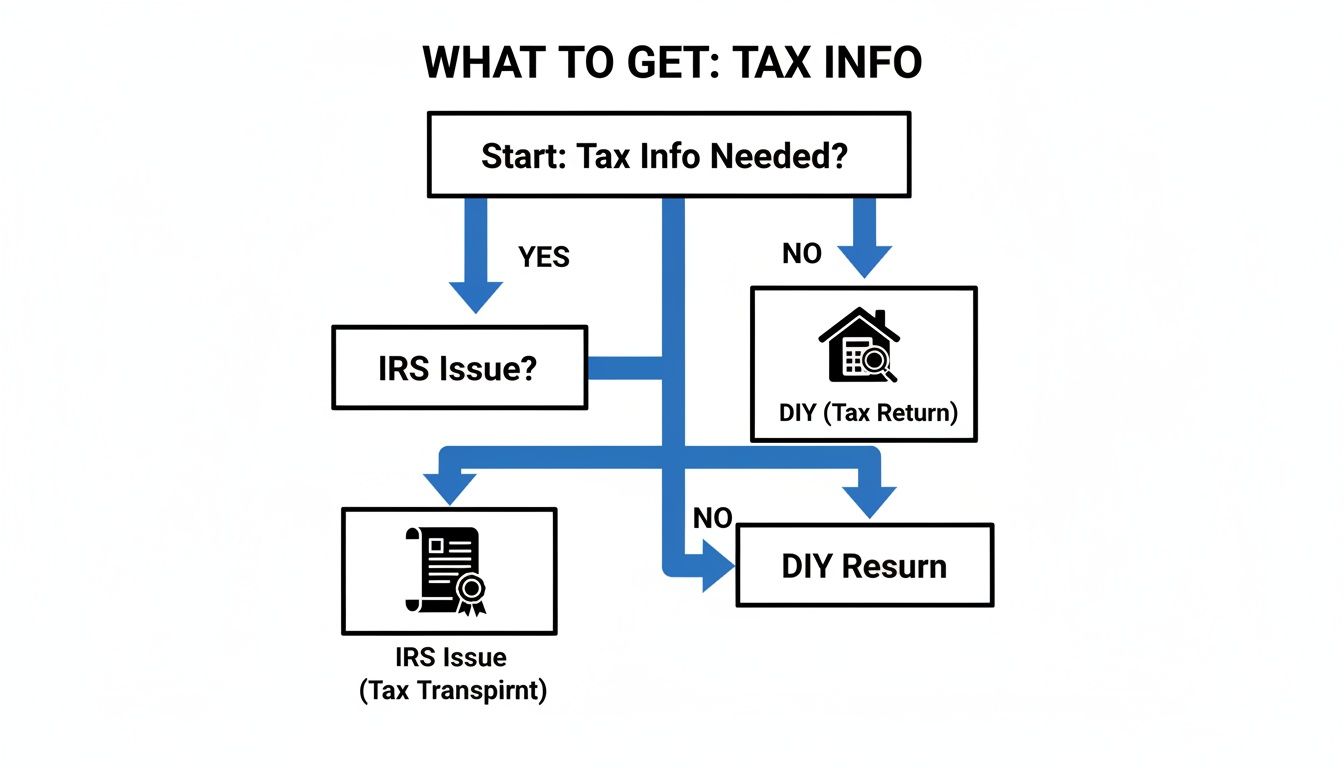
As you can see, for simple tasks like preparing a new return, your own records often do the trick. But the moment you need to sort out a past issue with the IRS or prove your income to a third party, you’ll need an official transcript.
Tax Return Transcript
The Tax Return Transcript is the most common one people request, and for good reason. It’s basically the IRS's summary of your original tax return (like your Form 1040). It shows most of the line items, including your adjusted gross income (AGI), along with data from any schedules you filed.
Just be aware, it won't show any changes or amendments made after you filed. This is the document most mortgage lenders and financial aid offices want to see to verify your income.
Tax Account Transcript
Now, the Tax Account Transcript is different. It doesn't give you the line-by-line detail of your return. Instead, it provides a running history of your account for a specific tax year. Think of it as a statement showing all the activity.
It's perfect for quickly seeing key information like:
- Your filing status and return type
- Adjusted Gross Income (AGI)
- Taxable Income
- A log of payments you’ve made or refunds you’ve received
- Any penalties or adjustments the IRS has applied to your account
This is the transcript you pull when you need to see a timeline of events, like confirming when a payment was posted or when a penalty was assessed.
Record of Account Transcript
If you need the full story, the Record of Account Transcript is what you’re after. It’s the most comprehensive document you can get, combining everything from the Tax Return Transcript and the Tax Account Transcript into one file.
For tax professionals trying to get to the bottom of a complex IRS problem, this transcript is the holy grail. It gives us the complete picture: what you originally filed, plus every single transaction that has happened on your account since.
If you’re a business owner struggling with something like payroll tax debt, this is the document you absolutely need. It lays out the entire history of filings, payments, penalties, and interest, giving you a clear view of how you got to where you are. To better grasp where this information originates, it's helpful to understand how returns are prepared. While UK-specific, this Self Assessment Tax Return Guide offers some great foundational context.
Wage and Income Transcript
This transcript is incredibly useful but serves a very specific purpose. The Wage and Income Transcript lists all the information returns the IRS has received from third parties under your Social Security Number. We're talking about forms like W-2s, 1099s, and 1098s.
It’s a lifesaver if you've misplaced a W-2 or want to double-check that you've accounted for all your income before filing your return.
One important heads-up: The IRS has seen transcript demand skyrocket as tax filings climbed to 165,824,000 in a recent year—a 1.4% jump. While these free transcripts are a fantastic resource, the online version of the Wage and Income Transcript is capped at 85 documents. If you’re a gig worker with dozens of 1099s, the online portal may not show everything. You might have to request it by mail to get the complete list.
Verification of Non-filing Letter
Finally, there’s the Verification of Non-filing Letter. This is a simple but important document. It’s an official letter from the IRS stating they have no record of a processed Form 1040-series tax return for a specific year.
It doesn't say whether you were required to file, only that you didn't. Lenders or government agencies often ask for this letter as proof that you weren't a filer in a particular year.
How to Request Your Tax Transcripts From the IRS
So you need to get your hands on your tax transcripts. The good news is the IRS gives you a few different ways to do it. The best method really just depends on how quickly you need them and whether you're comfortable with the IRS's online systems. Let's walk through the options so you can get what you need without the headache.

Whether you need a transcript for a mortgage application, an immigration filing, or to prepare back taxes, the process starts at the IRS's official "Get Transcript" page. From there, you'll choose your path.
The Fastest Method: Get Transcript Online
If you need your transcripts right now, the IRS’s Get Transcript online portal is your best bet. It’s a self-service tool that gives you immediate access to view, print, and download your records for the current tax year plus the three prior years.
The main hurdle here is identity verification. The IRS uses a third-party service called ID.me to confirm you are who you say you are, and frankly, it can be a frustrating process. During the 2024 filing season alone, the IRS had to suspend processing on over 1.9 million returns until taxpayers verified their identity, which shows just how common this step is becoming.
To get through the ID.me setup, you’ll need to have a few things ready:
- Your Social Security Number (SSN) or Individual Taxpayer Identification Number (ITIN)
- A government-issued photo ID, like a driver’s license or passport
- A smartphone with a camera or a computer with a webcam
- Access to a financial account number (like a credit card, mortgage, or auto loan) that’s in your name
A Quick Tip from Experience: The ID.me verification can be tricky. I've seen plenty of people get stuck because the system couldn't read their ID. If that happens, don't panic. Find a spot with better lighting, lay your ID on a dark, flat surface, and try again. It often works on the second attempt.
Once you’re successfully verified, you get instant access. For urgent needs, this is definitely the way to go.
Request by Mail or Phone
Not a fan of the online verification gauntlet? Or maybe you just don't need the documents immediately. In that case, you can request your transcripts by mail. You can do this through the same 'Get Transcript' portal (just select the mail option, no account needed) or by calling the IRS’s automated phone line at 800-908-9946.
The key thing to know is that the IRS will only send the transcript to the address it has on file for you—no exceptions. You can’t have it rerouted to your office or a PO Box. Expect your transcript to arrive in your mailbox within 5 to 10 calendar days. It's a reliable, if slower, alternative.
Using Form 4506-T for Specific Needs
Sometimes, the standard online or mail options just won't cut it. That's when you turn to Form 4506-T, Request for Transcript of Tax Return. This paper form is the solution for a few specific scenarios.
You'll have to use Form 4506-T if you need to:
- Get transcripts for older tax years (anything beyond the three previous years available online).
- Request transcripts for a business, like an S-Corp or partnership.
- Pull a Wage and Income Transcript that has more than 85 separate income documents on it (the online system has a limit).
- Have the transcript sent directly to a third party, such as a mortgage lender or your tax professional.
When you fill out this form, precision is critical. The name and address you put on Form 4506-T must exactly match the information the IRS had for you in that specific tax year. Any small difference, like a newly married name or a move, will get the request rejected.
With the IRS processing a staggering 163,024,000 returns and issuing $311.651 billion in refunds by a single point in 2026, it's clear why there's such a massive demand for these documents. Transcripts are the official record taxpayers rely on to prove their financial history. For the latest filing season details, you can explore the full IRS statistics for 2026.
Authorizing a Professional to Access Your Transcripts
Look, sometimes handling an IRS problem yourself is just too much. When the pressure is on and the letters keep coming, calling in a tax professional isn't giving up—it's getting smart. But for them to actually solve your problem, you have to give them permission to get your tax records and talk to the IRS for you.
This is done with specific IRS forms, and it's critical to know which one to use. One form gives a professional the power to represent you fully, while another is just a permission slip to get documents. Using the wrong one can bring your case to a screeching halt or give someone more access to your private information than you intended.

Granting Full Power with Form 2848
When you bring on a tax attorney, CPA, or Enrolled Agent to resolve an issue, you’ll almost certainly be signing an IRS Form 2848, Power of Attorney and Declaration of Representative. This is the key that unlocks true representation. It officially tells the IRS that your chosen pro can act on your behalf.
And this is much more than just requesting a tax transcript. A valid Form 2848 lets your representative:
- Get on the phone with IRS agents to discuss your case.
- Receive copies of every notice the IRS sends to you.
- Negotiate resolutions, like an Offer in Compromise or an Installment Agreement.
- Represent you in an audit or an appeal.
Think of it this way: you're handing your attorney the keys to your car. They can't sell it, but they can drive it, take it to the mechanic, and speak for you. Our guide on Form 2848 instructions walks you through how to fill out this essential document correctly.
A Power of Attorney is a declaration of trust. It empowers your representative to not only pull the necessary transcripts but to take decisive action based on what they find, turning information into a resolution.
Using Form 4506-T for Third-Party Access
On the other hand, Form 4506-T, Request for Transcript of Tax Return, has a much more limited scope. While a representative with a Power of Attorney might use this form, it’s most commonly used when a third party only needs to see your tax data and has no right to represent you.
This is the form a mortgage lender needs to verify your income, or a financial advisor might request to check your AGI for retirement planning. It gives the IRS a one-time permission to send your transcript to a specific person or company. Critically, it does not give them the right to speak to the IRS for you, negotiate anything, or do anything other than receive the documents.
Why the Distinction Is So Important
The difference between these two forms is a big deal for everyone involved. A mortgage broker, for instance, has no business negotiating your back taxes, and a tax attorney can't resolve a complex case with just a transcript and no authority to act. When professionals get your transcripts, they often use tools like a specialized tax statement parser to quickly sort through the dense data and pinpoint issues.
This distinction is also a huge factor in the professional tax world. The IRS recently processed 165,469,000 individual returns, a 1.2% increase that shows just how many people are interacting with the system. Tax pros e-filed 87,855,000 of those returns, and it's not uncommon for a CPA to pull a client's transcript and uncover a serious problem that requires a tax attorney. At that point, the CPA refers the client, and the attorney needs a Form 2848 to step in and take over.
Choosing the right form from the start ensures your confidential information is handled correctly and your case moves forward without unnecessary delays.
Troubleshooting Common Tax Transcript Problems
Even when you follow all the right steps, trying to get a tax transcript from the IRS can sometimes go sideways. An error message or unexpected delay is frustrating, especially when you need that information for something important like a loan. But don't panic. Most of these issues are common, and with a little know-how, you can work right through them.
The first hurdle most people trip over is the ID.me identity verification needed for the IRS online portal. I see this all the time. You might fail because the photo of your driver’s license was a little blurry, your address is out of date in some database, or you simply don’t have enough of a credit history for the system to validate.
If you get stuck, don’t just throw your hands up. Try again first. Seriously. Find a room with better lighting, place your ID on a dark, flat surface to kill the glare, and snap a new picture. If that still doesn't do the trick, ID.me has a video chat option to connect with a live agent. It’s a bit of a wait, but it’s a reliable fallback to get you verified.
What if My Transcript Is Unavailable?
It’s a heart-stopping moment: you finally get logged in, only to see a message like "Transcript Not Available" or that the IRS has "no record" of your return. This can mean a few different things, and most of them aren’t cause for alarm.
- You just filed. It takes time for the IRS to process a return. For paper returns, we're talking several weeks, and even longer during the chaos of tax season. E-filing is quicker, but there's still a processing window.
- The return is too old. The online "Get Transcript" tool usually only has the current year plus the three prior years. If you need something older, you'll have to request it using Form 4506-T.
- The IRS hasn't processed your return yet. This one is a bit more concerning. It could mean your return was flagged for a simple error, or it could be something more serious, like suspected identity theft. If weeks have gone by with no movement, that’s a red flag.
If you think identity theft could be the culprit, you need to act fast. We've put together a guide that explains how to navigate IRS identity theft and secure your account.
When the Transcript Data Looks Wrong
Okay, you have the transcript in hand, but the numbers are all wrong. Maybe it shows a balance due that you’re sure you paid off, or a refund you were counting on has vanished. This is where your transcript goes from a simple record to a powerful diagnostic tool.
When your transcript shows a balance due that you believe is incorrect, don't immediately pay it. Instead, cross-reference the Tax Account Transcript with any IRS notices you've received. The transcript provides transaction codes and dates, which should line up with the notices.
For instance, you might spot "Code 290" for an additional tax assessment. The date next to it should match the date on an IRS notice you received explaining why your tax was adjusted. If you never got a notice, or the reason isn't clear, it’s time to start digging.
Another one to watch for is "Code 570 - Additional Account Action Pending." This is the IRS’s way of saying there’s a temporary freeze on your account while they review something. It’s almost always followed by a "Code 971 - Notice Issued," which means a letter explaining the hold-up is on its way. Whatever you do, don't ignore that letter—it holds the key to unlocking the freeze.
If the numbers are way off or you're looking at a bunch of complex codes you don’t recognize, that’s your cue to stop guessing. An expert can read the tea leaves of the transcript codes and build a strategy to get your account corrected with the IRS.
Warning Signs on Your Transcript That Signal a Major IRS Problem
Getting your hands on your IRS transcript can feel like a moment of truth. For many, it’s a simple confirmation of what’s already known—a clean record, no surprises. But every now and then, what you find isn’t what you expected. It’s a gut-punch moment when you realize the document in your hands points to a much bigger issue.

These aren’t small mistakes or minor typos. I’m talking about serious red flags that, if left unaddressed, can spiral into major financial trouble. This is the point where trying to fix it yourself goes from being thrifty to being incredibly risky.
Red Flags to Watch For on Your Transcript
As you scan your transcript, some codes and entries should make you stop in your tracks. Think of them less as numbers and more as signals that the IRS is taking action on your account. Knowing how to spot them is the first step toward getting things back under control.
Here are a few of the most urgent warning signs I’ve seen in my practice:
- Substitute for Return (SFR) Filed: You see "Code 150 - Return filed" for a year you know you never filed. That means the IRS filed a return for you. An SFR is almost always a worst-case scenario because it’s calculated with few, if any, of your eligible deductions and credits, leading to a massively inflated tax bill.
- Large, Unexplained Penalties: Significant penalties, particularly for failure-to-file or failure-to-pay, can balloon a small debt into an unmanageable one. Your transcript will break down these amounts and show exactly when the IRS assessed them.
- Trust Fund Recovery Penalty (TFRP) Assessment: This is a five-alarm fire for business owners. It means the IRS has decided to hold you personally liable for the business's unpaid payroll taxes. You'll see specific transaction codes showing this penalty has been assessed against you as an individual.
If you find an unfiled return or a surprise assessment on your transcript, it’s a clear sign your problem has moved past simple non-compliance. The IRS is now actively working the case, and that demands a strategic response—not just a payment.
Understanding the Implications
These red flags aren't just bad news; they're active threats to your financial wellbeing. An SFR, for example, is the starting gun for IRS collections, which can quickly lead to federal tax liens and levies on your wages or bank accounts. A TFRP assessment puts your personal assets, from your savings to your home, directly in the IRS’s crosshairs.
Another critical code to watch for is "Code 420 - Examination of Account." This means you’re under audit. An audit is a formal investigation into your finances, and how you handle it can drastically change the outcome. Trying to navigate an audit alone is a challenge I wouldn't recommend to anyone.
If your transcript turns up these kinds of issues, your goal needs to shift immediately from fact-finding to building a defense. The temptation to call the IRS and explain might be strong, but this is usually a mistake. Anything you say can be used against you and may limit your future options.
At this point, your best move is to contact a tax attorney. They can translate the complex codes, handle all communication with the IRS for you, and start exploring resolution strategies you probably don’t know exist. While in some situations it may be possible to set up a payment plan with the IRS, that can only happen after a thorough analysis of the entire situation.
Frequently Asked Questions
Even with the best instructions, you're bound to have a few questions when you're trying to pull your tax records. Let’s tackle some of the most common ones we hear from our clients.
How Long Does a Tax Transcript Request Take?
This really comes down to how you ask for it. If you're using the IRS "Get Transcript" online tool and can get through the identity verification, you'll have immediate access. You can view and download your transcripts right then and there.
On the other hand, if you go the old-school route by mail or phone, plan on waiting. The IRS will mail the transcript to the address they have on file for you, which typically takes about 5 to 10 calendar days to arrive. Using Form 4506-T can also have a similar wait time, sometimes longer if the IRS is backed up.
Is a Tax Transcript the Same as a Tax Return?
That’s a great question, and the answer is a firm no. They’re completely different documents. Your tax return is the Form 1040 (or other series) that you or your accountant prepared and sent to the IRS. A tax transcript is the IRS’s summary of the data from that return, processed through their own system.
A tax transcript is often more useful than a copy of your return. Why? It shows the final numbers after the IRS has processed everything, including any changes, adjustments, or penalties they may have added. A copy of your original return won't show you any of that.
Why Can't I Get My Transcript Online?
This is easily the most common point of frustration. The biggest hurdle is almost always the ID.me identity verification process. It's notoriously strict and requires a perfect match between your photo ID, personal details, and even financial records. Any small mismatch can lock you out.
But that's not the only reason an online request might fail. Here are a few other common roadblocks:
- Your most recent tax return hasn't been fully processed by the IRS yet.
- You're looking for a transcript from a very old tax year, which usually aren't available through the online portal (typically anything older than three years).
- There's a freeze or another specific flag on your IRS account that's blocking the system from generating the transcript automatically.
If you hit any of these walls, don't worry. Your next move is to simply request the transcript by mail or submit Form 4506-T.
If your transcripts show a tax problem that feels overwhelming, it's time to bring in a professional. Attorney Stephen A Weisberg at The W Tax Group provides a free, no-pressure Tax Debt Analysis to review your situation and lay out a clear strategy. Book your free consultation today at weisberg.tax.