Your Complete Guide to IRS Tax Transcript Codes
Demystify your IRS account with our complete guide to tax transcript codes. Understand what each code means for your tax situation and learn your next steps.
In this article
- Why Your Tax Transcript Codes Matter
- Who Needs to Understand These Codes?
- A Diagnostic Tool for Tax Professionals
- How to Obtain and Read Your IRS Tax Transcript
- Getting Your Transcript Online
- Alternative Methods and Reading the Transcript
- Quick Reference Guide to Common Tax Transcript Codes
- Common IRS Tax Transcript Codes at a Glance
- Decoding Foundational Filing and Assessment Codes
- When the Initial Tax Amount Changes
- Real-World Example of an Additional Assessment
- Understanding Codes for Payments and Credits
- Common Payment Codes
- Key Tax Credit Codes
- Understanding Penalty and Interest Codes on Your Transcript
- Common Penalty and Interest Codes
- A Path Forward: Penalty Abatement Codes
- Explaining Codes Related to Audits, Holds, and Collections
- Codes Signaling an IRS Audit
- When Your Refund Is Put on Hold
- Codes That Indicate Collections Actions
- When to Seek Professional Help for Your Tax Issues
- Critical Red Flag Codes
- Common Questions We Hear About Tax Transcript Codes
- What Is a Cycle Date on My Transcript?
- Why Does My Transcript Say TC 570 and Where's My Refund?
- Can the IRS Make a Mistake on a Transcript?
Tax transcript codes are the three-digit numbers the IRS uses to document every single action taken on your tax account. Think of them as the official language of your IRS record. Learning to speak this language is the key to understanding your tax history, spotting potential issues, and figuring out what to do next.
Why Your Tax Transcript Codes Matter

Imagine the IRS keeps a detailed diary of your financial life for each tax year—that's essentially what your tax transcript is. The tax transcript codes are the individual entries in that diary, complete with dates and dollar amounts. While the IRS offers a few different transcript types, this guide will focus on the codes you'll find on an Account Transcript, as it provides the most comprehensive, step-by-step history of your account.
Who Needs to Understand These Codes?
Getting a handle on these codes is crucial for anyone who needs a clear, factual picture of their standing with the IRS. It's especially important for taxpayers, business owners, and tax professionals who find themselves in these situations:
- Navigating an IRS audit or examination.
- Working to resolve existing tax debt.
- Applying for a mortgage, student aid, or another loan that requires income verification.
- Trying to figure out why a tax refund is delayed.
- Confirming payments were received and correctly applied to an outstanding balance.
A Diagnostic Tool for Tax Professionals
For a tax attorney, the Account Transcript is the single most important diagnostic tool. The specific codes, their sequence, and their timing tell a detailed story of every interaction between you and the IRS. A seasoned professional can look at these codes and immediately grasp the root of a problem, whether it’s a missing return, an unexpected tax assessment, or the start of collection actions.
For example, seeing a Code 420 (Examination Indicator) followed by a Code 290 (Additional Tax Assessed) and then a Code 582 (Lien Indicator) paints a very clear picture. It shows an audit occurred, which resulted in more tax being owed, and ultimately led to the IRS filing a federal tax lien.
This initial analysis is absolutely fundamental. It allows a tax attorney like Stephen A. Weisberg to accurately diagnose the complexity of a case and map out a precise strategy for resolution before taking any other steps. Learning to read these codes yourself empowers you to have a much more informed and productive conversation about your path forward.
How to Obtain and Read Your IRS Tax Transcript
Before you can make sense of any transaction codes, you first need to get your hands on the transcript itself. The good news is the IRS offers a few different ways to do this, with their online portal being the fastest by a long shot.
Getting Your Transcript Online
The quickest and most direct route is using the IRS 'Get Transcript Online' tool. To use this, you'll have to verify your identity through a secure service called ID.me. The one-time setup process can feel a bit involved—you'll need a government-issued photo ID and a smartphone—but once you're registered, you get immediate access to all your transcripts whenever you need them.
When you go to the portal, you’ll see a login screen that looks something like this.

This is the secure sign-in page where you’ll use your ID.me login to get straight into your IRS account information.
Alternative Methods and Reading the Transcript
If you can't or prefer not to create an online account, you can still request a transcript by mail. You'll need to fill out and send in Form 4506-T, Request for Transcript of Tax Return. Keep in mind this method is much slower; the IRS mails the transcript to the address they have on file for you, and it usually arrives within five to ten calendar days.
Once you have your Account Transcript in front of you, you'll see it’s basically a running log of all activity on your account for a given tax year, laid out in chronological order. Here are the columns you'll be looking at:
- Code: The three-digit transaction code we'll be decoding throughout this guide.
- Explanation of Transaction: A short, and often cryptic, description of what the code means.
- Cycle Date: An eight-digit code (in YYYYWWDD format) that shows when the transaction was processed in the IRS's main system.
- Date: The effective date for the transaction.
- Amount: The dollar amount tied to the transaction.
Here's a crucial tip for reading the Amount column: a negative number is actually a good thing. It represents a credit to your account (like a payment you made) or a decrease in what you owe. On the other hand, a positive number is a debit, meaning an increase in your tax liability. For example, a Code 150 (Return Filed) will have a positive amount, while a Code 846 (Refund Issued) will show a negative one.
Now that you know how to get your transcript and understand its basic layout, let's start breaking down what the most common tax transcript codes really mean for your bottom line.
Quick Reference Guide to Common Tax Transcript Codes
Opening up your IRS Account Transcript for the first time can feel like you're trying to read a foreign language. It's just a wall of three-digit codes, dates, and numbers. This section is your Rosetta Stone—a quick-start guide to help you make sense of the most common tax transcript codes you'll encounter.
Think of it as your first-pass analysis. We'll help you quickly figure out if a transaction is just a normal part of the IRS processing your return, something that needs a closer look, or a more serious flag that requires your immediate attention.
Common IRS Tax Transcript Codes at a Glance
Before we dive deep into every possible code, here’s a quick lookup table. Find the code from your transcript below to get a snapshot of what it means. For more detailed explanations and real-world examples, you’ll want to check out the in-depth sections that follow.
| Code | Plain-Language Meaning | What It Usually Means for You |
|---|---|---|
| 150 | Return Filed & Tax Assessed | Routine. This is the starting point for your tax year. |
| 170 | Failure to File Penalty | Review Carefully. A penalty has been added to your account. |
| 270 | Failure to Pay Penalty | Review Carefully. Another penalty has been added. |
| 290 | Additional Tax Assessed | Action Needed. The IRS says you owe more than you filed. |
| 420 | Examination or Audit Indicator | Action Needed. Your return has been selected for an audit. |
| 570 | Additional Account Action Pending | Review Carefully. A hold is placed on your account. |
| 582 | Lien Indicator | Urgent Action Needed. A federal tax lien has been filed. |
| 610 | Payment with Return | Routine. A payment you made with your filing was posted. |
| 670 | Subsequent Payment | Routine. A payment made after filing has been posted. |
| 766 | Tax Relief Credit | Routine. A credit, like from withholdings, was applied. |
| 810 | Refund Freeze | Action Needed. Your refund is frozen pending a review. |
| 846 | Refund Issued | Routine. Your refund has been approved and sent. |
| 971 | Notice Issued | Action Needed. The IRS mailed you a notice. |
This table should give you a good starting point. Just find the code you're curious about and see what the general implication is.
Important Takeaway: A "Routine" code is generally good news—it’s just the IRS system doing its job. "Review Carefully" is your cue to dig a bit deeper into that specific transaction. Any code marked "Action Needed" or "Urgent Action Needed" is a red flag. These often signal audits, refund holds, or collection actions, and this is where getting professional help can make all the difference.
With this quick reference in your back pocket, you're ready to tackle the details. Let's move on and break down what these codes really mean in practice, starting with the foundational codes for filing and tax assessment.
Decoding Foundational Filing and Assessment Codes
The story of any tax year on your transcript always starts with a few key codes. These are the foundational entries that show you filed a return and the IRS officially recorded—or "assessed"—the tax you owe. Think of these as the opening chapter; they establish the starting point for everything that comes after.
The most important code you'll see here is TC 150, "Return Filed & Tax Liability Assessed." This is the big one. It's the official confirmation that the IRS has processed your tax return. More importantly, it sets the initial tax amount for the year and kicks off the clock for calculating any future penalties and interest.
You can't overstate the importance of this code. TC 150 is the bedrock of your tax record for a given year. In 2021 alone, the IRS processed over 257 million individual tax returns, and every single valid filing resulted in a TC 150 on a transcript. It's the definitive starting line.
When the Initial Tax Amount Changes
Of course, the amount shown next to your TC 150 isn't always set in stone. The IRS might adjust your tax bill after you've already filed, which is when new, related codes will pop up on your transcript. It's crucial to spot these because they directly increase what you owe.
Two common codes signal an increase in your tax liability:
- TC 290 (Additional Tax Assessment): This code means the IRS has added to your tax bill for a reason that isn't a full-blown audit. It often appears because of a math error, a discrepancy in reported income (like a missing 1099), or a credit you claimed that was later disallowed during automated processing.
- TC 300 (Additional Tax Assessed by Examination/Audit): Seeing this code is more serious. It means the extra tax is a direct result of the IRS formally auditing your return.
This flowchart maps out a simplified path for what happens after that initial filing code appears.
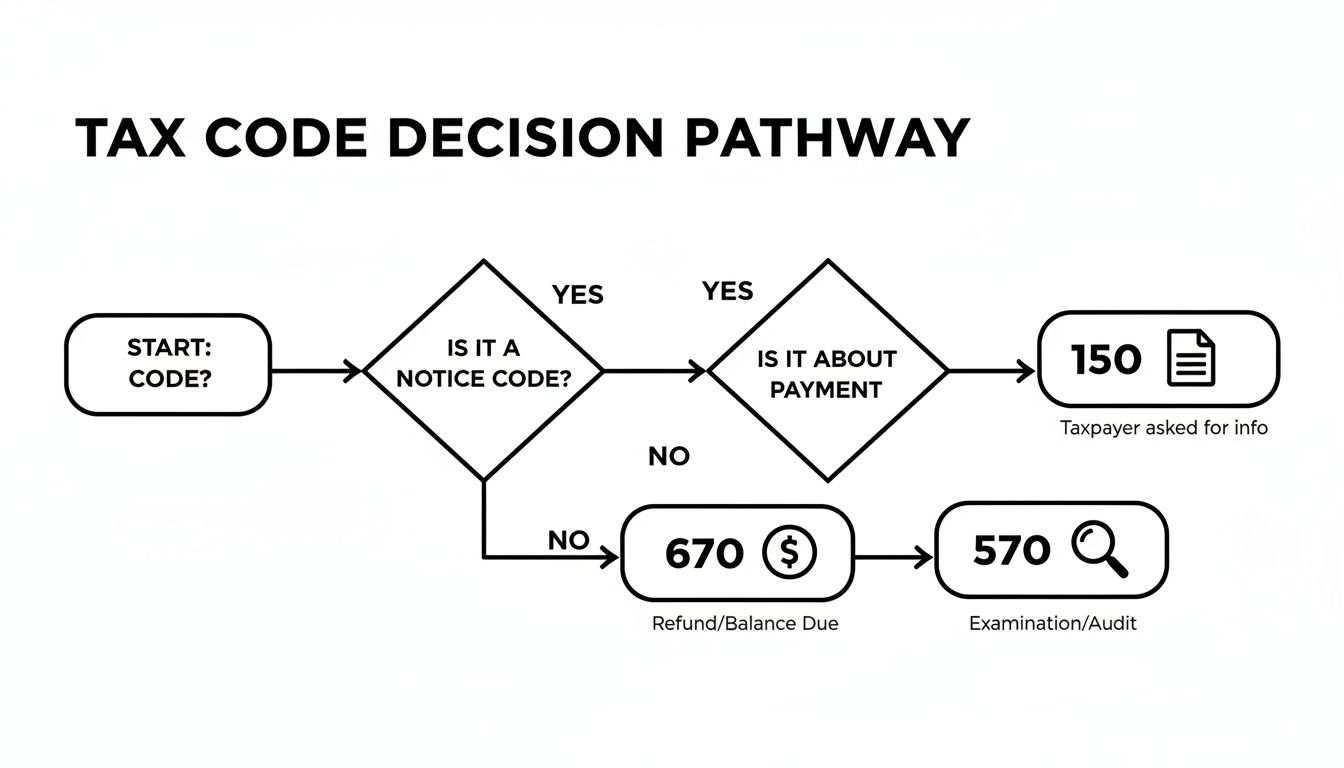
As you can see, different codes represent distinct stages in the process, branching out from that initial filing to holds, payments, and other actions.
Real-World Example of an Additional Assessment
Let's walk through a common scenario. A self-employed graphic designer files their return, and a TC 150 appears with a tax liability of $5,000. A few months later, they get a notice in the mail, and a TC 290 for $1,200 posts to their account. What happened? The IRS computer system flagged that they had fully expensed a new high-end computer instead of depreciating it, disallowing part of the deduction.
That TC 290 entry means their new total tax debt for the year is $6,200, plus any penalties and interest that will now start to build on that additional amount. An assessment like this almost always triggers a formal letter from the IRS. If you get one, you can learn more about what to do in our guide to responding to an IRS Notice CP14. Checking for your TC 150 and then keeping an eye out for any TC 290 or TC 300 codes is the absolute first step in figuring out what you owe and why.
Understanding Codes for Payments and Credits
Once the IRS posts your initial tax liability (you'll see this as TC 150), the next set of codes to look for are the ones that lower what you owe. These are your payments and credits—every dollar you've sent to the IRS or earned through credits should be reflected here. It’s absolutely essential to confirm these entries are accurate.
On your transcript, these codes will show up as negative amounts. Think of it like a bank statement: a negative entry on your IRS account is a credit in your favor, reducing your overall balance due. Getting these right is the first step in making sure you're on solid ground with the IRS.
Common Payment Codes
The IRS uses several different codes to track the payments you make. Each code tells a specific story about how and when you paid, so knowing what they mean helps you piece together your payment history. If you've sent money and don't see the corresponding code, that’s a problem you need to address right away.
Here are the most common payment codes to look for:
- TC 610 (Payment with Return): This is the code for a payment you made right when you filed your tax return.
- TC 660 (Estimated Tax Payment): If you're an independent contractor or run a small business, you should see these codes for your quarterly estimated payments.
- TC 670 (Subsequent Payment): This is a catch-all for any payment made after you've filed. It could be a payment on a balance you already owe or a payment made as part of an installment plan.
- TC 650 (Transferred-in Payment): This code means a payment was moved from another tax year or even from a spouse's account to cover the bill for this particular tax year.
Practical Example: A freelance graphic designer makes four estimated tax payments of $2,000 throughout the year. Their transcript should have four distinct TC 660 entries, each listed as -$2,000.00. If one is missing, the IRS thinks they've underpaid, and their tax bill will be incorrectly inflated.
Key Tax Credit Codes
It’s not just direct payments that chip away at your tax liability—tax credits do, too. These codes represent some of the most common credits that can drastically reduce what you owe or even increase your refund.
Look out for these important credit codes:
- TC 766 (Credit for Tax Withheld): This is a big one. It represents all the federal income tax your employer withheld from your paychecks during the year, as shown on your W-2. Always double-check this number against your own pay stubs and W-2s.
- TC 768 (Earned Income Credit): This code appears when you've qualified for the Earned Income Tax Credit (EITC), a valuable credit designed for taxpayers with low-to-moderate incomes.
Finding a missing payment or an incorrect credit on your transcript is serious. It can create an artificial balance due, triggering penalties, interest, and even collection notices. When this happens, you may need to set up a payment plan to keep the IRS at bay while you work on getting the record corrected. If you're in that boat, it's a good idea to understand your options by reading our guide on how to make payment arrangements with the IRS. Scrutinizing these codes is your best line of defense against paying more than you truly owe.
Understanding Penalty and Interest Codes on Your Transcript
Let's be honest—seeing codes for penalties and interest pop up on your tax transcript is never a good feeling. It's a direct signal from the IRS that, in their view, you didn't meet your tax obligations on time. These codes can dramatically increase what you owe, so figuring out why they're there is your first step toward getting things sorted out.
Think of these codes as the IRS's way of charging you for not following the rules. The penalties are usually calculated based on how much tax you owe and how late your filing or payment is. If you just ignore them, the balance will keep growing, turning a manageable problem into a much bigger one.
Common Penalty and Interest Codes
Most of the time, you'll run into one of three main penalties on a transcript. Each one is for a different kind of slip-up, and yes, it's entirely possible to get hit with more than one for the very same tax year.
- TC 170/176 (Failure to File Penalty): This is the penalty for not filing your tax return by the due date (including any extensions). It's usually much steeper than the penalty for not paying, which is why any tax pro will tell you to always file on time, even if you can't pay a dime.
- TC 270/276 (Failure to Pay Penalty): This one applies when you don’t pay the tax you owe by the original deadline. The penalty keeps adding up monthly until you've paid off the tax debt completely.
- TC 340/346 (Failure to Pay Estimated Tax Penalty): If you're self-employed or have other income without withholding, the IRS expects you to make quarterly estimated tax payments. This penalty shows up when you didn't pay enough tax throughout the year with those payments.
On top of all that, the IRS also charges interest on any unpaid tax. You'll see this as TC 190/196 (Interest Assessed). This interest gets tricky because it compounds daily, adding to your original tax debt and to any penalties that have been tacked on.
A Critical Insight: When you see multiple penalty codes on your transcript, it’s a sign that the situation has escalated. You're not just dealing with a simple tax bill anymore; you have a compounding debt that needs a clear strategy to resolve.
A Path Forward: Penalty Abatement Codes
Now for some good news. Seeing penalty codes isn't always the final word. The IRS has established procedures for removing—or "abating"—these penalties if you have a good reason. When a penalty is successfully removed, you'll see a corresponding abatement code appear on your transcript.
These are the codes you're hoping to see:
- TC 171: Reversal of the Failure to File Penalty
- TC 271: Reversal of the Failure to Pay Penalty
- TC 341: Reversal of the Estimated Tax Penalty
Seeing one of these codes is a huge relief; it means a chunk of your debt has been erased. Getting a penalty abated usually means you have to formally ask the IRS, making a case based on criteria like First Time Abatement or Reasonable Cause. For instance, a serious illness, a death in the family, or a natural disaster could all be considered a valid "reasonable cause" for not filing or paying on time.
The moment you spot a TC 170 or TC 270, it's time to get professional help. A tax attorney can dig into your specific situation, determine if you qualify for abatement, and build a strong argument to present to the IRS. That one move could potentially save you thousands of dollars.
Explaining Codes Related to Audits, Holds, and Collections
While some transcript codes are just part of the normal processing dance, others are a clear signal that the IRS is taking a much closer look at your account. When you spot codes for audits, refund holds, or collections, you need to pay attention. These aren't routine—they're warnings that often come before the IRS takes more serious action.

Knowing what these specific codes mean is your first line of defense. They tell you that a simple filing question has escalated into a formal examination or a collections case. At this stage, getting professional guidance isn't just a good idea; it's often essential.
Codes Signaling an IRS Audit
Seeing one of the following codes is usually the first official sign that your tax return is under review. Catching them early gives you a crucial head start to gather your documents and prepare a proper response.
- TC 420 (Examination or Audit Indicator): This is the big one. If you see a TC 420, your return has been officially selected for an audit. This code automatically freezes any potential refund and starts the formal examination clock.
- TC 424 (Examination Reopened): Just when you thought you were in the clear, this code means the IRS is reopening a previously closed audit. This is a rare and very serious development that demands your immediate attention.
When Your Refund Is Put on Hold
It's incredibly frustrating to expect a refund only to find it delayed. Your transcript can often reveal exactly why your money is being held, thanks to a specific hold code. These codes mean the IRS has paused your refund to investigate a potential issue.
Here are two of the most common hold codes you might encounter:
- TC 570 (Account Hold/Additional Liability Pending): Think of this as a temporary pause button. The IRS system has flagged something on your return—often to verify income, credits, or tax withholdings—and has placed a hold while it looks into it.
- TC 810 (Refund Freeze): This code is much more serious than a TC 570. A TC 810 indicates a major problem, like suspected identity theft or a highly questionable credit claim. It puts a hard freeze on your refund until you resolve the underlying issue.
Important Note: A TC 570 can sometimes clear up on its own after a few weeks. A TC 810, however, almost never goes away without direct action from you or your tax professional. It's a complete stop sign from the IRS.
Codes That Indicate Collections Actions
If you have an unpaid tax debt, the IRS will eventually shift from simply assessing the tax to actively collecting it. When that happens, a new set of codes will start appearing on your transcript. These signal that the IRS is ramping up its enforcement, which could put your personal assets on the line.
Look out for these key collections codes:
- TC 971 (Notice Issued): This code is a bit general, but in a collections scenario, its meaning comes from the codes it appears with. For example, a TC 971 appearing alongside a collections code often corresponds to the date the IRS mailed a final notice of intent to levy.
- TC 582 (Lien Indicator): This is a major red flag. It confirms that the IRS has filed a Notice of Federal Tax Lien against you. This is a public legal claim against your property that can wreck your credit score and make it difficult to sell assets.
The moment these codes appear is critical. A tax lien can quickly lead to even more severe consequences. For a deeper understanding of what comes next, it’s helpful to learn how the IRS levies bank accounts and seizes other property. If you see any of these collections codes, it's time to seek professional legal help immediately to protect your rights and finances.
When to Seek Professional Help for Your Tax Issues
Being able to look up a few tax transcript codes is a great starting point, but knowing when you're in over your head is what really matters. You might be able to figure out what one code means, but a tax professional sees the bigger picture. They can interpret how a whole series of codes, posted over weeks or months, tell the complete story of your IRS account and what the best move is.
Frankly, self-help has its limits, especially when the financial stakes are high.
Some codes are more than just informational—they’re giant, flashing red flags telling you that your tax problem has gotten serious. If you spot any of the following codes on your transcript, it's time to stop guessing and get professional help right away.
Critical Red Flag Codes
- TC 420 (Audit Indicator): This isn't just a question; it's official. The IRS is formally examining your tax return.
- TC 570 (Account Hold): This code signals a problem or delay with your account. It's a temporary pause that can easily escalate into a much bigger issue if ignored.
- TC 810 (Refund Freeze): This is a much more serious hold than a TC 570. The IRS has frozen your refund, and it won't be released until you take specific action to resolve the underlying problem.
- TC 582 (Lien Indicator): This means the IRS has filed a Notice of Federal Tax Lien, a public claim against your property and assets.
- Multiple Penalty Codes (like TC 170 or TC 270): Seeing several of these indicates a growing, compounding debt that requires a real strategy to resolve, not just a simple payment.
Dealing with these issues is about much more than just looking up definitions in a glossary. It’s about knowing the legal process, understanding your rights, and having experience with IRS negotiation tactics. While a big national tax resolution company might push you toward a quick sale, a tax attorney's first job is to diagnose the problem correctly.
A dedicated tax attorney can analyze how these codes interact, protect you from aggressive IRS actions, and negotiate on your behalf. We always start with a free, no-obligation Tax Debt Analysis to get to the root of the problem before we even talk about solutions. Understanding the benefits of hiring a tax attorney makes it clear why expert guidance is non-negotiable for these kinds of problems.
If you see these codes on your transcript, don't wait for the situation to get worse.
Common Questions We Hear About Tax Transcript Codes
Even with a detailed glossary, some transcript codes and terms tend to cause more confusion than others. Let’s tackle some of the most frequent questions taxpayers ask when they're trying to make sense of their IRS records.
What Is a Cycle Date on My Transcript?
Think of the cycle date as the IRS's internal timestamp. It’s an eight-digit number (formatted as YYYYWWDD) that tells you exactly when a specific transaction officially posted to your account in their master file.
It breaks down like this:
- YYYY: The calendar year.
- WW: The processing week of that year (from 01 to 53).
- DD: The day of that processing week (01 for Monday, 04 for Thursday, etc.).
So, if you see a cycle date of 20240804, it means the IRS processed that transaction on Thursday of the 8th week of 2024. Watching these dates can give you a real-time timeline of what’s happening with your account.
Why Does My Transcript Say TC 570 and Where's My Refund?
Seeing a TC 570 (Account Hold) code is understandably stressful, as it means the IRS has hit the pause button on your return and your refund. It’s important to know this isn’t usually a full-blown audit. It’s typically just a temporary freeze while they double-check something.
The most common triggers for a TC 570 are things like a mismatch between the income you reported and the W-2s or 1099s the IRS received, or a need to verify your eligibility for a credit you claimed. Often, these holds clear up on their own in a few weeks. If it lingers, keep an eye on your mailbox for an IRS notice asking for more information.
Can the IRS Make a Mistake on a Transcript?
Absolutely. While the system is mostly automated, errors can and do happen. You might find a tax transcript code or a dollar amount that makes no sense—a payment applied to the wrong year, a penalty that shouldn't be there, or an assessment you don't owe.
If you're certain there's a mistake, you have the right to challenge it. Just be prepared; disputing an error with the IRS often means gathering strong evidence and navigating a complex process. This is precisely the kind of situation where getting a seasoned tax attorney involved can make all the difference in getting your record corrected.
If you've spotted confusing codes or potential problems on your transcript, don't just wait and hope it goes away. The team at Attorney Stephen A Weisberg offers a free Tax Debt Analysis to get to the bottom of your situation and lay out a clear strategy. Contact us today to get the expert help you need.