Tax Topic 151 Explained: A Guide to Your IRS Notice
Received a notice about Tax Topic 151? Learn what it means for your tax refund, why you got it, and the step-by-step process to appeal the IRS decision.
In this article
- What IRS Tax Topic 151 Really Means
- What the notice is really telling you
- Why this notice feels more serious than it often is
- Common Reasons for Receiving a Topic 151 Notice
- The most common offset triggers
- Where the Treasury Offset Program fits in
- The Impact on Business Owners and the Self-Employed
- Why this becomes a cash-flow problem fast
- What works and what usually doesn't
- A Step-by-Step Guide to Responding and Appealing
- Start with the notice itself
- The appeal path depends on the amount in dispute
- IRS appeal paths for refund disputes
- A practical response sequence
- What usually causes appeals to fail
- Documents You Need to Prepare Your Case
- Core documents almost every case needs
- Documents by debt type
- What to leave out
- When to Get Professional Help with Your IRS Notice
- Signs the case needs more than a self-help response
- What professional review can do
- Frequently Asked Questions About Tax Topic 151
- Does receiving a Topic 151 notice increase my chances of a full audit
- How long do I have to file an appeal
- What happens if I ignore the notice
- The debt is with another agency, not the IRS. Who do I contact
- Is there one practical takeaway I should remember
You checked your refund status, expected money is missing, and the IRS notice mentions Tax Topic 151. Taxpayers often read that and jump straight to the worst conclusion. They assume audit, fraud flag, or some major enforcement action is already underway.
Usually, that isn't what this notice means.
Tax Topic 151 matters because it often shows up at the moment a refund has been reduced, withheld, or redirected. For a wage earner, that can wreck a monthly budget. For a self-employed taxpayer or business owner, it can throw off estimated tax planning, payroll timing, and basic cash management. The notice is confusing because it sounds technical, but the practical question is simple: what happened to your refund, and what can you do about it now?
What IRS Tax Topic 151 Really Means
A common client scenario looks like this. You file on time, expect a refund to cover rent, payroll, or quarterly estimates, then the IRS refund tracker shows less money than expected and mentions Tax Topic 151. The notice reads like a warning, but its practical meaning is narrower. It signals that the IRS is giving you appeal rights connected to a decision affecting your refund.
That point matters because cash flow is usually the primary problem. For an employee, a held or reduced refund can upset a tight monthly budget. For a sole proprietor or small business owner, it can interfere with vendor payments, payroll timing, and tax planning. Topic 151 puts you on notice that the government has acted, or is about to act, on your refund and that there is a process to challenge that result if the decision is wrong.
What the notice is really telling you
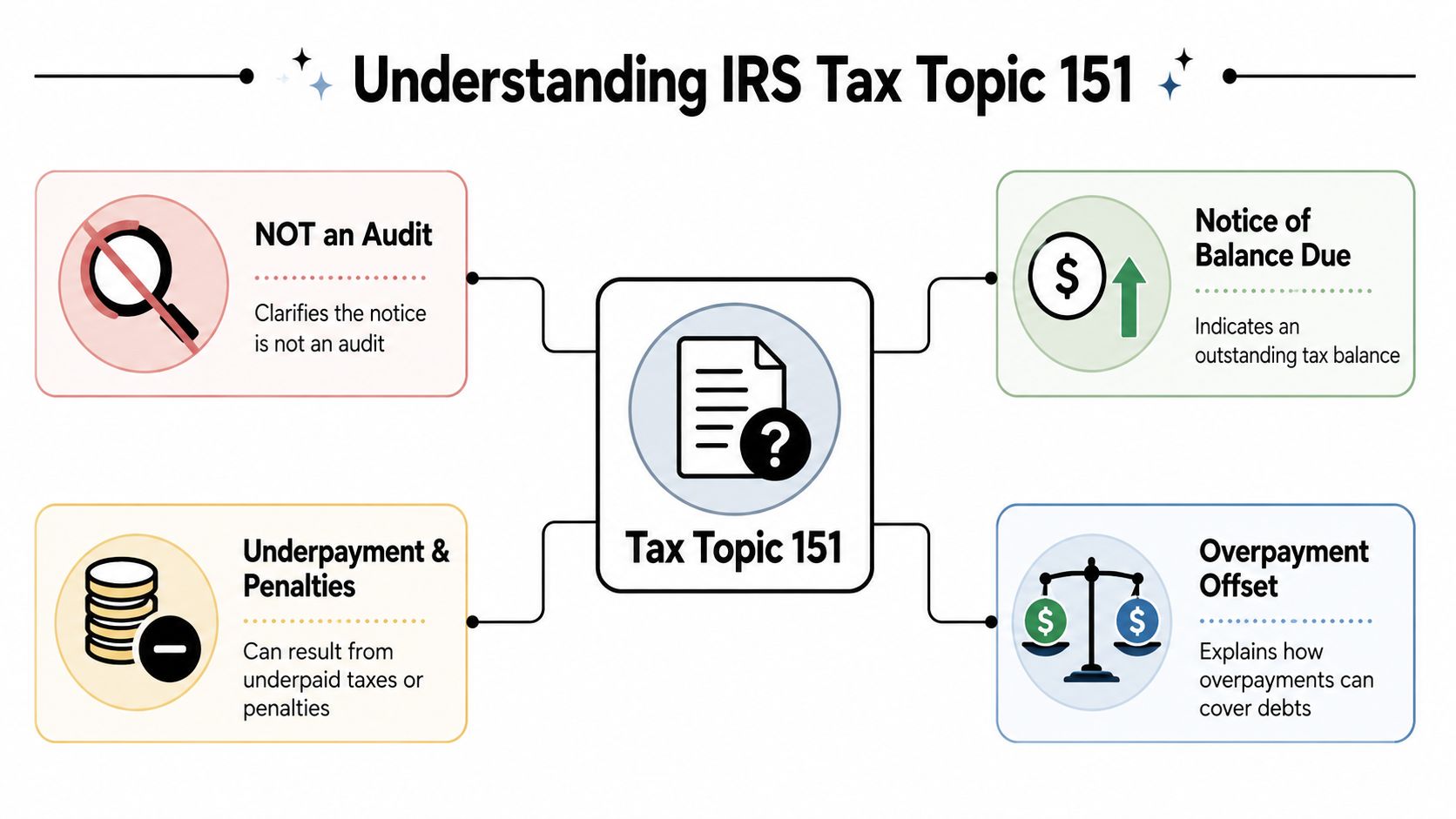
Topic 151 is a procedural notice about appeal rights. In practice, it often appears after the IRS has flagged a refund for reduction, delay, or review. The immediate question is not whether you are in trouble. The immediate question is what decision was made, what part of the refund is affected, and how quickly you need to respond.
That distinction helps people avoid a costly mistake. Taxpayers often spend days worrying about an audit while the actual issue is a time-sensitive dispute over money they were counting on. A missed deadline can turn a fixable refund problem into a longer collection problem.
A fair comparison is a replay review in sports. The call has already been made. Topic 151 tells you there is a formal way to ask for a second look.
Practical rule: Read Topic 151 as a notice about your rights to contest a refund decision, and treat the refund shortfall as a cash-flow issue that needs immediate attention.
Why this notice feels more serious than it often is
IRS wording is technical, and technical language tends to sound punitive. In many cases, the notice is merely the point where an administrative problem becomes a matter with deadlines, records, and appeal rights. That is serious, but it is different from an accusation of fraud or an automatic audit.
This is also why context matters. If you have received other IRS mail recently, compare the notice number and tax year before reacting. Our guide to IRS letters and notices can help you identify what the IRS sent and what response the agency expects.
The practical takeaway is straightforward. Tax Topic 151 means the IRS has connected your refund to a decision you may be able to challenge. If that refund was part of your plan to cover personal expenses or keep business cash reserves stable, address the notice promptly and build your response around the dollars at stake, the deadline, and the records that support your position.
Common Reasons for Receiving a Topic 151 Notice
Most Topic 151 situations come down to one practical issue. Your refund has been offset or withheld because another debt is in play. Operationally, this often means another agency or another IRS module has a claim on the payment before any money reaches you.
That's why the notice can be so confusing. The problem may not start with your current tax return at all. It may start with an older tax balance, child support obligation, or federal student loan issue that now intersects with your refund.
The most common offset triggers
The most common causes for a refund offset associated with Topic 151 are unpaid taxes, unpaid child support, and defaulted federal student loans, and the IRS describes Appeals as an independent office that reviews disputes impartially to avoid litigation, as noted in this discussion of common Topic 151 offset causes and IRS Appeals independence.
In plain terms, your refund can be intercepted because the government is applying it to a different obligation.
Here's how that usually looks in real life:
- Past-due tax debt: A prior federal tax balance can absorb part or all of the refund.
- Child support arrears: A support agency may have the right to claim the refund before you receive it.
- Defaulted federal student loan debt: Collection systems can redirect the refund to satisfy that debt.
Where the Treasury Offset Program fits in
Many taxpayers think, “The IRS took my refund, so this must be an IRS tax mistake.” Sometimes that's wrong. A refund offset can happen through Treasury offset mechanics, where the payment is intercepted to satisfy another government-related debt.
That distinction matters because the notice is about your appeal rights, but the underlying debt source may sit with another agency. The refund issue and the debt issue are related, but they aren't always handled by the same office.
A Topic 151 notice often tells you more about process than fault. It means someone in the system made a claim on your refund, and timing matters if you want to challenge it.
If you're trying to separate a refund offset issue from a true examination risk, it helps to understand what usually triggers a tax audit. Those are different problems, even if taxpayers often lump them together.
The Impact on Business Owners and the Self-Employed
A reduced refund hits differently when you run your own business.
Employees may see the loss as an immediate household budgeting problem. Sole proprietors, independent contractors, and small business owners often feel it in several places at once. The same refund may have been earmarked for quarterly estimates, bookkeeping cleanup, vendor payments, payroll support, or catching up on compliance work.
Why this becomes a cash-flow problem fast
For self-employed taxpayers and small businesses, a reduced refund can significantly affect estimated tax planning, payroll liquidity, and the ability to fund compliance costs, a consequence highlighted in this discussion of cash-flow risks tied to Topic 151.
That's the part many basic articles miss. Losing a refund isn't just disappointing. It can force bad decisions.
A business owner who expected a refund may suddenly need to choose between:
- Making estimated payments on time: Missing those creates a new problem while you're still dealing with the old one.
- Covering payroll or contractor payments: Delay that, and the tax issue spreads into operations and relationships.
- Paying for cleanup work: Sometimes you need records, amended bookkeeping, or professional review to respond properly.
What works and what usually doesn't
What works is treating the offset as a cash-flow event and a tax controversy issue at the same time. That means adjusting near-term business planning while you sort out the dispute.
What doesn't work is waiting for the system to fix itself.
Taxpayers often tell themselves the refund will “shake loose” if they leave it alone for a while. That approach can backfire. If there's a deadline to challenge the decision, lost time narrows your options. If you depend on that money to stabilize the business, delay creates pressure elsewhere.
Business owners usually make their worst tax decisions when cash gets tight. A Topic 151 notice deserves attention because it can turn a refund issue into a planning issue, then into a collection issue.
If you're self-employed, the broader self-employed tax guide is useful because it frames refunds, estimates, and tax reserves as part of one system. That mindset helps when a refund disappears unexpectedly.
A Step-by-Step Guide to Responding and Appealing
A Topic 151 notice often arrives at the worst time. You were expecting a refund, you have plans for the money, and now the IRS is signaling that some or all of it may be held back or applied elsewhere. The right response starts with control, not speed. Read the notice closely, confirm what the government is saying, and then choose the response path that fits the problem.
Start with the notice itself
Before calling the IRS or sending a letter, pin down four things:
Read every page
The headline is not enough. Check the explanation of the refund change, the agency named in the notice, and any date by which you must respond.Decide whether the offset is correct
Some taxpayers agree they owe the debt but need to address how it was applied. Others believe the offset is wrong because the balance was paid, discharged, misapplied, or belongs to another person or period.Match the issue to the right records
A tax debt dispute calls for different proof than a child support, student loan, or other federal debt issue. Sending a general packet of records usually slows things down.Choose the correct procedure
Procedure matters at this stage. A missed deadline or the wrong type of appeal can narrow your options even when the underlying facts are favorable.
The appeal path depends on the amount in dispute
For disputes under $25,000, taxpayers can often request review with Form 12203. Larger disputes generally require a formal written protest that lays out the facts, the history, and the legal basis for your position.
That distinction affects workload and timing. A smaller case may allow a shorter request if the issue is clear. A larger case usually needs a more careful presentation, especially if the refund offset is tied to an older liability, a joint return issue, or a debt being collected through another agency.
IRS appeal paths for refund disputes
| Amount in Dispute | Required Action | Typical Form |
|---|---|---|
| Below $25,000 | Simplified request for review | Form 12203 |
| $25,000 or more | Formal written protest | Detailed written protest |
A practical response sequence
Use a disciplined sequence before filing anything:
- Confirm who is holding the money: If another agency triggered the offset, identify that agency first. The IRS may process the offset without controlling the underlying debt.
- Build a short timeline: List the filing date, the notice date, any prior payments, and the reason you believe the offset is right or wrong.
- Prepare only the records that prove your point: Focused documentation is more persuasive than a large stack of unrelated papers.
- File the right response on time: In these cases, timing affects your advantage, cash flow, and sometimes whether Appeals will consider the dispute in the form you intended.
For taxpayers who want a practical framework, the firm's guide on responding to IRS letters explains how to answer IRS correspondence without creating new problems in the process.
If your records are spread across payroll systems, lenders, tax folders, and scanned statements, organizing them early saves time. Tools like DigiParser for finance operations can help extract transaction and statement data into a format your accountant or attorney can review more efficiently.
What usually causes appeals to fail
The weakest responses usually share the same problems. The taxpayer reacts before identifying the actual debt. The file includes missing or irrelevant records. Or the protest argues with the IRS even though the underlying dispute must be fixed with the agency that certified the debt.
That last point matters more than many people expect. If the refund was offset for a non-tax obligation, correcting the account often requires action outside the IRS first. From a cash-flow standpoint, that can affect how quickly money is released, whether future refunds are exposed, and whether a business owner needs a short-term plan while the dispute is pending.
A good response is calm, narrow, and documented. That gives you the best chance to protect both your position and your cash.
Documents You Need to Prepare Your Case
A good appeal usually looks boring. That's a compliment. It means the file is organized, the records match the issue, and the reviewer doesn't have to guess what happened.
Most weak responses fail because taxpayers send too much of the wrong material or too little of the right material.
Core documents almost every case needs
Start with the basics and build from there:
- The IRS notice itself: Keep every page, including envelopes and inserts if they identify dates or mailing details.
- Your filed return and refund records: Include the return connected to the offset and any proof of expected refund amount.
- Account transcripts or agency correspondence: These often show whether the issue is an IRS balance, a support claim, or a federal debt collection matter.
- A short written timeline: List what happened, when you filed, when you received the notice, and why you believe the action was wrong.
Documents by debt type
Then narrow the file to the actual dispute.
- For unpaid tax debt disputes: Gather proof of payment, copies of prior notices, installment agreement records, or documents showing the balance was already resolved or misapplied.
- For child support offsets: Pull court orders, divorce or support decrees, payment histories, and proof of direct payments if that matters under the facts.
- For federal student loan issues: Get records from the servicer or agency showing the loan status, rehabilitation, discharge, consolidation, or evidence the loan shouldn't be treated as in default.
The strongest file answers the reviewer's next question before they have to ask it.
If your records are scattered across PDF statements, agency notices, and tax documents, tools that structure paperwork can save time. For firms and taxpayers managing messy financial records, DigiParser for finance operations is one example of a document-processing tool that helps extract and organize data from tax-related statements.
What to leave out
Don't send a box of unrelated receipts because you want to look cooperative. Don't attach emotional explanations that never address the legal or factual issue. And don't assume volume equals credibility.
A short, clean package usually beats a large, unfocused one.
When to Get Professional Help with Your IRS Notice
A Topic 151 notice can look manageable at first. Then the refund you were counting on to cover payroll, estimated taxes, rent, or vendor bills gets tied up, and the issue stops being a paperwork problem. It becomes a cash-flow problem.

Some cases are straightforward enough to handle on your own. Others are not. The harder cases usually involve an unclear debt source, overlapping agency procedures, or a refund amount large enough that a wrong move costs more than professional review would have.
Signs the case needs more than a self-help response
Professional help makes sense when the notice creates real financial or procedural risk, especially in these situations:
- The refund matters to near-term cash flow: If you planned to use it for payroll, quarterly tax payments, inventory, or operating expenses, delay has consequences beyond the tax issue itself.
- More than one agency is involved: The IRS may be administering the refund, but the underlying dispute could sit with a child support agency, the Department of Education, a state tax agency, or another creditor.
- The reason for the offset is still unclear: If you cannot identify the debt or confirm the amount, an appeal drafted too early can miss the core issue.
- You run a business or work for yourself: Owners and self-employed taxpayers often have tighter timing pressures because a withheld refund can affect both household and business obligations.
- Deadlines or appeal routes are confusing: The right response depends on whether the dispute belongs with the IRS, the Bureau of the Fiscal Service offset process, or the agency claiming the debt.
Confusion here is common. The rules are technical, and the notice often answers less than it should.
What professional review can do
A good review does more than explain the notice. It identifies where the dispute belongs, what deadline controls, and whether the facts support a challenge worth making.
In practice, that can mean reviewing the notice line by line, pulling transcripts, matching the refund issue to the underlying debt, and deciding whether to file an IRS appeal, contest the debt with another agency, or do both in a coordinated way. That analysis also helps with a practical question many taxpayers ask first: is there a realistic path to getting the money released, reduced, or redirected before the delay creates a larger financial problem?
Attorney Stephen A. Weisberg offers a free Tax Debt Analysis for individuals, business owners, and self-employed taxpayers dealing with IRS and state tax disputes. That kind of review is useful when you need a clear recommendation before committing to full representation.
If the notice affects cash flow, involves multiple agencies, or still does not make sense after you have read it carefully, getting professional help early is often the cheaper decision.
Frequently Asked Questions About Tax Topic 151
A lot of worry around Tax Topic 151 comes from a few recurring misunderstandings. These are the questions clients ask most often after they've read the notice twice and still feel like it says too little.
Does receiving a Topic 151 notice increase my chances of a full audit
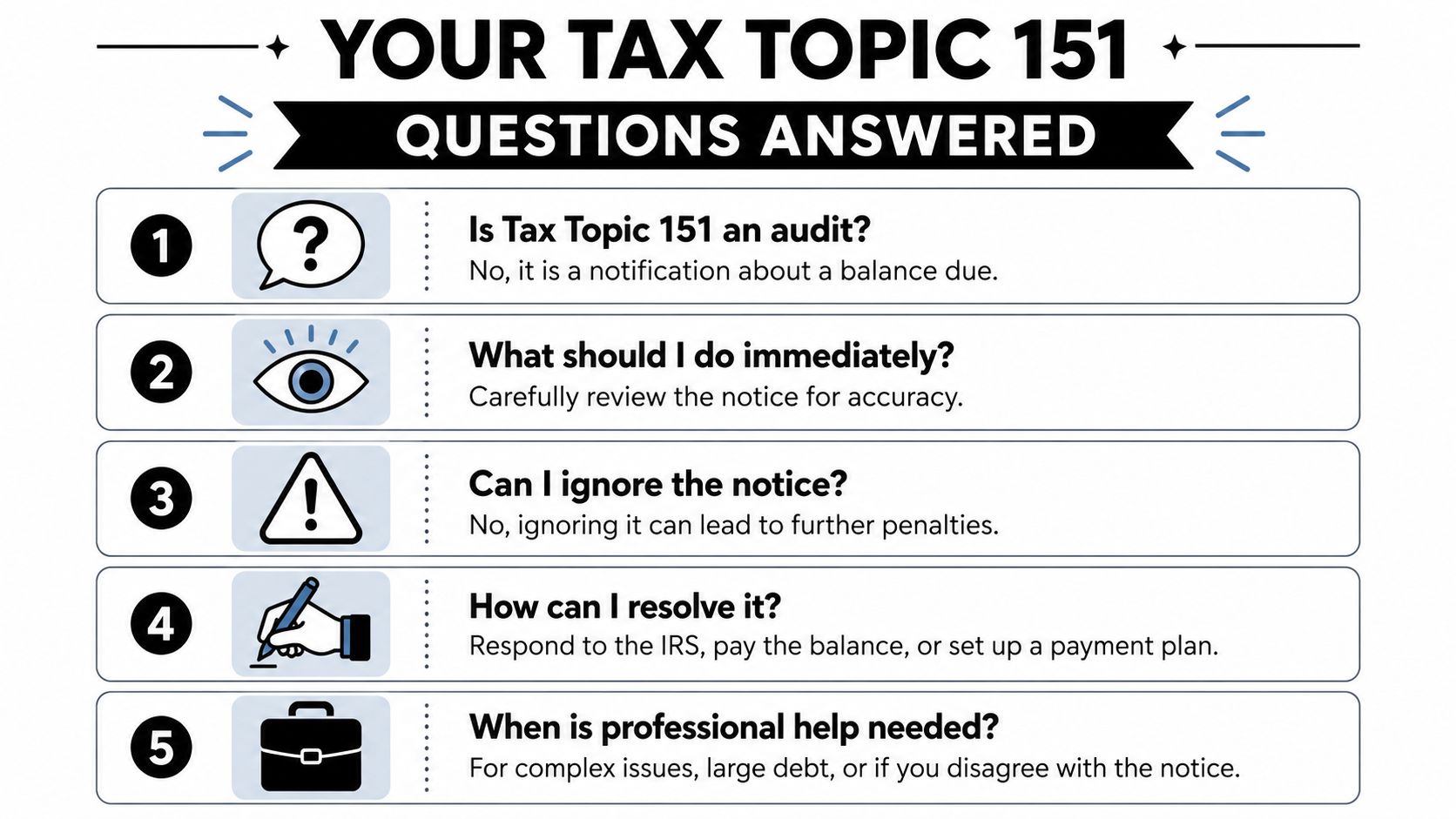
No. A Topic 151 notice and an audit are separate issues. Topic 151 concerns appeal rights tied to an IRS decision affecting your refund or related dispute process. It should not be read as a stand-alone audit notice.
That said, don't let the good news make you passive. The absence of an audit issue doesn't mean the notice can be ignored.
How long do I have to file an appeal
The notice controls. Read it carefully and follow the deadline listed there.
Some notices provide a short response window. What matters most is that you don't assume you have plenty of time. If you wait until the deadline is close, gathering records and identifying the right agency becomes much harder.
What happens if I ignore the notice
Ignoring it usually means losing the chance to challenge the decision effectively. If the refund was reduced or withheld, inaction can leave that outcome in place while your options narrow.
That's especially risky when the withheld refund was supposed to solve another immediate problem, such as estimated tax funding or business operating cash.
The debt is with another agency, not the IRS. Who do I contact
Start by identifying the debt owner named in the notice or related correspondence. The IRS may be the agency that processes the refund impact, but the underlying dispute may belong elsewhere.
That's why some taxpayers feel like they're getting bounced between offices. They call the IRS about the debt source, or they call the debt agency about the appeal procedure. In more complex cases, both tracks matter.
Is there one practical takeaway I should remember
Yes.
- Tax Topic 151 isn't automatically an audit
- It often involves a refund reduction or offset
- The notice is about rights, deadlines, and process
- Business owners should treat it as a cash-flow issue, not just a tax notice
- If the facts are unclear, get the file reviewed before the deadline passes
If you received a Topic 151 notice and your refund was reduced, withheld, or redirected, the next step is to get clear on what happened before time runs out. Attorney Stephen A Weisberg offers a free Tax Debt Analysis to determine whether the issue can be challenged, what agency is really involved, and what response path makes sense for your situation.


