Tax Return Statute of Limitations: 2026 Guide
Tax return statute of limitations - Learn how long the IRS has to audit or assess your taxes, which events pause the clock, and what the rules mean for your
In this article
- Why the Statute of Limitations Is Not One Clock
- One tax year can involve all three clocks
- The Three-Year Assessment Window Under IRC Section 6501
- How to calculate the ordinary period
- What taxpayers often misread
- Refund Claim Deadlines Under IRC Section 6511
- Why payment dates matter
- Timeliness is a legal requirement
- Exceptions That Extend or Eliminate the Assessment Period
- The size of the omission matters
- When there is no ordinary assessment limit
- The Ten-Year Collection Period and the CSED
- Why the return year can mislead you
- Events that affect the CSED
- How State Statutes of Limitations Differ From Federal Rules
- Where state analysis goes wrong
- Walking Through a Real Audit and SFR Timeline
- A practical timeline
- Key Federal Tax Statute of Limitations at a Glance
- Practical Takeaways and When to Talk to a Tax Attorney
“Three years and you're safe” is the most common advice about the tax return statute of limitations, and it's incomplete enough to cause real damage. Federal tax exposure involves separate clocks for the IRS to assess tax, the taxpayer to claim a refund, and the IRS to collect an assessed debt. Each clock has a different trigger, and exceptions can extend or eliminate the ordinary deadline.
A late-filed return, omitted income, unpaid assessment, or missed refund claim can produce a result that looks nothing like the simple rule taxpayers remember. The right question isn't “How many years does the IRS have?” It's “Which clock applies, when did it start, and what event changed it?”
Why the Statute of Limitations Is Not One Clock
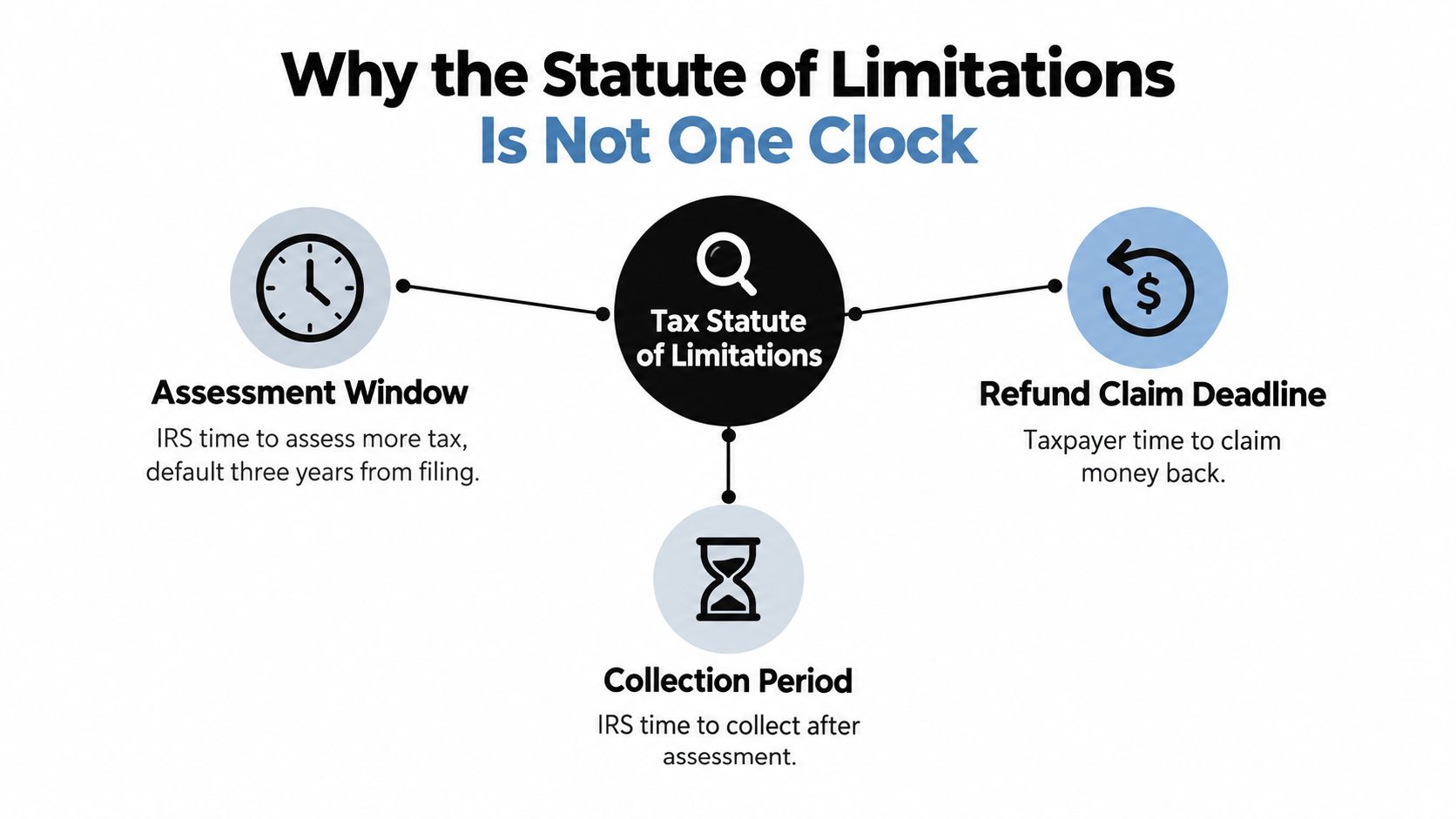
Most taxpayers use “the statute of limitations” as though it were one deadline. It isn't. Federal tax administration has at least three separate limitation clocks, and they protect different parties.
The assessment clock limits how long the IRS generally has to determine and formally assess additional income tax. The default period is three years after the return is filed, including a return filed late, under Internal Revenue Code Section 6501(a). The period can become longer, or disappear entirely, under statutory exceptions.
The refund clock limits how long you have to claim money back. A refund claim generally must be filed by the later of three years after filing the return or two years after paying the tax, with a separate look-back limit affecting how much you can recover. That clock doesn't exist to give the IRS more time. It protects the government from stale taxpayer claims.
The collection clock begins later, after the IRS assesses a liability. The collection period generally runs ten years from assessment, not from the return's original due date, and each assessment can have its own Collection Statute Expiration Date, or CSED. Bankruptcy, collection due-process proceedings, court judgments, and certain agreements can suspend or affect that period, as described in the IRS collection procedures guidance.
One tax year can involve all three clocks
Take a self-employed taxpayer who files a return late, leaves out income reported on a Form 1099, and later discovers that estimated payments exceeded the correct liability. The IRS may still have an assessment question, the taxpayer may have a refund question, and any resulting assessment may create a separate collection question.
Those questions don't share one answer. The filing date matters for assessment, payment dates matter for refunds, and the assessment date matters for collection.
Practical rule: Never decide that a tax year is closed until you identify the relevant clock and verify its trigger date.
The same year can therefore be open for one purpose and closed for another. A taxpayer might lose the right to claim an additional refund while the IRS still has authority to assess omitted income, or face a collection period that began years after the return was filed. Memorizing “three years” is less useful than building a timeline.
The Three-Year Assessment Window Under IRC Section 6501
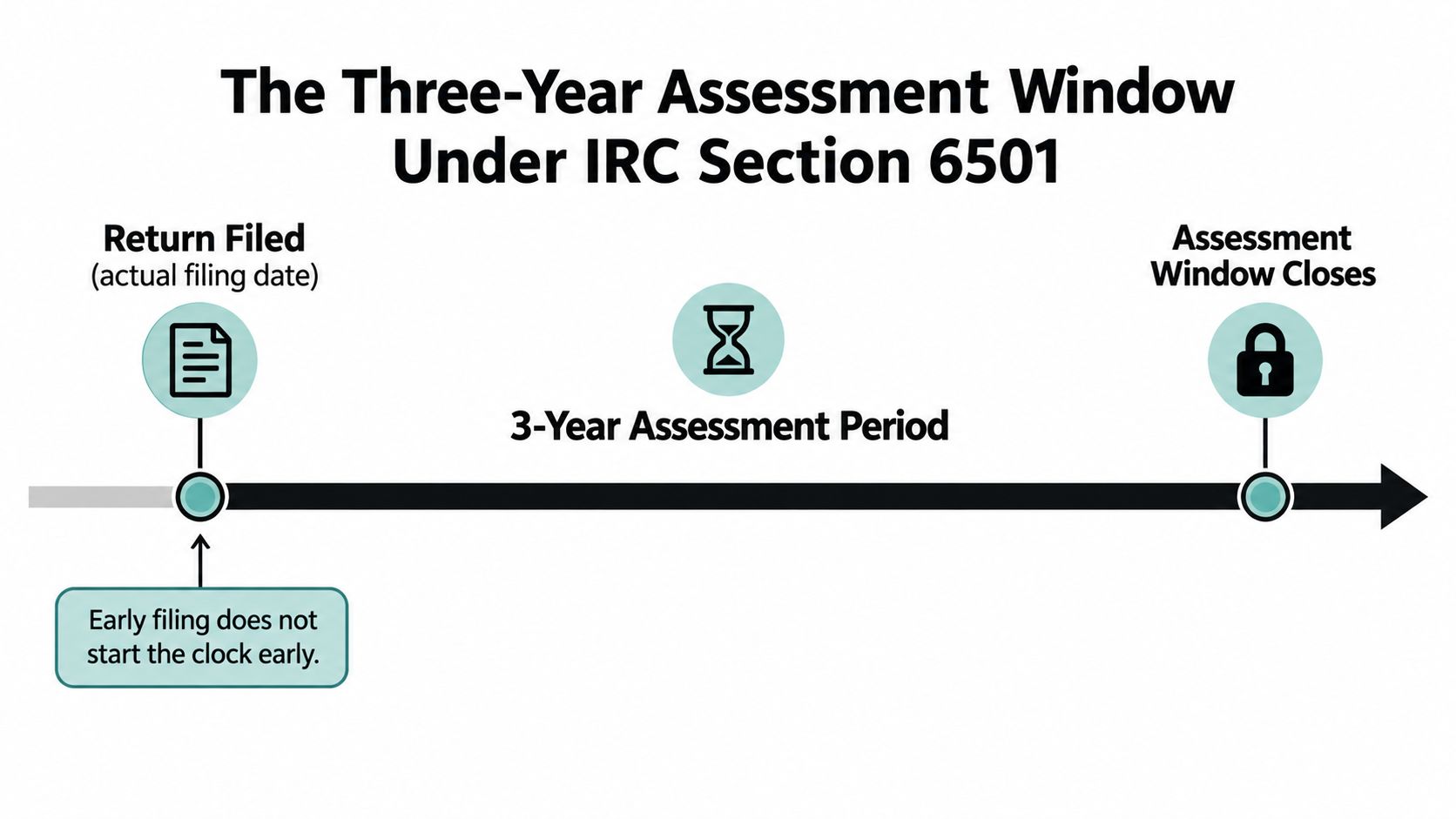
The default federal assessment rule is straightforward. The IRS generally has three years after a return is filed to assess additional income tax, even when the taxpayer filed late. The rule appears in Internal Revenue Code Section 6501(a) and creates a defined period for examining the return and making a formal assessment.
The important detail is the trigger. When a taxpayer files after the original deadline, the ordinary period generally runs from the actual filing date, not automatically from the original due date.
How to calculate the ordinary period
Use this sequence:
- Identify the return involved.
- Confirm the date the taxpayer filed it.
- Add the ordinary three-year assessment period.
- Check for exceptions before concluding that the period has expired.
Suppose a taxpayer files a 2023 individual income-tax return on October 15, 2024. Under the ordinary rule, the assessment period generally runs for three years from that filing date, making October 15, 2027 the relevant closing date, subject to statutory exceptions. The IRS doesn't measure the ordinary period from the original April filing deadline when the return was filed later.
What taxpayers often misread
The passage of another tax year doesn't close the earlier year. An audit discussion doesn't automatically mean the assessment period has expired, and filing an amended, nonfraudulent return isn't a substitute for analyzing the original filing, the income reported, and any statutory exception.
A taxpayer-filed return and an IRS-prepared Substitute for Return also require different analysis. If the taxpayer never files a required return, the absence of a taxpayer-filed return can leave the IRS without the ordinary assessment limitation that would otherwise apply. A Substitute for Return can produce an assessment, but it doesn't automatically give the taxpayer the same protections as a properly filed return.
The filing date is a starting point, not a conclusion. Before relying on it, determine what return was filed and whether the filing was complete.
For a deeper discussion of the audit period and the facts that can change it, review this explanation of the IRS audit statute of limitations. The key point is simple: the ordinary three-year rule is a baseline. It's not permission to discard records or ignore an IRS notice.
Refund Claim Deadlines Under IRC Section 6511
The refund clock runs in the opposite direction. The IRS may be limited in how long it can assess additional tax, but taxpayers also face strict limits when seeking money back.
Under Internal Revenue Code Section 6511, a refund claim generally must be filed by the later of:
- Three years after the return was filed, or
- Two years after the tax was paid.
The applicable rule and related look-back limits are described in the IRS administrative guidance on refund claims.
Why payment dates matter
Taxpayers often have several payment dates. Withholding, estimated taxes, installment payments, and payments made after an examination may not line up with the return-filing date. That's why a refund review based only on the original filing date can miss a later deadline that controls.
For example, if a taxpayer files a return on April 15, 2024, the ordinary three-year filing-based period generally expires on April 15, 2027. A later tax payment may create a later deadline under the two-year payment rule. The taxpayer must compare both periods and use whichever ends later.
That doesn't mean the taxpayer can recover every dollar paid during the entire history of the account. The look-back limitation generally caps the recoverable amount at taxes paid during the applicable preceding period. A timely claim can therefore still recover less than the total overpayment if the relevant payments fall outside the permitted look-back period.
Timeliness is a legal requirement
Refund deadlines are not informal IRS preferences. Courts have treated the statutory deadlines and monetary limits as jurisdictional, which means equitable arguments generally can't replace a timely claim.
Refund discipline: Gather the return, payment records, withholding information, estimated-tax vouchers, and account transcript before calculating the deadline.
If a claim is filed outside the three-year filing-based period, the two-year payment period may become especially important, but it doesn't eliminate the need for precise payment records. Taxpayers dealing with an amended return or a disputed adjustment should map every payment date before assuming the claim is preserved.
A related issue is whether an amended return can still recover an overpayment. The practical rules are explained in this guide to how far back you can amend taxes. Treat refund rights as a separate legal project, not as an automatic consequence of winning an audit dispute.
Exceptions That Extend or Eliminate the Assessment Period
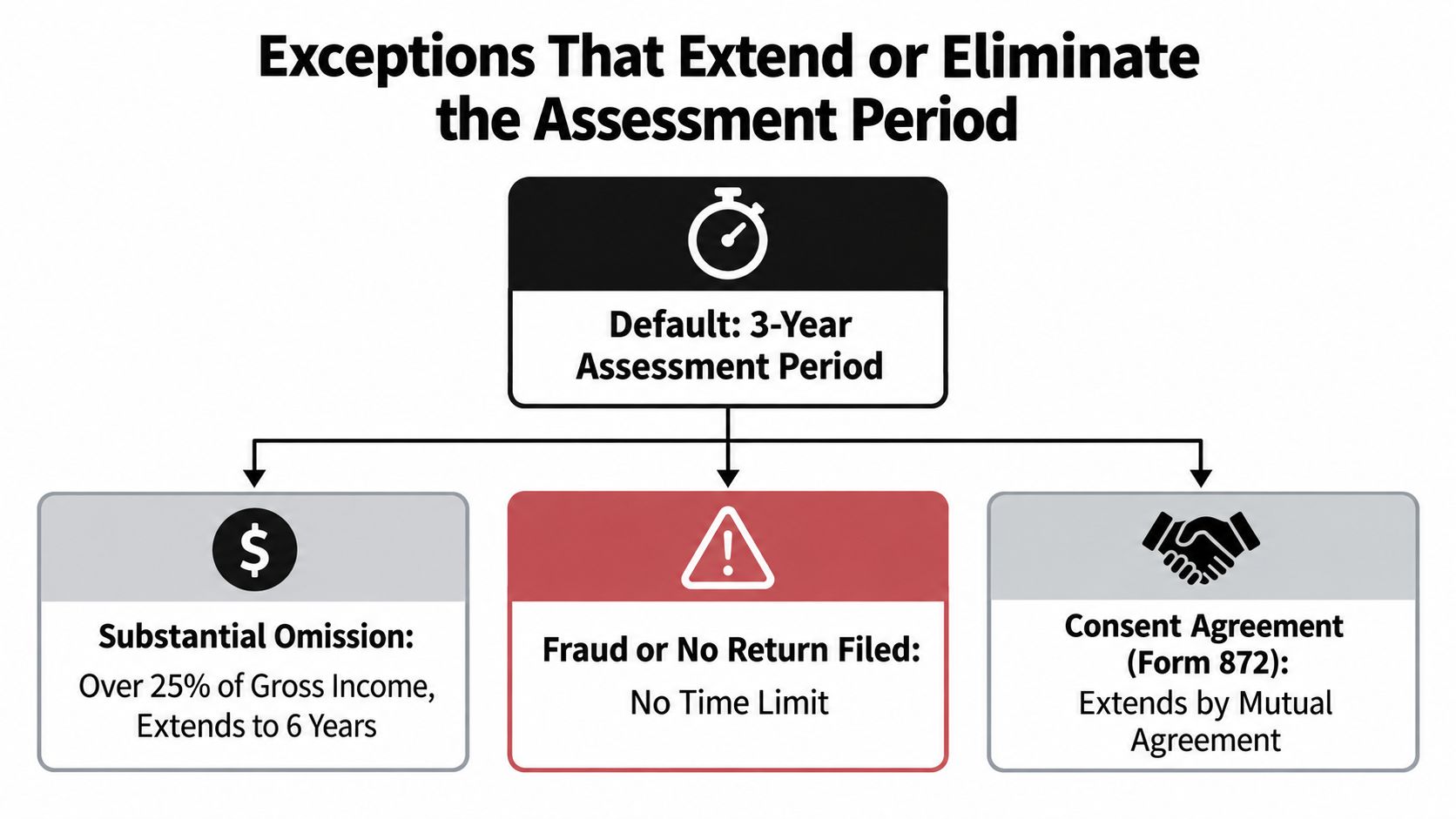
The three-year rule is only the default assessment clock. A large income omission, a fraudulent return, or a missing return can give the IRS more time, or remove the assessment deadline entirely.
The first major exception applies when a taxpayer omits more than 25% of gross income from the return. Under Section 6501(e), the IRS generally has six years from filing to assess the omitted tax, as explained by the IRS tax topic on assessment limitations.
The size of the omission matters
The threshold concerns omitted gross income, not whether the taxpayer made a minor arithmetic error. An omission equal to 15% of gross income does not meet the stated threshold, while an omission equal to 30% does. The source and character of the missing income can matter too, including certain foreign-asset omissions.
Self-employed taxpayers and small-business owners face particular exposure because income may surface through Forms 1099, K-1s, payment-platform reporting, or foreign-account records after the taxpayer considers the year closed. Compare the filed return with third-party reports and business records. Do not assume an IRS notice arriving after three years is invalid.
When there is no ordinary assessment limit
Fraud and nonfiling create the greatest exposure. Federal law provides no assessment limitation for a fraudulent return filed with intent to evade tax, as covered in this guide to the statute of limitations for tax evasion, or for failure to file a required return.
Filing a late return can therefore be better than leaving the year unfiled. A late filing generally starts the ordinary assessment period, provided the return is not fraudulent and no other exception applies. Nonfiling can leave the IRS able to assess tax indefinitely.
An amended, nonfraudulent return filed after a fraudulent return does not restart or create an assessment period. The analysis turns on the original conduct, the filing history, and whether the government alleges fraud or intentional evasion.
The question is not whether the year is old. Ask what was filed, when it was filed, and what income was omitted.
Before claiming an assessment is time-barred, confirm the original filing date, quantify omitted income, identify fraud or nonfiling, and review statutory extensions or agreements. If an examination notice arrives after the ordinary period, preserve records and obtain legal advice before making factual admissions.
The Ten-Year Collection Period and the CSED
Assessment and collection run on separate federal clocks. The IRS can assess tax during the assessment period, but the collection period generally begins with the assessment, not the return's original due date.
The general federal collection period runs ten years from assessment. Each assessment has its own Collection Statute Expiration Date, or CSED. A taxpayer with several unpaid years may therefore have multiple CSEDs, each connected to a different assessment.
Why the return year can mislead you
A taxpayer who files a 2020 return in 2023 and receives an assessment in 2024 generally faces a collection period tied to that 2024 assessment, producing a CSED in 2034. Events can suspend or otherwise affect that period. A Substitute for Return involving an earlier year can create a separate assessment and CSED.
The age of the tax year does not resolve the collection question. The account transcript, assessment date, current balance, pending appeals, and collection history control the analysis. Treat each assessed liability as its own timeline.
Events that affect the CSED
Bankruptcy and a collection due-process proceeding can suspend the collection period. Court judgments and certain agreements can also affect the government's collection rights. Review an installment agreement or offer in compromise before signing because its legal terms may change the timeline.
A payment does not erase the debt, and inaction can lead to avoidable enforcement problems. While the liability remains collectible, the IRS may file a lien or pursue a levy, depending on the circumstances.
For a focused explanation of the IRS Collection Statute Expiration Date, review this guide to the IRS collection statute expiration date, then start with the account transcript rather than a calendar calculation. Request the assessment date, current CSED, every suspension period, and the event behind each adjustment. A tax attorney can then determine whether the IRS's collection rights remain enforceable.
How State Statutes of Limitations Differ From Federal Rules
Federal rules don't control state tax agencies. A federal year that appears closed can remain open for state purposes, and a state deadline can expire on a schedule that doesn't match the federal assessment or refund period.
Many states use rules that resemble the federal framework, but resemblance isn't identity. A state may apply a different assessment period, a different threshold for substantial omissions, a shorter refund-claim period, or a collection window that runs differently. Some jurisdictions also require separate state filings or disclosures even when the federal return has already been filed.
Where state analysis goes wrong
Taxpayers who moved during the year, worked across state lines, operated a business in multiple jurisdictions, or maintained property and customers in more than one state need a state-by-state review. Residency, source income, nexus, filing requirements, and notices can each create separate questions.
The federal return may provide information to a state agency, but that doesn't make the federal limitation period controlling. A state may begin its analysis from a state filing date, a federal adjustment, a required filing that never occurred, or another event defined by its own law.
State warning: Never use a federal CSED or federal assessment deadline as proof that a state liability is unenforceable.
The same discipline applies to refunds. Before filing an amended federal return, determine whether a corresponding state amendment is required and whether the state refund deadline has already expired. Don't assume that a federal extension preserves a state claim.
A reliable review identifies every state where the taxpayer lived, worked, owned property, paid employees, or conducted business. Then it checks the applicable assessment, refund, and collection rules for each jurisdiction. General internet summaries are poor substitutes for state statutes, account transcripts, and professional advice tied to the taxpayer's facts.
Walking Through a Real Audit and SFR Timeline
Consider a self-employed taxpayer with several unresolved years. The taxpayer files one late return, leaves another year unfiled, and receives IRS notices based on third-party income information.
For the late-filed year, the taxpayer-filed return generally starts the ordinary assessment analysis from the actual filing date. If the return omits more than the statutory income threshold, the longer assessment period may apply. If the taxpayer never files the other year, the failure-to-file exception can leave the IRS without an ordinary assessment limitation.
A practical timeline
IRS notice: The taxpayer receives a notice alleging unreported income or requesting a return. The taxpayer should not ignore it or assume age makes it unenforceable.
Substitute for Return: If the taxpayer doesn't file, the IRS may prepare a Substitute for Return. That filing can lead to an assessment based on IRS information, often without deductions the taxpayer could have claimed on a proper return.
Taxpayer-filed return: The taxpayer should gather books, bank records, Forms 1099, K-1s, payment records, and proof of deductions before responding. Filing a correct return can change the liability, but it doesn't erase prior assessment or collection issues.
Assessment: Once the IRS formally assesses the liability, the collection clock generally runs from that assessment date. The taxpayer should request account transcripts to identify the assessment and any CSED.
Collection: Liens, levies, installment agreements, offers, appeals, and bankruptcy can affect the timeline. No payment or agreement should be evaluated without understanding its effect on the account.
The refund clock may also matter if the taxpayer made estimated payments or withholding exceeded the correct tax. That claim has its own filing and payment deadlines, even while the IRS is pursuing an assessment for another issue.
Key Federal Tax Statute of Limitations at a Glance
| Clock | Triggering Event | Default Length | Key Exceptions |
|---|---|---|---|
| Assessment | Return filed | Three years | More than 25% of gross income omitted, fraud, or failure to file |
| Refund claim | Return filed or tax paid | Later of three years after filing or two years after payment | Look-back limits can restrict recovery |
| Collection | Tax assessed | Ten years generally | Bankruptcy, collection due-process proceedings, court judgments, and certain agreements can affect the CSED |
Before speaking with the IRS, write down the return filing date, assessment date, payment dates, notice dates, and every prior agreement or proceeding. A tax attorney can then analyze the actual account rather than relying on the tax year alone.
Practical Takeaways and When to Talk to a Tax Attorney
Pull these records before deciding that a year is closed:
- Returns: Confirm the actual filing date for every federal and state return.
- Income: Check for omitted Forms 1099, K-1s, payment-platform records, and foreign-asset information.
- Assessments: Obtain account transcripts and identify each assessment date and CSED.
- Payments: Map withholding, estimated payments, installments, and later payments for refund purposes.
- Notices: Preserve every IRS and state notice, including envelopes and response deadlines.
Representation is usually worth considering for a Substitute for Return, a multi-year audit, a trust fund recovery penalty, an offer in compromise, or a collection action involving liens or levies. Tax professionals who advise clients can also use resources such as this guide to measure local SEO ROI when evaluating professional marketing, but the legal work here remains document-driven and account-specific.
Common questions deserve direct answers. An amended return doesn't automatically restart the assessment clock. Bankruptcy doesn't automatically erase every tax debt or resolve every collection issue. A spouse's filing status doesn't eliminate the need to analyze the taxpayer's own filing, assessment, refund, and collection facts. If an IRS notice arrives for a year you thought was closed, stop relying on the calendar and obtain the transcript.
Tax Attorney Stephen A Weisberg represents individuals and businesses in IRS audits, tax debt matters, Substitute for Return cases, and state tax disputes, beginning with a free Tax Debt Analysis to determine whether representation fits the facts. Visit Tax Attorney Stephen A Weisberg with your notices, returns, payment records, and transcripts so the applicable tax statute clocks can be calculated before you respond or sign an agreement.


