Tax Resolution Near Me: Find a Local Attorney You Can Trust
Searching for 'tax resolution near me'? This guide shows you how to find, vet, and hire a local tax attorney, avoiding costly mistakes and high upfront fees.

In this article
- Why Tax Resolution Near Me is a Smarter Search
- Local help is easier to verify
- Local firms usually understand the full picture
- The smartest move is simple
- How to Find Qualified Local Tax Attorneys
- Use sources that screen for real professionals
- Look for local signals that can’t be faked easily
- Don’t overlook non-private help
- Keep your shortlist tight
- Vetting Your Candidates Beyond the Website
- Verify the license and the record
- Match the lawyer to your actual problem
- Watch how they talk about process
- Technology matters, but only if it serves the work
- One more test that matters
- The First Conversation and Questions You Must Ask
- Start with who will actually handle the case
- Use compliance as the litmus test
- Ask questions that force real answers
- Listen for order, not promises
- Bring your own documents and facts
- Decoding Fees Timelines and Red Flags
- Read the billing model like a warning label
- Red flags show up before representation begins
- Timelines separate serious lawyers from sales scripts
- What I would look for before signing anything
- Your Next Step Taking Control of Your Tax Situation
Most advice about tax resolution near me is backwards.
It tells you to call the biggest company with the loudest ads, sit through a “free consultation,” and trust that a national brand knows what to do. That’s how people end up paying a huge retainer before anyone has even figured out what the problem really is.
I’ve seen this play out for business owners, independent contractors, and people who just opened a nasty IRS notice after putting it off too long. They’re scared, they want the pressure to stop, and the first sales team that promises relief gets the call. That’s exactly when bad decisions get made.
A tax problem is a legal and financial diagnosis issue before it’s a sales issue. You want someone who can review transcripts, identify what’s filed and unfiled, spot whether the issue is income tax, payroll tax, collections, or something more dangerous, and then tell you whether there’s a real path forward. If a firm wants your money before doing that work, you should be skeptical.
Why Tax Resolution Near Me is a Smarter Search
National tax relief marketing sells speed. It sells certainty. It sells the idea that a tax problem is basically a subscription service: swipe your card, hand over your file, and the machine starts running.
That’s nonsense.
The industry has a pricing problem. Many large firms push for significant upfront fees, sometimes as high as $10,000, before a full analysis is complete, and many “free consultation” calls are sales-focused rather than diagnostic, according to Kennedy Tax Solutions’ discussion of tax attorney pricing concerns. If you’re searching tax resolution near me, you’re already asking the better question. You’re looking for accountability, not a call center.
Local help is easier to verify
A local attorney has a real office, a real license, and a real reputation in a community. That matters.
If your case involves payroll tax debt, unfiled returns, state tax issues, or a personal guarantee problem tied to a business, you don’t want to explain the same facts to three intake people and then get transferred to someone who’s never met you. You want one responsible professional or one accountable local team.
Local firms usually understand the full picture
Tax debt rarely stays in one box. A small business owner may have personal income tax issues, business filings, payroll problems, and state notices all at once.
A local attorney is more likely to ask practical questions early:
- What years are unfiled
- Whether payroll tax returns are missing
- Whether the state is also collecting
- Whether your business is still operating
- Whether bankruptcy, divorce, lending, or licensing issues are tied to the tax problem
That’s what competent tax resolution looks like. It starts with diagnosis.
Practical rule: If the first call feels like a sales funnel instead of a case review, keep looking.
The smartest move is simple
Search local. Shortlist real attorneys. Ask who will review your transcripts and filings before a retainer is discussed.
That one step filters out a lot of bad actors fast. The firms worth talking to won’t dodge it.
How to Find Qualified Local Tax Attorneys
Start narrow. Don’t search for “best tax relief company.” Search for tax resolution near me, tax attorney IRS debt, or tax controversy attorney in your city or county.
Then stop trusting the ads.

Use sources that screen for real professionals
Google is fine for discovery. It’s terrible for judgment.
Build your list from places that connect you to actual licensed professionals and established offices:
- State bar directories. Confirm the lawyer is licensed and active.
- Local bar referral services. These often sort by practice area.
- Your CPA or EA. Good tax preparers know who handles IRS controversy work.
- Bankruptcy attorneys and family law attorneys. They see tax messes all the time and usually know who can clean them up.
- Financial planners and business advisors. They often know which attorneys can move a tax issue without making it worse.
If you’re already working with a firm that handles compliance work, bookkeeping, or tax preparation services, ask them one direct question: “Who do you trust when a client has an IRS collections problem, not just a filing problem?”
Look for local signals that can’t be faked easily
A real local tax attorney usually leaves tracks. Not marketing fluff. Operational details.
Look for:
- A physical office address
- Clear identification of the attorney leading the practice
- Content focused on IRS collections, audits, payroll tax, or state tax disputes
- Evidence that the office works with business owners, not only wage earners
- Local references that make sense for your area
Skip sites that feel like intake portals. If every page pushes one phone number and says almost nothing about who handles the work, assume you’re looking at a lead-generation machine.
Don’t overlook non-private help
Not every taxpayer needs a private firm immediately.
For limited-income taxpayers, Low Income Taxpayer Clinics offer free or low-cost help in tax disputes, and states like North Carolina also have an Office of the Taxpayer Advocate for issues that couldn’t be resolved through normal channels, as described by the IRS Taxpayer Advocate Service’s information on LITCs. If cost is the obstacle, those are serious options.
A trustworthy professional doesn’t act threatened by alternative resources. They’ll tell you when a clinic, advocate office, or another kind of help makes more sense.
Keep your shortlist tight
You don’t need ten names. You need two or three good ones.
Use this quick filter:
- Can I identify the actual attorney?
- Does the firm appear local and established?
- Does the site discuss tax controversy, not just tax filing?
- Can I verify credentials independently?
- Does the intake process sound diagnostic instead of sales-driven?
For a practical screening approach, this piece on how to find a good tax attorney is worth reviewing before you start calling offices.
Vetting Your Candidates Beyond the Website
A polished website proves one thing. The firm paid a designer.
It doesn’t prove competence. It doesn’t prove ethics. It doesn’t prove the attorney has handled your kind of tax problem before.

Verify the license and the record
Every attorney you consider should be checked through the state bar. Do that yourself.
You’re looking for basic facts first:
- Active license status
- Disciplinary history
- Office location
- How long the lawyer has been practicing
- Whether tax controversy or tax resolution appears to be a real part of the practice
This takes minutes. Do it before the consult, not after you’ve signed anything.
Match the lawyer to your actual problem
Tax debt is not one category. It’s several.
An attorney who handles old individual income tax balances may not be the right fit for a business with payroll tax trouble. A lawyer who mostly negotiates installment agreements may not be the right person for audit fallout, appeals, or multi-entity filing issues.
Ask specific experience questions based on your facts.
If you’re a business owner
Your issue may involve:
- Payroll tax debt
- Business income tax debt
- Unfiled entity returns
- Sales tax or withholding issues at the state level
- Exposure for owners or responsible persons
That requires someone who understands both the entity and the owner side of the mess.
If you’re self-employed or a contractor
Your issue may be simpler on paper and uglier in practice.
You may have years of unfiled returns, estimated tax failures, penalty buildup, and IRS collections activity tied to fluctuating income. You need someone who can separate the compliance work from the collections strategy and explain the order of operations.
If another professional referred you
That referral helps, but it doesn’t replace screening.
A CPA, planner, or bankruptcy lawyer may know the attorney personally. Good. You still need to ask whether that attorney routinely handles your category of controversy.
Ask, “How often do you handle matters like mine?” Then listen for a real answer. Not a speech about how experienced the firm is in general.
Watch how they talk about process
Competent lawyers don’t need to oversell. They can explain the path.
A serious answer usually covers some version of these points:
- What records they need
- Whether they’ll review transcripts
- How they identify missing returns and entities
- Who handles communication with the IRS
- What happens first and what waits until later
If they jump straight to “We’ll settle this” without discussing review and groundwork, that’s a problem.
Technology matters, but only if it serves the work
You want an attorney who can manage documents securely, review records efficiently, and keep your file organized. Firms that use modern systems often move cleaner and communicate better.
If you’re evaluating how a firm manages workflow and remote document handling, it helps to understand what cloud-based tax software solutions do behind the scenes. Good systems support the legal work. They don’t replace judgment.
One more test that matters
Ask whether the attorney will personally stay involved.
A lot of unhappy clients thought they hired one person and got handed off to another. Sometimes that’s unavoidable in larger practices. It should never be hidden.
For a concise explanation of why legal representation can matter in these cases, see the overview on the benefits of hiring a tax attorney.
The First Conversation and Questions You Must Ask
Your first call shouldn’t be passive. Don’t sit there waiting to be impressed.
Lead the conversation. The questions you ask will tell you more than the website ever could.

Start with who will actually handle the case
Ask this early: Who will be doing the work on my file?
That’s not rude. That’s basic diligence.
You need to know:
- Whether the attorney you’re speaking with stays involved
- Whether a junior staff member runs point
- Who talks to the IRS
- Who reviews filings and transcripts
- Who answers strategic questions when the case shifts
If the answer is vague, expect confusion later.
Use compliance as the litmus test
This is the question that separates professionals from marketers:
Before discussing settlement options, do you first determine whether all required returns are filed and the taxpayer is compliant?
The right answer is yes. Always.
The IRS will not approve an Offer in Compromise, payment plan, or other settlement until a taxpayer is in full compliance, meaning all required individual, entity, payroll, and state tax returns must be filed first. Cases without compliance have a zero percent chance of success, according to TaxRep LLC’s explanation of the compliance-first method.
That matters because a lot of firms sell the end result before they’ve even checked whether the case is eligible for the starting line.
If a firm talks settlement before it talks filings, transcripts, and compliance, you’re not talking to a serious resolver. You’re talking to a salesperson.
Ask questions that force real answers
Use these in your consult.
Questions about the file
- What records do you need from me before you can give meaningful advice?
- Will you review IRS transcripts or just rely on what I remember?
- How do you determine whether returns are missing or incorrect?
Questions about strategy
- What has to happen first in a case like mine?
- What options might be available after compliance is restored?
- Are there state issues or business filing issues that need to be handled alongside the IRS matter?
Questions about staffing and communication
- How often will I get updates?
- Can I speak directly with the attorney when the case changes?
- Who should I contact if I receive a new notice?
Listen for order, not promises
You want a lawyer who thinks in sequence.
A competent answer often sounds like this: first we gather records, then review transcripts and filing status, then fix compliance, then decide which resolution path makes sense. It sounds boring. Good. Boring is usually honest.
A bad answer sounds exciting. “We’ll get the IRS off your back fast.” “We do these all the time.” “We can probably settle this.” None of that means anything without file review.
Bring your own documents and facts
Don’t show up empty-handed if you can help it.
Bring or send:
- IRS notices
- Any unfiled years you know about
- Business entity information
- Recent tax returns
- A rough picture of income, expenses, and assets
- Any payment plan or prior representative paperwork
That shortens the distance between guesswork and real advice.
If you need a grounded overview of immediate priorities when taxes are already owed, this guide on what to do if you owe taxes is a useful prep read before the consultation.
Decoding Fees Timelines and Red Flags
The fee structure usually tells you whether you are talking to a law office or a sales machine.
Good tax resolution work starts with diagnosis. Bad tax resolution sales starts with a big retainer, a rushed script, and vague promises about “settling” your debt before anyone has reviewed transcripts, filing status, or compliance problems.
Major tax relief companies often require a minimum debt of $10,000 to engage. Investigation fees can average $549 for personal cases and $999 for business cases, with full resolution services costing around $2,900 or more, based on Money’s review of tax relief company pricing and service thresholds. Those numbers matter for one reason. The national-firm model often asks you to spend serious money before anyone can accurately tell you whether your case qualifies for real relief.
Read the billing model like a warning label
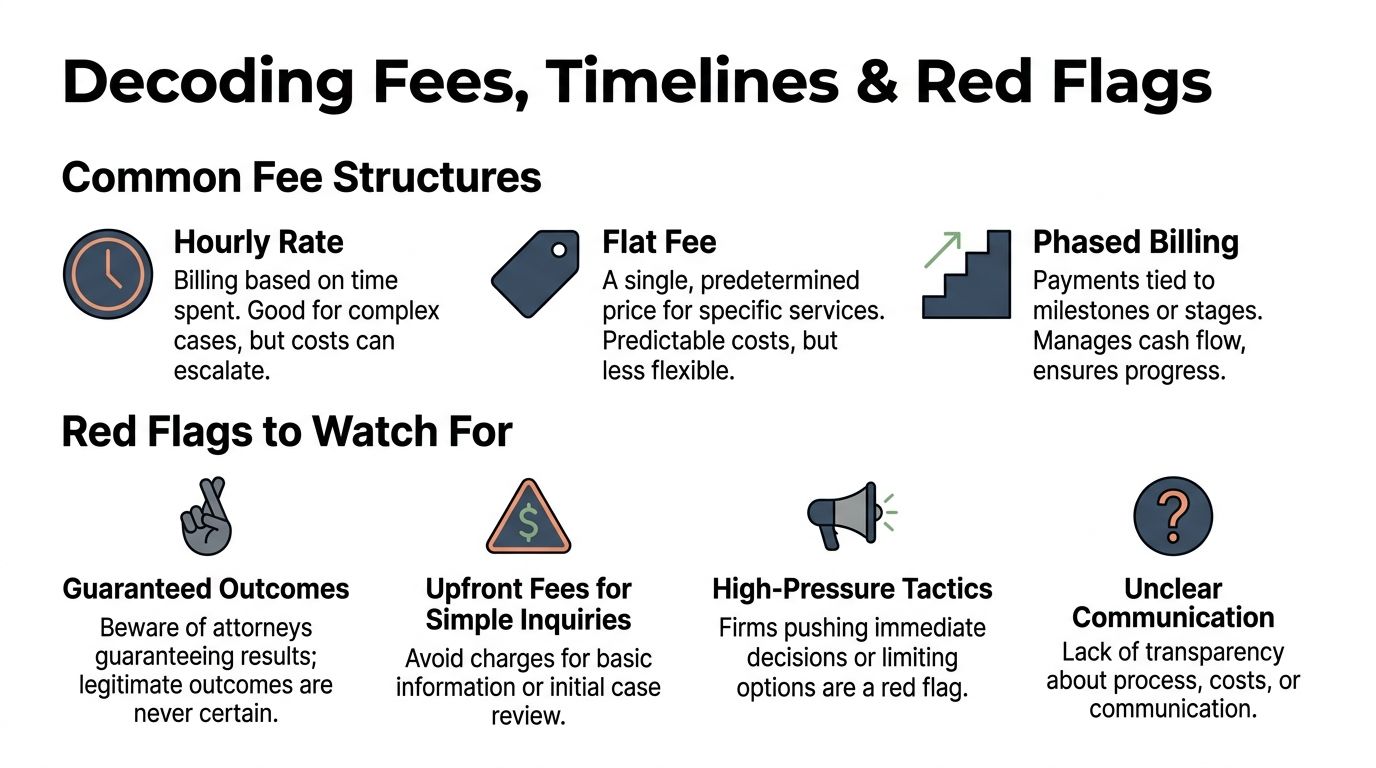
Different billing structures can be fair. The question is whether the fee matches a defined piece of legal work.
Hourly billing
Hourly billing can fit a messy case with missing records, multiple agencies, or business issues. You pay for time spent on actual tasks.
It also needs controls. Ask who bills time, what work is likely to consume hours, and whether support staff rates are separate from attorney rates.
Flat fees
Flat fees are easier to understand if the scope is tight. One fee for one phase can work well.
The danger is a vague engagement letter. If the letter does not spell out what is included, you can end up paying a “flat” fee and still arguing over basics like transcript review, compliance work, or response drafting.
Phased billing
Phased billing is the model I trust most for tax controversy matters.
First comes the file review and case analysis. Next comes compliance work if needed. After that, the attorney recommends the right resolution path and quotes the next phase. That approach protects you from paying five figures up front just to learn you were never a fit for an Offer in Compromise in the first place.
Red flags show up before representation begins
You can usually spot the problem during intake.
| Green Flags (Signs of a Trustworthy Professional) | Red Flags (Warning Signs of a Potential Problem) |
|---|---|
| A real case review comes first | A large retainer is demanded before meaningful analysis |
| The attorney explains what records must be reviewed | The firm pushes urgency before understanding the facts |
| Fees are tied to phases or clearly defined work | The pricing is vague or keeps changing during intake |
| The lawyer discusses compliance, eligibility, and sequence | The sales pitch jumps straight to settlement promises |
| You know who handles the file | You cannot tell who will actually work on the case |
| Communication expectations are clear | Calls and emails stay trapped with intake staff |
One red flag matters more than the rest. If a firm wants a large payment before giving you an in-depth Tax Debt Analysis, assume you are being sold a process, not advice.
Timelines separate serious lawyers from sales scripts
No honest tax attorney promises a quick fix across the board.
IRS cases move at the speed of facts and procedure. Unfiled returns slow everything down. Bad bookkeeping slows everything down. State tax issues, payroll tax problems, and incomplete financial records slow everything down. A lawyer who gives you a clean sequence is being straight with you. A salesperson who gives you a miracle timeline is trying to close you.
What I would look for before signing anything
I would insist on a free, in-depth Tax Debt Analysis before discussing a major retainer.
That review should answer two questions clearly:
- Is there a realistic path to help in this case
- What must be fixed first before any resolution option is on the table
If you do not get those answers, do not sign the engagement letter yet.
For a sharper breakdown of how the high-pressure national model works, read this guide to tax debt relief companies and how to find expert help. It explains why so many taxpayers pay large upfront fees for little more than intake, delay, and recycled promises.
Your Next Step Taking Control of Your Tax Situation
Here is the plain truth. Searching tax resolution near me is usually safer than hiring a national tax relief brand with a polished ad budget and a scripted intake team.
Your job now is simple. Pick two or three local tax attorneys and book the first call. Do not chase the firm with the loudest promises. Chase the lawyer who will study your notices, filings, transcripts, and business records before talking about a large retainer.
A good local attorney will give you a clear starting point. They will tell you whether the case is ready for resolution work, what has to be repaired first, and who will do the work. That is what competent counsel looks like.
The wrong firm sells relief before diagnosis.
So make your next move count. Ask for a free, in-depth Tax Debt Analysis. If a lawyer will not review the actual facts before asking for serious money, keep looking. If they will, you are finally dealing with someone who is treating your tax problem like a legal case instead of a sales opportunity.
Attorney Stephen A Weisberg helps individuals, business owners, and professionals dealing with IRS and state tax problems through The W Tax Group. If you want a direct assessment of whether your case can be helped and what the right next step is, request a free Tax Debt Analysis through his office.