Tax Relief for Business Owners: How to Resolve IRS Debt
Struggling with IRS tax debt? Explore tax relief for business owners, including OICs and Installment Agreements. Learn how to settle payroll & income tax debt.
In this article
- That IRS Notice Arrived Now What
- Tax Planning vs Tax Debt Relief
- What planning does well
- What debt relief is trying to solve
- The two debt categories that drive strategy
- Your Primary IRS Tax Relief Options
- Offer in Compromise
- Installment Agreement
- Currently Not Collectible status
- Comparison of IRS Tax Relief Options
- What tends to work and what usually doesn't
- The Unique Dangers of Payroll Tax Debt
- Why the IRS pursues payroll cases so aggressively
- Who can be a responsible person
- What business owners should do immediately
- How Tax Debt Complicates Bankruptcy and Divorce
- Bankruptcy doesn't automatically solve the tax problem
- Divorce makes tax issues more personal
- Preparing Your Case for IRS Tax Relief
- The forms that anchor the file
- What to gather before you submit anything
- Build the record like someone will challenge it
- When to Call a Tax Attorney and FAQs
- What to avoid
- FAQs
A certified IRS letter can stop a business owner cold. You open it at the desk where you run payroll, approve invoices, and answer customers, and suddenly none of that feels urgent anymore. The only thing you see is the balance due, the deadline, and the fear that one bad tax quarter has turned into a problem you can't control.
That reaction is normal. It also leads a lot of owners into the two worst mistakes. They either ignore the notice and hope the problem settles down, or they rush into a one-size-fits-all “resolution” program without understanding what the IRS is trying to collect.
Tax debt is serious, but it isn't chaos. It's a legal and financial problem with a sequence. If you identify the type of tax involved, get current with filings, document your finances properly, and choose the right relief path, you can often stabilize the situation and negotiate from a stronger position.
That IRS Notice Arrived Now What
The first thing most business owners feel is dread. The second is confusion.
Maybe the notice says you owe income tax from a profitable year that didn't leave enough cash behind. Maybe it's payroll tax debt from a period when you chose employees, rent, and vendors over the IRS because the business had to stay alive. Maybe you already knew there was a problem, but seeing it in a certified envelope makes it real in a different way.

The notice matters, but it doesn't usually require panic. It requires triage. Before you decide whether to call your CPA, a tax attorney, or both, read the notice carefully. Confirm what tax period it covers, what tax type is involved, whether a return is missing, and whether the IRS is asking for payment, proposing a change, or warning about collection action.
Practical rule: Never assume all IRS notices mean the same thing. A notice about a balance due, a payroll tax issue, and a levy warning each call for a different response.
Start with these immediate steps:
- Read the notice line by line. Check the tax year or quarter, entity name, taxpayer ID, and response deadline.
- Match it to your records. Pull the filed return, payroll filings, prior notices, and payment history.
- Don't call blind. If you contact the IRS without understanding the issue, you can waste time or miss a better resolution path.
- Preserve every envelope and page. Dates and notice numbers matter later.
If you need a practical framework for that first response, this guide on how to respond to an IRS letter is a useful starting point.
Tax relief for business owners starts with getting out of paralysis. The IRS system is procedural. When you respond procedurally, your options usually improve.
Tax Planning vs Tax Debt Relief
A lot of owners use these terms as if they mean the same thing. They don't.
Tax planning is fire prevention. You use deductions, credits, entity structure, and timing strategies to reduce what you'll owe. Tax debt relief is firefighting. The tax has already been assessed, the return has already been filed or should have been filed, and now you're trying to resolve an existing liability.
That difference matters because many tax strategies that are excellent for planning don't solve a collection problem after the fact.
What planning does well
The 20% Small Business Deduction for eligible pass-through businesses was made permanent in 2025, and it can reduce current tax liability by allowing a deduction of up to 20% of qualified business income, as described in the NFIB summary of the permanent deduction. That's valuable planning.
It is not a direct fix for back taxes that are already due.
If you're still in planning mode, a business owner should absolutely think about deductions, entity structure, payroll design, and compliance systems. This overview of business tax planning strategies is useful for that side of the equation.
What debt relief is trying to solve
Debt relief deals with liabilities already on the books. The IRS isn't asking whether you could have planned better. It's asking how and when it will be paid, whether collection should pause, or whether the government should accept less because full collection isn't realistic.
That means the facts change. The important questions become:
- Are all returns filed
- Is this income tax debt or payroll tax debt
- What assets, cash flow, and equity does the IRS think you have
- Can the business stay operating while you resolve the problem
Planning lowers future exposure. Relief addresses damage that's already there.
The two debt categories that drive strategy
Most business tax trouble falls into two broad buckets.
Income tax debt usually comes from underpayment, a tax return showing a balance due, estimated tax failures, or an audit adjustment. This can affect sole proprietors, partners, S corporation owners, and businesses that pass tax liability through to individuals.
Payroll tax debt is different. This involves taxes tied to wages and withholding. The IRS treats that debt more aggressively because part of the money was withheld from employees and was supposed to be turned over.
Those two categories often look similar on a notice. They behave very differently in collection. That's why tax relief for business owners has to begin with diagnosis, not slogans.
Your Primary IRS Tax Relief Options
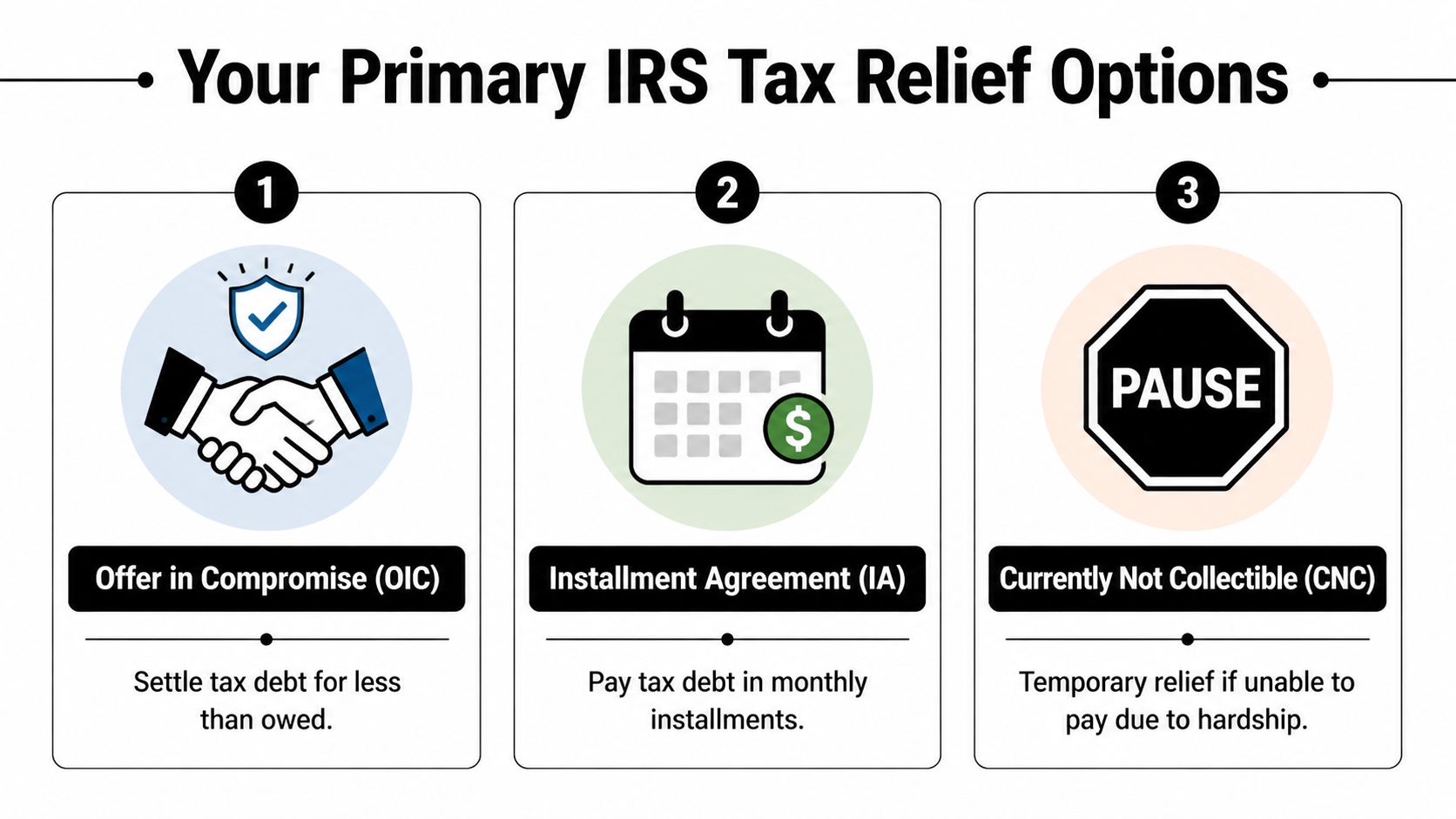
When a business already owes the IRS, three relief paths usually drive the conversation. They are Offer in Compromise, Installment Agreement, and Currently Not Collectible status.
Each has a place. Each also has limits.
Offer in Compromise
An Offer in Compromise, usually called an OIC, asks the IRS to settle a tax debt for less than the full amount. This is the option most heavily advertised, and it's also the one most commonly misunderstood.
An OIC is usually strongest when the taxpayer can prove doubt as to collectibility. In plain English, that means the IRS is unlikely to collect the full balance within the legal collection period based on the taxpayer's assets, income, and allowable expenses. According to this discussion of IRS relief options and OIC outcomes, an Offer in Compromise succeeds in about 40% of cases and often reduces liability by 60% on average.
That doesn't mean every business owner qualifies. It means the cases that work are usually prepared with discipline and supported by real financial evidence.
Good OIC candidates often have limited equity, unstable or modest cash flow, and no realistic path to full payment. Poor candidates usually have significant disposable income, valuable assets, or a business that could pay over time.
Installment Agreement
An Installment Agreement is a payment plan. It doesn't reduce the principal the way a successful OIC can, but it can stop more aggressive collection while you pay over time.
This is often the right path for businesses that are still operating, still generating revenue, and can handle structured monthly payments without collapsing. It can also be the practical choice when the owner doesn't qualify for an OIC but needs breathing room.
The trade-off is straightforward. You keep the debt and pay it in installments. Interest and penalties may continue, and the IRS will still want current compliance going forward. If the business misses new filings or new deposits, the agreement can fail.
Currently Not Collectible status
Currently Not Collectible, or CNC, is hardship status. It tells the IRS that collection should pause because paying now would prevent the taxpayer from meeting necessary living or operating expenses.
CNC isn't forgiveness. It's a hold.
For the right business owner, though, that hold can matter a lot. It can stop active collection pressure and create time to stabilize operations, catch up records, or determine whether a later OIC makes sense. It's often relevant where the owner has little available cash, little collectible equity, and immediate financial distress.
The best relief option isn't the one that sounds dramatic. It's the one the facts can support.
Comparison of IRS Tax Relief Options
| Relief Option | Primary Goal | Best For | Key Consideration |
|---|---|---|---|
| Offer in Compromise | Settle for less than the full balance | Owners who cannot realistically pay in full | Requires detailed proof that full collection isn't likely |
| Installment Agreement | Pay over time | Operating businesses with workable monthly cash flow | Must stay current on new taxes and payments |
| Currently Not Collectible | Pause collection due to hardship | Owners with no present ability to pay | Temporary relief, not a permanent elimination of debt |
What tends to work and what usually doesn't
Some patterns come up repeatedly in practice.
- Strong filings help. If returns are missing, relief usually stalls before it starts.
- Real numbers matter. IRS collection decisions are driven by forms, bank records, profit and loss statements, and asset disclosures.
- Wishful budgeting fails. If the proposed payment doesn't fit the actual cash flow, the arrangement usually doesn't last.
- Delay gets expensive. Penalties, interest, and enforcement pressure don't improve while you “wait and see.”
For some businesses, the right move is to combine approaches over time. An owner might start by securing a collection hold, move into CNC while the business stabilizes, and later submit an OIC once the financial profile is clearer. Others need a clean installment agreement because the company is viable and can support monthly payments.
Attorney Stephen A. Weisberg offers a Free Tax Debt Analysis through W Tax Group to determine whether a business owner's facts point toward one of these options and whether the case is one that can realistically be improved before fees are charged.
The Unique Dangers of Payroll Tax Debt
Income tax debt is serious. Payroll tax debt is usually more dangerous.
The reason is simple. When a business withholds taxes from employees' paychecks, that money is not the business's money to use. The IRS treats those withholdings as trust fund taxes. If the company uses them for rent, payroll, suppliers, or survival, the government still sees those funds as taxes that should have been turned over.

Why the IRS pursues payroll cases so aggressively
The IRS has a special tool for payroll cases. Under IRC §6672, it can assess the Trust Fund Recovery Penalty, or TFRP, against a responsible person. As described in the earlier-cited relief discussion, the TFRP creates 100% personal liability for unremitted trust fund taxes, and assessments average $250,000 per case.
That matters because corporate structure doesn't necessarily protect you here. A business owner may think, “The company owes it, not me.” In a payroll case, that assumption can be badly wrong.
Who can be a responsible person
The IRS doesn't limit this analysis to whoever owns the most shares.
A responsible person may be someone who had authority over financial decisions, control over which creditors got paid, signature authority, or practical control over payroll and tax compliance. Depending on the facts, that can include an owner, officer, manager, bookkeeper, or another person who had enough power to decide whether the IRS got paid.
What the IRS looks for is control and willfulness. If someone knew the taxes were due and allowed other bills to be paid first, the government may argue that person is liable.
For a deeper overview, this article on the Trust Fund Recovery Penalty walks through how that process works.
Payroll tax debt is one of the few business liabilities that can move from the company ledger to your personal life very quickly.
What business owners should do immediately
If payroll taxes are involved, speed matters more than perfection.
- Identify the unpaid quarters. Confirm exactly which Forms 941 or related payroll periods are at issue.
- Separate payroll debt from income tax debt. They require different strategy and carry different personal exposure.
- Stop adding to the problem. Current deposits and filings need to be addressed immediately.
- Document who had authority. Emails, signature cards, payroll roles, and operating practices can matter in a TFRP investigation.
Owners often make the mistake of treating payroll tax debt like an ordinary payable. It isn't. Vendors can wait. The IRS won't treat withheld taxes as a flexible business loan.
How Tax Debt Complicates Bankruptcy and Divorce
Business owners are often surprised to learn that tax debt doesn't stay neatly inside a tax file. It spills into bankruptcy planning, divorce negotiations, business valuation, and settlement discussions in ways that can change the entire legal strategy.
In bankruptcy matters, the central issue is often whether the debt is dischargeable, priority debt, or tied to conduct and timing that keeps it alive after the case ends. Even when someone is exploring bankruptcy for broader financial relief, tax liabilities require separate analysis because the answer is rarely simple.
Bankruptcy doesn't automatically solve the tax problem
Some income tax debt may be dischargeable under the right facts, but many tax liabilities survive. Payroll taxes are especially difficult. So are debts tied to missing returns, recent assessments, or conduct the IRS views as disqualifying.
That's why bankruptcy attorneys and tax counsel often need to coordinate. A bankruptcy filing may help with overall pressure, but it doesn't automatically make the tax issue disappear. This overview on whether tax debt can be discharged in bankruptcy is a useful starting point for that analysis.
Divorce makes tax issues more personal
Divorce adds another layer. A tax debt can affect business valuation, asset division, support discussions, and post-judgment enforcement. If one spouse believes the other created the problem, the case can become emotionally charged very quickly.
Retroactive credits can complicate that process further. The Employee Retention Credit, which offered up to $28,000 per employee in 2021, can create allocation issues in divorce valuation and bankruptcy proceedings, as noted in the Treasury summary of small business tax credit programs. A potential refund, an amended payroll position, or a disputed credit claim may all affect how the business is valued and who bears the benefit or risk.
When tax debt intersects with bankruptcy or divorce, the legal question is no longer just “What do we owe?” It's also “Who carries the consequence, and in what forum?”
For business owners, that means timing matters. Filing a case, negotiating a settlement, or valuing a company before the tax picture is clear can create avoidable mistakes.
Preparing Your Case for IRS Tax Relief
The IRS doesn't grant relief because a story sounds sincere. It grants relief when the file supports the request.
That means your job is to build a case file, not just complete forms. If you're pursuing an OIC, installment agreement, or hardship status, you need documents that show the IRS exactly what you earn, what you own, what you owe, and what you can afford.

The forms that anchor the file
For many cases, the financial heart of the submission is Form 433-A for individuals and Form 433-B for businesses. These forms are where the IRS evaluates income, expenses, bank balances, receivables, real estate, vehicles, retirement accounts, loans, and monthly cash flow.
Preparation matters. According to the earlier-cited IRS relief discussion, TIGTA audits found that about 25% of Offer in Compromise applications are rejected due to incomplete or unsubstantiated financial information. That's not a small drafting issue. It's often the difference between getting considered and getting denied.
What to gather before you submit anything
A strong file usually includes more than tax returns.
- Bank records: Recent statements for business and personal accounts help the IRS test whether the numbers on Form 433 match activity.
- Profit and loss statements: Current internal financials show whether the business is viable and what cash flow is.
- Accounts receivable and payable records: These help explain whether the business is collecting slowly, carrying vendor pressure, or sitting on collectible cash.
- Asset documents: Vehicle titles, loan balances, property records, and equipment lists matter because equity affects collection analysis.
- Proof of necessary expenses: Rent, insurance, payroll, loan payments, and health expenses often need backup.
Build the record like someone will challenge it
Because someone probably will.
If your numbers shift from one document to another, the IRS will notice. If your form says cash flow is tight but your bank statements show transfers, withdrawals, or discretionary spending that tell a different story, the case becomes harder. Consistency is part of credibility.
This issue comes up often when tax debt overlaps with family law. A business owner preparing for relief while also dealing with divorce needs to think carefully about how liabilities, joint accounts, and household obligations are documented. For a plain-English discussion of the financial implications of divorce, that resource helps frame how debt may be characterized and disputed outside the tax context.
A weak tax relief application doesn't fail only because the taxpayer owes money. It fails because the proof doesn't hold together.
Good preparation also makes professional help more effective. Whether you're working with a CPA, enrolled agent, or tax attorney, organized records shorten the path to a realistic strategy.
When to Call a Tax Attorney and FAQs
Some cases can be managed directly with the IRS. Others shouldn't be.
If the issue involves payroll taxes, a pending levy, a revenue officer, a disputed assessment, multiple unfiled returns, an OIC that must be carefully documented, or overlap with bankruptcy or divorce, legal strategy usually matters as much as tax knowledge. That's where business owners often benefit from a tax controversy attorney rather than a volume-based resolution company.
What to avoid
Many large tax resolution firms sell hope first and analysis second. They quote a large upfront fee, promise aggressive relief, and move every caller toward the same solution whether the facts support it or not.
That model is dangerous because IRS relief is fact-driven. A real evaluation starts with filings, transcripts, notice history, entity structure, tax type, assets, and cash flow. If someone is pushing an Offer in Compromise before reviewing those things, that's a warning sign.
If bankruptcy is also part of the conversation, it's smart to ask sharper questions before hiring anyone. This list of key questions for your bankruptcy lawyer is useful because tax issues often survive general advice and require targeted planning.
FAQs
Can the IRS really seize my assets?
Yes. The IRS has powerful collection tools, including levies and liens. Whether it will use them depends on the stage of the case, the type of debt, and whether you've engaged with the process.
How long does tax relief take?
It depends on the relief path, the IRS unit involved, and how complete your documentation is. Cases move faster when returns are filed, records are organized, and the proposed resolution fits the facts.
What happens if my application is denied?
Denial doesn't always end the case. Sometimes the better move is to appeal, supplement the record, switch strategies, or stabilize compliance and reapply later.
Can I get relief if my business is still operating?
Yes. In many cases, an operating business is in a better position to support a payment arrangement or a documented hardship analysis than a business with no active operations at all.
Attorney Stephen A Weisberg helps business owners, self-employed individuals, and professionals dealing with IRS tax debt, audits, payroll tax problems, and related disputes. If you want a clear assessment before paying for representation, request a Free Tax Debt Analysis through Attorney Stephen A Weisberg.


