Tax Relief Eligibility: How to Qualify for IRS Programs
Discover if you qualify for IRS tax relief eligibility. Learn the criteria for Offers in Compromise, CNC status, and installment agreements to resolve tax debt.

In this article
- The Reality of Modern Tax Relief Eligibility
- Evaluating the Primary IRS Relief Pathways
- Financial Criteria and Documentation Requirements
- How the collection calculation works
- What the financial file must prove
- Common Disqualifiers and Hidden Compliance Barriers
- Business taxpayers face additional exposure
- Strategic Guidance for Referring Professionals
- Triage the underlying problem
- Securing a Professional Tax Debt Analysis
“Settle your IRS debt for pennies on the dollar” is one of the most misleading promises in tax resolution marketing. Tax relief eligibility isn't automatic, universal, or based on how badly a taxpayer wants a lower payment. The IRS evaluates the legal category of the problem, current compliance, verified income, assets, expenses, and the amount it believes it can collect.
The first question isn't “Can I get an Offer in Compromise?” It's what kind of tax problem do you have? Someone who can't pay faces a different pathway from someone who disputes the assessment. Treating both situations as settlement cases wastes time, increases professional fees, and can leave a taxpayer exposed while penalties and interest continue.
The Reality of Modern Tax Relief Eligibility
The IRS does not treat every tax debt as a settlement opportunity. It separates doubt as to collectibility, where the liability may be valid but the taxpayer cannot realistically pay in full, from doubt as to liability, where the taxpayer disputes the assessment itself. Effective tax administration covers cases in which collection may be legally possible but would be inequitable or create exceptional hardship. These categories are explained in Publication 594.
The legal theory determines the next move. An audit-driven assessment may require challenging the underlying liability, requesting audit reconsideration, pursuing an appeal, or seeking penalty relief. A taxpayer with accurate returns and insufficient income needs documented financial analysis, an assessment of reasonable collection potential, and a comparison of an Offer in Compromise with Currently Not Collectible status. A form cannot correct a misclassified tax problem.
Practical rule: Do not submit an OIC until you have established whether the dispute concerns the amount owed or the ability to pay it.
Acceptance requires realistic expectations. IRS OIC approvals fell to about 5,500 in fiscal 2025, down 57% from roughly 12,700 in 2023, while applications rose to about 38,800, according to CNBC's reporting on IRS Offers in Compromise. An OIC remains possible for a properly supported applicant. Filing one, however, proves nothing about eligibility.
The IRS screens for compliance and evidence. Required returns must be filed, estimated taxes must be current where applicable, and financial disclosures must withstand verification. “I'm struggling” is not an analysis. The file must show what the taxpayer owns, earns, spends, and can contribute without relying on unsupported estimates.
Foreign talent programs follow the same principle. An OECD review of tax relief programs for foreign talent found that at least 10 countries required an income threshold, while income-based incentives existed in 21 of 38 OECD countries and 16 of 27 EU countries in 2022. Governments increasingly grant relief through measurable conditions, not broad promises.
Evaluating the Primary IRS Relief Pathways
An OIC is only one branch of the IRS system. The correct strategy depends on the problem: inability to pay, a challenge to the liability, penalties caused by reasonable cause, or responsibility for a spouse's conduct. Compare payment arrangements, hardship status, penalty relief, and spouse-based relief before recommending a filing. IRS materials distinguish doubt as to liability, doubt as to collectibility, and effective tax administration. Required returns generally must be filed, estimated taxes must be paid where applicable, and an applicant cannot have an open bankruptcy proceeding. See the IRS overview of collection alternatives.
| Relief Program | Ideal Candidate | Core Eligibility Requirement | Primary Benefit |
|---|---|---|---|
| Offer in Compromise | Taxpayer whose verified collection potential is below the full liability | Current filing and payment compliance, no open bankruptcy, and an offer supported by reasonable collection potential | Potential resolution for less than the total assessed debt |
| Installment Agreement | Taxpayer who can pay over time but cannot pay immediately | A payment structure supported by income, expenses, and account requirements | Spreads payment over an approved period |
| Currently Not Collectible | Taxpayer whose income does not cover basic living expenses | Financial proof showing that collection would interfere with basic subsistence | Suspends active collection while hardship continues |
| Penalty Abatement | Taxpayer with reasonable cause or another recognized basis | Facts and records supporting removal of eligible penalties | Reduces penalty charges without disputing the underlying tax |
| Innocent Spouse Relief | Joint filer unfairly burdened by a spouse's error or omission | Statutory requirements based on knowledge, circumstances, and equitable factors | May separate the requesting spouse from part or all of the joint liability |
An Installment Agreement usually fits a taxpayer with stable disposable income. It does not erase the debt, but it can establish an orderly repayment route without requiring proof that the IRS will collect less through an OIC. Choose it when the taxpayer can meet the payment without creating a new compliance failure.
Currently Not Collectible status addresses inability to pay basic living expenses. It does not address disagreement with the amount assessed. The liability generally remains, interest and penalties may continue, and collection can be reviewed if the taxpayer's financial circumstances improve. A taxpayer who disputes the tax should examine liability-based remedies instead of presenting an affordability problem.
Penalty abatement requires its own analysis. A taxpayer may owe the underlying tax while having a defensible explanation for late filing or late payment, including facts that support reasonable cause. Abatement can reduce the balance, but it does not replace filing missing returns or resolving the principal liability.
Joint filers require a separate review when one spouse managed the finances or caused the error. An innocent spouse relief guide for couples can help identify the relevant facts and records before preparing a request. For a broader comparison, review these tax debt relief options.
Business owners should not default to an OIC. Payroll obligations, current deposits, personal exposure for trust fund taxes, and the company's ability to continue operating may make a payment arrangement or structured hardship strategy more realistic. The decision should follow the taxpayer's verified capacity and the type of dispute, not the promise of a reduced settlement.
Financial Criteria and Documentation Requirements
The IRS reduces tax relief eligibility to a financial record that can be tested. For an OIC, the central concept is reasonable collection potential, or RCP. The IRS generally expects the offer to equal at least the amount it calculates from realizable asset equity plus anticipated future income after allowed basic living expense deductions. The IRS Offer in Compromise guidance describes that framework.
How the collection calculation works
Start with assets. The IRS examines bank accounts, vehicles, real estate, business interests, investments, and other property, then evaluates the equity it believes can be realized. Accurate valuations matter. A property's gross market value isn't the same as its realizable equity, and a business asset may require support for depreciation, liabilities, or restricted marketability.
Next comes future income. The IRS considers what the taxpayer can contribute from anticipated earnings after permitted living expenses. A self-employed taxpayer must separate legitimate operating costs from personal spending, while an employee must document recurring income and necessary expenses. Unsupported discretionary spending can undermine the calculation.
The expense analysis is where many applications fail. The IRS doesn't accept every amount appearing on a bank statement. It tests whether expenses are necessary, adequately documented, and consistent with applicable standards and the taxpayer's circumstances. Verified allowable expenses can reduce projected disposable income, while undocumented or excessive expenses can increase the apparent ability to pay.
What the financial file must prove
Individuals commonly use Form 433-A, while businesses generally provide financial information through Form 433-B. These forms aren't clerical paperwork. They create the factual record the IRS uses to assess income, assets, liabilities, operating expenses, dependents, and payment capacity.
A credible file should reconcile the forms with source records:
- Income records: Pay statements, profit and loss statements, bank deposits, contracts, and recent tax filings should tell the same story.
- Asset records: Mortgage statements, loan balances, valuation evidence, retirement account records, and investment statements should support stated equity.
- Expense records: Housing, transportation, insurance, medical costs, utilities, and other necessary expenses need a clear recurring pattern.
- Business records: Payroll reports, merchant statements, accounts receivable, inventory, and operating obligations should reflect the actual cash position.
- Compliance records: Filed returns, estimated payments, and current federal tax deposits must be checked before the application is submitted.
CNC analysis uses a different standard. The IRS reviews financial information on Form 433-A or Form 433-B and may suspend collection when monthly income doesn't cover basic expenses. Interest and penalties generally continue, and the liability can be reviewed later. The critical question is whether collection would interfere with basic living needs, not whether paying would be inconvenient.
For a technical review of the individual financial statement, use this guide to IRS Form 433-A OIC. The right objective isn't to make expenses appear artificially high. It's to document the taxpayer's real financial position accurately and defensibly.
Common Disqualifiers and Hidden Compliance Barriers
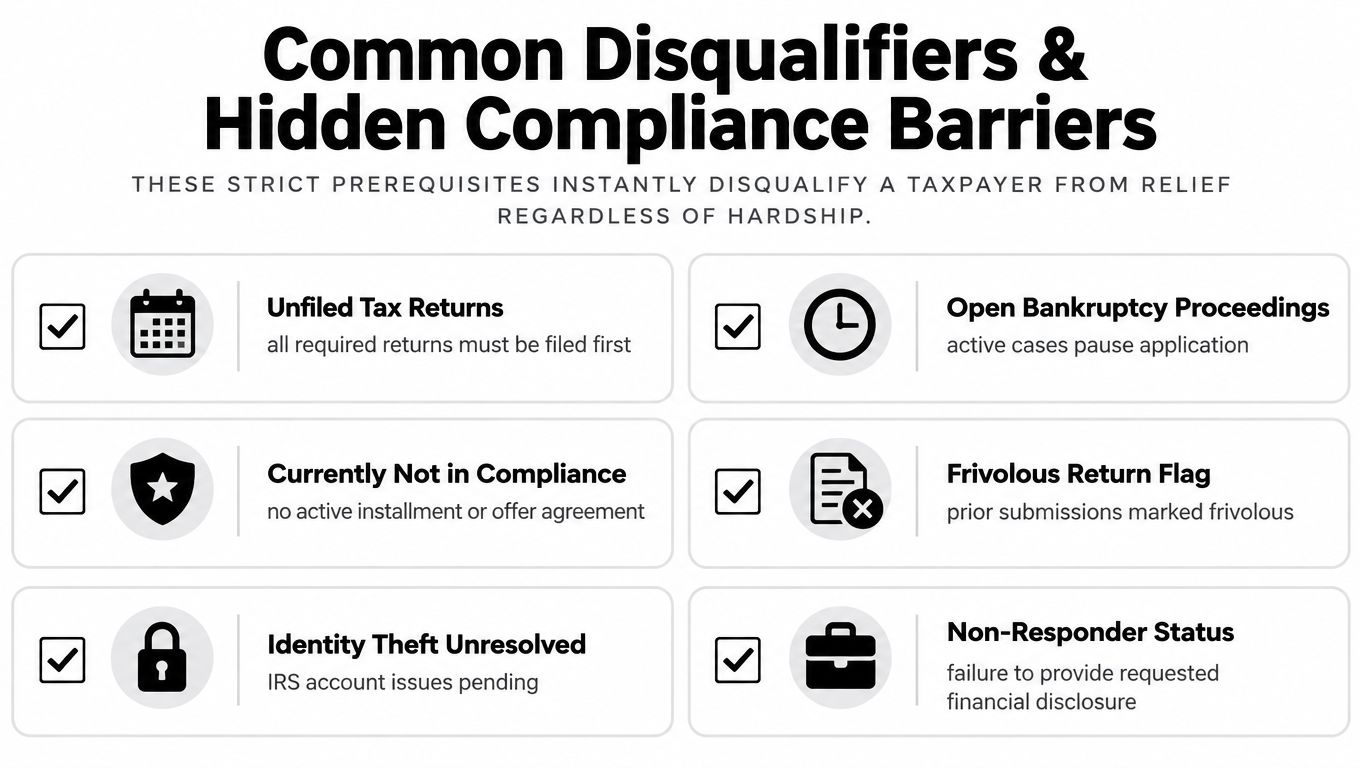
Financial hardship doesn't excuse current noncompliance. A taxpayer may have little income and substantial debt, yet still lose access to an OIC review because required returns remain unfiled, estimated taxes are unpaid, or a business hasn't made required payroll deposits. The IRS treats compliance as a continuing condition, not a box checked once at the beginning.
The first cure is a complete account review. Obtain transcripts, identify every missing return, confirm the filing status for each period, and determine whether estimated payments are required. Don't rely on the taxpayer's memory. IRS records and the taxpayer's records often diverge, and the difference must be resolved before a relief request is built.
Business taxpayers face additional exposure
Employers must make payroll tax deposits for the current and prior two quarters before applying for an OIC. That requirement is particularly important for corporations, partnerships, and small businesses that are trying to resolve historical payroll liabilities while continuing to operate. A business can't ask the IRS to compromise old debt while allowing new trust fund obligations to accumulate.
The same concern applies to individuals assessed the Trust Fund Recovery Penalty. The IRS may pursue responsible persons personally for certain unpaid employment taxes, so a business-level strategy may not resolve the individual's exposure. The analysis must identify who is assessed, which tax periods are involved, and whether the taxpayer has a viable liability dispute.
Open bankruptcy proceedings create another barrier to OIC consideration. Bankruptcy counsel should coordinate with tax counsel before assuming that a bankruptcy filing will solve the tax problem. The treatment of tax liabilities depends on the type of tax, the age and filing history of the returns, the status of notices, and other legal factors.
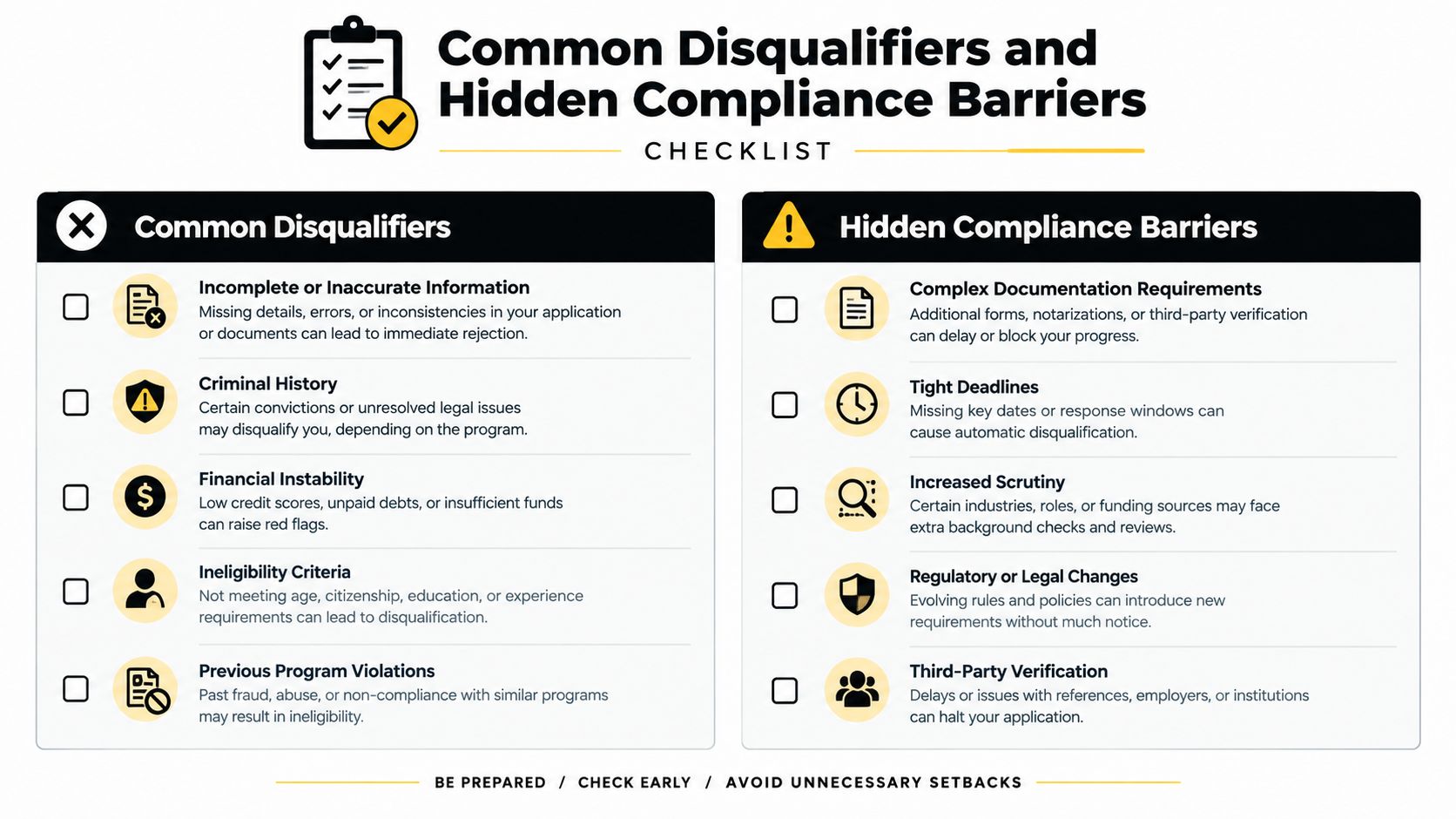
Other application problems are procedural but serious:
- Incomplete disclosure: Missing bank statements, asset records, or business information can cause the IRS to reject the financial presentation.
- Inconsistent reporting: Returns, forms, bank activity, and explanations must fit together.
- Unresolved notices: A taxpayer may be addressing collection while an audit or identity issue remains active.
- Failure to respond: Ignoring IRS requests can end an otherwise viable review.
- New liabilities: A taxpayer who becomes delinquent again weakens the case for discretionary relief.
Before submitting anything, use a documented cure plan. Resolve filing gaps, bring current obligations into compliance, and establish a reliable process for future deposits or estimated payments. For payment-plan problems, these IRS installment agreement rejection reasons provide useful warning signs.
Strategic Guidance for Referring Professionals
A tax liability can undermine a transaction or legal matter. CPAs, enrolled agents, wealth advisors, realtors, mortgage professionals, bankruptcy attorneys, and family law counsel should ask about IRS debt before a client reaches the closing table or signs a final agreement. The referral point is usually earlier than the client expects.
Triage the underlying problem
Ask three questions:
- Does the client dispute the assessment? If yes, send the matter toward liability analysis, audit reconsideration, appeals, or litigation rather than immediately pursuing collection relief.
- Can the client pay without sacrificing basic needs? If no, gather cash-flow and expense information for a hardship or collection-potential review.
- Is the client currently compliant? Check filed returns, estimated taxes, payroll deposits, active agreements, bankruptcy status, and outstanding information requests.
A realtor or lender may notice a federal tax lien or collection notice when a sale or mortgage approval is already under pressure. The professional doesn't need to give tax advice. The right move is to identify the issue, preserve transaction timelines, and refer the client to someone who can evaluate release, withdrawal, subordination, payment arrangements, or other available measures.
Bankruptcy attorneys should avoid promising that filing will eliminate IRS exposure. Some tax debts may remain collectible, and unresolved filing or payroll issues can complicate the case. A tax attorney should review the liability before the bankruptcy strategy is finalized.
Family law counsel faces a similar problem. A divorce decree can allocate responsibility between spouses, but a private allocation doesn't necessarily bind the IRS. Joint-return liabilities, omitted income, and one spouse's lack of knowledge may require an innocent spouse analysis before the parties treat the tax issue as settled.

The best referral is specific. Send the tax professional the notices, account transcripts, filed returns, payment history, business records, and the deadline that matters.
Professionals can use this tax debt referral resource for CPAs and tax attorneys to structure that handoff. A complete referral lets counsel determine whether the client has a collection problem, a liability problem, a compliance problem, or several at once.
Securing a Professional Tax Debt Analysis
Don't pay a large upfront fee merely to have someone fill out Form 433-A or mail a generic IRS packet. The difficult work happens before submission. Counsel must determine the correct relief category, reconstruct the account, test compliance, calculate collection potential, and decide whether an OIC is stronger than an installment agreement, CNC request, penalty abatement, or liability challenge.
A useful analysis should answer specific questions:
- Are all required returns filed?
- Are estimated tax payments current?
- If the client is an employer, are payroll deposits current?
- Is the client in open bankruptcy?
- Does the client dispute the tax itself?
- What assets can the IRS realistically reach?
- What income remains after properly supported basic expenses?
- Would an OIC, installment agreement, CNC request, or penalty strategy produce the most defensible result?
The acceptance figures reported for fiscal 2025 make this triage more important, not less. A weak OIC can consume time while collection activity continues, and an incomplete financial statement can create credibility problems. A realistic recommendation may be less dramatic than a settlement promise, but it should fit the evidence.
Tax Attorney Stephen A Weisberg offers a free Tax Debt Analysis before charging clients to resolve IRS issues. The analysis is intended to determine whether help is available and which strategy fits the taxpayer's actual account, financial records, and compliance position.
Tax Attorney Stephen A Weisberg works directly with individuals, business owners, and referring professionals on IRS tax debt, audits, payroll-tax exposure, and state tax problems. Visit Tax Attorney Stephen A Weisberg to request a free Tax Debt Analysis and identify the appropriate path before paying for a formal resolution strategy.


