Your Ultimate Guide to Tax Refund Offsets
Is your refund at risk? Learn what tax refund offsets are, why they happen, and the exact steps you can take to fight them and protect your money.

In this article
- What Is the Treasury Offset Program?
- Understanding the Key Players
- Common Debts That Can Trigger a Refund Offset
- The Debts That Put Your Refund at Risk
- Past-Due Federal and State Income Taxes
- Delinquent Child Support
- Defaulted Federal Student Loans
- Overpaid Unemployment Benefits
- A Critical Warning for Business Owners
- So, You Got an Offset Notice. Now What?
- Your Immediate Action Plan
- What Is an Injured Spouse Claim?
- Your Options for Challenging a Refund Offset
- Request a Review or File an Appeal
- Apply for Hardship Relief
- Negotiate a Resolution for the Debt
- Comparing Strategies to Address Your Tax Debt
- Consider How Bankruptcy Might Help
- How to Prevent Future Tax Refund Offsets
- A Financial Checklist for Individuals
- Essential Strategies for the Self-Employed
- A Critical Warning for Small Business Owners
- When to Hire an Experienced Tax Attorney
- Why a Personalized Strategy Matters
- Achieving a Permanent Resolution
- Frequently Asked Questions About Tax Offsets
- Can I Stop an Offset After Getting a Notice?
- Will Filing for Bankruptcy Stop a Refund Offset?
- What if I Don’t Recognize the Debt?
You’ve filed your tax return, you’re looking forward to a nice refund, and you wait. And wait. But instead of a check or a direct deposit, a letter from the government arrives, informing you that your refund was seized to pay off an old debt.
This unwelcome surprise is a tax refund offset, and it’s one of the most powerful collection tools the government has at its disposal.
What Is the Treasury Offset Program?

Think of it this way: when you’re due a refund, the IRS doesn’t just cut you a check. It first runs your name through a centralized database to see if you owe money to any other federal or state agencies. If it finds a match for a past-due debt, the government can legally intercept your refund to cover it.
This entire process is managed by the Treasury Offset Program (TOP), which is operated by the U.S. Department of the Treasury's Bureau of the Fiscal Service (BFS). The program's main job is to act as a collections agency for the government, intercepting federal payments—most often tax refunds—to pay off delinquent debts.
A tax refund offset is a legal process where the government uses all or part of your federal tax refund to pay a past-due debt you owe to the IRS, another federal agency, or a state. It often happens with no warning, catching many taxpayers completely off guard.
Don’t underestimate how common this is. In fiscal year 2025 alone, the Treasury Offset Program intercepted over $5.2 billion from tax refunds. This affected roughly 4.8 million individual refunds, which works out to about 3.5% of all refunds issued that year. These numbers show just how many people find their expected refunds gone. You can dive deeper into these figures by exploring annual tax refund statistics for a broader perspective.
Understanding the Key Players
Here’s where a lot of confusion comes in. Even though it’s your IRS refund that gets taken, the IRS is usually just the middleman. They are simply following instructions from the TOP.
This is a critical distinction to make. If you want to fight the offset, you can’t just call the IRS. You have to contact the agency that holds the original debt. The TOP is essentially a payment clearinghouse for other government bodies. So, if your refund was taken for a defaulted student loan, your fight is with the Department of Education, not the IRS.
Common Debts That Can Trigger a Refund Offset
A whole range of legally enforceable debts can put you in the Treasury Offset Program's crosshairs. Knowing what these are is the first step toward avoiding a nasty surprise come tax time.
The table below breaks down the most common debts that lead to a refund offset and shows you which agency is responsible for each.
Common Debts That Can Trigger a Refund Offset
| Type of Debt | Responsible Agency | Common Scenario |
|---|---|---|
| Past-Due Federal Taxes | Internal Revenue Service (IRS) | You have an unpaid tax bill from a previous year. |
| Delinquent Child Support | State Child Support Agencies | You are behind on court-ordered child support payments. |
| Defaulted Federal Student Loans | Department of Education | You have failed to make payments on your federal student loans. |
| State Income Tax Liabilities | State Tax Departments | You owe back taxes to your state government. |
| Unemployment Insurance Debt | State Workforce Agencies | You received unemployment benefits that you were not eligible for. |
As you can see, the list goes well beyond just old tax bills. From child support to unemployment overpayments, if you owe a government agency, your tax refund is fair game.
The Debts That Put Your Refund at Risk
So, you know the government can take your tax refund. But for what, exactly? It's not just any old bill you have lying around. A tax refund offset only kicks in for specific, legally enforceable debts owed to federal and state agencies through something called the Treasury Offset Program (TOP).
Let's walk through the main culprits that could put your expected refund on the chopping block. Some are obvious, while others catch people completely by surprise.
Past-Due Federal and State Income Taxes
This one’s the most direct. If you owe the IRS from a prior tax year, they don't need to jump through any hoops. They simply apply this year's refund to that old tax bill to pay themselves back.
What many people don't realize is that your state can get in on this, too. Most states have arrangements with the federal government, allowing them to file a claim with the TOP. If you owe back taxes to your state, they can intercept your federal refund to settle that debt.
Dealing with back taxes can be overwhelming, and it's worth exploring all your options, including looking into whether bankruptcy can clear tax debt.
Delinquent Child Support
Past-due child support is one of the biggest reasons for refund offsets. State child support agencies are required by law to report parents who are behind on their payments to the TOP.
If you have court-ordered child support arrears, the state can request that your entire federal refund be seized to cover what you owe. The government treats this as a top-priority debt, and it impacts millions of families every single year.
Defaulted Federal Student Loans
Fallen behind on your federal student loan payments? After about nine months of nonpayment, that loan typically goes into default, and the Department of Education can refer your account to the TOP.
This means your tax refund can be taken to chip away at that defaulted loan balance. It's a powerful collection tactic that often blindsides borrowers, especially if they haven’t heard from their loan servicer in a while.
Key Takeaway: There is no statute of limitations for the government to collect on defaulted federal student loans. Even if the debt is decades old, your tax refund is fair game until you resolve the default.
Overpaid Unemployment Benefits
Sometimes, state workforce agencies accidentally overpay unemployment benefits. If the state determines you received money you weren't entitled to and you haven't paid it back, they can send that debt to the TOP.
States are quite aggressive about clawing these funds back, and they won't hesitate to use the federal tax refund system to do it.
A Critical Warning for Business Owners
If you run a small business as a sole proprietor, S-Corp, or LLC, your personal refund could be at risk for business tax debts. This happens most often with payroll taxes—the money you withhold from employee paychecks for Social Security and Medicare.
When a business fails to send those funds to the IRS, the agency can hold you personally responsible through the Trust Fund Recovery Penalty (TFRP). This penalty makes the "responsible person" (an owner, officer, or even a bookkeeper) personally liable for the unpaid taxes. Once the TFRP is assessed against you, the IRS can seize your personal tax refund to pay off the business's debt.
This is a massive threat, and payroll issues are an incredibly common pitfall. To give you an idea of the scale, over 150,000 people were hit with TFRP assessments in 2025 alone, resulting in $1.2 billion in personal refund seizures. If you're facing this situation, our team can help you navigate your options for handling unpaid back taxes and complex payroll liabilities.
So, You Got an Offset Notice. Now What?
It’s a moment that can make your stomach drop. You’ve been waiting for your tax refund, and instead, an official-looking letter from the U.S. Department of the Treasury's Bureau of the Fiscal Service (BFS) shows up. This is the offset notice, and it’s the government’s way of telling you they’ve intercepted your refund to cover a past-due debt.
It’s easy to feel panicked or overwhelmed, but the worst thing you can do right now is ignore it. This letter isn't just bad news; it's your roadmap to figuring this out. It breaks down the original refund amount, tells you exactly how much was taken, and—most importantly—identifies the agency that now has your money. Strict deadlines are already ticking, so you need to act fast.
This flowchart shows the most common reasons a refund gets snagged. It’s not always about taxes.
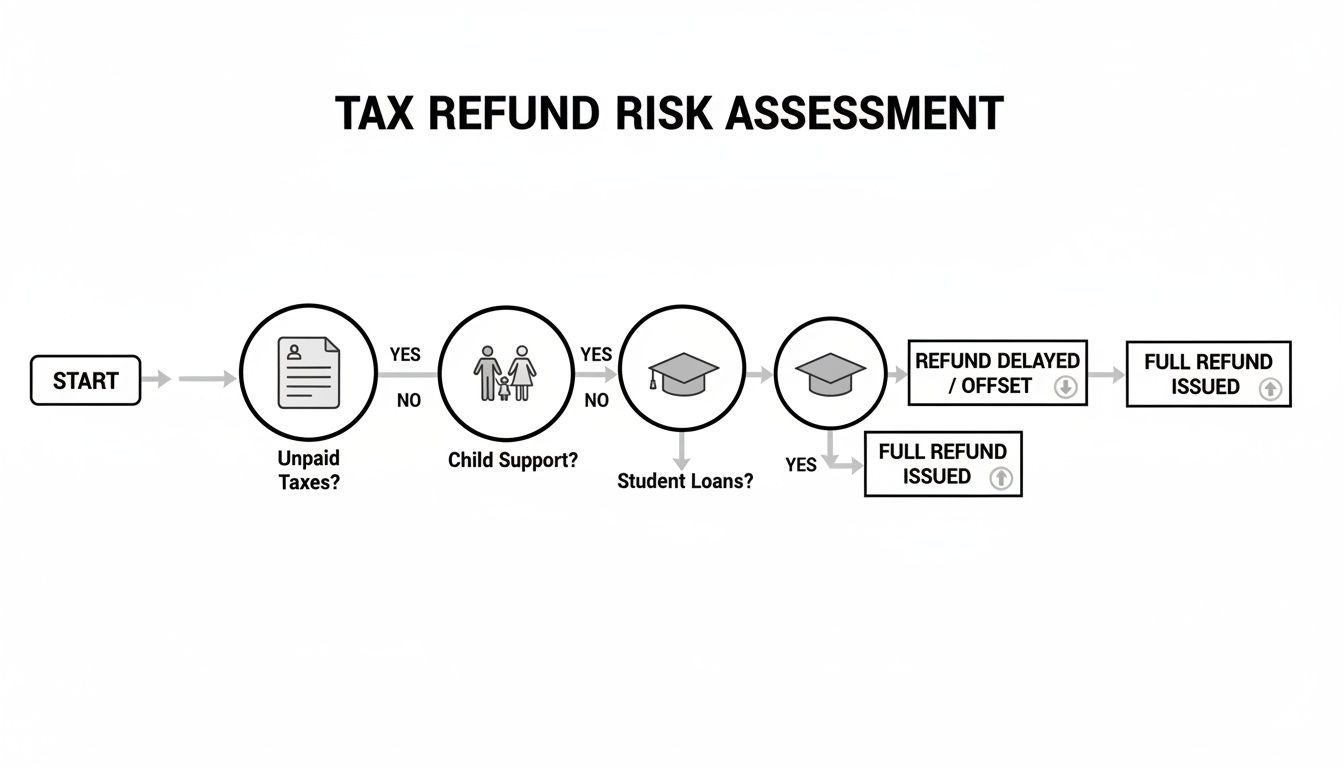
As you can see, things like overdue child support or defaulted federal student loans are frequent culprits, right alongside old tax debts.
Your Immediate Action Plan
With the notice in hand, you have a clear path forward. Your first instinct might be to call the IRS, but don't. They can’t help you here. The IRS simply followed instructions from another government agency to redirect the funds.
Your focus needs to be on the creditor agency named in your offset notice. Your first call should be to them. Is it the Department of Education for a student loan? A state’s family services agency for child support? The notice will give you their name and contact info. When you call, your goal is to verify the debt is actually yours and that the amount is correct. Mistakes happen more often than you’d think.
For more general help deciphering government letters, our guide on how to read and respond to various IRS letters and notices can provide some useful context.
What Is an Injured Spouse Claim?
Here’s a common scenario we see all the time: you filed a joint return, but the debt that triggered the offset belongs solely to your spouse. Maybe it’s child support from a previous relationship or a student loan they defaulted on years ago. If that debt isn't legally yours, you shouldn't have to lose your portion of the tax refund to pay for it.
This is where you might qualify as an "injured spouse." By filing Form 8379, Injured Spouse Allocation, you are officially asking the IRS to separate your portion of the joint refund and send it directly to you.
Injured Spouse vs. Innocent Spouse: These two claims sound similar but are completely different. An Injured Spouse Claim is used to get your share of a refund back when it's taken for your spouse's separate debt. An Innocent Spouse Claim is a request to be relieved of tax liability created by your spouse's errors on a joint return you both signed.
To file a successful Injured Spouse Claim, you must meet a few key conditions:
- You filed a joint tax return.
- You are not legally responsible for your spouse’s past-due debt.
- You had reported income (like wages or self-employment income) on the joint return.
- You made tax payments (through withholding from your paycheck or estimated tax payments).
You can file Form 8379 with your tax return if you know an offset is coming, or you can file it by itself after you’ve received the notice. Filing it with your return is proactive, but if you’ve already been blindsided by an offset, it's not too late. Filing afterward will get the process started to reclaim your money.
Your Options for Challenging a Refund Offset
Seeing your expected tax refund disappear is a gut punch. It’s frustrating and can leave you feeling powerless, but I want you to know this isn't the end of the story. You have real, concrete options to fight back.
Think of it less like a final judgment and more like the start of a negotiation. The key is to understand why your refund was taken and then choose the right strategy to either get it back or prevent it from happening again. Let’s walk through the paths you can take.
Request a Review or File an Appeal
What if the government simply got it wrong? It happens more often than you might think. If you have a legitimate reason to believe the debt that triggered the tax refund offset is a mistake—maybe it's a clerical error, a case of mistaken identity, or a bill you’ve already paid off—you absolutely have the right to challenge it.
Your first move isn’t to call the IRS. Instead, you need to go directly to the source. The offset notice you received from the Bureau of the Fiscal Service (BFS) will name the specific agency that claimed your refund. That’s who you need to contact.
- Contact the Creditor Agency Immediately: Get on the phone with them right away. Clearly state that you dispute the debt and ask them to begin their formal review process.
- Gather Your Evidence: This is where you build your case. Pull together any and all documents that prove your point: bank statements showing payment, court orders modifying a debt, or any correspondence confirming the debt was settled.
- File a Formal Appeal: If the agency’s initial review doesn’t go your way, don’t give up. They are required to give you instructions for a formal appeal. This is a more serious process where a neutral third party will examine the evidence from both sides.
Pushing back against a government agency takes persistence. Our guide on navigating the IRS tax appeals system can give you a better feel for how these formal proceedings work, even when dealing with other federal or state agencies.
Apply for Hardship Relief
Okay, so what if the debt is legitimate, but losing your entire refund right now will throw your life into chaos? If that offset means you can’t pay your rent, keep the lights on, or afford critical medical care, you may be able to claim financial hardship.
This specific protection is called an Offset Bypass Refund (OBR). It's important to know this is an option only for debts you owe directly to the IRS, not for debts held by other agencies like a state or the Department of Education. And with this, timing is absolutely everything.
You must request an OBR before the offset actually happens. Once the IRS has applied your refund to your outstanding tax debt, that money is gone, and you can't use this option.
To apply, you have to contact the IRS right after you file your return. You'll need to explain your hardship situation and be ready to provide proof, like an eviction notice or utility shut-off warning. If the IRS approves your request, they will issue just enough of your refund to cover your immediate needs and apply the rest toward your tax bill.
Negotiate a Resolution for the Debt
If you know the debt is yours, the best long-term play is to tackle it head-on. Resolving the underlying debt is the only way to permanently stop future tax refund offsets and get yourself back on solid ground with the government. For IRS debts, two of the most powerful tools are the Offer in Compromise and the Installment Agreement.
An Offer in Compromise (OIC) is a formal agreement with the IRS to settle your tax liability for less than the full amount you owe. This isn't for everyone; it's designed for people facing genuine financial trouble who simply don't have a realistic way to pay back their entire tax bill.
An Installment Agreement is much more common. It’s a straightforward monthly payment plan you arrange with the IRS. As long as you make your payments on time, the IRS will typically halt aggressive collection actions—including seizing your future tax refunds.
To help you see how these different options stack up, we've put together a quick comparison.
Comparing Strategies to Address Your Tax Debt
This table breaks down some common tax debt resolution strategies, who they're best suited for, and how they might affect future refund offsets.
| Strategy | Best For | Impact on Future Offsets | Complexity |
|---|---|---|---|
| Installment Agreement | Taxpayers who can afford to make monthly payments to clear their debt over time. | Halts offsets as long as you remain current on payments. | Low |
| Offer in Compromise | Taxpayers with significant financial hardship who cannot pay their full tax liability. | Halts future offsets once the OIC is accepted and the settlement amount is paid in full. | High |
| Hardship Status (CNC) | Individuals who currently cannot afford to pay their tax debt due to very low income/assets. | Temporarily stops offsets, but debt continues to accrue interest and penalties. | Medium |
| Injured Spouse Claim | A spouse whose share of a joint refund was seized for their partner's separate debt. | Recovers the "injured" spouse's portion of the refund; doesn't resolve the underlying debt. | Medium |
Choosing the right strategy depends entirely on your specific financial situation. An Installment Agreement offers a clear path forward, while options like an OIC or claiming hardship status are meant for more severe circumstances.
Consider How Bankruptcy Might Help
For some people facing a mountain of debt from many different creditors, bankruptcy can feel like the only way out. Filing for bankruptcy typically triggers an "automatic stay," a legal injunction that immediately stops most creditors from trying to collect—and that includes halting tax refund offsets.
Be careful here, though. The interplay between bankruptcy and tax debt is notoriously complex. While some older income tax debts might be dischargeable in bankruptcy, many are not, including recent tax debts and critical liabilities like payroll taxes. This is a path you should never walk alone; it requires an expert eye from a professional who is fluent in both tax and bankruptcy law.
Finally, if your refund was taken for a debt that isn't yours at all—but belongs solely to your spouse—you may have another way out. To learn more, it’s worth reading about the key differences between innocent spouse vs injured spouse relief. They are two very different tools designed to protect your portion of a joint tax refund under specific circumstances.
How to Prevent Future Tax Refund Offsets

Dealing with a tax refund offset after the fact is always a scramble. It's stressful and immediately puts you on the defensive. The best strategy, by far, is to make sure it never happens in the first place. Preventing the government from seizing your refund requires a proactive financial game plan, whether you’re a salaried employee, a freelancer, or a business owner.
Think of it like regular maintenance for your financial health. You get an annual check-up with your doctor to catch small issues before they become big problems, right? The same logic applies here. An annual financial review can stop government debts from quietly growing until they trigger a surprise offset. The goal is simple: stay current on your obligations so the Treasury Offset Program never has a reason to flag your name.
A Financial Checklist for Individuals
For most people, preventing an offset comes down to staying on the right side of federal and state agencies. The key is to know exactly where you stand with them before you even think about filing your tax return.
Check Your Status: Before tax season gets into full swing, log into your online IRS account to see if you have any outstanding federal tax balances. For any non-tax debts, you can call the Treasury Offset Program's automated hotline at 800-304-3107. This will tell you if another agency has slated your refund for collection.
Tackle Debts Head-On: If you find out you owe money, don’t ignore it. Contact the agency you owe right away to set up a payment plan or work out a resolution. Getting into a formal agreement almost always stops collection actions, including future refund offsets.
Stay Current: It sounds simple, but it’s the most effective rule of all. Make sure you are completely up-to-date on any court-ordered child support, student loan payments, and state tax liabilities.
Essential Strategies for the Self-Employed
If you’re a freelancer, gig worker, or sole proprietor, you’re basically running your own one-person payroll department. That extra responsibility makes you particularly vulnerable to tax refund offsets if you’re not disciplined.
One of the biggest traps for the self-employed is the giant, unexpected tax bill at the end of the year. Since you don't have an employer withholding taxes from each paycheck, it’s entirely on you to set that money aside and pay the IRS throughout the year. Dropping the ball on this is a surefire way to rack up a big tax debt and get your future refund seized.
The Quarterly Payment Rule: The U.S. tax system is designed as a "pay-as-you-go" system. For anyone self-employed, this means making quarterly estimated tax payments isn't just a good idea—it's a requirement to avoid underpayment penalties and a nasty year-end bill that could easily trigger an offset.
Meticulous bookkeeping is your best defense. Track every single dollar of income and every legitimate business expense. This not only lowers your taxable income but also gives you a clear financial picture, which helps you make accurate quarterly payments. For those with income that goes up and down, it might be worth looking into the IRS Fresh Start Program for more flexible payment options.
A Critical Warning for Small Business Owners
For business owners with employees, especially S-Corps and LLCs, the biggest danger comes from payroll taxes. These are the "trust fund" taxes—Social Security, Medicare, and income tax—that you withhold from your employees' wages. The IRS takes these funds very seriously. Failing to hand them over is one of the quickest ways to trigger massive penalties and even personal liability.
This can lead to something called the Trust Fund Recovery Penalty (TFRP), which pierces the corporate veil and makes you, the owner, personally responsible for the business's unpaid payroll taxes. Once that happens, the IRS won't hesitate to seize your personal tax refund to cover the company's debt. The only way to avoid this nightmare is to be absolutely diligent about your payroll tax deposits.
This isn't just a U.S. problem; similar programs exist worldwide. For example, Canada's Revenue Agency (CRA) has set-off provisions that intercepted CAD 2.8 billion in a single year, with small businesses and their payroll issues being a primary target. You can find more global tax compliance trends on equusoft.com.
When to Hire an Experienced Tax Attorney
You could certainly try to tackle a tax refund offset on your own. But let's be honest—the financial stakes are high, and the system itself feels like a tangled web of confusing deadlines, agency-specific rules, and legal jargon. Going it alone when a significant debt is on the line can easily backfire, leading to missed opportunities or simple mistakes that just dig you into a deeper hole.
That’s where an experienced tax attorney comes in. Their job isn't just about filling out paperwork. They’ve spent years navigating the complexities of the Treasury Offset Program and know how to map out the best strategic route for your unique situation. This is where professional guidance stops being a luxury and becomes a necessity.
Why a Personalized Strategy Matters
Many of the big, national tax resolution firms tend to treat their clients like case numbers. They often push a one-size-fits-all solution that might not be right for you. At The W Tax Group, we do things differently. We believe every successful resolution starts with a personalized strategy, which is why we begin with a comprehensive and completely FREE Tax Debt Analysis.
Think of this free analysis as a no-strings-attached diagnostic, not a sales pitch. It’s our way of giving you a clear, honest look at your financial situation to see if and how we can help. You'll get a transparent roadmap of your options before you ever pay a dime.
A seasoned attorney can also step in and immediately take over all communications with the IRS and other agencies. That immense burden is lifted from your shoulders. They know exactly who to contact, what to say, and how to frame your case to get the best possible outcome—whether you're filing an appeal, claiming financial hardship, or submitting an Injured Spouse Claim.
Achieving a Permanent Resolution
The real goal here isn't just to stop this year's refund from being taken. It's about resolving the underlying debt for good so you can regain your financial footing. A qualified tax attorney has the authority and experience to negotiate powerful resolutions you likely couldn't secure on your own.
This might look like:
- Negotiating an Offer in Compromise (OIC), which could allow you to settle your tax debt for a fraction of what you originally owed.
- Structuring a manageable Installment Agreement that fits your actual budget and prevents future offsets.
- Guiding you through the formal appeals process if you have grounds to dispute the debt’s validity in the first place.
Facing a tax refund offset is stressful and overwhelming. The good news is, you don’t have to go through it by yourself. Getting an expert in your corner is often the most important step you can take to protect what's yours and finally get some peace of mind.
Frequently Asked Questions About Tax Offsets
It's completely normal to feel confused and a little panicked when you find out your tax refund has been taken. We get these questions all the time from people in your exact situation. Here are some straightforward answers to help you understand what's happening and what you can do about it.
Can I Stop an Offset After Getting a Notice?
Yes, but the clock is ticking. Your ability to stop an offset really depends on the type of debt you owe and how quickly you can respond.
Once you get an offset notice from the Bureau of the Fiscal Service (BFS), you typically have 60 days to challenge the debt with the agency that claims you owe them money. That agency's name will be on the notice.
If the debt is for back taxes owed to the IRS, you might be able to head off the offset by getting into a formal payment plan, like an Installment Agreement or an Offer in Compromise. When you take proactive steps to resolve the debt, the IRS will often pause other collection efforts. Your best bet is to contact a tax professional immediately to figure out the right move before those deadlines pass.
Will Filing for Bankruptcy Stop a Refund Offset?
Filing for bankruptcy usually puts an "automatic stay" in place, which is a powerful court order that stops most creditors from trying to collect on a debt. This includes stopping a tax refund offset, but it's not a magic bullet.
The real issue is whether your tax debt can even be discharged (forgiven) in bankruptcy. That depends on many factors, including the age and type of the tax. For example, very recent income tax debts or payroll tax penalties are often non-dischargeable. This is a complex area where tax law and bankruptcy law intersect, so it's critical to get advice from an attorney who is an expert in both.
Injured vs. Innocent Spouse Claims
An Injured Spouse Claim (Form 8379) is what you file when your share of a joint refund is taken for your spouse's separate debt. You are asking for your portion of the refund back.
An Innocent Spouse Claim (Form 8857) is a request for relief from tax liability on a joint return because your spouse made an error you were unaware of. They solve two completely different problems.
What if I Don’t Recognize the Debt?
If the debt listed on the notice doesn't look familiar, your first step is to play detective.
Call the Treasury Offset Program's automated information line at 800-304-3107. You'll need to enter your Social Security number, and the system will tell you exactly which agency took your money and for how much.
Once you know which agency it is, you have to contact them directly. This is the most important part—the IRS can't help you with a debt owed to the Department of Education or a state agency. The IRS was just the middleman. When you call the creditor agency, have your offset notice handy to dispute the debt or ask for a detailed explanation.
Facing a tax refund offset is a serious financial challenge, but you don't have to navigate it alone. Attorney Stephen A Weisberg and The W Tax Group start with a FREE Tax Debt Analysis to give you a clear, honest assessment of your situation. Take the first step toward a permanent resolution by scheduling your free analysis.


