Tax Rate in Delaware
Get the full tax rate in Delaware for 2026. Our guide covers individual income, corporate, franchise, and payroll taxes for residents and businesses.
In this article
- The Delaware Advantage and Its Tax Realities
- The four taxes people confuse most often
- What works and what doesn't
- Navigating Delaware Personal Income Tax Rates
- The bracket structure in practical terms
- How marginal rates trip people up
- Wilmington changes the picture
- When personal tax planning becomes more than routine
- Key Taxes for Delaware Businesses
- Corporate income tax is about Delaware-taxable business income
- Gross receipts tax is not a sales tax substitute
- Franchise tax is where a lot of avoidable pain starts
- What to review before you file anything
- Understanding Payroll Taxes and Employer Duties
- What Delaware employers actually have to do
- Why payroll debt is different from other tax debt
- Red flags inside your payroll process
- Common Tax Pitfalls and Misconceptions
- The three assumptions that cause the most trouble
- Retirement income is where the headline rate can mislead
- Mistakes that look small until they aren't
- When Your Delaware Tax Situation Needs an Expert
- Call for help when the problem involves enforcement or multiple years
- Payroll debt needs fast action
- The decision rule is simple
- Key Filing Deadlines and Resources for 2026
- The dates most people should have on the calendar
- The resources worth bookmarking
You're probably here because Delaware looks simple from the outside. No sales tax. Business-friendly reputation. Lots of companies formed there. Then the questions start. Do you owe Delaware tax if you live elsewhere? Does your LLC owe franchise tax even if it made no money? Why is Wilmington different? And why did someone mention gross receipts tax when you don't even sell products?
Those are the right questions.
The practical problem with the tax rate in Delaware is that people often look for one number and stop there. Delaware doesn't work that way. A resident may care most about personal income tax. A founder may be more exposed to franchise tax, corporate income tax, and payroll compliance than to anything labeled “sales tax.” A retiree may focus on what Delaware excludes from income rather than on the headline top rate.
If you understand which tax applies to which activity, Delaware becomes manageable. If you assume “no sales tax” means “low tax across the board,” mistakes get expensive fast.
The Delaware Advantage and Its Tax Realities
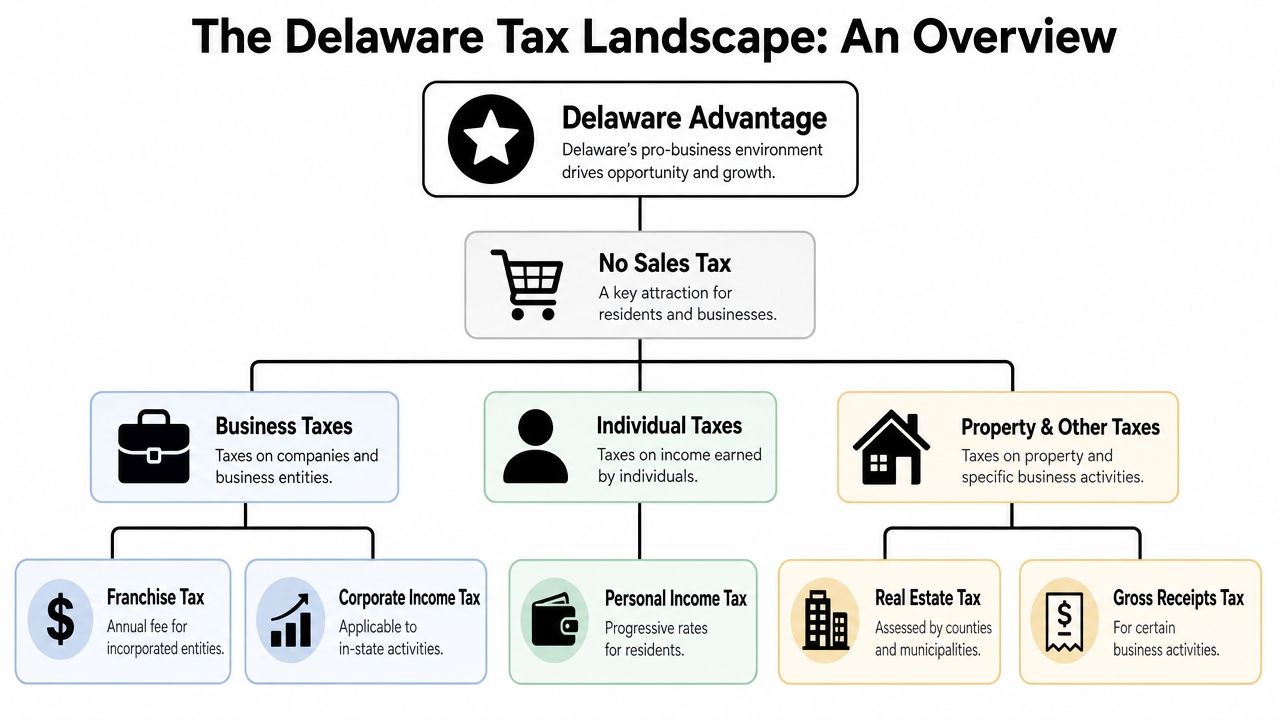
The starting point is the fact everybody knows. Delaware is one of the few states with no general state sales tax. That's real, and it matters. But it's only one leg of the stool.
Delaware funds itself through a different mix. According to Delaware tax rate details compiled by inDinero, the state uses a graduated personal income tax with rates from 2.20% to 6.60%, a flat 8.7% corporate income tax, a gross receipts tax that generally ranges from 0.0945% to 0.7468%, and a franchise tax that can range from $175 to $200,000.
That means “no sales tax” doesn't eliminate tax exposure. It shifts where the exposure shows up.
The four taxes people confuse most often
A lot of new business owners mash Delaware taxes into one bucket. That causes filing mistakes because these taxes hit different things.
| Tax type | What it generally applies to | Why people miss it |
|---|---|---|
| Personal income tax | Individual taxable income | People focus on federal withholding and ignore state planning |
| Corporate income tax | Income allocated or apportioned to Delaware | Owners assume incorporation alone answers the question |
| Gross receipts tax | Certain seller and service-provider receipts | Service businesses often assume it only applies to retail sales |
| Franchise tax | The privilege of maintaining certain Delaware entities | Owners confuse it with income tax and think no profit means no bill |
What works and what doesn't
What works is treating Delaware taxes as separate systems with separate triggers.
What doesn't work is using the shortcut logic I hear all the time:
- “We don't sell products, so we don't have state tax issues.” That can fail because Delaware's structure includes taxes that aren't sales tax.
- “The company didn't make money, so there's no Delaware filing problem.” That can fail on franchise tax and other compliance duties.
- “I formed in Delaware but operate elsewhere, so Delaware doesn't matter.” Sometimes true for one tax, false for another.
Practical rule: Identify the tax by activity first. Residence, payroll, Delaware-source business income, entity type, and where work is performed all matter more than the state's reputation.
For residents, the main concern is usually personal income tax. For founders, the immediate risk is often not the headline tax rate in Delaware at all. It's missed filings, wrong assumptions about franchise tax, and payroll money that should never have been used for operations.
Navigating Delaware Personal Income Tax Rates
For individuals, Delaware uses a progressive income tax. That means the rate changes as taxable income rises, and the higher rate applies only to income in the higher bracket, not to every dollar you earned.
According to SmartAsset's Delaware tax calculator overview, Delaware uses seven brackets with marginal rates from 0% to 6.6%, and the top rate starts once taxable income exceeds $60,000. The same source notes that Wilmington imposes a 0.76% city income tax on residents and workers.
The bracket structure in practical terms
The most useful way to read Delaware's personal rates is not “What's my tax bracket?” but “Which slices of my income fall into which rate?”
Here is the framework you need to remember.
| Marginal Tax Rate | Taxable Income |
|---|---|
| 0% to 6.6% | Delaware uses seven brackets, with the top rate applying above $60,000 |
That summary is enough for planning at a high level, but not enough for precision. If you're adjusting withholding, making estimated payments, handling part-year residency, or dealing with pass-through income, use an actual calculator or return worksheet instead of guessing. If you want broader context on state-by-state issues that affect planning, this collection on state income tax topics is a useful reference point.
How marginal rates trip people up
Here's the mistake. Someone earns more, sees a higher bracket, and assumes all of their income is suddenly taxed at that higher rate. That isn't how Delaware's progressive system works.
A simple way to consider this:
- Income is stacked into brackets.
- Each layer is taxed at the rate for that layer.
- Crossing a threshold increases the tax on the next dollars, not on the entire amount.
That matters for self-employed people and owners of pass-through entities because uneven income during the year can throw off withholding and estimated-tax planning. It also matters for couples with one strong earning spike, a bonus, or a large year-end distribution.
If your year changes midstream, your withholding should change with it. Delaware problems often start with stale payroll settings, not with the return itself.
Wilmington changes the picture
If you live in Wilmington or work there, you need to account for the city income tax as well. That local layer is easy to miss because people often search only for the state tax rate in Delaware and stop after they find the state brackets.
For employees, that usually means checking paystubs and year-end forms carefully. For employers, it means making sure payroll is coded correctly for work location and residency issues. A clean federal payroll process doesn't guarantee a clean Delaware or Wilmington result.
When personal tax planning becomes more than routine
Call a professional when the facts stop being straightforward:
- You moved in or out of Delaware during the year
- You worked remotely across state lines
- You have pass-through income from an LLC or S corporation
- Your payroll withholding was clearly too low
- You live or work in Wilmington and your pay records don't match reality
The rate itself is easy enough to describe. The hard part is matching the right income to the right state and the right local rules.
Key Taxes for Delaware Businesses
Business owners usually care about three Delaware taxes first. Corporate income tax, gross receipts tax, and franchise tax. They sound related. They aren't interchangeable.
That distinction matters because a company can be clear on one and still have a problem on another.

Corporate income tax is about Delaware-taxable business income
Delaware imposes a flat 8.7% corporate income tax on income allocated or apportioned to Delaware, as noted in the earlier overview from inDinero.
The practical mistake here is assuming incorporation and taxability are the same thing. They aren't. A Delaware corporation may still need a careful analysis of where it does business and what income is tied to Delaware. Owners who operate in multiple states tend to oversimplify this and either overfile or underfile.
Gross receipts tax is not a sales tax substitute
This is one of the least understood parts of Delaware's system. Gross receipts tax generally applies to sellers and service providers, and the rates generally range from 0.0945% to 0.7468%, again based on the earlier inDinero summary.
The trap is conceptual. People hear “gross receipts” and think “that must mean retail.” Not necessarily. If you run a service business, don't assume you're outside the system just because you don't collect sales tax from customers.
A good operating checklist for owners is available in this small business tax checklist, especially if you're trying to sort recurring filing duties from one-time setup items.
Franchise tax is where a lot of avoidable pain starts
Franchise tax is not a tax on profits. It's a cost tied to maintaining certain Delaware entities. The statutory range identified in the verified data is wide, from $175 to $200,000.
That range tells you something important by itself. This isn't a line item you should dismiss without checking the actual calculation method that applies to your entity.
Common owner mistakes include:
- Assuming the minimum applies automatically
- Treating franchise tax as the same thing as annual income tax
- Ignoring the return because the company was inactive
- Not reviewing the entity's capitalization and filing posture before the due date
A Delaware entity can create a tax problem without earning a profit. Franchise tax is often the reason.
What to review before you file anything
Instead of asking “What's my Delaware business tax rate,” ask these questions:
| Question | Why it matters |
|---|---|
| Am I a corporation or another entity type? | Delaware taxes differ by entity structure |
| Did the business have Delaware-source income? | That affects whether corporate income tax is in play |
| Do I provide services or sell into Delaware? | That may trigger gross receipts obligations |
| Is the entity active only on paper? | Franchise obligations can still exist |
For small companies, the costly errors usually aren't aggressive tax strategies. They're compliance assumptions. A business owner who misses a filing because “nothing happened this year” can create a problem that takes much longer to unwind than it would have taken to file correctly the first time.
Understanding Payroll Taxes and Employer Duties
Payroll tax problems are less about rates and more about custody. Once you withhold tax from an employee's wages, that money isn't yours. You're holding it for the government.
That's why payroll issues escalate faster than many other state tax problems.
What Delaware employers actually have to do
If you have employees, you generally need to withhold applicable state income tax from wages and remit it properly. You also need to manage unemployment-related obligations and keep payroll records consistent with the wages paid.
This sounds routine until a company gets tight on cash. Then owners start treating withheld taxes like a short-term operating loan. That is one of the worst moves a struggling business can make.
For businesses building or repairing payroll systems, this guide to small business payroll taxes is a solid operational reference.
Why payroll debt is different from other tax debt
Income tax debt from a return often leaves some room for later negotiation. Payroll withholding problems are more dangerous because the government views those funds differently.
Two patterns show up again and again:
- The owner files payroll forms but can't pay. Better than not filing, but still dangerous if the debt keeps rolling.
- The owner stops filing because the numbers are ugly. That usually makes the problem worse and harder to reconstruct.
Don't wait for a business to “catch up” before dealing with payroll tax debt. The delay often creates a larger personal-risk problem for the people in charge.
Red flags inside your payroll process
You need immediate attention if any of this is happening:
- Deposits are being skipped to cover rent or payroll
- The bookkeeper can't reconcile wages, withholdings, and filings
- You're behind for more than one filing cycle
- Employee forms don't match payroll reports
- You changed payroll providers and no one confirmed the old periods were fully closed out
When Delaware payroll compliance breaks down, the issue usually isn't a misunderstanding of the tax rate in Delaware. It's weak controls, delayed deposits, and missing follow-through.
Common Tax Pitfalls and Misconceptions
Most Delaware tax mistakes don't come from complexity alone. They come from false confidence.
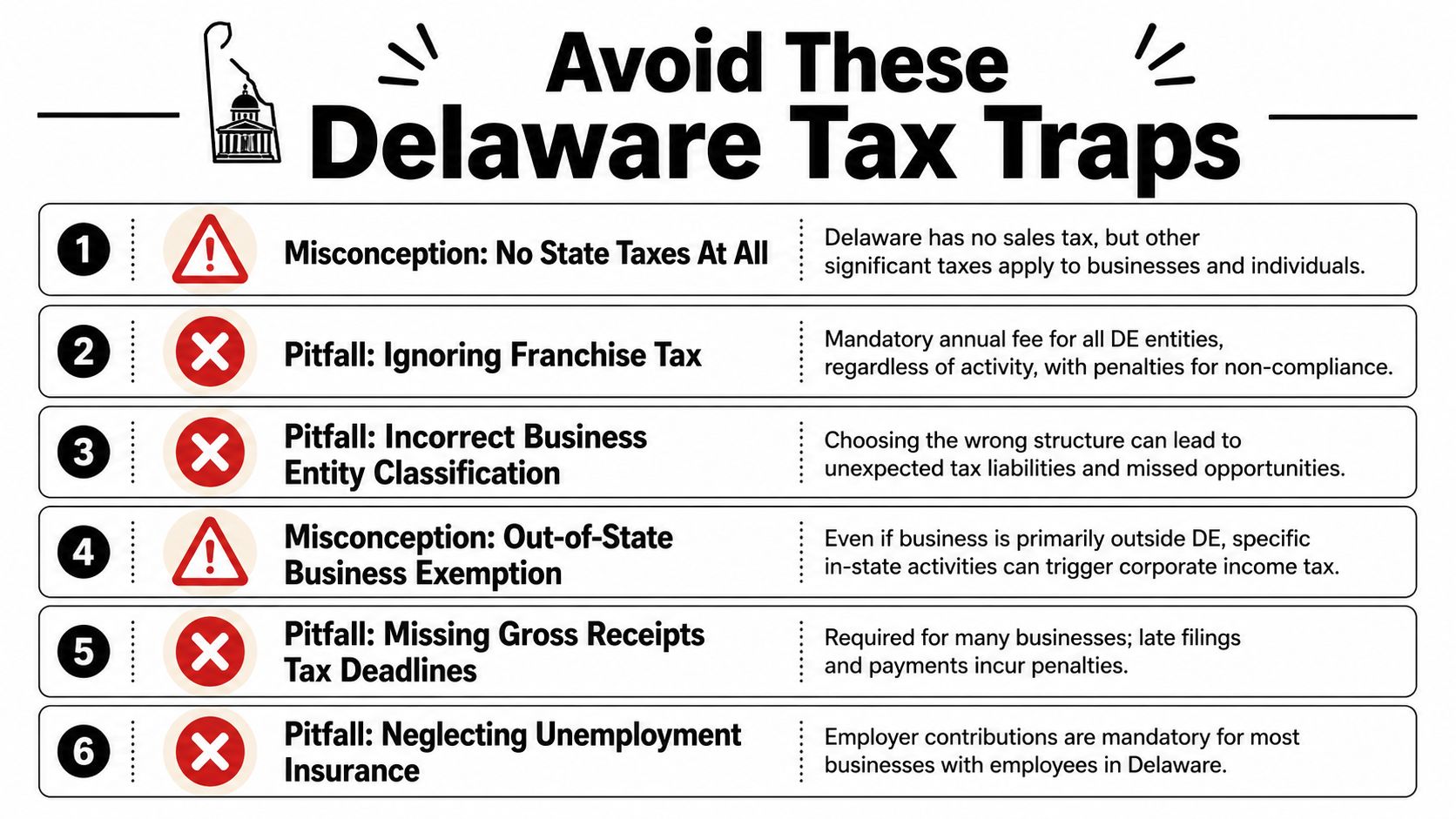
The owner read that Delaware has no sales tax, formed an entity online, and assumed the hard part was over. Then the notices start. Often the first notice is not about the tax they expected.
The three assumptions that cause the most trouble
The first is that a small company automatically owes only the minimum franchise amount. That's not a safe assumption.
The second is that service businesses can ignore gross receipts tax because they don't sell taxable goods. That's another common miss.
The third is that the headline top personal rate tells retirees everything they need to know. It doesn't.
Retirement income is where the headline rate can mislead
According to the Delaware personal income tax FAQs from the Division of Revenue, residents age 60 or older may exclude up to $12,500 of pension and eligible retirement income, residents under 60 get a $2,000 exclusion, and Social Security and Railroad Retirement benefits are not taxable in Delaware. The same FAQ also states that nonresidents must file when Delaware-source income exceeds $9,400.
That's why a simple search for the tax rate in Delaware can mislead retirees and cross-border workers. The top marginal rate exists, but exclusions and sourcing rules may matter more to your actual bill.
Mistakes that look small until they aren't
- Inactive entity thinking. Owners assume no revenue means no Delaware obligation.
- Wrong tax vocabulary. They confuse franchise tax, income tax, and gross receipts tax.
- Remote work confusion. They treat all income as if one state has sole claim.
- Retirement misunderstanding. They plan around the top rate and ignore exclusions.
- Late cleanup syndrome. They wait for several years of notices before reconstructing filings.
Delaware is often simple at formation and less forgiving at cleanup.
If you're a retiree, a nonresident with Delaware-source income, or an owner operating across states, broad tax summaries usually aren't enough. That's where people either overpay, underfile, or both.
When Your Delaware Tax Situation Needs an Expert
Some tax issues are manageable with good records and a prompt filing. Others are not DIY projects anymore.
You should treat these situations as escalation points.
Call for help when the problem involves enforcement or multiple years
If you received an audit notice from Delaware or the IRS, the issue has moved past routine compliance. The same is true if you've discovered several years of unfiled returns, if a lien has been filed, or if you've fallen behind on payroll deposits and can't fix the gap immediately.
Those cases require more than form preparation. They require strategy, sequencing, and controlled communication with the taxing authority.
Payroll debt needs fast action
Payroll debt is where owners lose time by hoping the business will recover first and the tax issue can be cleaned up later. That order usually fails.
If your team is disorganized, one practical operational upgrade is better document control and centralized access. Firms that handle distributed staff often rely on cloud solutions for tax professionals to keep tax software, records, and workflow accessible without passing files around insecurely or losing track of version history.
The decision rule is simple
Bring in a tax attorney, CPA, or enrolled agent when the issue includes any of the following:
- An audit notice
- Payroll withholding debt
- A tax lien or levy threat
- More than one year of unfiled returns
- Conflicting state residency or sourcing positions
- A business shutdown with unresolved Delaware filings
This is also the point where legal controversy work can matter. Attorney Stephen A Weisberg handles tax debt resolution and controversy matters for individuals and businesses dealing with the IRS and state tax agencies, which is the kind of work that becomes relevant once notices, collection risk, or payroll exposure are already in play.
The practical test is whether the issue is still about calculation. If it's become about defense, negotiation, or damage control, get help.
Key Filing Deadlines and Resources for 2026
A tax system becomes much easier to manage when you stop treating deadlines as background noise. Delaware rewards businesses and individuals who calendar filing dates early, confirm account access, and reconcile records before the due month.
The dates most people should have on the calendar
For 2026, the deadlines most readers should watch are:
| Filing item | Deadline |
|---|---|
| Delaware franchise tax reports | March 1 |
| Delaware corporate income tax filings | March 1 |
| Delaware personal income tax returns | April 30 |
If you make estimated payments, add those dates to your calendar too. This guide on quarterly tax payment deadlines helps keep the federal and state planning side from drifting apart.
The resources worth bookmarking
Keep direct access to the state's systems and practical explainers you'll use:
- Official Delaware tax administration. Use the Delaware taxation history and property tax overview for background on how the state is structured, including the fact that Delaware has no state-level property taxes, with local governments handling those levies.
- Rental owners. If part of your Delaware filing issue involves lease income, expense tracking, or year-end reporting, this rental income tax guide is a useful companion resource.
Delaware's system has been around a long time. Tax assessments were first taken in 1693, and records were taken annually after 1726, according to the FamilySearch summary linked above. The modern lesson is simple. Delaware isn't improvised. Its filing systems, notices, and compliance expectations are established and consistent.
A workable plan for the tax rate in Delaware isn't just knowing the percentages. It's knowing which tax applies, what the trigger is, and when a small filing issue is turning into a collections problem.
If you're dealing with Delaware tax debt, payroll problems, missed filings, or state and IRS notices at the same time, Attorney Stephen A Weisberg offers a free Tax Debt Analysis to determine whether he can help and what the next steps should be before any engagement begins.


