Tax Lien Attorney: A Guide to Removing an IRS Lien in 2026
Facing an IRS notice? Learn what a tax lien is, your options for removal, and when to hire a tax lien attorney. Get a clear path to resolving your tax debt.

In this article
- That Official Envelope from the IRS
- What to do first
- What a Federal Tax Lien Really Means for You
- A lien is broad
- A lien is not a levy
- Why this confusion causes bad decisions
- The Domino Effect of an Unresolved Tax Lien
- The first few dominoes
- Property can be at real risk
- Why ignoring it makes the case harder
- Strategic Pathways to Tax Lien Resolution
- The main tools
- How these options differ in real life
- Broader settlement paths
- What works and what doesn't
- Do You Really Need a Tax Lien Attorney
- When a CPA or Enrolled Agent may be enough
- When a tax lien attorney becomes critical
- A practical decision framework
- The mistake to avoid
- How to Choose Your Advocate and Avoid Scams
- Red flags that should slow you down
- What a better intake process looks like
- Ask these questions before hiring anyone
- Don't overlook free or low-cost help
- Your Next Step A Clear Path Forward
You open the mailbox, see an IRS envelope, and your stomach drops. You don't need a legal definition in that moment. You need to know two things. How serious is this, and what do I do next?
If the notice involves a federal tax lien, the problem is serious, but it's also manageable when you approach it strategically. A lien is not the end of the road. It's the government staking a legal claim while it tries to collect. The worst response is panic buying, where a company scares you into a large retainer before anyone has done a real analysis of your facts.
A better approach is calmer and more disciplined. Read the notice. Identify what the IRS has filed. Match the problem to the right tool. In some cases, a CPA or Enrolled Agent can handle the job well. In others, a tax lien attorney becomes critical because the risk to your property, your business, or your legal position is too high to treat casually.
That Official Envelope from the IRS
That certified IRS letter can make even organized people freeze. Some clients leave it unopened for days because they assume the notice means the IRS is about to seize everything. Usually, the first job is to slow down and separate the immediate facts from the fear.
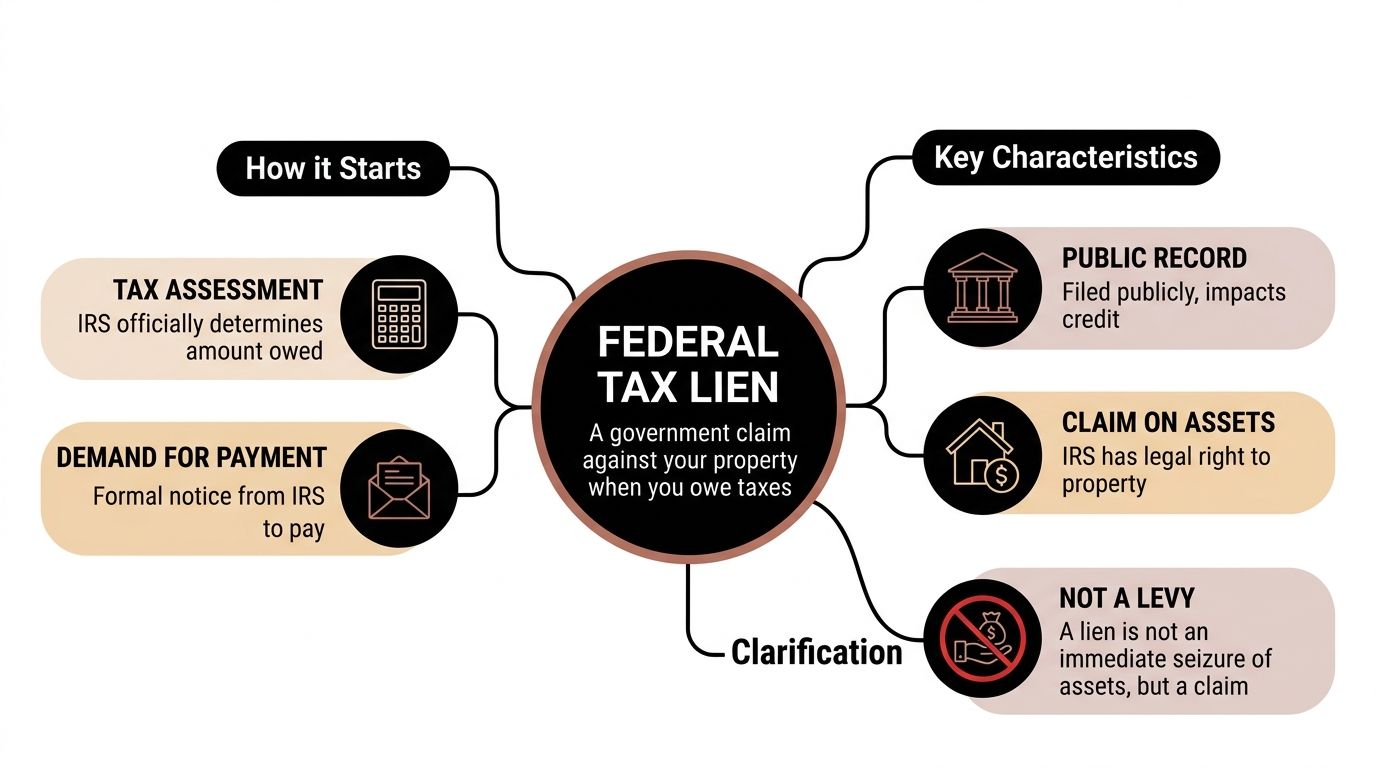
A Notice of Federal Tax Lien is the government's public claim against your property because of unpaid taxes. It tells the world that the IRS says it has rights against what you own. That can affect financing, transactions, and negotiations long before anyone takes property away.
If you're looking at a confusing notice number, start by identifying exactly what the IRS sent. A practical guide to IRS letters and notices can help you match the document in your hand to the issue you're facing.
What to do first
Start with a short checklist:
- Confirm the notice type: Make sure this is a lien notice and not a levy notice, audit letter, or balance-due reminder.
- Check the tax periods: Many cases turn on whether the problem involves one year, several years, or payroll issues for a business.
- Pull your records: Gather prior notices, returns, proof of payments, and any recent IRS correspondence.
- Avoid fast promises: If a firm guarantees a result before reviewing transcripts and facts, that's a red flag.
Practical rule: The first goal isn't to “fight the IRS.” It's to understand what stage of the process you're in so you can choose the right response.
People often assume a lien means there's only one solution, usually paying the full balance immediately. That's not how this works. There are several resolution paths, and the right one depends on whether you need time, a property transaction, a compromise, or relief tied to a specific asset.
What a Federal Tax Lien Really Means for You
A federal tax lien is easiest to understand if you compare it to a lender's lien on a financed car. When a bank lends money for the car, it keeps a legal interest in that asset until the debt is resolved. A tax lien works on the same basic principle, except the IRS is the creditor and the reach is broader.
The lien is the government's legal claim against your property when you owe taxes and don't resolve the debt after the IRS has gone through its collection steps. It is a claim. It is not, by itself, the act of taking property.
For a closer explanation of the filing itself, this article on a Notice of Federal Tax Lien is a useful companion.
A lien is broad
The practical problem is scope. The IRS isn't limiting its claim to one account or one piece of real estate. A federal tax lien generally clouds your overall property picture. That matters when you try to refinance, sell, borrow, or clean up title issues.
For a business owner, the effect is often felt in ordinary operations. A lender hesitates. A closing gets delayed. A buyer asks questions. A partner wants assurance that the tax issue won't spill into a transaction.
A lien is not a levy
This distinction matters because people confuse the two constantly.
- A lien is a claim: It secures the government's interest.
- A levy is a seizure: That's when the IRS takes property, funds, or rights to payment.
- The timing matters: A lien often comes earlier in the collection path. It establishes a strong position and applies pressure.
- Your options are different: Some strategies are designed to remove or limit the lien. Others are meant to stop collection from escalating.
A lien tells you the IRS has planted a flag. A levy means it has started carrying property away.
That difference shapes the strategy. If you treat every lien like an active seizure, you may overreact and spend money badly. If you treat every lien like harmless paperwork, you may wait too long and lose options that were available earlier.
Why this confusion causes bad decisions
Fear-based firms often exploit the confusion. They lean on the public-record aspect of a lien and imply that every case requires an attorney-led emergency intervention. Sometimes that's true. Often it isn't.
A disciplined professional looks at the underlying debt, the current collection posture, the client's goals, and whether a property event is pending. A taxpayer trying to close a sale next month needs a different plan from a taxpayer whose main goal is to get into a workable monthly arrangement and avoid escalation.
The Domino Effect of an Unresolved Tax Lien
An unresolved lien rarely stays confined to one problem. It tends to trigger a chain reaction. One issue blocks another, and soon the tax debt starts affecting decisions that don't seem tax-related at all.

The first few dominoes
A common sequence looks like this:
- Credit and financing friction: Lenders and underwriters may treat the lien as a major obstacle.
- Property transactions stall: Selling or refinancing real estate becomes more complicated because title and payoff issues have to be addressed.
- Business pressure builds: Vendors, partners, or prospective buyers may ask for explanations and documents.
- Collection risk increases: If the debt remains unresolved, the IRS may move toward stronger enforcement.
For individuals, the emotional toll is real. People delay ordinary financial decisions because they don't know what the lien means for their home, their accounts, or future plans. For business owners, that uncertainty can freeze hiring, lending, and expansion decisions.
Property can be at real risk
In tax lien foreclosure matters, the stakes become much sharper. In that context, property owners lose title once a final judgment is entered, which is a decisive legal milestone highlighted by New Jersey tax lien foreclosure guidance. That's one reason early intervention matters. Waiting too long can convert a negotiable problem into a title-loss problem.
The same source also notes that federal tax liens can be defeated by attorney liens when the designated parties hold one of the ten superpriorities in IRC 6323(b). That's not a technical footnote. In the right case, priority rules shape negotiation power and determine who gets paid first from property or proceeds.
The practical lesson is simple. Once property rights and lien priorities are in play, timing matters almost as much as the underlying tax balance.
Why ignoring it makes the case harder
People usually ignore liens for one of three reasons. They hope the problem will cool off. They don't know what tool applies. Or they've already been burned by a firm that wanted a large retainer before answering basic questions.
What doesn't work is silence. The lien doesn't get less important because you stop opening mail. It becomes harder to fix because deadlines, title issues, and collection posture keep moving while you stand still.
A useful way to think about it is this. A lien is like a heavy clamp on your financial life. The longer it stays in place, the more activities it interferes with. Borrowing, selling, settling, and planning all become harder.
Strategic Pathways to Tax Lien Resolution
There isn't one universal way to resolve a lien. There are several tools, and each solves a different problem. The mistake I see most often is choosing a tool based on marketing language instead of legal effect.
One person needs the lien released after the debt is resolved. Another needs to sell one asset and keep the rest of the collection matter on a separate track. Another needs a lender to move ahead despite the IRS claim. These are different problems, so they require different remedies.
A practical overview of the mechanics appears in this guide on how to remove a tax lien.
The main tools
Under IRS rules discussed by Bryson Law Firm's lien assistance page, the IRS must remove liens from assets within 30 days after full payment of the tax debt. That same source also notes that attorneys often pursue property discharges so the IRS removes liens from specific assets without full payment. Those two paths sound similar, but they serve different goals.
Here's a clear comparison.
| Method | Primary Goal | Best For |
|---|---|---|
| Release | End the lien after the debt is resolved | Taxpayers who've fully paid or otherwise completed the qualifying resolution |
| Discharge | Remove the lien from a specific asset | A pending sale, transfer, or transaction involving particular property |
| Subordination | Allow another creditor to move ahead of the IRS for a limited purpose | Refinancing or financing situations where the deal won't close unless priority changes |
| Withdrawal | Remove the public notice of lien filing | Cases where removing the notice itself advances resolution or reduces transaction friction |
| Offer in Compromise tied strategy | Resolve the underlying debt for less than the full amount when appropriate | Taxpayers whose financial facts support a compromise review |
| Installment agreement strategy | Create a structured payment path while managing collection risk | Taxpayers who can't pay immediately but can sustain a monthly plan |
How these options differ in real life
Release is the cleanest finish, but it usually comes after the underlying tax debt is fully resolved through payment or another qualifying outcome. Think of it as closing the file, not just managing the pressure.
Discharge is a transaction tool. If you're selling a house, parcel, or other asset, you may not need the entire tax controversy solved before closing. You may need the IRS to remove its claim from that one asset so the deal can happen.
Subordination is often misunderstood. It doesn't erase the IRS interest. It reorders priority in a way that can let another lender move first. That can be the difference between a refinance that funds and one that dies in underwriting.
Withdrawal is different from release. A release says the lien obligation has been dealt with in the legally required way. A withdrawal focuses on removing the public notice. That distinction matters if your problem is less about final collection and more about the practical harm caused by the filing itself.
Broader settlement paths
Some taxpayers don't need a lien-specific tool first. They need a debt-resolution tool that later supports lien relief.
- Installment agreement: This can create structure and reduce the chance of the IRS taking more aggressive action while you pay over time.
- Offer in Compromise: In the right case, this is a settlement path based on the taxpayer's ability to pay and overall financial picture.
- Case-specific sequencing: Sometimes the right move is to handle the property issue first, then settle the liability. Other times it's the reverse.
People also ask whether bankruptcy changes the analysis. If that's part of your situation, this discussion of can tax liens be discharged is a useful starting point. Bankruptcy can affect the situation, but it doesn't automatically make a tax lien disappear in the way many people assume.
Key takeaway: The right strategy starts with the actual bottleneck. Is the problem the debt, the public filing, the pending sale, lender priority, or all of the above?
What works and what doesn't
What works is matching the remedy to the immediate business or personal objective. If a closing is scheduled, transaction strategy comes first. If no transaction is pending, overengineering the case can waste time and money.
What doesn't work is buying a one-size-fits-all “tax resolution package.” Those packages often treat every lien case like a generic script. Good lien work is more surgical than that. The order of operations matters, and so does the documentation.
Do You Really Need a Tax Lien Attorney
The honest answer is no, not always.
That's important because a lot of content in this space implies that every lien problem requires an attorney from day one. That's not accurate. As noted in this discussion of IRS tax lien removal options, a common misconception is that a tax attorney is always required. For many tasks, including filing an Offer in Compromise or negotiating payoff, a CPA or Enrolled Agent can be equally effective. An attorney becomes necessary when the case may require litigation in Tax Court to contest the underlying liability.
That distinction builds trust because it reflects how these cases work.
When a CPA or Enrolled Agent may be enough
If your case is straightforward, another qualified professional may be the right fit.
- Simple payment structure: You need a manageable arrangement and there's no major property issue or disputed legal question.
- Routine financial disclosure: The case turns on gathering records, presenting numbers, and handling normal IRS collection communications.
- No litigation risk: You're not headed toward Tax Court over the underlying liability.
- No unusual transaction pressure: There's no urgent closing, refinancing issue, or title complication requiring legal strategy.
A good CPA or EA can be excellent in these settings. Many are efficient, practical, and less expensive than law firm representation.
When a tax lien attorney becomes critical
The calculus changes when legal risk enters the picture.
A tax lien attorney is often the better choice when you're dealing with wrongful filings, priority disputes, business-entity complications, trust fund exposure, property transfers under scrutiny, or a contested liability that may end up in court. The same is true when the lien is sitting in the middle of a sale, refinance, divorce, probate matter, or partnership breakup.
This guide on the benefits of hiring a tax attorney is helpful if you're trying to sort out that line.
A practical decision framework
Ask yourself these questions:
- Is the amount owed disputed? If yes, legal analysis matters more.
- Is there a court risk? If yes, attorney involvement becomes much more important.
- Is property about to be sold or refinanced? If yes, lien mechanics and timing become central.
- Does the case involve a business or multiple parties? If yes, the facts often get more legally sensitive.
- Is the issue mainly administrative? If yes, a CPA or EA may be the most sensible first call.
If your case is about forms, numbers, and routine negotiation, a CPA or EA may be enough. If it's about legal rights, litigation posture, or property leverage, that's where a tax lien attorney earns the fee.
The mistake to avoid
Don't hire based on title alone. Hire based on the actual problem.
Some taxpayers overhire and pay legal fees for work that didn't require a lawyer. Others underhire and assume a general tax preparer can handle a case that has real legal exposure. The right answer depends on complexity, not fear.
How to Choose Your Advocate and Avoid Scams
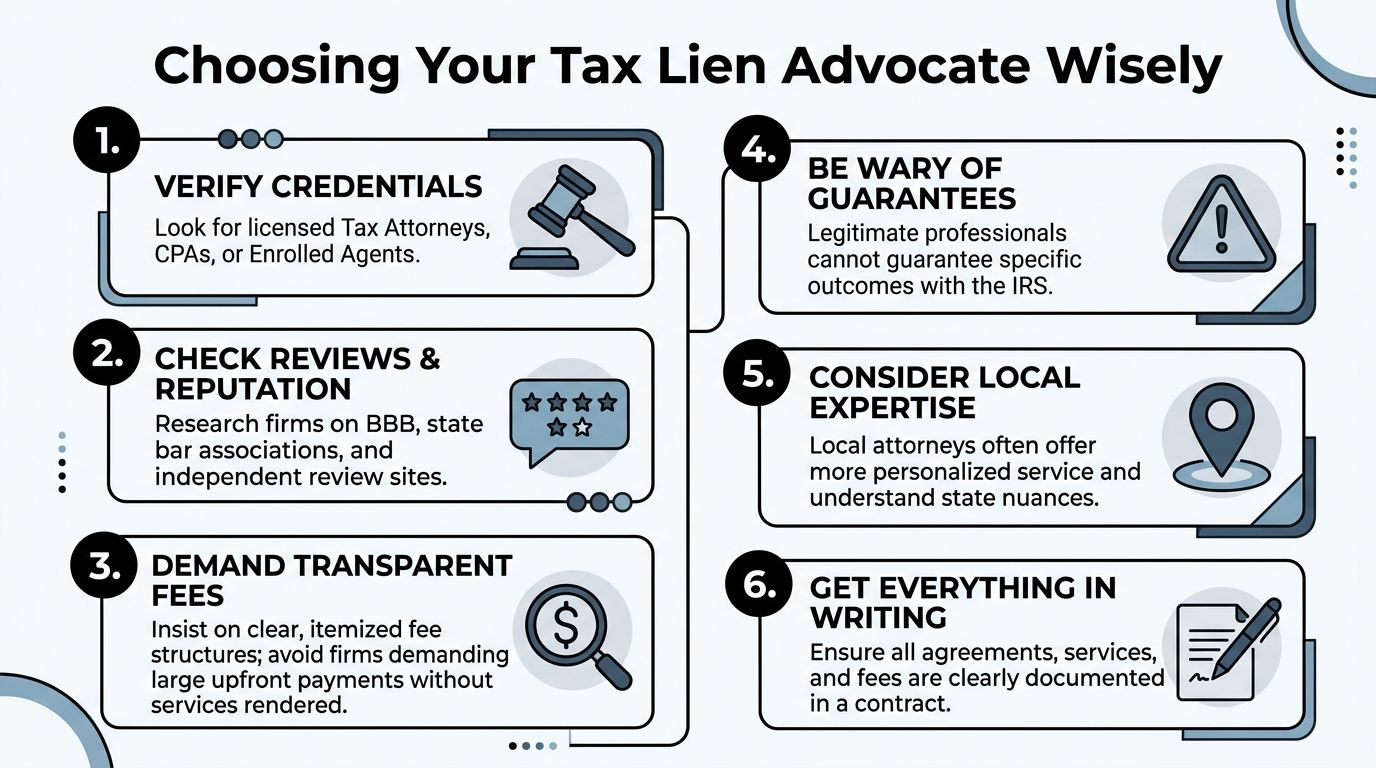
The tax resolution industry has a marketing problem. Too many firms lead with fear, not analysis. They use the existence of an IRS lien to create urgency, then push a large upfront retainer before anyone has reviewed transcripts, notices, financials, or transaction deadlines.
That approach may be profitable for the firm, but it's often bad for the client. A lien case should start with diagnosis. What was filed. What property is affected. What collection stage you're in. Whether the debt is disputed. Whether a sale or refinance is pending. Without that review, the fee quote is often just theater.
Red flags that should slow you down
Watch for these warning signs:
- Large upfront fees before analysis: If the firm hasn't reviewed your IRS posture, the fee may be based on fear, not scope.
- Guaranteed outcomes: No honest professional can guarantee what the IRS will do in your case.
- Call-center handoffs: If you can't tell who is responsible for your file, service often suffers.
- No discussion of alternatives: A credible advisor should tell you when a CPA, EA, or lower-cost option may be enough.
- Pressure to sign immediately: Serious tax work requires facts. High-pressure sales tactics usually signal the opposite.
What a better intake process looks like
A trustworthy professional usually starts by asking focused questions. What notices have you received. What years are involved. Is there a pending closing. Is the liability agreed or disputed. Have returns been filed. Is this individual debt, business debt, or both.
That's not glamorous, but it's how competent representation starts. Tax lien work is detail work.
If your issue overlaps with a real estate dispute, title problem, or foreclosure-adjacent property issue, local real estate counsel may also matter. In that kind of situation, a resource like an expert Fresno property attorney can illustrate the value of jurisdiction-specific property guidance alongside federal tax strategy.
Good representatives don't sell panic. They identify leverage, sequence the steps, and tell you plainly when a cheaper option may solve the problem.
Ask these questions before hiring anyone
Use this checklist in consultations:
- Who will handle my file? Ask whether it will be an attorney, CPA, EA, or a rotating team.
- What is your initial analysis process? You want to hear about notices, transcripts, financial review, and case objectives.
- What outcome are we trying to achieve first? The answer should fit your facts, not a canned script.
- How are fees structured? Look for clarity, not vague promises.
- What happens if my case doesn't fit your service model? Honest professionals will say so.
Don't overlook free or low-cost help
Most articles about hiring a tax lien attorney skip this entirely, and they shouldn't. The IRS explains that Low Income Taxpayer Clinics and other qualifying resources can provide free or low-cost legal help for some taxpayers, as described in the IRS page on legal representation if you can't afford it.
If you qualify, that may be the smartest starting point. A good advisor should tell you that, even if it means you don't hire them.
Your Next Step A Clear Path Forward
A tax lien is serious because it affects financial flexibility, property, and timing. It is not hopeless. Most cases improve once someone stops reacting emotionally and starts working from a real plan.
That plan starts with facts, not slogans. Identify the notice. Understand whether the problem is the debt itself, the lien filing, a pending sale, a refinancing obstacle, or a legal dispute. Then choose the tool that matches the actual bottleneck.
Some people need a release after resolving the debt. Others need a discharge for one asset, subordination for a lender, or a broader settlement path such as an installment agreement or compromise. Some can work effectively with a CPA or Enrolled Agent. Others need a tax lien attorney because the matter touches litigation risk, title, business structure, or contested liability.
The common thread is this. Good outcomes usually come from early, informed action. Bad outcomes often start with delay, confusion, or hiring the first firm that knows how to scare you.
This is also why a diagnostic first step matters so much. Before anyone talks about retainers, staffing, or big promises, the case should be reviewed with enough care to answer a basic question. Can this problem be solved, and if so, what is the smartest path?

If you're holding an IRS lien notice right now, don't measure progress by how fast you can hire someone. Measure it by whether you understand your options and the order they should happen in. That's how you protect property, maintain your advantage, and avoid paying for the wrong kind of help.
If you want that kind of clear first step, Attorney Stephen A Weisberg offers a FREE Tax Debt Analysis designed to answer two questions before you commit to representation: if he can help and how he would approach the case. That's a more transparent model than fear-based firms that demand a large retainer before they've done the work to understand your IRS problem.


