A Homeowner's Guide to a Tax Levy on Property
Facing a tax levy on property? Understand the process from lien to levy, discover your rights, and learn actionable steps to protect your home from seizure.

In this article
- What a Tax Levy Actually Means for You
- Tax Lien vs. Tax Levy: Knowing the Difference is Your First Line of Defense
- Tax Lien vs. Tax Levy At a Glance
- Why This Matters More Than Ever
- Understanding the Path From Tax Lien to Property Levy
- How a Claim Escalates to Seizure
- How a Lien Triggers a Levy Action
- How the Tax Levy Process Unfolds Step by Step
- The Initial Warning Signs from the IRS
- The Final Notice and Your Right to a Hearing
- State and Local Levy Procedures
- Know Your Rights When Facing a Property Levy
- The Taxpayer Bill of Rights: Your Foundation
- What Assets Are Off-Limits?
- Actionable Strategies to Stop a Tax Levy on Your Property
- Establish an Installment Agreement
- Propose an Offer in Compromise
- Prove Currently Not Collectible Status
- Use the Formal Appeals Process
- Consider Bankruptcy as a Last Resort
- When to Hire a Tax Professional for a Property Levy
- Clear Signs You Need Expert Help
- The Value of Professional Representation
- Common Questions About Property Tax Levies
- Can the IRS Really Take My House for Unpaid Taxes?
- What Is the Difference Between a Federal and State Levy?
- Can You Sell a Property That Has a Tax Levy on It?
A tax levy on property is the government's legal seizure of your property to settle an unpaid tax debt. It’s not just a threat or a warning—it’s the forceful, final step in a long collection process.
What a Tax Levy Actually Means for You

Getting a tax levy notice can be terrifying. It feels like the end of the road, but understanding what it truly is gives you the power to act. A levy isn't a bill or a request for payment. It's the government actively taking your property to sell it and pay off what you owe.
Here’s a simple way to think about it: A tax lien is like the government putting a legal "dibs" on your property. It’s a public notice to all other creditors that they get paid first if the property is ever sold. A tax levy, on the other hand, is when the government cashes in on that "dibs" by actually taking the property from you.
The lien is the claim; the levy is the enforcement of that claim.
Tax Lien vs. Tax Levy: Knowing the Difference is Your First Line of Defense
It's so easy to mix these two up, but confusing them can be a costly mistake. They represent two very different stages of the tax collection process, and understanding where you stand is critical to protecting your home.
A tax lien secures the government's interest in your property, much like a mortgage secures a bank's loan. A tax levy is the government actually foreclosing on that interest to take possession.
To make it even clearer, let's look at a side-by-side comparison.
Tax Lien vs. Tax Levy At a Glance
Use this quick comparison to understand the critical differences between a tax lien and a tax levy.
| Aspect | Tax Lien (The Claim) | Tax Levy (The Action) |
|---|---|---|
| What It Does | Secures the debt and gives the government priority over other creditors. | Actively seizes your property to sell it and pay the tax bill. |
| Impact on You | You still own and live in your property, but your credit is damaged. | The government takes legal control, and you can lose your property for good. |
| How It Affects Your Finances | Makes it incredibly difficult to sell, refinance, or get new credit. | Can lead to the complete loss of your home or other real estate. |
| When It Happens | Usually after your tax debt is assessed and the first payment demand is ignored. | Happens only after a lien is filed and multiple formal notices have been sent. |
As you can see, a levy is a much more immediate and severe threat to your ownership.
Why This Matters More Than Ever
Navigating property taxes is getting trickier every year. The global market for property tax services, which exists to help people deal with issues just like this, was valued at USD 3.26 billion in 2024 and is expected to grow to USD 5.45 billion by 2032. This tells us that more and more people are struggling to keep up with complex tax rules. You can read more about these property tax market trends to understand the bigger picture.
Knowing what a tax levy on property is—and how it’s different from a lien—is the foundation of your defense. It helps you move from a state of panic to one of preparedness. You begin to see that a levy isn't something that happens out of the blue; it’s the end of a process with clear warning signs and opportunities to get things back on track.
Understanding the Path From Tax Lien to Property Levy
A tax levy on your property doesn't just happen overnight. It's the final, most aggressive step in a process that almost always starts with a quieter, but no less serious, action: the filing of a federal tax lien. If you want to avoid losing your property, you need to understand how one leads to the other.
Think of a tax lien as the government officially staking its claim. After the IRS figures out what you owe and sends you a bill that goes unpaid, they can file a Notice of Federal Tax Lien. This document goes into the public record, creating a legal claim against your property and putting the government first in line to get paid, ahead of most other creditors.
It’s like a financial anchor dropped on your property's title. You still own your home, but that anchor makes it nearly impossible to sell or refinance until the tax debt is cleared. The lien essentially tells the world, "We get paid first."
How a Claim Escalates to Seizure
A lien is a passive claim, but it's the legal groundwork for something far more aggressive. If you continue to ignore the debt, the IRS can shift gears from just securing its interest to actively collecting on it. This is where things get serious, turning a claim into a direct threat of seizure.
This transition from lien to levy is the critical phase. A lien messes up your credit and complicates your financial life, but it doesn't take your home. A levy is the government's decision to cash in on its claim by actually taking possession of your property to sell it.
Thankfully, this escalation doesn't happen in secret. The IRS is legally required to send you several notices, culminating in a Final Notice of Intent to Levy and Notice of Your Right to a Hearing. This is your last official warning shot. Ignoring this final notice is the single biggest reason a lien turns into a levy.
A tax lien is the government's way of saying, "You owe us, and this property guarantees the debt." A tax levy is when they say, "Time's up. We are now taking this property to satisfy that debt."
The lien is the warning; the levy is the direct hit. For a deeper dive into that first crucial step, our guide on the Notice of Federal Tax Lien explains exactly what that document means for you.
How a Lien Triggers a Levy Action
Once a tax lien is in place, it gives the government the legal authority it needs to pursue a levy. The lien establishes the debt's priority. Your failure to resolve that debt gives the IRS the justification it needs to take forceful collection action.
The journey looks like this:
- Tax Debt Assessed: The IRS calculates what you owe.
- Notice and Demand for Payment: You get an official bill in the mail.
- Failure to Pay: The bill goes unpaid after the demand.
- Tax Lien Filed: The government files a public notice to secure its claim against your property.
- Notice of Intent to Levy: You receive a final warning that a seizure is coming.
- Property Levy: The IRS starts the legal process to seize your property.
This step-by-step process shows that you have multiple chances to step in and fix the problem before you lose your home.
Globally, property taxes are a key source of government funding, though their use varies. For instance, across OECD countries, taxes on property accounted for just 1.1% of GDP in 2022. This is much lower than taxes on income (11.3% of GDP) or goods and services (10.8% of GDP), suggesting that while property levies are a powerful tool, they are often a last resort. You can find more global tax on property statistics from the OECD to see how different countries approach this.
Ultimately, the road from a lien to a levy is paved with ignored notices and missed opportunities to act. By understanding that a lien is the critical first step toward a tax levy on property, you can see the red flags early and take steps to resolve the debt long before the government shows up at your door.
How the Tax Levy Process Unfolds Step by Step
Getting a letter about a tax levy on property can be terrifying, but it's important to know the government can’t just show up and seize your home out of the blue. The whole process follows a strict, legally required timeline that gives you several chances to settle the debt. Knowing these steps is the key to understanding where you are in the process and how much time you have to fight back.
The journey from a simple unpaid tax bill to a full-blown property seizure starts with a series of letters. Each one has a specific purpose and its own deadline, acting as a clear warning that things are getting more serious. Ignoring them is the quickest way to find yourself in a world of trouble.
This timeline shows you exactly how a tax debt can escalate into a lien, and then finally, a levy.
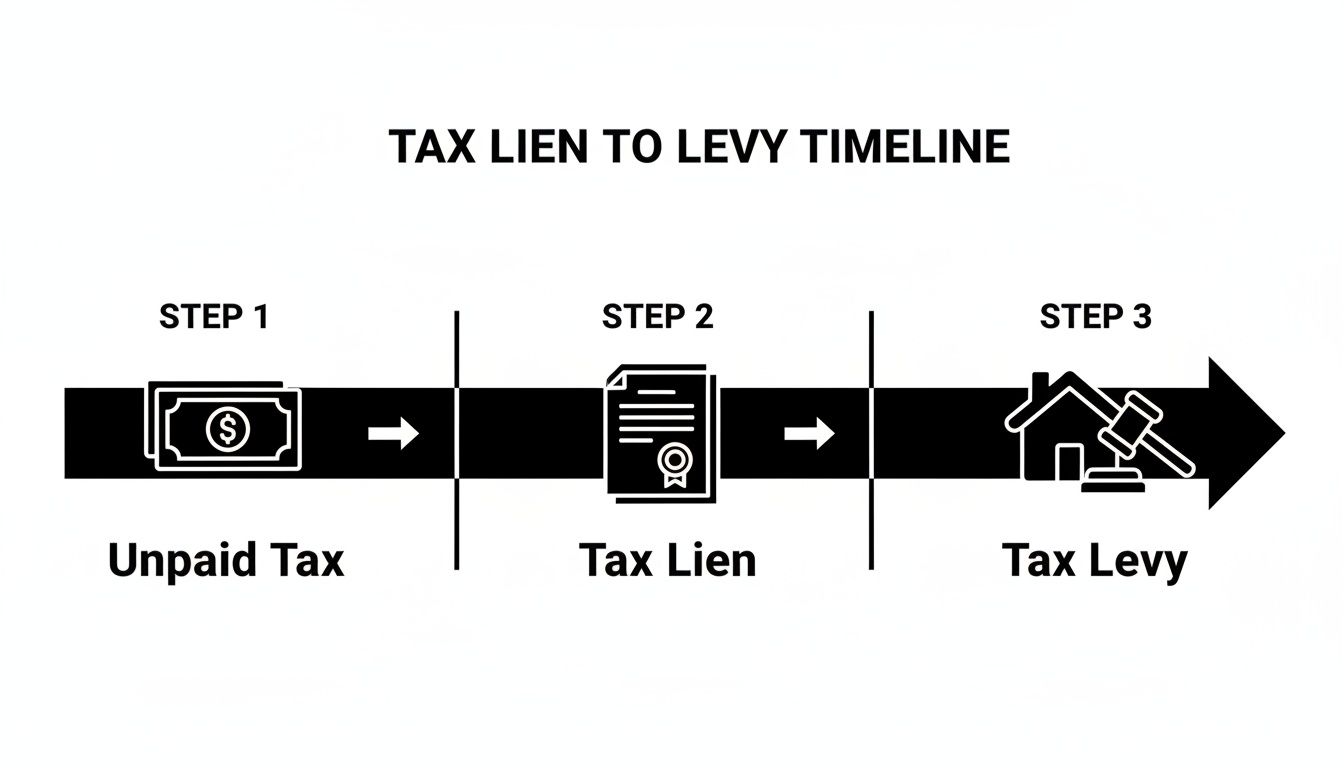
As you can see, it’s a clear progression from a simple debt to a formal legal claim, and finally, to an aggressive collection action. Each stage is a chance to intervene.
The Initial Warning Signs from the IRS
The first official move the IRS makes after a tax debt isn't paid is to send out a series of notices. These aren't just friendly reminders; they are legal steps the agency must take before it can escalate to a levy. The first notice you'll likely see is the CP14, which is simply the initial bill for what you owe.
If you don't pay, the IRS will follow up with more reminder notices, usually a CP501, then a CP503. The one that really turns up the heat is the CP504, which is a Notice of Intent to Levy. While it sounds final, think of it as a warning shot across the bow. It informs you that the IRS has the right to seize your assets, but it doesn't actually start the levy yet. It’s a very serious signal that it's time to engage with them immediately.
The Final Notice and Your Right to a Hearing
The most important piece of mail you’ll get in this whole process is the Final Notice of Intent to Levy and Notice of Your Right to a Hearing. This usually comes as Letter 1058 or LT11. This letter is your last official warning, and it kicks off a critical countdown.
From the date printed on this final notice, you have exactly 30 days to formally request a Collection Due Process (CDP) hearing. This hearing is your legal right and, frankly, your best shot at stopping the levy cold. It gives you a chance to negotiate directly with the IRS Independent Office of Appeals to work out an alternative.
Receiving the Final Notice of Intent to Levy is a pivotal moment. It officially starts a 30-day clock, during which you can exercise your legal right to an appeal. Missing this deadline means the IRS can legally begin seizing your property without further notice.
That 30-day window is ironclad. If you don't request a hearing in time, you forfeit many of your most powerful appeal rights, and the IRS gets the green light to start seizing your property. For a deeper dive into this crucial document, check out our complete guide on understanding a Notice of Levy.
State and Local Levy Procedures
While the IRS follows a standard nationwide playbook, state and local property tax levy rules can be a completely different ballgame. Every state, county, and even city has its own set of laws for collecting delinquent property taxes.
Generally speaking, though, the pattern is similar:
- Delinquency Notice: You’ll get an official notice that your property taxes are past due.
- Public Notice: Your name and property details might be published in a local newspaper as part of a "tax sale" list.
- Redemption Period: Most states give you a window of time, known as a redemption period, to pay the back taxes, interest, and penalties to prevent the sale of your property.
Unlike an IRS levy, which can move fairly quickly after the final notice, local property tax sales often have much longer redemption periods—sometimes a year or more. The end result is the same, though: fail to pay, and you will lose your property. It's absolutely essential to get familiar with the specific rules in your jurisdiction to protect your home.
Know Your Rights When Facing a Property Levy
It's easy to feel overwhelmed and powerless when a tax authority comes knocking. But here's the most important thing to remember: you have rights. The law has built-in protections to make sure you're treated fairly, and understanding them is the first step to defending your property.
The government can’t just seize your assets out of the blue. They have to give you a chance to respond. After you get a Final Notice of Intent to Levy from the IRS, you have a powerful tool at your disposal: the right to request a Collection Due Process (CDP) hearing.
This isn't just another piece of paperwork. A CDP hearing is a formal meeting where you can challenge the levy and suggest other ways to resolve your tax debt. You'll get to make your case with the IRS Independent Office of Appeals, which is a neutral department separate from the agents focused on collecting. It's your best chance to negotiate an installment plan or an Offer in Compromise before things escalate.
The Taxpayer Bill of Rights: Your Foundation
Your relationship with the IRS is grounded in the Taxpayer Bill of Rights. Think of this as your personal constitution when dealing with tax issues. These ten fundamental rights are the bedrock of your defense against an aggressive tax levy on property.
These rights guarantee you'll be treated with respect. Some of the most critical protections are:
- The Right to Be Informed: The IRS can't operate in secret. They have to clearly explain the levy process, what your deadlines are, and what options you have.
- The Right to Challenge the IRS's Position and Be Heard: This is the heart of your appeal rights. You can submit documents, explain your situation, and expect the IRS to actually listen and consider your side of the story.
- The Right to Representation: You never have to face the IRS alone. You are legally allowed to have a professional, like a tax attorney or an Enrolled Agent, represent you. This is especially important when your home is on the line.
The Taxpayer Bill of Rights isn't just a guideline—it's the law. Mentioning these rights in your conversations and letters reminds IRS agents of their legal duties. It changes the power dynamic, turning you from a passive target into an active participant with legal standing.
What Assets Are Off-Limits?
A tax levy is a serious enforcement tool, but it doesn't give the government a blank check to take everything you own. Federal law protects certain property and income from seizure, ensuring that a tax debt doesn't leave you completely destitute. Knowing what's protected can bring some peace of mind and help you focus on protecting the assets that are truly at risk.
Even with a property levy looming, some of your assets are safe. The government cannot take:
- Unemployment benefits and certain types of pension and annuity payments.
- Workers' compensation payments.
- A specific portion of your wages or other income. The exact amount is calculated based on your filing status and how many dependents you have.
- Your main home isn't entirely exempt, but the IRS has to jump through major legal hoops to seize it. It’s almost always a last resort for them.
These protections prove that while a tax levy on property is a serious threat, the system has safeguards. By understanding your right to a hearing, leaning on the Taxpayer Bill of Rights, and knowing which assets are exempt, you can face this challenge with confidence and a clear plan.
Actionable Strategies to Stop a Tax Levy on Your Property

Getting that final levy notice is a heart-stopping moment, but it's not the end of the road. You have several powerful options to stop the collection process dead in its tracks and protect your home. This is where we move from theory to action, and it all starts with a clear-eyed look at your playbook.
The absolute worst thing you can do is ignore the situation. Engaging with the tax authority proactively is the key. They have procedures for a reason, and taking decisive action opens up pathways to a real resolution. Let's break down the most effective ways to stop a tax levy on property.
Establish an Installment Agreement
One of the most straightforward ways to halt a levy is to set up an Installment Agreement. Think of it as a payment plan that lets you chip away at your tax debt with manageable monthly payments. As long as you stick to the schedule, the tax agency calls off all collection activities, including any levy on your property.
To get on board, you typically need to be up-to-date on filing all your tax returns. For federal taxes, if you owe less than $50,000 (that's tax, penalties, and interest combined), you can often apply for a payment plan online in just a few minutes. It’s usually the fastest route to getting immediate relief.
An Installment Agreement is a formal contract. Once it's approved, the levy action stops. But be warned: defaulting on even one payment can immediately reactivate the levy process, putting your property right back at risk.
Propose an Offer in Compromise
What happens when you genuinely can't afford to pay the full amount you owe, no matter how much you stretch it out? This is where an Offer in Compromise (OIC) comes in. An OIC allows certain taxpayers to settle their tax liability for less than the full amount owed. It's an incredibly powerful tool, but it's not for everyone.
To be eligible, you have to prove to the tax agency that paying in full would create a serious economic hardship. The IRS will put your finances under a microscope, looking at:
- Ability to pay: What's your current income versus your necessary living expenses?
- Income potential: What are your future earning prospects?
- Asset equity: What is the value of everything you own, from your home and cars to your bank accounts?
If the IRS accepts your offer, all collection efforts, including the levy, come to a halt. Just be prepared for a complex application process that requires extensive financial disclosure.
Prove Currently Not Collectible Status
If you're facing an extreme financial crisis, you might qualify to have your account placed in Currently Not Collectible (CNC) status. This isn't debt forgiveness—interest and penalties keep adding up—but it is a temporary pause on all collection efforts. It immediately stops the threat of a levy.
To get CNC status, you have to demonstrate that paying your tax debt would leave you unable to cover basic necessities like food, housing, and healthcare. The IRS will check in on your financial situation periodically, usually annually, to see if your ability to pay has improved. It's a lifeline for those in a truly dire spot.
Use the Formal Appeals Process
As we've covered, you have a right to a Collection Due Process (CDP) hearing if you request one within 30 days of receiving the Final Notice of Intent to Levy. This is a game-changer because filing a timely CDP request legally stops the levy process until your hearing is over and a decision is made. During the hearing, you can propose alternatives like an installment plan or an OIC.
Even if you miss that critical 30-day window, you can still ask for an Equivalent Hearing. The catch is that this type of hearing doesn't legally stop the levy while your case is being reviewed. Successfully navigating the appeals process requires a good grasp of tax law and procedure. You might find our guide on how to remove a tax lien helpful, as dealing with the lien is a big part of preventing future levy threats.
Consider Bankruptcy as a Last Resort
Filing for bankruptcy is a serious financial step, but it offers immediate and powerful protection against a tax levy. The moment you file, an "automatic stay" goes into effect. This is a legal injunction that forces all creditors, including the IRS, to immediately stop all collection activities.
While some older income tax debts might be dischargeable in bankruptcy, property tax liens are secured debts and usually survive the process. This means you’ll likely still have to address the underlying tax debt eventually, but bankruptcy buys you invaluable time to reorganize your finances without the immediate threat of seizure.
When to Hire a Tax Professional for a Property Levy
It's tempting to think you can handle a tax problem on your own, especially to save a few bucks. But when it comes to a tax levy on your property, this is absolutely not a DIY project. The stakes are just too high—we're talking about the potential loss of your home. Knowing when to call in a professional isn't just a good idea; it's critical.
If you see any of the red flags below, it's time to pick up the phone. These situations can get complicated fast, and the seasoned knowledge of a tax pro becomes your most valuable asset.
Clear Signs You Need Expert Help
Your tax debt is substantial. Once you owe more than $50,000, the IRS playbook changes. Their procedures get tougher, and any negotiation becomes far more intense. You're not just having a simple conversation at that point.
You own a business or have complex assets. If your financial picture includes business assets, payroll tax debts, or a complicated investment portfolio, figuring out what you can realistically pay is a specialized skill. This isn't straightforward math.
The tax agency is unresponsive or aggressive. Are your calls going unanswered? Are agents pressuring you to make a quick decision you're not comfortable with? That’s a clear signal you need an advocate who knows how to navigate the bureaucracy and command respect.
You want to pursue an Offer in Compromise (OIC). An OIC can be a fantastic tool for settling tax debt for less than you owe, but the application is a beast. It's a mountain of paperwork, and the rejection rate is notoriously high. A professional knows how to build the strongest possible case for your financial situation.
Trying to fight a property levy alone is like walking into a major court case without a lawyer. Sure, you can do it, but you're putting yourself at a massive disadvantage against a system built by and for experts. A tax attorney or an Enrolled Agent is your equalizer.
The Value of Professional Representation
A good tax professional brings far more to the table than just form-filling. They know the ins and outs of how tax agencies operate, they understand which arguments actually work, and most importantly, they can protect your rights every step of the way. They’ll take over all communications, saving you from those incredibly stressful phone calls and letters.
Of course, the best strategy is prevention. Staying on top of your finances with professional property business accounting services can help you avoid a levy in the first place. But once that levy notice arrives, an expert can step in and negotiate directly on your behalf to secure the best outcome, whether that's a manageable payment plan, a settlement, or proving that the levy would cause you severe economic hardship.
Ultimately, their guidance turns a terrifying crisis into a structured process with a clear path forward.
Common Questions About Property Tax Levies
When you're dealing with a potential tax levy on your property, a lot of questions start swirling. It can feel overwhelming, but getting clear, straightforward answers is the first step toward finding a solution. Let's tackle some of the most common concerns head-on.
Can the IRS Really Take My House for Unpaid Taxes?
Yes, they can. The IRS does have the legal power to seize and sell your primary home to cover a tax debt, but it's important to understand this is an absolute last resort. It’s not something that happens out of the blue.
This drastic measure only comes after a long, drawn-out process. It requires a court order and happens only when a taxpayer has ignored repeated notices and made no effort to work with the IRS. Think of it as the final step after all other options—like payment plans or an Offer in Compromise—have been exhausted or ignored.
What Is the Difference Between a Federal and State Levy?
The main distinction comes down to who is taking action and what rulebook they're following.
- Federal IRS Levy: This comes from the Internal Revenue Service for unpaid federal taxes, such as income tax. The process is the same no matter where you live, as it’s governed by the federal Internal Revenue Code.
- State or Local Levy: This is issued by your state, county, or even city for things like overdue state income tax or, most commonly, property taxes. The rules, timelines, and your rights can change dramatically from one state to the next.
While both are serious, state and local authorities are often more aggressive when it comes to a tax levy on property for unpaid property taxes. After all, the property itself is the source of the debt.
Can You Sell a Property That Has a Tax Levy on It?
Trying to sell a property with an active levy on it is nearly impossible in a traditional sale. A levy isn't just a claim; it's an active seizure. The government is already in the process of taking control, which effectively freezes any sale.
However, the situation is different if there's only a tax lien on the property. A lien is just a legal claim against your property to secure the debt. You can still sell the house, but the tax debt must be settled using the proceeds from the sale at closing. This is the only way the new owner can get a clean title.
The difference is critical: a lien complicates a sale, but a levy brings it to a halt. You can learn more by reading our guide about how to sell a home with an IRS lien.
A tax levy on your property is a serious legal challenge that requires immediate and strategic action. Instead of facing the IRS or state alone, let an experienced professional guide you. Attorney Stephen A Weisberg starts with a FREE Tax Debt Analysis to determine the best path forward before you ever pay a fee. Start your free analysis today and protect your property.


