Tax Levy on Paycheck: A Complete Guide to IRS Wage Levies
Learn what a tax levy on paycheck means, how IRS wage levies work, exemptions, employer duties, and proven ways to stop or reduce one fast.
In this article
- When the IRS Takes a Bite Out of Your Paycheck
- What a wage levy actually is
- How Often the IRS Actually Uses Wage Levies
- Why that matters to a paycheck problem
- The Notice Path That Leads to a Paycheck Levy
- Reading the letters in plain English
- Why this is different from state levies and bank levies
- How Much of Each Paycheck Is Actually Protected
- Two 2026 examples from the IRS table
- How to think about the formula
- What Employers Must Do and How State Levies Differ
- What payroll should do right away
- Federal and state levies are not the same thing
- Matching the Remedy to the Situation
- When stopping the levy comes first
- When resolution matters more than immediate relief
- First 72 Hours and How The W Tax Group Helps
- Key Takeaways and Common Follow-Up Questions
A missing pay stub can turn a normal week into a panic. You open payroll, see a line item you don't recognize, and your take-home pay is suddenly smaller for reasons no one at work seems able to explain. If that sounds familiar, you may be looking at a tax levy on paycheck, which means the IRS has told your employer to withhold part of your wages for an unpaid tax debt.
A levy is not the IRS asking nicely. It's a legal collection order sent to the employer, and it keeps working until the debt is paid, an alternative arrangement is made, or the levy is released, as described in IRS guidance on wage levies and levy procedures IRS wage levy guidance and IRS levy internal guidance. That's why the problem feels so disruptive, the employer has to follow the levy, and the withholding can repeat every pay period.
If you're trying to understand whether this is the same thing as garnishment, the short answer is no. A wage levy is an administrative federal collection tool, not a court judgment, and the IRS generally doesn't need to go to court first to send it to an employer. If you want a plain-language comparison of the wage side of this issue, see this explanation of can the IRS garnish my wages.
When the IRS Takes a Bite Out of Your Paycheck
The first thing you notice is the math, not the paperwork. The paycheck looks normal at the top, then a deduction appears that doesn't match benefits, taxes, or anything your employer usually withholds. That line is often the first visible sign that the IRS has entered the payroll stream.
What a wage levy actually is
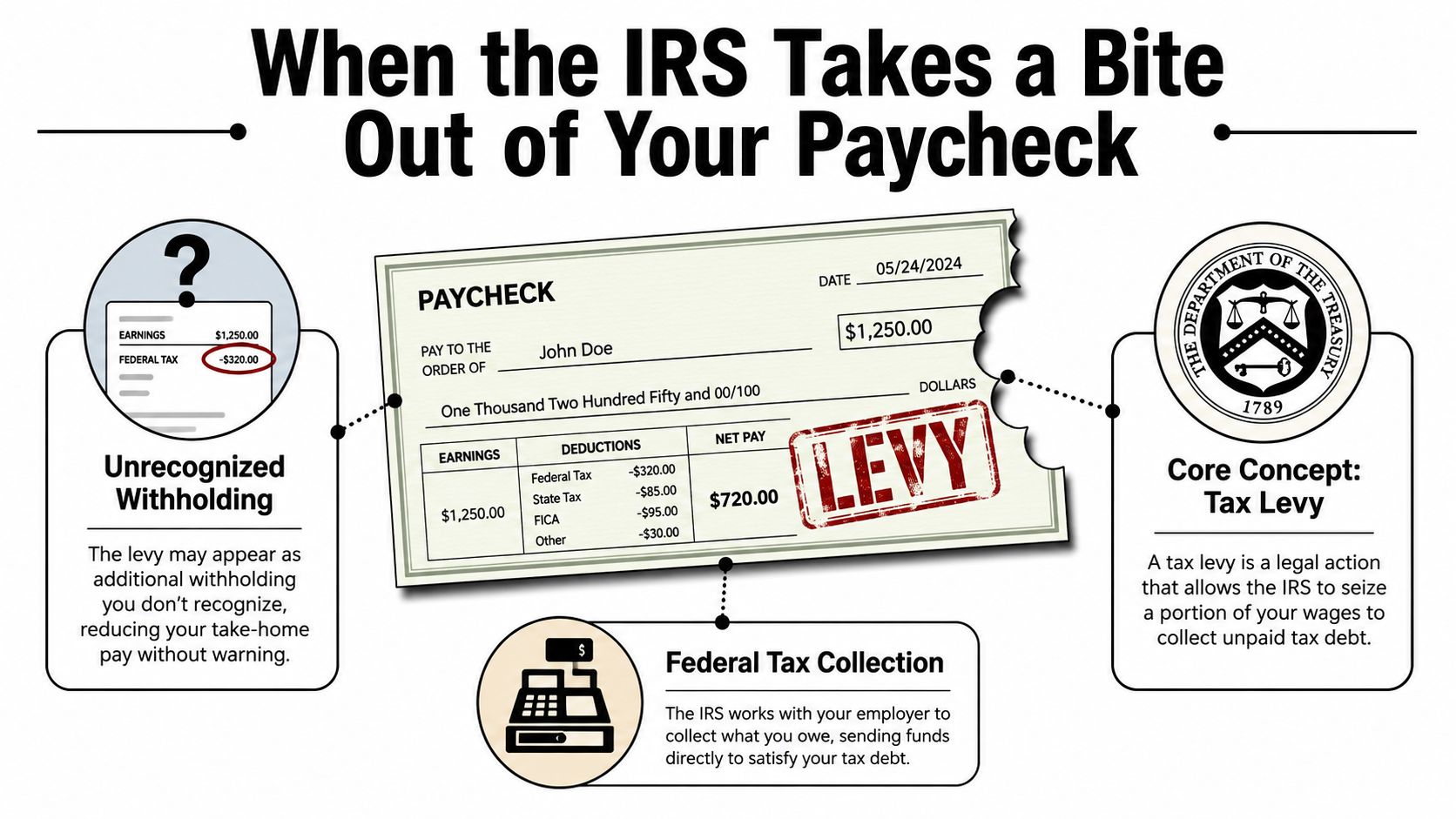
A tax levy on paycheck is the IRS directing an employer to send part of an employee's wages to the government to satisfy an unpaid tax debt. Under IRS rules, the employer withholds the portion of wages above the employee's exempt amount, which depends on filing status, pay frequency, and dependents using IRS Publication 1494 IRS Publication 1494. That means two people with similar gross pay can have very different levy results.
The process is administrative. The IRS does not need to file a lawsuit before it can issue the levy, and that's one reason people often feel blindsided when the deduction appears. Once the employer is served, payroll has to keep following the levy until the IRS releases it or the debt is otherwise resolved IRS levy internal guidance.
Practical rule: If a deduction started after IRS notices and you didn't sign anything authorizing payroll withholding, treat it as a levy until you verify otherwise.
The emotional shock is real, but the legal structure is straightforward. The IRS is collecting a federal tax debt through the employer, not punishing the employee through a one-time seizure. If you're comparing this to other collection tools, the key difference is continuity, the levy keeps reaching forward to future wages.
The visual below helps tie the concept to what you're seeing on the pay stub. The central fact is simple, the IRS is intercepting pay before it reaches you.
How Often the IRS Actually Uses Wage Levies
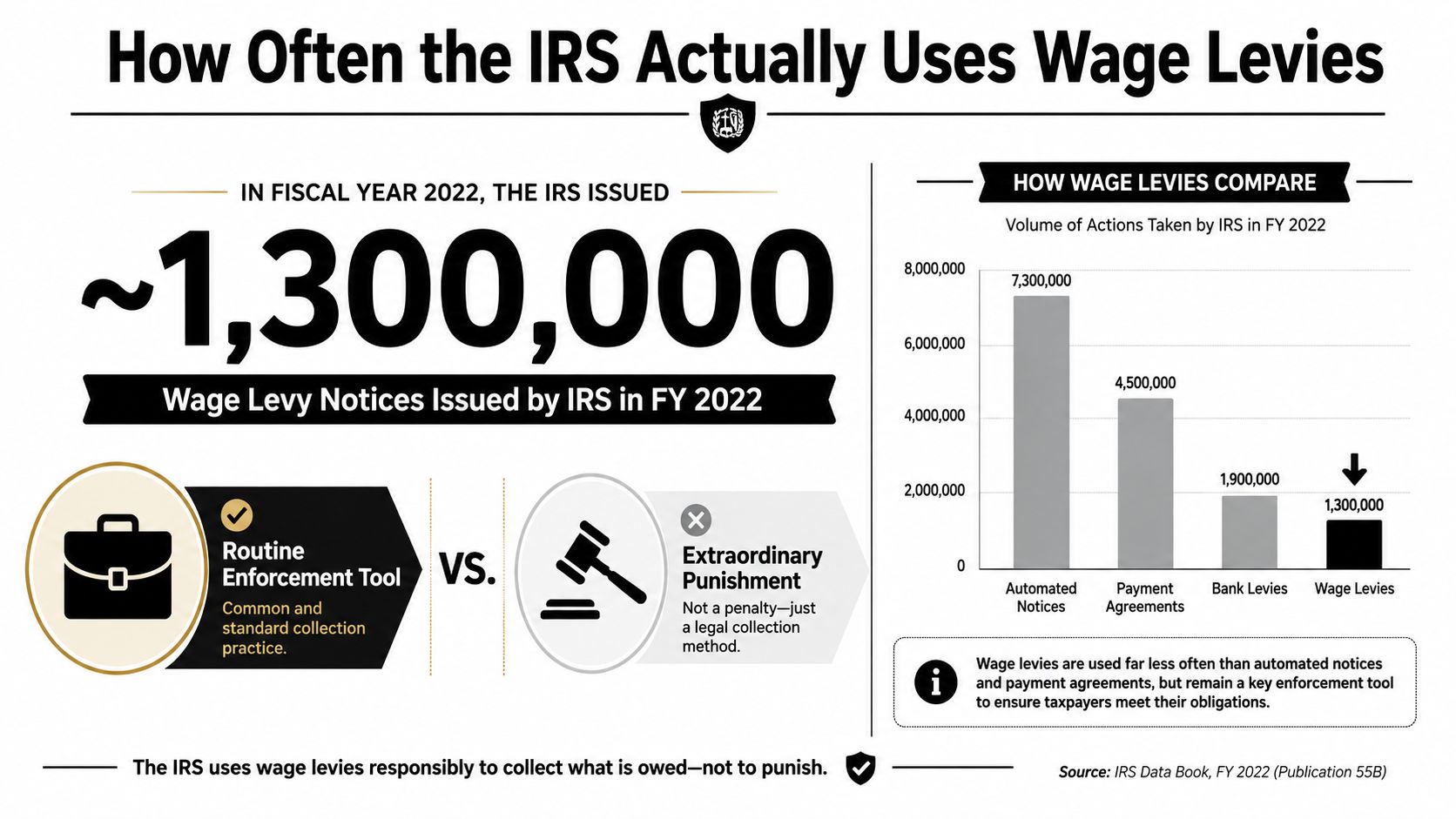
A wage levy feels extreme when it hits one household. On the federal enforcement side, though, it's routine. In fiscal year 2025, the IRS served about 339,137 notices of levy on third parties, up from roughly 313,792 in fiscal year 2024, an increase of about 8% year over year, and the IRS filed about 214,099 Notices of Federal Tax Lien in the same year IRS levy statistics. That means levies outnumbered liens by roughly 58% in FY2025 IRS levy statistics.
Why that matters to a paycheck problem
The IRS also conducted only 50 property seizures in FY2025, which works out to roughly 6,783 levies for every seizure IRS levy statistics. That gap matters because it shows where the agency spends its collection energy. For employees and payroll departments, a paycheck levy is not a rare event, it's one of the IRS's standard collection tools.
That also means the IRS has repeatable procedures. Payroll teams know how to process the notice, taxpayers know the kinds of letters that come first, and practitioners know which deadlines matter. The upside of that predictability is practical, if you move quickly, the same system that starts the levy can also stop it.
The enforcement pattern also explains why paycheck levies tend to feel more immediate than liens. A lien is a public claim against property, while a levy reaches into an actual payment stream. For a worker, that's the difference between a credit file issue and a smaller paycheck next Friday.
A wage levy is common enough that the IRS has built a standardized process around it. That's uncomfortable, but it also means there's a known path out.
The Notice Path That Leads to a Paycheck Levy
The IRS usually doesn't jump straight from silence to a withheld paycheck. The process tends to move through notices, warning language, and a final chance to respond before the employer starts remitting wages. If you're reading your mailbox now, every envelope matters more than it did a month ago.
Reading the letters in plain English
A common path starts with a tax bill and demand for payment, then moves to a notice that the IRS intends to levy if the balance isn't addressed. People often see references to CP504, LT11, or Letter 1058 in this stage, and those names matter because they signal escalation. The important point is not the code number, it's that the IRS is telling you collection is moving from billing to enforcement.
The final notice triggers a short appeal window before money starts coming out of wages. Under IRC 6330, the taxpayer generally has the right to request a Collection Due Process hearing, and the timing is critical because the request usually has to be made within 30 days of the final notice to preserve the pre-levy hearing right IRS levy guidance. Missing that window doesn't make the debt disappear, but it can change the procedural tools available.
Why this is different from state levies and bank levies
Federal wage levies are one category within a broader collection system. The IRS also uses other levy tools, including bank levies and the Federal Payment Levy Program, while states run their own systems separately IRS levy guidance. That distinction matters because the agency issuing the levy controls the process, and the notice path can differ depending on whether the debt is federal or state.
If you want a broader explanation of the IRS warning stages, this overview of notice of intent to levy is a useful companion. The practical takeaway is simple, once the final notice arrives, the clock is real and the employer side of the process can begin soon after.
How Much of Each Paycheck Is Actually Protected
A levy is not a flat percentage taken from every check. That's one of the biggest misunderstandings people have when they first see the payroll deduction. The IRS uses an exempt-income calculation tied to filing status, dependents, and pay frequency under Publication 1494 IRS Publication 1494, so the protected amount can vary a lot from one worker to another.
Two 2026 examples from the IRS table
| Filing Status | Pay Frequency | Dependents | Exempt Amount per Pay Period |
|---|---|---|---|
| Single | Weekly | 3 | $615.38 |
| Married filing jointly | Biweekly | 2 | $1,646.16 |
Those two numbers show why identical-looking paychecks can produce very different levy outcomes. A single worker paid weekly with three dependents has one protected amount, while a married taxpayer filing jointly and paid biweekly with two dependents has another. The IRS withholds only the part above the exempt amount, so the levy result turns on the table entry, not a universal percentage IRS Publication 1494.
How to think about the formula
Your pay frequency matters because the IRS measures protection per pay period, not by the year. Your filing status and dependents matter because they shape the exempt amount the table allows. That's why a change in household facts can materially change take-home pay without any change in gross wages.
Plain-language rule: the levy takes what's above the IRS-protected amount, not a fixed slice of your whole paycheck.
That is also where state systems can confuse people. Some states use flat-rate approaches, while the IRS uses a table-driven exemption structure, so the result is not interchangeable across agencies. If you're trying to estimate your own paycheck, start with the table, not with a percentage shortcut.
For a deeper walk-through of the table logic, see the internal explanation of inside IRS wage levy formula.
What Employers Must Do and How State Levies Differ
Employers often feel caught in the middle, but the compliance duty is direct. When a levy arrives on a Form 668-W, payroll has to calculate the exempt amount, withhold the levied portion each pay cycle, and send the money where the notice directs. The obligation continues until the IRS releases the levy or the debt is resolved, which is why employers can't treat it like a one-time payroll adjustment IRS levy internal guidance.
What payroll should do right away
The first step is to read the notice carefully and match the employee to the exemption table. The second is to confirm the pay frequency and dependent count used for withholding, because those facts drive the protected amount under IRS Publication 1494 IRS Publication 1494. The third is to remit on the schedule the levy requires, not on a schedule that feels administratively convenient.
If an employer ignores the levy, the government can pursue the employer for the amount that should have been withheld. That's why payroll teams treat these notices as urgent, even when the employee is trying to work out a release. The employee's dispute with the IRS does not suspend the employer's duty unless and until the IRS changes the levy.
Federal and state levies are not the same thing
State systems can look similar on the surface and still differ in important ways. Colorado generally uses a tax levy rate of 25% of disposable pay after notice, while South Carolina and Hawaii describe levies of 25% of gross wages in their state systems what is a state tax levy. Those differences matter because the base amount, disposable pay versus gross wages, changes the practical result.
The same is true outside wages. Levy tools can reach federal payments, retirement accounts, contractor receivables, and other non-wage income streams, so self-employed taxpayers and owners need to identify the type of collection action, not just the fact that money is missing IRS levy guidance. If you're comparing systems, a wage levy is only one slice of the larger collection picture.
For families dealing with wage withholding in a support case, the collection process can feel familiar but still be legally separate. A helpful discussion of the legal process for child support enforcement shows how another type of withholding follows its own rules, which is exactly why the source of the levy matters.
Matching the Remedy to the Situation
Not every wage levy calls for the same response. A taxpayer with a missing return has a different problem from someone with a valid debt but a temporary cash crunch, and both are different again from a spouse who shouldn't have been pulled into the case in the first place. The best remedy depends on what kind of problem is driving the withholding.
When stopping the levy comes first
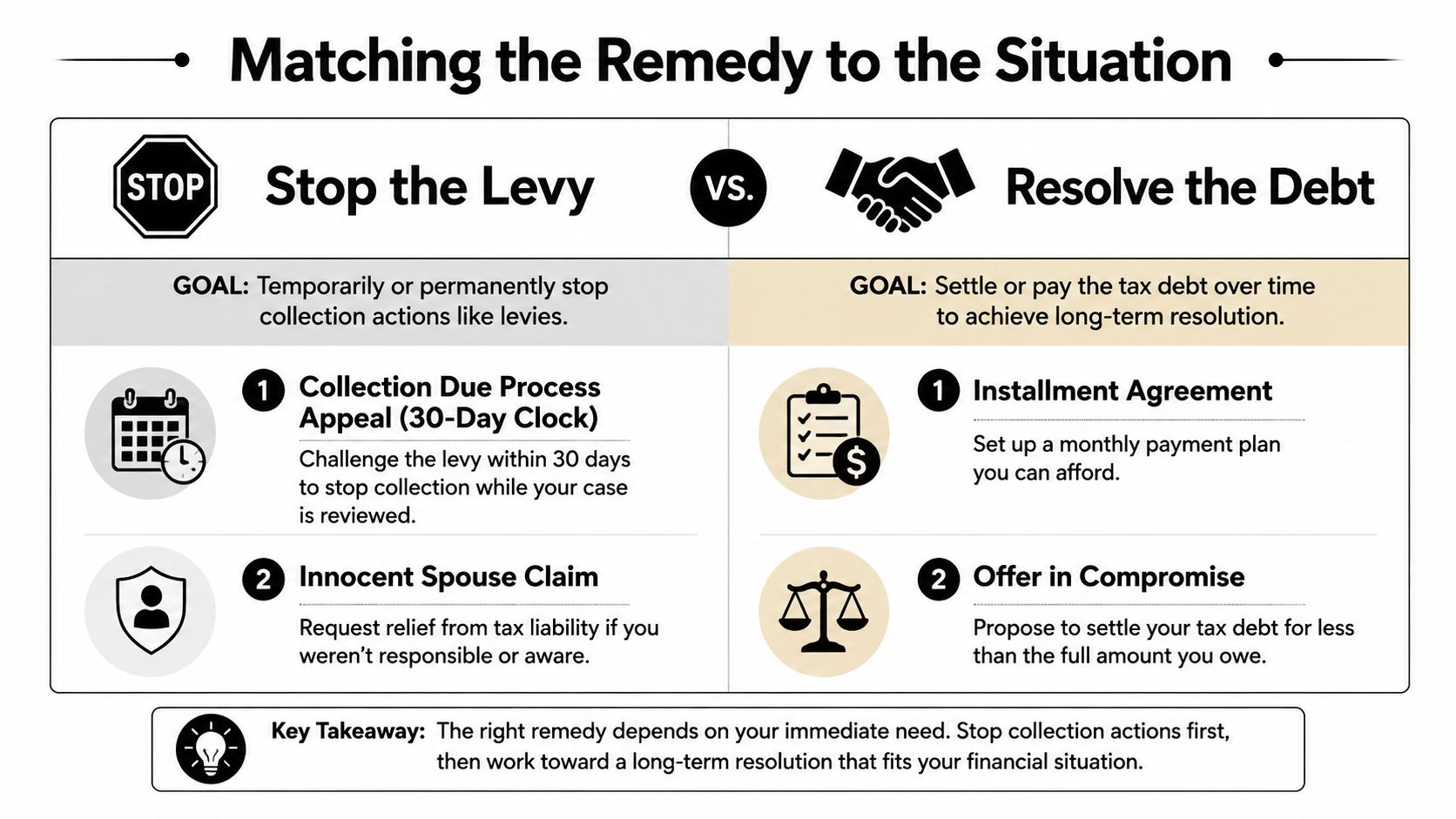
A Collection Due Process appeal is the most time-sensitive tool because it can preserve review rights if you act within the 30-day window tied to the final notice IRS levy guidance. An innocent spouse claim fits cases where the liability belongs, at least in part, to a spouse and fairness or allocation is the issue. Those tools are about stopping or narrowing the levy, not just chipping away at the debt.
When resolution matters more than immediate relief
An installment agreement spreads the balance over time and can be the right fit when the taxpayer can pay something regularly. An offer in compromise is for situations where the taxpayer can't reasonably full-pay and the IRS may accept less than the full amount based on collectability. Currently not collectible status is the hardship-based pause when basic living expenses leave no disposable income, and the debt still exists even though active collection usually stops.
Bankruptcy is the most technical option in the mix. Some tax debts are not dischargeable, some are, and the outcome depends on the type and age of the debt, so it's not a blanket answer to wage withholding. The key is to match the remedy to the actual fact pattern instead of choosing the first option that sounds hopeful.
If the levy is active, ask first whether you need a procedural stop, a hardship pause, or a long-term payment structure. The right answer changes the strategy completely.
First 72 Hours and How The W Tax Group Helps
If you discover a levy this week, move in three stages. In the first 24 hours, gather the IRS notices, the pay stub, and any recent letters so you can identify which agency is collecting and what stage you're in. In the next 48 hours, check whether the final notice deadline is still open and whether a hearing request is still available, then call the IRS if you need to discuss release options or a payment path.
By 72 hours, you should know three things, the amount at issue, whether the levy is federal or state, and which document controls the next deadline. Employers should also confirm they're using the correct exemption data and keeping copies of the levy notice and remittance records. If the facts are messy, especially in self-employment, payroll tax debt, joint liability, or mixed federal and state collection issues, the problem usually needs a full review before anyone makes promises.
The W Tax Group starts with a free Tax Debt Analysis, which is a practical first pass before anyone talks about fees. It's designed for individuals, small businesses, S-corps, payroll-tax debtors, self-employed taxpayers, spouses with joint liabilities, and the professionals who refer them. That kind of analysis is where a practitioner can sort out whether the issue is a wage levy, a state levy, a non-wage collection problem, or something that needs a different remedy entirely.
Key Takeaways and Common Follow-Up Questions
A wage levy is continuous, not one-and-done, and the exempt amount depends on the IRS table, not a flat percentage. Employer compliance is mandatory once the notice is served, and federal rules don't automatically match state rules. The most valuable deadline on the calendar is still the 30-day CDP window tied to the final notice.
A common follow-up question is whether an installment agreement stops a levy right away. The practical answer is that it often helps, but the details depend on how the agreement is set up and whether the IRS has already moved to enforced collection. Another frequent question is whether the levy can hit a spouse's wages, and the answer depends on whose liability is being collected and whether joint issues are involved.
People also ask what happens if the taxpayer quits or changes jobs. A paycheck levy doesn't disappear just because the employee changes employers, because the liability remains and the IRS can serve the new employer once it learns where wages are being paid. If your situation looks anything like the examples above, a full review is worth getting before the payroll cycle turns again.
Tax Attorney Stephen A Weisberg helps taxpayers, businesses, and their advisers sort out IRS and state collection problems, including wage levies, before the wrong form of relief gets filed. If a tax levy on paycheck has started, or you've received levy notices and aren't sure which deadline controls, visit Tax Attorney Stephen A Weisberg to request a free Tax Debt Analysis and get a clear reading of the next step.


