Master tax forms 8283: Noncash Deductions & Audit Avoidance
Maximize noncash charitable deductions with our 2026 guide on tax forms 8283. Master completion, choose appraisers, and avoid IRS audits. Get expert tips!
In this article
- When Do You Need to File Form 8283?
- Who Is Required to File?
- Quick Guide to Filing Form 8283
- Understanding the "Similar Items" Rule
- Section A: The Everyday Giving Lane
- Section B: The High-Value Highway
- The Three Pillars of Section B
- The Critical Role of a Qualified Appraisal
- What Makes an Appraisal "Qualified"
- Choosing a "Qualified Appraiser"
- A Costly Mistake: A Real-World Warning
- A Step-by-Step Guide to Completing Form 8283
- Initial Information All Filers Must Complete
- Completing Section A for Donations Up to $5,000
- Completing Section B for High-Value Donations
- Common Mistakes That Trigger IRS Audits
- Overvaluing Your Donations
- Failing to Get a Qualified Appraisal
- Missing Essential Signatures and Information
- When to Consult a Tax Professional
- Red Flags That Signal You Need an Expert
- The Value of Proactive Tax Advice
- Common Questions About Form 8283
- When Do I Actually Need to File Form 8283?
- Can I Just Fill Out the Form Later if I Forget?
- What Happens if the Charity Sells My Donated Car?
- Can My CPA Just Appraise My Donation?
If you've donated property to a charity—think clothes, a car, or even stocks—you'll need to know about Form 8283. It's the IRS's way of getting the details behind your noncash charitable contributions. When the total value of these donations tops $500 for the year, this form isn't optional; it's a required part of your tax return.
Think of it as the official record of your generosity. Simply writing a number on your Schedule A won't cut it once you pass that $500 mark. The IRS wants to see a detailed breakdown of what you gave, who received it, and how you determined its value.
When Do You Need to File Form 8283?
The filing trigger is that $500 total noncash donation threshold. Once you cross it, you must attach Form 8283 to your tax return. It’s an essential piece of substantiation that helps the IRS verify the deductions you’re claiming.
It's a bit like providing an itemized list to an insurance company after a claim. You can't just say "I lost some valuables"; you have to list what they were. Form 8283 provides that same level of detail for your noncash gifts, creating a clear paper trail for both you and the government.
Who Is Required to File?
This isn't just for major philanthropists. The requirement hits a broad spectrum of taxpayers. You'll need to file Form 8283 if you're an:
- Individual who donated a bag of clothes, used furniture, or an old vehicle.
- Business Owner (from a sole proprietor to a C-corp) that contributed old equipment, company inventory, or real estate.
- Investor who gifted assets like appreciated stocks or mutual funds.
Basically, if your tax return includes a noncash charitable deduction over the $500 limit, the IRS expects to see a Form 8283 attached.
Let's quickly recap the filing triggers. This table breaks down when you need to file Form 8283 and which section to focus on.
Quick Guide to Filing Form 8283
| Donation Value Threshold | Form 8283 Section Required | Key Requirement |
|---|---|---|
| $500 or less | Not required | Keep good records for yourself. |
| Over $500 up to $5,000 | Section A | Itemize your donations. |
| Over $5,000 | Section B | A written appraisal is generally required. |
This table is a great starting point, but the details matter—especially when it comes to grouping items.
Understanding the "Similar Items" Rule
Here's where many taxpayers get tripped up. The IRS has a rule for "similar items," which means you must group together donations of the same type when calculating your $500 threshold.
For instance, say you dropped off a bag of clothes worth $200 in March and another bag worth $350 in November to the same charity. Neither donation is over $500 on its own. But because they are similar items, you have to add them up. Your total donation of clothing is $550, which means you now have to file Form 8283.
The IRS does this to prevent people from splitting up a large donation into smaller chunks just to avoid the reporting requirement. This rule applies to things like books, furniture, art, and collections.
Getting this right is a key part of staying compliant and is a fundamental strategy for anyone looking to properly reduce their overall tax liability through charitable giving.
And this form is no small matter. In tax year 2019 alone, the IRS processed 3.9 million returns that included Form 8283, accounting for a staggering $72.8 billion in deductions. This highlights just how critical this form is to the tax system. For a deeper dive into these statistics, the IRS website offers extensive data and reports.
Of all the parts of Form 8283, understanding the difference between Section A and Section B is the most crucial. Getting this wrong is one of the easiest ways to attract unwanted IRS attention or even have your deduction disallowed completely.
Think of it like this: the form has two separate lanes, and the value of what you donated determines which one you must use.
Section A: The Everyday Giving Lane
This is where most people will land. Section A is designed for straightforward donations of single items (or a group of similar items, like a bag of clothes) valued at $5,000 or less. This covers the vast majority of noncash gifts taxpayers make each year—things like clothing, furniture, books, and household goods dropped off at a local charity.
Even though it’s the simpler route, you still need to be diligent. The IRS wants a clear picture of what you gave. For each charity, you'll need to list out:
- The charity’s name and address.
- A specific description of the property (e.g., "men's dress shirts," not just "clothing").
- When and how you got the item (e.g., "purchased," "gifted").
- Your cost or basis in the property.
- Its fair market value on the day you donated it.
Essentially, you’re creating a detailed log for the IRS. It’s built for transparency but doesn’t require the expensive and time-consuming process of a formal appraisal.
Section B: The High-Value Highway
The moment your donation of a single item or a group of similar items crosses the $5,000 threshold, you're automatically rerouted to Section B. Welcome to the big leagues. This section is reserved for substantial gifts—think artwork, valuable antiques, real estate, a boat, or a large block of stock.
Filing Section B is a completely different ballgame. The level of scrutiny from the IRS increases dramatically because the potential for overvaluing the deduction is so much greater. It's no surprise that a lot of the big-dollar deductions fall into this category.
In the 2019 tax year alone, returns with Form 8283 claimed $72.8 billion in deductions. The average claim was a whopping $18,635, up 11.2 percent from the prior year. This jump was driven largely by high-value gifts that require a trip through Section B. For a deeper dive, you can explore the IRS's statistical reports.
This flowchart can help you visualize the decision process and see exactly where the filing requirement kicks in.
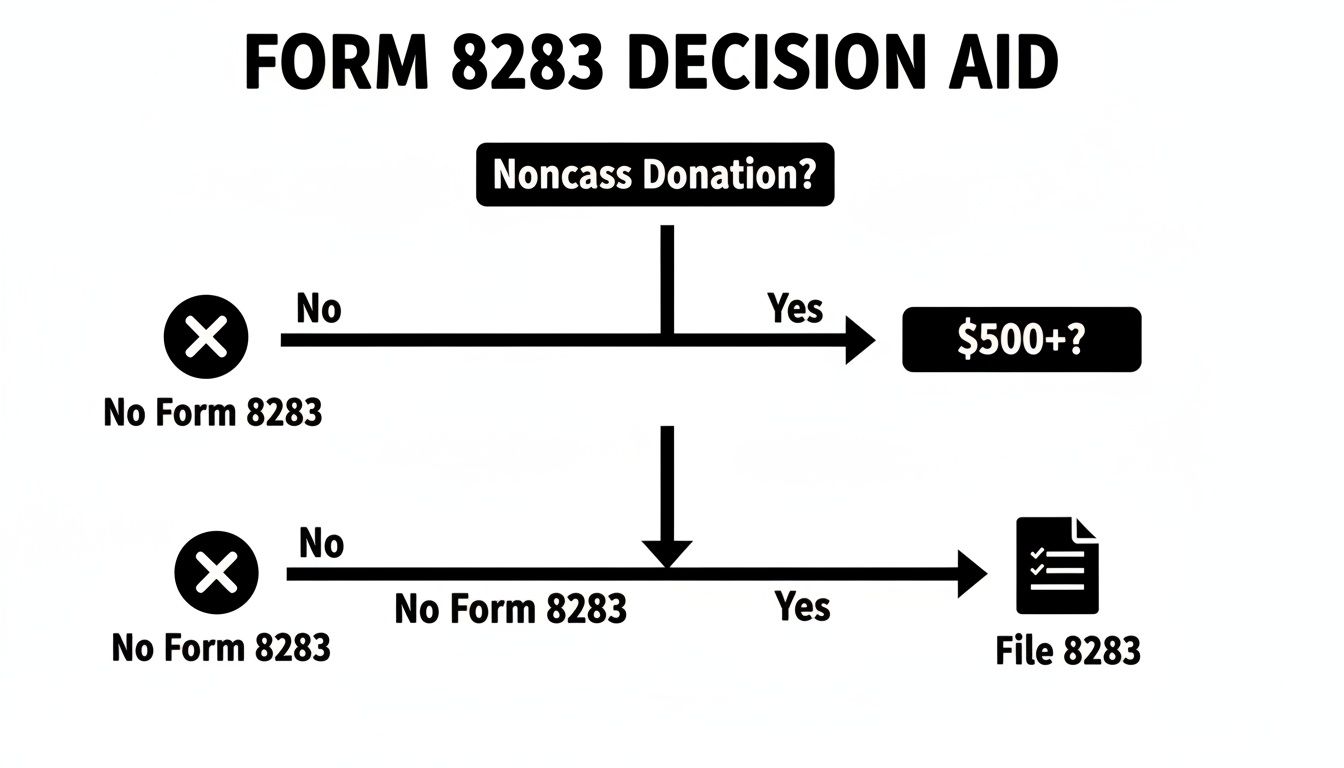
As you can see, once your total noncash donations for the year exceed $500, filing Form 8283 becomes mandatory.
The Three Pillars of Section B
So what makes Section B so much more intense? It comes down to three non-negotiable requirements. Missing any one of these is a red flag for the IRS and a near-guarantee that your deduction will be denied.
- A Qualified Appraisal: Your opinion of the item's value doesn't count. The IRS requires a formal, written appraisal from a qualified appraiser who meets specific professional standards.
- The Appraiser's Signature: The appraiser can't just hand you a report. They must sign Part IV of Form 8283, legally declaring their qualifications and standing by their valuation.
- The Charity's Acknowledgment: An authorized person at the charity must sign Part V, confirming they received the exact property you’ve described. This is called the "Donee Acknowledgment."
Think of it as a three-party verification system. You, your appraiser, and the charity must all be on the same page, with the paperwork to prove it. You need to get these signatures and the full appraisal before you file your tax return. Trying to get them after the fact is a recipe for disaster.
The Critical Role of a Qualified Appraisal

When your noncash donation crosses the $5,000 line, you've moved into a different league with the IRS. This is where Section B of Form 8283 comes into play, and the rules get serious. Suddenly, the single most important document is a qualified appraisal.
Think of it as the IRS shifting from a trust-based system to a "show me the proof" approach. For smaller gifts, they generally take your word for the value. But for significant contributions, they need an independent, expert opinion to justify your deduction. That proof is the qualified appraisal, and it's an area where the IRS looks very, very closely.
What Makes an Appraisal "Qualified"
So, what exactly does the IRS consider "qualified"? It's not a casual estimate from a friend in the industry or a quick valuation you found online. A qualified appraisal is a formal report that must be prepared, signed, and dated by a qualified appraiser, and it has to follow some very strict rules.
The timing, for instance, is absolutely crucial. The appraisal must be completed no earlier than 60 days before you donate the property. On the other end, it can't be finished any later than the due date of the tax return where you claim the deduction (including any extensions). This window is firm, and getting it wrong is a common and costly mistake.
An appraisal done a week after you file your taxes, or even 70 days before the donation, will be rejected by the IRS. This small timing error can lead to your entire deduction being disallowed.
Choosing a "Qualified Appraiser"
Just as the appraisal has strict standards, so does the person creating it. The IRS won't accept a valuation from just anyone. A qualified appraiser is a professional who meets specific, verifiable standards for their credentials, experience, and independence.
An appraiser absolutely must meet these three conditions:
- Credentials: They've earned an appraisal designation from a recognized professional organization or have met specific education and experience requirements.
- Experience: They regularly perform appraisals for compensation. This isn't a side hobby.
- Knowledge: They can prove they have education and experience in valuing the specific type of property you donated. A real estate appraiser isn't qualified to value a vintage car, for example.
The process of valuing unique assets can be incredibly detailed. For instance, understanding how to get a watch appraised gives you a glimpse into the rigorous standards that apply to high-value items for tax purposes.
On top of all that, the appraiser must be completely independent. They can't be you, the charity you're donating to, or the person from whom you originally bought the item. This firewall is essential to ensuring the valuation is unbiased.
A Costly Mistake: A Real-World Warning
Let's look at a real-world scenario. A business owner we'll call Mark donates a modern art collection he values at $75,000 to a museum. He asks a longtime friend who owns an art gallery to write up an appraisal. Mark files his return, attaches the document to Form 8283, and claims his deduction.
Two years later, an IRS audit notice arrives. The agent immediately sees that Mark's appraiser, while knowledgeable about art, lacks the formal credentials required by the IRS. The appraisal is thrown out.
The result? The IRS disallows the entire $75,000 deduction. Mark is on the hook for back taxes at his highest rate, plus hefty accuracy-related tax penalties and interest. The final bill was many times what it would have cost to hire a properly credentialed appraiser in the first place.
Mark’s story is a powerful warning: when you're in Section B territory, cutting corners on the appraisal is one of the most expensive mistakes you can make.
A Step-by-Step Guide to Completing Form 8283
Alright, let's break down IRS Form 8283. I know tax forms can look intimidating, but this one is more about careful organization than complex math. Think of it as telling the story of your generosity to the IRS, one line at a time.
We'll start at the top with the basics every filer needs to cover, then dive into the two main sections, Section A and Section B, so you know exactly which one applies to you.
Initial Information All Filers Must Complete
Before you get into the nitty-gritty of what you donated, there’s some basic identifying information to fill out right at the top of the form. Everyone filing Form 8283 has to do this, regardless of which section you use.
Simply enter:
- Your Name: Make sure it's the exact name shown on your main tax return (like your Form 1040).
- Your Identifying Number: This is almost always your Social Security Number (SSN).
This step is quick, but crucial. It links the form to your tax file, so skipping it or getting it wrong can cause frustrating processing delays with the IRS.
Completing Section A for Donations Up to $5,000
If the total value of your donation for a single item (or a group of similar items) is $5,000 or less, you'll be working in Section A. This is the section most people use, covering common donations like clothing, furniture, books, and household goods.
Here’s a walkthrough of the columns in Part I of Section A for each charity you gave to:
- Charity Information (Column a): List the full name and mailing address of the organization that received your donation.
- Property Description (Column b): Specificity is your friend here. Instead of just "Clothes," a better description is "Two boxes of women's professional clothing." Instead of "Furniture," try "Maple coffee table and two end tables." This level of detail gives the IRS a clear picture.
- Date of Contribution (Column c): Enter the exact date you handed over the items.
- Date Acquired (Column d): When did you originally get the property? For items you've collected over the years, like a wardrobe of clothes, simply writing "Various" is perfectly fine.
- How Acquired (Column e): This is just a brief note. "Purchase," "Gift," or "Inheritance" are the most common answers.
- Donor's Cost or Basis (Column f): This is what you paid for the item. For older household goods, you might not have the receipt, and that's okay. You can provide a reasonable estimate. If you truly can't estimate, you can leave it blank, but it’s always best to include a number if possible.
- Fair Market Value (Column g): This is the most important number in this section. It's what a buyer would realistically pay for the item in its current state. A great way to determine this is by checking the prices for similar items at local thrift stores or online consignment shops.
- Method Used to Determine FMV (Column h): Simply state how you got your value. "Thrift shop value" is a standard and acceptable explanation for most used goods.
After you list all your Section A donations, you’ll add up the Fair Market Values in column (g). That total is what you'll carry over to your Schedule A (Itemized Deductions).
Pro Tip: Always get a receipt from the charity. At home, take photos of what you're donating and keep a simple list. This documentation is your best defense if the IRS ever asks for proof of your donation.
Completing Section B for High-Value Donations
When you donate a single item or a group of similar items valued at over $5,000, you graduate to Section B. This part of the form comes with much stricter rules because the tax deductions are significantly larger. This is where that qualified appraisal becomes non-negotiable.
Section B is a team effort, requiring signatures from you, your appraiser, and the charity. Here’s who does what:
- Part I, Information on Donated Property: This is your part. You'll describe the property with a high level of detail. For a donated car, include the VIN, make, model, year, and mileage. For artwork, list the artist, title, and medium. You'll also enter the appraised fair market value from the professional appraisal.
- Part II, Taxpayer (Donor) Statement: You’ll sign and date here, formally declaring that you understand the rules and that your appraisal was done by a qualified professional.
- Part IV, Declaration of Appraiser: Your appraiser fills this out. They must sign, provide their identifying information and credentials, and certify that they are qualified and that the appraisal adheres to IRS standards. Your form is incomplete without their signature.
- Part V, Donee Acknowledgment: An authorized person from the charity signs here to confirm they received the property you described. You must get this signature before you file your tax return.
Navigating Form 8283 is really a process of methodical record-keeping. By taking it one step at a time and understanding the "why" behind each field, you can confidently and accurately report your contributions.
Common Mistakes That Trigger IRS Audits

You’ve gone through the effort of making a generous donation and filling out tax forms 8283. That's a huge step, but the work isn't quite done. Now it's about defense—avoiding the simple, common errors that can turn your goodwill into a stressful and costly IRS audit.
Think of Form 8283 as a giant spotlight on your largest noncash deductions. Because these aren't cash contributions, their value can be subjective, which is precisely why the IRS gives them a closer look. Any mistake, no matter how innocent it seems, can look like an attempt to inflate your deduction.
Overvaluing Your Donations
This is, without a doubt, the number one mistake people make. It’s easy to feel your donated items are worth a lot, but the IRS has a very specific standard: you can only deduct the item's Fair Market Value (FMV). In simple terms, that’s what a stranger would realistically pay for it today, in its current condition.
- Vehicles: You can't just pull a value from a pricing guide and call it a day. If the charity sells your car for more than $500, your deduction is typically limited to what they actually sold it for. The charity will report this amount to you on Form 1098-C.
- Clothing and Household Goods: Saying a bag of used clothes is worth $600 without any backup is a major red flag. A much safer and more defensible approach is to use pricing from local thrift stores as your guide.
Getting too aggressive with valuation is a fast track to having your entire deduction thrown out, and you could even face accuracy-related penalties. Honesty and conservative estimates are always your best strategy.
Failing to Get a Qualified Appraisal
When you donate an item (or a group of similar items) valued over $5,000, getting a qualified appraisal isn't just a good idea—it's a requirement. Simply skipping this step because it seems like a hassle or an extra expense is a critical error. Filing Section B of Form 8283 without an appraisal summary attached is practically an invitation for an audit.
Just as bad is hiring the wrong person for the job. The IRS has very strict rules about who qualifies as an appraiser for tax purposes. Using your well-meaning but uncredentialed friend will get your appraisal, and your deduction, invalidated.
An appraisal must be completed by a qualified appraiser no earlier than 60 days before you make the donation and no later than the due date of your tax return. This is a tight window, so you can't procrastinate.
Missing Essential Signatures and Information
Form 8283 is all about verification. If one link in the chain is missing, the whole thing falls apart. Two of the most common slip-ups are simply missing the required signatures for donations reported in Section B.
- Missing Donee Acknowledgment: The charity you donated to must sign Part V of Section B to confirm they received the property. It’s your job to get this signature before you file your return.
- Missing Appraiser Declaration: Your appraiser must fill out and sign Part IV, which certifies their qualifications and the work they performed.
On top of that, vague property descriptions just won't cut it. "Miscellaneous goods" or "Art" is too generic. You need to be specific: "Three-piece brown leather sofa" or "Oil on canvas landscape by Jane Doe" gives the IRS the clarity it needs. If you want to dive deeper into what else can draw IRS attention, you can explore what triggers a tax audit in our comprehensive guide.
The best way to protect yourself is through meticulous record-keeping. Knowing how to organize receipts for taxes properly can make all the difference, helping you build a strong defense against potential scrutiny. By treating your documentation with the same care you took in making the donation, you ensure your generosity is rewarded, not penalized.
When to Consult a Tax Professional
While you can certainly handle donating a bag of clothes or a used car on your own, don't let that confidence trick you when the stakes get higher. The moment your donation involves something more complex than everyday items, the rules for Form 8283 get exponentially more difficult.
Think of it this way: successfully navigating a simple donation is one thing, but trying to value and document a high-value, unique asset without an expert is like performing surgery on yourself. A tax professional isn't just an expense; they are an insurance policy against a denied deduction and a future IRS headache.
Red Flags That Signal You Need an Expert
If your donation even remotely resembles anything on this list, it’s a bright, flashing warning sign. This is your cue to pause the donation process and call a qualified CPA or tax attorney. These are the exact kinds of donations the IRS scrutinizes most heavily, and the rules are notoriously complex.
Hiring an expert is non-negotiable when you're donating:
- Intellectual Property: This includes assets like patents, copyrights, or trademarks. Valuing these is a minefield. The deduction is often tied to the future income the charity actually generates from your IP, a calculation you do not want to get wrong.
- Closely Held Corporate Stock: Donating shares in your private family business is nothing like donating a few shares of Microsoft. You can't just look up the value. It requires a formal, defensible business valuation to determine its fair market value.
- Partial Interests in Property: Giving a charity part-ownership in an asset, like your vacation home or a tract of land, is called a "split-interest" gift. The IRS rules for these are incredibly strict and full of traps.
- Large or Unique Collections: If you're donating a significant art collection, rare coins, or antiques, a simple appraisal won't cut it. You have to consider provenance (its history), condition, and even potential "blockage discounts"—all factors that require a specialist.
These aren't just minor details. An error with one of these high-value donations won't just get your return flagged for an audit. It can lead to your entire deduction being disallowed, forcing you to pay substantial back taxes plus penalties and interest.
The Value of Proactive Tax Advice
Getting a tax professional involved before you make the gift is a powerful defensive strategy. They’ll help you structure the donation for the maximum tax benefit while ensuring every single compliance box is checked from day one. This includes vetting the appraiser, reviewing all the paperwork, and making sure Form 8283 is filled out perfectly.
A good tax attorney or CPA does far more than just fill out the form. They build a bulletproof case for your deduction, anticipating the IRS's questions before they're ever asked. This proactive approach is the key to a worry-free, high-value donation.
Ultimately, the more unique or valuable your noncash gift, the more critical it is to have an expert in your corner. And if you do end up in a dispute with the IRS over a donation, that expert becomes your first line of defense. To see how a professional can advocate on your behalf, you can learn more about securing an IRS audit representative. Their guidance ensures your major act of generosity remains a financial benefit, not a costly liability.
Common Questions About Form 8283
Even if you’re no stranger to filing taxes, Form 8283 can throw a few curveballs. Let's tackle some of the most common questions that pop up when dealing with noncash donations.
When Do I Actually Need to File Form 8283?
The magic number here is $500. If your total deduction for all the property you donated during the year is more than $500, you’ll need to file Form 8283.
Keep in mind, this isn't a per-item limit. It’s the grand total of everything you gave. The IRS also requires you to group "similar items" of property, so if you donated three paintings, you have to add their values together to see if you cross the threshold.
Can I Just Fill Out the Form Later if I Forget?
This is a common misconception, and unfortunately, it’s a critical error. Form 8283 is not an afterthought; it must be completed and attached to the tax return you file.
For larger gifts that fall under Section B, this is even more important. You have to get all the required signatures—from you, the qualified appraiser, and the charity—before you file your return. Trying to do it afterward is a major red flag for the IRS.
What Happens if the Charity Sells My Donated Car?
If you donate a vehicle worth more than $500, your deduction is almost always tied to what the charity sells it for. You can't just look up the Blue Book value and call it a day.
The charity is required to send you a copy of Form 1098-C (Contributions of Motor Vehicles, Boats, and Airplanes) after the sale. This form will state the gross proceeds they received, and that amount is typically the maximum you can deduct.
It's easy to get this wrong. The actual sale price reported by the charity on Form 1098-C nearly always overrides whatever you thought the car's fair market value was.
Can My CPA Just Appraise My Donation?
Absolutely not. The IRS is very strict about who can be a "qualified appraiser." Your CPA or tax preparer is disqualified because they aren't independent. The same goes for you (the donor) and the organization receiving the gift.
For any donation valued over $5,000, you must hire a professional who is truly independent and has verifiable credentials for valuing your specific type of property.
Navigating complex donations or facing an IRS audit notice can be incredibly stressful. As a tax attorney, Attorney Stephen A Weisberg works directly with taxpayers to resolve these issues and ensure everything is filed correctly. If you need expert guidance on your noncash contributions or other tax matters, start with a FREE Tax Debt Analysis to see what your options are.


