Mastering Tax Form 941 Your Complete Guide for 2026
Struggling with Tax Form 941? This guide breaks down filing, deadlines, and how to handle payroll tax debt. Get clear answers and avoid costly IRS penalties.

In this article
- Who Has to File Form 941?
- Exceptions to the Quarterly Filing Rule
- How to Complete Tax Form 941 Line by Line
- Your Starting Point: Lines 1 Through 4
- Calculating Social Security and Medicare Taxes
- Finalizing Your Total Tax Liability
- Understanding Your Payroll Tax Deposit Schedule
- Determining Your Deposit Schedule
- How to Make Your Deposits
- The Dangers of Unpaid Payroll Taxes and the TFRP
- What Is the Trust Fund Recovery Penalty?
- Who Can Be Held Responsible?
- How to Correct Filing Errors with Form 941-X
- When to Use Form 941-X
- Understanding Adjustments vs. Claims
- When You Need Professional Help with Tax Form 941
- Signals You Need a Tax Professional
- CPA vs. Tax Attorney: What’s the Difference?
- Frequently Asked Questions About Tax Form 941
- What if I Have No Employees for a Quarter?
- Can I Use a Credit Card to Pay 941 Taxes?
- How Do I Fix Worker Misclassification Issues?
If you have employees, you're not just a business owner—you're also a tax collector for the federal government. It's a role you might not have signed up for, but it’s a critical one. Every time you run payroll, you withhold federal income tax, Social Security, and Medicare taxes from your employees' paychecks.
Think of it this way: those withheld funds aren't your money. You're simply holding them in trust for the government. Form 941, the Employer's Quarterly Federal Tax Return, is how you report to the IRS exactly how much you collected and owe.

This quarterly report is the backbone of payroll tax compliance for most U.S. businesses. It accounts for both the employee's share of taxes you withheld and your own matching employer share of Social Security and Medicare taxes. While most employers will use Form 941, there are a few exceptions for specific industries, such as agricultural employers who use Form 943.
Who Has to File Form 941?
The rule of thumb is straightforward: if you pay wages to even one employee, you almost certainly need to file Form 941. It doesn't matter if your business is an S-Corp, a partnership, or a sole proprietorship with a team.
Here's the part that trips up many new business owners: you must file a Form 941 every single quarter. This holds true even if you had no employees on the payroll or paid zero wages during that period. You'll simply file a "zero return" until you officially tell the IRS you've closed your business for good.
Key Takeaway: The requirement to file Form 941 isn't tied to your business's size or profitability. It’s all about having employees. Skipping a filing can trigger serious penalties, even if you didn’t owe any tax for that quarter.
Exceptions to the Quarterly Filing Rule
Of course, not every business fits neatly into the quarterly filing schedule. The IRS recognizes this and has created a few exceptions to simplify reporting for certain employers.
Here are the main exceptions:
- Very Small Employers: If your total annual liability for Social Security, Medicare, and withheld income tax is $1,000 or less, the IRS may send you a written notice instructing you to file Form 944, the Employer's ANNUAL Federal Tax Return, instead. This allows you to report just once a year.
- Seasonal Employers: Do you only hire people for a specific season, like a summer resort or a holiday shop? If so, you don’t have to file for the quarters when you have no employees and pay no wages. You just need to check the "seasonal employer" box on the Form 941 you do file.
- Household Employers: If you employ a household worker, such as a nanny or a housekeeper, you won't use Form 941. Instead, you'll report their wages on Schedule H, which you file with your personal Form 1040 tax return.
Getting this right from the start is important, so it’s wise to understand the key differences between Form 944 vs 941.
How to Complete Tax Form 941 Line by Line
At first glance, government forms can be a bit much. But Tax Form 941 is actually quite logical once you get the hang of it. The best way to think of it is as a quarterly story you're telling the IRS about your payroll. Each line builds on the one before it, painting a clear picture of the money you withheld, what you owe, and what you’ve already paid.
Let's break down the key lines in Part 1 for the 2026 tax year. Understanding the "why" behind each number will give you the confidence to either fill out the form yourself or intelligently review the work your payroll service has done for you.
Your Starting Point: Lines 1 Through 4
The form starts by gathering the foundational facts. These numbers set the stage for all the tax calculations that come next.
Line 1: This asks for the number of employees you paid during the pay period that includes March 12th. It's a very specific request—the IRS wants a snapshot from that exact period, not your total employee count for the entire quarter.
Line 2: Here, you'll report the total compensation paid to all employees during the quarter. This is your gross payroll figure, covering everything from regular wages and salaries to bonuses and tips. It’s the starting block for all your tax calculations.
Line 3: This is where you enter the total federal income tax you withheld from your employees' paychecks. This isn't your money; you were simply holding it in trust for the government, and this line reports the total amount you collected on their behalf.
With these basics in place, you’re ready for the Social Security and Medicare tax calculations. If you're looking to speed this up and cut down on mistakes, a dedicated tax statement parser can pull this data directly from your payroll records, which helps avoid manual entry errors.
Calculating Social Security and Medicare Taxes
Lines 5a through 5d are the heart of your FICA (Federal Insurance Contributions Act) tax calculation. You’ll notice separate columns for wages and tips, as they can have different rules.
A key update for 2026 is the higher Social Security wage base limit, which now sits at $176,100. This means you and your employee each stop paying the 6.2% Social Security tax on that employee's earnings once they pass that cap for the year. For businesses with high-earning employees, tracking this carefully is essential. You can find more official details from the IRS, including information on how new fields for direct deposit refunds are streamlining cash flow, on their website.
Here’s how to tackle these critical lines:
Line 5a (Taxable Social Security Wages): Enter the total wages subject to Social Security tax. For any single employee, this amount cannot go over the $176,100 annual limit. Once you have the total for all employees, multiply it by 0.124 (the combined 12.4% employer and employee rate) and put the result in Column 2.
Line 5c (Taxable Medicare Wages & Tips): Report the total wages and tips that are subject to Medicare tax. This one is simpler because there is no wage base limit for Medicare. Every dollar of an employee's covered wages is taxable. Multiply the total by 0.029 (the combined 2.9% rate) and enter the result in Column 2.
Example: Let's say you paid one employee $200,000 in the first quarter of 2026. On your Form 941, you'd report $176,100 on Line 5a for Social Security wages. But for Medicare, you’d report the full $200,000 on Line 5c, since it has no cap.
Finalizing Your Total Tax Liability
Now it’s time to bring all the numbers together. The next few lines combine your calculated taxes and account for any adjustments to determine your final tax obligation for the quarter.
Line 5e (Total Social Security and Medicare Taxes): Simply add up the figures from Column 2 of lines 5a, 5b, 5c, and 5d. This gives you your total FICA tax bill for the quarter.
Line 6 (Total Taxes Before Adjustments): Add your federal income tax withheld (from Line 3) to your total Social Security and Medicare taxes (from Line 5e). This represents your grand total tax liability before any special adjustments or credits.
From this point on, the form guides you through accounting for things like sick pay adjustments, claiming payroll tax credits, and then comparing your total tax bill to the deposits you've already made. The bottom lines will clearly show whether you have a balance due to the IRS or if you’ve overpaid and are due a refund.
Understanding Your Payroll Tax Deposit Schedule
Filing Form 941 every quarter is only half the battle. The other, arguably more critical part, is depositing the taxes you've withheld from employee paychecks. It's a common misconception that you just pay the tax when you file the form. In reality, the IRS wants that money much sooner, and they have a strict schedule for it.
Think of it this way: you're holding government funds in trust. The IRS sets up a "deposit schedule" to make sure those funds are handed over promptly. Messing this up leads to steep penalties that are completely separate from any late-filing fees for the Form 941 itself.
Determining Your Deposit Schedule
So, how do you know how often you need to pay? The IRS decides for you based on a “lookback period.” This is a specific 12-month window of your past payroll tax liability. For the 2026 calendar year, for instance, the lookback period is July 1, 2024, through June 30, 2025.
The total tax you reported on your Form 941s during that lookback period sorts you into one of two categories for the entire next year:
- Monthly Depositor: If your total tax liability during the lookback period was $50,000 or less, this is you. You’ll need to deposit each month's payroll taxes by the 15th of the following month.
- Semi-Weekly Depositor: If your liability was more than $50,000, you fall into this more frequent schedule. The rules here are a bit more complicated and are tied directly to when you run payroll.
Key Insight: If you're a new business without any payroll history, you get to start as a monthly depositor, which is a bit simpler. But don't get too comfortable—a special rule can change your status in an instant.
Here’s the big one: If your accumulated tax liability hits $100,000 or more on any single day, you trigger the "Next-Day Deposit Rule." You must deposit those funds by the very next business day. This rule overrides everything else and instantly converts you to a semi-weekly depositor for the rest of that year and all of the next. Keeping a close eye on your running payroll total is absolutely crucial to avoid this costly surprise. For a deeper dive, check out our guide on managing small business payroll taxes.
The flowchart below gives you a high-level view of how the information flows into your Form 941, which ultimately determines your tax liability and deposit schedule.
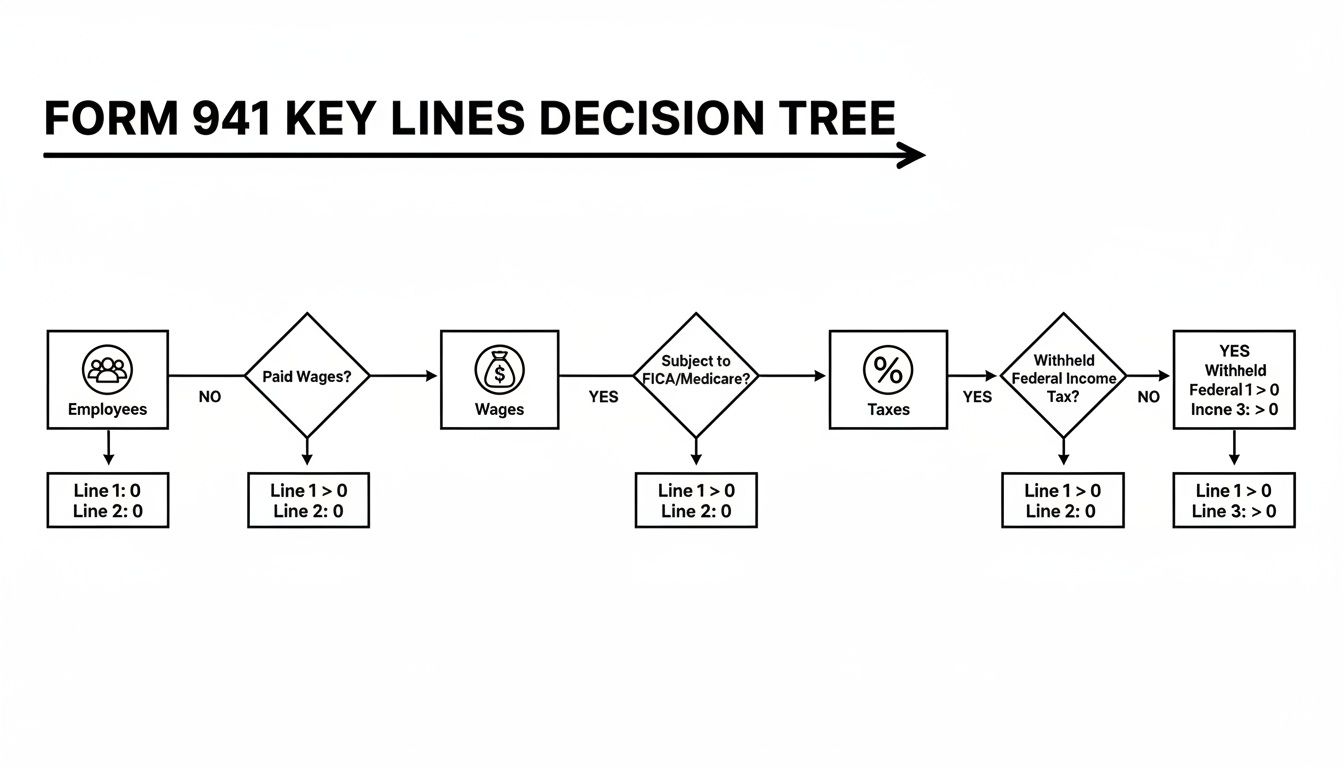
As you can see, everything starts with accurately tracking your employees and their wages. Getting this right from the start is fundamental to everything that follows.
How to Make Your Deposits
You can't just mail a check anymore. The IRS requires all federal tax deposits to be made electronically. The system for this is the Electronic Federal Tax Payment System (EFTPS).
EFTPS is a free and secure service from the U.S. Department of the Treasury. You'll need to enroll before you can make your first payment, so don't wait until the day before a deposit is due. Once you're set up, you can schedule payments online 24/7, giving you a clear digital trail that proves you paid on time. Making these deposits correctly is every bit as important as filing your Form 941 accurately.
The Dangers of Unpaid Payroll Taxes and the TFRP
Of all the financial missteps a business owner can make, falling behind on payroll taxes is easily one of the most dangerous. A simple math error on your tax form 941 might just get you a notice in the mail. But failing to remit the taxes you've withheld from your employees? That's a whole different ballgame, and the IRS does not play around.
The reason for their aggressive stance is simple: the IRS doesn't see this as your company's debt. They see it as a breach of trust.

The money you withhold from an employee’s paycheck for federal income tax, Social Security, and Medicare is designated as trust fund taxes. Think of your company as a temporary holding tank for that money. It flows in from the employee’s gross pay and is supposed to flow directly out to the U.S. Treasury. It was never your money to begin with, and using it to cover other business expenses is a cardinal sin in the eyes of the IRS.
What Is the Trust Fund Recovery Penalty?
When a business fails to hand over those trust fund taxes, the IRS can deploy one of its most powerful collection weapons: the Trust Fund Recovery Penalty (TFRP). This isn't just another penalty tacked onto your bill. The TFRP is a legal mechanism that allows the IRS to completely bypass your company's liability shield—like an LLC or corporation—and hold individuals personally responsible for the debt.
The penalty is equal to 100% of the unpaid trust fund portion of the taxes. Suddenly, the business's problem becomes your problem. Your personal assets, from your house and savings accounts to your car and investments, are now on the line to satisfy the government's debt. This isn't a theoretical risk; it’s a reality that can lead to personal bank levies, wage garnishments, and federal tax liens that will devastate your financial life.
Who Can Be Held Responsible?
Here’s where it gets even more serious. The IRS casts a wide net when looking for someone to hold accountable. They are searching for any "responsible person" who had the authority to handle the company's finances and "willfully" failed to pay the taxes.
You might be surprised who can fit that description:
- Owners and Officers: The President, CEO, or CFO are the most obvious targets.
- Bookkeepers and Controllers: An employee who managed the books and had the power to sign checks can be held liable, even if they were "just following orders."
- Board Members: If a board member had significant control over financial decisions, they could be on the hook.
- Anyone with Check-Signing Authority: The IRS looks at it this way: if you had the power to decide who gets paid, you had the power to pay the IRS.
The IRS uses Form 4180, Report of Interview with Individual Relative to Trust Fund Recovery Penalty, to figure out who is responsible. A Revenue Officer will conduct an interview asking pointed questions designed to uncover who really controlled the company's checkbook.
And the "willfulness" standard is much easier to prove than you'd think. It doesn't require evil intent. It simply means you knew the taxes were due and you consciously chose to pay other creditors instead—be it your landlord, a supplier, or even your own salary.
If you find yourself in this situation, it is a five-alarm fire. You need to understand the serious nature of the Trust Fund Recovery Penalty and how to fight it. Ignoring unpaid payroll taxes won't make them go away; it will only give them time to grow into a personal financial catastrophe. Swift, informed action is your only defense.
How to Correct Filing Errors with Form 941-X
Mistakes happen. Finding one on a tax form 941 you’ve already sent to the IRS can definitely raise your blood pressure. But don't panic—the IRS has a specific process for this. The tool for the job is Form 941-X, Adjusted Employer's Quarterly Federal Tax Return or Claim for Refund.
Think of Form 941-X as the official "do-over" form for your quarterly payroll tax filings. It’s not just for correcting mistakes that led to you underpaying; it’s also how you claim a refund if you realized you paid too much. The key is to act quickly. Filing a correction shows the IRS you’re acting in good faith, which can go a long way in minimizing penalties and interest.
When to Use Form 941-X
You’ll need to file a Form 941-X any time you find a discrepancy between what you reported on your original Form 941 and what the numbers should have been. This covers both underpayments and overpayments.
Some of the most common reasons we see clients needing to file a Form 941-X include:
- Miscalculated Wages: You accidentally under- or overreported total employee wages, tips, or other compensation.
- Worker Misclassification: You treated a worker as an independent contractor but later determined they were an employee, requiring you to pay the employer's share of FICA taxes.
- Unclaimed Tax Credits: You realize you were eligible for a payroll tax credit (like the now-expired Employee Retention Credit) but didn't claim it on the original Form 941.
- Incorrect Withholding: The amounts you reported for federal income tax, Social Security, or Medicare tax withholding were wrong.
Key Takeaway: You never "amend" a Form 941 by just sending in a corrected one. Form 941-X is a separate, standalone return. It’s specifically designed to show the IRS the figures from your original return, the correct figures, and the difference between the two.
Understanding Adjustments vs. Claims
Form 941-X has two functions, and the one you use depends entirely on whether you owe more tax or are due a refund. This is a critical distinction.
- Adjustment (Underpayment): If you discover you didn't report or pay enough tax, you'll file an "adjusted" return. This process corrects the record and means you must pay the additional tax owed at the same time you file the Form 941-X.
- Claim (Overpayment): If you find you paid too much, you'll file a "claim for refund." This is your formal request to get that money back. You can either request a check from the IRS or ask them to apply the overpayment as a credit toward your next payroll tax filing.
Fixing tax return errors can feel overwhelming, especially when you're navigating the forms and instructions on your own. For a broader look at this topic, our guide on how to amend a tax return provides some additional helpful perspective.
When you fill out the form, you'll enter the numbers you originally reported, the corrected figures, and then calculate the difference. The IRS instructions are your guide here, walking you through it line by line. A welcome change is that beginning in 2025, the IRS allows for e-filing Form 941-X. This is a big improvement, as it speeds up processing times and gives you immediate confirmation of receipt. When it comes to tax errors, being proactive is always your best move.
When You Need Professional Help with Tax Form 941
Handling your own payroll and Form 941 filings is a great way to manage costs when you're starting out. But one of the most important skills a business owner can have is knowing when a problem has grown bigger than they can handle alone. With payroll taxes, certain issues are clear signals that it’s time to stop guessing and bring in an expert.
Ignoring these red flags is a gamble you can't afford to take. A seemingly small 941 issue can quickly spiral into a financial nightmare that puts not just your business, but your personal assets, on the line. Think of a tax professional less as an expense and more as a strategic partner you call when the stakes get this high.
Signals You Need a Tax Professional
So, how do you know you've moved past a simple mistake you can fix yourself? Watch for these serious warning signs:
- You've received an IRS notice about unfiled 941s. This is the IRS firing its first warning shot. Ignoring it is not an option and will only invite more aggressive collection tactics down the road.
- The IRS is investigating you for the Trust Fund Recovery Penalty (TFRP). If you get any mail that mentions a "responsible person" interview or includes Form 4180, the IRS is now targeting you personally. This is a five-alarm fire requiring immediate, specialized help.
- Your payroll tax debt is growing and feels overwhelming. When penalties and interest are piling up faster than you can make payments, you're caught in a debt spiral. You need a real strategy to break free, not just wishful thinking.
CPA vs. Tax Attorney: What’s the Difference?
When you’re facing serious payroll tax trouble, it’s crucial to understand that not all professional help is the same. Your CPA is an essential part of your team for routine bookkeeping and tax prep. But when the IRS is threatening collections or personal liability, you need the specific protections that only a tax attorney can offer.
A tax attorney works under attorney-client privilege, which means your conversations are legally confidential and protected from the IRS. This is absolutely critical during a TFRP investigation or an audit. A tax attorney also has the legal standing and experience to negotiate directly with IRS Revenue Officers and Appeals Officers, fighting to protect your rights and assets in a way an accountant simply can't. You can learn more about what to look for and how to find a good tax attorney who focuses on these complex tax issues.
Strategic intervention from a qualified tax attorney can be the difference between resolving your payroll tax debt and losing your personal assets. It's a proactive business decision to protect your company's future.
The numbers don't lie. About 1 in 20 small employers faces an audit related to Form 941 each year, and the resulting tax debts often fall between $50,000 and $200,000. A debt like this can freeze your business loans or even complicate personal matters like a divorce. Unlike other debts, recent payroll tax liabilities are generally not dischargeable in bankruptcy.
This is why working with a specialist is so important. They can negotiate with the IRS for penalty relief or prove you are currently unable to pay. A reputable expert won't demand a huge upfront retainer; they'll start with a clear-eyed review of your situation. For instance, Stephen A. Weisberg at The W Tax Group offers a FREE Tax Debt Analysis. He will compare your 941s against the official IRS transcripts to map out the best path toward a resolution. You can always discover more about Form 941 and its requirements directly from the IRS website.
Frequently Asked Questions About Tax Form 941
Even after you've gotten the hang of filing Form 941, some practical, real-world questions always seem to come up. Let's tackle a few of the most common ones we see from business owners.
What if I Have No Employees for a Quarter?
It's a common misconception that you can skip filing Form 941 if you didn't have any employees or payroll for a particular quarter. Unfortunately, that's a myth that can get you into trouble.
Once you start filing, the IRS expects a return from you every single quarter like clockwork. The only way to stop this requirement is to formally close your business and tell them you're done paying wages.
So, if you just had a slow quarter with no payroll, you still have to file. You'll simply put zeros on the wage and tax lines. If you've shut down for good, check the "final return" box on Line 17 and attach a statement explaining you've ceased operations. That's the signal the IRS needs to take you off their active filer list.
Can I Use a Credit Card to Pay 941 Taxes?
Yes, you can, but it's not as simple as logging into the main IRS payment portal. While the standard Electronic Federal Tax Payment System (EFTPS) only allows direct bank transfers, you can use a credit or debit card through an approved third-party payment processor.
Be aware, though, that this convenience comes at a cost. These services charge a processing fee, making it a more expensive way to pay your taxes compared to a free EFTPS transfer. It can be a lifesaver in a pinch, but we generally don't recommend it for routine tax deposits.
How Do I Fix Worker Misclassification Issues?
Discovering you've been paying an employee as a 1099 independent contractor is a serious problem. This isn't just a simple mistake—it's a worker misclassification issue that requires you to go back and correct past tax periods.
You'll need to file the overdue Forms 941 for all the quarters that worker should have been on payroll. This means reporting their wages properly and paying your share of Social Security and Medicare taxes. Depending on the situation, you may also need to file a Form 941-X to amend previously filed returns.
This is a complex and high-stakes area. Trying to fix it yourself can easily make things worse and lead to massive penalties. It's often best to get professional help to explore options like the IRS's Voluntary Classification Settlement Program (VCSP), which can significantly reduce your liability.
A quick note on timing: The IRS generally has three years from the date you filed your Form 941 to assess the Trust Fund Recovery Penalty. However, this statute of limitations disappears entirely if you never filed a return or if a fraudulent one was submitted. This makes it absolutely critical to address old, unfiled returns as soon as possible.
Facing mounting payroll tax debt or a TFRP investigation can be overwhelming. At Attorney Stephen A Weisberg, we understand the stakes. Instead of demanding a large upfront fee, we start with a FREE Tax Debt Analysis to determine the best path forward for your specific situation. Don't let 941 issues threaten your business or personal assets. Get your free, confidential analysis today.


