2026 Tax Exemption for Senior Citizens Guide
Unlock every tax exemption for senior citizens. Our 2026 guide covers federal, state, & property tax breaks, eligibility, and how to claim them.

In this article
- Are Rising Taxes Squeezing Your Retirement Budget
- The problem isn’t always income tax
- Why this matters more when you already owe taxes
- Understanding Your Senior Tax Exemption Toolkit
- Income tax tools and property tax tools
- Federal benefits versus local benefits
- Strategic tools matter too
- Don’t confuse deductions, exemptions, and allowances
- Federal Income Tax Breaks for Seniors in 2026
- The enhanced deduction deserves your attention first
- Social Security taxation still catches seniors off guard
- Credits can matter more than deductions
- What to do before you file
- State and Local Tax Relief Beyond Federal Benefits
- How to Claim Your Senior Tax Exemptions Step-by-Step
- Step 1 through Step 3
- Step 4 through Step 6
- Colorado shows how specific these rules can get
- What commonly triggers problems
- Use the savings strategically if you owe back taxes
- Common Mistakes That Cost Seniors Thousands
- The mistakes I see most often
- When to Seek Professional Tax Help
- Situations where professional help makes sense
- Multi-state and high-asset seniors need sharper planning
- Tax debt changes the whole conversation
Your tax bill doesn’t stop just because your paycheck did.
A lot of seniors are in the same spot right now. Social Security comes in. Maybe a pension does too. Maybe there’s IRA income, part-time consulting, or a small business that still throws off income. Then the property tax notice arrives, the federal return shows more tax than expected, and an old IRS or state balance keeps hanging over everything.
That’s where people make a costly mistake. They assume retirement means fewer tax problems. Often it means different tax problems.
The good news is that tax exemption for senior citizens isn’t some obscure loophole. It’s a set of benefits built into federal, state, and local law to reduce the burden on older taxpayers. The bad news is that many people either never claim them, claim the wrong ones, or fail to use them strategically when they already owe back taxes.
If you’re trying to protect retirement income, lower monthly pressure, and create room to deal with IRS or state tax debt, these exemptions matter. A lot.
Are Rising Taxes Squeezing Your Retirement Budget
You’ve probably seen this play out up close. A retired homeowner has the house paid down, income is mostly fixed, and everyday costs keep climbing. Then taxes rise in places they didn’t expect. Property taxes jump because values went up. A portion of Social Security becomes taxable. A state tax return adds another bill. If there’s old tax debt in the background, every extra dollar feels spoken for before it even arrives.
That pressure gets worse when people start making reactive decisions. They pull extra money from retirement accounts without planning for the tax impact. They ignore notices because they don’t have the cash. They stop opening mail from the IRS or the county.

If that sounds familiar, start with this: many senior tax breaks exist for exactly this situation. They were designed to protect retirees from being taxed into financial instability. They aren’t favors. They’re part of the system, and you should use them.
The problem isn’t always income tax
For many seniors, the hardest hit comes from housing costs tied to tax assessments, not just the IRS. Others are dealing with collection pressure that reaches retirement income streams and raises urgent questions about what can and can’t be touched. If that’s your concern, review whether a pension can be garnished so you know what’s exposed and what isn’t.
Tax relief for seniors isn’t just about saving money on paper. It’s about preserving cash flow so you can keep up with essentials and deal with tax debt from a position of control.
Why this matters more when you already owe taxes
When you owe the IRS or a state agency, every legitimate exemption does two things. First, it lowers your current tax burden. Second, it can free up actual monthly money that you can redirect toward a payment plan, a settlement strategy, or staying compliant going forward.
That second part gets ignored too often. Seniors and their families look at exemptions as small annual savings. In practice, they can become a powerful tool.
Understanding Your Senior Tax Exemption Toolkit
Stop thinking about tax relief as one form or one deduction. Think of it as a toolkit. Different tools solve different problems.
Some tools reduce income tax. Others reduce property tax. Some come from the federal government. Others come from your state, county, city, or school district. The smartest approach is stacking every benefit you qualify for.
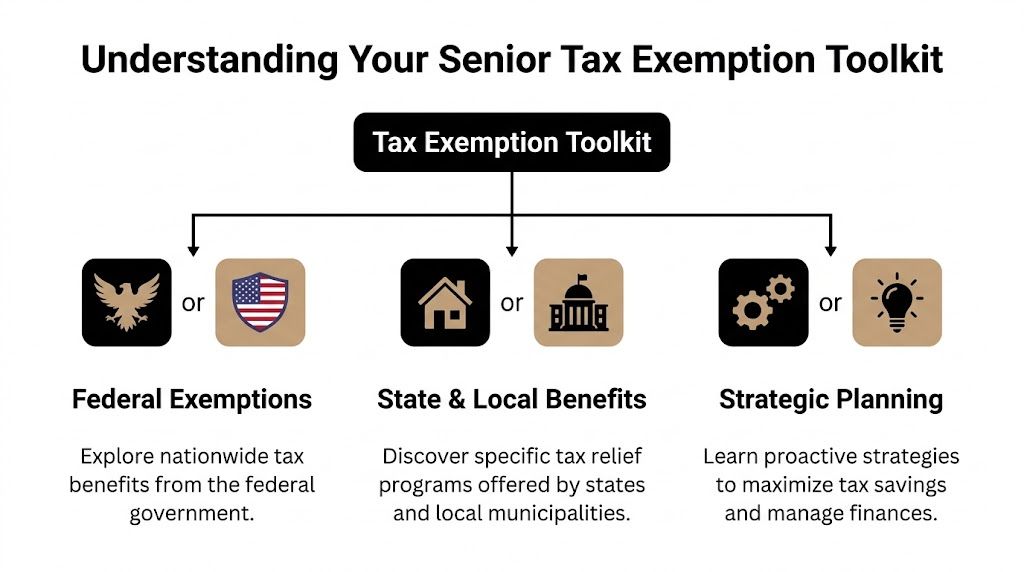
Income tax tools and property tax tools
Start with the basic split.
Income tax relief affects what you owe on a tax return. That can include an extra standard deduction, favorable treatment of Social Security, or a credit for certain older taxpayers. These benefits usually matter most if you’re filing a federal or state income tax return and your retirement income is high enough to create a tax bill.
Property tax relief lowers the tax burden tied to your home. That’s often where seniors miss serious savings. These programs can reduce assessed value, exempt part of a home’s value, freeze taxes in some jurisdictions, or provide credits tied to age, income, and primary residence status.
Federal benefits versus local benefits
Federal rules are more uniform. If you qualify, the mechanism is usually straightforward. You claim the benefit on your federal return.
State and local relief is different. Every jurisdiction writes its own rules. Age thresholds, income limits, residency rules, ownership periods, filing windows, trust ownership issues, and reapplication requirements can all change from one place to another.
That’s why broad tax advice is often useless for retirees. You don’t need theory. You need a checklist tied to where you live and what you own.
Practical rule: Build your tax exemption for senior citizens strategy in layers. Federal first. State second. Local property relief third. Then look at how those savings affect any existing tax debt plan.
Strategic tools matter too
The third part of the toolkit is planning. Through planning, people either save money or leave it on the table.
Here are the moves that usually matter most:
- Timing income carefully: If you control distributions or business income, timing can affect whether benefits phase out or whether more of your Social Security becomes taxable.
- Checking ownership structure: A home in a trust may still qualify for a senior exemption in some places, but assumptions here can be expensive.
- Documenting residency: If you split time between states, proof matters. Mailing address alone usually won’t solve the issue.
- Using exemptions to support debt resolution: Lower current taxes can improve your ability to stay current while addressing old balances.
If you want a plain-English overview of recently expanded relief, this breakdown of new senior deductions is a useful companion to the federal rules discussed below.
Don’t confuse deductions, exemptions, and allowances
A lot of seniors hear these terms used interchangeably. That creates mistakes on returns and missed questions when talking to preparers.
A deduction reduces taxable income. An exemption usually removes certain property or income from tax treatment under a specific rule. An allowance can mean something else entirely depending on the tax context. If you want a clean explanation of the terminology, review this article on tax allowances definition.
The point is simple. Use every tool that applies. Don’t wait for the tax bill to tell you what you should’ve claimed.
Federal Income Tax Breaks for Seniors in 2026
You file your return, expect a manageable bill, and then learn more of your Social Security is taxable than you thought. That surprise hits harder if you already owe the IRS. Federal senior tax breaks can prevent that problem. Used correctly, they cut this year’s tax bill and free up cash you can use to stay current or negotiate old balances.

The enhanced deduction deserves your attention first
Start with the deduction that changes the numbers fastest. The Enhanced Deduction for Seniors applies for 2025 through 2028 and adds $6,000 for each qualifying taxpayer age 65 or older, or $12,000 for qualifying joint filers, on top of the usual age-based standard deduction increase. Rep. Meuser’s senior deduction FAQ explains the mechanics and notes that this larger deduction can eliminate federal income tax for many retirees who live mainly on Social Security and modest retirement income.
That is immediate tax relief, not a technical footnote.
If you have IRS debt, treat this deduction as part of your resolution plan. A lower current-year bill makes it easier to avoid new balances while you work out an installment agreement, currently not collectible status, or another settlement path.
Social Security taxation still catches seniors off guard
Many retirees assume Social Security is automatically tax free. Federal law does not work that way. Depending on your combined income, up to 85% of your benefits can become taxable under IRS rules for Social Security benefits.
The planning point is simple. Deductions and income timing can keep you below a threshold that exposes more of your benefits to tax. A Roth withdrawal, a capital gain, or extra IRA distribution in the wrong year can raise your bill fast. The IRS explains the underlying formula in its guidance on Social Security and equivalent railroad retirement benefits.
That issue gets even more important for seniors trying to resolve tax debt. If you can reduce taxable income this year, you improve monthly cash flow and put yourself in a better position to propose a payment you can keep.
Credits can matter more than deductions
A deduction lowers taxable income. A credit cuts tax directly.
Some seniors qualify for the Credit for the Elderly or Disabled through Schedule R. If you qualify, do not overlook it. Returns often capture the age-based deduction and miss the credit entirely, especially when a preparer is rushing through a standard retirement return.
Ask these two questions every time:
- Did I claim every age-based deduction available to me?
- Do I qualify for the Credit for the Elderly or Disabled through Schedule R?
That second question is where real money gets missed.
What to do before you file
Pull your Social Security statement, IRA distribution records, pension income documents, and last year’s return. Then check whether the standard deduction is better than itemizing, whether the age-based increase was applied, and whether Schedule R should be reviewed.
If you expect a balance due, do not wait until filing week to deal with it. Estimate the return early. Then decide whether reducing withdrawals, adjusting withholding, or making a targeted payment now will keep the problem from growing.
For seniors who split time between federal and state tax issues, it also helps to review how state rules can affect the bigger picture, especially if you are comparing residency or retirement income treatment under state and local tax updates for seniors and retirees.
The right move is straightforward. Claim every federal deduction and credit you qualify for, file on time, and use the tax savings to stop the cycle of new debt. That is how senior tax relief turns into real bargaining power with the IRS.
State and Local Tax Relief Beyond Federal Benefits
A retired homeowner can do everything right on the federal return and still overpay badly at the state and local level. That happens every year. A county exemption goes unclaimed, a state keeps taxing retirement income that could have been reduced or excluded, and the senior ends up using savings to cover bills or old tax debt.
State and local relief is where missed money often turns into a cash flow problem.
Start with one rule. Never assume age alone gives you the benefit automatically. In many places, age only makes you eligible to apply. If you do not file the local form, prove residency, or meet the income test, the tax bill stands.
State income tax treatment varies widely. Some states fully exempt Social Security. Some partially exempt retirement income or give seniors larger deductions than younger taxpayers. Some largely follow the federal approach. Others add income limits, phaseouts, residency rules, or different treatment for pensions, IRAs, and public retirement systems. You need your state’s actual rule, not a general retirement tax article and not a guess based on where a friend lives.
Property tax relief is even more technical because local offices usually control the process. The same state can have very different results from one county to the next. Common requirements include:
- Primary residence status
- Minimum age
- Household income below a set limit
- Ownership on a specific date
- A timely application
- No title change that breaks eligibility
Programs can be substantial. A single approved exemption, freeze, deferral, circuit breaker, or homestead reduction can save hundreds or thousands of dollars a year, as summarized in Rocket Mortgage’s overview of senior property tax relief programs.
Here are the kinds of programs seniors commonly see at the local level:
| State | Example of Relief | Typical Requirement Pattern |
|---|---|---|
| Alabama | Exemption from certain property taxes for qualifying seniors | Age and income limits may apply |
| Georgia | County homestead relief for older homeowners | Primary residence and income testing |
| Kentucky | Reduction tied to assessed home value | Age or disability qualification |
| New York | Percentage exemption from assessed value | Local income caps and renewal rules |
| Ohio | Homestead reduction in taxable value | Age and household income review |
| Colorado | Exemption for part of a home’s value | Age, residency, or surviving spouse rules |
Use examples like these for direction only. Then verify the exact rule with your county assessor or local tax collector.
That verification matters more than seniors expect. A move into a trust, a transfer to an adult child, remarriage, a temporary absence for medical care, or a missed renewal can wipe out relief that looked automatic on paper.
If you are dealing with residency changes, property ownership issues, or broader state tax questions, review current state and local tax updates for seniors and retirees. State rules change. Local forms change. Filing windows change.
The practical payoff is bigger than the exemption itself. Lower property taxes and better state income tax treatment free up monthly cash. That cash can fund an IRS installment agreement, help resolve state tax balances, and reduce the chance that you will borrow against the house or drain retirement accounts to stay current.
Treat every state and local exemption as part of tax debt strategy, not just tax savings. If a senior household cuts annual housing taxes and keeps more retirement income, it gains room to negotiate, room to pay, and room to stop new tax debt from piling up.
How to Claim Your Senior Tax Exemptions Step-by-Step
Claiming a tax exemption for senior citizens usually isn’t difficult once you know where to look. The problem is that every agency assumes you already know the rules. You probably don’t, and that’s normal.
Use a disciplined process. Don’t rely on memory, don’t rely on what a neighbor told you, and don’t assume last year’s status carries over.
Step 1 through Step 3
Identify every taxing authority involved.
Start with the IRS, your state revenue department, your county assessor, and your local property tax office. Seniors often check only the federal return and forget the property side.Confirm which benefits require an application.
Federal deductions usually flow through your tax return. Property tax relief often requires a separate filing with local government.Pull the documents before you start.
Gather proof of age, proof of ownership, proof of primary residence, and income records if the program is means-tested. Missing paperwork is one of the fastest ways to lose a benefit.
Step 4 through Step 6
- Read the ownership rules carefully: A transfer into a trust, a deed change, or a move can affect eligibility even if you still live in the home.
- Check annual deadlines early: Many seniors miss savings because they look into relief after the filing window closes.
- Ask whether approval renews automatically: Some programs continue after approval. Others require periodic recertification.
Action step: Make one folder for senior tax benefits and keep every application, approval letter, deed, income statement, and assessor notice in it. If an agency questions eligibility later, you’ll be ready.
Colorado shows how specific these rules can get
Colorado is a good example because the rules are clear and strict. Qualifying seniors can receive a 50% exemption on the first $200,000 of their primary residence’s actual value, which can save about $1,000 to $2,000 annually depending on local levies. To qualify, you generally must be 65 or older, have owned and occupied the home as your primary residence for 10 consecutive years, and file with the county assessor by July 15, according to the Clear Creek County senior exemption guidance.
Once approved, the benefit generally continues automatically unless a disqualifying event occurs. That’s a major advantage, but it also means you need to know what counts as a disqualifier.
What commonly triggers problems
Seniors run into trouble when they:
- Move the home into a different ownership structure without confirming the exemption still applies
- Miss the filing deadline
- Assume surviving spouse rules work automatically
- Forget that primary residence status must be provable
- Fail to recheck eligibility after a sale, move, or estate-planning change
Colorado’s rules also show why details matter. Some exceptions can preserve the benefit in special situations, but you need to confirm them with the local assessor before assuming you’re covered.
Use the savings strategically if you owe back taxes
If you have existing IRS or state debt, don’t treat an exemption approval as isolated good news. Adjust your budget immediately. Redirect the savings toward compliance first. That may mean estimated payments, withholding, current-year filing costs, or a structured payment on old debt.
The best tax debt outcomes usually go to people who stop the bleeding first. Senior exemptions can help you do that.
Common Mistakes That Cost Seniors Thousands
A retired couple finally gets their monthly budget under control, then misses one local exemption deadline and overpays for a full year. That kind of mistake is common, and it creates a cash problem fast. If they already owe the IRS or the state, that lost savings could have funded a payment plan, stopped new penalties from building, or strengthened an offer based on actual ability to pay.
The cost usually comes from bad assumptions, not bad intent. Senior tax relief is split across federal, state, county, and city rules. Each office wants its own form, its own proof, and its own filing timeline. Seniors and adult children often assume the benefit will apply automatically. It usually will not.
The mistakes I see most often
- Assuming age is the only test. It rarely is. Residence, income, ownership, disability status, widow or widower status, and local filing rules often control the result.
- Treating tax relief as one system. Your federal return does not usually claim your county property tax break. A state income exclusion does not automatically trigger a local freeze or homestead benefit.
- Ignoring title and trust changes. A deed transfer, trust funding, life estate, or inherited-property cleanup can knock out an exemption if you do not confirm the rules first.
- Failing to answer follow-up notices. Assessors and tax offices deny claims every year because requested proof never arrives.
- Missing the tax debt angle. If you owe back taxes, every exemption dollar should be assigned a job. Current compliance comes first. Then use the freed-up cash to reduce arrears or support a settlement position.
That last mistake is the one standard guides miss. A senior exemption is not just a discount. It changes your monthly numbers. Better monthly numbers can keep you current on this year’s taxes, which matters a lot if you are trying to resolve older debt. Tax agencies give better terms to people who have stopped falling behind.
Some of these errors overlap with broader common retirement planning mistakes, especially poor cash-flow planning and sloppy account coordination. But tax exemptions create a separate administrative risk. You can make smart investment decisions and still lose thousands because one county form was filed late or ownership changed without checking eligibility.
One wrong move often triggers the next one. A senior loses a property tax break, pulls extra money from a retirement account to cover housing costs, increases taxable income, and then cannot keep up with the next bill. That is how a preventable exemption issue turns into IRS or state tax debt.
Fix it with a simple rule. Review every exemption after any major life or property change, and tie the expected savings to a written debt-reduction plan if you already owe taxes. If the facts are messy, read our guide on when to hire a tax attorney for IRS or state tax problems.
When to Seek Professional Tax Help
Some senior tax issues are simple enough to handle yourself. Many aren’t.
If all you need is to check the right box on a clean federal return, fine. If you own property in more than one state, have income from a business, are dealing with old IRS balances, or need to prove residency for a local exemption, DIY can get expensive fast.
Situations where professional help makes sense
Start looking for help if any of these apply:
- You have IRS or state tax debt already. Exemptions should be used as part of a broader resolution strategy, not handled in isolation.
- You own homes in multiple states or move seasonally. Residency and primary-home rules can get technical.
- Your home is in a trust or changed title recently. Eligibility can depend on exact ownership facts.
- You have mixed income streams. Social Security, retirement distributions, consulting income, rentals, or pass-through business income create planning issues.
- You’re trying to time a move or property decision around changing laws. Legislative windows can create planning opportunities, but only if you act correctly.
Multi-state and high-asset seniors need sharper planning
This is especially true for seniors with larger balance sheets or multi-state exposure. Recent coverage points to emerging 2026 legislative trends, including Texas proposed exemption increases and Oklahoma tax freeze proposals, creating planning opportunities that depend on timing and residency documentation, according to Realtor.com’s discussion of senior property tax exemptions and legislative trends.
That kind of planning isn’t just for the wealthy. It matters any time a property move, filing position, or exemption claim affects what you owe.
Tax debt changes the whole conversation
If you already owe taxes, experienced legal help provides its greatest value. A senior exemption can improve monthly cash flow. It can reduce current-year tax liability. It can affect what an agency sees when reviewing your finances. In some cases, it can improve your ability to maintain an installment agreement or support a broader settlement approach.
But none of that works if the filings are wrong, the exemption wasn’t claimed, or old debt strategy and current compliance aren’t aligned.
If you’re trying to decide whether this is the point to involve counsel, read when to hire a tax attorney. The short answer is simple. If the matter is consequential, the facts are messy, or the debt is already there, get help before you make the next move.
You don’t hire a tax professional because forms are annoying. You hire one because the right filing position can protect cash flow, preserve assets, and improve your negotiating position with tax authorities.
A good advisor doesn’t just hunt for deductions. They connect those deductions to the bigger financial problem you’re trying to solve.
If rising taxes, missed exemptions, or existing IRS or state debt are putting pressure on your retirement, talk with Attorney Stephen A Weisberg. He’s the founder of The W Tax Group and works directly with individuals, business owners, and families dealing with tax debt, audits, and state or IRS problems. His approach starts with a FREE Tax Debt Analysis so you can find out if there’s a real path forward before paying for representation.


