Tax Defence Group: What It Is and How It Resolves IRS Debt
Learn what a tax defence group does, how it resolves IRS audits and debt, and how to choose a reputable firm over volume-based lead generators.

In this article
- What a Tax Defence Group Does
- Representation covers several distinct problems
- The first consultation separates sales from case analysis
- Core Services and Resolution Pathways
- Audit defense comes before collection strategy
- Collection alternatives require modeling
- Offers in compromise are selective, not automatic
- Reputable Attorneys Versus Volume-Based Lead Generators
- Who handles the case
- What the fee conversation reveals
- National advertising can hide local accountability
- The Client Intake and Resolution Process
- Start with facts, not promises
- Establish authority and reconstruct the account
- Choose, submit, and maintain
- Personal Liability and the Trust Fund Recovery Penalty
- How a business problem becomes personal
- Bankruptcy isn't a universal answer
- Pricing Expectations and the Free Tax Debt Analysis
- What a free analysis should include
- Referral partners need a clear handoff
- Frequently Asked Questions About Tax Defence Groups
- Do I need a tax attorney?
- What happens if I ignore IRS notices?
- Can the IRS seize my home or assets?
- Can bankruptcy discharge tax debt?
- What if my current firm isn't delivering?
The most popular advice in tax debt advertising is often the least useful: “Settle your IRS debt for pennies on the dollar.” That promise encourages taxpayers to chase an offer in compromise before anyone has analyzed their income, assets, filing history, business cash flow, or the time remaining on the IRS collection statute.
A legitimate tax defence group does something more disciplined. It determines what the IRS is pursuing, identifies the taxpayer's legal and financial exposure, and matches the case to a resolution path that can survive scrutiny. Sometimes that path is an installment agreement. Sometimes it's currently not collectible status, penalty relief, an appeal, audit defense, or a trust fund recovery penalty challenge. An offer in compromise can be appropriate, but it's only one tool, and often not the first one worth considering.
What a Tax Defence Group Does
A tax defence group steps in when an IRS or state tax dispute requires more than routine filing assistance. The matter may involve an audit, unpaid individual or business taxes, a levy threat, a federal tax lien, unfiled returns, payroll tax exposure, an offer in compromise, or a penalty dispute.
The word defence describes work beyond submitting forms. Counsel reviews the government's position, tests whether the assessment is supported, protects procedural rights, and communicates with the agency under proper authorization. The objective is practical: keep a manageable tax problem from becoming a larger collection matter or a personal-liability problem.
Practical rule: Start with the liability and the taxpayer's ability to address it, not with an advertised settlement percentage.
Representation covers several distinct problems
An attorney-led practice may assist with:
- Audit representation: Responding to information requests, reviewing proposed adjustments, and challenging findings that the records or law do not support.
- Collection defense: Addressing notices, levies, liens, and payment demands before they disrupt personal or business finances.
- Resolution planning: Comparing installment agreements, currently not collectible status, and offers in compromise.
- Penalty work: Preparing a reasonable-cause or other abatement request when the facts support relief.
- Business tax defense: Handling income tax, employment tax, and payroll compliance issues.
- Personal exposure: Responding when the IRS examines whether an owner, officer, bookkeeper, or another responsible person should be assessed personally.
The IRS closed roughly 626,000 individual audits in Fiscal Year 2022, and 85% were correspondence audits, according to the Congressional Research Service summary of IRS audit activity. A courtroom lawyer is not required for every correspondence audit. Professional representation becomes more valuable when the proposed adjustment is large, records are incomplete, or the examination could create later collection problems.
The first consultation separates sales from case analysis
A serious consultation should identify the tax periods involved, the liability type, missing returns, current notice status, and the taxpayer's present ability to pay. It should also determine whether the matter needs representation or can be handled through a payment arrangement or direct contact with the IRS.
Ask who will perform the substantive review, who will communicate with the agency, whether a licensed attorney is involved, and which documents the firm needs before recommending a solution. Organized IRS correspondence makes that review easier. Taxpayers who need a practical way to manage documents sent to or received from the agency can consult the IRS fax tag from SendItFax for focused guidance on IRS faxing topics.
A volume-based lead generator may emphasize urgency and an upfront fee. A tax defence group should begin with the facts, the governing authority, and the resolution mechanism that fits the taxpayer's circumstances. That distinction matters because an offer in compromise is not automatically better than an installment agreement, and fear-driven marketing often obscures the difference.
Core Services and Resolution Pathways
The IRS does not resolve every tax problem through one process. An audit concerns whether reported items are correct. A filed return with an unpaid balance creates a collection matter. Missing payroll deposits can produce both a business liability and an investigation into an individual's responsibility. Calling all three situations “tax debt” often leads to the wrong recommendation.
Audit defense comes before collection strategy
Individual income tax returns were audited less often in tax year 2019 than in tax year 2010. Taxpayers with positive income and Earned Income Tax Credit claims also faced different examination rates, according to the Congressional Research Service, as noted earlier. Those figures do not make an audit harmless. They show that the IRS uses targeted selection and that the risk is uneven across taxpayer groups.
During an audit, the immediate task is to establish what the taxpayer can prove and whether the proposed adjustment follows the law and the available records. That requires reviewing notices, returns, books, receipts, bank records, and the examiner's requests. If the adjustment becomes final, the question changes from whether an item can be defended to how the resulting liability can be resolved without disrupting business operations or forcing the sale of needed assets.
Collection alternatives require modeling
The IRS treats installment agreements, offers in compromise, and temporary collection delay as different collection alternatives, according to its guidance on getting help with tax debt. A practitioner should compare income, necessary expenses, equity, filing compliance, and the Collection Statute Expiration Date before recommending one.
A payment arrangement may be appropriate when the taxpayer can make sustainable monthly payments and eventually pay the liability in full. A taxpayer who cannot maintain that schedule may need an analysis for currently not collectible status or compromise treatment. Submitting an installment agreement without testing the budget can postpone the problem rather than resolve it.
The practical distinction is straightforward. An installment agreement addresses payment over time. An offer in compromise asks whether the IRS should accept less than the full balance based on the taxpayer's financial circumstances and collection potential. The second option is not automatically better.
Offers in compromise are selective, not automatic
An offer in compromise can reduce the amount paid when the financial evidence supports that result, but it carries compliance obligations. The Taxpayer Advocate Service explains that a lump-sum offer generally requires 20% of the offered amount at submission. The fee and accompanying payments are non-refundable if the offer is rejected or closed without acceptance. After acceptance, the taxpayer must remain current with filing and payment obligations for five years, or the IRS may default the agreement and restore the remaining debt balance. The Taxpayer Advocate Service explanation of offers in compromise sets out those requirements.
The IRS accepted 5,464 offers out of 38,797 submissions in Fiscal Year 2025, totaling $98.1 million, according to the source cited in the original data. That record does not make offers in compromise useless. It shows why a firm should explain the financial basis for an offer instead of presenting it as the default product.
The IRS also processed 3.16 million new installment agreements and collected $17.9 billion through installment plans in Fiscal Year 2025, while it collected $117.5 billion in unpaid assessments on returns filed with additional tax due, netting $73.1 billion after credit transfers, according to the IRS Fiscal Year 2025 collections report. Those figures reinforce a practical point. A structured monthly arrangement may fit the facts better than an OIC-first strategy.
Taxpayers can review these tax debt relief options in plain language. The appropriate path depends on compliance, liquidity, assets, future income, and the time remaining for collection.
Reputable Attorneys Versus Volume-Based Lead Generators
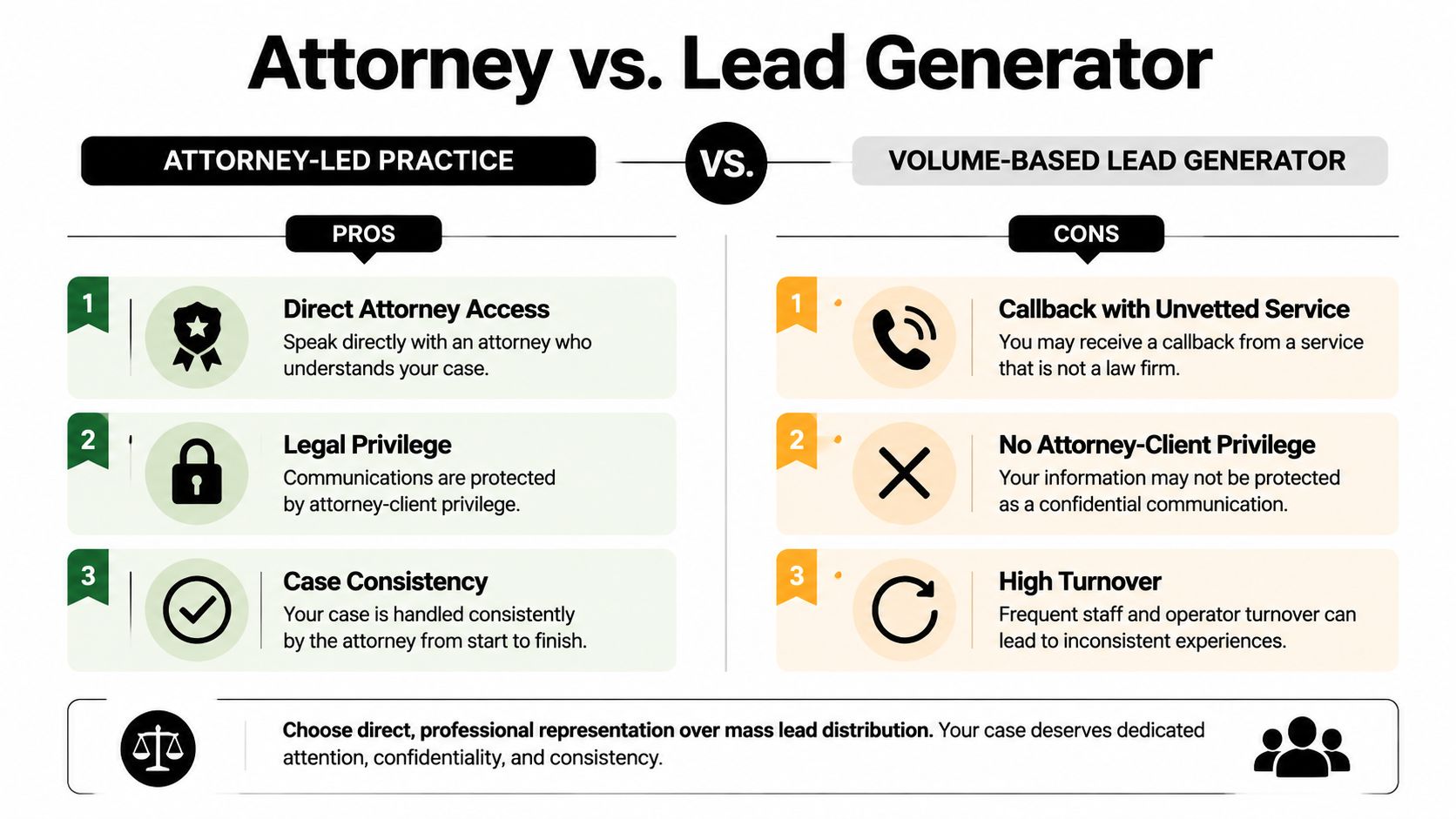
Two firms can use nearly identical language online while providing entirely different services. One may be an attorney-led practice that evaluates the file and manages the representation. The other may purchase an inquiry, sell the engagement, and transfer the work to people the taxpayer never met.
The distinction is structural, not cosmetic.
Who handles the case
Ask for the name and license status of the person who will review the IRS transcripts, financial statements, notices, and prior filings. A legitimate practice should be able to explain whether the assigned professional is an attorney, CPA, enrolled agent, or support employee, and which tasks each person performs.
Attorney involvement also matters for confidentiality and legal strategy. A volume-based operation may use a sales representative to promise a result before a qualified professional has reviewed the file. That creates a predictable conflict. The salesperson wants the engagement signed. The attorney or processor later has to explain that the advertised solution doesn't fit.
What the fee conversation reveals
A responsible consultation should connect the fee to identifiable work, such as transcript analysis, power of attorney preparation, financial statement review, correspondence, audit representation, or an offer submission. Fees may be flat, hourly, or divided into phases, but the engagement should state what happens if the case becomes more complicated.
Be cautious when a firm:
- Guarantees an outcome: The IRS makes its own determination, and no representative can guarantee acceptance of an offer or a particular collection result.
- Demands a large retainer immediately: A firm can charge for its work, but it should explain what review occurs before the taxpayer commits.
- Uses only fear: Levy and lien risks deserve attention, but panic isn't a substitute for analysis.
- Won't identify the assigned professional: The taxpayer has a right to know who will work the matter.
- Promises a settlement before reviewing finances: An OIC recommendation without financial analysis is marketing, not advice.
National advertising can hide local accountability
A firm may advertise nationwide while outsourcing preparation, communication, or document collection. Outsourcing isn't automatically improper, but the responsible attorney should remain identifiable and accountable. The taxpayer should know who signs submissions, who answers technical questions, and who decides whether to change strategy.
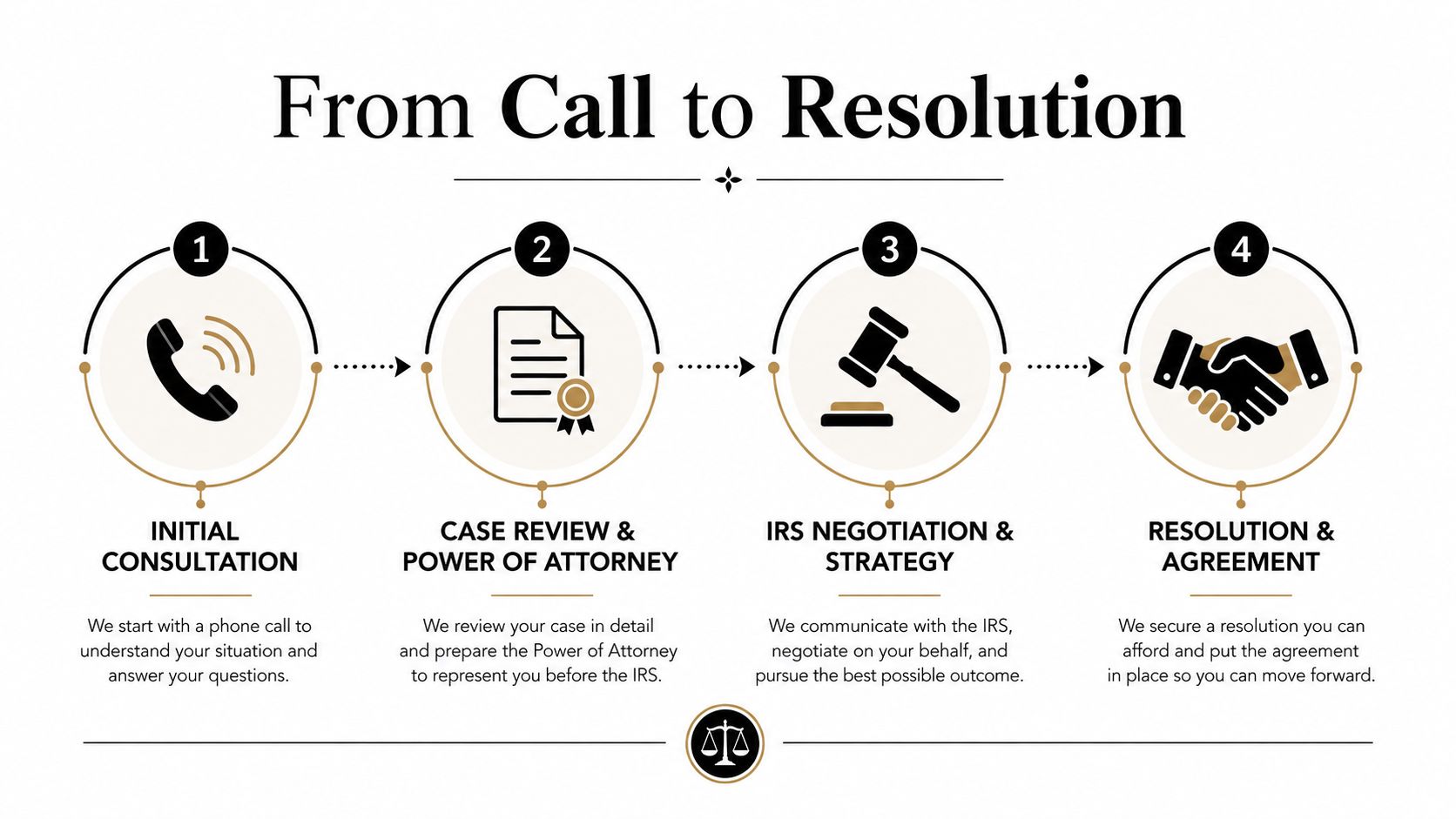
The process should move from consultation to document review, authorization, strategy, and implementation. A useful guide on evaluating that relationship is how to find a good tax attorney. The questions are simple, but the answers expose whether the practice provides representation or merely sells access to a back-office processor.
The Client Intake and Resolution Process
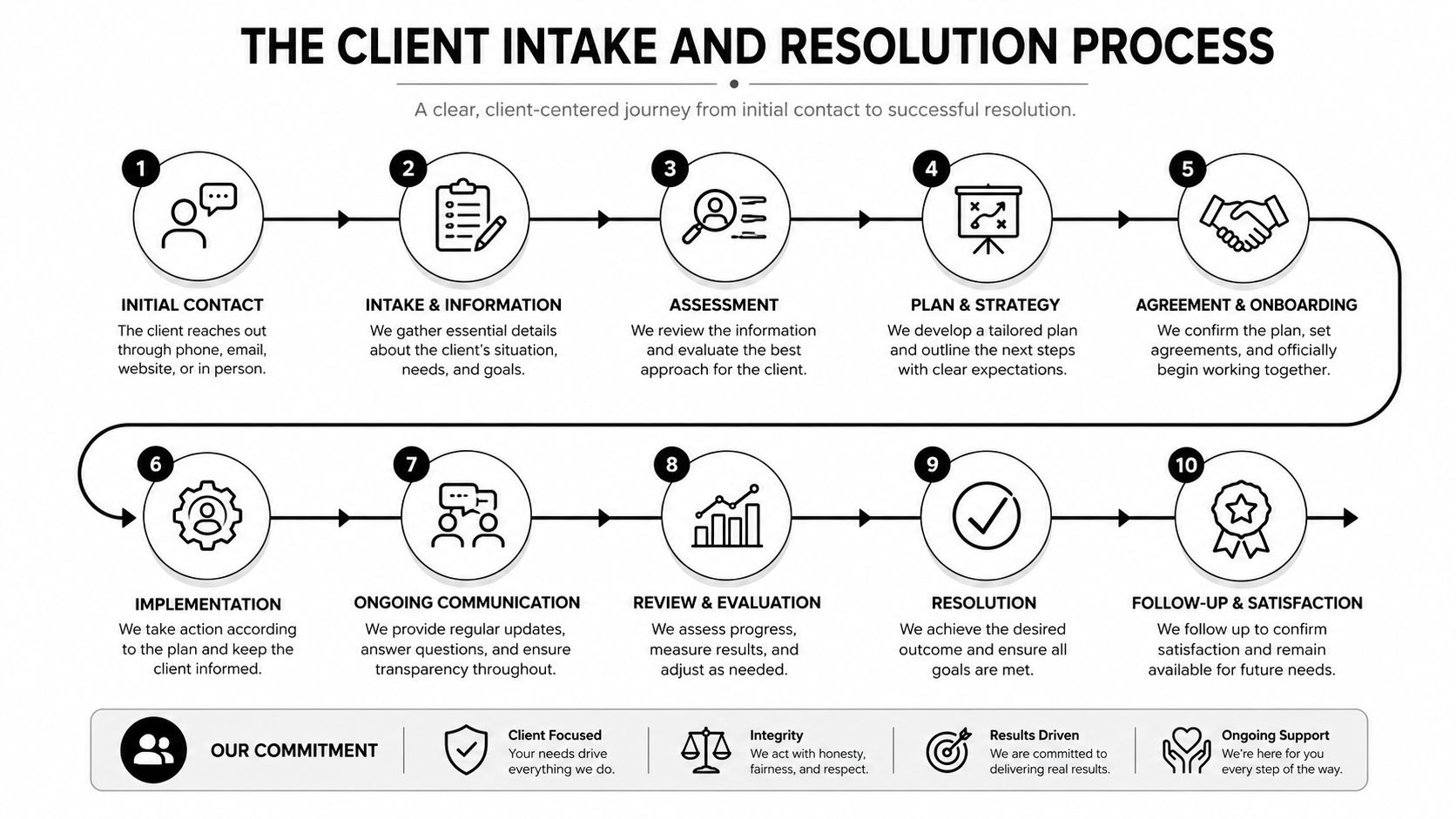
A taxpayer should know what happens after signing an engagement. The process varies by case, but the underlying work usually follows a recognizable sequence.
Start with facts, not promises
The first conversation should identify the tax years, notice types, filing status, business structure, payroll history, bank levies, liens, prior agreements, and immediate deadlines. The firm then requests documents such as IRS notices, filed returns, income records, bank statements, expense information, and business financial records.
Incomplete information can produce a bad recommendation. For example, a payment plan based on gross revenue instead of actual business cash flow may be unworkable, while an OIC based on outdated expenses may fail financial review.
Establish authority and reconstruct the account
A power of attorney allows the representative to communicate with the IRS or a state agency within the scope of the authorization. The representative typically obtains account transcripts, assesses whether returns are missing, confirms balances, reviews collection activity, and checks whether the government's records match the taxpayer's records.
This stage often changes the case. A taxpayer may believe the balance comes from an audit when part of it comes from a substitute return, an unprocessed payment, a penalty, or a missing filing. The solution must address the actual account, not the taxpayer's first assumption.
Choose, submit, and maintain
The representative compares the viable pathways and explains the trade-offs. An installment agreement requires sustainable payments. Currently not collectible status may pause active collection while penalties and interest continue. An offer in compromise requires both financial support and future compliance.
The taxpayer still has important responsibilities:
- Provide complete records. Missing documents can delay analysis or undermine credibility.
- File required returns. A resolution usually can't succeed while basic compliance remains unresolved.
- Make required payments. A taxpayer must understand which payments are due during review.
- Report changes. New income, asset sales, or business changes may affect the proposed arrangement.
- Keep future filings current. An accepted agreement can fail when the taxpayer stops filing or paying.
For taxpayers preparing the detailed financial information used in an offer, this guide to IRS Form 433-A OIC can help clarify the type of information the IRS expects. The representative handles communications and submissions, but the taxpayer supplies the financial truth that makes the strategy defensible.
Personal Liability and the Trust Fund Recovery Penalty
An LLC or corporation can separate business operations from personal assets, but that protection does not automatically cover withheld payroll taxes. The Trust Fund Recovery Penalty, or TFRP, can shift liability from the company to individuals the IRS identifies as responsible for collecting, accounting for, or paying over trust fund taxes.
The IRS states that the TFRP equals 100% of unpaid trust fund taxes and may apply when a responsible person acted willfully, according to its Trust Fund Recovery Penalty guidance. The IRS credited about $738.9 million in TFRP in Fiscal Year 2025, confirming that unpaid payroll taxes remain an active enforcement concern.
How a business problem becomes personal
An owner who controls payroll, signs checks, and chooses which bills to pay may face personal exposure when revenue falls and withheld employee taxes remain unpaid. Paying suppliers and rent while repeatedly failing to remit payroll taxes can support an IRS finding of responsibility and willfulness. Closing the company does not necessarily end the inquiry, because the IRS can assess the individual separately from the company.
The review examines authority over payroll, access to bank accounts, knowledge of unpaid taxes, check-signing power, and participation in payment decisions. A job title does not settle the question. Formal ownership is not required either.

Bankruptcy isn't a universal answer
The IRS generally has a ten-year collection period from assessment for the TFRP, and its guidance states that payroll taxes and TFRP generally are not dischargeable in bankruptcy. Bankruptcy may still affect other debts or tax categories, but treating it as a complete answer to payroll tax exposure can delay a more appropriate defense.
A business owner facing a proposed TFRP assessment should preserve payroll records, bank records, internal communications, and evidence showing who made payment decisions. This explanation of the Trust Fund Recovery Penalty provides useful background, but an individual assessment requires case-specific review. Personal assets may be at risk, and the right response depends on the evidence supporting responsibility and willfulness.
Pricing Expectations and the Free Tax Debt Analysis
Tax defense fees should reflect the work required, not the emotional intensity of the taxpayer's situation. A straightforward installment agreement may require less analysis than a multi-year audit, a complex business payroll matter, or an offer in compromise supported by extensive financial documentation.
Common arrangements include flat fees, hourly billing, and phased fees tied to defined milestones. A phased engagement might separate transcript review, financial analysis, submission preparation, and later representation. The important question isn't whether a firm uses one model or another. It's whether the agreement clearly defines the work, exclusions, communication expectations, and additional charges.
What a free analysis should include
A legitimate free tax debt analysis should help determine whether the firm can help and which direction deserves investigation. It may involve a discussion of notices, tax periods, filing status, business structure, collection activity, income, assets, and immediate risks. It shouldn't require the taxpayer to accept a settlement promise before the firm has enough information to make a responsible recommendation.
A high-pressure sales call looks different. The representative may emphasize a dramatic reduction, demand immediate payment, or quote a fee before reviewing any account information. The taxpayer leaves with urgency but no diagnosis.
The right question isn't “How much can you save me?” It's “Which resolution can I maintain without creating a new default?”
Referral partners need a clear handoff
CPAs, enrolled agents, accountants, bankruptcy attorneys, family law attorneys, financial advisors, and other professionals often encounter tax problems outside their service scope. A referral should preserve the client relationship and give the referring professional clarity about what the tax attorney will examine.
The handoff should identify the immediate issue, relevant deadlines, notices already received, and documents available. A tax attorney can then determine whether the matter involves controversy representation, collection strategy, payroll liability, or a problem that another professional should handle. That division of responsibility protects the client from paying for a generic service that doesn't address the underlying issue.
Tax Attorney Stephen A Weisberg offers a free Tax Debt Analysis before charging clients to resolve IRS or state tax problems, and his practice uses a power of attorney so the firm can represent clients before the relevant tax agency. That model is one option, but every taxpayer should compare the scope of work and the assigned professional before signing.
Frequently Asked Questions About Tax Defence Groups
Do I need a tax attorney?
Not always. A CPA or enrolled agent may be sufficient for routine filing and some collection matters. An attorney becomes particularly useful when the case involves an audit dispute, potential personal liability, appeals, litigation risk, privilege concerns, or complicated negotiations.
What happens if I ignore IRS notices?
The IRS may continue collection activity, and ignoring correspondence removes opportunities to respond within the agency's process. Open every notice, record the deadline, and obtain professional advice when the amount, legal issue, or requested documentation is beyond your ability to handle.
Can the IRS seize my home or assets?
The risk depends on the account, notice stage, equity, collection alternatives, and applicable procedures. A tax defence group can assess the immediate threat and determine whether a payment arrangement, collection delay, appeal, or other action is available.
Can bankruptcy discharge tax debt?
Some income tax liabilities may qualify under strict rules, but payroll taxes and the TFRP generally aren't dischargeable. Bankruptcy should be evaluated with both bankruptcy and tax consequences in mind.
What if my current firm isn't delivering?
Request the account transcripts, copies of filed authorizations and submissions, a written status report, and a clear explanation of the next decision point. If the firm won't identify the assigned professional or explain what work it completed, consider an independent review before paying for additional services.
Tax Attorney Stephen A Weisberg provides a free Tax Debt Analysis to assess IRS and state tax problems before charging for resolution work, including cases involving audits, collections, business tax debt, and personal exposure. Visit Tax Attorney Stephen A Weisberg to request an evaluation and identify a practical path forward.


