Tax Deductible Funeral Expenses: 2026 Guide to Eligible Costs
Discover tax deductible funeral expenses in 2026: see which costs qualify and how to claim the deduction for estates or individuals.

In this article
- Understanding the Basics of Funeral Expense Deductions
- Who Claims the Deduction?
- The Role of the Estate Tax Return
- Understanding Who Can Claim the Deduction
- The Estate as the Claimant
- An Individual Taxpayer's Limited Options
- What Specific Funeral Expenses Are Tax Deductible
- Core Deductible Service Costs
- Other Directly Related Deductible Expenses
- What You Cannot Deduct
- Deductible vs. Non-Deductible Funeral Expenses Checklist
- A Step-by-Step Guide to Claiming the Deduction
- For the Estate Executor
- For the Individual Taxpayer
- Real-World Scenarios of Funeral Expense Deductions
- Scenario 1: The Executor
- Scenario 2: The Self-Employed Spouse
- Scenario 3: The Common Pitfall
- When to Seek Professional Tax Help
- Identifying When You Need an Expert
- Frequently Asked Questions About Funeral Expenses and Taxes
- Can I Deduct the Cost of a Headstone or Grave Marker?
- What if a Pre-paid Plan Covered the Costs?
- Are Costs for a Memorial Service Held Later Deductible?
- Can I Deduct Funeral Expenses on My State Tax Return?
Yes, funeral expenses can be tax deductible—but there's a critical catch that trips up countless families every year. The deduction almost always belongs to the deceased's estate, not the individual family member who actually paid the bill.
For the vast majority of people, these costs are considered personal expenses and unfortunately cannot be claimed on your personal income tax return.
Understanding the Basics of Funeral Expense Deductions
When a loved one passes, you're suddenly faced with a mountain of decisions and expenses. With average funeral costs easily topping $8,000, it's only natural to wonder if there’s any tax relief available.
The answer lies in a fundamental concept of tax law: the distinction between an individual and their estate. Think of the deceased's estate as a separate, temporary financial entity. Its sole purpose is to wrap up all the final affairs—paying off debts, filing final taxes, and covering administrative costs before any remaining assets go to the heirs.
Because the funeral is a necessary expense for settling the estate, the IRS allows the estate to deduct these costs.
Who Claims the Deduction?
This is where most of the confusion happens. The entity responsible for settling the final accounts is the one that gets to claim the deduction for final expenses. In nearly every case, that’s the estate, which files its own unique tax return.
The deduction for funeral expenses is designed to reduce the value of a taxable estate, not to give a personal tax break to the family members who paid for the services.
So, can an individual ever claim these costs? The circumstances are incredibly narrow. The deceased would have to have been your legal spouse or a dependent, and even then, the costs are lumped into the medical expense deduction. This requires your total medical bills to exceed a very high percentage of your income—a threshold most people simply don't meet. For most families, the hard truth is that funeral expenses are not tax deductible on a personal level.
To make this distinction crystal clear, it’s helpful to see who typically pays for the funeral versus who is legally entitled to the tax benefit.
Who Pays vs Who Can Claim the Funeral Expense Deduction
This table breaks down common scenarios to show the critical difference between the person paying the bill and the party that can actually claim the deduction.
| Scenario | Who Typically Pays? | Who Can Claim the Deduction? | Relevant Tax Form |
|---|---|---|---|
| Estate has sufficient funds | The estate, via the executor, pays directly from estate assets. | The Estate | Form 706 |
| Family member pays upfront | A child or spouse pays out-of-pocket and is later reimbursed by the estate. | The Estate | Form 706 |
| No formal estate exists | A family member pays, and there are not enough assets to require a formal estate. | No one. The deduction is lost as there is no estate to claim it. | N/A |
| Payable-on-death account | A beneficiary pays using funds from a POD bank account. | No one. The expense is considered personal. | N/A |
As you can see, the path to the deduction almost always runs through the estate itself, regardless of whose credit card or checkbook was used initially.
The Role of the Estate Tax Return
The actual mechanism for this deduction is the estate tax return, officially known as Form 706, United States Estate (and Generation-Skipping Transfer) Tax Return. The executor of the estate is responsible for listing all "reasonable" funeral expenses on this form.
By doing this, the executor effectively lowers the estate's total taxable value.
Now, it’s important to know that most estates will never actually pay federal estate tax. Thanks to a very high federal exemption amount (over $13 million for 2024), only the wealthiest estates are subject to it. Even so, the principle remains the same: the deduction belongs to the estate, not the person who wrote the check for the funeral home.
Understanding Who Can Claim the Deduction
Knowing that funeral expenses can be tax-deductible is one thing. But the real question, the one that truly matters, is: who actually gets to claim the deduction? The IRS draws a very clear line here, and the rules are completely different for an estate versus an individual.
The most direct and common way to deduct these costs is through the deceased person's estate. Think of the estate as a temporary legal and financial entity. Its sole purpose is to gather all the person's assets, pay off their debts, and handle all their final affairs. Paying for the funeral is a core part of settling those affairs.
Because funeral costs are considered a necessary administrative expense for wrapping things up, the IRS allows the estate to deduct them on its own specific tax return, Form 706. This deduction lowers the estate's total value, which can reduce—or even eliminate—any estate tax that might be owed.
The Estate as the Claimant
When an estate claims the deduction, the process is straightforward. The executor, who is the person in charge of managing the estate, simply needs to collect the receipts for all reasonable funeral expenses. These costs are then reported on Schedule J of the estate tax return.
It's a common scenario for a family member to pay for the funeral upfront on a personal credit card. That’s perfectly fine. As long as the estate formally reimburses that person, the expense officially belongs to the estate. This makes the cost deductible for the estate, not the individual who paid. This is a crucial detail for executors to get right.
This simple flowchart breaks down who can—and can't—claim the deduction.
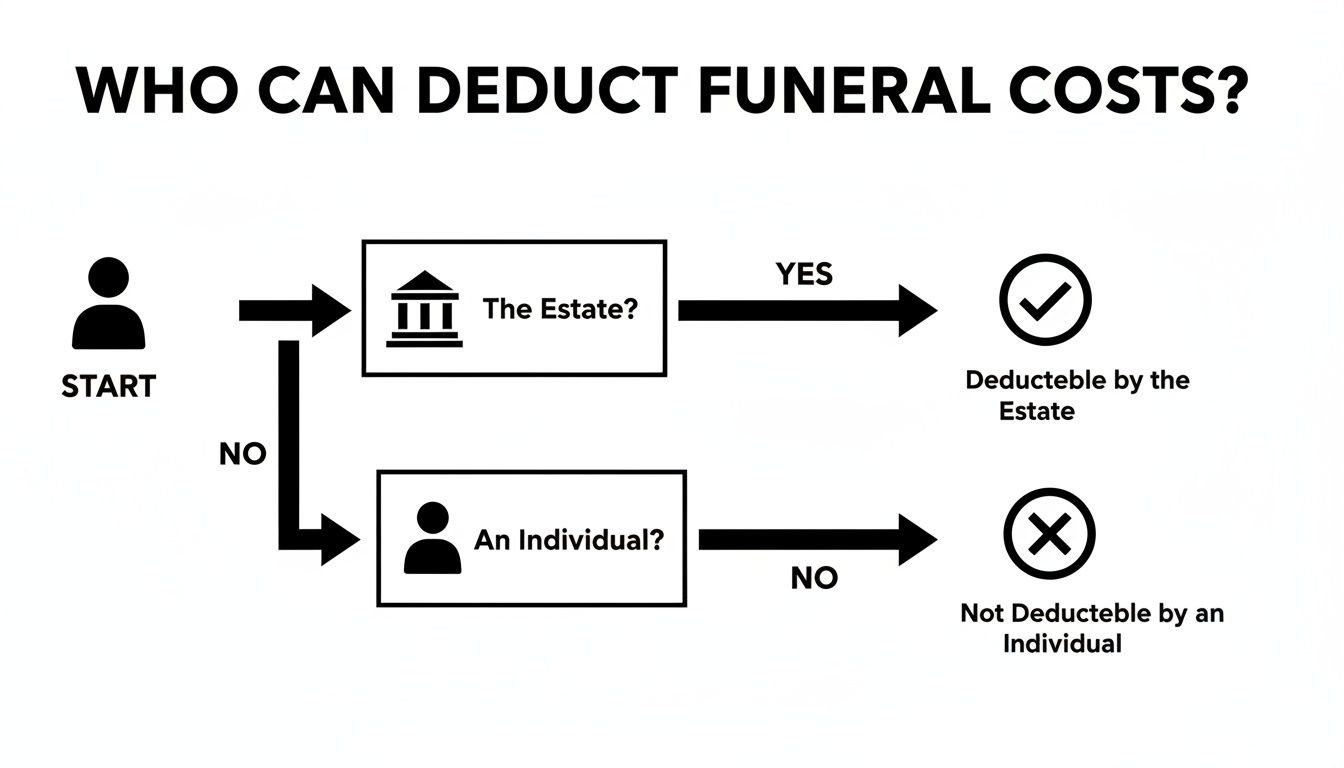
As you can see, the path for an estate is a straight line. For an individual, it's pretty much a dead end.
An Individual Taxpayer's Limited Options
So, what about a son, daughter, or spouse who paid for the funeral and wants to claim it on their personal tax return? While there's a technical path for this, the hurdles are so high that almost no one qualifies.
To even have a chance, you must meet both of these strict conditions:
- Relationship Status: The person who passed away must have been your legal spouse or a qualifying dependent. You can't claim these costs for a parent, sibling, or another relative unless they were your legal dependent at the time of their death.
- The 7.5% AGI Threshold: This is the big one. Funeral expenses must be lumped in with your other medical bills for the year. You can only deduct the total amount of these medical expenses that exceeds 7.5% of your Adjusted Gross Income (AGI).
Think of that 7.5% threshold like a massive insurance deductible. If your AGI is $80,000, you’d need your medical and funeral costs to total more than $6,000 before you could deduct a single penny. For most people, that bar is just too high to clear.
In the eyes of the IRS, funeral expenses are considered a personal cost for an individual. The only exception is the very narrow medical expense deduction, which is why the estate is almost always the only realistic claimant.
This distinction is more important than ever. The cost of final arrangements has been rising steadily, often outpacing inflation. For 2026, the national median cost for a burial is projected to be around $8,300, with cremation at $6,300. These figures can be even higher depending on where you live. You can explore more data on how funeral costs vary by state to see just how significant this potential tax deduction can be.
What Specific Funeral Expenses Are Tax Deductible
Figuring out who can claim a deduction is one piece of the puzzle. The other, equally important piece, is knowing exactly what expenses qualify. This is where many well-intentioned executors and family members get tripped up.
The IRS draws a pretty clear line in the sand. Think of it this way: deductions are meant for the services directly related to the deceased’s final arrangements, not for the comfort and convenience of the mourners attending the service. Once you grasp that distinction, navigating the rules becomes much simpler.

Core Deductible Service Costs
When an estate is handling the taxes (using Form 706), it can deduct all "reasonable" funeral expenses. The IRS uses the word "reasonable" to suggest that the costs should align with the deceased's lifestyle and financial standing. It’s a subjective term, but it’s the guideline we have.
So, what typically makes the cut? Here are the usual suspects that are almost always deductible:
- Funeral Home and Director Fees: This is the big one. It covers the professional services for planning the funeral, coordinating the details, and using the funeral home's facilities.
- Body Preparation: Any costs for embalming or cremation are fundamental parts of the process and are fully deductible.
- Casket or Urn: The container for the deceased’s remains, whether it's a traditional casket for burial or an urn for ashes, is a standard deductible expense.
- Transportation of the Deceased: This includes the hearse to get the body to the funeral home and then to the cemetery or crematorium. If you paid for a police escort, that fee could also be included.
For an estate, any expense that is directly tied to the final disposition of the deceased is a strong candidate for a tax deduction. These are considered necessary administrative costs of settling the estate's final affairs.
Other Directly Related Deductible Expenses
The paper trail often extends beyond a single bill from the funeral home. Fortunately, other related costs also qualify, as long as they are directly connected to memorializing and burying the deceased.
These can include payments made to various vendors for:
- Burial Plot or Niche: The cost of the gravesite or a space in a columbarium wall is deductible, regardless of whether it was bought years ago or after the death.
- Headstone or Grave Marker: Designing, creating, and installing a monument or other permanent marker is a qualified expense.
- Clergy or Officiant Fees: A fee or honorarium paid to the minister, priest, rabbi, or other celebrant who conducts the service is deductible.
- Music for the Service: Paying an organist, soloist, or other musicians to perform during the actual funeral or memorial service is also allowed.
What You Cannot Deduct
This is where the line gets drawn, and where costly mistakes often happen. Expenses that are really for the mourners—not the deceased—are not considered tax deductible funeral expenses.
Here’s a quick rundown of common non-deductible items:
- Reception or Wake Costs: The catering, venue rental, food, and drinks for any post-funeral gathering are considered personal expenses.
- Travel for Family and Friends: Airfare, hotel stays, and rental cars for family members traveling to the funeral are not deductible.
- Sympathy Flowers: While the main floral spray for the casket might be rolled into the funeral director's bill, flowers sent by other family and friends are not.
- Obituaries and Death Notices: The cost of placing a death notice in newspapers is also typically disallowed by the IRS.
To help you keep it all straight, here is a simple checklist breaking down what you generally can and cannot deduct.
Deductible vs. Non-Deductible Funeral Expenses Checklist
This table is designed to be a quick reference guide for executors and family members. Always remember that "reasonableness" is a factor, but this list covers the most common scenarios.
| Expense Item | Generally Deductible? | Important Notes |
|---|---|---|
| Funeral Director Fees | Yes | The core charge for professional services is the primary deduction. |
| Embalming/Cremation | Yes | Costs for preparing the body are always considered essential. |
| Casket or Urn | Yes | The cost of the container for the remains is a standard deduction. |
| Hearse/Transportation | Yes | Transporting the deceased to the funeral home and final resting place. |
| Burial Plot or Niche | Yes | Includes the cost of the gravesite or columbarium space. |
| Headstone/Grave Marker | Yes | The cost of creating and installing a permanent marker. |
| Officiant/Clergy Fees | Yes | Payment for the person conducting the service. |
| Musicians for Service | Yes | Fees for an organist, soloist, etc., during the ceremony. |
| Funeral Reception | No | Catering, venue rental, and food for mourners are not deductible. |
| Family Travel Costs | No | Airfare, hotels, and car rentals for attendees are personal expenses. |
| Sympathy Flowers | No | Flowers sent by friends and family are considered personal gifts. |
| Newspaper Obituaries | No | The cost of placing death notices is generally not allowed. |
This checklist should serve as a solid starting point, but always keep detailed records and receipts for everything.
Understanding how these specific deductions fit into the larger picture of settling an estate's financial obligations is key. For a deeper dive into that process, it's helpful to review information on debts and taxes in probate. It’s a crucial area for any executor to get right.
Finally, remember that if an individual is trying to claim these costs through the narrow medical expense deduction, the same rules apply. In the United States, funeral expenses can be treated as a medical expense on your personal income tax return, but it's a tough threshold to meet. Your total medical expenses, including the funeral costs, must be more than 7.5% of your adjusted gross income (AGI). For a self-employed person with an AGI of $100,000, that means you'd need more than $7,500 in total expenses before you could deduct a single dollar. You can discover more insights about these rules from the NFDA to see just how high this bar is for most taxpayers.
It's also useful to see how other financial events might affect your taxes. We cover some of those situations in our articles about certain non-taxable payments.
A Step-by-Step Guide to Claiming the Deduction
Alright, you understand who can potentially claim a deduction and which costs are on the table. Now comes the practical part: actually filing the claim. The process for claiming tax deductible funeral expenses isn't one-size-fits-all. It changes completely depending on whether the estate is filing or an individual is trying to claim the costs.

Let’s break down how each of these paths works in the real world.
For the Estate Executor
If you're handling the affairs of an estate, your work will center around a specific tax document: Form 706, United States Estate (and Generation-Skipping Transfer) Tax Return. This is the form used to calculate the estate's tax liability. Even if the estate's value is nowhere near the federal exemption threshold (which is over $13 million for 2024), you may still need to file this form to properly deduct funeral costs.
Here’s what the process looks like for the executor:
Gather Every Piece of Paperwork: Before you touch the tax forms, your first job is to collect every invoice, receipt, and contract related to the funeral. This means getting the final bills from the funeral home, the cemetery, the florist—everyone. Being organized now will save you major headaches later.
Fill Out Schedule J: On Form 706, you’ll find Schedule J, "Funeral Expenses and Expenses Incurred in Administering Property Subject to Claims." This is your dedicated space to itemize every single reasonable funeral expense you've paid. Be meticulous.
Account for Reimbursements: This is a big one. You have to subtract any money the estate received that was meant to cover these costs. This includes things like VA burial benefits or the Social Security lump-sum death payment. The IRS only lets you deduct the estate's net, out-of-pocket expenses.
Don't panic if you realize you've made a mistake on a return that's already been filed. It can often be fixed. Our guide on how to amend a tax return walks you through the correction process.
For the Individual Taxpayer
Things look quite different if you're an individual trying to deduct these expenses on your personal tax return, Form 1040. The deduction isn't a direct line item for "funeral costs." Instead, these expenses get bundled with your medical expense deduction, which comes with some very high hurdles.
Crucial Reminder: You can only even consider this route if the deceased was your legal spouse or a qualifying dependent. On top of that, you can only deduct the amounts you personally paid and were not reimbursed for by the estate or any other source.
Here’s how it works for an individual:
Step 1: Tally Your Medical Bills: Start by adding up all your own qualifying medical expenses for the year. To this total, you'll add the reasonable funeral expenses you paid for the decedent.
Step 2: Find Your AGI Threshold: Next, you need your Adjusted Gross Income (AGI) from your Form 1040. You can only deduct medical expenses that exceed 7.5% of your AGI. So, if your AGI is $100,000, your threshold is $7,500.
Step 3: Itemize on Schedule A: If your combined total of medical and funeral costs is more than that 7.5% threshold, you can finally claim a deduction. You would deduct the amount above the threshold on Line 1 of Schedule A, "Itemized Deductions."
As you can see, that high AGI threshold makes it extremely difficult for most individuals to qualify. This is precisely why, in the vast majority of cases, the estate is the proper—and only—entity that can successfully claim tax deductible funeral expenses.
Real-World Scenarios of Funeral Expense Deductions
Tax rules can feel a bit theoretical. Let's ground these concepts in reality by walking through a few common scenarios. Seeing how these deductions work—or don't work—for real people is the best way to understand the stakes.
These stories show how the rules apply differently depending on who pays and their relationship to the person who passed away.
Scenario 1: The Executor
Let's start with Sarah. She’s the executor of her father's estate, a role she's taking very seriously. The estate is valued at a modest $200,000, so it falls well below the federal estate tax exemption. Still, Sarah knows that proper accounting is a non-negotiable part of her duties.
She carefully keeps every receipt and invoice related to the funeral, which comes to a total of $15,000. These expenses cover everything from the funeral home's services and the casket to the burial plot and headstone. Even though she put some of the initial costs on her personal credit card, she made sure to reimburse herself directly from the estate's bank account, creating a clean paper trail.
Because these are reasonable administrative expenses, Sarah properly lists the full $15,000 on Schedule J of Form 706, the U.S. Estate Tax Return. While the estate doesn't owe any tax, this action officially reduces its taxable value from $200,000 to $185,000. It's a critical step for an accurate final accounting before the remaining assets go to the beneficiaries.
Scenario 2: The Self-Employed Spouse
But what if there isn't a formal estate? Let’s consider David, a freelance marketing consultant whose wife tragically passed away. As someone who is self-employed, David is always mindful of his finances. He paid $7,500 for his wife's cremation services out of his own pocket.
David is savvy enough to know that funeral expenses can sometimes qualify as a medical expense deduction. He sits down to run the numbers. His Adjusted Gross Income (AGI) for the year is $80,000. The rule is that you can only deduct medical expenses that exceed 7.5% of your AGI. For David, that threshold is $6,000 ($80,000 x 0.075).
He had already racked up $4,000 in other medical bills during the year. When he adds the $7,500 he spent on the funeral, his total medical expenses hit $11,500. This total is well over his $6,000 threshold, allowing him to claim a deduction.
The deductible amount is not the full $11,500. Instead, it's the amount that exceeds his threshold. So, David can deduct $5,500 ($11,500 - $6,000) on his Schedule A, providing him with valuable tax relief.
This is a perfect example of how small business owners and contractors can strategically use the medical expense deduction. As noted by Attorney Stephen A. Weisberg of The W Tax Group, finding these opportunities is what good tax planning is all about and can save taxpayers thousands. You can see how professionals break down these situations to find every available tax advantage for their clients.
Scenario 3: The Common Pitfall
Finally, we have the most common and unfortunate situation. Meet Maria, who generously covered the $9,000 funeral bill for her brother after he passed away unexpectedly. Her brother was not her legal dependent, and they didn't live together. Maria simply assumed that since she paid, she could claim a deduction.
When she met with her tax preparer, she got some bad news. She can't claim the $9,000 on her personal return. There are two big reasons why. First, her brother was not her spouse or a qualifying dependent. Second, even if he had been, her own income was too high for the funeral costs to get her over the 7.5% AGI threshold.
Her brother had very few assets, so no formal estate was ever opened and no Form 706 was filed. In the eyes of the IRS, Maria's wonderful gesture is considered a personal gift, not a deductible expense. This is a tough lesson, and it’s one of the most frequent and costly mistakes we see people make.
When to Seek Professional Tax Help
Dealing with a loss is emotionally draining. The last thing you want to do is wade through a swamp of complicated tax rules. While we've laid out the basics for tax deductible funeral expenses, some situations are just too messy to handle on your own.
Trying to DIY a complex estate can easily lead to missed deductions or, worse, costly mistakes that attract unwanted IRS attention. Knowing when to call in a professional isn't a sign of weakness; it's the smartest move you can make, especially if you're the executor.
Identifying When You Need an Expert
Certain scenarios are red flags that practically scream for professional guidance. If you find yourself in any of these situations, it’s time to seriously consider getting help:
- Large Estates: When an estate's value gets close to the federal or state exemption threshold, every single deduction counts. A tax pro can make sure every expense is perfectly documented to protect the estate's value for the heirs.
- Disagreements Among Heirs: Let's be honest—funerals can bring out family tensions. If relatives are arguing over who pays for what, a neutral expert can provide sound advice to settle things fairly and legally before they spiral out of control.
- Complex Reimbursement Scenarios: Did multiple people chip in for different costs? A professional can untangle that web, creating a clear record to ensure everyone gets reimbursed correctly from the estate without creating an accounting nightmare.
- Executor with Personal Tax Debt: If you're the executor and also have your own tax troubles, you're walking a tightrope. It is absolutely crucial to keep the estate's finances completely separate from your own. An expert can help you manage both without getting them dangerously intertwined.
Trying to navigate the IRS alone during such a sensitive time adds a layer of stress you simply don't need. A consultation with a pro gives you clarity and prevents simple errors from turning into long-term financial headaches.
Instead of guessing and hoping for the best, a quick chat with an experienced tax professional can uncover liabilities you might have completely missed. For executors, business owners, or anyone feeling overwhelmed, it's the surest path to getting everything right from the start.
If you aren't sure where to look, our article on how to find a good tax attorney gives you practical steps for vetting and choosing the right expert for your situation. It’s a small investment of your time that can save you a world of trouble down the line.
Frequently Asked Questions About Funeral Expenses and Taxes
Even with a solid grasp of the rules, you’re bound to have some specific questions about how tax deductible funeral expenses play out in the real world. I’ve found that most executors and family members run into the same handful of "what if" scenarios, so let's walk through the most common ones.
Think of this as a quick-reference guide for those questions that inevitably pop up during an already difficult time.
Can I Deduct the Cost of a Headstone or Grave Marker?
Yes, you can. The IRS views a headstone, monument, or grave marker as an integral part of the funeral itself. The cost for the marker, including its design and installation, is fully deductible for the estate.
Just be sure to claim it on Schedule J of Form 706 and keep the detailed invoices from the monument company with the estate's records.
What if a Pre-paid Plan Covered the Costs?
This is a great question, and the answer is a firm no. If a pre-paid funeral plan or a life insurance policy paid for the expenses, they can’t be deducted. It's a fundamental tax principle: you can only deduct an expense that the estate actually paid out-of-pocket.
In simple terms, you can't deduct an expense that someone else already paid for. Since the pre-paid plan or insurance policy settled the bill, there's no outstanding cost for the estate to claim.
Are Costs for a Memorial Service Held Later Deductible?
They certainly can be, as long as the service is a reasonable part of the funeral process. The IRS is practical about this; they know families sometimes need to hold a memorial weeks or even months after a passing, especially if travel is involved or after a cremation.
The direct costs for the ceremony itself—like renting a venue, paying an officiant, or hiring musicians—are generally deductible. The key distinction is that costs for a social gathering, like a reception or party afterward, are not. The deduction is for the service, not the wake.
Can I Deduct Funeral Expenses on My State Tax Return?
This is where you have to be careful. The answer depends entirely on the state where the decedent lived. State-level estate and inheritance tax laws can be wildly different from federal rules.
- Many states have their own estate or inheritance tax systems.
- These states often have much, much lower exemption thresholds than the federal government's $13.61 million.
- The list of what's considered a deductible expense can also vary.
Never assume the federal rules automatically apply at the state level. You absolutely must check the specific tax code for the decedent’s state to see what's allowed.
For more in-depth answers to your tax questions, you can always find more on our extensive FAQ page.
When you're navigating the complexities of an estate, you don't have to figure it all out on your own. At The W Tax Group, Attorney Stephen A. Weisberg offers a free, no-strings-attached tax analysis to help you see your options clearly. Get expert guidance instead of guessing by visiting https://weisberg.tax today.


