Tax Debt Service: Your Guide to IRS Resolution in 2026
Facing the IRS? Learn what a tax debt service is, explore resolution options like OIC, and find out how to choose a trustworthy professional to help you.

In this article
- That IRS Notice The Weight of Unresolved Tax Debt
- It's not just about what you owe
- Stress changes judgment
- Defining a True Tax Debt Service
- Diagnosis comes before treatment
- Why the IRS takes collection seriously
- Who should handle the case
- Your Tax Debt Resolution Options Explained
- The major options and when they fit
- Comparing IRS Tax Resolution Options
- Business owners need a different level of caution
- The Tax Resolution Process and Timelines
- Phase one starts with records, not promises
- Strategy depends on timing
- What implementation actually looks like
- How to Choose the Right Tax Debt Attorney
- Questions worth asking in the first consultation
- Look for strategy, not theater
- Fee structure should make sense
- Red Flags and Predatory Tax Relief Scams to Avoid
- The most common warning signs
- What a bad engagement usually looks like
- Take Control with a Free Tax Debt Analysis
You open the mail, see the IRS logo, and your stomach drops. Maybe you've been meaning to deal with it for months. Maybe you thought you had more time. Maybe you're a business owner who was juggling payroll, vendors, and a bad quarter, and now the tax issue that sat in the background is suddenly the loudest problem in the room.
That moment is where a lot of bad decisions start. People panic, call the first national “tax relief” ad they find, pay a large fee, and get sold a canned solution before anyone has reviewed transcripts, assessment dates, or business structure. Good tax debt service works the opposite way. It starts with diagnosis, not promises.
That IRS Notice The Weight of Unresolved Tax Debt
The first notice rarely feels “administrative.” It feels personal. For a self-employed professional, an independent contractor, or the owner of an S corporation, unresolved tax debt can affect far more than a balance due. It can put pressure on your ability to keep operating, keep contracts, and keep your name clear enough to move forward professionally.

It's not just about what you owe
For many self-employed professionals, contractors, and business owners, the consequences of unresolved tax debt extend beyond IRS actions. Significant tax delinquency can threaten professional licenses, create problems with background checks, and interfere with future employment or contract opportunities. When that happens, the tax debt issue stops being only a payment problem. It becomes a career-protection problem.
I've seen people focus so hard on the monthly payment question that they miss the larger risk. A tax problem that sits unresolved can spread into licensing, financing, business operations, and partnerships. By the time they ask for help, they aren't just trying to reduce stress. They're trying to prevent a chain reaction.
Unresolved tax debt often costs people more in lost opportunity than in direct collection action.
That's especially true for taxpayers whose income depends on reputation and ongoing eligibility. If your work requires a professional credential or clean financial disclosures, delay can make every other part of your life harder.
Stress changes judgment
This is also the moment when people become vulnerable to aggressive marketing. A frightened taxpayer is easy to sell. If you're trying to make clear business decisions while worried about levies, payroll exposure, or whether a license renewal will get flagged, you're not in a good position to evaluate a sales pitch.
That's why I tell clients to slow the process down mentally, even if the issue itself is urgent. The notice matters. The deadlines matter. But your first move should still be analysis.
If you're a tax professional or business owner trying to understand how tax issues intersect with client acquisition and firm positioning, ConvertBankToExcel's tax SEO strategies offer a useful look at how tax-focused services are framed online. That matters because many distressed taxpayers first encounter bad advice through search results and ad copy, not through a careful referral.
Defining a True Tax Debt Service
A real tax debt service is not a script, a settlement slogan, or a promise that everyone qualifies for the same program. It is a professional process for identifying what the IRS can legally collect, what the taxpayer can realistically pay, and which resolution path creates the least long-term damage.
Diagnosis comes before treatment
The best analogy is medicine. A careful specialist orders tests before recommending surgery. A predatory tax relief company often does the opposite. It sells the surgery first, then figures out later whether the patient even needed it.
A legitimate tax debt service starts by gathering facts such as:
- IRS transcripts: These show assessments, balances, filing history, and timing issues.
- Collection status: The professional checks whether levies are active, threatened, or still avoidable.
- Financial reality: Forms in the 433 series often matter because the IRS will evaluate ability to pay through assets, income, and allowable expenses.
- Entity structure: A sole proprietor case is different from a multi-member LLC or an S corporation with payroll issues.
If that sounds less exciting than “pennies on the dollar,” that's because it is. It's also how cases get resolved correctly.
Why the IRS takes collection seriously
The collection environment is not abstract. The federal debt burden is enormous. As of August 2025, total public debt was nearly $37 trillion, and net interest payments reached $886 billion in fiscal 2024, becoming the third-largest federal expenditure category and exceeding Medicare and national defense according to U.S. Treasury historical debt data. For taxpayers, the practical takeaway is simple. The IRS has every institutional reason to pursue collection aggressively where it believes collection is available.
That pressure doesn't mean every taxpayer should rush into the same resolution method. It means the agency will expect documentation, consistency, and compliance.
Who should handle the case
Not every tax problem requires the same kind of professional.
- Enrolled Agents and CPAs: Often strong on returns, accounting records, and financial reconstruction.
- Tax attorneys: Often essential when the case involves legal exposure, disputed liability, privilege concerns, payroll tax issues, or multi-party conflicts.
- Team-based representation: In more complex matters, the right answer is often coordinated work among legal, accounting, and administrative staff.
Practical rule: If your case involves payroll taxes, a Trust Fund Recovery Penalty risk, bankruptcy overlap, or business partners with competing interests, treat it as a legal strategy matter, not just a forms matter.
Your Tax Debt Resolution Options Explained
The right resolution tool depends on what the IRS can collect, what you can prove, and what could go wrong if the wrong application gets filed. Most cases are not really about choosing the “best” program. They're about avoiding the wrong one.
The major options and when they fit
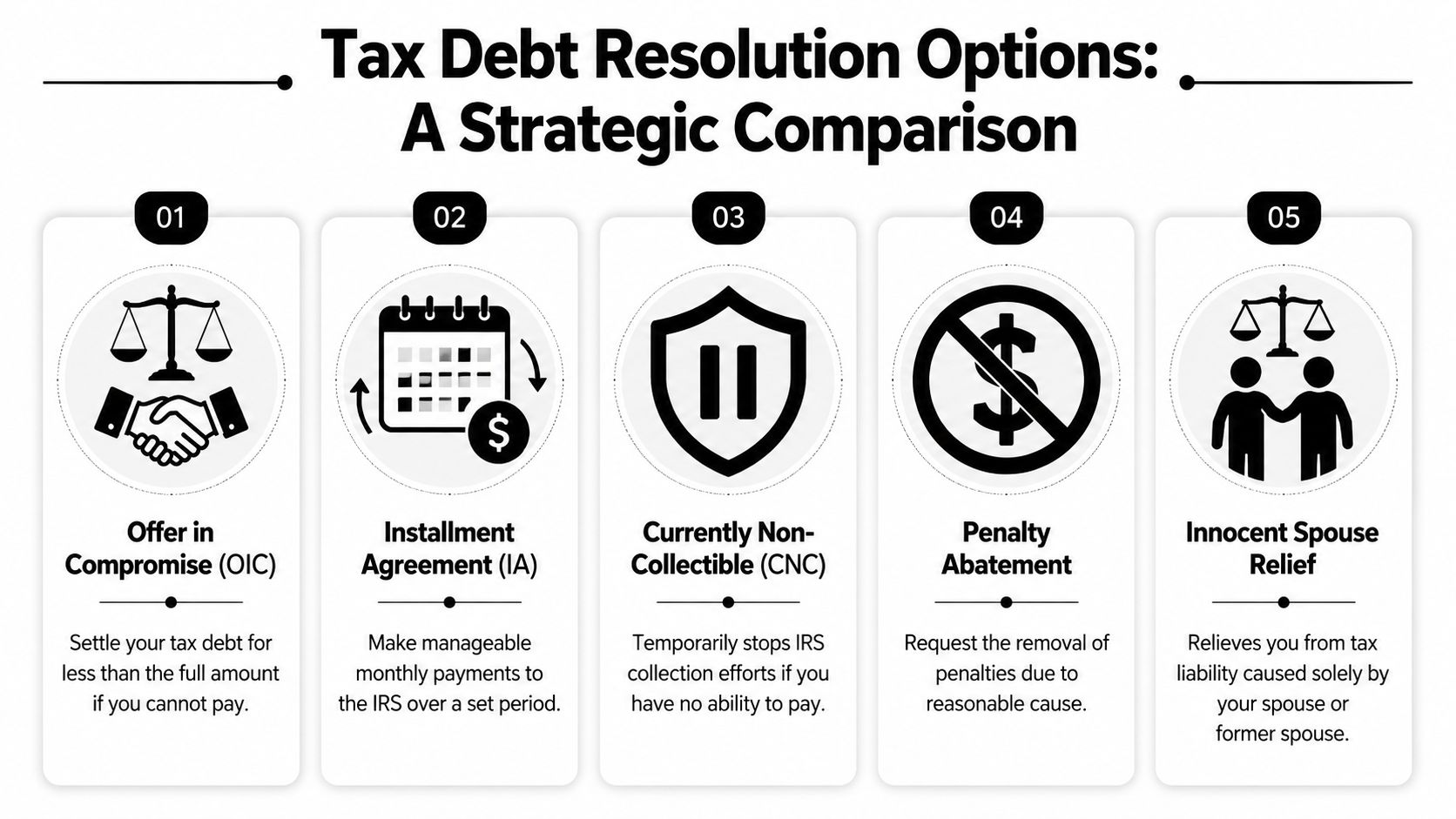
Offer in Compromise is the program people ask about first. It can work, but only when the numbers support it. An OIC turns on Reasonable Collection Potential, and IRS data from FY2023 showed a 34% acceptance rate for OICs, with average settlements around $50,000 against liabilities often exceeding $200,000. It also requires a $205 fee unless waived and generally a 20% initial payment for certain offers, as outlined in this OIC and RCP guide. That's why filing one just to “see what happens” is often a mistake.
Installment Agreements are often more practical than clients expect. If the taxpayer has steady income and can stay compliant going forward, a payment plan may stop escalation and create breathing room. In some cases, a standard agreement makes more sense than forcing a weak settlement application.
Partial Payment Installment Agreements deserve more attention than they get. They can be useful when the taxpayer can pay something, but not enough to full-pay before collection time runs out. These cases require careful financial review and timing analysis.
Currently Non-Collectible status can be appropriate when a taxpayer lacks the ability to pay. CNC doesn't erase the debt, but it may pause active collection while the taxpayer stabilizes.
Penalty abatement matters when penalties, not just tax, are driving the balance. It isn't a cure-all, but it can materially improve a case when the facts support relief.
Innocent Spouse Relief belongs in a different category because it addresses responsibility, not payment terms alone. In the right case, it can change the entire posture of the matter.
For a broader overview of how these paths differ, this page on tax debt relief options is a helpful companion.
Comparing IRS Tax Resolution Options
| Resolution Method | Best For | Impact on Credit/Liens | Key Requirement |
|---|---|---|---|
| Offer in Compromise | Taxpayers who can't realistically full-pay and can prove low collection potential | Existing federal tax lien issues may still need separate attention | Strong RCP analysis and complete financial disclosure |
| Installment Agreement | Taxpayers with reliable cash flow who need structure | May not remove lien issues by itself | Affordable monthly payment and ongoing compliance |
| Currently Non-Collectible | Taxpayers with no present ability to pay | Collection may pause, but the debt remains | Proof that paying would create hardship |
| Penalty Abatement | Taxpayers whose balance is inflated by penalties | Usually limited effect on lien posture by itself | Facts that support penalty relief |
| Innocent Spouse Relief | Taxpayers tied to a spouse's or former spouse's tax problem | Can change liability exposure rather than collection terms | Facts showing the liability should not be attributed to you |
Business owners need a different level of caution
Payroll tax debt is where cookie-cutter tax debt service breaks down fast. The Trust Fund Recovery Penalty can shift payroll tax exposure from the business to individuals the IRS considers responsible. In a multi-owner business, one owner's rushed resolution move can damage another owner's position.
That's why analysis has to include who signed checks, who made payroll decisions, who had authority, and whether the IRS is treating the debt as shared or disputed. A one-size-fits-all settlement can look efficient on paper and still be strategically wrong.
If you own a business with other people, never assume the entity's tax problem and your personal tax problem are the same case.
The Tax Resolution Process and Timelines
Understanding the sequence can bring a sense of calm. The process is rarely fast, but it is usually manageable when the work is done in the right order.
Phase one starts with records, not promises
The first step is usually authorization and transcript review. That means getting the IRS account history, confirming what years are involved, checking whether returns are missing, and identifying where the case stands. Many taxpayers think they know the problem until transcripts show a different assessment date, substitute-for-return history, or collection status than expected.
A competent professional also looks for immediate risk. Is a levy already in process? Is the taxpayer compliant with current filing and deposits? Is there a payroll issue hiding inside what the client thinks is only an income tax issue?
Strategy depends on timing
The Collection Statute Expiration Date, or CSED, is one of the most important timing rules in tax debt service. The IRS generally has a 10-year period to collect after assessment, but certain actions, including submitting an Offer in Compromise or filing bankruptcy, can pause that clock, according to this explanation of the IRS collection statute and tolling rules. That means a bad filing is not harmless. It can give the IRS more time.
Analysis-first representation is paramount. Sometimes the right move is to file quickly. Sometimes the right move is to avoid an application that would extend the government's collection window without improving the client's position.
For taxpayers weighing whether insolvency law should be part of the conversation, this overview of bankruptcy options for clearing tax debt is a useful starting point. The key point is that bankruptcy and tax resolution affect each other. They should never be evaluated in separate silos.
What implementation actually looks like
Once the strategy is chosen, the work gets more concrete:
- Clean up filing compliance. The IRS usually won't approve a resolution while required returns are missing.
- Prepare financial disclosures. This often means Forms 433 and supporting records.
- Submit the right request. That may be an installment agreement, CNC request, OIC, or another targeted filing.
- Respond to follow-up. IRS collections personnel often want clarification, proof, or updated documents.
- Stay compliant after approval. A good result can unravel if the taxpayer misses future filings or payments.
If you're trying to understand the practical mechanics of one common route, this guide on how to set up a payment plan with the IRS gives a useful baseline. The larger point remains the same. The form is not the strategy. The analysis behind it is.
A tax resolution timeline is rarely linear. What keeps a case on track is accurate records, realistic expectations, and disciplined compliance after the paperwork is filed.
How to Choose the Right Tax Debt Attorney
Choosing representation is not mainly about credentials on a website. It's about whether the professional thinks like a diagnostician or like a closer.
Questions worth asking in the first consultation
Ask direct questions and pay attention to whether you get direct answers.
- What do you review before recommending a plan? If the answer skips transcripts, assessment dates, filing status, and financial records, that's a warning.
- Who will work on my case? Some firms sell the engagement through one person and hand the file to someone else immediately.
- Are you evaluating legal exposure, or only settlement eligibility? That distinction matters in payroll and multi-owner cases.
- How do you decide whether not to file an OIC? A serious professional should be able to explain why a popular option may be wrong for many taxpayers.
Look for strategy, not theater
A calm attorney should be willing to say, “I don't know yet. I need the records first.” That answer is often more trustworthy than a polished promise. Real tax debt service involves judgment calls about timing, risk, and collateral effects. It is not a scripted intake funnel.
Attorney-client privilege can also matter. Not every tax matter turns on privilege, but when facts are sensitive, overlapping, or potentially disputed, legal counsel provides protections that non-attorney representation does not.
Fee structure should make sense
A reasonable fee conversation is tied to scope. Initial analysis should lead to a defined plan, not an open-ended emotional pitch. Be wary of firms that demand a large upfront commitment before they've identified the actual problem.
One useful screening step is reviewing practical guidance on how to find a good tax attorney. The best fit is usually the professional who can explain trade-offs plainly, identify risks early, and tell you when a cheaper or simpler path may work.
Red Flags and Predatory Tax Relief Scams to Avoid
Predatory tax relief companies tend to sound confident before they know anything. That confidence is usually a sales asset, not a legal one.

The most common warning signs
- They promise a settlement before analysis. Nobody can predict a valid resolution path without records.
- They push one program for everyone. Most often, that means an Offer in Compromise whether it fits or not.
- They use fear as the entire pitch. Business owners hear this a lot with payroll tax issues and personal liability threats.
- They want a large fee immediately. The pressure is often highest when the factual review is weakest.
A common tactic is to use the Trust Fund Recovery Penalty as a scare tool. The penalty is serious, but it requires careful legal and factual analysis, especially in multi-owner businesses. A rushed, generic settlement can harm one partner, leave another exposed, and fail to fix the underlying payroll problem.
What a bad engagement usually looks like
The pattern is familiar. The client pays. A weak application gets filed. The IRS predictably challenges it or rejects it. The taxpayer loses time, money, and sometimes strategic ground.
If you want a plain-language warning about firms that market Offer in Compromise filings to almost everyone, the IRS-focused discussion of OIC mills that promise Offer in Compromise for everyone is worth reading.
The presence of a tax debt problem does not mean every advertised solution is available to you. It only means the facts need to be reviewed carefully.
Take Control with a Free Tax Debt Analysis
A tax debt problem feels chaotic when you're staring at notices, deadlines, and competing advice. It becomes more manageable once you separate sales language from legal reality. The right tax debt service starts with records, timing, and a strategy that matches the actual case.
That's the central difference between analysis-first representation and the high-pressure model. One approach asks, “What is the IRS legally able to collect, what can this taxpayer sustain, and what option does the least damage?” The other asks, “What can we sell today?”
If your case involves personal returns, business debt, payroll tax exposure, or a multi-owner structure, the first step should be a proper review before any major fee is paid or any application is submitted. One option for that kind of front-end review is the free tax debt analysis offered by Attorney Stephen A. Weisberg and The W Tax Group, which is designed to determine whether help is possible and what path makes sense before moving into a paid engagement.
You do not need a magic fix. You need a clear diagnosis, an honest explanation of your options, and a plan built around the facts.
If you want a calm, informed starting point, contact Attorney Stephen A Weisberg for a free tax debt analysis. That conversation can help you understand what the IRS is doing, what options are realistically available, and whether a customized resolution plan makes sense before you commit to anything more.


