Tax Debt Relief Scams: Red Flags and What to Do
Learn how to identify tax debt relief scams, spot urgent red flags, and take immediate steps to protect your finances and find legitimate tax representation.
In this article
- The Anatomy of Tax Debt Relief Scams
- Why the pressure works
- The Scale and Economics of Tax Imposter Fraud
- Government impersonation has become the central tool
- Your 10 Minute Verification Checklist
- Minute one, stop the interaction
- Minutes two through four, locate the official channel
- Minutes five through seven, verify the liability
- Minutes eight through ten, preserve and report
- Scam Sales Funnels Versus Legitimate Tax Representation
- Compare the operating models
- What a serious analysis should uncover
- Immediate Recovery Steps for Scam Victims
- Stop additional losses first
- Secure accounts and identity
- Reconstruct what happened
- Legal Rights and Official Reporting Channels
- Use the correct reporting path
- Don't confuse legal vocabulary with legal authority
- Securing Your Future with a Free Tax Debt Analysis
- What the analysis should produce
You're at your desk when the phone rings. The caller says your business owes the IRS, your account is headed for immediate enforcement, and you can avoid the problem by paying a tax resolution company today. They may know your name, business name, or part of an old tax issue. The pressure sounds official, and your first instinct is to stay on the line.
Don't. A frightened taxpayer is exactly what the scammer is trying to create. Tax debt relief scams work by transferring trust from a government agency to a private seller, manufacturing urgency, and demanding payment before you can verify the claim. The safest response is to stop the conversation, independently confirm whether a real liability exists, preserve the evidence, and only then speak with a qualified tax professional.
The Anatomy of Tax Debt Relief Scams
A typical scam begins with an unexpected robocall, text message, email, or letter. The sender may claim to be the IRS, a state revenue department, or a “tax resolution officer.” Another version uses a private company that says its review has already determined you qualify for a dramatic reduction in your tax debt.
The message usually contains three ingredients: authority, urgency, and a simple payment demand. The caller may threaten a levy, lawsuit, arrest, business closure, or account freeze. The offer may promise an Offer in Compromise for “pennies-on-the-dollar,” even though eligibility and terms depend on the taxpayer's actual facts and the government's decision. The IRS specifically warns about scammers who make these promises and rush people to pay, while unexpected communications that imitate government notices can also be used to obtain personal information. You can review the IRS guidance on recognizing tax scams and fraud.
Why the pressure works
The scammer doesn't need to perform detailed tax analysis. The sales process is built around trust transfer. A government-sounding title makes the caller seem credible. A short deadline prevents you from checking the IRS account yourself. A demand for an upfront retainer converts fear into immediate revenue.
Some operations look more polished than a simple phishing email. They advertise online, collect leads through forms, route calls through sales representatives, and present a “free consultation” that is really a scripted qualification call. The salesperson may ask about your balance, income, property, and bank accounts, then use those answers to push you toward a large payment.
Protective rule: A caller who insists you must pay before you can independently verify the debt is selling pressure, not tax representation.
The problem is substantial. In October 2010, the Federal Trade Commission announced that it had halted a national tax relief operation that allegedly collected more than $60 million by falsely claiming it could reduce consumers' tax debts. The case became an early high-profile enforcement milestone because it showed how deceptive debt relief could scale. For broader guidance on how to protect against IRS scams, use a resource that focuses on verification rather than sales.
A legitimate tax professional may discuss possible strategies, but they won't pretend to control the IRS. The IRS warning about Offer in Compromise mills is especially relevant when a company treats government relief as a guaranteed product.
The Scale and Economics of Tax Imposter Fraud
Tax debt impostor schemes belong to the broader imposter-scam category. In 2026, the FTC reported that people lost $3.5 billion to imposter scams in 2025, and reported losses had nearly tripled since 2020, according to the FTC's imposter scam data and guidance. Tax debt schemes are only one part of that wider category, but they use the same commercial logic: acquire a worried target, create a credible identity, shorten the time available for checking, and collect money or sensitive information.
The economics favor the fraudster. A scam operation can use the same script across many taxpayers, while each victim supplies the facts needed to make the pitch sound personal. The seller doesn't need to prove that a resolution strategy will work. It only needs to keep the prospect engaged until the payment request feels safer than hanging up.
Government impersonation has become the central tool
Older pitches often centered on the familiar promise of an Offer in Compromise for nearly everyone. Modern schemes increasingly combine that promise with fake government authority. A caller may claim to be from the IRS, threaten enforcement, and then transfer the taxpayer to a supposed private specialist who can “fix” the account.
That hybrid model is dangerous for business owners. A person dealing with payroll tax debt, employment tax exposure, or a possible trust fund recovery penalty may already fear personal liability. A scammer can exploit that concern by using collection language and demanding immediate action. The fraud depends less on tax law than on making the victim believe verification itself is risky.
In a 2025 FTC and Nevada case, regulators said alleged tax debt relief scammers took $77.7 million from victims over four years, while recovering only about $8 million in cash and surrendered assets for compensation, as described in the FTC enforcement release about the alleged government-impersonation scheme. Those figures illustrate the gap between money collected and money available to compensate victims.
The FTC's consumer guidance states a rule that should control every suspicious interaction: only the IRS or a state tax authority can decide whether you qualify for tax relief. A private company can analyze your facts, prepare documents, and represent you. It can't declare that the government has approved a result before the government has reviewed the case.
Your 10 Minute Verification Checklist
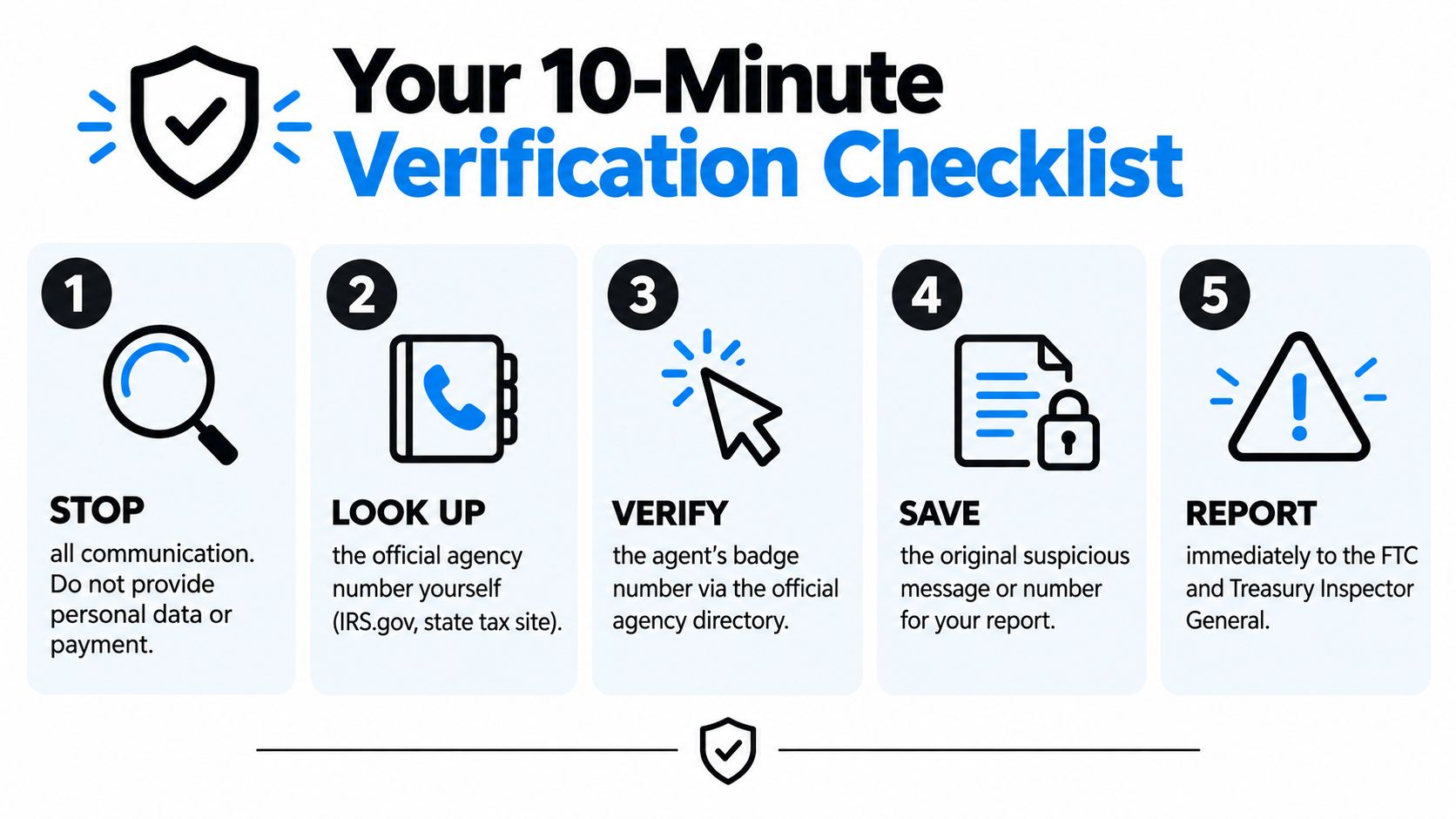
The first ten minutes matter because the scammer wants you to remain inside the sales conversation. Your job is to break that structure. Don't argue, negotiate, or try to expose the caller. End the interaction and verify the underlying claim through a channel you chose yourself.
Minute one, stop the interaction
Say that you'll verify the matter independently, then hang up. Don't click a link in the message, call the number printed in an unexpected text, or use a callback number supplied by the caller. Don't provide your Social Security number, employer identification number, date of birth, bank details, tax transcripts, or online account credentials.
If the person is already on the phone, silence is safer than debate. A legitimate agency won't need you to remain on an unverified call to protect your rights.
Minutes two through four, locate the official channel
Open a browser yourself and go to IRS.gov or your state tax department's official website. Find the agency's published contact information and use that number or secure account system. The FTC's guidance warns that callers may use fake government notices and urgent demands to obtain data or payment, so never treat the incoming number or contact details as proof of identity.
If you received a letter, preserve the original. Note the notice date, notice number, stated tax period, mailing address, and any payment instructions. Don't scan a QR code or visit a web address merely because the letter looks official.
For a separate explanation of how to check your actual balance, use this guide on checking whether you owe back taxes.
Minutes five through seven, verify the liability
Use your official IRS online account or contact the agency through its independently located channel. Ask whether the notice or alleged balance corresponds to your account and the stated tax period. If the issue involves a state, verify it directly with that state authority.
A private company's statement that you “qualify” isn't verification. The FTC's 2026 consumer alert warns against companies making that claim or requesting a full fee upfront. Eligibility must come from the relevant government authority, not from a sales representative.
Minutes eight through ten, preserve and report
Save the email, text, letter, caller ID, phone number, payment instructions, website address, and any voicemail. Take screenshots before deleting anything. Don't forward suspicious attachments to friends or colleagues without warning them.
Report the communication through the appropriate official channels, especially if the sender impersonated the IRS or demanded payment. If you already disclosed information, move immediately to the recovery steps below. Verification removes the scammer's artificial deadline and puts the decision back in your hands.
Scam Sales Funnels Versus Legitimate Tax Representation
A “free consultation” tells you nothing by itself. Scam operations use free calls to gather financial information, identify fear points, and move a prospect toward a retainer. The call may produce a confident eligibility statement without any review of account transcripts, filing history, collection status, assets, income, or necessary returns.
A legitimate free tax debt analysis is different in both purpose and sequence. The professional first determines what liability exists, whether the IRS or state account is accurate, whether required returns are filed, and what collection tools might apply. Only after reviewing the facts should the professional discuss an Offer in Compromise, an installment arrangement, currently not collectible status, penalty relief, levy action, or another strategy.
Compare the operating models
| Feature | Predatory Tax Relief Scam | Legitimate Tax Attorney |
|---|---|---|
| Initial contact | Unexpected call, text, email, or official-looking notice designed to create fear | You choose the firm and can verify its identity independently |
| Eligibility | Salesperson says you qualify before reviewing the government account | Professional treats eligibility as a question requiring records and analysis |
| Promise | Guaranteed reduction, fast settlement, or “pennies-on-the-dollar” result | No guaranteed outcome, only a fact-based assessment of available options |
| Review | Minimal questions followed by a payment request | Review of liabilities, filings, transcripts, collection history, and finances |
| Fee structure | Pressure for a full upfront payment or immediate retainer | Clear engagement terms, defined work, and transparent explanation of fees |
| Communication | Threats, countdowns, repeated calls, and refusal to let you verify | Time to ask questions, verify credentials, and make an informed decision |
| Government role | Company implies it controls the IRS or state authority | Attorney explains that the agency makes the final determination |
The FTC's 2026 consumer alert on tax debt specifically warns about guaranteed results and full upfront fees. That warning should shape your screening process. A professional can charge for work, but the fee should correspond to an identifiable scope of representation, not to a promise that the government will accept a result.
What a serious analysis should uncover
Ask what records the professional needs and what the analysis will answer. A meaningful review may identify unfiled returns, incorrect balances, penalties, payroll tax exposure, ownership issues, and collection deadlines. It should also tell you what remains unknown.
Use this guide on how to find a good tax attorney before signing an engagement. The safest provider welcomes verification, explains uncertainty, and lets you decide after understanding the work.
Immediate Recovery Steps for Scam Victims
If you paid money or disclosed sensitive information, stop treating the incident as an uncomfortable sales call. Treat it as a potential financial and identity-security event. Speed matters because payment systems, account access, and unauthorized debits may remain active after the conversation ends.
Stop additional losses first
Contact the bank, card issuer, or payment provider through its official number. Explain that the payment may involve fraud and ask what options are available for stopping, reversing, or disputing the transaction. If you authorized recurring ACH debits, ask the bank how to revoke authorization and monitor the account for further withdrawals.
Don't send a second payment to “close the file,” release a refund, or expedite a supposed government process. Fraudsters and related recovery scammers often target victims again after learning they've already paid.
Secure accounts and identity
Change passwords for the email account, financial accounts, IRS online account, and any account that used the same credentials. Turn on multifactor authentication where available. If you shared identity information, contact the credit bureaus through their official websites and ask about placing a fraud alert or other protective measure.
For a business owner, review payroll, banking, merchant, accounting, and payment-platform access. Tell your bookkeeper and financial institution what happened. An attacker who obtains tax or banking information may target the business separately from the individual.
Reconstruct what happened
Create a written timeline while the details are fresh. Record who contacted you, what identity they claimed, what they requested, what you sent, how you paid, and which documents they promised to prepare. Preserve contracts, invoices, emails, call records, voicemails, and screenshots.
Then independently obtain your IRS and state account information. Look for missing filings, unauthorized submissions, changes of address, payment arrangements, or powers of attorney you didn't approve. Don't assume the company performed tax work just because it sent forms or used official terminology.
If you fear an unauthorized bank levy or need to understand collection action, review the guidance on IRS levies against bank accounts. Report the fraud through the official channels, and consult a qualified tax professional about correcting the tax account itself. Reporting the scam won't automatically resolve the underlying tax debt, so handle both problems separately.
Legal Rights and Official Reporting Channels
You have the right to verify who is contacting you, understand what debt the government claims you owe, and refuse to make a rushed payment to an unverified business. A scammer's demand doesn't create a legal deadline, and a private company can't replace the IRS or state authority's decision-making role.
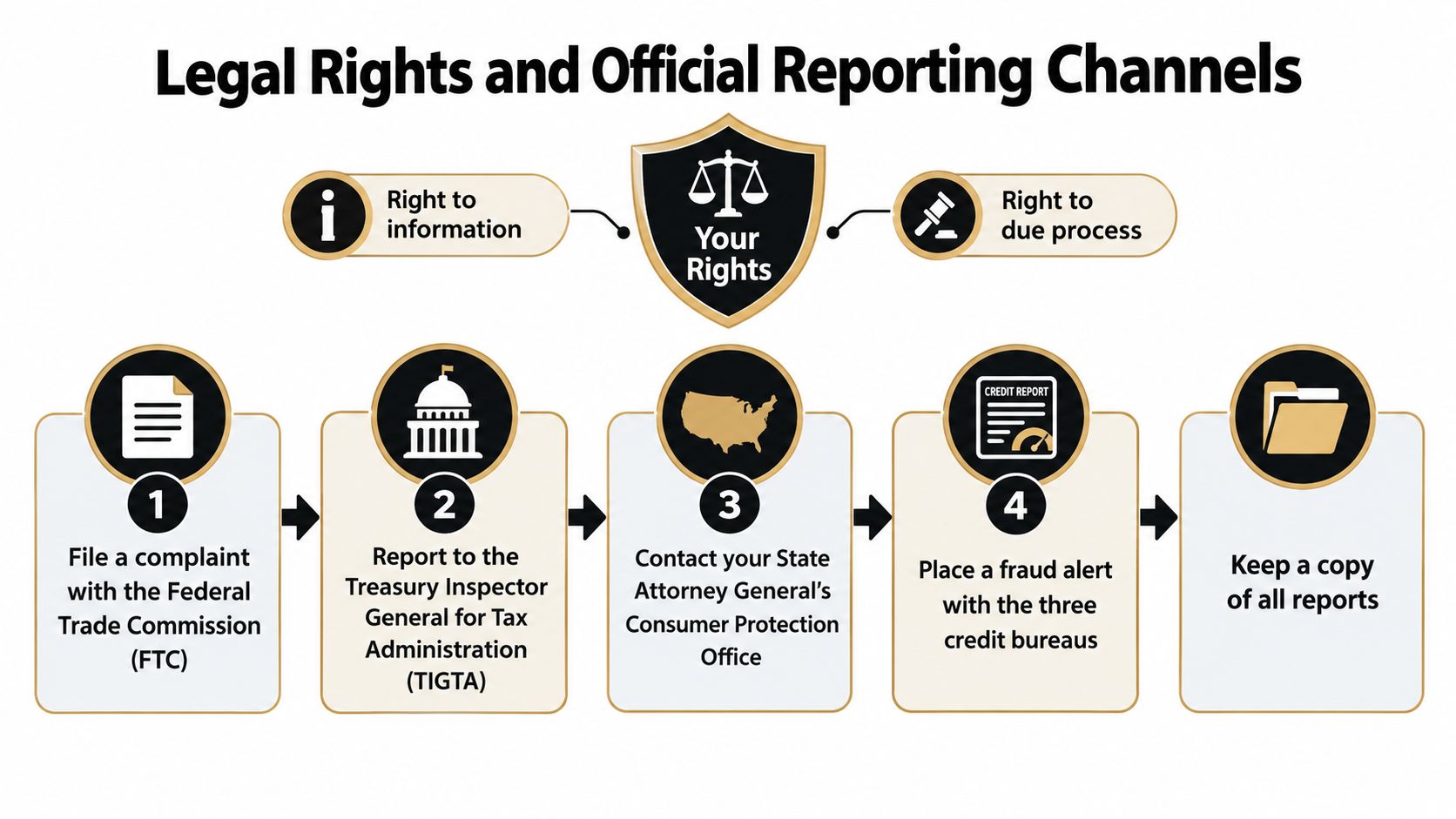
Reporting serves two purposes. It may help investigators connect your experience to a broader operation, and it creates a record that can support disputes with financial institutions or later professional review. Keep copies of every complaint, confirmation number, attachment, and communication.
Use the correct reporting path
Federal Trade Commission. Report deceptive business conduct and impersonation through the FTC's official complaint system. Include the company name, website, phone number, payment details, and the exact promises made.
Treasury Inspector General for Tax Administration. Report suspected IRS impersonation, tax-related fraud, and communications that misuse the agency's identity to TIGTA.
State consumer protection authorities. Contact your state attorney general's consumer protection office when the operation targeted residents of your state or claimed to represent the state tax agency.
Financial institutions and credit bureaus. Tell the bank or payment provider promptly, and ask the credit bureaus about fraud protections if identity information was exposed.
Tax authorities. Notify the IRS or state tax agency through independently verified channels if the scammer submitted documents, changed account information, or claimed to act under a power of attorney.
Don't confuse legal vocabulary with legal authority
Scammers often use terms such as “case officer,” “settlement division,” “levy release,” or “compliance counsel.” Familiar legal words can make an ordinary sales pitch sound official. If you want a clearer explanation of confident use of legal terms, focus on whether the person has verifiable credentials and a defined professional role, not whether the language sounds impressive.
The scale of enforcement shows why complaints matter. In the FTC and Nevada case described earlier, regulators said the alleged operation collected $77.7 million and that only about $8 million in cash and surrendered assets had been recovered for compensation. That disparity reinforces a practical lesson: recovery may be incomplete, so prevention, immediate bank action, and prompt reporting are essential.
Securing Your Future with a Free Tax Debt Analysis
Tax debt is serious, but it isn't a license for someone else to frighten you into paying a retainer. The legitimate path starts with identifying the actual liability and separating it from the sales story. That means reviewing IRS or state records, confirming that returns are filed, examining penalties and interest, and determining whether the government has begun collection activity.
A qualified tax professional should ask about the source of the debt and your current financial position. For a business, that may include payroll tax problems, trust fund recovery penalty exposure, income tax liabilities, responsible-person issues, or the relationship between the business and its owners. For an individual, the analysis may involve filing history, assets, income, household expenses, and collection status.
What the analysis should produce
A useful analysis doesn't promise an outcome. It gives you a defensible understanding of your options and the information needed to choose among them. Depending on the facts, the discussion may involve an Offer in Compromise, an installment agreement, currently not collectible status, penalty relief, collection appeals, or correcting an inaccurate account.
Ask for a written explanation of what will be reviewed, what the professional can and can't determine at the outset, and what happens if the case isn't suitable for representation. A free analysis is valuable only when it informs your decision rather than functioning as a disguised pressure call.
Tax Attorney Stephen A Weisberg offers a Free Tax Debt Analysis before charging clients to resolve IRS or state tax problems, with a review focused on whether he can help and how. If you're dealing with a suspicious tax debt offer or an actual liability, visit Tax Attorney Stephen A Weisberg to request an analysis based on your records instead of a promise made by an unexpected caller.


