Your Guide to Federal and State Tax Debt Relief Programs
Struggling with tax debt? Explore federal and state tax debt relief programs. Learn how options like OIC and Installment Agreements can resolve your tax issues.

In this article
- Your First Step When Facing Tax Debt
- Understanding the Landscape of Tax Debt
- Overview of Federal Tax Debt Relief Programs
- Understanding Federal Tax Relief Options
- Offer in Compromise: The Settlement
- Installment Agreement: The Payment Plan
- Currently Not Collectible: The Pause Button
- Penalty Abatement and Innocent Spouse Relief
- The Myth of Uniformity in State Tax Relief
- A Tale of Two States Tax Programs
- Solving Tax Debt for Business Owners
- The Trust Fund Recovery Penalty Explained
- Common Scenarios For LLCs And S-Corps
- Tax Debt Scenarios and Recommended Relief Paths
- The Ripple Effect On Other Professionals
- How to Choose the Right Professional Help
- Spotting the Red Flags of Predatory Firms
- The Power of a True Financial Analysis
- Attorney Access vs. Case Managers
- What To Do Next
- Your Immediate Action Plan
- The Smart, No-Risk Next Step
- Your Top Tax Debt Questions, Answered
- Can I Get Help If I Haven't Filed My Taxes?
- Will Applying for a Program Stop the IRS from Coming After Me?
- How Long Does This Whole Process Take?
- What’s the Difference Between a Tax Attorney and One of Those Big "Tax Resolution" Companies?
Tax debt relief programs aren't some secret back-door trick. They are well-established, government-approved solutions designed to help people and businesses get right with the IRS, either by settling for less than the full amount or getting on a payment plan they can actually handle. These are structured pathways, not loopholes, for those experiencing real financial hardship.
Your First Step When Facing Tax Debt
Getting a massive tax bill in the mail can feel like a punch to the gut. The stress and uncertainty are overwhelming, but here's the most important thing to remember: this is a solvable problem. The worst thing you can do is ignore it. Taking action is your most powerful tool, shifting you from a victim of scary IRS notices to the driver of your own financial recovery. The key is to get past the initial panic and start thinking strategically.
Many people get scared and fall for the slick promises of those national tax resolution companies you hear on the radio. They promise the world before they even know the first thing about your situation. A much smarter first step is to take a breath and get a clear, calm assessment of where you stand. Think of it like a financial check-up—you need to understand the problem before you can pick the right solution.
Understanding the Landscape of Tax Debt
If you're dealing with tax debt, you are definitely not alone. Back in 2020, Americans owed a staggering $128 billion in back taxes. That number shows just how common this issue is.
The good news? The IRS has clear, established procedures to help. For example, during the 2023 fiscal year, the IRS accepted over 30,000 Offer in Compromise (OIC) agreements. On average, these deals settled tax debts for about 40% of what was originally owed. These aren't just numbers; they show that structured programs provide real, tangible solutions for people every day.
Before you do anything else, you need to protect your assets and avoid making a bad situation worse. Trying to hide money or property from the IRS is a huge mistake that can lead to serious legal trouble.
It’s essential to understand what constitutes a fraudulent conveyance to sidestep these legal landmines. Knowing what you can and can't do with your property while you owe the IRS is a critical piece of the puzzle. Instead of making rash moves, your first focus should be simple: gather up every letter the IRS has sent you and get a professional, no-cost evaluation from a tax attorney who can help you map out a clear path forward.
To help you get a clearer picture of your options, here's a quick look at the main federal tax relief programs.
Overview of Federal Tax Debt Relief Programs
| Program Name | Best For | Potential Outcome |
|---|---|---|
| Offer in Compromise (OIC) | Taxpayers with significant financial hardship who cannot pay their full tax debt. | Settle the tax debt for a lower amount than what was originally owed. |
| Installment Agreement (IA) | Individuals or businesses who can pay their full debt over time but need a structured payment plan. | Pay off the full tax liability through manageable monthly payments. |
| Currently Not Collectible (CNC) | Those experiencing severe, temporary financial hardship and unable to make any payments. | The IRS temporarily pauses collection efforts until your financial situation improves. |
| Penalty Abatement | Taxpayers with a good compliance history who have a reasonable cause for failing to file or pay on time. | Removal of penalties, which can significantly reduce the total amount owed. |
| Innocent Spouse Relief | Individuals whose spouse or former spouse understated taxes on a joint return without their knowledge. | Relief from being held responsible for the tax debt created by the other spouse. |
Each of these programs serves a different purpose and has specific eligibility requirements. Understanding the basics is the first step toward finding the right solution for your unique circumstances.
Understanding Federal Tax Relief Options
Staring down a significant tax bill can be incredibly intimidating, almost like you're lost at sea with no land in sight. Federal tax relief programs are the life rafts the government provides to help you get back to shore. Each one is built for a different kind of storm, so understanding your options is the first critical step toward finding solid ground again.
The first question is always the same: can you pay what you owe in full, or do you need help? This simple decision tree lays it out perfectly.
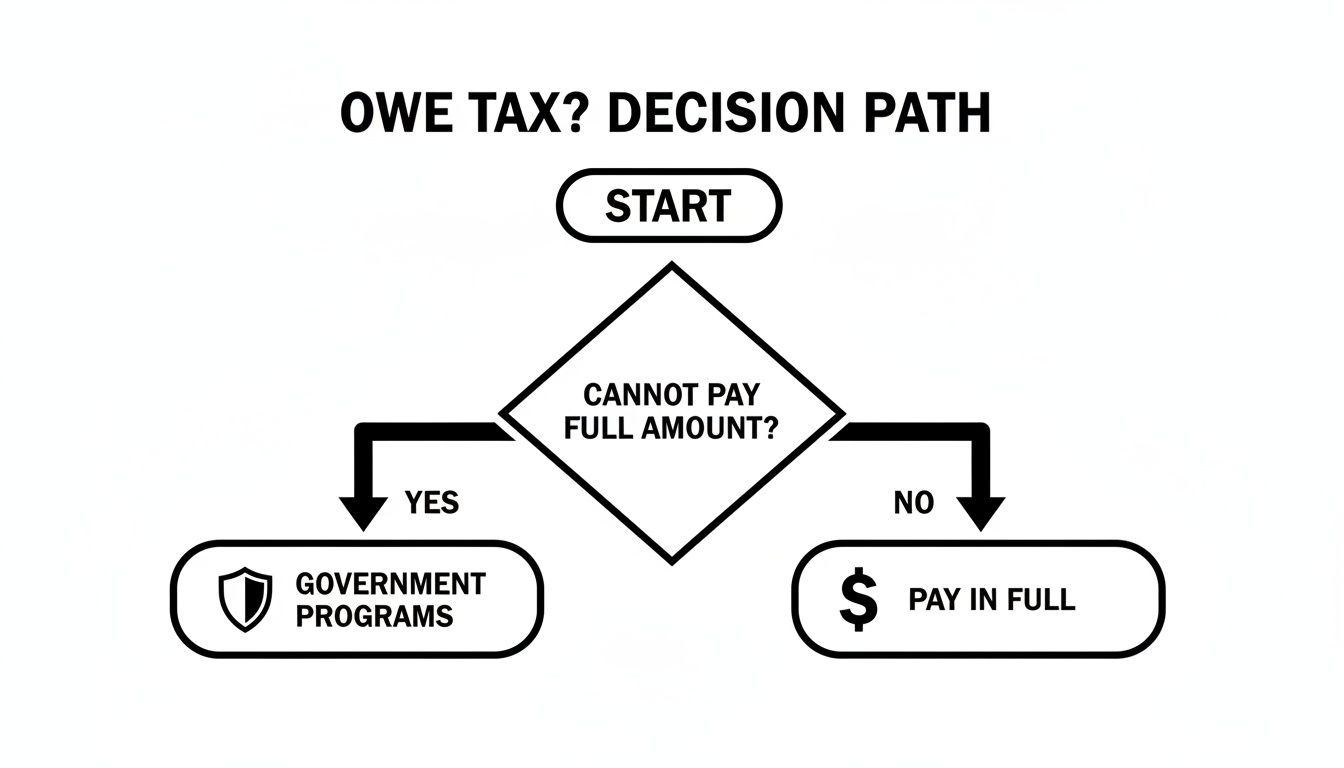
As you can see, being unable to pay right now isn't a dead end. It’s simply a signal that it’s time to explore the established, government-approved solutions available to you.
Offer in Compromise: The Settlement
Think of an Offer in Compromise (OIC) as a formal settlement with the IRS. It’s not all that different from how a credit card company might agree to accept less than your full balance. They know that getting something is far better than getting nothing at all if you’re in serious financial trouble.
This program is specifically for taxpayers facing genuine hardship, who simply cannot pay their tax debt now or in the foreseeable future. The IRS doesn’t just hand these out, though. They’ll take a deep dive into your entire financial life using Form 433-A (OIC) for individuals or Form 433-B (OIC) for businesses, scrutinizing every detail of your income, expenses, and assets to gauge your true ability to pay.
An accepted OIC can be life-changing, letting you settle your tax liability for a fraction of what you originally owed. But the process is notoriously complex, and the IRS has very strict criteria. A successful outcome almost always hinges on presenting a completely thorough and convincing financial picture.
To even be considered, you have to be fully up-to-date on all your tax filings and current tax payments. If your OIC is accepted, you’re on probation, so to speak—you must stay 100% compliant with all tax laws for the next five years, or the IRS can reinstate the original debt in full.
Installment Agreement: The Payment Plan
What if you can pay the full amount, just not all at once? That’s exactly what an Installment Agreement (IA) is for. This is the most common and straightforward path for taxpayers. It’s a lot like financing a car; you take a large, overwhelming sum and break it down into predictable, manageable monthly payments.
The IRS has a few different flavors of payment plans:
- Short-Term Payment Plan: Gives you up to 180 days to pay your balance in full.
- Guaranteed Installment Agreement: If your debt is under $10,000, you’re generally guaranteed approval as long as you meet a few basic conditions.
- Streamlined Installment Agreement: For debts up to $50,000 for individuals (or $25,000 for businesses), this option has a much simpler application process.
- Partial Payment Installment Agreement (PPIA): This is for people who can’t pay the full debt over time but don’t quite qualify for an OIC. A PPIA sets up monthly payments based on what you can realistically afford.
While an IA is a fantastic tool for getting back on track, just remember that interest and penalties keep adding up until the last dollar is paid. Many of these programs are part of the broader IRS Fresh Start Program, which was created to give struggling taxpayers a better chance to resolve their issues.
Currently Not Collectible: The Pause Button
Sometimes, life throws so much at you that paying anything—even a small amount—is simply out of the question. For these situations, there’s Currently Not Collectible (CNC) status. You can think of it as hitting a temporary "pause" button on all IRS collection efforts.
If your financial information clearly shows you can't even cover basic living expenses, let alone a tax payment, the IRS may place your account in CNC status. They’ll immediately stop aggressive collection actions like levying your bank account or garnishing your wages.
It's absolutely critical to understand that CNC is not forgiveness. The debt doesn't go away. In fact, interest and penalties keep piling up. The IRS will also check in on your financial situation periodically to see if your ability to pay has improved. And while collections are paused, a federal tax lien can still remain in place, securing the government's claim against any property you own.
Penalty Abatement and Innocent Spouse Relief
Finally, there are two other important options that apply to very specific circumstances.
First, Penalty Abatement is a request to have the IRS remove penalties from your tax bill. This is often granted if you have a good history of tax compliance but fell behind due to a "reasonable cause." This could be a serious illness, a death in the family, a natural disaster, or another event completely beyond your control.
Second, Innocent Spouse Relief is a crucial protection for people who are unfairly stuck with a tax debt created by their spouse (or ex-spouse) on a joint return. If your partner hid income or claimed bogus deductions without your knowledge, you can apply to be legally separated from that liability. It ensures you aren’t on the hook for someone else’s wrongdoing.
Getting the IRS off your back is a huge relief, but it’s often just half the battle. A lot of folks don't realize that their state tax agency can be just as tough, if not tougher, than the IRS. They have the same arsenal of collection tools—wage garnishments, bank levies, and property liens—and they are not shy about using them.
Putting your head in the sand about state tax debt is a massive mistake. While most states have programs that look a lot like the federal options—think Offers in Compromise or Installment Agreements—that’s where the similarity ends. If you try a one-size-fits-all approach, you're setting yourself up for failure. The rules, who qualifies, and even the core philosophy behind these programs can be wildly different from state to state.
The Myth of Uniformity in State Tax Relief
Assuming your successful IRS strategy will work with your state is like thinking you can use the same currency in every country. Sure, the goal is the same—settling your debt—but the local rules are completely different, and ignoring them will get you nowhere.
Take California’s Franchise Tax Board (FTB), for example. It has its own unique Offer in Compromise program. The way they analyze your finances and their willingness to accept an offer can be a world away from the IRS. It's entirely possible to get a federal OIC approved only to have the FTB turn you down flat, or vice versa, all because of specific state rules and economic factors.
The most dangerous assumption a taxpayer can make is that state tax agencies are simply smaller versions of the IRS. In reality, they are separate entities with their own priorities, budgets, and legal frameworks, making a specialized approach essential for a successful outcome.
This is exactly why you have to dig into your specific state's guidelines. It's the only way to find a real, lasting solution to your entire tax problem.
A Tale of Two States Tax Programs
Let’s look at just how different states can be. New York, for one, is known for being incredibly strict with its OIC program. You often need to prove a case of extreme economic hardship, and they tend to be far less flexible in negotiations than the IRS.
Now, contrast that with other states that might have more forgiving programs. The big takeaway here is that every state revenue department plays by its own rulebook, driven by its own legislative mandates. Some states are laser-focused on squeezing out every last penny, while others are more interested in just getting taxpayers back on the books with flexible payment plans. You can even find helpful state-specific guidance, like this overview explaining that Michigan's back taxes can also be addressed with an Offer in Compromise program, which just goes to show how local these solutions really are.
This patchwork of regulations proves a few critical points:
- Eligibility Isn't Universal: Just because you qualify for an IRS program doesn't mean you'll get the green light from your state.
- Paperwork Is Different: The financial forms and proof your state needs could be completely different from what you sent the IRS.
- Negotiations Are a Whole New Game: A state agency's willingness to cut a deal can hinge on its budget, internal policies, and the specifics of your situation.
At the end of the day, you need a two-front strategy. You need a plan for the IRS and a separate, tailored plan for your state, built around its unique rules. This takes more than just knowing federal tax law; it requires deep knowledge of the specific procedures for your state's tax authority.
Solving Tax Debt for Business Owners
When you're running a business, tax debt is never just about the numbers on a spreadsheet. It can get personal, fast. This is especially true when it comes to payroll taxes, which carry some of the most unforgiving penalties the IRS can levy. For entrepreneurs, partners, and anyone in a leadership role, ignoring this risk isn't just bad business—it's a direct threat to your personal financial security.

This is a massive issue. The global debt settlement market, which includes tax relief services, was valued at $9.83 billion in 2024. It’s expected to balloon to $18.28 billion by 2034, with much of that growth coming from small businesses and self-employed individuals wrestling with complex tax obligations.
The Trust Fund Recovery Penalty Explained
The single most dangerous threat looming over business owners is the Trust Fund Recovery Penalty (TFRP). Here’s how to think about it: the payroll taxes you withhold from an employee's check (Social Security, Medicare, federal income tax) are not, and never were, your money. You are simply holding them in trust for the government.
When a business fails to send these "trust fund" taxes to the IRS, the agency doesn't just go after the company. It pierces the corporate veil. The TFRP gives the IRS the power to hold any "responsible person" personally liable for every penny of that unpaid tax. This means your personal bank accounts, your home, and your other assets are all on the line.
So, who is a "responsible person"? The definition is incredibly broad. It can be:
- Corporate officers and directors
- Partners and LLC members
- A bookkeeper or even an employee with significant financial control
Basically, if you had the authority to decide which bills got paid, you can be held personally accountable. The IRS pursues these cases aggressively because, in their eyes, you didn't just fail to pay a business tax—you failed to turn over your employees' money.
Common Scenarios For LLCs And S-Corps
For S-Corps and LLCs, the line between business and personal finances often gets blurry, making them especially vulnerable. Picture this common scenario: cash flow gets tight. A business owner decides to use the withheld payroll tax money to pay a critical supplier or just to make payroll, fully intending to catch up with the IRS later.
That decision, often made under incredible pressure, is a catastrophic mistake. The penalties are brutal, and because of the TFRP, that tax debt will follow you personally even if the business goes under. It’s a debt that usually can't be discharged in bankruptcy, creating a financial anchor that can weigh you down for years. We've seen this happen countless times, which is why we've put together a guide for navigating payroll tax debt as a business owner.
"The Trust Fund Recovery Penalty is the IRS's most potent weapon against businesses. It transforms a corporate debt into a personal one, and the IRS pursues these cases with extreme prejudice because they see it as recovering employee funds."
This is exactly where an experienced tax attorney becomes indispensable. They can get on the phone with the IRS Revenue Officer assigned to your case, argue that you weren't a "willful" party, or structure a payment agreement that shields both your business and your personal assets. Staying ahead of these issues with smart tax strategies for business owners can also prevent these problems from ever starting.
To help you see how these situations play out, here’s a table outlining some common scenarios and the relief paths we often explore.
Tax Debt Scenarios and Recommended Relief Paths
| Taxpayer Type | Common Scenario | Potential Relief Program |
|---|---|---|
| Business w/ Payroll Debt | Used withheld trust funds to cover operating costs and now faces TFRP. | Installment Agreement for the business; separate negotiation for the TFRP. |
| LLC or S-Corp Owner | Personally assessed for the TFRP after the business closed down. | Offer in Compromise based on personal inability to pay the full amount. |
| Trustee of an Estate | Discovered the decedent had significant unpaid business tax liabilities. | Penalty Abatement for reasonable cause; negotiation to settle the estate's debt. |
Each case is unique, but understanding the general direction is the first step toward finding a resolution. An attorney can help pinpoint the exact strategy that fits your specific circumstances.
The Ripple Effect On Other Professionals
Unresolved business tax debt doesn’t just affect the business owner; it creates major roadblocks for other professionals and their clients. A federal tax lien, for instance, can pop up at the worst possible moment and completely derail a transaction.
Here’s how it creates chaos in different fields:
- Family Law Attorneys: A tax lien slapped on a shared property can bring divorce proceedings to a dead stop. You can't divide assets equitably when the IRS has a primary claim on one of them.
- Bankruptcy Attorneys: While some income taxes might be dischargeable in bankruptcy, trust fund taxes almost never are. A tax expert is needed to carefully dissect the debt and figure out what can and can't be included in the filing.
- Real Estate Professionals: A deal is ready to close, but a title search reveals an IRS lien. That lien must be paid before the property title can be transferred cleanly, leaving realtors and lenders with a stalled transaction.
In all of these situations, bringing in a tax specialist is the only way forward. A tax attorney can work to get the lien subordinated or discharged, negotiate a settlement with the IRS, and provide the legal firepower needed to clear the path. They become the key that unlocks an otherwise frozen transaction, allowing other legal and financial processes to finally move forward.
How to Choose the Right Professional Help
Trying to find reliable help for tax debt can feel like walking through a minefield. The industry is flooded with companies making loud, aggressive promises they simply can't keep. It's so important to know the difference between a high-pressure sales pitch and genuine, expert legal guidance.

Many of the big, national "tax resolution" firms you see on TV run on a volume-based model. To them, you're often just another case number. Their main goal is to get you signed up and collect a massive upfront fee—sometimes thousands of dollars—before they’ve even filed a single piece of paper on your behalf.
Spotting the Red Flags of Predatory Firms
The biggest and most common red flag is a guaranteed outcome. If a company immediately promises to settle your debt for "pennies on the dollar" without doing a deep-dive into your specific financial situation, you should be incredibly skeptical. That's a sales tactic, not a professional assessment.
Be on the lookout for these misleading claims:
- Guaranteed Settlements: No one can guarantee an outcome with the IRS. Period. The success of any tax relief program depends entirely on your unique financial details and the strict guidelines the IRS follows.
- One-Size-Fits-All Solutions: They might push a single program, like an Offer in Compromise, just because it sounds impressive, even when it’s a terrible fit for your actual circumstances.
- High Upfront Fees: Demanding a large payment before they’ve even presented a clear strategy is a huge warning sign. Ethical help always starts with a thorough analysis, not a credit card machine.
A truly professional approach is diagnostic, not presumptive. An experienced attorney acts like a doctor, first running the necessary tests to understand your financial health before ever prescribing a solution. A sales-driven firm tries to sell you the medicine before they even know what’s wrong.
These distinctions are critical. Our guide on what to look for in tax debt relief companies breaks down exactly how to protect yourself in even greater detail.
The Power of a True Financial Analysis
A qualified tax attorney takes a completely different path. The process should always start with a comprehensive, and often free, Tax Debt Analysis. This isn't just a quick phone call; it's an in-depth review of your IRS notices, income, expenses, and assets. The goal is to build a realistic roadmap based on facts, not empty promises.
This initial analysis is where the real value lies. For example, a wealth advisor with a deal frozen by a tax lien or a family law attorney trying to finalize a divorce needs expert intervention. A proper analysis can uncover options like Currently Not Collectible (CNC) status, which can suspend collections entirely for taxpayers facing hardship—a situation that affects millions. Attorneys with over a decade of hands-on IRS controversy experience deliver these kinds of results without demanding huge fees upfront, a stark contrast to the industry giants. You can even explore insights into global debt and hardship on financing.desa.un.org to understand the broader context.
Attorney Access vs. Case Managers
Another major difference is who you actually work with. At those large resolution firms, you're usually handed off to a series of "case managers" who may not have any legal credentials at all. They act as intermediaries, which slows down communication and leaves you without a direct line to the person supposedly making decisions on your case.
Working directly with a tax attorney gives you several crucial advantages:
- Direct Communication: You can actually speak to the expert who is developing the strategy for your case.
- Attorney-Client Privilege: Your conversations are legally protected and completely confidential. This is a protection you don't get with a non-attorney.
- Legal Expertise: An attorney understands the intricate details of tax law and can represent you in all potential legal proceedings, including taking your case to Tax Court if necessary.
Choosing the right professional is the single most important decision you'll make in this entire process. It’s the difference between buying a sales pitch and investing in a sound legal strategy.
What To Do Next
You’ve just learned about the major tax debt relief programs available. That's a huge step. But just knowing about them won't make the IRS or state go away. The only thing that moves the needle is action. It’s time to shake off that feeling of being stuck and start getting your financial life back on track.
Let's be clear: there's no magic bullet or one-size-fits-all solution. The "best" program for you—whether it's an Offer in Compromise, an Installment Agreement, or something else entirely—depends completely on your specific situation. We're talking about your income, assets, and living expenses, all of which determine what you can realistically qualify for. Trying to guess which program fits is a recipe for getting rejected.
Your Immediate Action Plan
The good news? You don't have to figure it all out at once. The first moves are simple. Your job right now is just to get your facts straight so an expert can build a solid strategy for you.
Here’s what you can do today:
- Find All Your Tax Notices: Grab every single letter you've gotten from the IRS or your state's tax department. These papers hold the key details—like which tax years are in question and exactly how much they say you owe.
- Get Your Financials Together: Pull together your most recent pay stubs and bank statements. It’s also a good idea to jot down a quick list of your essential monthly living expenses. This is the raw data needed for any real financial analysis.
The Smart, No-Risk Next Step
Once you have those documents handy, the most logical thing you can do is get a professional to look at your case. This isn't about a sales pitch or locking you into a contract. Think of it as a diagnostic—a way to get a clear picture of what's going on.
A professional Tax Debt Analysis gives you a confidential look at the specific relief options you actually have a chance of qualifying for. It’s designed to give you a clear path forward and show you that there really is a light at the end of the tunnel, all without any cost or obligation.
Taking this one step moves you from worrying to problem-solving. You’ll finally understand exactly where you stand and what it’s going to take to put this all behind you. The journey to resolving your tax debt doesn't start with some massive, intimidating decision. It starts with this one small, manageable action.
Your Top Tax Debt Questions, Answered
When you're facing tax debt, questions and worries can pile up fast. Getting clear, honest answers is the first step toward taking back control of your finances. Let's tackle some of the most common questions I hear from clients every day.
The goal here isn't to give you jargon, but real-world answers so you can understand what to expect and move forward with confidence.
Can I Get Help If I Haven't Filed My Taxes?
This is probably the most common question I get, and the answer is a hard no. Before the IRS or any state tax agency will even look at a relief application, you have to be in full compliance. That means every single overdue tax return must be filed.
It's a non-negotiable first step. I know it can feel overwhelming, especially if years have gone by and records are a mess. But this is exactly where a tax attorney can step in—we can help reconstruct your financial history and get those returns filed, clearing the path to start negotiating a solution.
Will Applying for a Program Stop the IRS from Coming After Me?
For the most part, yes. This is one of the biggest immediate benefits of formally seeking help. Once you submit a legitimate application for an Offer in Compromise or an Installment Agreement, the IRS typically has to hit pause on its most aggressive collection tactics. That means bank levies and wage garnishments usually stop while your case is under review.
Keep in mind, they might still file a Notice of Federal Tax Lien to protect their claim on your property. This is why moving quickly is so important—it puts a crucial shield in place, giving you the breathing room needed to work out a permanent solution without your assets being seized.
"A common misconception is that tax relief is just about settling for less. In reality, it's a formal, legal process where initiating a program application provides a critical shield against the IRS's most aggressive collection tactics, giving you the breathing room needed to negotiate a viable resolution."
This temporary halt is a powerful tool when you use tax debt relief programs correctly.
How Long Does This Whole Process Take?
There's no one-size-fits-all answer here; the timeline really depends on which program you're using and how complex your financial picture is.
Here’s a rough idea of what you might be looking at:
- Simple Installment Agreement: If you qualify for a streamlined plan, this can sometimes be set up in a matter of weeks.
- Complex Offer in Compromise (OIC): An OIC is a much deeper dive. From the day you send in the application, expect the IRS to take anywhere from 6 to 12 months (and sometimes longer) to dig into your finances and give you a final yes or no.
A good tax attorney can look at your specific situation and give you a much more accurate timeline from the get-go.
What’s the Difference Between a Tax Attorney and One of Those Big "Tax Resolution" Companies?
Choosing who represents you is one of the most important decisions you'll make. A licensed tax attorney is a legal professional who not only knows tax law inside and out but can also represent you in U.S. Tax Court if it comes to that. You'll work directly with the attorney, and everything you discuss is protected by attorney-client privilege.
On the other hand, many of those large national firms you see on TV are essentially sales operations. Their priority is often to get a big upfront fee from you, sometimes before they've even determined if they can actually help. An ethical attorney works differently—they start with a thorough financial analysis, often at no charge, to figure out which solution is genuinely right for you.
Ready to stop worrying and start solving? Attorney Stephen A. Weisberg offers a free, no-obligation Tax Debt Analysis to give you a clear understanding of your options. Get the expert guidance you need today.


