File a Tax Court Petition: 2026 Expert Guide
Learn to file a tax court petition with clear steps on eligibility, deadlines, drafting, filing, fees, ADR, trial, and appeals in this 2026 guide.
In this article
- The Role and Importance of a Tax Court Petition
- Why the petition matters more than most taxpayers realize
- What the digital shift changes
- Eligibility Requirements and Deadline Management
- Start with the notice, not with the complaint
- Know where deadline arguments are changing
- Drafting the Petition and Gathering Attachments
- Draft the facts like a litigation record
- Attachments should be curated, not dumped
- Protect identification data the right way
- Filing Procedures with Form 2 and Pro Se Filers
- File through DAWSON with discipline
- Pro se filers need a stricter checklist
- Fees Service and Waiver Options
- Pay the fee or request the waiver cleanly
- Service is a procedural step, not an afterthought
- Early Proceedings Settlement and ADR Paths
- Use the petition to strengthen your settlement position
- ADR works best when the record is clean and the issue is narrow
- Trial Preparation Appeals and Final Checklist
- Build trial materials like the judge has no time to spare
- Appeal planning starts before the hearing ends
You're staring at a letter that can change the whole case, and the clock is already running. The IRS has put a number on the page, a deadline is in motion, and waiting for the next notice is how taxpayers lose options they thought they still had. A tax court petition is the move that keeps the dispute alive in the one forum where you can challenge the deficiency before paying it, so the filing has to be deliberate, fast, and clean.
The Role and Importance of a Tax Court Petition
A Tax Court petition is the document that starts your case in the U.S. Tax Court. It is not a formality. It is the jurisdictional filing that tells the Court you are contesting the IRS determination and asking for judicial review before assessment or collection puts you in a worse position.
That filing sits at the center of real tax controversy practice, not at the margins. The Tax Court received 33,300 petitions from January 1 through November 30, 2021, and about 20% were filed electronically, with electronic filing rising from 30% in October to 36% in November after DAWSON launched on December 28, 2020 (U.S. Tax Court press data). The Court's press data also showed 29,002 cases filed in FY 2022, including 19,468 paper petitions and 9,534 electronic petitions, which shows how quickly filing behavior shifted in a short period.
Why the petition matters more than most taxpayers realize
The petition frames the case before the IRS answers it. That framing matters because later steps are narrower, more procedural, and less forgiving. If the petition is sloppy, you hand the IRS easy defenses and weaken your own record.
Practical rule: file a petition as if the Court will read it first, because it will.
The strongest petition stays focused. It identifies the notice being challenged, the tax periods at issue, and the relief you want, without wandering into side arguments that only distract from the core dispute. When taxpayers try to argue everything at once, they often dilute the strongest points and make the case harder to settle.
What the digital shift changes
DAWSON changed the filing culture. Electronic filing makes speed easier, but it also makes careless duplication and document mistakes more visible. The Court's own materials show that the petition process is no longer a paper-first system, and taxpayers who still treat it that way are already behind.
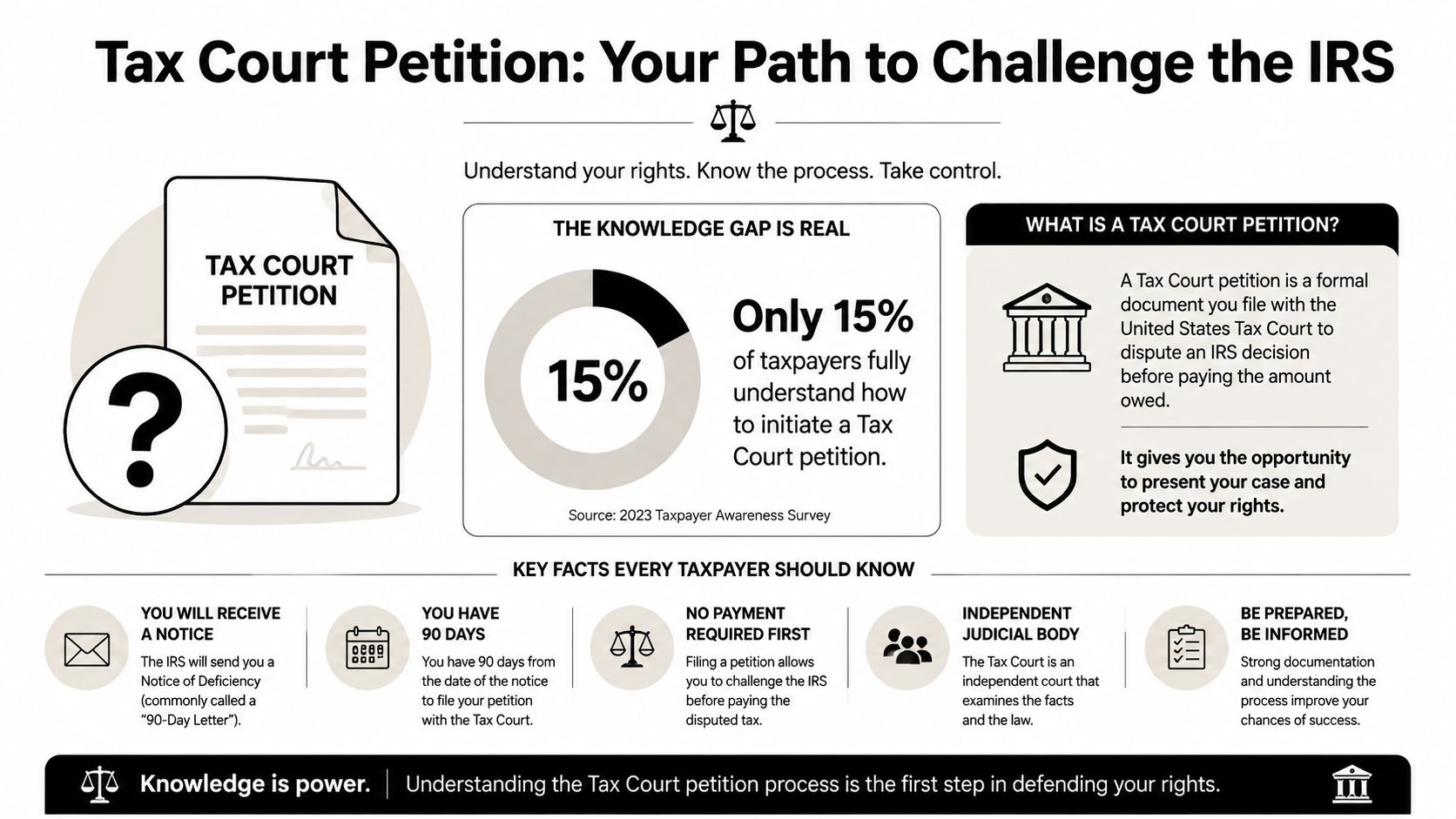
A petition should read like a document built for a judge, not a complaint drafted in panic. Use the right notice, keep the scope tight, and make the filing clean enough that the Court can understand the dispute without extra explanation. That is how you preserve tactical advantage from the start.
For a plain-language explanation of what triggers the filing deadline, review this guide to IRS Notices of Deficiency before you draft anything.
Eligibility Requirements and Deadline Management
A lot of taxpayers think eligibility is just a question of whether they disagree with the IRS. It is tighter than that. You need a qualifying notice, the right type of dispute, and a filing date that fits the statutory window. If any one of those pieces is wrong, the Court can shut the door before the merits are ever discussed.
The standard deficiency case gives you 90 days after the IRS mails a Notice of Deficiency, or 150 days if the notice is addressed to a person outside the United States (U.S. Tax Court petitioners start page). Missing that deadline generally forfeits Tax Court review of the deficiency notice. For a taxpayer who wants prepayment review, that is the line that matters most.
Start with the notice, not with the complaint
The date on the Notice of Deficiency controls the calendar. Don't guess, and don't rely on memory. Read the notice, confirm the mailing date, and calculate the deadline from that mailing date, not from when the letter happened to show up in your hands.
If you want a clean explanation of what a Notice of Deficiency is and how it drives the filing deadline, use this IRS Notice of Deficiency guide before you do anything else. That document is the trigger point. Treat it that way.
Know where deadline arguments are changing
The old habit was to treat all Tax Court deadlines as rigid and untouchable. That is too simplistic now. The Supreme Court's Boechler decision held that the 30-day deadline for Collection Due Process petitions is a nonjurisdictional deadline subject to equitable tolling (Supreme Court opinion). That does not erase the deficiency deadline, but it does mean deadline issues deserve real legal analysis instead of reflexive assumptions.
A late filing is not a strategy. If you are inside the window, file. If you are outside it, assume you need a separate legal theory and document it immediately.
That distinction matters because deficiency petitions and CDP petitions are not interchangeable. The paperwork may look similar from the outside, but the jurisdictional stakes are different. Read the notice, identify the petition type, and don't let a deadline issue get buried under general tax stress.
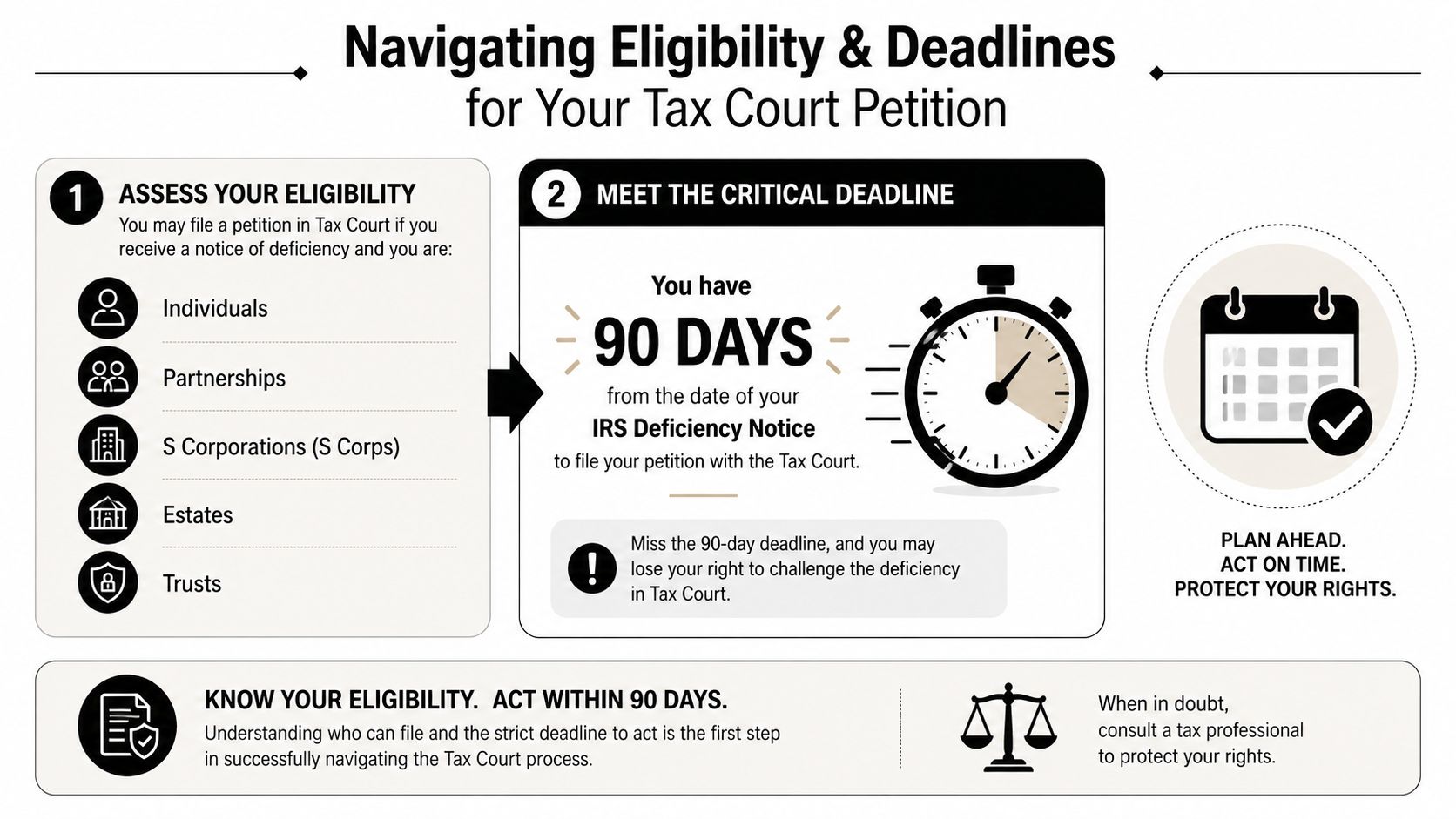
The rule is blunt. If the deadline is live, protect it first and argue later. If you need help deciding whether your notice supports a petition, get that review done immediately instead of trying to improvise after the deadline has passed.
Drafting the Petition and Gathering Attachments
The petition is not the place for a long personal history. It needs to tell the Court what happened, what notice you received, what tax years are at issue, and what you want the Court to do. Everything else is noise unless it helps prove jurisdiction or narrow the dispute.
A strong petition includes the basics the Court expects, then stops. It identifies the parties, references the Notice of Deficiency or other challenged determination, states the tax periods, and asks for redetermination or other specific relief. If you're representing yourself, write for the judge, not for the IRS examiner who already made up their mind.
Draft the facts like a litigation record
The best petition reads like the first page of a case file. Start with the notice, not with emotional commentary. State the relevant tax periods, the IRS action, and your position on the disputed adjustment in plain English.
Use short, exact statements where possible. For example, say the IRS mailed a Notice of Deficiency for the identified tax year, that you disagree with the proposed deficiency, and that you request redetermination. If there is a procedural issue, such as a mailing problem or an incorrect address, say so cleanly and attach proof.
Attachments should be curated, not dumped
Many taxpayers commonly make the same mistake. They upload every file they own and hope volume will substitute for organization. It won't. The Court needs the notice, proof of filing support, and the documents that prove the factual point you are making.
If your source file discipline is weak, tighten it before you file. A practical guide to managing accounting source documents is useful because the same discipline applies here. Put the notice, mailing proof, correspondence, and any redacted identification materials into a clean order so the Court can follow the record without hunting.
Protect identification data the right way
The Court's workflow requires a separate sealed Statement of Taxpayer Identification Number, so the SSN or TIN is not put into the public record (U.S. Tax Court petitioners start page). That is not optional cleanup. It is part of filing correctly and protecting sensitive information from the start.
Practical rule: if a document supports the petition, attach it. If it doesn't, leave it out. Overpacking the file makes weak petitions look worse, not stronger.
A good petition also anticipates the answer. The IRS will often challenge jurisdiction, timeliness, or the factual framing. Draft so the petition can survive that pressure without needing a second rewrite after the Court docket is opened. The point is not to impress. The point is to make the dispute readable, provable, and hard to dismiss.
Filing Procedures with Form 2 and Pro Se Filers
A petition fails at the filing stage for simple reasons, and those mistakes are usually avoidable. People submit the wrong version, leave out the sealed identification statement, or file twice because they are unsure which path the Court accepts. DAWSON reduces the friction, but it does not rescue a sloppy submission.
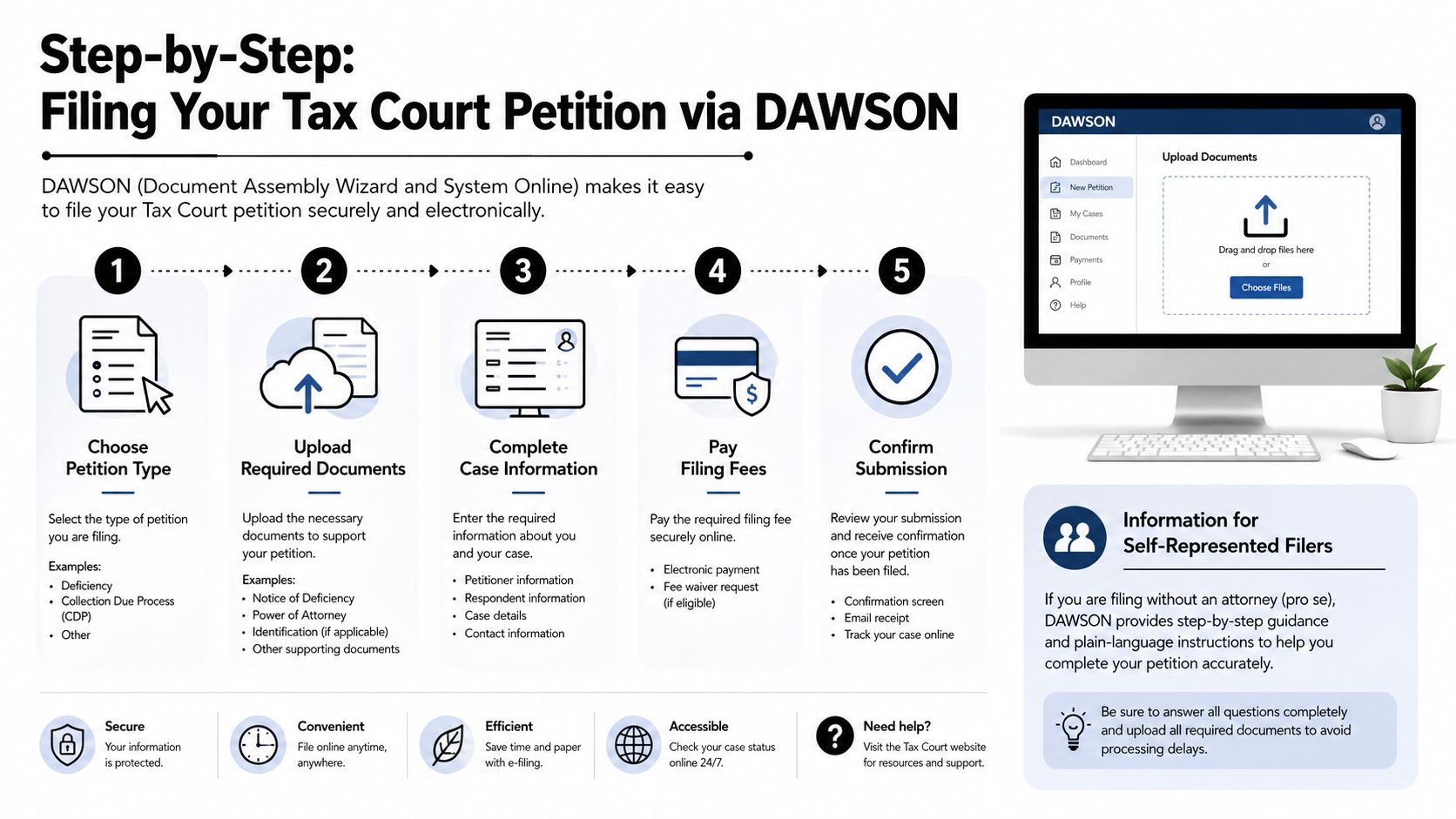
The Court's eFile workflow breaks the petition process into seven steps, including choosing the petition type, uploading the notice, selecting small tax case or regular case, and filing a separate sealed SSN or TIN statement (A five-step infographic showing how to file a tax court petition electronically using the DAWSON system online.). The eFile filing fee is $60. Those are the checkpoints that matter. Miss one, and you create a problem the Court does not need to solve for you.
File through DAWSON with discipline
Start with the correct petition type. If the notice is a deficiency notice, the filing has to match that posture from the start. Upload the notice, the petition package, and the case information exactly as they appear on the official papers.
Do not treat the system as a filing bin. A missing notice upload, the wrong case selection, or a mismatched taxpayer name can force a cleanup that burns time you do not have. The sealed identification statement also belongs in its own place, separate from the main petition file, because mixing it into the public packet is the wrong move.
Pro se filers need a stricter checklist
Self-represented taxpayers should use the same filing discipline a tax lawyer would use on a client matter. If the petition is unclear, the Court will not rebuild it for you. Docket staff can process papers, but they will not fix bad judgment or guess at missing facts.
If you are still deciding whether to file on your own, read when to hire a tax attorney before you commit. That decision matters most when the case involves tight deadlines, multiple tax years, or identification issues that need careful handling.
File once only. Filing both electronically and by mail creates avoidable processing problems and can slow the docket.
That warning is practical, not theoretical. Choose one filing path and finish it. If you mail the petition, the packet has to be complete and sent to the correct Court address. If you e-file, confirm the upload, the docket number, and the fee or fee-waiver status before you stop checking the file.
A clean filing is the goal. Once the petition is accepted, the focus shifts to building the record that will control the case.
Fees Service and Waiver Options
The filing fee is small compared with the tax dispute, but it still matters because fee problems can slow the filing process or create a docket issue that should never exist. If you need the waiver, request it through the Court's required process and do not assume silence in your petition will tell the Court you cannot pay. Fee handling should be deliberate from the start.
Pay the fee or request the waiver cleanly
If you can pay, submit the fee with the filing. If you cannot, request the waiver in the form the Court requires. Do not improvise with a separate explanation buried in the petition unless the instructions specifically allow that approach. A clerk reviewing the filing should be able to see the payment choice immediately.
The point is straightforward. A fee issue should never be the reason a timely petition turns into an administrative mess. Keep the payment decision aligned with your filing path, and document the request if you need relief.
Service is a procedural step, not an afterthought
Service matters because the IRS needs formal notice of the petition, and the Court needs proof that the petition moved through the correct channel. A petition that reaches the wrong place, or lacks proof of service where required, invites delay and argument that could have been avoided. That kind of mistake can turn a defensible case into a paperwork fight.
Keep your proof of service with the filing packet and your records. If you mailed the petition, save the mailing proof. If you e-filed, keep the confirmation page and docket information. You want a clean trail from the moment you submit the petition to the moment the case is opened.
Practical rule: never treat service as ceremonial. If you cannot prove what you sent and when you sent it, you are inviting a fight you did not need.
The fee and service issues sound minor until they are not. Handle them as if they matter, because they do. A tidy filing record reduces the chance that the IRS or the Court focuses on avoidable procedural defects before it ever reaches the tax issue.
If the IRS starts pressing for settlement early, use the process deliberately. The article on mastering Office of Appeals strategy explains why organized presentation matters once the case leaves the filing stage.
Early Proceedings Settlement and ADR Paths
A petition is not a trial script. It is the document that sets the IRS up to assess the case, narrow the issues, and decide whether it should settle or fight. If you draft it with that in mind, you give yourself room to resolve the dispute without spending months cleaning up avoidable confusion.
The settlement reality in Tax Court is straightforward. In FY 2024, the Tax Court had 16,117 petitions filed and 23,280 cases closed, with over 99% ending without a trial on the merits; Taxpayer Advocate data also shows that around 80% settle and only 1% to 2% proceed to full trial (Taxpayer Advocate Service FY 2024 materials). That means the petition should be written for resolution, not for theater. Clear facts, tight issue framing, and disciplined attachments make settlement discussions more productive from the start.
Use the petition to strengthen your settlement position
The IRS typically files its answer in about 60 days (JH Tax Law overview). Once that happens, the case moves into the part that matters most for many taxpayers, the IRS is deciding how seriously it should defend the adjustment and how much room exists to compromise. A petition that states the dispute cleanly gives the government less room to overstate the issue or hide behind vague readings of your facts.
That is why the opening framing matters. If your petition identifies the exact adjustment, the taxpayer's position, and the core facts without clutter, you make it easier to get the case into a settlement track. If the petition is loose or argumentative, the IRS has more room to stall, and you spend the next phase correcting preventable drafting mistakes instead of discussing the merits.
Appeals is the first serious settlement route for many taxpayers. It gives both sides a structured way to resolve the case without trial, and it works best when you present the dispute in a way Appeals can evaluate quickly. For a practical approach to that process, see how to work the IRS Office of Appeals.
ADR works best when the record is clean and the issue is narrow
Alternative dispute resolution is most useful when both sides already know what the fight is about. If the core issue is narrow and the documents are organized, ADR can move the case faster than a round of back-and-forth negotiation. It is not a fix for a messy file, and it is not a shortcut around missing proof.
Use ADR only after you have cleaned up the record. If the file needs basic document reconstruction, do that first, because a bad record weakens every settlement discussion that follows. The petition should help define the dispute tightly enough that the ADR conversation stays focused on the core issue, not on avoidable gaps in the papers.
The lesson is simple. Draft the petition so it supports settlement, not wishful thinking about trial. If you get the framing right, you improve your odds of resolving the case on paper before anyone starts posturing in court.
Trial Preparation Appeals and Final Checklist
If settlement falls apart, the case turns on proof. At that point, taxpayers find out whether the petition and early filings were built for litigation or just for getting a docket number. The Tax Court wants a clean record, organized exhibits, and a witness who can answer questions without wandering into side issues.
Treat the hearing like a short, controlled presentation. A practical tax court petition guide should already have told you to expect a fast-moving process, so prepare documents that can be handed up without sorting, a witness story that stays on the issue, and records that make sense in a brief hearing. For a useful overview of how those disputes are handled after the IRS response, review how to appeal an IRS decision.
Build trial materials like the judge has no time to spare
Put exhibits in the order you plan to use them. Keep the originals ready and bring the required copies, because a missing copy can slow the hearing or weaken a point you should have made cleanly. Do not count on the IRS to fill gaps in your file or correct sloppy organization.
Witness prep needs discipline. Tell the witness to answer the question asked, then stop. A hearing is not the place for a long narrative about every tax issue that came up over the year, and extra details usually hand control of the record to the other side.
Also check the small procedural details that get ignored until they cause trouble. Make sure names match across the petition, the notices, and the exhibits. If you are filing pro se, keep your papers consistent and readable, because the Court will not clean up filing mistakes for you.
Appeal planning starts before the hearing ends
If the case goes badly, your appeal position depends on the record you built before and during the hearing. Start thinking about that before the hearing begins, not after the decision arrives. The strongest appellate posture comes from a clean record, which means objections, exhibits, and any factual stipulations have to be handled with care from the outset.
Practical rule: appellate courts review what is in the record. If you never made the point below, you usually cannot repair that mistake later.
Here is the checklist taxpayers should follow, in order:
- Confirm the notice date immediately. The mailing date controls the deadline, so calculate it before doing anything else.
- Identify the petition type. A deficiency case, a CDP case, and another procedural posture do not use the same approach.
- Draft a narrow petition. State the tax periods, identify the notice being challenged, and say exactly what relief you want.
- Collect the core documents. Keep the notice, proof of mailing or filing, and supporting records together.
- Protect identification data. Use the sealed SSN or TIN statement required by the Court.
- Choose one filing method. File electronically or by mail, not both.
- Confirm receipt and docketing. Save the confirmation, docket number, and payment or waiver record.
- Prepare for the answer and settlement phase. Expect the IRS response and be ready to discuss resolution.
- Organize trial evidence early. Bring originals, two copies, and a clean exhibit list if the case moves forward.
- Preserve the record for appeal. Object clearly, document everything, and keep every filing notice.
A tax court petition is the first serious decision in the case, and it deserves lawyer-level attention from the moment the notice arrives. If you want a disciplined review of your deadline, your petition draft, or your next move after the IRS notice, visit Tax Attorney Stephen A Weisberg and get the file reviewed before a procedural mistake takes the choice away.


