Tax Audit Lawyers Protecting You When Facing the IRS
Facing an IRS audit? Our guide explains when you need tax audit lawyers, what they do, and how they protect your assets. Navigate your audit with confidence.

In this article
- Why You Need a Legal Shield for an IRS Audit
- A Specialist for a Specialized Problem
- Protecting Your Rights from Day One
- When You Absolutely Need a Tax Audit Lawyer
- A Notice of Deficiency Arrives in the Mail
- IRS Criminal Investigation Comes Knocking
- You're Facing a Trust Fund Recovery Penalty
- The Audit Involves Multiple Years or a High Tax Bill
- Navigating the IRS Audit Process Step by Step
- Understanding the Three Main Types of Audits
- The Examination and Information Document Request
- The Appeals Process and When to Fight Back
- Escalation to U.S. Tax Court
- How Tax Lawyers and CPAs Form Your Defense Team
- Clarifying the Roles for Maximum Impact
- The Lawyer's Role as the Strategic Lead
- How Attorney-Client Privilege Protects You
- Proven Strategies for a Favorable Audit Outcome
- Argue for Penalty Abatement with Reasonable Cause
- Negotiate Manageable IRS Payment Plans
- Settle for Less with an Offer in Compromise
- Understanding the Spectrum of Audit Outcomes
- How to Choose the Right Tax Audit Lawyer for You
- Key Questions for Your Consultation
- Red Flags to Watch Out For
- Frequently Asked Questions About Tax Audits
- How Much Does a Tax Audit Lawyer Cost?
- Can I Represent Myself in an IRS Audit?
- What's the Difference Between a Tax Lawyer and an EA?
Tax audit lawyers are a specific type of attorney who steps in to represent and defend people and businesses during an IRS or state tax audit. Their entire job is to provide critical legal protection and strategic guidance. They take over all the stressful communication with tax authorities and make sure your rights are protected from start to finish.
Why You Need a Legal Shield for an IRS Audit

Getting that audit notice in the mail is an incredibly stressful experience. It immediately puts you on the defensive. In a high-stakes situation like this, a tax audit lawyer isn't just an advisor; they're your dedicated legal advocate—your shield.
Here’s a good way to think about it: your CPA is like your trusted family doctor. They know your financial history inside and out. But if you suddenly develop a complex heart condition, you’re going to need a cardiac surgeon.
A serious legal challenge from the IRS, an agency with immense power, requires a specialist. That’s exactly where a tax audit lawyer comes in.
A Specialist for a Specialized Problem
Unlike other financial professionals, a lawyer's main job is to interpret complex tax law, handle legal procedures, and fight for you. They know the intricate rules of evidence and procedure that control audits, negotiations, and even court cases.
This is especially important because anything you say to an IRS agent can be held against you. A lawyer manages every single conversation, making sure your words don't accidentally create new problems.
A tax audit lawyer’s core function is to control the flow of information, protect your legal rights under the law, and build a strategic defense aimed at the best possible resolution, whether that's a 'no change' audit or a favorable settlement.
Protecting Your Rights from Day One
From the moment you bring them on board, a tax audit lawyer creates a protective barrier between you and the auditor.
Here’s what they typically handle right away:
- Taking over all IRS communications to prevent you from making a costly misstep and to keep the audit from expanding.
- Analyzing your tax returns and documents to get ahead of the auditor’s questions and find potential weak spots.
- Preparing for a potential fight in U.S. Tax Court if the IRS won't agree to a fair outcome.
A key part of their expertise is drilling down into the legal details, like understanding the legal bindingness of electronic signatures on documents. This kind of deep legal oversight is what sets them apart. If you're looking for someone to handle the process, learning about the role of an IRS audit representative is a great place to start.
With the government ramping up enforcement, the need for this kind of specialized legal help is on the rise. Law firms that focus on tax controversies have seen demand spike, with midsize firms reporting a 6.1% increase driven by these complex disputes. It's a clear sign that taxpayers are recognizing the value of expert legal protection when they have to face the IRS.
When You Absolutely Need a Tax Audit Lawyer
Most tax issues are manageable with the right help. But some situations aren't just about the numbers anymore—they've crossed over into serious legal territory. Knowing how to spot these red flags can be the difference between a manageable outcome and a financial catastrophe.

Think of it this way: your CPA is like your trusted family doctor, great for regular check-ups and common ailments. A tax audit lawyer is the specialist you need when the diagnosis looks severe. Here are the clear signs it's time to bring in that legal specialist.
A Notice of Deficiency Arrives in the Mail
When a Statutory Notice of Deficiency lands in your mailbox, the clock starts ticking. Often called a "90-day letter," this isn't just another inquiry from the IRS. It's their final, formal declaration that they believe you owe more taxes, and it officially kicks off a 90-day countdown.
If you don't file a petition with the U.S. Tax Court within that tight window, you lose your right to challenge the assessment before paying up. The IRS will move forward with collecting the debt, full stop. A tax audit lawyer is critical at this stage to file a legally sound petition and protect your day in court.
IRS Criminal Investigation Comes Knocking
The moment a Special Agent from IRS Criminal Investigation (CI) contacts you, the entire situation has changed. These aren't your typical civil auditors; they are federal law enforcement officers building a case for potential tax crimes, like fraud or evasion.
Anything you say can and will be used against you. Trying to talk your way out of it is a massive, unforced error. You need a lawyer to step in immediately, handle all communications, and safeguard your constitutional rights.
The involvement of IRS Criminal Investigation means the government is building a case that could lead to severe penalties, including steep fines and even prison time. This is the single most critical red flag that requires immediate legal intervention.
You're Facing a Trust Fund Recovery Penalty
For business owners, the Trust Fund Recovery Penalty (TFRP) is a nightmare scenario. This penalty hits when a business fails to hand over the payroll taxes it withheld from employee paychecks—think Social Security and federal income taxes.
The IRS has the power to hold any "responsible person" personally liable for that debt. That could be you as the owner, but it could also be a manager, a bookkeeper, or even a board member. The TFRP pierces the corporate veil, putting your personal home, savings, and assets on the line. A tax audit lawyer is essential to fight the "responsible person" label and find a way out.
The Audit Involves Multiple Years or a High Tax Bill
If an audit stretches across several tax years or involves a significant amount of money (usually over $50,000), the complexity and the risk skyrocket. A multi-year audit is a sign that the IRS suspects a consistent pattern of problems, not just a one-off mistake.
These cases are a tangled web of records, documentation, and potentially cascading penalties. A tax audit lawyer knows how to manage the massive document requests, construct a unified defense across all the years in question, and negotiate a global settlement that resolves everything at once. Facing this alone is a recipe for a devastating financial blow.
Navigating the IRS Audit Process Step by Step
Getting an audit notice from the IRS can feel like you've been dropped into a maze without a map. Every turn brings a new question, and a wrong move can have serious financial consequences. Think of this section as your map, breaking down each stage so you know exactly what’s coming.
The whole thing kicks off with a letter in the mail. This isn't just junk mail; it's your first real clue about the scope and intensity of the audit. Understanding the type of audit you're facing is the first step in building a solid defense.
Understanding the Three Main Types of Audits
Not all audits are created equal. The way the IRS chooses to conduct its examination says a lot about how seriously they're taking your case and the level of scrutiny you're under. A good tax audit lawyer can tell what's what right away and tailors the strategy from day one.
- Correspondence Audit: This is the most common and, thankfully, the least invasive. It’s all handled through the mail and usually zeroes in on a few specific items on your tax return, like itemized deductions or dependents. It might seem straightforward, but a poorly handled response can easily turn a small inquiry into a much bigger problem.
- Office Audit: This one is a step up. It requires you or your representative to meet an agent at a local IRS office. The agent will have a specific list of items they want to dig into, and you'll need to show up with all your supporting documents. This is more serious than a mail-in audit and demands careful preparation.
- Field Audit: This is the big one—the most comprehensive and serious type of audit. An IRS agent comes to you: your home, your business, or your accountant's office. This gives them a chance to do a broad review of all your books and records, which usually means they suspect more significant issues are at play.
No matter the type, your tax audit lawyer steps in and takes over all communication. This is key. It ensures the auditor gets only the necessary information, presented in a legally sound way. It stops you from accidentally saying something that could complicate your case and helps you understand the red flags that may have triggered the audit in the first place. You can discover more about what might have caught the IRS's attention by reading our guide on what triggers a tax audit.
The Examination and Information Document Request
Once the audit is underway, the main event is the Information Document Request (IDR). This is the IRS's formal shopping list for documents, records, and explanations to back up what you reported on your tax return. An auditor might ask for anything from bank statements and receipts to contracts and mileage logs.
Think of the IDR like a discovery request in a legal case. How you respond is absolutely critical. Give them too little, and you look suspicious. Give them too much, and you might accidentally open up entirely new lines of questioning.
A tax audit lawyer meticulously reviews every single IDR. They make sure the requests are reasonable and legally within the audit's scope. They then gather and organize the documents, presenting them in a way that directly answers the auditor's questions without volunteering a scrap of extra information. This controlled, deliberate approach is fundamental to keeping the audit contained.
This examination phase is also where the real back-and-forth begins. Your lawyer will defend your tax positions, armed with the relevant tax code and case law to support your deductions and income. The goal is to resolve any disagreements directly with the auditor and, ideally, walk away with a "no change" letter—the IRS's way of saying they accept your return as filed.
The Appeals Process and When to Fight Back
What happens if you and the auditor just can't agree on the proposed changes? This isn't the end of the road. The IRS will issue a formal report with their findings, but you have the right to appeal the decision internally with the IRS Office of Appeals.
This is a crucial strategic move. The appeals process takes your case away from the auditor and puts it in front of an impartial appeals officer whose entire job is to resolve disputes without going to court. An experienced tax audit lawyer will prepare a formal protest letter that lays out the legal arguments against the auditor's position. This gives you a fresh opportunity to negotiate a settlement, often on much better terms.
Escalation to U.S. Tax Court
If a settlement can't be reached during the examination or through appeals, the final option is to petition the U.S. Tax Court. This shifts your dispute from an internal IRS process to a formal legal battle. It's a major escalation that requires highly specialized legal skill.
The stakes here are incredibly high. In fiscal year 2023 alone, the U.S. Tax Court took on 22,211 new cases, with disputes totaling around $8.5 billion. As Chambers and Partners highlights in its tax controversy trends, judges are handling a massive caseload. Without a perfectly prepared legal strategy, your case could easily get lost in the shuffle. At this point, having a tax audit lawyer isn't just a good idea—it's an absolute necessity.
How Tax Lawyers and CPAs Form Your Defense Team
A lot of people think that hiring a tax audit lawyer means sidelining their trusted CPA. That’s a common misconception. The reality is much more powerful. You’re not making a substitution; you're building a strategic alliance—a robust defense team where each person plays a critical and distinct role.
Think of it like putting together an elite medical team. Your CPA is the family doctor who knows your entire financial history, from annual check-ups to minor bumps and bruises. The tax lawyer is the specialist surgeon, brought in when a high-stakes procedure is needed to protect your long-term health.
This collaborative approach ensures your defense is built on two solid pillars: deep financial insight from your CPA and sharp legal strategy from your lawyer.
Clarifying the Roles for Maximum Impact
When you're facing the IRS, any confusion over who does what can become a serious weakness. A well-defined partnership between your CPA and tax lawyer closes that gap, creating a streamlined, efficient defense where everyone's strengths are put to good use. The roles are complementary, not conflicting.
Your CPA is the master of the numbers and your financial history:
- Providing Financial Data: They hold the keys to your financial kingdom and can quickly pull together the documents, statements, and ledgers the IRS is asking for.
- Explaining Accounting Methods: They can expertly explain why certain accounting methods were used, giving crucial historical context to your tax filings.
- Supporting the Legal Strategy: The CPA’s work provides the factual bedrock upon which your lawyer builds the legal arguments.
Meanwhile, your tax lawyer takes the lead on the legal and strategic front, making sure every move is protected.
The Lawyer's Role as the Strategic Lead
Once a lawyer is on board, they become the central command for your audit defense. They direct the overall strategy, handle every interaction with the government, and shield you from direct questioning by IRS agents. This is where their unique legal authority is absolutely essential.
A tax audit lawyer is responsible for:
- Building the Legal Case: They dive into complex tax law, research legal precedents, and frame your financial data within a legally sound argument.
- Protecting All Communications: Their involvement provides a powerful legal shield known as attorney-client privilege over every conversation and document related to your audit. This privilege doesn't apply to accountants in the same way, making it a game-changing strategic advantage.
- Serving as the Single Point of Contact: Your lawyer manages all communication with the IRS. This prevents accidental missteps and ensures the audit stays confined to its original scope, without expanding into other areas.
This flow chart shows the simplified journey through an audit, highlighting the key stages where your defense team is most crucial.
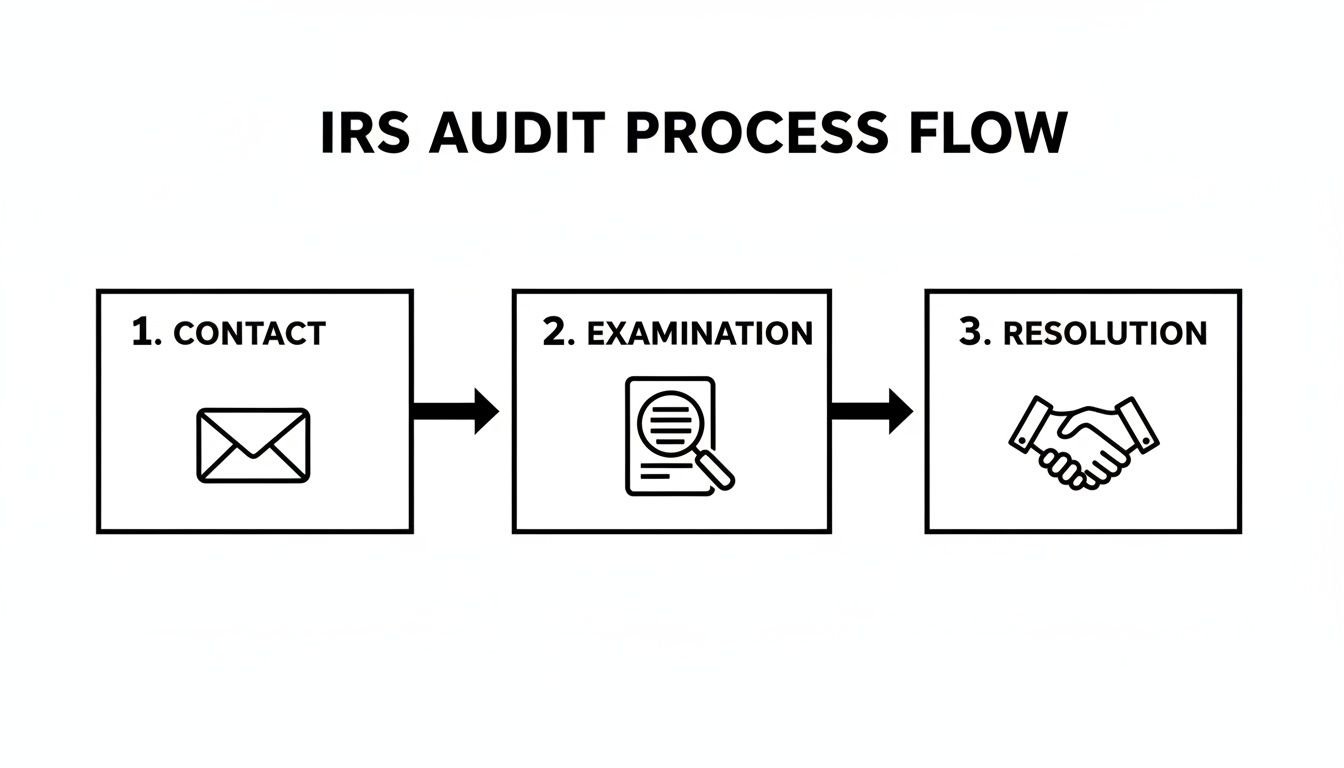
This visual helps show how a controlled process, managed by a legal pro, moves methodically from the initial notice to a final resolution.
How Attorney-Client Privilege Protects You
Without a doubt, the single most important benefit of bringing a tax lawyer onto your team is attorney-client privilege. This is a legal doctrine guaranteeing that your communications with your lawyer for the purpose of getting legal advice are confidential. This protection is absolute—and it’s something an accountant simply cannot offer.
Why is this such a big deal? It means you can have completely open and honest discussions about your tax situation without the fear that your own words will be used against you by the IRS.
With attorney-client privilege, you can freely discuss potential weaknesses in your case, concerns about past filings, or any other sensitive information. Your lawyer can then use this full picture to build the strongest possible defense, knowing that the IRS cannot legally compel them to reveal those conversations.
To make this official, your lawyer will have you sign an IRS Form 2848, Power of Attorney. This document formally names them as your representative, giving them the authority to speak to the IRS for you. To better understand this crucial step, check out our detailed guide on Form 2848 instructions.
By doing this, you're placing a legal expert between you and the government, ensuring every single interaction is handled strategically. This powerful combination of financial data and legal protection gives you the best possible chance for a favorable outcome.
Proven Strategies for a Favorable Audit Outcome
An IRS audit can feel like you’re cornered in a purely defensive fight, but bringing in a skilled tax audit lawyer completely changes the dynamic. It’s no longer about just reacting to IRS letters. It’s about going on the offensive with a proactive strategy.
A good lawyer does more than just answer the auditor’s questions. They build a powerful, evidence-backed case to defend your tax position. They know the auditor's playbook, anticipate their next move, and prepare compelling counterarguments. This transforms the audit from a one-sided interrogation into a structured, professional negotiation.
Argue for Penalty Abatement with Reasonable Cause
One of the most effective tools a tax lawyer has is the ability to argue for penalty abatement. The IRS can tack on some hefty penalties for late filing, late payment, or inaccuracies on your return. The good news? These can often be waived if you can prove you had a reasonable cause for the mistake and weren't trying to pull a fast one.
This isn't just about coming up with a good excuse; it's a formal legal argument. Your lawyer knows exactly how to frame your situation to meet the IRS's strict criteria. Common grounds for reasonable cause include:
- Reliance on a professional: You trusted a CPA or other tax pro who, unfortunately, made an error.
- Serious illness or death: A major health crisis in your immediate family understandably knocked your tax obligations off the priority list.
- Unavoidable absence: You were out of the country or otherwise unavailable due to circumstances beyond your control when taxes were due.
- Destruction of records: Your financial records were lost in a disaster like a fire, flood, or major computer crash.
A successful reasonable cause argument can wipe thousands of dollars in penalties right off your bill.
The secret to winning a reasonable cause argument isn't just having a legitimate reason. It's about presenting it with the right legal framing and documentation. A lawyer packages your story into a format the IRS is trained to understand and accept, which dramatically boosts your odds of success.
Negotiate Manageable IRS Payment Plans
If the audit concludes that you do owe more tax, the next battle is making that debt manageable without derailing your financial life. The IRS doesn't always demand a check for the full amount on the spot. A savvy lawyer can negotiate different payment options.
A common route is an Installment Agreement, which lets you pay off your tax debt in more manageable monthly payments. While there’s a streamlined process for debts under $50,000, a lawyer’s negotiation skills become crucial for larger amounts. They will work to secure terms you can actually afford, ensuring the payment plan doesn't create an undue hardship for you or your business. Of course, the best strategy is to avoid getting into this situation in the first place—it's always smart to learn more about how to avoid an IRS audit.
Settle for Less with an Offer in Compromise
For taxpayers in a truly difficult financial spot, an Offer in Compromise (OIC) can be a lifeline. This is a formal deal with the IRS to settle your tax debt for less than what you originally owed. It sounds great, but the OIC process is notoriously complex, and the IRS rejects a huge number of applications from people who try to file on their own.
Here's how a tax audit lawyer helps:
- Determine Eligibility: First, they run the numbers. They do a deep dive into your finances to see if you even meet the IRS's rigid criteria based on your income, expenses, and assets.
- Prepare the Application: They meticulously handle the mountain of paperwork and financial disclosures, building the strongest possible case for why the IRS should accept your offer.
- Negotiate the Offer: They take the lead in negotiating directly with the IRS to land on a final settlement amount that is both fair and puts the issue to rest for good.
Getting an OIC approved can shrink a crushing tax bill to a mere fraction of the original amount, giving you a genuine fresh start.
Understanding the Spectrum of Audit Outcomes
At the end of the day, a tax audit can conclude in a few different ways. Your lawyer’s job is to steer the process toward the best possible result on this spectrum.
- No Change Audit: This is the home run. The IRS looks everything over and agrees your return was filed correctly. You owe nothing more.
- Agreed Case: The auditor finds some issues and proposes changes, which you agree to. Before you sign anything, your lawyer will have negotiated to make sure those changes are accurate and fair.
- Negotiated Settlement: A very common outcome. Your lawyer and the IRS don't see eye-to-eye, so they negotiate a middle ground. This often happens in the IRS Appeals process and results in a lower tax bill than what the auditor first proposed.
- Tax Court Litigation: If a fair agreement just isn't possible, your lawyer can take the fight to the U.S. Tax Court and let a judge decide the outcome.
By understanding these strategies, you can see how tax audit lawyers do more than just play defense. They actively manage and direct the audit, always fighting to secure the most favorable resolution for their clients.
How to Choose the Right Tax Audit Lawyer for You
Picking the right legal advocate is probably the single most important decision you'll make when you get that dreaded notice from the IRS. This choice really sets the tone for the entire audit, influencing everything from your own stress levels to the final resolution. Your goal is to find an experienced attorney who is upfront, lays out a clear strategy, and gives you a realistic picture from the get-go.
First things first: look for a specialist. The tax world is massive and complex, so you need a lawyer who lives and breathes tax controversy every single day, not a general practitioner who just handles these cases on the side. A true specialist knows the ins and outs of IRS procedures, has honed their negotiation tactics over years, and understands the rules of U.S. Tax Court. That focused experience is your best weapon.
Key Questions for Your Consultation
Think of the initial consultation as a two-way interview. It’s your chance to size up potential lawyers, get a feel for their expertise, and see if their approach fits your needs. Don't hold back—this is when you need to ask the tough questions to make a confident choice.
Come to the meeting prepared with a list. Here’s what you should be asking:
- What's your specific experience with audits just like this one? Get them to talk about their track record with cases involving similar issues, whether it’s self-employment income, business expense deductions, or something else.
- Who will I actually be working with? Will the senior attorney you're talking to now be your day-to-day contact, or will your case be passed down to a junior lawyer or even a paralegal? You need to know.
- How does your fee structure work? Good tax audit lawyers are completely transparent about their costs. They should be able to clearly explain if they charge by the hour or offer a flat fee for certain stages of the process.
- What’s your honest, unfiltered opinion of my case? A great lawyer will give you the unvarnished truth and a realistic outlook, not just feed you the best-case scenario they think you want to hear.
Red Flags to Watch Out For
Sadly, the tax resolution field has its fair share of bad actors who use fear to their advantage. These firms often make wild promises they have no intention of keeping, locking people into expensive agreements that deliver very little. To see the difference, it's helpful to understand how ethical firms use effective lead generation strategies for lawyers to find clients who genuinely need help, which is a world away from the high-pressure sales tactics of scam operations.
Be on high alert for any firm that guarantees a specific result. If they promise to settle your debt for "pennies on the dollar" before they've even seen your documents, that's a massive red flag.
Run from any company that demands a huge, non-refundable payment upfront without giving you a detailed plan of action. The relationship you have with your lawyer has to be built on a foundation of trust. You need a partner who is there to protect your interests, not just their own bank account.
Frequently Asked Questions About Tax Audits
Getting that audit notice from the IRS can make your head spin, and a million questions probably pop up immediately. Let's tackle some of the most pressing concerns people have when they're staring down an audit and wondering if they need professional help.
How Much Does a Tax Audit Lawyer Cost?
There's no single price tag, as the cost really hinges on how messy your situation is. A good tax audit lawyer will be upfront about their fees, which are usually either a straightforward hourly rate or a flat fee for handling a specific part of your audit.
What you want to watch out for are firms that demand a huge, non-refundable retainer before they've even mapped out a plan. A trustworthy attorney will want to dig into your case first to give you a realistic idea of the cost. That initial review is everything.
Can I Represent Myself in an IRS Audit?
Legally, yes, you can. But I'll be blunt: it's a huge gamble. IRS agents are highly trained and know exactly what questions to ask. Anything you say—even a casual, off-the-cuff remark—can be twisted and used to dig deeper into your finances or slap on more penalties.
Think of a tax audit lawyer as your shield. We handle every single phone call and letter, and all our conversations are protected by attorney-client privilege. That's a powerful legal protection you simply don't get on your own. It means we can have frank, strategic discussions without fear of the IRS using that information against you.
The biggest mistake people make going it alone is accidentally saying something that opens up a whole new can of worms. A lawyer’s job is to control the flow of information, sticking only to what’s legally required and smart to share.
What's the Difference Between a Tax Lawyer and an EA?
This is a great question. An Enrolled Agent (EA) is a tax pro who is licensed by the IRS itself, so they know tax inside and out. A tax audit lawyer is an attorney who focuses their legal practice on tax law.
Both can stand in for you during an IRS audit. The key difference, though, is what happens if the audit doesn't go your way. Only a lawyer can take your fight to the next level and represent you in federal courts, like the U.S. Tax Court. Plus, as I mentioned, the attorney-client privilege you get with a lawyer provides a much stronger layer of confidentiality than you have with an EA.
At Attorney Stephen A Weisberg, we believe you deserve clear answers, not a surprise bill. That’s why we don't start with a big retainer. Instead, we offer a FREE Tax Debt Analysis to see exactly what’s going on and figure out the best way to solve your IRS problems. See if our approach is the right fit for you. Learn more and schedule your free analysis at weisberg.tax.