Tax Attorneys in Michigan: Your 2026 Guide
Find top tax attorneys in Michigan who handle IRS and state issues. Learn fees, when to hire, and how to choose the right lawyer.

In this article
- The Notice in the Mail and the First Decision
- Why the first call matters
- What a Tax Attorney Does
- Planning is not the same as defense
- What only a lawyer can really add
- Michigan's Dual-Track Tax Law Market
- Where the work clusters
- Common Tax Problems Michigan Residents and Businesses Face
- Individual matters often start small
- Business cases escalate differently
- When Hiring a Tax Attorney Actually Makes Sense
- Red flags that point to counsel
- Lower-stakes matters may not need a lawyer
- How to Choose the Right Michigan Tax Attorney
- Ask about the exact person handling the file
- Fee transparency should come before a retainer
- Michigan Case Patterns and What Resolution Looks Like
- A business owner with payroll tax exposure
- A taxpayer with multiple unfiled years
- A Michigan audit that turns into an appeal
- Start With a Free Tax Debt Analysis Before Paying Anyone
The letter shows up on a Tuesday, and it doesn't look dramatic at first. Then you read it twice, realize it's from the IRS or the Michigan Department of Treasury, and now every phone call feels urgent, every Google result looks like a trap, and the question isn't just “Who can help?” It's “Do I need a lawyer, or am I about to pay for the wrong kind of help?”
That's the decision many in Michigan face. A tax attorney can be the right move, but not every tax problem needs one, and not every “tax resolution” pitch is worth a retainer. If you've already started searching for tax attorneys in Michigan, the better move is to slow down long enough to classify the problem correctly, because the right answer depends on whether you're dealing with planning, an audit, collections, a state dispute, or something that's still simple enough to fix without counsel.
The Notice in the Mail and the First Decision
A small business owner in Grand Rapids opens a letter and sees words like “balance due,” “intent to levy,” or “proposed assessment.” A week later, a self-employed taxpayer in Troy gets a notice asking for records that don't match the return that was filed. In both cases, the panic is the same, and so is the temptation to call the first office that promises to “fix back taxes” without asking what kind of problem this is. If you're in that moment, start with the notice itself, not the sales pitch. A practical first read on IRS correspondence can help you separate a routine notice from a real dispute, and a useful reference point is this guide to IRS letters and notices.
What matters most is whether you're dealing with a math issue, a filing issue, or an actual controversy. A math issue can sometimes be corrected with documents and a timely response. A controversy, especially one involving a levy, audit, state assessment, or a business payroll problem, can move fast enough that the wrong response makes the matter harder to unwind.
Why the first call matters
A CPA, enrolled agent, or lawyer may all be useful, but they're not interchangeable. A CPA is often the right person for filing corrections and accounting cleanup. An enrolled agent is often strong on IRS representation. A tax attorney becomes the better fit when the matter involves legal strategy, deadlines, privilege, litigation, or a state and federal fight at the same time.
Practical rule: if the problem is mostly “what numbers belong on the return,” that's usually an accounting question. If the problem is “what rights do I have, what forum applies, and what happens if I miss a deadline,” that's where legal help starts to matter.
The mistake I see most often is hiring by panic. People call whichever office answers fastest, sign paperwork before they know what the notice means, and then learn later that the issue needed a narrower fix or a different kind of professional. The better question isn't “Who can start today?” It's “Who is suited to this exact notice?”
What a Tax Attorney Does
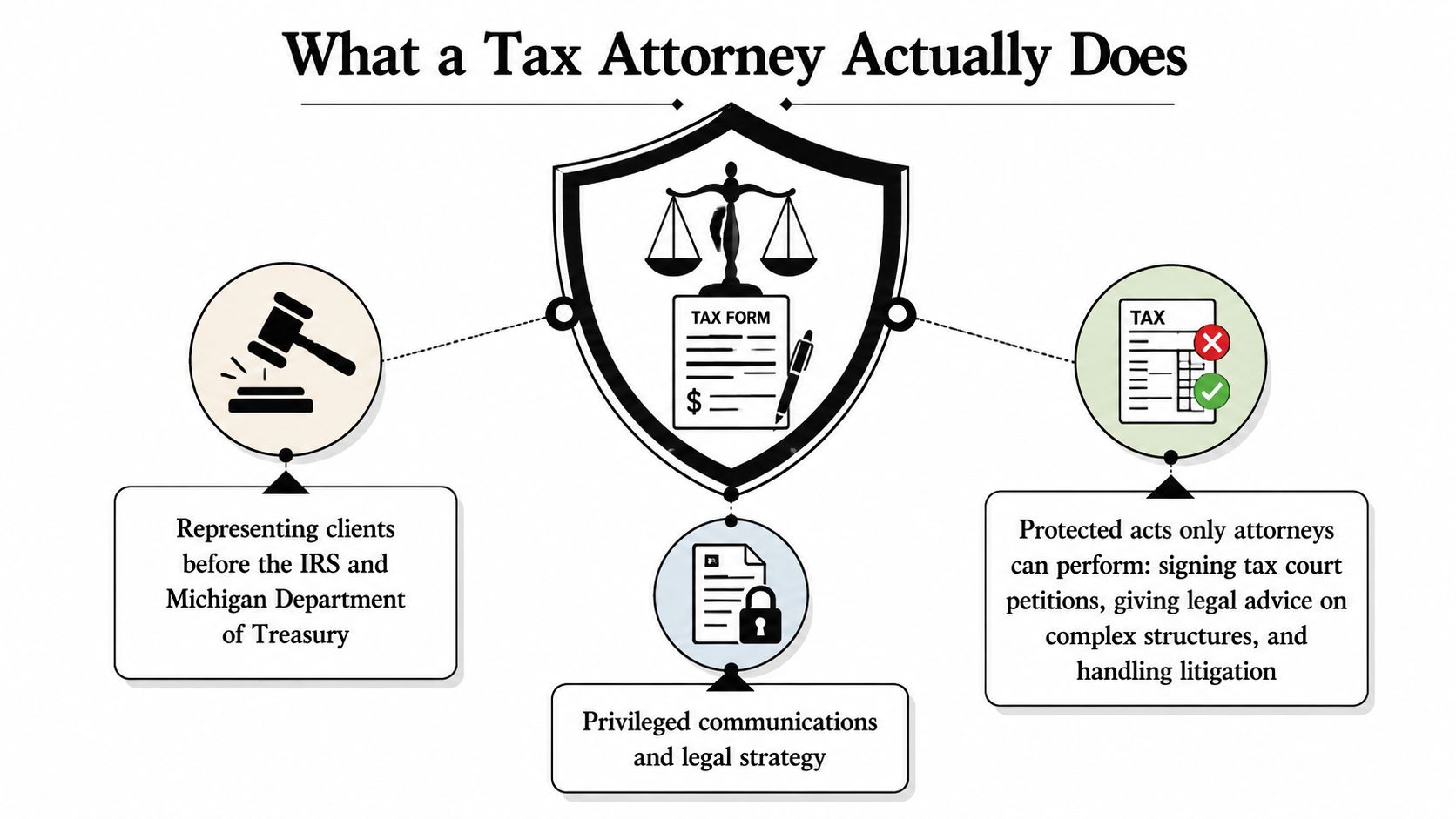
A tax attorney is not a tax preparer with a law license. The work usually falls into two different lanes, transactional tax planning and tax controversy. Michigan firms that focus on business tax law describe that split directly, with planning work centered on entity formation, restructuring, mergers and acquisitions, deferred compensation, and pass-through taxation, while controversy work focuses on audits, appeals, collections, criminal investigations, and litigation before bodies such as the Michigan Tax Tribunal and Court of Claims, as outlined by Foster Swift's tax law practice overview.
Planning is not the same as defense
Planning work is proactive. It helps before the IRS or Treasury has a problem with the file, so the focus is on structure, reporting, and lowering legal risk before it hardens into a dispute. A lawyer in that lane may review how an entity is formed, whether compensation is structured correctly, or how a deal is documented so tax exposure is reduced from the start.
Controversy work is reactive. It starts after the government has already raised its hand. Evidence, procedure, and deadlines dominate that work, and the attorney's role shifts away from return preparation and toward building a position that can hold up under scrutiny.
What only a lawyer can really add
Tax attorneys can give legal strategy protected by privilege, and they can handle litigation tasks when a dispute moves beyond the agency level. They are also the right professional when the matter is headed toward Tax Court or another tribunal where procedure matters as much as the numbers.
A good tax lawyer does not just say “pay it” or “fight it.” The better question is whether the record supports the position, whether the forum is right, and whether the client has a realistic path to resolution.
What they usually do not do is routine return prep as their main service. A simple Form 1040 with no dispute often belongs with a preparer or CPA, not a lawyer. The same is true for a routine installment agreement or a basic amended return when the facts are clean and the issue is narrow. The value of a tax attorney starts when the problem stops being purely mechanical and starts becoming legal. If you want a practical breakdown of when that matters, this overview of the benefits of hiring a tax attorney is a useful place to start.
Michigan's Dual-Track Tax Law Market
A Michigan taxpayer who needs a tax lawyer is usually dealing with one of two tracks. One track is planning, where the work happens before a return is filed or before a structure is locked in. The other is controversy, where the letter has already arrived, the assessment has already been made, or collections have already started. Those are different jobs, and they call for different skill sets.
Michigan's market reflects that split. Avvo lists 1,248 tax lawyers in the state and shows 515 reviews across those profiles, which points to a real supply of attorneys and a steady level of client demand in this niche (Avvo Michigan tax lawyer directory). The practical question for a taxpayer is not whether a tax lawyer exists, but whether the problem needs one now or can still be handled another way.
Where the work clusters
Compensation data helps show where tax work is concentrated. ZipRecruiter reported that, as of July 11, 2025, the average annual pay for a Tax Law Attorney in Michigan was $97,396, with the 25th percentile at $72,300, the 75th percentile at $119,400, and top earners at $124,202; the same report put the hourly equivalent at about $46.83 (ZipRecruiter Michigan tax law attorney salary data). City-level averages were higher in several commercial and government hubs, including Lansing at $113,339, Farmington at $109,958, and Troy at $105,910.
| Market | Average Annual Pay | Demand Signal |
|---|---|---|
| Lansing | $113,339 | Government and state-facing tax work |
| Farmington | $109,958 | Higher-end commercial demand |
| Troy | $105,910 | Business and owner-client concentration |
Those figures usually track complexity. Higher-paying markets tend to support attorneys who handle audits, appeals, collections, trust fund recovery penalty defense, business-owner disputes, and matters where the file has to be built carefully from the start. A lower-complexity filing problem may never need that level of representation. A payroll tax matter or a state collections case often does.
The state's tax practice also sits inside a larger professional network. The State Bar of Michigan publishes attorney demographic information, and national IRS preparer statistics show 25,598 attorneys holding current PTIN-related credentials in 2026. That means tax work in Michigan is spread across planners, controversy lawyers, and accountants, not concentrated in one narrow corner. For a closer look at how state collection activity fits into that mix, see Michigan state agency collections and Revenue Management.
The decision point is practical. If the issue is planning, the right lawyer is the one who can spot risk before the return goes out. If the issue is controversy, the right lawyer is the one who knows procedure, deadlines, and whether the case belongs in an administrative setting, in court, or in a negotiated resolution.
Common Tax Problems Michigan Residents and Businesses Face
Individuals don't search for a lawyer out of curiosity. They search because something has already gone wrong. For them, the list usually starts with unfiled returns, back taxes, audit letters, wage garnishments, bank levies, lien release issues, innocent spouse claims, and offers in compromise. For businesses, the pressure points are different, and often uglier, because payroll and sales tax problems can turn into personal liability fast.
Individual matters often start small
A single IRS notice may only need a careful response and supporting documents. An isolated underreporting issue may be manageable with a corrected filing or a payment plan. But once the notices stack up, the problem often stops being about one return and becomes about account posture, collection activity, and whether the taxpayer has lost track of more than one year.
That's also where many people overbuy help. A clean amended return or a straightforward installment agreement doesn't always need a lawyer. A CPA or enrolled agent may be enough if the issue is limited, the facts are documented, and no litigation is on the horizon.
Business cases escalate differently
Business tax issues are usually harder because the business entity and the people behind it can both get pulled into the case. The moment payroll tax debt, trust fund recovery penalty exposure, or a Michigan Treasury audit appears, the question shifts from “How do we pay this?” to “Who is liable, what records matter, and what procedure controls?”
The state side deserves special attention. A Michigan Department of Treasury dispute or Michigan Tax Tribunal appeal isn't just a federal tax matter with a different letterhead. It follows state procedure, and that usually means you want someone who knows how Michigan agencies move cases, not just someone who handles generic “tax help.”
Useful filter: if the pitch sounds identical no matter whether the problem is IRS, Treasury, payroll, or sales tax, the representation is probably too generic for the issue.
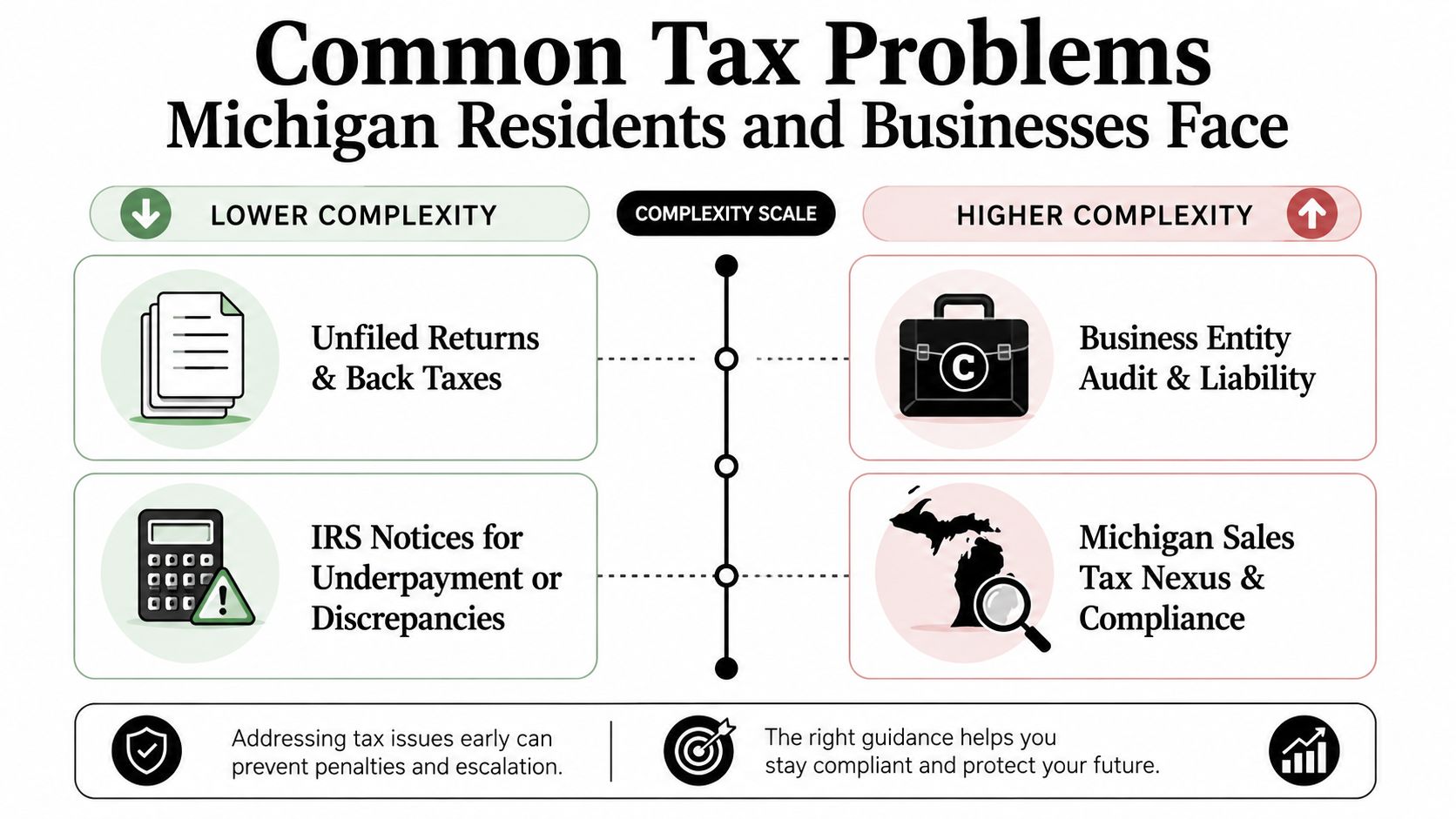
A one-size-fits-all “tax resolution” offer should be treated as a warning sign. The better match depends on whether you're dealing with one clean filing mistake, a multi-year compliance mess, a business liability issue, or a state appeal that needs precise procedural handling.
When Hiring a Tax Attorney Actually Makes Sense
There are times when a lawyer is the right first call, and times when that would be overkill. The difference usually comes down to risk, timing, and whether a legal position has to be defended rather than just corrected. If the IRS has already escalated the matter, or if the state is treating the issue as a dispute rather than a simple balance due, the case starts looking like a legal problem.
Red flags that point to counsel
A tax attorney is strongly indicated when the taxpayer is facing an active audit with meaningful exposure, a trust fund recovery penalty assessment, a criminal tax investigation, a Tax Court deadline, multiple years of unfiled returns with serious liability, a complicated offer in compromise, or a business closure with unpaid payroll taxes. Those are the kinds of matters where procedure matters as much as money, and where one wrong move can narrow the options.
Lower-stakes matters may not need a lawyer
A CPA, enrolled agent, or clinic may be enough if the issue is a routine amended return, a basic installment agreement, a simple penalty abatement request, or a single-year filing problem that hasn't turned into a controversy. That's not a knock on lawyers. It's just a recognition that some cases are technical but not adversarial.
Michigan taxpayers with limited means also have a different set of options than many realize. The University of Michigan Low Income Taxpayer Clinic says its clients often face overlapping barriers like poverty, disability, domestic violence, housing insecurity, literacy problems, and identity theft, and Michigan State University's Tax Clinic provides free legal services for taxpayers in controversy with both the IRS and the state (University of Michigan Low Income Taxpayer Clinic). If cost is the barrier, those clinics can be a real path forward.
Decision rule: if you need someone to negotiate facts, not just explain forms, you're getting close to lawyer territory.
A paid attorney makes sense when the issue is complicated enough that legal judgment changes the outcome. If the matter can be solved with records, a payment plan, or clinic help, don't let a hard sell turn a simple case into an expensive one.
How to Choose the Right Michigan Tax Attorney
A tax notice can push people to hire the first lawyer they find, but the better move is to ask whether a lawyer is needed at all. Some problems call for legal judgment, while others can be handled with a CPA, an enrolled agent, a clinic, or a careful round of self-correction. The right decision starts with the facts, not the sales pitch.
Credentials matter, but they are only the first filter. A real tax lawyer should have a Juris Doctor, active Michigan State Bar admission, and a clean path to practice in the forum where your case belongs. An LLM in taxation is a positive signal, but it is not required for competence, and it does not replace actual controversy experience or familiarity with Michigan's split between planning work and dispute work.
Ask about the exact person handling the file
The first question is not about the firm name. It is about who will do the work. Some matters are sold by one person and handled by another, so you want to know whether the attorney you meet is the one reading transcripts, preparing filings, and speaking for you in the dispute.
You should also ask what kind of cases they resolve most often. An attorney who mostly drafts plans for businesses may not be the right fit for a payroll tax collection problem, and a lawyer who mainly handles audits may not be the right choice for a Treasury appeal or a contested assessment. The issue type matters more than the marketing headline.
If you want a practical checklist before you sign anything, the how to find a good tax attorney guide lays out the kind of questions that separate real case experience from polished branding.
Fee transparency should come before a retainer
Flat fee, hourly, or rolling retainer. Those structures tell you a lot about whether the lawyer is being clear or evasive. You should ask what the fee covers, what happens if the facts change, and what the likely range of resolution looks like before you sign anything.
Warning signs are easy to spot once you know what to look for. High-pressure sales tactics, guarantees of a specific result, and large upfront retainers before any real analysis should slow you down. A credible attorney can explain risk without trying to frighten you into signing.
For readers comparing firms and doing their own research, the guide to law firm SEO in 2026 is a useful reminder that online visibility does not equal legal fit. A polished website can help you find a firm, but it cannot tell you whether that firm has the right case experience for your facts.
A good consultation should leave you with answers, not pressure. If the discussion is specific, the fee structure is clear, and the lawyer can explain the path from your notice to a resolution, you are in the right room. If the conversation jumps straight to payment, keep looking.
A free Tax Debt Analysis is often the cleanest diagnostic step before any retainer. It gives you a chance to see whether the problem is really attorney work, whether it belongs in the planning track or the controversy track, and whether you should pay a lawyer at all.
Michigan Case Patterns and What Resolution Looks Like
A payroll tax case for a small business owner doesn't look like a back-income-tax problem, and neither looks like a state audit. The label on the notice matters, but the pattern underneath it matters more, because the available tools change with the facts.
A business owner with payroll tax exposure
When a company falls behind on payroll taxes, the government can look beyond the business and at the people running it. The practical fight often centers on who controlled the decision to pay the government, what the records show, and whether the liability can be reduced, shifted, or paid over time. In some cases, resolution comes through structured payment, in others through negotiation over the scope of the assessment, and in the hardest cases through litigation or a narrowed liability position.
A taxpayer with multiple unfiled years
For a self-employed taxpayer with several missing returns, the first step is usually not a settlement form. It's reconstructing the filing history and getting accurate returns on file so the balance is real instead of estimated. Once the actual picture is clear, the right result might be a payment plan, penalty relief, or, if the financial facts support it, an offer in compromise.
A Michigan audit that turns into an appeal
State income tax audits can become appeals if the taxpayer and Treasury disagree on the result. That's where familiarity with Michigan procedure matters, because the dispute may need to move from agency negotiation to a formal filing before the Michigan Tax Tribunal or another forum. A skilled attorney won't promise a perfect result, but they can keep the matter inside the right procedural lane and avoid losing arguments because of missed steps.
Resolved doesn't always mean “zero balance.” It often means the government has been moved from collection pressure to a payment plan, a reduced liability, or a documented position it will accept.
The best outcome is usually the one that stops the escalation and gives the taxpayer a manageable path forward. That can be a full payment plan, currently-not-collectible treatment, an innocent spouse claim, penalty abatement, or a compromise when the facts really support it. The tool changes with the case, not with the marketing package.
Start With a Free Tax Debt Analysis Before Paying Anyone
A lot of tax resolution advertising starts at the wrong end. It asks for a big retainer before anyone has reviewed the transcripts, checked the account status, or even decided whether a lawyer is needed at all. That's backwards, because most taxpayers need diagnosis before they need representation.
A proper Tax Debt Analysis should start with the IRS or state account, then move to the filing history, current collection posture, and the options available. It should answer a few basic questions plainly. Is representation needed, or can the matter be handled another way? Does the taxpayer qualify for an installment agreement, currently-not-collectible status, penalty relief, or an offer in compromise? And what will the specific work cost if counsel is the right next step?
For taxpayers worried about bankruptcy versus tax debt, the comparison often gets messy fast. A useful outside reference on that overlap is Minnesota bankruptcy tax consequences, because it shows how quickly tax issues can interact with a broader financial reset. That same kind of analysis is why a diagnostic matters before anybody talks about a retainer.
The right first step is clarity. If the facts show that help isn't needed, or that another path is better, you shouldn't be paying lawyer prices for a problem that doesn't require them. If the facts do justify representation, then the fee quote should match the actual work, not a fear-driven package sold before the case is understood.
Tax Attorney Stephen A Weisberg offers a free Tax Debt Analysis for people dealing with IRS and state tax problems, and that's the smartest place to start if you're deciding whether you need counsel at all. If you want a direct read on your options before signing a retainer, visit Tax Attorney Stephen A Weisberg and request the analysis.