When to Hire a Tax Attorney for Small Business
Feeling overwhelmed by IRS notices or tax debt? This guide explains when hiring a tax attorney for small business is essential to protect your company.

In this article
- Navigating the Complex World of Small Business Taxes
- When to Call a Tax Attorney vs. a CPA
- CPA vs. Tax Attorney: Who to Call and When
- The True Role of a Tax Attorney for Your Business
- The Legal Shield of Attorney-Client Privilege
- Representation Where It Counts Most
- When to Call a Tax Attorney: 4 Red Flags You Can't Ignore
- The Dreaded IRS Audit Notice
- Delinquent Payroll Taxes and the TFRA
- When Tax Debt Spirals Out of Control
- Facing Aggressive IRS Collection Actions
- A Look Inside the Tax Resolution Process
- Step 1: The Initial Consultation and Diagnosis
- Step 2: Granting Power of Attorney and Taking Back Control
- Step 3: The Investigation and Strategy Phase
- Step 4: Negotiation and Final Resolution
- Understanding the Costs and Finding the Value
- Demystifying Attorney Fee Structures
- The True Cost of Inaction vs. Investment
- How to Choose the Right Tax Attorney
- Verifying Credentials and Specialization
- Demanding Transparency and a Clear Strategy
- Who Is Actually Handling Your Case
- Answering Your Most Pressing Questions
- Can My CPA Handle an IRS Audit for Me?
- Is It Worth the Cost to Hire a Tax Attorney?
- How Serious Are Unpaid Payroll Taxes?
- What Happens During an Initial Consultation?
Running a small business is tough. You're juggling everything from marketing to payroll, and the last thing you need is a tax problem that spirals out of control. Most of the time, your CPA has your back. But what happens when a simple tax issue becomes a serious legal threat?
This is where a tax attorney for small business becomes your most critical ally. Think of them not just as a tax expert, but as your legal shield, protecting your business, your livelihood, and your personal assets when the stakes get dangerously high.
Navigating the Complex World of Small Business Taxes

Whether you're running an S-corp, an LLC, or a sole proprietorship, the fear of an IRS audit, crushing payroll tax penalties, or a mountain of tax debt is very real. The tax code is a maze, and while your CPA is an excellent guide for your annual journey, some paths lead to places where you need a legal specialist.
When you get a notice from the IRS that feels more like a threat than a simple inquiry, you’ve moved beyond an accounting problem. You're now in a potential legal fight, and that's a battle you don't want to face alone.
When to Call a Tax Attorney vs. a CPA
Knowing who to call—and when—is the first and most important step in protecting your business. Calling the wrong professional can waste precious time and leave you exposed when you can least afford it.
A Certified Public Accountant (CPA) is your trusted partner for the day-to-day financial health of your business. They're masters of tax planning, preparation, bookkeeping, and making sure your annual filings are buttoned up and accurate.
A Tax Attorney is your legal defender when you're in a dispute with the IRS or state tax authorities. They step in for audits, appeals, tax court litigation, and serious issues like criminal tax investigations.
The real game-changer is attorney-client privilege. Your conversations with a tax attorney are legally protected and confidential. While communications with a CPA have some confidentiality, it's limited and can be pierced by the IRS, especially in criminal matters. A tax attorney is your legal advocate, a role a CPA simply cannot fill.
Making the right call from the start is crucial. This quick guide should clear things up.
CPA vs. Tax Attorney: Who to Call and When
This quick reference table clarifies the distinct roles of a CPA and a tax attorney, helping you decide which professional you need for specific tax challenges.
| Tax Situation | Certified Public Accountant (CPA) | Tax Attorney |
|---|---|---|
| Annual Tax Filing | Ideal for preparation and strategy | Not typically required |
| IRS Audit Notice | Can provide initial support | Essential for legal defense |
| Unpaid Payroll Taxes | Can calculate liability | Critical for negotiation & TFRA defense |
| Tax Debt Settlement | Limited negotiation ability | Specializes in OIC and payment plans |
| Tax Court Petition | Cannot represent you | Required for legal representation |
| Criminal Investigation | Should not be involved | Absolutely necessary |
In short, a CPA helps you comply with the law, while a tax attorney defends you under the law. When the situation escalates beyond routine filing and into a dispute, it's time to bring in legal counsel.
The True Role of a Tax Attorney for Your Business

It’s one of the most common—and costly—misconceptions in the business world: thinking a CPA and a tax attorney do the same job. While you absolutely need both on your team, they play very different roles, especially when the IRS comes knocking with a serious problem.
Getting this distinction right is the first step in protecting your business, your bank account, and your peace of mind.
Think of your CPA as your financial primary care doctor. They're the experts you see for preventative care and routine check-ups. They handle your annual tax filings, manage your bookkeeping, and offer sound advice on tax planning to keep your business financially healthy. They are essential for day-to-day compliance.
A tax attorney for small business, on the other hand, is the specialist you call when you get a scary diagnosis. They are the surgeons, the legal strategists you bring in for high-stakes situations where legal authority and courtroom experience are the only things that matter.
The Legal Shield of Attorney-Client Privilege
The single biggest difference comes down to a powerful legal protection called attorney-client privilege. This isn't just legal jargon; it's a critical shield.
When you discuss sensitive details about your tax problems with a lawyer, that conversation is legally confidential. The IRS cannot force your attorney to reveal what you said, and it can't be used against you in court.
Your CPA, however, doesn't have this same level of protection. Their accountant-client confidentiality is limited and doesn't hold up in criminal tax cases. In a serious dispute, the IRS could legally require your CPA to testify against you.
This legal privilege is your safety net. It creates a secure space where you can be completely honest with your legal counsel, giving them every detail they need to build the strongest possible defense for you, without fear of that information being turned into a weapon.
This protection is absolutely critical when you're dealing with issues like multiple unfiled returns, underreported income, or payroll tax debts where the threat of criminal charges is very real.
Representation Where It Counts Most
Beyond confidentiality, a tax attorney can go places and fight battles a CPA legally cannot. Their job is to advocate, negotiate, and, if necessary, litigate in arenas where only a lawyer can operate.
A tax attorney is trained in legal negotiation and has an intimate understanding of tax law, court precedents, and the procedural rules of the IRS and the courts. This specialized knowledge is what makes complex tax debt resolutions possible.
- Offer in Compromise (OIC): This is a formal, legal agreement with the IRS to settle your tax liability for less than what you owe. An attorney doesn't just fill out forms; they build a compelling legal and financial case to prove you can't pay the full amount.
- Trust Fund Recovery Penalty (TFRA) Defense: When payroll taxes aren't paid, the IRS can come after the business owners or key employees personally. An attorney's job is to defend you from this personal assessment, protecting your home, savings, and other assets from seizure.
- U.S. Tax Court Representation: If you need to challenge an IRS decision in court, only a licensed attorney (or another specially admitted practitioner) can represent you. A CPA cannot argue your case before a judge.
These are legal fights, not accounting errors. You need a qualified legal professional who speaks the language of both the tax code and the courtroom. To get a clearer picture of when to make the call, consider reading about the distinct benefits of hiring a tax attorney for your business.
Ultimately, your CPA helps you stay on the right path. A tax attorney is the expert you hire to defend you when the IRS tries to blow up that path entirely. They are your legal advocate and your defender when your business's future is truly on the line.
When to Call a Tax Attorney: 4 Red Flags You Can't Ignore
Some letters from the IRS are routine. Others should send a chill down your spine. As a small business owner, you need to know the difference. When you receive certain notices, you’ve crossed a line from a simple accounting question into a serious legal fight.
These are the moments when you stop what you're doing and call a tax attorney for small business. Trying to handle these situations yourself, or even with just your regular CPA, is a high-stakes gamble you can’t afford to lose.
The Dreaded IRS Audit Notice
An official audit notice is one of the most unnerving things a business owner can get in the mail. It means the IRS is formally putting your books under a microscope to make sure you’re reporting everything by the book. While some audits are just random bad luck, most are triggered by something specific—unusually high deductions, major discrepancies in reported income, or other red flags their computer systems are designed to catch.
This is a legal proceeding, not just a financial review. IRS agents are highly trained investigators looking for errors that will result in a bigger tax bill. Your first move shouldn't be to start handing over documents. A tax attorney immediately steps in to manage all communication, acting as a shield between you and the auditor. They control the flow of information and build a legal defense around your tax positions, preventing you from accidentally saying something that could make things much worse. To get a better sense of what this process looks like, check out our detailed guide on navigating a small business IRS audit.
Delinquent Payroll Taxes and the TFRA
Of all the tax messes a business can find itself in, falling behind on payroll taxes is by far the most dangerous. The IRS doesn't see this as a typical debt; they see it as theft. Why? Because you withheld that money from your employees' paychecks on behalf of the U.S. Treasury. It was never your money to begin with. They pursue these cases with a vengeance.
The government’s most powerful weapon here is the Trust Fund Recovery Penalty (TFRA). This devastating penalty allows the IRS to smash right through the protections of your LLC or corporation and hold individuals personally liable for the unpaid trust fund taxes (that’s the Social Security, Medicare, and federal income tax withholding).
Who is a "responsible person"? It's a much broader definition than most people think. It's not just the owner. It can be a co-owner, a bookkeeper, or any manager with the authority to decide which bills get paid. This puts their personal assets—their home, their car, their savings—squarely in the IRS's crosshairs. A tax attorney is absolutely critical to defend you against a TFRA assessment.
When Tax Debt Spirals Out of Control
It happens faster than you'd think. A couple of slow quarters, an unexpected major expense, or just some sloppy cash-flow management can leave you with an income tax bill you simply can't pay. Before you know it, penalties and interest start piling up, and a manageable problem balloons into a crushing, seemingly impossible amount of debt.
When the numbers get this big, you need more than a simple payment plan. You need a legal strategy. A tax attorney will dig into your business and personal finances to find the best way out. This could mean:
- Offer in Compromise (OIC): Negotiating a settlement with the IRS to pay a fraction of what you originally owed.
- Installment Agreement: Setting up a formal, structured payment plan that your business can actually afford without going under.
- Currently Not Collectible (CNC) Status: Getting the IRS to press pause on collections entirely because you can prove you don't have the ability to pay right now.
Facing Aggressive IRS Collection Actions
If you ignore a tax debt, the IRS won’t just go away. Their process escalates from letters to much more forceful actions designed to take what they're owed. When you receive a notice of a federal tax lien or an intent to levy, the situation has become critical.
- Federal Tax Lien: This is a public legal claim against all your assets—business property, accounts receivable, even your personal home. It wrecks your credit and makes it nearly impossible to sell assets or get a loan.
- Bank Levy: This is even more direct. The IRS orders your bank to freeze your accounts and hand over the money. It can shut down your operations overnight, leaving you unable to make payroll or pay suppliers.
The moment you're facing a lien or levy, you need a tax attorney to make an emergency call to the IRS. They can often get the levy released quickly and start negotiating a long-term solution so it doesn't happen again. These complex issues are a huge reason why the U.S. tax services industry is projected to hit $14.3 billion in 2025. The demand is massive because the stakes are so high, underscoring the value of expert legal help when you’re up against the IRS.
A Look Inside the Tax Resolution Process
Walking into a tax attorney's office can feel daunting, especially when you're already buried under the stress of an IRS problem. But the process of getting things sorted out is a lot more structured and straightforward than you might think. Knowing what to expect—from that first phone call to the final handshake—can turn that feeling of anxiety into a sense of control.
It’s a bit like seeing a medical specialist. You don't just jump into surgery. First, there's a thorough diagnosis, then a clear treatment plan, and only then does the specialist get to work, guiding you every step of the way. A good tax attorney approaches your small business's tax issues with the same disciplined, methodical mindset.
Step 1: The Initial Consultation and Diagnosis
Everything kicks off with an initial consultation, which we often call a tax debt analysis. This is where we get to the heart of the matter. You’ll walk me through your situation, show me any letters or notices you’ve received from the IRS, and give me a general idea of your business’s financial state. My job here is to listen and understand the full picture.
This isn't some high-pressure sales pitch. Any reputable attorney uses this time to figure out if they can actually help you. We'll gauge how urgent the problem is, map out a few potential legal routes, and give you an honest, no-fluff assessment of the likely outcomes before you ever sign anything.
Step 2: Granting Power of Attorney and Taking Back Control
Once you decide to move forward, the first official piece of paper we sign is an IRS Form 2848, which is a Power of Attorney. This document is a game-changer. It legally authorizes your attorney to represent you and speak to the IRS for you.
The moment this is filed, you can stop talking to the IRS. Period. Every phone call, every letter, every single piece of communication gets routed through your attorney's office. This puts an immediate end to the stressful collection calls and gives you the space you need to breathe and focus.
This one step gives our clients incredible relief and puts a professional buffer between them and the revenue officers.
Step 3: The Investigation and Strategy Phase
With the Power of Attorney filed, your attorney essentially becomes your private investigator. We'll pull your complete file directly from the IRS—this includes account transcripts and all the internal notes and records they have on you. This lets us see exactly what they see, from unfiled returns to outstanding balances and every action taken on your account.
At the same time, we'll work with you to gather your key financial documents. This deep dive is what we build your entire strategy on. By cross-referencing the IRS’s version of the story with your actual financial reality, we can pinpoint the strongest and most effective path forward.
These are the most common situations that bring business owners to our door.
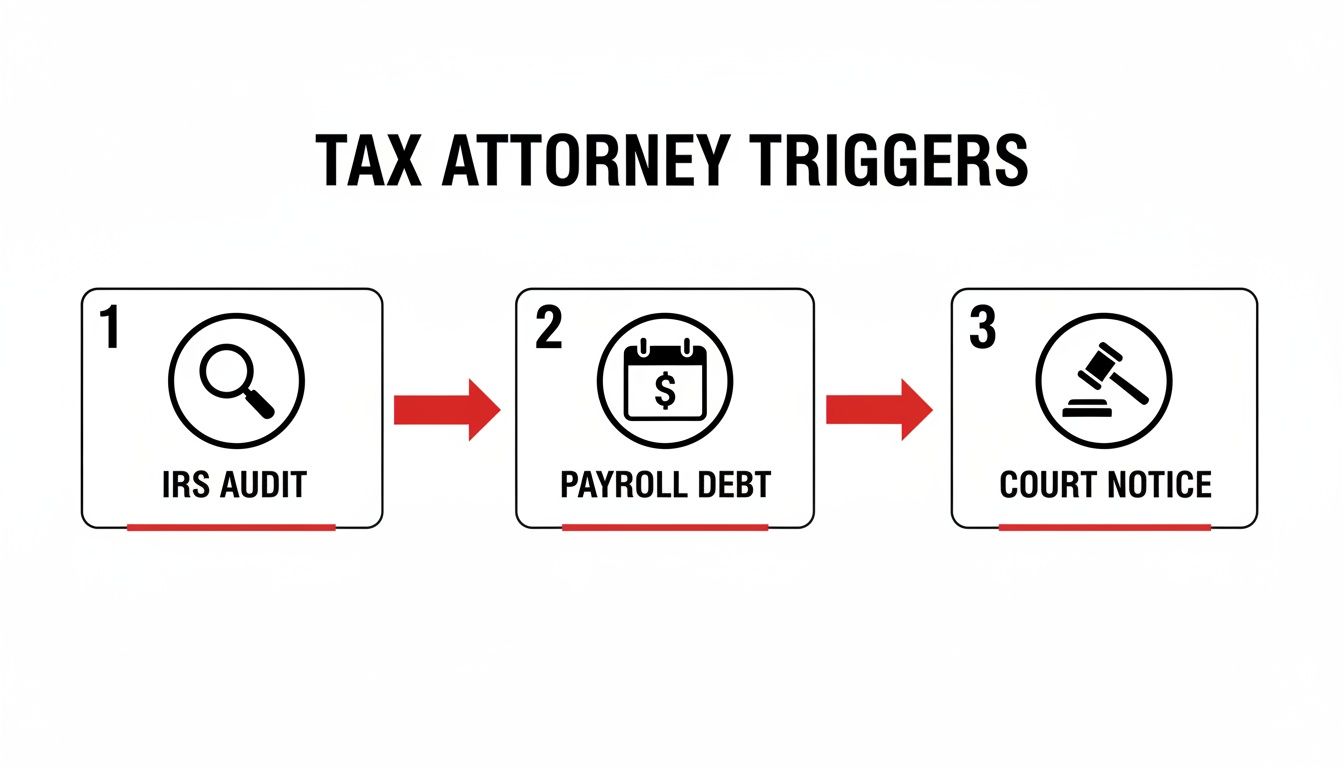
Each one of these triggers—an audit notice, a payroll tax mess, or a court summons—demands a very specific legal game plan to start the resolution process.
Step 4: Negotiation and Final Resolution
Armed with all the facts, your attorney will lay out your resolution options. These are custom-fit legal solutions, not generic, one-size-fits-all fixes. Depending on your unique circumstances, the strategy could involve:
- Offer in Compromise (OIC): This is a formal deal with the IRS to settle your tax debt for less than you owe.
- Currently Not Collectible (CNC) Status: If you're facing legitimate financial hardship, we can request the IRS to temporarily stop all collection efforts.
- Installment Agreement: We can negotiate a manageable, structured payment plan that you can actually afford.
- Penalty Abatement: This involves formally requesting the IRS to remove penalties, which often requires proving you had a "reasonable cause" for the issue.
From there, your attorney takes the lead, negotiating directly with the IRS to advocate for your case and secure the best possible outcome. Their experience in tax law and sharp negotiation skills are what transform a situation that feels hopeless into a resolution that lets you get back to what you do best: running your business.
To learn more about the specifics, our guide explains how to settle tax debt with the IRS in greater detail.
Understanding the Costs and Finding the Value
Let's talk about the elephant in the room: the cost. For any small business owner, every dollar counts, and the thought of hiring an attorney when you're already facing an IRS problem can feel overwhelming.
But here’s a shift in perspective I always urge my clients to make: a tax attorney isn't an expense. They're an investment in the survival and stability of your business. You aren't just paying for their time; you're paying for a solution—a way out of a very stressful and financially dangerous situation.
The right expert can often save you far more than their fee by negotiating away penalties, slashing your total tax bill, or stopping aggressive IRS collection actions like bank levies. The real value is in protecting the business you’ve poured everything into.
Demystifying Attorney Fee Structures
One of the biggest red flags you'll see in the tax resolution industry are those giant, impersonal "tax relief" companies. They often demand huge, non-refundable retainers upfront while offering vague promises. A reputable, independent tax attorney works differently. Transparency is key.
You’ll typically see a few common fee arrangements:
- Flat Fees: This is my preferred method for predictable work. For a specific, clearly defined service—like representing you in an audit or preparing an Offer in Compromise—you pay one fixed price. You know exactly what it will cost from day one.
- Hourly Rates: Some situations are just too unpredictable for a flat fee. Think of complex negotiations with the IRS, tax court litigation, or a deep-dive investigation. In these cases, the attorney will charge by the hour.
- Retainers: A retainer is essentially a down payment. You pay a certain amount upfront, and the attorney deducts their hourly fees from that balance as they work on your case. They should always provide detailed invoices so you can see exactly where your money is going.
Here's the bottom line: An ethical attorney will walk you through their billing process during your first conversation. The goal is to build a partnership based on trust, not to trap you in a confusing contract with no clear end in sight.
The True Cost of Inaction vs. Investment
The attorney's fee isn't the real financial threat here. The real danger is what happens if you do nothing. IRS penalties and interest are relentless; they compound daily and can quickly turn a manageable tax debt into an insurmountable one.
Even just staying compliant has its costs. Research from 2025 shows the average tax prep cost for a single-member LLC is $457, while multi-member LLCs pay around $1,065. For S-corps, that figure jumps to $1,265, and complex situations can inflate those costs by as much as 285%.
When you weigh those numbers against the thousands—or even tens of thousands—an attorney can save you through a negotiated settlement, the investment makes perfect sense. Professionals in this field are always looking for ways to work more efficiently, which helps keep client costs down. For example, some firms harness AI Front Desk to save money by automating administrative tasks.
Ultimately, hiring an expert who knows the system inside and out is the most cost-effective way to protect your business, your peace of mind, and your personal assets from the IRS.
How to Choose the Right Tax Attorney
When the IRS is knocking on your door, picking the right legal advocate is probably the single most important decision you'll make for your business's future. It's a crowded field out there, and frankly, not all tax attorneys have the specific, in-the-trenches experience required to handle small business tax problems.
Your mission is to find a true partner—someone who will dig into the details of your situation and build a strategy from the ground up, not just sell you some one-size-fits-all "tax relief" package.
Think of it like this: if you discovered a serious crack in your home's foundation, you wouldn't call a general handyman. You'd find a structural engineer, an expert who deals exclusively with foundations. The same logic applies here. You need a tax attorney for small business who lives and breathes IRS resolution cases just like yours.
Verifying Credentials and Specialization
First things first, you have to do some basic homework. Any attorney you even consider must be a member in good standing with their state bar association. This is the absolute baseline; it just confirms they're licensed to practice law. But that’s just the starting point.
Now, you need to find out if they are a genuine specialist. Get ready to ask some direct questions:
- How much of your practice is actually dedicated to tax controversy?
- What percentage of your clients are small business owners?
- Can you share some anonymized examples of cases you've handled that are similar to mine?
An attorney who lists tax law as one of five different practice areas isn't the expert you need. You're looking for the lawyer whose entire professional world revolves around representing businesses in front of the IRS.
Demanding Transparency and a Clear Strategy
Be on high alert for red flags. If an attorney or firm uses high-pressure sales tactics or asks for a huge fee before they even understand your case, that’s your cue to leave. A reputable professional will be completely transparent about their fee structure. It might be a flat fee for a defined project or an hourly rate, but it will always be spelled out in a clear retainer agreement.
A legitimate professional will focus on diagnosing your problem and outlining a clear plan of action. They should be able to explain their proposed strategy in simple terms, helping you understand the "why" behind each step. If you feel rushed or pressured, walk away.
This is exactly why our guide on finding a good tax attorney puts so much stress on that initial consultation. It should feel like a strategy session where you gain clarity, not a sales pitch. When looking at potential attorneys, it can also be useful to know what kind of tools they use to run their practice, like the best legal software for small firms, as it can be a sign of their efficiency.
Who Is Actually Handling Your Case
Finally, there's one last crucial question you must ask: “If I hire your firm, who will actually be handling my case?” It’s a classic bait-and-switch. Many larger firms will have a senior partner handle the initial meeting, but once you sign on, your case gets handed down to a junior associate or even a paralegal.
You're paying for expertise and experience, and you have every right to expect direct access to the person with that expertise. A 2024 report on legal trends highlights that solo and small-firm lawyers often manage heavy administrative burdens, which can affect client focus. Finding a firm where you know you'll be working directly with the lead attorney is key to ensuring your case gets the attention it truly deserves.
At the end of the day, choosing the right advocate comes down to finding a skilled professional who is transparent, dedicated, and will personally see you through the entire process.
Answering Your Most Pressing Questions
It’s completely normal to still have a few questions rolling around in your mind. Deciding to bring a tax attorney for small business into the fold is a big step, and you should feel 100% confident before you move forward. Let’s tackle some of the most common—and most important—questions we hear from business owners every day.
Think of this as our final chat before you decide on a plan. We'll get into the practical side of things—cost, necessity, and what really happens when you pick up the phone—so you have total clarity.
Can My CPA Handle an IRS Audit for Me?
Your CPA is an invaluable part of your team for preparing taxes and financial planning, and they can even offer some initial support in an audit. But their authority has limits. When things get serious, only a tax attorney can mount a true legal defense, represent you in U.S. Tax Court, and offer the protection of attorney-client privilege.
That legal shield is a game-changer. It means every conversation, every email, and every document you share with your attorney is confidential and cannot be used against you by the IRS. A CPA simply can't offer that level of legal protection, and in a high-stakes audit, it's a protection you can't afford to be without.
Is It Worth the Cost to Hire a Tax Attorney?
Hiring a tax attorney is best viewed as an investment in protecting your business, your livelihood, and your personal assets. Yes, there's a cost, but that fee often pales in comparison to the mountain of penalties, interest, and back taxes the IRS can pile on if your case is handled poorly.
A good attorney doesn't just cost money; they save you money. By negotiating a favorable resolution like an Offer in Compromise or getting penalties removed, their services can save you far more than their fee. The real question is, can you afford the cost of not hiring one?
How Serious Are Unpaid Payroll Taxes?
Extremely serious. In the eyes of the IRS, this isn't just a debt—it's viewed as theft. You were entrusted to hold onto your employees' tax money and pass it along to the government, so when that doesn't happen, they pursue it more aggressively than any other kind of tax debt.
The IRS can and will shut down your business. Worse, they can hold you personally liable for the money through the Trust Fund Recovery Penalty (TFRA). This means your personal bank accounts, your home, and your savings are all on the line. If you're behind on payroll taxes, getting professional help isn't just a good idea; it's critical for your financial survival.
What Happens During an Initial Consultation?
The first meeting, which we call a tax debt analysis, should be all about you, not a high-pressure sales pitch. It's your opportunity to lay everything out on the table, show the attorney the notices you've received, and get a professional opinion on your situation.
The whole point is for you to walk away with a clear picture of your options and what the path forward looks like, including the potential costs. You should leave that conversation feeling informed and empowered, never pressured into making a decision. It’s a diagnostic session, plain and simple.
That feeling in the pit of your stomach when you see an IRS notice or realize how much debt has piled up is a heavy burden. But it’s not one you have to carry by yourself. At Attorney Stephen A Weisberg, we start by listening. Our first goal is to simply understand your unique situation to see if we are the right people to help you.
You can take the first step toward putting this problem behind you today. Schedule your free, no-obligation Tax Debt Analysis by visiting https://weisberg.tax. Let's work together to build a strategy that protects your business and gives you back your peace of mind.