Hiring a Tax Attorney for Back Taxes A Guide
Facing IRS debt? This guide shows you when and how to hire a tax attorney for back taxes. Learn to resolve tax issues with expert legal help.

In this article
- When to Hire a Tax Attorney for Back Taxes
- Red Flags That Signal You Need an Attorney
- The Power of Attorney-Client Privilege
- Tax Attorney vs CPA vs Enrolled Agent
- The First Step: A Clear Diagnosis with a Tax Debt Analysis
- What to Expect During the Analysis
- Building a Concrete Strategy Before You Commit
- Getting Ready For Your First Meeting With Us
- Your Document "To-Go" Bag
- For Business Owners: Why Your Financials Are Everything
- Navigating Your Tax Resolution Options
- Offer In Compromise: The Fresh Start
- IRS Installment Agreements: Predictable Payments
- Other Strategic Solutions
- What to Expect: Timelines, Costs, and Red Flags
- How Long Does Tax Resolution Actually Take?
- What’s the Price Tag for Professional Help?
- Red Flags That Scream "Run Away!"
- Common Questions About Hiring a Tax Attorney
- Can a Tax Attorney Really Stop IRS Wage Garnishments?
- Why Do I Need an Attorney if My CPA Can Handle Back Taxes?
- What if I Haven't Filed Tax Returns for Many Years?
- Is It Possible to Settle My Tax Debt for Less Than I Owe?
Most people think of back taxes as a simple accounting problem. A few missed filings, some math errors—nothing a good CPA can't fix, right? That’s often true, but sometimes, a tax problem spirals into something much more serious. It becomes a legal problem.
Knowing when you've crossed that line is the key to protecting yourself.
When to Hire a Tax Attorney for Back Taxes

Think of it this way: An accountant is like your coach, helping you play by the rules of the game. A tax attorney is the defensive player you bring in when the other team's star player—the IRS—is about to score on you.
While CPAs and Enrolled Agents are brilliant at tax preparation and routine financial matters, a tax attorney brings legal authority and protections that are essential in high-stakes situations.
Red Flags That Signal You Need an Attorney
If you're experiencing any of the following, the time for "wait and see" is over. It's time to call an attorney.
- You've Received a Statutory Notice of Deficiency: This is not just another letter. It's a 90-day countdown clock giving you the right to petition the U.S. Tax Court. Only a licensed tax attorney can represent you in Tax Court, and this notice is your ticket to that venue.
- The IRS Is Threatening Levies or Liens: A notice of intent to levy your bank account, garnish your wages, or place a federal tax lien on your property is an act of aggression. An attorney can step in immediately to fight for a collection hold while they negotiate a resolution.
- You Have Multiple Years of Unfiled Returns: Getting compliant after years of unfiled returns isn't just about filling out old forms. It requires a strategy to manage the fallout, mitigate penalties, and negotiate the total liability, which can be overwhelming.
- You’re Facing a Trust Fund Recovery Penalty (TFRP): This is one of the most severe penalties the IRS can impose. If your business fell behind on payroll taxes, the IRS can hold you personally responsible for the money. Defending against a TFRP is a complex legal battle.
Make no mistake, the IRS is not a passive creditor. The agency is trying to close a $696 billion tax gap—the massive shortfall between taxes owed and taxes actually paid. That staggering number fuels their aggressive collection tactics.
The Power of Attorney-Client Privilege
Here’s one of the biggest, and least understood, advantages: attorney-client privilege.
Your conversations with a tax attorney are legally confidential. They cannot be forced to testify against you. A CPA or Enrolled Agent’s privilege is limited and, crucially, does not apply in a criminal case. If your tax issue has even a remote chance of being viewed as fraud or evasion, talking to anyone other than an attorney is a risk you can't afford.
Tax Attorney vs CPA vs Enrolled Agent
Choosing the right professional can be confusing. While CPAs and EAs are tax experts, their roles are distinct from a tax attorney, especially when legal trouble is brewing. This table breaks down who you should call based on your specific situation.
| Situation | Tax Attorney (Recommended) | CPA/EA (May Be Limited) |
|---|---|---|
| Facing an IRS Criminal Investigation | Essential. Only an attorney can provide confidential legal counsel and defense in a criminal matter. | Cannot represent you in a criminal case; their communications are not privileged in this context. |
| Receiving a Statutory Notice of Deficiency | Essential. Only a tax attorney can represent you in U.S. Tax Court if you choose to petition the IRS's findings. | Can help you understand the notice but cannot represent you in Tax Court. |
| IRS Threatens Wage Garnishment or Levy | Highly Recommended. Can immediately contact the IRS to halt collections and negotiate a release under legal authority. | Can contact the IRS on your behalf but may have less leverage in forcing an immediate stop to collection actions. |
| Complex Back Taxes & Unfiled Returns | Recommended. Can develop a legal strategy to get compliant, minimize penalties, and negotiate the entire debt. | Excellent at preparing the returns but may not be equipped to handle the legal negotiation aspect of a large debt. |
| Innocent Spouse or TFRP Cases | Highly Recommended. These are legal arguments requiring specific evidence and skilled negotiation. | Can assist with forms but lack the legal training to build the strongest possible case. |
Ultimately, an EA or CPA is your go-to for preparing tax returns and general accounting. But when you find yourself in a genuine fight with the IRS, you need someone who specializes in fighting. That’s the tax attorney.
Hiring an attorney is an investment in protecting your assets, your livelihood, and your future from the formidable power of the government.
Discover more about the specific benefits of hiring a tax attorney in our detailed guide.
The First Step: A Clear Diagnosis with a Tax Debt Analysis

When you're dealing with a serious tax problem, the last thing you need is a hard sales pitch. Unfortunately, many large "tax resolution" companies will try to get you to sign a massive retainer—sometimes $10,000 or more—before they even have a clue what’s really going on with your case. That’s not how a trustworthy tax attorney for back taxes should ever operate.
The first conversation should feel like a doctor's visit: it’s about diagnosis, not selling you a cure on the spot. A professional, client-focused approach always begins with a comprehensive Tax Debt Analysis. This is far more than a quick phone call; it's a meticulous investigation into your specific situation to figure out if and how a legal team can genuinely help.
A proper analysis is the only way to build a successful resolution strategy. It’s all about replacing that feeling of dread and uncertainty with a clear, data-driven plan. You should never have to commit thousands of dollars just to find out what’s wrong.
What to Expect During the Analysis
Think of this initial meeting as a fact-finding mission. The objective is to get a complete, unbiased picture of your tax situation, pulling information directly from the source—the IRS itself.
An experienced tax attorney will dig into the key documents to grasp the full scope of your problem. This process almost always involves:
- Scrutinizing IRS Notices: Every letter the IRS sends tells a piece of your story. The attorney will analyze any notices you’ve received, like a Notice of Deficiency or an Intent to Levy, to understand the immediate threats and critical deadlines you’re facing.
- Pulling Your Official IRS Transcripts: With your signed permission (using IRS Form 2848, Power of Attorney), the attorney can access your official IRS account transcripts. These are the internal records that show exactly what the IRS sees: filed returns, payments you've made, and all the penalties and interest they've tacked on.
- Having a Frank Financial Discussion: A candid conversation about your income, assets, and living expenses is absolutely essential. This information is what determines your eligibility for different resolution programs, such as an Offer in Compromise.
This thorough, upfront work is the complete opposite of firms that just make vague promises. For business owners, especially those running an S Corporation or multi-member LLC struggling with debt, this initial step is non-negotiable. This is particularly true for payroll tax issues, which are a major focus for IRS enforcement and a big part of the national tax gap, as detailed in these IRS statistics. A proper analysis allows a good legal team to start fighting back against things like wage garnishments and property liens right away.
Building a Concrete Strategy Before You Commit
Only after this detailed analysis is complete can a tax attorney lay out a realistic path forward. They can identify the most viable resolution options for your unique circumstances and give you an honest assessment of the potential outcomes. If you want a head start, you can review our guide on how to calculate tax liability to get a better handle on the numbers.
Ultimately, the Tax Debt Analysis transforms a scary, unknown problem into a defined challenge with a clear set of next steps. It ensures that when you do decide to hire a tax attorney for back taxes, you’re not just paying for a promise—you’re investing in a well-defined strategy built on real data from your actual case file.
Getting Ready For Your First Meeting With Us
Walking into a tax attorney's office can be nerve-wracking. I get it. But coming prepared can make all the difference, turning that first meeting from a stressful info-dump into a productive strategy session. The more you prepare, the more we can accomplish, saving you both time and money right from the start.
Your goal is simple: give us a clear, honest picture of your tax situation. Think of it as laying all the cards on the table. The sooner we see the full hand, the faster we can figure out the winning play.
Your Document "To-Go" Bag
Before you come in, start gathering all the relevant paperwork. Don't stress about organizing it perfectly—just get it all in one pile or folder. We can sort through the chaos. What’s important is that we have it.
Here’s what we absolutely need to see:
- All Correspondence from the IRS and State: This is the big one. Every single notice, letter, and bill you’ve received is a critical piece of the puzzle. These documents tell us what the agency thinks you owe, what stage of collections you're in, and most importantly, what deadlines are looming.
- Copies of Your Filed Tax Returns: Bring any returns you've filed for the tax years we're dealing with. This gives us a baseline of what you've already reported.
- Records for Unfiled Years: Haven't filed for a few years? No problem. Just gather what you can. This means any W-2s, 1099s, or other income statements. If you’re a business owner, this is where your bookkeeping records are essential.
We see these documents as a story. Your financial history has a narrative, and an experienced attorney knows exactly how to read it to find the best path forward. Getting your papers together is the first step in taking back control.
For Business Owners: Why Your Financials Are Everything
If you own a business, your Profit & Loss (P&L) statements and Balance Sheets are more than just accounting documents—they're the foundation of our entire legal strategy.
These aren't just numbers on a page. They are the core of our argument for any kind of tax relief.
For instance, when we explore a resolution like an Offer in Compromise (OIC), the IRS wants to see exactly why you can't pay the full amount you owe. A detailed P&L is our proof. It demonstrates your real-world ability to pay (or lack thereof) and is the key to calculating a settlement offer the IRS will actually consider.
This information is also what we'll use to complete the IRS's detailed financial disclosure forms. You can get a sneak peek at the level of detail required in our guide to completing Form 433-A for an OIC.
When you walk in with these documents ready, you're not just a client—you're an active partner in solving your tax problem from day one.
Navigating Your Tax Resolution Options
Tackling a major tax debt isn’t like picking something off a menu. It’s a strategic process. This is precisely where a good tax attorney proves their worth—they dig into your unique financial situation to map out the best legal route forward. They don't just find a solution; they find the right solution for you, turning that overwhelming confusion into a clear, step-by-step plan.
Behind the scenes, we often rely on sophisticated tools, like the best software for tax professionals, to run different scenarios and pinpoint the most favorable resolution. This lets us back up our legal arguments with hard numbers, giving you the best possible shot at a positive outcome.
Offer In Compromise: The Fresh Start
The Offer in Compromise (OIC) is what most people are thinking of when they hear stories about settling a tax bill for pennies on the dollar. An OIC allows you to resolve your entire tax liability with the IRS for less than you originally owed. It sounds great, but it’s not for everyone—the eligibility rules are incredibly strict.
The most common path to an OIC is through an argument called Doubt as to Collectibility. This is where your attorney must prove to the IRS that, based on your current assets, income, and realistic future earnings, you’ll never be able to pay off the full debt. It’s a deep financial negotiation, not a simple request.
Think of a freelance graphic designer who got hit with a serious illness. It wiped out their savings and they couldn't work for a year. Now they owe $80,000 in back taxes but have very few assets and their income is just a fraction of what it used to be. This is a classic "Doubt as to Collectibility" scenario where an OIC could be the lifeline they need.
IRS Installment Agreements: Predictable Payments
If you can't pay everything at once but don't qualify for an OIC, an Installment Agreement is a very common alternative. This is a formal plan to make manageable monthly payments over time, often for up to 72 months. There are a few different types, from simple agreements for smaller debts to complex plans that require a full financial deep-dive.
This is another area where your attorney's negotiation skills are vital. They will work to secure payment terms you can actually afford without putting you in a deeper financial hole. A properly structured agreement immediately stops aggressive collection actions like wage garnishments and bank levies.
The flowchart below shows how an attorney will review your key documents to figure out which of these options is the right fit.
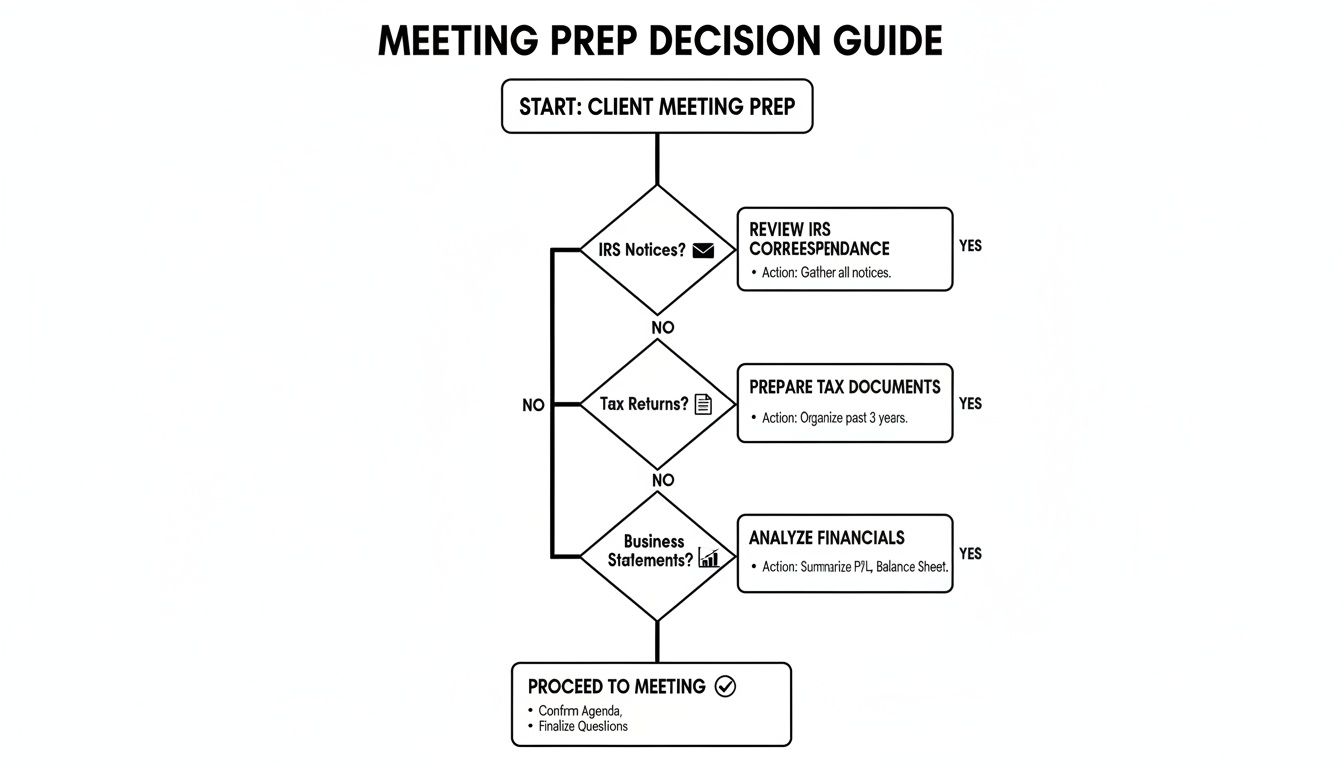
As you can see, it's a methodical process. We work through your IRS notices, past tax returns, and any business financials to build the strongest possible case for you.
Other Strategic Solutions
Beyond an OIC or payment plan, a seasoned tax attorney has a few more tools in their belt.
- Currently Not Collectible (CNC) Status: If you're facing extreme financial hardship and can't even cover basic living expenses, we can petition the IRS to place your account in CNC status. This puts a temporary pause on all collection efforts, giving you breathing room until your financial situation improves.
- Penalty Abatement: Sometimes, the penalties and interest make up a huge chunk of the total debt. An attorney can request a Penalty Abatement, arguing that you had a "reasonable cause" for not filing or paying on time. Legitimate reasons can include a serious illness, a death in the immediate family, or a natural disaster.
One thing is non-negotiable: you must be in filing compliance before the IRS will consider any resolution. For individuals, this generally means filing the last six years of tax returns. Every detail matters here. The IRS cross-checks late-filed returns against all the W-2s and 1099s they have on file for you. Any mismatch is a red flag that could trigger an audit.
For an even more detailed look at these strategies, check out our comprehensive guide to tax debt relief options.
What to Expect: Timelines, Costs, and Red Flags
When you’re facing a tax problem, you need straight answers. Unfortunately, the tax resolution industry is notorious for misleading promises. Let's cut through the noise and talk frankly about what you should realistically expect when it comes to timelines, costs, and the warning signs of a company you shouldn't trust.
How Long Does Tax Resolution Actually Take?
This is always the first question, and the honest answer is: it depends. Your unique financial picture and the specific path we take with the IRS will set the timeline. There are no overnight fixes here.
Here’s a realistic breakdown based on common resolution types:
- Offer in Compromise (OIC): This path requires the most patience. From preparing a flawless submission to getting a final answer from the IRS, you're typically looking at 6 to 12 months. If an appeal is needed, it can take even longer.
- Installment Agreement: Getting a formal payment plan set up is much quicker. We can often have an agreement locked in within 30 to 90 days, which immediately stops aggressive collection actions.
- Currently Not Collectible (CNC) Status: For those in a tough financial spot, we can often secure CNC status relatively fast. Sometimes this happens within a few weeks of the IRS receiving your financial details.
Be deeply skeptical of anyone promising to solve your tax problem in a flash. The IRS moves at its own pace. A successful resolution is a marathon, not a sprint, and it requires persistent, professional follow-up.
What’s the Price Tag for Professional Help?
Just as important as "how long" is "how much." The cost can be a huge source of anxiety, so let's demystify it. You'll generally run into two models: hourly rates and flat fees.
For resolving back taxes, a flat-fee structure gives you clarity and peace of mind. You know the exact cost from day one, no matter how many phone calls or letters it takes.
Hourly billing, on the other hand, can be a runaway train. Complex cases can drag on, and your bill can climb higher and higher each month. It's worth looking into the various alternative fee arrangements firms might use, as this directly affects your financial exposure. We are big believers in transparent, fixed fees that cover everything from the initial investigation to the final handshake with the IRS.
Red Flags That Scream "Run Away!"
The tax resolution world has its share of sharks. Knowing how to spot them can save you from a scam that could leave you in an even worse financial hole.
In 2022, the tax gap from underpayment alone—taxes people reported but didn't pay—was a staggering $94 billion. That kind of money attracts predators looking to cash in on your fear. These are the same issues that can derail a real estate closing or loan application when clients have IRS liens.
Here are the non-negotiable warning signs to watch for:
- Guarantees of "Pennies on the Dollar" Results. This is the oldest trick in the book. No one can guarantee an Offer in Compromise will be accepted. Promising one before a deep dive into your finances is the biggest red flag out there.
- High-Pressure Sales Tactics. If you feel like you're being pushed into a corner to sign a contract and pay a huge fee right now, hang up the phone. A legitimate professional gives you space to make a sound decision.
- Demands for Massive Upfront Fees. A reputable firm will start with a thorough analysis of your situation, often for a smaller, specific fee. Be very wary of anyone demanding thousands of dollars just to look at your case.
- No Access to an Actual Attorney. Are you only ever talking to a "senior case analyst" or salesperson? That’s not legal representation. You must have a direct line to the attorney who is personally handling your case.
Common Questions About Hiring a Tax Attorney
Even after you’ve done your research, deciding to hire a tax attorney is a big step. It’s only natural to have a few more questions. We get it. To give you some peace of mind, let’s walk through the questions we hear most often from people just like you.
Can a Tax Attorney Really Stop IRS Wage Garnishments?
Absolutely. In fact, this is often the very first thing we do to get you some relief.
As soon as you hire us, we file a Power of Attorney (Form 2848) with the IRS. This is a legal document that instantly changes the game. It forces the IRS to stop all direct contact with you and communicate exclusively with our firm.
From there, we can get on the phone with the IRS revenue officer on your case and demand a temporary hold on collections. This can stop wage garnishments and bank levies in their tracks, giving you the breathing room needed to figure out a permanent fix.
It’s like hitting a pause button on the IRS's aggressive tactics. That pause is crucial. It lets us move from a defensive crouch to an offensive stance, where we can build a resolution that works for you, not just for the IRS.
Why Do I Need an Attorney if My CPA Can Handle Back Taxes?
This is a great question because a good CPA is invaluable. But when you're dealing with serious back taxes, the roles of a CPA and a tax attorney are fundamentally different. The core of it comes down to legal authority and protection.
An attorney provides attorney-client privilege, a powerful legal shield that keeps our conversations completely confidential. This protection is far stronger than what a CPA can offer and becomes critical if there's even a hint that your case could be considered criminal. Plus, only a tax attorney can fight for you in U.S. Tax Court if you need to formally dispute an IRS decision.
We often work hand-in-hand with our clients’ CPAs. They focus on the complex accounting and tax preparation, while we build the legal strategy and handle all negotiations with the IRS. It’s a powerful team approach.
What if I Haven't Filed Tax Returns for Many Years?
First off, you’re not alone. This is far more common than you might think, and it’s a problem we know how to fix.
Generally, to be considered "compliant" and eligible for a resolution, the IRS wants to see the last six years of tax returns filed. But we don't just start filling out old forms. That would be a mistake.
The first move for a tax attorney for back taxes is to request your official wage and income transcripts directly from the IRS. This data shows us every W-2, 1099, and other income document they have on record for you. By starting with the IRS's own information, we can prepare returns that are accurate from the get-go, dramatically lowering the risk of a future audit and ensuring we address the entire problem at once.
Is It Possible to Settle My Tax Debt for Less Than I Owe?
Yes, it is. The formal program for this is called an Offer in Compromise (OIC). But you need to be very careful here. It’s not the “pennies on the dollar” magic wand that late-night commercials make it out to be.
Qualifying for an OIC is a tough, detailed legal process. Your attorney has to build a rock-solid case proving to the IRS there’s “doubt as to collectibility”—a legal term meaning that your documented income, expenses, and assets show you’ll likely never be able to pay back the full debt.
Be extremely skeptical of any company that guarantees an OIC. A legitimate firm will never make that promise without first digging deep into your complete financial picture.
Ready to get some clarity on your own tax situation? The first step is to understand exactly what you're facing. At The W Tax Group, we provide a free, no-obligation Tax Debt Analysis to diagnose the problem and show you a clear path forward. Learn more and book your free analysis at https://weisberg.tax.


