The Ultimate Guide to a Tax Amnesty Program
Understand what a tax amnesty program is, who qualifies, and how it can resolve your tax debt. Our guide covers the benefits, process, and alternatives.

In this article
- Getting to the Heart of Tax Amnesty
- Why Do Governments Bother With Amnesty?
- Tax Amnesty Program at a Glance
- What’s the Catch? What Do You Have to Do?
- Who Qualifies for Tax Amnesty and What Are the Benefits
- Unlocking the Core Benefits of Participation
- Interest Reduction and Legal Protection
- How Governments Put Tax Amnesty Programs to Work
- States Use Amnesty to Balance the Books
- National Governments Use Amnesty for Big-Picture Strategy
- Your Step-by-Step Application Guide
- Step 1: Gather Your Financial Records
- Step 2: Prepare and File All Overdue Tax Returns
- Step 3: Complete the Official Amnesty Application
- Step 4: Calculate and Pay What You Owe
- Step 5: Get Confirmation and Stay on the Straight and Narrow
- Comparing Tax Amnesty to Other Relief Options
- Offer in Compromise: The All-or-Nothing Bid
- Installment Agreement: The Slower Path to Resolution
- Comparison of Tax Debt Resolution Options
- When You Should Consult a Tax Professional
- Red Flags That Signal You Need Expert Help
- Taking the Next Step Toward Resolution
- Frequently Asked Questions About Tax Amnesty
- Can I Join an Amnesty Program if I'm Already on a Payment Plan?
- Will Tax Amnesty Ruin My Credit Score?
- What Happens If I Miss the Amnesty Deadline?
Ever found yourself staring at a tax bill that’s grown to a terrifying size, mostly thanks to penalties and interest? You're not alone. When this happens, a tax amnesty program can feel like a lifeline.
Think of it as a limited-time deal offered by the IRS or a state tax agency. They essentially say, "Pay us the original tax you owe, and we'll agree to forget about some, or even all, of the penalties and interest that have piled up." It's a structured way to get a fresh start and put old tax problems behind you.
Getting to the Heart of Tax Amnesty

Let's picture a scenario. A local restaurant owner hits a rough patch for a couple of years and gets behind on their sales tax payments. Before they know it, the original debt has doubled because of steep penalties and daily compounding interest. That debt now feels impossible to climb.
This is exactly where a tax amnesty program comes in. It’s not an informal negotiation; it’s a formal, government-backed initiative to get taxpayers back on the right side of the law. You agree to pay the base tax you originally owed, and in return, the government waives the punitive extras that made the bill so overwhelming. It's a straightforward path to compliance.
Why Do Governments Bother With Amnesty?
It might seem like pure generosity, but tax agencies have very practical reasons for offering these programs. They aren't just forgiving debt for the sake of it—it's a strategic move that benefits them, too.
Here’s what’s in it for the government:
- Quick Cash Infusion: Amnesty programs bring in a flood of revenue without the government having to raise taxes. For instance, the upcoming 2025 Illinois Tax Amnesty Program is designed to collect unpaid taxes from mid-2018 to mid-2024, helping the state balance its books.
- Reduced Administrative Costs: Chasing down every single delinquent taxpayer with audits, liens, and court cases costs a fortune in time and money. Amnesty is a much cheaper way to close thousands of cases at once.
- Cleaning Up the Books: These programs get non-filers to finally step forward. This adds them to the tax rolls for future years and ensures the government has more accurate records.
- Boosting the Economy: When people and businesses are no longer crushed by tax debt, they have more money to spend, invest, and grow. This gives the local economy a healthy push.
This quick table breaks down the core elements of a typical tax amnesty program.
Tax Amnesty Program at a Glance
| Component | Description |
|---|---|
| Limited Window | Programs run for a specific, non-negotiable period (e.g., a few months). |
| Voluntary Disclosure | The taxpayer must come forward on their own initiative. |
| Penalty & Interest Waiver | The main benefit: some or all penalties and interest are forgiven. |
| Full Tax Payment | The original, base tax amount must be paid in full by the deadline. |
| Future Compliance | Participants must agree to stay current on all future tax obligations. |
Understanding these components is key to deciding if a program is the right fit for your situation.
What’s the Catch? What Do You Have to Do?
For the taxpayer, jumping on an amnesty offer means playing by the rules within a very strict timeframe. While each program has its own quirks, the fundamental give-and-get is pretty standard across the board.
A tax amnesty program is essentially a pact. You agree to come clean and pay what you originally owed. In return, the government agrees to wipe away the penalties and interest that made the debt feel unmanageable.
To hold up your end of the bargain, you'll need to voluntarily step forward, file any back-due or amended returns for the amnesty period, and pay the entire base tax you owe before the deadline. It’s all about encouraging voluntary compliance instead of forcing collection.
Successfully completing the program doesn't just clear your past-due accounts. It also protects you from future civil or criminal action for those specific tax years. It’s a clean slate, both financially and legally.
Who Qualifies for Tax Amnesty and What Are the Benefits

A tax amnesty program isn't a free-for-all; it’s a specific opportunity with a clear set of rules. Think of it as a conditional peace treaty offered by the government. The first and most important hurdle is figuring out if you're even eligible to come to the table.
While every program is different, they generally target individuals and businesses who have hit a few common stumbling blocks. You're likely a good candidate if you have unfiled returns from previous years or didn't report all of your income. For instance, a state might open an amnesty window covering all income and sales tax debts from the last five years. If your tax issues fit within that timeframe, you’re probably in a great position to apply.
But there’s a big catch. These programs almost always shut the door on anyone already under criminal investigation for tax fraud. The goal is to encourage people to come forward voluntarily, not to give a get-out-of-jail-free card to those already facing serious legal trouble.
Unlocking the Core Benefits of Participation
So, what’s the real draw of a tax amnesty program? It boils down to significant financial relief. This is more than just paying off a bill; it's about rewriting the financial math to work in your favor.
The single biggest benefit is the waiver of penalties. If you've ever been hit with failure-to-file or failure-to-pay penalties, you know how brutal they can be. These can easily tack on 25% or more to what you originally owed. Amnesty programs often wipe these penalties off the books entirely, which can dramatically slash your total debt.
By participating in a tax amnesty program, you are essentially given the chance to turn back the clock and pay only the original tax debt, freeing yourself from the weight of accumulated penalties and interest.
This relief is a true game-changer. For a small business owner who fell behind on payroll taxes, getting rid of years' worth of penalties could be the difference between closing up shop and keeping the doors open. It turns a debt that felt impossible into something you can actually manage.
Interest Reduction and Legal Protection
On top of waiving penalties, many programs also offer a reduction or complete elimination of the interest that’s been piling up. Compounding interest is relentless, but amnesty can stop it cold for the periods covered. This is crucial for preventing your debt from spiraling even further out of control.
Finally, and this one is huge, participating in a tax amnesty program shields you from civil and criminal prosecution for the specific tax periods you’re settling. When you step forward, file correctly, and pay what's due, you get a clean slate. The peace of mind that comes from this is priceless—no more looking over your shoulder for audits, liens, or levies.
Governments all over the world use this approach because it’s effective. Back in 2006, the General Tax Amnesty in the Philippines brought in P7.15 billion (about $140 million USD) by offering to waive all penalties and interest. It worked, encouraging thousands to come forward and clear their names.
Understanding how to navigate these programs is the key to unlocking these benefits. If you're weighing your options for dealing with a tax problem, you might find our guide on how to qualify for tax forgiveness helpful.
How Governments Put Tax Amnesty Programs to Work

A tax amnesty program isn't some generic, one-size-fits-all policy. Governments get creative with them, tailoring each one to hit specific economic targets. Looking at how different states and even countries have rolled these out shows you they're strategic tools. Sometimes the goal is to plug a budget hole, other times it’s about modernizing taxpayer records or kick-starting the economy.
Once you see the different ways they’re used, you start to recognize the "why" behind any program you might be looking at. It makes the whole idea a lot less abstract and much more real.
States Use Amnesty to Balance the Books
At the state level, think of tax amnesty as a quick and powerful way to generate a burst of cash. When a state is staring down a budget shortfall, rolling out an amnesty program is a popular move. It’s a way to collect overdue taxes without having to pass politically unpopular tax hikes.
A perfect real-world case is the 2025 Illinois Tax Amnesty Program. It’s designed to cover most state taxes due between mid-2018 and mid-2024. By offering to completely waive penalties and interest, Illinois is giving thousands of people and businesses a massive incentive to finally settle up. That means a direct shot of much-needed cash into state coffers.
These state-level programs usually zero in on the most common areas where people fall behind, like:
- Individual and Corporate Income Tax: This gets people who haven't filed returns or may have underreported their income to come forward.
- Sales and Use Tax: This targets businesses that collected sales tax from customers but never managed to send it to the state.
By opening this limited-time window, states create a sense of urgency that turns old, forgotten tax debts into fresh revenue.
National Governments Use Amnesty for Big-Picture Strategy
When you zoom out to the national level, tax amnesty programs can tackle much broader economic challenges. It’s not just about collecting back taxes anymore. Sometimes, the goal is to convince citizens to bring undeclared money stashed in offshore accounts back into the country—a process called repatriation.
Before launching something this big, governments often have to conduct a SWOT analysis to map out the strategic pros and cons. They’re weighing the potential payoff, like a surge in domestic investment and a bigger tax base, against any potential risks.
A successful national amnesty can do more than just collect back taxes; it can fundamentally reshape a country's economic landscape by formalizing billions in previously hidden wealth.
Argentina's 2016 program is a stunning example of this in action. The country was under economic pressure, so it launched a program to encourage people to declare hidden assets, both at home and abroad. The outcome was jaw-dropping. Argentinians declared hidden assets equal to a massive 21% of the country’s GDP. After the amnesty, the national tax base for wealth and capital income more than doubled. It was a game-changer.
This shows how a smart national tax amnesty program can hit several targets at once:
- Increase Transparency: It pulls a huge amount of undeclared money out of the shadows and into the formal financial system.
- Boost Investment: Once that money is back in the country, it can be invested in local businesses and projects, fueling growth.
- Expand the Future Tax Base: After these assets are declared, they (and the income they produce) are on the government's radar for good, creating a more stable source of tax revenue for years.
Whether it’s a state trying to fix a budget crisis or a nation trying to overhaul its entire economic foundation, tax amnesty is an incredibly versatile tool. The specific design of any program is a direct reflection of the unique financial goals and challenges of the government behind it.
Your Step-by-Step Application Guide
Jumping into a tax amnesty program can feel a bit overwhelming, but it's really just a matter of following a clear set of steps. If you break it down, the process is far more manageable. Think of it as a roadmap to get you from tax debt to a clean slate.
The most common reason applications get rejected? Missing or incorrect information. Getting organized from the very beginning is the single most important thing you can do to ensure success.
Step 1: Gather Your Financial Records
Before you fill out a single form, you need to pull together a complete financial picture for all the years the amnesty program covers. This is the bedrock of your application. It’s like gathering your ingredients before you start to cook—skip this, and you’re setting yourself up for failure.
You'll need to round up documents like:
- Proof of Income: W-2s from employers, 1099s for contract work, and any other income records.
- Business Financials: If you run a business, this means profit and loss statements, balance sheets, and receipts for your expenses.
- Bank Statements: These are crucial for verifying both your income and your expenses.
- Old Tax Filings: Even if they were wrong, they're a good place to start.
Step 2: Prepare and File All Overdue Tax Returns
Here's the non-negotiable part: you have to get fully caught up. Every single tax amnesty program requires you to prepare and file all of the tax returns you missed or need to correct for the amnesty period. This is how you show the tax agency you’re serious about getting back on track.
Frankly, this can be the trickiest step, especially if you're dealing with several years of unfiled taxes. All that record-keeping from Step 1 really comes into play here. If you find yourself stuck, our complete guide to help with unfiled tax returns can give you some more detailed strategies.
Step 3: Complete the Official Amnesty Application
Once your returns are filed, it’s time to fill out the official amnesty application. This is a specific form provided by the state or federal agency that formally enrolls you in the program.
Pay very close attention to the details and, most importantly, the deadlines. These programs are not open-ended. For example, the 2025 Illinois Tax Amnesty Program is only open from October 1 to November 17, 2025. If you miss that window, the opportunity is gone.
Step 4: Calculate and Pay What You Owe
With your application ready, you'll calculate the base tax you owe for the amnesty period. The whole point of amnesty is that the government agrees to waive the hefty penalties and interest—but you still have to pay the original tax you owed.
The core of the amnesty deal is simple: you pay the tax, and they forgive the extras. Make sure you submit the full tax payment before the final deadline to lock in the benefits.
Tax agencies usually provide a few ways to pay, like online portals or mailing a check. Just be sure you're paying the exact amount to the right place to avoid any snags.
Step 5: Get Confirmation and Stay on the Straight and Narrow
After you've sent everything in, you should get a confirmation letter from the tax agency. This is your proof that you’ve successfully completed the program, so keep it somewhere safe.
But your work isn't quite done. The final string attached to any tax amnesty program is your commitment to stay compliant in the future. You have to file and pay your taxes on time, every time, moving forward. If you slip up, the agency can void your amnesty agreement and reinstate all those penalties and interest charges you worked so hard to get rid of.
Comparing Tax Amnesty to Other Relief Options
A tax amnesty program can be a game-changer, but it's not the only way to tackle a mountain of tax debt. Think of it like trying to cross a river. The ferry (amnesty) is a fantastic, direct option, but it only runs at certain times. If the ferry isn't available, you might need to take the long, steady bridge (Installment Agreement) or try to convince a private boat owner to take you across for a fraction of the cost (Offer in Compromise). The best route depends entirely on your situation and what's available.
Choosing the right path is crucial. While amnesty offers a clean slate by wiping out penalties and interest, other solutions like an Offer in Compromise or an Installment Agreement are designed for different scenarios. It's vital to understand the pros and cons of each before you commit to a strategy.
Offer in Compromise: The All-or-Nothing Bid
An Offer in Compromise (OIC) is often considered the holy grail of tax resolution. It’s an agreement with the IRS to settle your tax liability for less than the full amount you owe. It sounds amazing, but there's a huge catch: it's incredibly difficult to get approved.
The IRS only accepts an OIC if they're convinced they'll never be able to collect the full debt from you. You have to open up your entire financial life and prove, with exhaustive documentation, that your "reasonable collection potential" is less than what you owe. This is a very high bar to clear.
An Offer in Compromise is a high-stakes negotiation where you must prove severe financial hardship. A tax amnesty program, on the other hand, is a straightforward, rules-based opportunity with clear eligibility.
An OIC can slash your debt significantly, but the application process is long, invasive, and has a low success rate. It's a lifeline for those in truly dire financial straits, not for someone who just fell a bit behind.
Installment Agreement: The Slower Path to Resolution
The Installment Agreement is the most common and straightforward form of tax relief. It's simply a payment plan that lets you pay off your full tax debt in manageable monthly payments over time. If you can afford to pay what you owe but just need more time to do it, this is often the go-to solution.
The big drawback? Penalties and interest continue to pile up until the entire debt is paid off. An Installment Agreement will stop aggressive collection actions like wage garnishments, but it won't reduce your total bill. In contrast, a tax amnesty program does the opposite—it requires you to pay the base tax owed, but it erases the very penalties and interest that an installment plan allows to grow.
This flowchart maps out the typical journey for someone applying for tax amnesty.
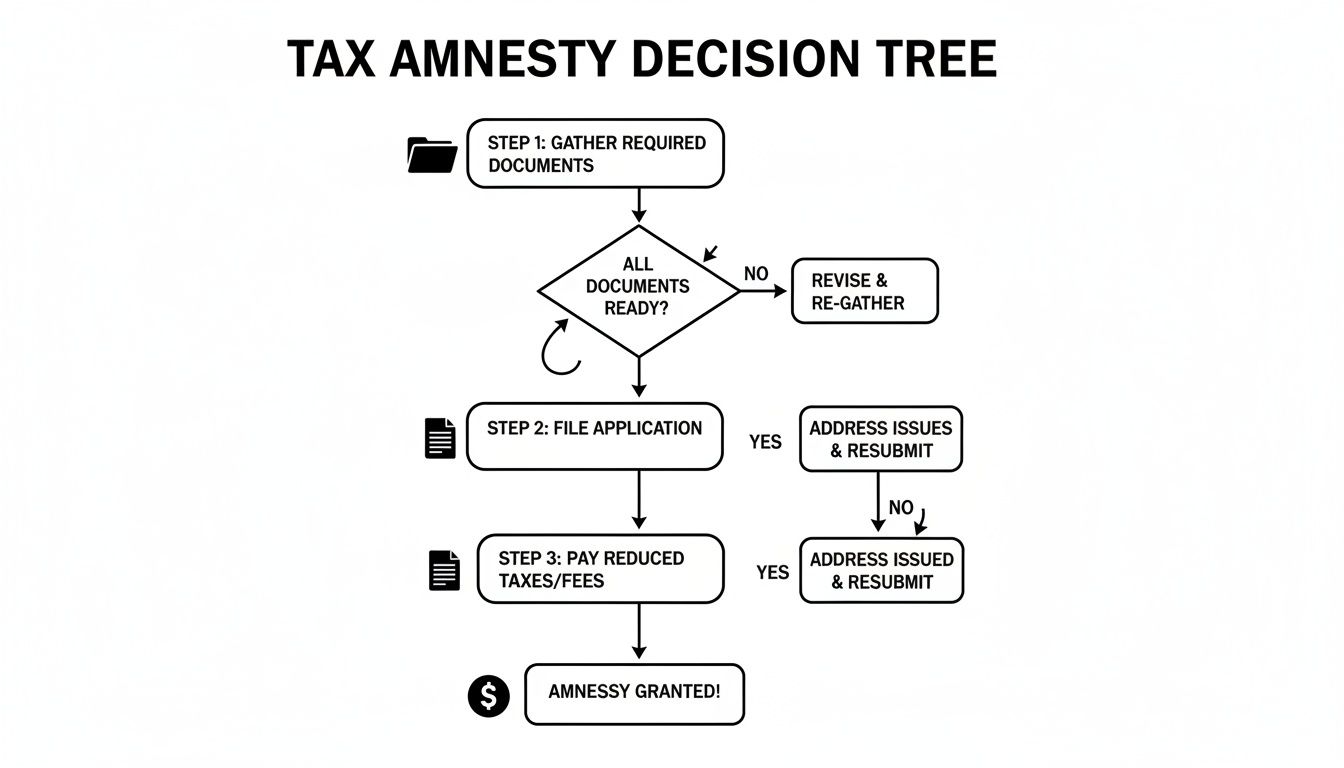
As you can see, the process is linear. It's about getting your records in order, filing the necessary paperwork correctly, and paying the core tax amount to get your slate wiped clean.
To help you see how these options stack up side-by-side, here’s a quick comparison.
Comparison of Tax Debt Resolution Options
| Feature | Tax Amnesty Program | Offer in Compromise (OIC) | Installment Agreement |
|---|---|---|---|
| Primary Goal | Waive penalties & interest | Settle tax debt for less than the full amount | Pay the full debt over time |
| Availability | Limited-time state/federal offers | Always available, but hard to qualify for | Generally available to most taxpayers |
| Financial Requirement | Must be able to pay the full base tax owed | Must prove severe financial hardship | Must be able to make consistent monthly payments |
| Total Amount Owed | Reduces total debt by removing penalties | Can significantly reduce total debt | Increases over time due to accruing interest |
| Complexity | Relatively straightforward, rules-based | Extremely complex and document-intensive | Relatively simple and easy to set up |
Each of these tax debt relief options serves a distinct purpose. Tax amnesty is a golden opportunity if you qualify and it's being offered. But if one isn't available, an OIC or an Installment Agreement might be the right path for your specific financial circumstances.
When You Should Consult a Tax Professional
Trying to navigate a tax amnesty program on your own can be tempting. You might think you can save a few bucks by handling it yourself, and sometimes, for simple cases, you can. But think of it this way: you can probably handle painting a room, but would you try to rewire your entire house? When the stakes are high and a mistake could be catastrophic, you call in a licensed professional.
It's the exact same principle with serious tax issues. The financial and legal consequences can be life-altering. Knowing when to raise your hand and ask for help is crucial.
Red Flags That Signal You Need Expert Help
Some tax situations are more than just complicated; they’re potential minefields. If you find yourself in any of the scenarios below, it's a clear signal that it's time to stop what you're doing and get professional advice.
It’s time to call a tax attorney if you're dealing with:
- Large Tax Liabilities: When the amount you owe is substantial, a single mistake on an application can cost you thousands. An expert's job is to get every detail right to maximize your relief and protect your finances.
- Complex Business Taxes: Payroll taxes, sales taxes, and corporate income taxes are notoriously tricky. Each comes with its own set of rules and pitfalls that a seasoned pro knows how to navigate.
- Potential Criminal Exposure: If there's even a slight chance the IRS could interpret your actions as willful tax evasion, you need legal protection immediately. A tax attorney can shield you from criminal investigation and defend your rights.
- Many Years of Unfiled Returns: Trying to piece together years of missing financial records is a monumental task. A professional has the systems and experience to reconstruct your history accurately and efficiently.
A good tax professional is more than just a preparer—they're your guide and your advocate. They don't just fill out the forms correctly; they stand between you and the tax agency, handling the intimidating communications and negotiations for you.
This kind of expert intervention does more than just save you stress; it often leads to a much better financial outcome than you could ever get on your own. For those with intricate financial histories that extend beyond just tax debt, exploring financial consulting services can also offer a broader level of support.
Taking the Next Step Toward Resolution
If you know you need help but aren't sure where to begin, a good first step is to get an initial analysis from a reputable tax firm. This will give you a clear picture of what you're up against and what a path forward actually looks like. If you'd like to learn more about choosing the right person for the job, our guide to tax debt relief companies is a great resource for finding expert help you can trust.
Don't let fear or confusion keep you stuck. The sooner you bring in an expert, the sooner you can close this chapter and move on.
Frequently Asked Questions About Tax Amnesty
Even when you have a good grasp of what tax amnesty is, real-world questions always pop up when you start thinking about your own tax situation. Let's walk through some of the most common things people ask when they're looking at this powerful option.
Can I Join an Amnesty Program if I'm Already on a Payment Plan?
This is a fantastic question, and one I hear all the time. For many programs, the answer is a resounding yes. Being on an installment agreement with a state or the IRS doesn't usually kick you out of the running for a new amnesty program.
It helps to think of it this way: your current payment plan is the slow, scenic route to resolving your debt. A tax amnesty program is a brand new, limited-time-only expressway that just opened up. The specific rules of the program will always have the final say, but many are intentionally designed to bring taxpayers who are already trying to pay into the fold. It can be a brilliant financial move, allowing you to clear the core tax debt while wiping out all the future penalties and interest that would have kept piling up.
Think of it like this: getting into an amnesty program while on a payment plan is like being offered a chance to refinance a high-interest loan at zero percent. You get to stop the bleeding from penalties and interest and just focus on paying off what you originally owed.
Will Tax Amnesty Ruin My Credit Score?
Most people are understandably worried about how their tax troubles will affect their credit, but I have some good news for you on this front. Tax agencies like the IRS or state tax departments don't report your payment activities to the big three credit bureaus—Experian, Equifax, or TransUnion. So, just entering a tax amnesty program won't directly ding your credit score.
The catch, however, is the tax lien. If your back taxes were large enough, the government might have filed a Notice of Federal Tax Lien. That lien is public record, and it can absolutely wreck your credit.
- Before Amnesty: A tax lien is a huge red flag for lenders. It tells them you have a significant, unresolved government debt, which makes getting a mortgage, car loan, or even a credit card much more difficult.
- After Amnesty: Paying off the debt through the amnesty program is your key to getting that lien removed. Once the lien is officially withdrawn, your credit score has a clear path to start healing and improving over time.
What Happens If I Miss the Amnesty Deadline?
I can't stress this enough: tax amnesty deadlines are set in stone. These programs are intentionally short-lived to create a powerful incentive for people to act now. When that window slams shut, the opportunity is gone—often for years.
Missing the deadline means you forfeit the chance to have all those crushing penalties and interest waived. Your debt goes right back to its full, intimidating amount, and the tax agency will pick up its collection efforts right where it left off. You'll be back to square one, looking at a standard payment plan (where interest keeps growing) or facing much harsher actions like liens and wage garnishments. The government's olive branch will have been officially pulled back.
Navigating tax debt is complicated, and figuring out the best move requires a clear-eyed look at your specific circumstances. At Attorney Stephen A Weisberg, we believe you deserve clarity before you make any commitment. We offer a FREE Tax Debt Analysis to break down your situation and lay out all your options, giving you a solid strategy before you take another step. If you're struggling with tax challenges, let us help you find the best way forward.
Learn more and get your free analysis at https://weisberg.tax.