Substantial Authority Standard: Your Guide to IRS Penalties
Navigate the IRS substantial authority standard to avoid tax penalties. Learn how to document your position, compare standards, and know when to seek help.
In this article
- What Is the Substantial Authority Standard
- Think of it as a legal scale
- Why this standard exists
- How Substantial Authority Compares to Other Standards
- The confidence spectrum
- What the differences mean in practice
- Where professionals make costly judgment calls
- Documenting Your Substantial Authority Position
- What counts and what doesn't
- A workable memo-to-file approach
- Common documentation mistakes
- Real-World Examples and High-Stakes Scenarios
- Income tax disputes where the standard actually matters
- The payroll tax trap
- Why this difference matters for LLCs and closely held businesses
- A Practitioner's Checklist for Supporting Tax Positions
- The working checklist
- What this looks like in professional practice
- Final pre-filing questions
- When to Engage IRS Controversy Counsel
- Situations where waiting gets expensive
- Why controversy counsel changes the posture
You may be staring at a return position that feels defensible, but not comfortable. A deduction has support. A credit claim has logic. The facts are true. Still, you know the IRS may see it differently, and the core question isn't just whether the position is arguable. It's whether it can survive a penalty challenge.
That's where the substantial authority standard matters. For many business owners, sole proprietors, and the CPAs who advise them, this standard is the line between taking a legitimate position and stepping into avoidable penalty exposure. It's also one of the most misunderstood concepts in tax practice.
The misunderstanding gets more dangerous when taxpayers carry income tax concepts into payroll tax problems. A business owner who thinks, “We had a good-faith legal position,” may be talking about the wrong battlefield entirely if the IRS is pursuing payroll tax debt or a Trust Fund Recovery Penalty.
What Is the Substantial Authority Standard
A common version of this problem looks like this. A business owner claims a deduction that isn't frivolous, but it also isn't squarely blessed by a single clean authority. The return goes out without disclosure. Months later, the IRS proposes an adjustment and adds an accuracy penalty.
The first defense question is whether the return position met the substantial authority standard.

The standard is legally defined in 26 CFR § 1.6662-4(d)(2) and serves as the threshold for avoiding the accuracy-related penalty for a substantial understatement of income tax under IRC Section 6662, as discussed in The Tax Adviser's analysis of substantial authority. The rule applies to returns due after December 31, 1982, and it requires that the weight of authorities supporting the treatment be substantial in relation to the weight of authorities supporting contrary treatment.
Think of it as a legal scale
This isn't a headcount test. You don't win because you found more citations than the IRS found. You weigh authorities the way a lawyer or IRS appeals officer would weigh them. The Internal Revenue Code matters. Treasury Regulations matter. Strong court precedent matters. Adverse authority matters too.
If a taxpayer ignores contrary authority, the analysis fails at the start. The regulation requires consideration of all authorities, not just the favorable ones.
Practical rule: If your file only contains the cases and rulings that help you, you probably haven't done a substantial authority analysis. You've done advocacy without risk assessment.
Why this standard exists
The rule serves a practical purpose. It protects taxpayers who take a well-researched position without disclosure when the legal support is meaningful, even if the answer isn't certain. In practice, it separates serious legal analysis from wishful reporting.
That also means substantial authority is not the same thing as “my preparer was comfortable with it” or “someone in my industry does this.” Those facts may explain why a position was taken, but they don't establish the standard.
When the issue is already in dispute, the next question is tactical. Do you defend the legal support, pursue another relief path, or both? In some cases, a broader IRS penalty abatement strategy may matter alongside the technical authority analysis.
How Substantial Authority Compares to Other Standards
Many taxpayers collapse all tax standards into one question: “Can I defend this?” The IRS doesn't analyze uncertain positions that way. Tax law uses a ladder of standards, and the standard you need depends on what kind of position you're taking and whether you disclosed it.
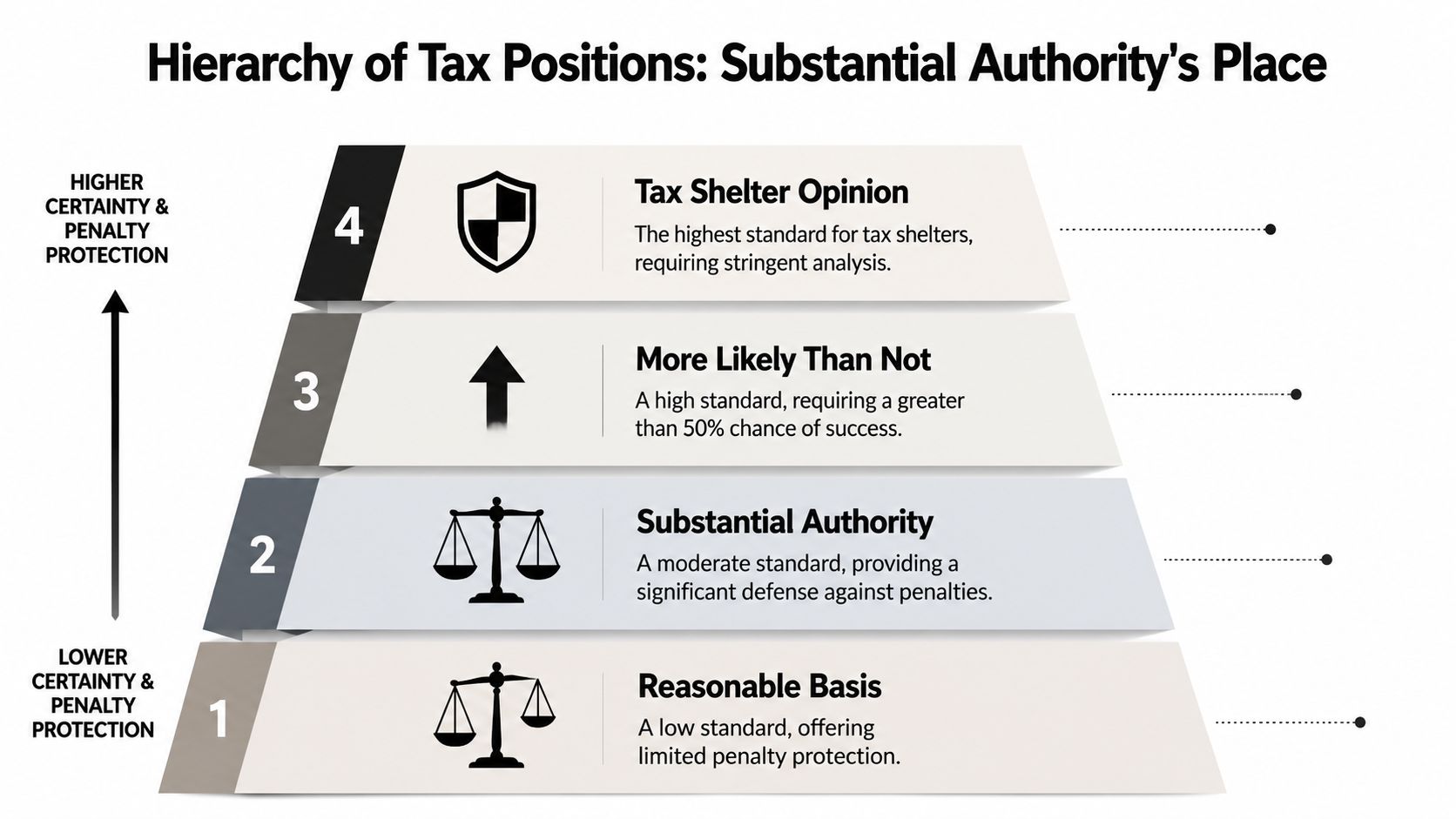
The substantial authority standard sits in the middle. It's stronger than a minimally defensible position, but it isn't the highest burden in the system.
The confidence spectrum
Expert analysis places substantial authority at roughly 40% confidence that the position would be sustained on its merits, which sits between reasonable basis at approximately 20%+ confidence and more likely than not at over 50% confidence, as explained in this analysis of the substantial authority confidence level.
That estimate helps because the term “substantial” misleads people. Many hear it and assume it means probable. It doesn't. It means there is real legal support, but not necessarily a better-than-even chance of success.
What the differences mean in practice
If you have reasonable basis, that may be enough to avoid certain penalty exposure if the position is properly disclosed on Form 8275. If you have substantial authority, a non-tax-shelter position may avoid the penalty without disclosure. If the law requires a more likely than not standard, the burden is higher, and a position that merely clears substantial authority won't be enough.
For practitioners, many files encounter issues here. The legal memo says the issue is “supportable,” but never states which standard is being met.
| Standard | Approx. Confidence Level | Penalty Protection (Non-Shelter) | Requires Disclosure (Form 8275) |
|---|---|---|---|
| Reasonable Basis | Approximately 20%+ | Limited protection if properly disclosed | Often yes |
| Substantial Authority | Roughly 40% | Significant defense against substantial understatement penalty | Not required for non-shelter items if standard is met |
| More Likely Than Not | Over 50% | Higher level of protection where this standard applies | Depends on issue |
| Tax Shelter Opinion | Higher standard | Specialized context with stricter analysis | Depends on issue |
Where professionals make costly judgment calls
A cautious preparer may disclose anything uncertain. That can be the right call, but not always. Disclosure can invite scrutiny, and it can signal that the legal support is weaker than the taxpayer hoped. On the other hand, failing to disclose when the file doesn't reach substantial authority can create a preventable penalty problem.
A strong tax file doesn't just reach a conclusion. It identifies the applicable standard, explains why that standard is met, and says what fallback position exists if the IRS disagrees.
This is also why penalty defense often overlaps with other abatement arguments. A return position might fall short of substantial authority but still support another form of relief, such as the framework discussed in reasonable cause IRS penalty abatement guidance.
Documenting Your Substantial Authority Position
The IRS cares less about what you believed after the audit notice arrived than what support existed when the return was filed or on the last day of the taxable year to which the return relates. That timing point matters. So does the quality of the authority in your file.
A substantial authority position should be documented like a litigation file in miniature. Not bloated. Not padded with secondary commentary. Just disciplined.
What counts and what doesn't
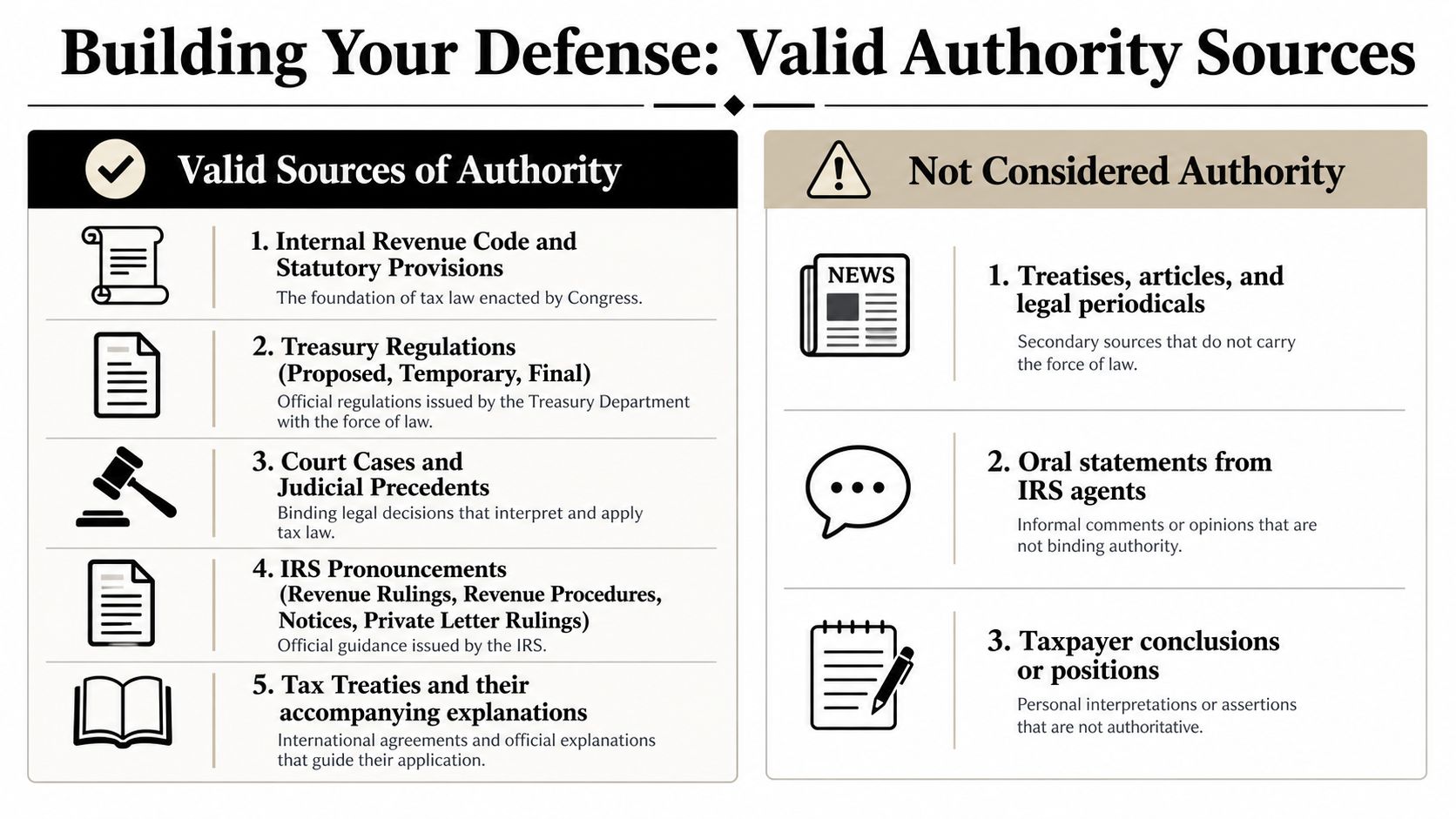
Under the regulation, the standard is a weight-of-evidence test using sources such as the Internal Revenue Code, Treasury Regulations, and controlling court precedent. The rule also excludes non-authoritative material such as treatises, legal periodicals, and opinions rendered by tax professionals, as stated in the text of 26 CFR § 1.6662-4.
That exclusion catches people off guard. A beautifully written article may be useful for research. A memo from a respected CPA may help the client understand the issue. Neither is itself authority for this test.
A workable memo-to-file approach
A practical memo should answer five questions:
- What is the exact tax treatment? State the item and the reporting position precisely.
- What facts control the issue? Include the facts that help and the facts that hurt.
- Which authorities support the treatment? Use primary authority only.
- Which authorities cut the other way? Don't bury them.
- Why does the favorable side carry substantial weight? Explain relevance and persuasiveness.
The best files are specific. They don't say “case law supports deductibility.” They identify the controlling code section, the regulation language, and the strongest judicial precedent in the taxpayer's appellate path.
Common documentation mistakes
Some mistakes show up repeatedly in audits:
- Relying on analysis instead of authority. A secondary article may point you in the right direction, but it doesn't carry weight in the calculation.
- Ignoring unfavorable facts. A legal rule that looks helpful may collapse if one key fact differs.
- Skipping adverse authority. If there's a regulation, case, or ruling on point against you, it belongs in the memo.
- Writing the memo after the dispute starts. Reconstruction is rarely as persuasive as contemporaneous analysis.
Keep the memo in the file before the return becomes controversial. That alone changes the tone of many examinations.
If an audit begins, the quality of this file can shape the entire interaction with the revenue agent. Good preparation before that stage is covered in this guide on how to prepare for an IRS audit.
Real-World Examples and High-Stakes Scenarios
The substantial authority standard becomes clearer when you apply it to the kinds of decisions small businesses face.
A sole proprietor may take an aggressive position on a mixed-use expense because the statute and one line of authority support allocation, while another line suggests the facts are too personal. An independent contractor may claim a tax benefit under a novel reading of a provision that hasn't been heavily litigated. An S corporation owner may report an item one way because the strongest appellate precedent available is favorable, even though other jurisdictions have gone the other way.
Those can be real substantial-authority questions. The issue is legal support weighed against contrary legal support.
Income tax disputes where the standard actually matters
In an income tax examination, substantial authority often becomes useful when the taxpayer didn't disclose the position and needs a penalty defense after the IRS proposes an adjustment. The taxpayer may still lose the underlying tax issue and yet defeat the accuracy-related penalty if the legal support was substantial when the return was filed.
That distinction matters. Tax due and penalty exposure are related, but they are not identical questions.
A referring CPA should keep that in mind when explaining a case to controversy counsel. “The client may owe the tax” is not the same as “the client should concede the penalty.”
The payroll tax trap
Many business owners commonly get burned. They assume the same framework applies when the IRS is pursuing payroll tax debt or investigating responsibility for unpaid withholding taxes. It usually doesn't.
For income tax understatements, the existence of substantial authority can waive the 20% substantial understatement penalty. But the Trust Fund Recovery Penalty under IRC § 6672 is different. It is 100% of the unpaid trust fund taxes, and that penalty is not waived through the same substantial-authority mechanism because the central issue is willfulness, which is generally a factual determination, as discussed in this William & Mary tax scholarship analysis of trust fund penalty issues.
That changes the defense posture completely.
If the IRS says a person was responsible and willful, the response is not usually, “We had substantial authority for our interpretation.” The response is factual and procedural. Who had control over disbursements? Who knew the taxes weren't being paid? Who chose which creditors got paid? Who had authority, and who exercised it?
In payroll tax cases, business owners often look for a legal-standard defense when the real fight is over facts, responsibility, and willfulness.
Why this difference matters for LLCs and closely held businesses
In multi-member LLCs, family businesses, and struggling operating companies, responsibility can be diffuse on paper and concentrated in practice. One owner signs checks. Another handles operations. A controller or outside payroll service enters data. The IRS may still assess individuals if it believes they were responsible and acted willfully.
That's why a business owner with payroll tax debt should be cautious about relying on income-tax advice models. A carefully reasoned deduction memo won't solve a Trust Fund Recovery Penalty interview. These are different controversies with different defenses.
A Practitioner's Checklist for Supporting Tax Positions
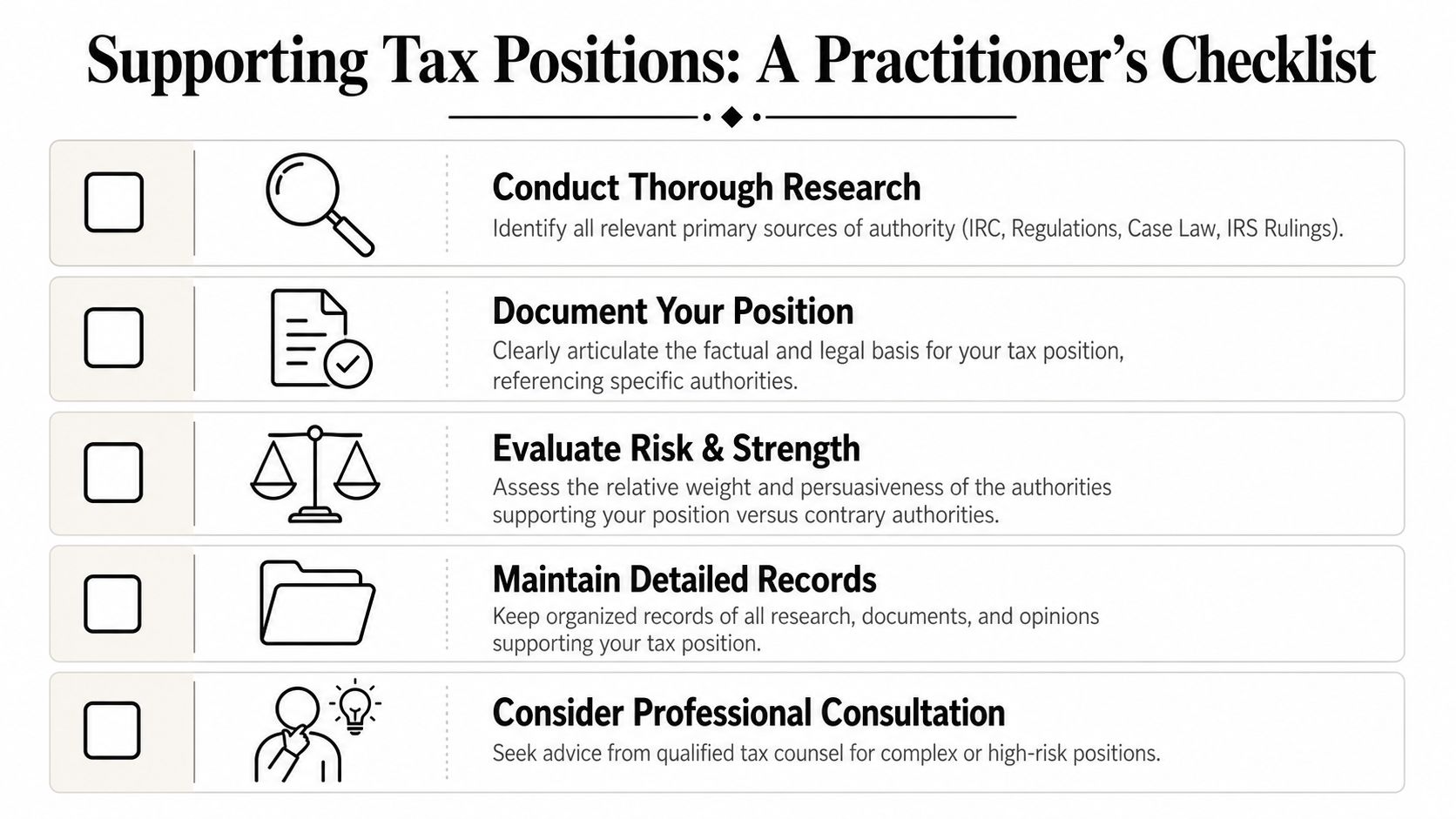
When a return position is uncertain, the worst approach is informal confidence. The best approach is a repeatable process. That process should be tight enough for a CPA firm and practical enough for a business owner who wants to understand the risk before signing the return.
The working checklist
- Pin down the exact position. Don't analyze “the deduction” in the abstract. Define the item, the year, the entity, and the treatment on the return.
- Lock the facts first. If the facts are fluid, the legal analysis will be unreliable. Gather the agreements, invoices, payroll records, correspondence, and books that matter.
- Research primary authority only. Start with the Code, regulations, official IRS pronouncements, and court opinions that are on point.
- Look for the bad law deliberately. This step can't be delegated mentally to the IRS. Search for contrary authority before the IRS does.
- Weigh relevance, not volume. One controlling authority may matter more than a stack of weaker materials.
- Write the conclusion down. A memo-to-file beats a verbal impression every time.
- Decide whether disclosure is the safer path. If the file doesn't reach substantial authority, consider whether disclosure and a lower standard may better manage the risk.
What this looks like in professional practice
Not every issue justifies a long legal memorandum. Some need a short internal write-up. Others require a fuller analysis because the amount at stake is meaningful, the issue is novel, or the facts are uneven.
That judgment comes up in planning work too. For example, when clients ask about transaction structuring, real estate exits, or reinvestment strategies, lawyers often need to separate planning ideas from positions that may later need to be defended. A useful example is this discussion of deferring California capital gains taxes, which shows why tax strategy should be reviewed through both a planning lens and a supportability lens.
Final pre-filing questions
Before signing off, ask three direct questions:
- If the IRS challenges this, what is our best authority?
- What is the strongest contrary authority?
- Would we be comfortable handing this file to an auditor today?
If the answer to the last question is no, the return position probably needs more work.
When to Engage IRS Controversy Counsel
Some tax positions can be vetted internally by a strong CPA or EA with good research discipline. Others need controversy counsel because the issue is no longer just return preparation. It has become risk management, procedural strategy, and defense.
The clearest trigger is uncertainty at the authority level. If the position has support, but the support is mixed, a controversy attorney can help assess whether the file meets the applicable standard or whether disclosure, amendment, or another approach is safer.
Situations where waiting gets expensive
Engage counsel when any of these are true:
- An audit notice has arrived and the return includes an aggressive position. The analysis now needs to be translated into an examination response.
- The file contains authority, but the contrary authority is serious. This is where weighting and framing matter.
- The taxpayer's preparer is uncomfortable being the advocate. That's common, and often appropriate.
- The issue involves payroll tax debt or a Trust Fund Recovery Penalty. Those cases are too fact-sensitive and high-risk to treat casually.
- Multiple parties are involved. Partners, officers, payroll managers, or family members may have conflicting interests.
- The client may owe tax but wants to contest penalties. That is a distinct strategic posture.
Why controversy counsel changes the posture
A controversy lawyer doesn't just research the issue. Counsel evaluates how the IRS will develop the record, what facts need to be protected, whether statements should be limited, which documents should be emphasized, and when a case should move from examination to Appeals.
That matters even more in payroll tax matters. Once the IRS starts building a responsibility and willfulness case, casual explanations by owners or staff can create lasting damage. A legal standard that works on an income tax return won't rescue a bad factual record in a payroll investigation.
The right time to involve controversy counsel is usually before the taxpayer has explained the case poorly, produced documents out of sequence, or treated a payroll tax matter like an ordinary audit.
A practical rule for CPAs and business owners is simple. If the issue feels like it may turn into a defense file rather than a preparation file, it's time to review when to hire a tax attorney.
If you're dealing with a disputed tax position, an audit, payroll tax debt, or a proposed Trust Fund Recovery Penalty, Attorney Stephen A Weisberg offers a free Tax Debt Analysis to determine whether he can help and what path makes sense before any engagement begins.


