IRS Streamlined Installment Agreement: A 2026 Guide
Confused by tax debt? Learn how an IRS Streamlined Installment Agreement can help. This guide covers new 2026 rules, eligibility, and how to apply.

In this article
- Feeling Overwhelmed by Tax Debt You Can't Pay
- What Is an IRS Streamlined Installment Agreement
- The old term and the current reality
- Why taxpayers care about this distinction
- Who Qualifies for a Streamlined Agreement
- The balance test that trips people up
- A practical checklist
- What the monthly payment means in real life
- How to Apply for Your IRS Payment Plan
- Applying online
- Applying by phone
- Applying with Form 9465
- What tends to work and what doesn't
- Key Benefits and Important Considerations
- What works in your favor
- What you still have to live with
- Streamlined Agreement vs Other IRS Options
- IRS tax debt options at a glance
- How to think about the choice
- Common Mistakes and When to Call an Attorney
- Mistakes that create bigger problems
- When legal help makes sense
You open the IRS notice, scan the balance, and your stomach drops. You know you can't pay it in one shot. Your mind jumps straight to wage garnishments, bank levies, and a tax lien showing up at the worst possible time.
That reaction is normal. It's also where a lot of taxpayers make their first mistake. They freeze, or they start reading outdated guidance that makes the situation look harsher than it is.
For many people, tax debt isn't a dead end. It's an installment problem. The IRS has long had payment plan options for people who can't pay immediately, and the rules got more practical with the newer Simple Installment Agreement framework that took effect in 2025. That change matters because many articles still describe the older Simplified Installment Agreement rules as if nothing changed.
If you're searching for a simplified installment agreement in 2026, you're usually trying to answer three real questions. Can I qualify without turning my life inside out. How much will the IRS make me pay each month. And can I avoid a federal tax lien while I get back on track.
Those are the right questions. The jargon is secondary.
A payment plan with the IRS works best when you treat it as a compliance tool, not just a monthly bill. The right agreement can stabilize the case, stop the account from moving deeper into collections, and give you room to solve the tax problem without creating a new financial crisis. The wrong approach, especially one based on old rules, can push you into terms you don't need to accept.
Feeling Overwhelmed by Tax Debt You Can't Pay
Tax debt has a way of making everything else feel urgent. People start worrying about payroll, rent, mortgage payments, pending loan applications, divorce issues, or whether a real estate closing is about to fall apart because of an IRS balance they can't clear today.
The pressure gets worse when the notices use collection language without explaining the practical path forward. Most taxpayers don't need a crash course in IRS procedure. They need to know whether there's a structured way to resolve the debt before the situation escalates.
There usually is.
An IRS installment agreement is often the first option I look at when someone owes money but has a realistic path to paying over time. It's not exotic. It's not a loophole. It's the standard way many taxpayers resolve a balance they can't pay immediately while staying in compliance.
Practical rule: Don't wait for the IRS to make the next move if you already know full payment isn't possible. Early action usually preserves more options.
What's changed, and what many taxpayers still miss, is that the old simplified framework is no longer the whole story. The newer rules are more forgiving in the places that matter most to real people. Payment terms can be longer. Lien avoidance is easier in many cases. And the process is still designed to be simpler than a full financial disclosure case.
That matters if you're self-employed, running a small business, or carrying a balance that looked impossible under the old monthly payment formula. A plan that once felt too aggressive may now be workable.
Fear makes people assume the IRS only has two settings. Pay in full or face enforcement. In practice, there's a middle ground. If you qualify, the issue shifts from crisis management to monthly budgeting, timing, and staying current going forward.
What Is an IRS Streamlined Installment Agreement
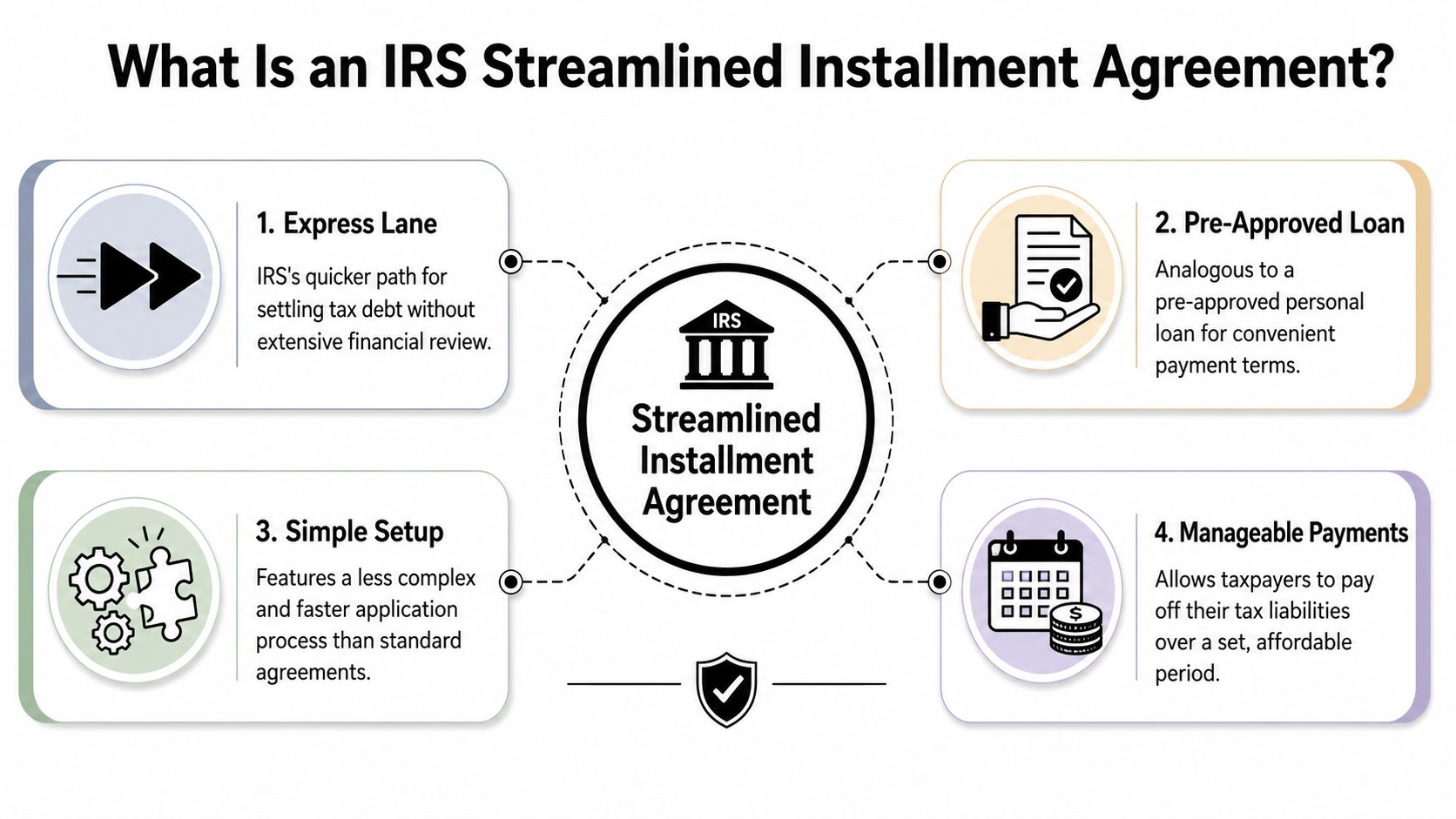
The phrase expedited installment agreement is still commonly used because that's the term that dominated IRS payment plan discussions for years. In plain English, it meant the IRS's express lane for certain payment plans. If your balance fit within the allowed range, you could often get approved without the deeper financial disclosure that shows up in more contested collection cases.
The best analogy is a pre-screened financing option. Not because tax debt works like consumer lending, but because the core feature is similar. If you fit the preset criteria, the process is simpler and faster than a custom underwritten arrangement.
The old term and the current reality
The important distinction is this. The legacy Installment Agreement, or SLIA, is the older framework. The Simple Installment Agreement, effective March 5, 2025, is the newer one that many individual taxpayers will care about now.
Under the updated rules, the payment period can extend to 120 months (10 years), which is a 67% increase in flexibility over the old 72-month cap, according to NATP's discussion of the new Simple Installment Agreement. That single change is often the difference between a plan someone can keep and one that was set up to fail.
A lot of consumer guides still describe the discontinued expedited installment agreement terms as if they're current. That's where taxpayers get bad expectations. They calculate a monthly payment under the older rules, decide it's impossible, and never apply.
Why taxpayers care about this distinction
The newer framework matters for practical reasons:
- Lower monthly pressure: Spreading the balance over a longer period can make the required payment more manageable.
- Less paperwork: A simplified plan is designed to avoid a full financial statement in qualifying cases.
- Better timing decisions: A taxpayer who thought a payment plan was out of reach may now have a current, workable option.
If you're reviewing options with a professional, the right question isn't whether the old simplified installment agreement still exists in the same form. The better question is whether your case now fits the newer simple agreement standards and whether that changes the strategy. For a closer look at the mechanics of IRS payment plans generally, this overview of an installment agreement with the IRS is a useful starting point.
Many payment plan problems don't come from the IRS rejecting the case. They come from the taxpayer relying on outdated rules and never asking for the plan they could have received.
Who Qualifies for a Streamlined Agreement
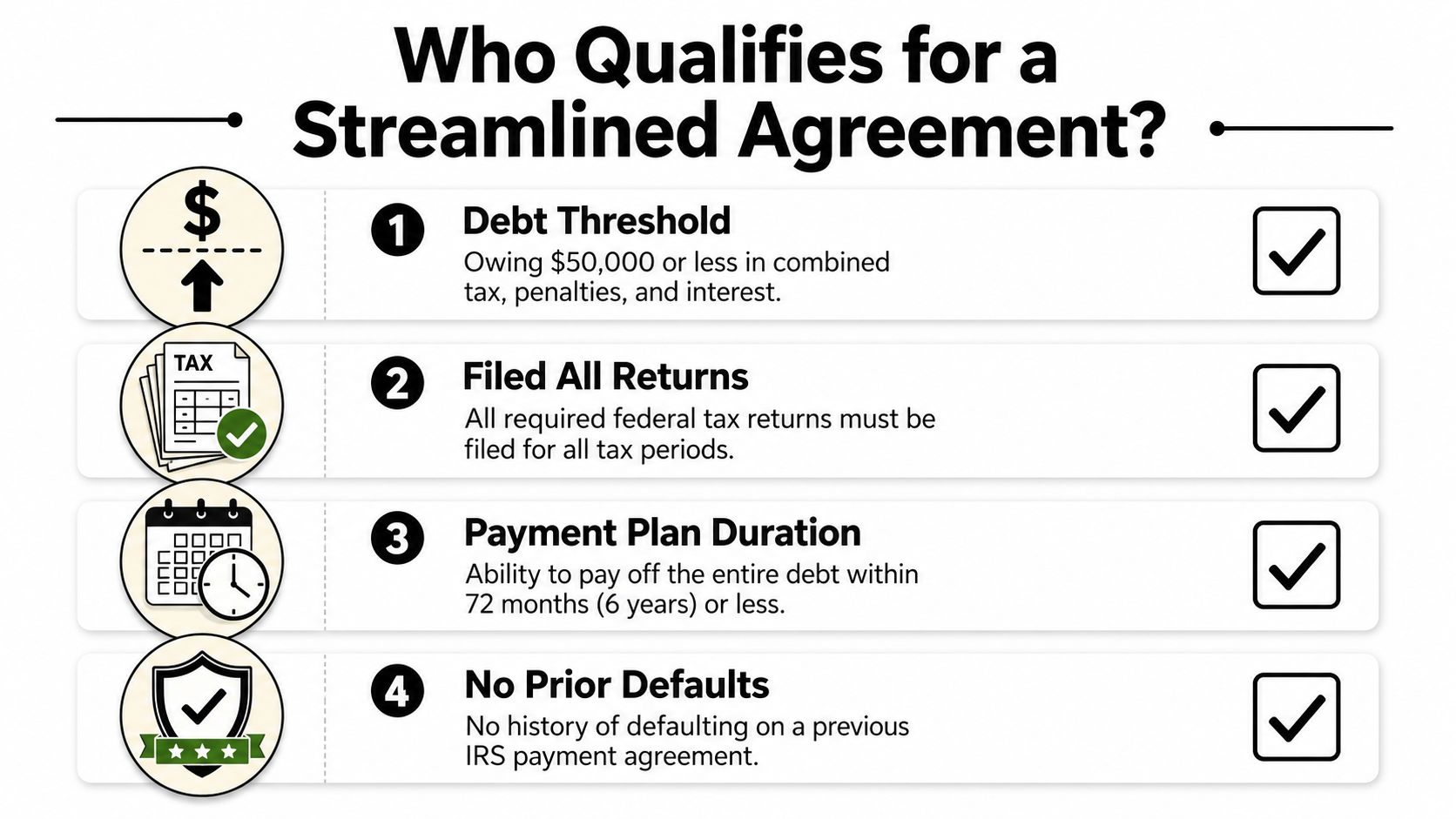
Eligibility starts with the balance the IRS counts for this purpose. A simplified-style agreement is available for aggregate unpaid assessments up to $50,000, and the plan eliminates the need for a financial statement such as Form 433-A. Under the newer Simple IA rules, the minimum monthly payment is calculated by dividing the total liability by up to 120 months, as described in H&R Block's explanation of the streamlined installment agreement rules.
The balance test that trips people up
The IRS distinction between assessed amounts and later accrued amounts matters here.
Under the legacy rules, the system looked at the aggregate unpaid balance of assessments. Tier 1 covered $25,000 or less and did not require mandatory direct debit. Tier 2 covered $25,001 to $50,000 and required payment by direct debit installment agreement or payroll deduction installment agreement to avoid a lien. The minimum monthly payment was determined by dividing the unpaid balance of assessments by 72 months, subject to payment before the collection statute expiration date. H&R Block's summary also notes that the unpaid balance excludes penalties and interest that accrue after assessment. That means a taxpayer with a $48,000 tax liability plus $5,000 of accrued interest could still fall within the $50,000 threshold, while a $51,000 assessed liability would not qualify under that limit.
That distinction still matters because taxpayers often look at the current number on an IRS notice and assume every dollar is counted the same way for qualification.
A practical checklist
If you're trying to size up eligibility, start here:
- Balance within the threshold: The relevant assessed amount must fit within the qualifying limit for this type of simplified plan.
- Returns filed: If required returns are still missing, the IRS usually won't treat the case as ready for a straightforward payment plan.
- Ability to finish within the allowed term: The monthly payment has to be enough to satisfy the liability within the permitted timeframe and before the collection statute runs.
- Current compliance going forward: If you keep adding new balances, even a well-structured agreement can default.
A general explanation of the IRS's broader relief framework appears in this discussion of the IRS Fresh Start Program, but qualification always turns on the actual account details, not marketing labels.
What the monthly payment means in real life
The formula sounds simple because it is simple. Divide the qualifying liability by the available repayment period. But simple doesn't mean harmless.
A payment plan only works if the number fits your real cash flow. Self-employed taxpayers run into this issue all the time. They focus on the average month and forget about slow periods, quarterly estimates, or seasonal business swings. The IRS doesn't manage your cash flow for you. It just expects the agreed payment to arrive on time.
If the formula produces a payment you can live with, this kind of agreement is often the cleanest route. If it produces a payment you can't sustain, then the conversation shifts to other resolution options that require more financial disclosure.
How to Apply for Your IRS Payment Plan
Once you've decided a payment plan makes sense, the next step is choosing the application method that fits the case. In a straightforward matter, speed matters. The sooner the agreement is requested and accepted, the sooner the account is stabilized.

Applying online
For many taxpayers, the IRS Online Payment Agreement tool is the most efficient path. If the case is simple and the account is otherwise in order, online setup is often the least cumbersome method.
Before using it, gather the basics:
- Identity and account information: You'll need enough information to verify the taxpayer and the balance involved.
- Banking details if using automatic payments: Even when not strictly required, automatic payment can make a plan easier to maintain.
- A realistic proposed payment: Don't choose a number based only on what gets the screen to move forward.
If you want more context on the paper application that often supports or supplements this process, these Form 9465 instructions help explain how that request works.
Applying by phone
Phone setup can make sense when the online tool isn't practical or when the account has enough wrinkles that you want direct confirmation from the IRS.
Expect the call to be administrative, not strategic. The IRS representative may discuss balance information, filing status issues, payment method, and proposed terms. What they usually won't do is build the larger resolution strategy for you.
A few things help before you call:
- Know whether all returns are filed. If they aren't, the conversation may end there.
- Have your proposed payment in mind. Guessing on the spot often leads to bad commitments.
- Check recent notices first. The notice often tells you where the account sits in the collection process.
If you're calling the IRS without a plan, the conversation tends to follow the IRS's priorities. If you're calling with a clear proposal, it's easier to steer the discussion.
Applying with Form 9465
Form 9465 is the paper route. It's slower, but it still has a place. Some taxpayers use it because their filing method or account status makes a paper request cleaner. Others use it when a written submission is better than trying to resolve details through a call center interaction.
Paper submissions work best when the case is organized. That means the tax returns are filed, the requested payment is realistic, and nothing in the file suggests that the IRS will need a larger financial review.
What tends to work and what doesn't
The process is usually smoother when taxpayers do three things well:
- They file first. An installment agreement is not a substitute for filing compliance.
- They choose a sustainable payment. A lower payment that lasts is better than a higher payment that defaults.
- They act early. Waiting until the account is already moving toward enforced collection narrows the margin for error.
What doesn't work is treating the application like a one-time fix while ignoring current-year obligations. If you're self-employed and you're not staying current on estimated taxes, the payment plan may only postpone the next problem.
Key Benefits and Important Considerations
A simplified agreement earns its value by creating order. Once the IRS accepts the plan and you keep it in good standing, the account is no longer moving through collections the same way it would if you ignored the balance. For most taxpayers, that alone lowers the temperature of the case.
The most important practical benefit in the newer framework involves federal tax liens. Under the new Simple IA effective in 2025, taxpayers can often avoid a Federal Tax Lien entirely, even without using direct debit, so long as the agreement is set up before the IRS files one. That's a major shift from the older SLIA approach, which required direct debit to avoid a lien on debts over $25,000, as explained in this review of the 2025 lien changes for regular installment agreements.
What works in your favor
A payment plan can be a strong solution when these goals matter most:
- Stopping escalation: A formal agreement can prevent the account from continuing toward more aggressive collection activity.
- Preserving financing or transactions: Easier lien avoidance can matter to owners, borrowers, and anyone dealing with property issues.
- Reducing procedural burden: In the right case, you can resolve the matter without building out a full financial disclosure package.
What you still have to live with
No one should enter an IRS payment plan thinking it freezes the balance in place. It doesn't.
- Interest and penalties continue: Until the debt is fully resolved, the unpaid balance can still grow.
- Default has consequences: Miss payments, stop filing, or incur new tax debt, and the agreement can collapse.
- Affordability matters more than approval: Getting accepted is only half the job. Keeping the agreement alive is the part that resolves the case.
The best installment agreement is not the one the IRS approves fastest. It's the one the taxpayer can keep through the end.
Streamlined Agreement vs Other IRS Options
A simplified installment agreement is often the cleanest answer when the taxpayer can pay over time and wants the least complicated path. It is not the only answer. In some cases, another resolution fits better because the primary problem isn't timing. It's collectability, hardship, or the fact that full payment may not be realistic.
IRS tax debt options at a glance
| Option | Best For | Financial Disclosure | Outcome |
|---|---|---|---|
| Simple or streamlined-style installment agreement | Taxpayers who can pay over time and want a simpler setup | Usually limited compared with deeper collection alternatives | Full balance is paid over time under approved terms |
| Offer in Compromise | Taxpayers whose full liability may not be realistically collectible | Extensive | Potential settlement for less than the full amount owed if the IRS accepts the offer |
| Currently Not Collectible | Taxpayers facing genuine financial hardship right now | Extensive | IRS collection is paused, but the debt remains |
| Short-term payment plan | Taxpayers who need brief additional time and expect to pay soon | Minimal | Full balance is paid in a shorter window |
How to think about the choice
The installment agreement is usually the first option to test because it is the most direct. If you can pay in a structured way without destabilizing your household or business, simplicity has real value.
An Offer in Compromise makes more sense when the taxpayer may never be able to pay the full amount. That route is document-heavy and slower. It can be the right solution, but it's not a casual application.
Currently Not Collectible status serves a different purpose. It's for hardship, not payment planning. If paying the IRS would interfere with basic living or essential business survival, a hardship analysis may be more appropriate than forcing an agreement that will fail.
There are also cases where the right comparison is not just among IRS programs. If the tax debt sits inside a larger financial collapse, you may need to assess broader insolvency options. For that reason, a practical overview of how much debt to file bankruptcy can be useful when tax debt is only one piece of the problem and legal coordination is necessary.
Common Mistakes and When to Call an Attorney
The most common mistakes are not dramatic. They're procedural. A taxpayer applies before all returns are filed. Someone misreads the balance and uses the wrong number. A business owner agrees to a monthly payment based on a strong month, then defaults when revenue tightens.
Those errors are avoidable, but they're costly.
Mistakes that create bigger problems
- Applying too early: If filing compliance isn't fixed first, the request often goes nowhere.
- Using the wrong balance figure: Assessed and accrued amounts don't always function the same way.
- Ignoring current taxes: A payment plan won't survive if new liabilities keep being added.
- Treating the IRS call as legal advice: The IRS can process requests, but it doesn't advise you on the best strategic option for your facts.
A lot of self-employed taxpayers benefit from tightening current-year compliance before they request relief. If that's part of your issue, a current 2026 small business tax guide can help you get the bookkeeping and filing side under control while the resolution strategy is being evaluated.
When legal help makes sense
Some cases are suitable for do-it-yourself handling. Others aren't.
You should strongly consider professional help if:
- The debt is above the simplified threshold
- A federal tax lien has already been filed
- Payroll tax issues or Trust Fund Recovery Penalty exposure are involved
- You think an Offer in Compromise may be on the table
- Your income is irregular enough that a standard payment formula may set you up for default
- A divorce, mortgage, sale, bankruptcy analysis, or business transaction depends on resolving the tax problem correctly
When the facts are more complicated, legal analysis matters more than form completion. If you're weighing that decision, this discussion of when to hire a tax attorney is a practical place to start.
A good tax resolution process should begin with diagnosis, not pressure. The point is to find the right resolution path before anyone pays for the wrong one.
If you want a practical review of your IRS payment plan options, Attorney Stephen A Weisberg offers a free Tax Debt Analysis to determine whether a specific agreement type, another IRS resolution, or a more personalized legal strategy fits your situation.


