A Practical Guide to Stop Wage Garnishment
Facing a wage levy? This guide provides actionable strategies to stop wage garnishment from the IRS and other creditors. Get your finances back on track.
In this article
- Understanding the Threat to Your Paycheck
- The Two Faces of Garnishment: IRS Levy vs. Creditor Action
- The Widespread Impact on Workers
- Your First Moves to Protect Your Income
- Put the Garnishment Order Under a Microscope
- Figure Out What They Can’t Touch
- File a Formal Objection—Fast
- Negotiating with the IRS to Release a Levy
- Proposing an IRS Installment Agreement
- When You Cannot Afford to Pay in Full
- Common Mistakes to Avoid in IRS Negotiations
- Building a Defense Against Creditor Lawsuits
- Questioning the Foundation of the Debt
- Scrutinizing the Legal Process
- Leveraging State Exemption Laws
- Can Bankruptcy Stop a Garnishment Immediately? Yes.
- Chapter 7 vs. Chapter 13: Which Path is Right?
- What About Your Tax Debt?
- Your Top Questions About Wage Garnishment Answered
- Can the IRS Really Garnish My Wages Without a Court Order?
- How Much of My Paycheck Can They Actually Take?
- What Happens If I Quit My Job to Stop the Garnishment?
- Can They Garnish My Social Security or Disability Checks?
Getting a notice that your wages are about to be garnished is a gut-wrenching moment. It's easy to panic, but the most important thing you can do is take a deep breath and act fast. The key to stopping it lies in figuring out who is taking your money and why, because the playbook for dealing with the IRS is completely different from handling a private creditor.
Taking immediate, informed action is your first—and best—step toward protecting your paycheck.
Understanding the Threat to Your Paycheck
When that garnishment notice shows up, whether from your employer or in the mail, it’s natural to feel powerless. But this isn't a random attack; it's the final stage of an unresolved debt. Your first job is to switch from panic mode to problem-solving mode and get a clear picture of what you're facing.
And this isn't just a headache for W-2 employees. If you're an independent contractor, a freelancer, or run a small business, you're just as vulnerable. A creditor can target your business bank account or intercept payments from your clients, treating that income just like a regular paycheck. Doing nothing is the worst possible option, as it guarantees they'll take the maximum amount allowed by law.
The Two Faces of Garnishment: IRS Levy vs. Creditor Action
It's critical to know that not all garnishments are the same. The most important distinction you need to make is whether you're dealing with a court-ordered garnishment from a private creditor (like a credit card company or hospital) or an administrative wage levy from the IRS. The power dynamic between these two is worlds apart.
To put it plainly, the IRS plays by a different set of rules. Here’s a quick breakdown to help you see what you’re up against.
IRS Levy vs Creditor Garnishment At a Glance
| Feature | IRS Administrative Wage Levy | Court-Ordered Creditor Garnishment |
|---|---|---|
| Court Order Required? | No. The IRS has statutory authority. | Yes. Creditor must sue and win a judgment. |
| Process Speed | Can be very fast once notices are sent. | Slower; involves lawsuits and court filings. |
| Amount Taken | Determined by IRS formulas; can be very high. | Limited by federal and state consumer protection laws. |
| Debtor's Rights | Appeal rights within the IRS system. | Right to defend yourself in court. |
| Negotiation Path | Direct negotiation with the IRS is possible. | Negotiation with the creditor or their attorneys. |
The takeaway here is that an IRS levy carries a different kind of urgency. While a private creditor has to jump through legal hoops, the IRS has the power to act on its own.
Court-Ordered Creditor Garnishment: Before a credit card company can touch your pay, they have to sue you, get a judge to rule in their favor, and then get a separate court order to garnish your wages. It's a process with multiple steps, giving you chances to show up in court and argue your case.
IRS Administrative Wage Levy: The IRS doesn't need a judge’s sign-off. After sending a series of required notices, they can unilaterally issue a levy straight to your employer, completely bypassing the court system. You can learn more about how the IRS can garnish wages in our detailed guide.
This is exactly why you can't ignore letters from the IRS. The path from a tax notice to a wage levy is much shorter and has fewer roadblocks than the path a private creditor has to take.
The Widespread Impact on Workers
Wage garnishment is far more common than most people think. Back in 2019, before the pandemic changed the economic landscape, more than one out of every 100 workers in the U.S. was having their pay garnished. That’s somewhere around 1.5 to 2 million people at any given time.
For the average person in that situation, the hit was about 11% of their gross pay for nearly five months straight. That's a massive financial blow that can easily destabilize a household or small business budget. You can find more on these workforce statistics over at NBER.org.
At its core, a wage garnishment is a symptom of a larger problem. By addressing the root cause—the underlying debt—you not only stop the immediate financial bleeding but also begin to rebuild your financial stability for the long term.
Figuring out who is behind the garnishment is the foundation of your entire strategy. It tells you who to call, what your rights are, and which negotiation tactics might actually work. An IRS levy demands you engage with federal tax resolution channels, while a creditor garnishment means you’ll be working within the framework of consumer protection laws and possibly the court system.
Making this one crucial identification is what empowers you to take the right next step and start taking back control of your income.
Your First Moves to Protect Your Income
The moment a wage garnishment notice shows up, the clock starts ticking. It’s a stressful, jarring experience, but what you do in the next few days can completely change the outcome. Your goal is to shift from defense to offense by digging into the details and using your legal rights to your advantage.
Think of yourself as a detective. That garnishment order isn't a final, unbreakable command—it's a legal document that might be full of holes. You’d be surprised how often these things contain mistakes, and finding one can be your ticket to getting the whole thing thrown out, or at least delayed. That delay buys you critical time to find a better way forward.
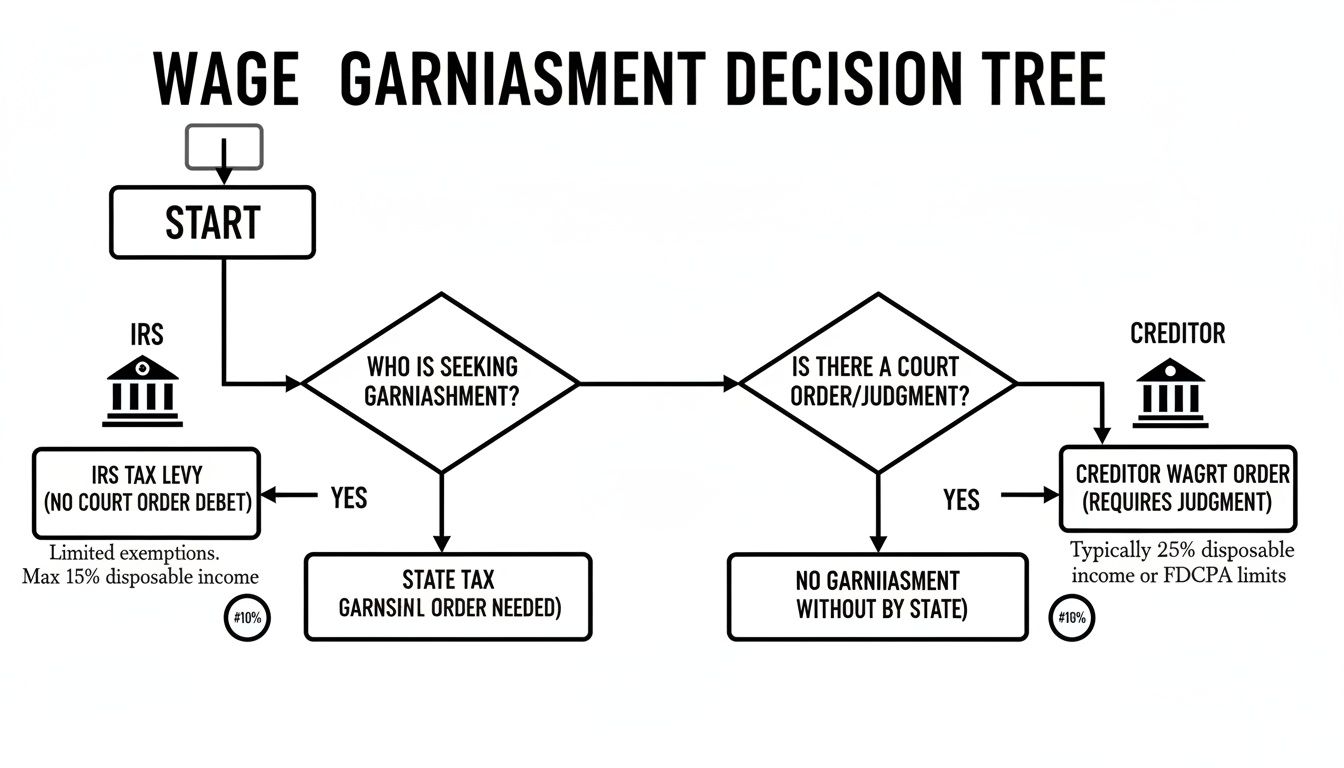
As you can see, the path you take depends entirely on who’s coming after your wages. The IRS plays by a different set of rules than a credit card company or a state tax agency.
Put the Garnishment Order Under a Microscope
Never, ever assume the paperwork is correct. Go over that document with a fine-tooth comb, looking for any mistake, no matter how tiny it seems. A single error could be enough to invalidate the entire order.
Here’s what I look for first:
- Mistaken Identity: Is your name spelled correctly? Is the address right? A simple typo could mean they’ve got the wrong person entirely.
- Inflated Debt: Does the amount they claim you owe match your records? Creditors have been known to tack on improper fees or conveniently forget to apply past payments.
- Bad Service: This is a big one. Think back—were you properly served with the original lawsuit summons and other notices? If a creditor cut corners and didn't follow the legal notification process, the judgment they got against you could be invalid.
A flaw in the paperwork isn't just a technicality—it's a legal shield. Successfully challenging an order on procedural grounds can stop wage garnishment immediately, forcing the creditor to restart the process and giving you a new window to act.
Figure Out What They Can’t Touch
The law—both federal and state—recognizes that you can’t be left with nothing. A certain portion of your income is protected, or exempt, from seizure. Creditors can’t touch it. The catch is that you often have to be the one to step up and prove how much of your income is off-limits.
The math for this works differently depending on who is garnishing you:
- For Creditors: Federal law, under the Consumer Credit Protection Act (CCPA), sets a floor for protection. A creditor can generally only take the lesser of 25% of your disposable income or whatever you earn above 30 times the federal minimum wage per week. The good news is that many states have their own laws that protect even more of your paycheck.
- For the IRS: The IRS has its own system, and frankly, it's not as generous. They use Publication 1494 to figure out the exempt amount based on your filing status and number of dependents. In my experience, this formula often leaves taxpayers with far less to live on than the protections for private creditor garnishments.
Getting a handle on these numbers is non-negotiable. It’s how you’ll know if they’re trying to take too much and it’s the foundation for any legal challenge you make.
File a Formal Objection—Fast
After you’ve torn apart the order and run the exemption numbers, you have to formally object. A phone call won't cut it. This requires filing specific legal documents, and the deadlines are incredibly strict. If you miss that window, you've essentially given up your right to fight.
If a regular creditor is garnishing you, you'll need to file a Claim of Exemption with the court that issued the order. This is the official document where you tell the judge, "Hey, this part of my income is legally protected."
For an IRS levy, the process is different. You need to request a Collection Due Process (CDP) hearing by submitting Form 12153. You must get this form in within 30 days of the date on your levy notice. This hearing is your chance to argue your case and propose alternatives like a payment plan. If you want to explore those options, you can learn more about making payment arrangements with the IRS.
Taking these formal steps is the single most important thing you can do to put an immediate halt to the garnishment and give yourself the breathing room to work out a real solution.
Negotiating with the IRS to Release a Levy

When the IRS is the one coming after your paycheck, the game changes. You're no longer dealing with courtrooms and legal filings; you're negotiating directly with the agency itself. The good news is the IRS has a structured—though admittedly complex—set of resolution options. The key is figuring out which one actually fits your financial reality and then presenting your case in the precise way the IRS demands.
This isn't about pleading for mercy. It's about demonstrating your financial situation with cold, hard data. Every successful negotiation I've ever handled started with a meticulously completed Collection Information Statement, usually Form 433-F. Think of this document as the bedrock of your entire case. It gives the IRS a complete snapshot of your income, assets, and living expenses, and they will scrutinize every single line.
Proposing an IRS Installment Agreement
Often, the most straightforward path to stopping an IRS wage levy is to set up an Installment Agreement (IA). In plain English, it's a monthly payment plan. You agree to pay your tax debt over time, and they agree to leave your paycheck alone.
If you owe less than a certain amount and can realistically pay it all off within a few years, you might qualify for a Streamlined Installment Agreement. This is the best-case scenario because it involves less financial disclosure and can sometimes be set up with a single phone call or through the IRS website.
But for larger debts, or if you simply need more time to pay, you'll have to pursue a non-streamlined agreement. This is where your Form 433-F becomes critical, as the IRS will use it to determine a monthly payment they deem acceptable.
It's worth noting that while overall wage garnishments fell from a high of 3.9% in March 2020 to 2.8% by January 2024, that dip was mostly due to the pause on federal student loan collections. IRS collection actions never stopped. As other types of collections resume, knowing how to handle tax debt is more important than ever. You can read the full research about these wage garnishment trends for more context.
When You Cannot Afford to Pay in Full
So, what happens if your financial reality shows you can't possibly repay the entire tax debt, even with a payment plan? This is where more advanced—and frankly, tougher to get—resolution options come into play.
- Offer in Compromise (OIC): This lets you settle your tax debt for less than you owe. To get one, you have to prove to the IRS that you have no conceivable way of paying the full amount, either now or in the future. It’s a very high bar to clear.
- Currently Not Collectible (CNC): If you can show that making any payment would create a severe economic hardship—meaning you can’t cover basic living expenses like rent and food—the IRS might place your account in CNC status. This temporarily stops all collection, including wage levies, until your financial situation improves.
Both an OIC and CNC status live or die by the numbers on your Form 433-F. The IRS uses rigid national and local standards for allowable living expenses. If they think your spending is "excessive," they'll disallow it, which could single-handedly sink your chances.
The IRS isn’t interested in your story nearly as much as they are in your numbers. Proving you can't pay is a mathematical exercise. An accurate, well-supported financial statement is your most powerful negotiating tool.
Common Mistakes to Avoid in IRS Negotiations
Navigating these options is tricky, and I've seen countless people make critical errors that get their proposals rejected flat-out. From my perspective as a tax attorney, these are the most common pitfalls people fall into when trying to go it alone.
Top Negotiation Mistakes:
- Submitting an Incomplete Form 433: Missing information or forgetting to attach required bank statements is the fastest way to earn a rejection letter.
- Understating Your Income: The IRS already has your income information. Any discrepancy will instantly destroy your credibility with the agent handling your case.
- Overstating Your Expenses: Using unrealistic numbers for groceries, housing, or transportation will be immediately flagged and disallowed. Stick to the facts.
- Ignoring Deadlines: The IRS runs on strict timelines. If you miss a deadline to submit information, they can close your case and restart the levy without warning.
Successfully negotiating with the IRS requires a strategic, data-driven approach. Whether you're setting up a simple payment plan or fighting for an OIC, the quality of your financial disclosure determines everything. For a much deeper dive into the nuts and bolts, you may want to check out our guide on how to negotiate IRS debt.
By understanding the options and avoiding these common mistakes, you can take control of the situation and finally get the IRS out of your paycheck for good.
Building a Defense Against Creditor Lawsuits
When a private creditor starts garnishing your wages, it’s because they’ve already taken you to court and won a judgment. But that doesn’t mean you’re out of options. The fight has just shifted to a new battlefield—one where you challenge the judgment itself and the garnishment order that followed.
Unlike the IRS, which has the power to levy your pay directly, a creditor has to go through the legal system. That process is full of rules and procedures, and every step is a potential opportunity for you to build a defense. You can attack the validity of the debt, pick apart how the lawsuit was handled, and use consumer protection laws to shield your income.
Questioning the Foundation of the Debt
Your first move should be to put the debt itself under a microscope. Just because a collection agency says you owe money doesn't automatically make it legally enforceable. You'd be surprised how often debts, especially older ones that have been bought and sold, have serious legal weaknesses.
One of the best tools in your arsenal is the statute of limitations. Each state has a strict deadline for how long a creditor has to sue you over a debt. If they missed that window, the court shouldn't have granted them a judgment at all. This is a surprisingly common oversight and a powerful way to get a judgment thrown out.
A judgment that was based on a time-barred debt is often completely invalid. If you can prove the statute of limitations had already expired, a judge can vacate the judgment and stop the garnishment cold.
Scrutinizing the Legal Process
Creditors have to follow the letter of the law when they sue you, and any misstep can be enough to invalidate their case. One of the most frequent mistakes is improper service of process, which is a legal way of saying you were never officially notified about the lawsuit.
If you never got the summons—maybe it went to an old address or was never delivered—you were denied your chance to show up and defend yourself. Some debt collectors are infamous for this tactic, sometimes called "sewer service." Proving this happened is often strong grounds to ask a judge to set aside the default judgment they won against you.
- Were you properly notified? Check the court file. It will show exactly how the creditor claims they "served" you with the lawsuit papers.
- Was the lawsuit filed correctly? Procedural errors are far more common than you might think.
- Did they sue the right person? Mistaken identity isn't just for movies; it's a real and completely valid defense.
Digging into the case file can often uncover the critical flaw you need to dismantle the creditor's legal standing.
Leveraging State Exemption Laws
Even if the judgment against you is rock-solid, state laws still protect a chunk of your income. Federal law provides a baseline of protection, but many states are far more generous, recognizing that you need a certain amount of your paycheck just to cover basic living expenses.
Here's a real-world scenario: A small business owner, set up as a single-member LLC, finds their business bank account garnished for a personal credit card debt. In many states, this is a huge overstep. The owner could argue that the LLC is a separate legal entity, and its assets can't be grabbed to pay a personal debt. Knowing and asserting these specific state-law protections is absolutely vital.
Getting these issues resolved often comes down to negotiation. To properly end the dispute and stop further legal trouble, it's smart to understand how a settlement release agreement works. This is the formal document that locks in your payment deal and legally forces the creditor to end the wage garnishment once you've held up your end of the bargain.
Fighting a creditor garnishment isn’t about being a passive victim; it's about taking proactive legal steps. You have rights. By questioning the debt, auditing the court process for mistakes, and using your state's exemption laws, you can build a strong case to protect your hard-earned money.
Can Bankruptcy Stop a Garnishment Immediately? Yes.

Let’s be clear: bankruptcy is a major financial decision. It’s not a step anyone takes lightly. But when you’re buried under a mountain of debt and a wage garnishment is just the latest symptom, it can be the most powerful tool in your arsenal. In many cases, it’s not just a last resort—it’s a strategic move to get immediate relief.
The real power of filing for bankruptcy comes from something called the automatic stay. This isn't a request; it's a legal injunction, a court order that goes into effect the very moment you file.
This order forces nearly all collection activities to come to a screeching halt. Creditors, collection agencies, and even government bodies like the IRS must stop. That means no more phone calls, no more threatening letters, and, most importantly, no more wage garnishments. Your employer is legally obligated to stop withholding money from your check.
Chapter 7 vs. Chapter 13: Which Path is Right?
When it comes to personal bankruptcy, you'll generally encounter two options: Chapter 7 and Chapter 13. They both trigger the automatic stay, but they work very differently, especially when tax debt is in the mix.
Chapter 7 Bankruptcy: This is what most people think of as a "fresh start." It’s a liquidation process designed to wipe out (or discharge) your eligible debts relatively quickly. To be eligible, you have to pass a "means test" to show your income is low enough. The good news is that certain older income tax debts can often be completely eliminated in a Chapter 7.
Chapter 13 Bankruptcy: Think of this as a "reorganization." Instead of wiping out debts, you set up a court-approved repayment plan that lasts three to five years. This is often the better route if you have assets you want to protect (like a house with equity) or need to get caught up on debts that can't be discharged, such as very recent tax liabilities.
While filing for bankruptcy has long-term credit consequences, its ability to provide immediate relief from an aggressive wage levy is unmatched. The automatic stay gives you the breathing room you desperately need to get your finances in order without a chunk of your paycheck disappearing every week.
What About Your Tax Debt?
It's a common myth that tax debt is completely immune to bankruptcy. While some tax debts are indeed non-dischargeable, many others can be managed or even wiped out entirely. It all comes down to a specific set of rules based on the age of the tax debt, when you filed your returns, and when the IRS assessed the tax.
For a deeper dive, we've put together a guide that answers the crucial question of whether bankruptcy can clear your tax debt.
This becomes even more critical when you're being squeezed from multiple directions. TransUnion, for instance, has projected that by summer 2025, nearly 2 million Americans could be facing federal student loan garnishments. Imagine dealing with an IRS levy and a student loan garnishment at the same time—it’s a perfect storm.
At the end of the day, bankruptcy isn't just about erasing debt. It's about getting a structured, legally-protected plan to move forward. When you're facing an aggressive IRS levy on top of other creditor demands, it can be the most direct and powerful way to take back control of your financial life.
Your Top Questions About Wage Garnishment Answered
When you're facing a potential wage garnishment, your mind is probably racing with questions. It’s a stressful situation, and you need clear, straightforward answers to figure out your next move. Let's cut through the confusion and tackle some of the most common concerns I hear from people every day.
Think of this as your quick-start guide. We'll revisit some of the core ideas from this guide, but with a focus on giving you the direct answers you need right now to start building a plan.
Can the IRS Really Garnish My Wages Without a Court Order?
Yes, absolutely. This is one of the most critical things to understand, and it's where a lot of people get into trouble.
Unlike a credit card company or a medical provider, the IRS has unique administrative powers. They don't need to sue you and get a judge’s permission to start taking your money. This is why an IRS notice is so much more serious than a bill from a regular creditor.
The IRS follows its own internal process, which involves a series of letters that lead up to a Final Notice of Intent to Levy. Once you get that notice and the clock runs out, they can legally order your employer to start the levy. Waiting around for a court date that will never come is a surefire way to lose a chunk of your paycheck.
How Much of My Paycheck Can They Actually Take?
This is not a one-size-fits-all answer. The amount they can legally garnish depends entirely on who you owe the money to, and the difference is huge.
- Consumer Debts: For things like credit cards, personal loans, or medical bills, federal law caps the garnishment at 25% of your disposable income. Some states have even lower limits, so you’ll want to check your local rules.
- Federal Taxes: The IRS doesn't follow that 25% rule. They have their own calculation based on your filing status and the number of dependents you claim. The bottom line is the IRS can often take a much bigger slice of your pay than any private creditor.
- Child Support: These obligations are taken very seriously by the courts. As much as 60% of your income can be garnished for child support, which is significantly higher than for other types of debt.
Knowing which set of rules applies to your situation is the first step in making sure the amount being withheld is actually legal.
A crucial takeaway: Never assume the garnishment calculation is correct. Creditors, employers, and even government agencies can make errors. Always double-check their math against the laws that apply to your specific type of debt.
What Happens If I Quit My Job to Stop the Garnishment?
I hear this question a lot, usually from people feeling cornered and desperate. While quitting your job will stop the garnishment from that particular paycheck, it's a very temporary solution that often creates bigger problems down the road.
The debt and the legal order to collect it don't just vanish. The creditor or the IRS will simply keep looking for you. They’ll use databases to find out where you're working next, and as soon as they do, they'll send a new garnishment order to your new employer.
All you accomplish is creating a cycle of job instability while the debt continues to grow with interest and penalties. A much more effective strategy is to face the problem head-on using the negotiation and resolution options we've talked about.
Can They Garnish My Social Security or Disability Checks?
This is another area where it depends on who you owe. For most private debts, your Social Security and disability benefits are heavily protected. But that protection has its limits, especially when the creditor is the federal government.
The government absolutely CAN garnish these federal benefits for debts owed to them.
- Federal Taxes: The IRS is legally allowed to take up to 15% of your Social Security benefits to pay off a tax debt.
- Federal Student Loans: The Department of Education can also garnish a portion of your benefits if you've defaulted on your student loans.
- Child Support: Unpaid child support can also be collected directly from your federal benefits.
So, while your benefits are generally safe from credit card companies, they are not safe from Uncle Sam. For a deeper dive into your rights and to explore legal guides, you might find value in reviewing legal resources like Nolo, a well-known source for consumer legal information. Understanding these distinctions is key to knowing where you stand and what to do next.
Facing a wage garnishment can feel overwhelming, but you don't have to navigate it alone. At Attorney Stephen A Weisberg, I provide a FREE Tax Debt Analysis to assess your situation and determine the best path forward before you ever pay a fee. Take the first step toward protecting your income by scheduling your free analysis today.


