A Practical Guide to Stop Garnishment Wages
Feeling overwhelmed by a wage garnishment notice? Learn how to stop garnishment wages with proven strategies for IRS levies, creditors, and child support.
In this article
- What to Do When You Get a Garnishment Notice
- First, Make Sure the Notice Is Real
- Next, Figure Out Who Is Garnishing Your Wages
- Your First Moves for Different Garnishment Types
- Talk to Your HR Department
- How to Stop IRS and State Tax Levies
- Set Up an Installment Agreement
- See If You Qualify for "Currently Not Collectible" Status
- Explore an Offer in Compromise
- Challenging Garnishments From Private Creditors
- File a Claim of Exemption
- Know Your State's Protections
- Negotiate a Settlement or Payment Plan
- Navigating Child Support and Alimony Orders
- The Standard for Modifying a Support Order
- Building Your Case for Modification
- Handling Federal Student Loan Garnishments
- Get Your Loans Out of Default
- Lower Your Payment with an Income-Driven Plan
- Use the Fresh Start Program
- Answering Your Top Garnishment Questions
- Can I Stop a Garnishment Immediately After It Starts?
- Will Filing for Bankruptcy Stop a Wage Garnishment?
- How Much of My Paycheck Can Legally Be Garnished?
To stop a wage garnishment, you have to move fast. It starts with figuring out exactly what the notice is, who sent it, and formally responding before the deadline hits. Your game plan will look a little different depending on whether you're dealing with a credit card company, the IRS, or a child support order. One thing is certain, though: ignoring it is the fastest way to lose a chunk of your paycheck.
What to Do When You Get a Garnishment Notice
Getting a wage garnishment notice in the mail is a gut-punch. It’s a formal legal order telling you and your employer that a creditor is about to start taking money directly from your pay. But panicking won't help. What you do in the first 24-48 hours is what really matters—it sets the tone for everything that follows and is your best chance to protect your income.
Whatever you do, don't just toss it in a drawer and hope it goes away. A garnishment order is legally binding, which means your employer has to follow it. The minute you get that notice, the clock is officially ticking on your window to fight it, negotiate a better deal, or see if you qualify for an exemption.
First, Make Sure the Notice Is Real
Before you do anything else, you need to be 100% sure the notice is legitimate. Scammers love to send official-looking but completely fake documents to scare people into paying debts they don't even owe.
A real garnishment order is packed with specific details. Look for these things:
- A case or docket number from the court that issued the judgment.
- The creditor's name (and often the law firm or collection agency they hired).
- The name of the court that granted the judgment.
- Your employer's information, since the notice is sent right to their HR or payroll office.
If something looks off or information is missing, don't use the phone number on the letter. Look up the court's official phone number yourself and call them directly to verify the case.
Next, Figure Out Who Is Garnishing Your Wages
This is probably the most important step. Who is coming after your wages determines the rules of the game and what options you have. For consumer debts—think credit cards, personal loans, or medical bills—the creditor has to sue you and win in court first. That whole process gives you a chance to show up and defend yourself.
Government agencies, however, play by a different set of rules. The IRS doesn't need a court's permission to levy your wages for back taxes. The same goes for federal student loans and child support orders; they can often skip the standard court process entirely, which makes them a lot harder to stop. Getting a handle on how the process works from the creditor's side can be insightful; for instance, understanding how to garnish wages in Texas can clarify the legal steps they've already taken.
The flowchart below gives you a quick visual guide for navigating these first crucial decisions.
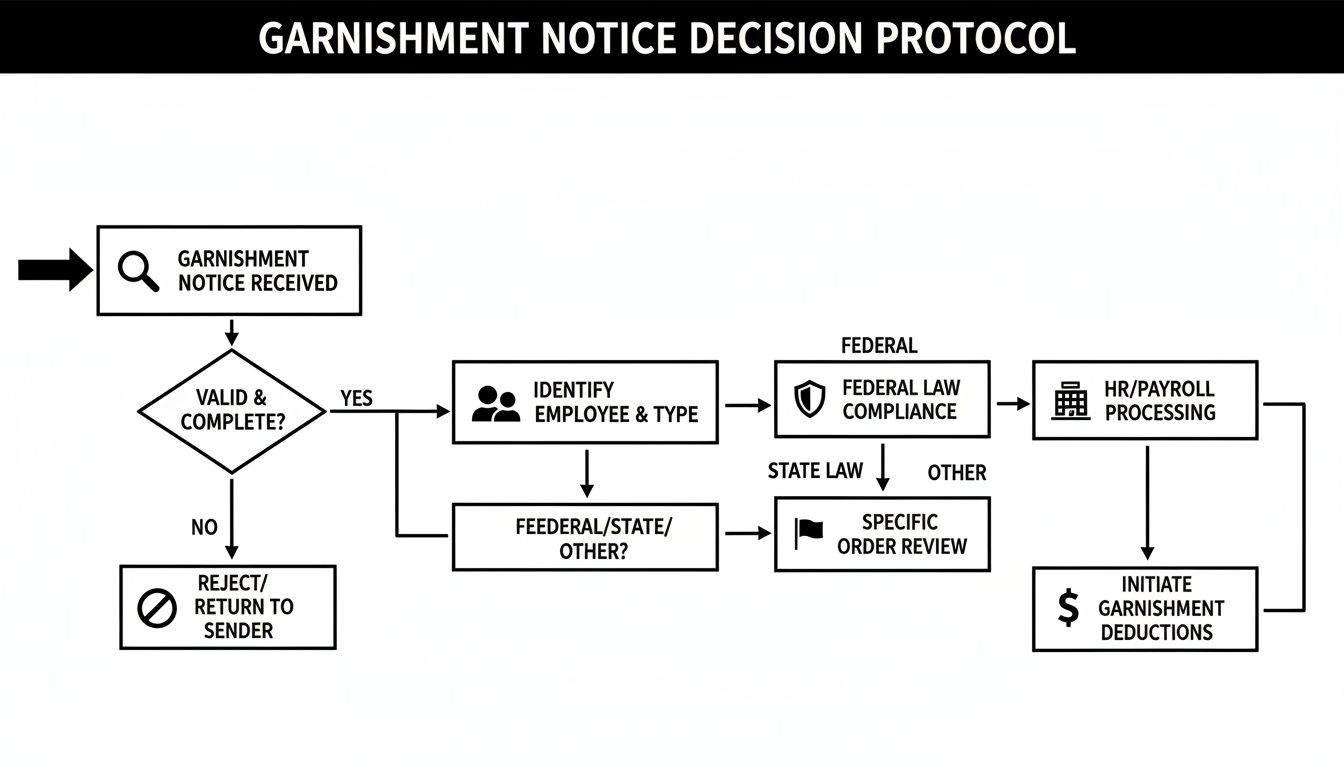
As you can see, confirming the notice is real, identifying the creditor, and getting in touch with HR are the non-negotiable first moves.
To make this even clearer, here’s a quick-reference table to help you organize your initial response based on who is demanding payment.
Your First Moves for Different Garnishment Types
| Garnishment Type | Immediate Action | Key Document to Find | Primary Goal |
|---|---|---|---|
| Consumer Debt | Review the court judgment and your original debt documents. | The original court judgment and the garnishment order. | Challenge the judgment if possible or negotiate a settlement. |
| IRS Tax Levy | Contact the IRS immediately to discuss payment options. | The Final Notice of Intent to Levy (usually Letter 1058 or LT11). | Set up a payment plan or prove financial hardship to get the levy released. |
| Child Support | Contact the state child support enforcement agency. | The original child support order from family court. | Modify the support order if your circumstances have changed or arrange a payment plan. |
This table should help you quickly identify the right path forward so you can take focused, effective action without wasting time.
Talk to Your HR Department
Like it or not, your employer is now in the middle of this. You need to schedule a private chat with someone in HR or payroll right away.
Remember, their hands are tied—they are legally required to comply with the court order, so arguing with them about the debt itself is pointless. Your goal here is to get information. Ask for a copy of the garnishment order, find out the exact date the first deduction will be taken, and confirm how much they plan to withhold. This information is critical for your next steps.
When dealing with the IRS specifically, the process has its own unique set of rules. You can find more details on how to handle that particular situation by reading about the IRS notice to levy in our guide.
How to Stop IRS and State Tax Levies
When the IRS or a state tax agency comes after your paycheck, you're playing by a whole different set of rules. Unlike a credit card company that has to sue you and win in court, government tax authorities can go straight for your wages through an administrative process. They don't need a judge's permission.
This power means they can move fast, and if you're not prepared, you could suddenly find a huge chunk of your paycheck missing. The key is to act the moment you get that first official warning.
That warning is usually a Final Notice of Intent to Levy, which might be an IRS Letter 1058 or LT11. Once that letter is in your hands, the clock starts ticking—you typically have just 30 days to respond before they contact your employer. Doing nothing is the worst thing you can do.

Set Up an Installment Agreement
One of the most common and direct ways to stop a tax levy is by getting into an Installment Agreement (IA). This is simply a formal payment plan you set up with the tax agency to chip away at your debt with manageable monthly payments.
As soon as your IA is officially approved, the agency is required to release the wage levy. Problem solved.
To get the ball rolling, you’ll need to be current on filing all your tax returns. For federal taxes, many people can apply for a payment plan right on the IRS website, as long as the total amount you owe is under their threshold.
Expert Tip: Be brutally honest with yourself about what you can actually afford each month. It's tempting to promise a high payment just to get the levy stopped, but if you default, you're right back at square one. A smaller, sustainable payment is always better than a larger one you can't keep up with.
See If You Qualify for "Currently Not Collectible" Status
What happens if you can't even afford a small monthly payment? If you can prove that taking any money from your paycheck would cause you serious financial hardship, you might be a candidate for Currently Not Collectible (CNC) status.
This doesn't erase your tax debt, but it does hit the pause button on all collection efforts, including wage levies.
To qualify, you have to open up your books and show the tax agency that your essential monthly living expenses are equal to or greater than your income. This means filling out a detailed financial disclosure, like the IRS Form 433-A (Collection Information Statement), and backing it up with hard proof:
- Recent pay stubs
- Bank statements for the last few months
- Proof of rent/mortgage payments and utility bills
If approved, they’ll stop the garnishment. Just know that they’ll check back in every year or two to see if your financial situation has improved. For a deeper dive, check out our stop IRS wage garnishment guide for more on protecting your income.
Explore an Offer in Compromise
An Offer in Compromise (OIC) is the holy grail for some taxpayers. It's an agreement to settle your entire tax debt for less—sometimes much less—than the full amount you owe. This is a powerful option, but it’s reserved for people in legitimate financial distress. If the IRS accepts your offer, all active levies are immediately released.
Getting an OIC approved isn't easy. The IRS looks at your case through a very specific lens and will only consider an offer for one of three reasons:
- Doubt as to Liability: You have a solid argument that you don't actually owe the tax in the first place.
- Doubt as to Collectibility: You can prove beyond a doubt that you don't have the income or assets to ever pay the full debt. This is the most common path.
- Effective Tax Administration: Paying the full amount would create an extreme economic hardship or would simply be unfair.
The OIC application process is intense, requiring non-refundable fees and extensive financial documentation. It’s a game-changer if you can get it, but it demands a perfectly prepared and well-supported case.
Challenging Garnishments From Private Creditors
When you're dealing with private creditors—think credit card companies, medical facilities, or personal loan lenders—they can't just start taking money from your paycheck on a whim. Unlike the IRS, they have to play by the rules, which means taking you to court and winning a judgment first.
This requirement for a court order is actually your first line of defense. It creates a formal paper trail and a legal process, giving you several opportunities to fight back and stop the garnishment before it even starts. If a creditor tries to garnish your pay without a valid court judgment, their actions are illegal, and you have solid ground to shut it down immediately.
File a Claim of Exemption
Once a creditor gets that judgment, your most powerful tool is the Claim of Exemption. This is a legal document you file with the court to argue that some or all of your income is legally protected from being touched. States have laws that "exempt" certain funds to ensure you have enough money to cover basic living expenses.
Think of these exemptions as your legal shield. Some of the most common ones include:
- Head of Household: If you provide more than half the financial support for a child or another dependent, many states protect a much larger chunk of your income.
- Government Benefits: Money from Social Security, disability, or unemployment benefits is almost always off-limits to private creditors.
- Low Income: Federal and state laws set income thresholds. If your earnings fall below these minimums, your wages may be completely exempt.
You have to act fast to file a Claim of Exemption. The garnishment notice you get from the court or sheriff should include the necessary forms and a strict deadline. You'll need to fill it out, list your income sources and dependents, and file it with the court that issued the judgment. The creditor can object, which triggers a hearing where a judge makes the final call. Even some retirement funds may be protected; find out more by exploring if a pension can be garnished in our related article.
Know Your State's Protections
This is a big one that people often miss: federal law only sets the minimum protection. Your state’s laws might be far more generous.
Some states have incredibly strong safeguards that make it difficult, if not impossible, for creditors to garnish wages for consumer debt. For example, a National Consumer Law Center analysis showed that states with better protections see far fewer debt collection lawsuits. A handful of states—like Texas, North Carolina, and Pennsylvania—go a step further and ban wage garnishment entirely for most consumer debts. This offers an incredible level of security for workers in those states. It's worth your time to research these powerful state-level wage garnishment protections and their impact to see where your state stands.
Key Takeaway: Never assume the federal limits are the end of the story. Always check your state's specific garnishment laws. They could give you the legal leverage you need to block the garnishment completely.
Negotiate a Settlement or Payment Plan
Even when they have a court judgment, most creditors would rather get paid without the red tape of garnishment. It’s an administrative headache for them, too. This gives you a surprising amount of leverage to negotiate directly with the creditor or their attorney.
You can usually approach them with one of two options:
- Lump-Sum Settlement: Offer a one-time payment to wipe the slate clean. Many creditors will jump at an offer of 40% to 60% of the balance if it means getting cash in hand now and closing the file.
- Voluntary Payment Plan: Propose a monthly payment you can actually afford. This shows good faith and gives them a steady stream of income without having to involve your employer, which is a win-win.
Whatever you do, get the agreement in writing before you send a dime. A proper settlement agreement will state that in exchange for your payment, the creditor will file a "satisfaction of judgment" with the court. This document officially closes the case and kills the garnishment for good.
Navigating Child Support and Alimony Orders
When it comes to your finances, garnishments for child support and alimony are in a completely different league. These aren't just ordinary debts like a credit card bill; they are court-ordered domestic support obligations, and the law prioritizes them above almost everything else. Because of this, trying to stop garnishment wages entirely for these debts is almost always a non-starter.
The realistic goal here isn't avoidance—it's modification. If a support order has become genuinely unaffordable, your path forward is through the very same legal system that created it. The law allows for adjustments, but you need to have a legitimate and significant reason.
The Standard for Modifying a Support Order
You can't just walk into court and ask for lower payments because they're inconvenient. You must prove a "substantial change in circumstances." This is a specific legal standard, and it means something significant and likely permanent has happened since the original order was issued that directly impacts your ability to pay.
Think of it as a financial earthquake, not just a temporary tremor. For instance, getting laid off from a long-term, high-paying job is a substantial change. On the other hand, voluntarily quitting that job to take a lower-paying one probably won't cut it. Courts are very good at spotting attempts to intentionally reduce income to get out of responsibilities.
So, what actually qualifies? Here are some common real-world examples:
- Involuntary Job Loss: Being laid off, furloughed, or having your position eliminated is the most classic reason for modification.
- Significant Income Reduction: This could be a major, non-voluntary cut in your pay or hours. For business owners, the loss of a key client or a major downturn in your industry could also qualify.
- A Long-Term Disability: A medical diagnosis that prevents you from working or severely limits your earning capacity is a very strong basis for a modification request.
- A Change in Custody Arrangements: If your child now lives with you most of the time, that’s a clear reason to revisit the original support order.
Simply having new expenses or taking on other debts won't meet the "substantial change" threshold. The court’s focus is almost entirely on your ability to earn an income now compared to when the order was first made. The legal ins and outs can be tricky, so getting guidance from an Austin Child Support Lawyer can bring some much-needed clarity to your situation.
Building Your Case for Modification
To successfully petition the court, you need more than just your word—you need a mountain of evidence. The burden of proof is entirely on you to show the judge that your situation has fundamentally changed. Your first step is to file a formal "Motion to Modify" with the same family court that issued your original support order.
From there, it's all about gathering meticulous documentation to back up your claims.
Crucial Insight: The court is going to put your financial life under a microscope. Be prepared to provide total transparency. Hiding assets or trying to obscure income will not only get your motion denied but could also land you in serious legal trouble.
Your documentation needs to be organized, compelling, and tell a clear story of your financial shift. Key documents you'll need include:
- Proof of Income Change: This could be a termination letter from your old job, recent pay stubs showing reduced hours, or detailed profit-and-loss statements if you're self-employed.
- Medical Records: If a disability is the basis for your request, you'll need official records from your doctor detailing your diagnosis, prognosis, and any work limitations.
- Job Search Records: If you were laid off, keep a detailed log of your job applications, interviews, and networking efforts. This shows the court you are actively trying to fix your situation.
- Financial Statements: Be ready to provide bank statements, tax returns, and a detailed monthly budget showing your current income versus essential expenses. It's also smart to understand the bigger financial picture, including the tax implications of divorce, which might affect your overall situation.
Presenting a well-documented, honest case is truly the only effective way to adjust a support order and, as a result, reduce the amount being garnished from your paycheck.
Handling Federal Student Loan Garnishments
If you're facing a federal student loan garnishment, it can feel like you're navigating a minefield, especially with all the recent changes to collection rules. For a while there, collections were on hold, but that pause is over, and borrowers in default are back in the crosshairs.
The good news? You have some surprisingly powerful ways to stop a wage garnishment before it even starts, or to put the brakes on one that's already happening.
Unlike a credit card company that has to take you to court, the Department of Education can start garnishing up to 15% of your disposable income without a judge's order. This is called an administrative wage garnishment. But they can't just do it out of the blue. By law, they have to send you a "Notice of Intent to Garnish" at least 30 days before they contact your employer. That 30-day notice is your window of opportunity—don't waste it.

The pandemic completely changed the game for student loan collections. Payroll data from ADP Research showed that the overall garnishment rate in the U.S. fell from 3.9% in March 2020 all the way down to 2.8% by January 2024, and the main reason was the suspension of federal student loan garnishments. Now that those protections are gone, knowing your options is critical. You can dig into the numbers yourself in the full report on wage garnishment trends from ADP Research.
Get Your Loans Out of Default
The only surefire way to end a student loan garnishment for good is to get the loans out of default. You’ve got a couple of solid paths to do this: loan rehabilitation and loan consolidation. They work differently, and one might be a better fit for your situation.
Loan Rehabilitation: This involves making nine on-time, income-based payments over a ten-month period. The biggest win with rehabilitation is that once you complete it, the default itself is erased from your credit report. If you jump on this within 30 days of getting that garnishment notice, the action is put on hold. If they're already taking your money, the garnishment will stop after you make your fifth rehab payment.
Loan Consolidation: This is a much faster route. You basically bundle your defaulted federal loans into a brand-new Direct Consolidation Loan, which can get you out of default in a matter of weeks. The catch is that while the loan will show as "paid in full," the original default will stay on your credit history. The key here is speed—you can't consolidate once a garnishment order is already active.
Lower Your Payment with an Income-Driven Plan
Let's be honest: for a lot of people, the fear of a massive, unaffordable payment is what pushed them into default to begin with. That's exactly what Income-Driven Repayment (IDR) plans are designed to fix.
IDR plans calculate your monthly payment based on what you actually earn and your family size, not on how much you owe. With the newest plans, many borrowers find their payment is incredibly low—sometimes even $0 per month. Getting on an IDR plan is the best long-term strategy to avoid default in the first place. If you go the consolidation route, you’ll be required to sign up for an IDR plan anyway.
Key Insight: Don't let the fear of a high monthly payment keep you trapped in default. An Income-Driven Repayment plan is built to be affordable, and it's your most powerful tool for staying in good standing and keeping your paycheck safe.
Use the Fresh Start Program
The government recognized how tough the transition out of the payment pause would be, so they created the Fresh Start program. Think of it as a temporary, one-time lifeline for borrowers with eligible defaulted loans to get back on their feet with less hassle.
Here’s how Fresh Start gives you an immediate advantage against garnishment:
- Immediate Protection: The moment you contact the Department of Education's Default Resolution Group and ask to enroll, your wages are protected from garnishment for up to a year. It's that simple.
- Path to Good Standing: The program gets you enrolled in an affordable IDR plan and quickly removes the default status from your account.
- Credit Report Boost: Just like with rehabilitation, once you're out of default through Fresh Start, the default record is removed from your credit report.
This program is a golden opportunity to fix a defaulted student loan with fewer hoops to jump through. But it won't be around forever, so acting now is key. By exploring these options, you can take back control of your finances and put a stop to student loan garnishment.
Answering Your Top Garnishment Questions
When you're trying to figure out how to stop wage garnishment, questions can feel like they're coming from all directions. Seeing a chunk of your paycheck disappear is a uniquely stressful experience, and the best way to get back on solid ground is with clear, direct information. Let's tackle the most common concerns people have when they find themselves in this tough spot.
Can I Stop a Garnishment Immediately After It Starts?
Yes, in many cases, you can take action right away. The trick is to move fast. Once the money leaves your paycheck, it’s incredibly difficult—often impossible—to get it back. Your first steps will depend entirely on who is garnishing your wages.
For example, if you're dealing with an IRS levy, sometimes a single phone call is all it takes. You can often get the levy released within days by setting up a payment plan or proving you’re facing significant financial hardship. For a consumer debt like a credit card bill, you might need to quickly file a "Claim of Exemption" form with the court. This legal move puts a pause on the garnishment until a judge can hear your case and decide if your income is protected.
Will Filing for Bankruptcy Stop a Wage Garnishment?
Filing for bankruptcy is a serious step, but it’s also one of the most powerful tools for stopping creditors in their tracks. The moment your bankruptcy petition is filed, the court issues an "automatic stay." This is a legal order that immediately halts most collection activities, and that includes wage garnishments.
This protection works for a wide range of debts, from credit card bills and medical expenses to even back taxes owed to the IRS. There's a big exception, though: the automatic stay does not stop garnishments for domestic support obligations like child support or alimony. Those payments will continue.
A Word of Caution: While bankruptcy provides immediate relief from most garnishments, it's a major financial decision with long-term consequences for your credit. It's absolutely crucial to talk it over with an experienced bankruptcy attorney to see if it's the right move for your specific situation.
How Much of My Paycheck Can Legally Be Garnished?
This is where things get complicated, because the amount a creditor can legally take from your paycheck changes based on the type of debt and your state's laws. Federal law sets a floor for protection, but some states give you much stronger shields.
Under the federal Consumer Credit Protection Act (CCPA), garnishments for ordinary debts (think personal loans or credit cards) are generally limited to the lesser of these two amounts:
- 25% of your weekly disposable earnings.
- The amount your disposable earnings exceed 30 times the federal minimum wage.
But these rules get thrown out the window for other types of debt, which the law often treats with more urgency.
Garnishment Limits by Debt Type
The limits are not one-size-fits-all. Here’s a quick breakdown of what to expect for different kinds of debt.
| Debt Type | Maximum Garnishment Percentage | Key Considerations |
|---|---|---|
| Consumer Debts | Up to 25% of disposable income | Your state's laws might offer better protection. Pennsylvania, for instance, has very strict limits on this type of garnishment. |
| Federal Student Loans | Up to 15% of disposable income | This is an administrative garnishment, meaning the government doesn't need a court order to start taking your pay. |
| Child Support/Alimony | Up to 60% of disposable income | This can jump to 65% if you are more than 12 weeks behind on payments. |
| IRS Tax Levies | Varies (not a set percentage) | The IRS doesn't use a simple percentage. Instead, they use a formula based on your filing status, dependents, and standard deductions. |
It is absolutely essential to check your specific state's laws. Some states, like Pennsylvania, go far beyond the federal minimums, making it much harder for certain creditors to touch your wages. Knowing these local rules can completely change your strategy.
Facing tax debt and the threat of an IRS levy can be overwhelming, but you don't have to navigate it alone. At Attorney Stephen A Weisberg, I start with a free, no-obligation Tax Debt Analysis to understand your situation and determine the best path forward. If you need expert help to resolve your tax issues, visit the official Weisberg Tax Law website to learn more and schedule your analysis today.


