How to Stop Garnishment of Wages and Protect Your Paycheck
Facing a wage garnishment? Learn how to stop garnishment of wages with actionable strategies for exemptions, legal challenges, and creditor negotiations.

In this article
- Your Immediate Action Plan for a Garnishment Notice
- Identify the Creditor and Verify the Notice
- Understand the Legal Limits on Your Paycheck
- A Quick Look at Different Wage Garnishment Rules
- Using Exemptions to Protect Your Income
- What Income and Assets Are Typically Exempt
- The Practical Steps to Filing a Claim of Exemption
- Taking the Fight to Court
- Finding the Cracks in Their Case
- Getting Your Day in Court and Building Your Defense
- Talk Directly to Your Creditor
- How to Make an Offer They Can't Refuse
- Don't Forget Your Employer's Role
- Always, Always Get It in Writing
- When Bankruptcy Is the Right Answer
- Chapter 7 vs. Chapter 13 Bankruptcy
- Is Bankruptcy the Right Move for You?
- Handling IRS and Student Loan Garnishments
- Tackling an IRS Tax Levy
- Addressing Federal Student Loan Garnishment
- Answering Your Top Questions About Wage Garnishment
- Will I Get Fired Because of a Wage Garnishment?
- What if I Quit or Change Jobs?
- How Badly Will a Garnishment Hurt My Credit Score?
Getting a notice that your wages are about to be garnished can feel like a punch to the gut. It’s stressful, and it feels like you're losing control. But you have options. The key is to act fast—don't just let it happen. The most effective way to stop a wage garnishment is to first figure out who is coming after your pay, understand exactly how much they can legally take, and then immediately assert your rights.
Your Immediate Action Plan for a Garnishment Notice
The moment that garnishment notice lands in your mailbox or on your desk at work, the clock starts ticking. It’s easy to panic, but a clear-headed, immediate response is your best defense. The first order of business isn't just about stopping the money from leaving your paycheck; it’s about figuring out the "who" and "why" behind the order.
This is critical because different creditors play by completely different rules. A private creditor, like a credit card company, has to go to court and get a judgment against you before they can touch your pay. On the other hand, government agencies like the IRS or a state tax authority can often start the process administratively, without ever seeing a judge. Child support is another world entirely, with its own unique legal framework. Knowing who you're dealing with dictates your entire strategy from this point forward.
Identify the Creditor and Verify the Notice
Before you do anything else, you need to confirm the notice is legitimate and understand where it came from. The first call you should make is to your employer's HR or payroll department. They’re legally required to comply with the garnishment order, so they will have a copy and can give you the details.
Once you have the notice in hand, comb through it for these key pieces of information:
- Who is the Creditor? Is it a bank you recognize, a collection agency you’ve never heard of, the IRS, or your state's child support agency?
- Is There a Court Case Number? This is a huge clue. If it’s for a private debt, there should be a case number that links the garnishment to a legal judgment.
- What's the Debt Amount? Check this against your own records. Mistakes are more common than you'd think, and sometimes creditors tack on all sorts of incorrect fees.
Think of it like a quick decision tree. Your next steps will be completely different depending on who sent that notice.
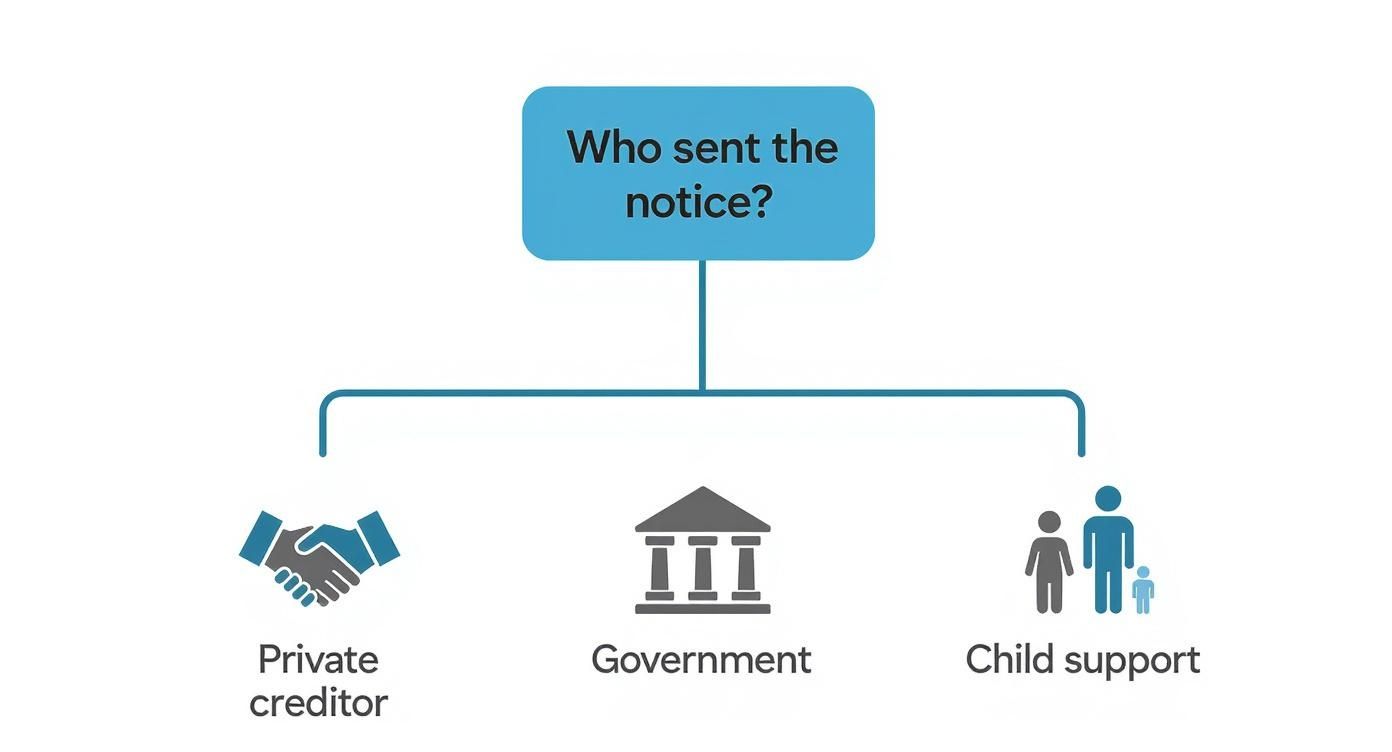
As you can see, the path you take diverges significantly based on whether you're dealing with a private creditor, the government, or a family support obligation.
Understand the Legal Limits on Your Paycheck
The good news is that creditors can't just take your whole paycheck. Both federal and state laws put strict caps on how much of your disposable income can be garnished. Knowing these limits helps you see what the financial hit will be and, just as importantly, spot if a creditor is trying to take more than they’re legally allowed.
Key Takeaway: Under federal law (the Consumer Credit Protection Act or CCPA), garnishments for most consumer debts are generally limited to the lesser of 25% of your disposable earnings or the amount your earnings exceed 30 times the federal minimum wage.
But those limits can change dramatically for different types of debt. For instance:
- Child Support: These orders can take a much bigger bite, sometimes as high as 50-60% of your disposable earnings.
- Federal Student Loans: The government can garnish up to 15% of your disposable income without a court order.
- IRS Tax Levies: The IRS has its own rulebook. The amount they can take is calculated using a formula that considers your filing status and dependents, and it can be incredibly aggressive. If the IRS is the one garnishing you, it’s crucial to understand what a notice of levy means and what your rights are in that specific situation.
A Quick Look at Different Wage Garnishment Rules
To help you sort this out, here’s a quick comparison of the most common types of garnishments. It’s a good starting point for understanding what you’re up against and what your first move should be.
| Garnishment Type | Federal Limit on Your Pay | Your First Strategic Move | Governing Authority |
|---|---|---|---|
| Private Creditor Debt | Lesser of 25% of disposable income or amount over 30x minimum wage. | Review the court judgment for errors and file a claim of exemption. | State Court and Federal CCPA |
| IRS Tax Levy | Amount determined by IRS formula (Publication 1494). | Contact the IRS immediately to request a payment plan or challenge the levy. | Internal Revenue Service (IRS) |
| Federal Student Loans | Up to 15% of disposable income. | Contact the Dept. of Education to discuss loan rehabilitation or consolidation. | U.S. Department of Education |
| Child/Spousal Support | Up to 60% of disposable income (or 65% if in arrears). | Petition the family court for a modification if your circumstances have changed. | State Family Court |
This table shows just how different the rules are for each type of debt. Your response has to be tailored to the specific creditor you're dealing with.
Using Exemptions to Protect Your Income
So, you’ve received a garnishment notice. Even if the order is legally sound, this is not the end of the road. Federal and state laws have built-in safeguards called exemptions, which are powerful tools that can protect a big chunk—or sometimes all—of your paycheck from being taken.
Honestly, filing a claim of exemption is often the single most effective first move you can make. This is especially true if losing that income would throw your finances into chaos. Many people don't even know these protections exist; they assume that once a judgment is in place, the fight is over. But the law recognizes that you still need to pay for rent, food, and other essentials for you and your family. Exemptions are your legal right to stand up for that need.
What Income and Assets Are Typically Exempt
The specific exemptions you can claim vary quite a bit depending on where you live, but they almost always cover certain types of income and financial situations. Your job is to figure out which of these protections fit your circumstances and then officially claim them.
Here are some of the most common sources of protected income:
- Social Security Benefits
- Supplemental Security Income (SSI)
- Veterans' Benefits
- Disability Benefits
- Unemployment Compensation
- Workers' Compensation
- Child Support and Alimony Payments
- Retirement and Pension Funds
It's one thing to know the list, but it's another to understand how it works in the real world. For example, knowing if pensions can be garnished can bring huge peace of mind. While these funds have strong federal protections, they can sometimes become vulnerable if you mix them with other money in a bank account. It’s a good reminder of why keeping separate accounts can be so important.
Beyond the source of your income, your personal situation can also provide an exemption. The most powerful one is often the head of household exemption.
In many states, if you can prove you provide more than 50% of the financial support for a dependent—like a child or an elderly parent—your wages might be completely shielded from most creditors. This is a game-changer that can stop the garnishment cold.
The Practical Steps to Filing a Claim of Exemption
When it comes to filing for an exemption, you have to move fast. Once you get that garnishment notice, the clock starts ticking. You often have a very narrow window—sometimes just 10 to 15 days—to submit your claim. If you miss that deadline, you could lose your right to claim the exemption.
Here’s a straightforward breakdown of what you need to do:
- Find the Right Paperwork: Head to your state's judicial or court system website. You're looking for forms usually called "Claim of Exemption" and "Financial Statement." A quick search for those terms plus your state's name should get you there.
- Fill Out the Forms Carefully: Be thorough and completely honest. The Claim of Exemption form will have a series of boxes you check to indicate which protections apply to you. The Financial Statement is where you lay out your monthly income and expenses to show the court that this garnishment would cause you real hardship.
- Back It Up with Proof: Don't just say you're struggling—show it. Make copies of documents that support your claim. Think pay stubs, benefit award letters, rent receipts, utility bills, and medical expenses. The more evidence you can provide, the stronger your argument becomes.
- File and Serve: You'll need to file the original, completed forms with the court clerk (the address will be on your garnishment notice). Then, you have to send a copy to the creditor or their attorney. Follow the instructions on the form to the letter, because a simple mistake in "serving" the other party could get your whole claim thrown out.
Making a compelling case really comes down to painting a clear picture. Instead of writing, "I can't afford this," try being more specific on your financial statement. For instance: "Garnishing my wages will prevent me from paying for my child's necessary medical care, which costs $250 per month." Details like that make your situation concrete and much more persuasive to a judge.
Taking the Fight to Court
Receiving a garnishment order can feel like a final judgment, but it’s often anything but. Creditors and their collection agencies are not infallible. They make mistakes, court documents get lost in the shuffle, and sometimes the whole case they built against you rests on a shaky legal foundation. If something about the debt or the way it was handled doesn't sit right with you, you have every right to challenge it.
Don't just assume the court order is the end of the story. The legal system gives you a path to fight back, but you have to be the one to walk it. This isn't about ducking a legitimate debt; it's about making sure the entity taking money from your paycheck has followed every single rule to the letter.
Finding the Cracks in Their Case
Your best shot at fighting a garnishment in court usually comes down to finding procedural errors or major flaws in the original lawsuit. The argument isn't simply, "I can't afford this." Instead, you’re making a much more powerful claim: "You don't have the legal right to collect this from me." That's a critical difference.
So, what kind of mistakes can invalidate a garnishment? Here are some of the most common—and effective—angles of attack:
- You Were Never Properly "Served." The law is crystal clear: you have to be legally notified that you're being sued. If the creditor can't prove they properly served you with the original summons and complaint, any judgment they got against you is likely void.
- The Clock Ran Out (Statute of Limitations). Every state sets a time limit for how long a creditor has to sue you over an old debt. If they waited too long to file their lawsuit, the judgment they won might be invalid.
- The Numbers Are Wrong. It happens more often than you'd think. Creditors sometimes tack on unauthorized fees, miscalculate interest, or fail to credit payments you've already made. You can challenge the entire garnishment based on these kinds of inaccuracies.
- It's Not Your Debt. This could be a case of straightforward identity theft or a simple mix-up where they have the wrong person. If the debt isn't yours, the judgment is fraudulent.
These aren't just legal theories; they are real-world tools that people use every single day to protect their paychecks from collectors who cut corners.
Getting Your Day in Court and Building Your Defense
To make your argument, you'll need to officially request a hearing. This usually means filing a specific document—often called a "Motion to Vacate Judgment" or an "Objection to Garnishment"—with the same court that issued the order.
Once that motion is filed, the court will set a date for you and the creditor to appear. This is your moment to present your side, and being prepared is absolutely everything.
You’ll need to bring concrete evidence that proves your claim. What does that look like?
- For Improper Service: Dig up anything that shows you never got the lawsuit papers. Maybe it's proof you lived at a different address at the time, mail logs, or a sworn statement (an affidavit) from a neighbor who can confirm the papers were never delivered.
- For an Expired Statute of Limitations: You need to establish a timeline. Find old bank statements or letters from the original creditor that show the date of your last payment or activity on the account.
- For an Incorrect Amount: Gather your own records. This includes the original contract, proof of payments you made, and any account statements you have. Highlight every single discrepancy between what they claim and what your records show.
A Pro's Advice: When you stand before the judge, be organized and stick to the facts. They are interested in legal arguments backed by clear evidence, not emotional pleas. Lay out your documents in a logical order and calmly explain exactly why the judgment against you is invalid.
It's also helpful to understand the bigger picture. Before the pandemic, wage garnishments were climbing, hitting a peak of 3.9% of workers in March 2020. Federal relief programs, especially the pause on student loan collections, pushed that number down to 2.8% by January 2024. But with those protections ending, experts expect a major resurgence in garnishments. This context, detailed in wage garnishment trends from ADP Research Institute, shows why knowing how to challenge a potentially flawed court order is more critical now than ever.
Talk Directly to Your Creditor
Believe it or not, a garnishment order doesn't mean the conversation is over. Far from it. Many creditors, even with a court judgment in hand, are surprisingly willing to talk. Why? Because from their perspective, wage garnishment is a slow, tedious grind. It can take years to get their money back, and that's not guaranteed.
This is your opening. By approaching your creditor directly, you can often negotiate a better deal and stop the garnishment before it wreaks havoc on your finances. It might feel like the last thing you want to do, but taking this step puts you back in the driver's seat.
How to Make an Offer They Can't Refuse
Your job is to propose a deal that’s more appealing than slowly siphoning money from your paycheck for the next several years. This almost always comes down to two options: a lump-sum settlement or a voluntary payment plan.
- The Lump-Sum Settlement: This is the gold standard. If you can pull together some cash—maybe from a tax refund, help from family, or savings—offering a one-time payment is incredibly powerful. Creditors frequently accept a fraction of the total debt, sometimes as low as 40-60%, to get paid now and close the books on your account.
- A Voluntary Payment Plan: Can't swing a lump sum? Propose a new payment plan you can actually afford. The trick is to offer them slightly more than they’re currently getting from the garnishment. This shows you're serious and gives them a reliable payment without the legal hassle.
When you call, frame it as a mutual win. Be direct and honest about your situation. You could say something like, "Look, this garnishment isn't sustainable for me, but I am committed to paying this debt. I can offer you a one-time payment of $X right now to settle this for good."
Don't Forget Your Employer's Role
Keep in mind that your employer probably hates this garnishment as much as you do. These orders create a ton of administrative work for HR and payroll departments. They have to process the legal paperwork, calculate the deductions correctly, and send the payments on time. If they mess up, they can face legal penalties.
This means your employer will likely be thrilled if you can resolve the issue directly with the creditor and get the order lifted. It's one less headache for them to manage.
Key Insight: Any deal you strike is a win-win. You stop the garnishment and resolve the debt on better terms. The creditor gets their money faster and with more certainty than relying on the court system.
Always, Always Get It in Writing
This is the most important part: a verbal agreement means nothing. Before you send a single penny, you absolutely must get the new terms in a signed, written agreement.
This document is your shield. It needs to spell out a few critical things:
- The exact settlement amount or payment plan details.
- A clear statement that this payment will satisfy the judgment in full.
- The creditor's promise to file a Satisfaction of Judgment with the court.
- A commitment to immediately instruct your employer to stop the garnishment.
That last point is non-negotiable. The creditor started this process, and only they can officially stop it. Make sure the agreement explicitly states they are responsible for filing the release and notifying your payroll department.
For tougher negotiations, especially with government agencies, you may need a more detailed strategy. For instance, the tactics in our guide on how to negotiate IRS debt can provide a solid framework for dealing with other types of creditors, too.
When Bankruptcy Is the Right Answer
Let's be honest, the word "bankruptcy" can be terrifying. For most people, it feels like hitting rock bottom. But when a wage garnishment is devouring your paycheck and other debts are piling up, it might just be the most powerful move you can make.
Filing for bankruptcy isn't about giving up. It's a legal process designed to give people a fresh start, and its most immediate power is stopping a garnishment dead in its tracks.
The second you file, a legal shield called the automatic stay kicks in. Imagine it as a giant, legally binding "STOP" sign that goes up in front of all your creditors. It forces them to cease all collection attempts—no more phone calls, no more lawsuits, and most importantly, no more wage garnishment. Your employer gets an official notice and is legally required to stop taking money from your pay for most debts.
This immediate relief is why so many people turn to bankruptcy. It doesn't just put the garnishment on pause; it gives you the breathing room you desperately need to sort out your finances without the constant stress of a disappearing paycheck.

Chapter 7 vs. Chapter 13 Bankruptcy
While the automatic stay is your first line of defense in any bankruptcy, what happens next depends on which type, or "chapter," you file. For individuals, the choice usually comes down to Chapter 7 or Chapter 13, and they tackle the debt behind the garnishment in very different ways.
Chapter 7: The "Fresh Start"
Often called a "liquidation" bankruptcy, the goal here is to completely wipe out (discharge) your unsecured debts like credit cards, medical bills, and personal loans. To be eligible, you have to pass a "means test" that looks at your income relative to your state's median.
If you qualify, a court-appointed trustee might sell any non-exempt assets to pay creditors. The good news is, most people find that exemptions protect everything they own. For a garnishment, Chapter 7 is the final word. Once the debt is discharged—usually in just 4-6 months—the garnishment is gone forever because the debt itself no longer exists.
Chapter 13: The Reorganization Plan
This path is for people with a steady income who either make too much for Chapter 7 or want to protect assets, like catching up on a mortgage to save a house. Instead of erasing debt, you set up a repayment plan to pay back a portion of what you owe over three to five years.
The automatic stay still stops the garnishment right away. That debt then gets rolled into your single, manageable monthly payment plan, replacing the harsh deduction from your paycheck.
Is Bankruptcy the Right Move for You?
Filing for bankruptcy is a huge decision. It has a major, long-term impact on your credit, and it’s not the answer for every situation. If the garnishment is from one small, manageable debt, you're probably better off trying to negotiate a payment plan directly.
But bankruptcy becomes a very real, and very smart, option when:
- The garnishment is just one piece of a much larger debt puzzle.
- You're juggling multiple creditors, and stopping one won't solve the core problem.
- Your income has dropped, and there’s simply no realistic way to ever pay back what you owe.
A Crucial Point to Understand: The automatic stay isn't all-powerful. It will not stop garnishments for domestic support like child support or alimony. Those debts will continue to be collected and cannot be discharged in bankruptcy.
Tax debt is another tricky area. While bankruptcy can help with some tax debts, the rules are incredibly complex. Whether a tax debt can be discharged depends on how old the tax is, if you filed your returns on time, and other specific criteria. Before you make any moves, it's critical to figure out if bankruptcy can clear your tax debt and which rules apply to you. This is one area where talking to an experienced attorney is non-negotiable.
Handling IRS and Student Loan Garnishments
When the creditor is the government, the rulebook for wage garnishment gets tossed out the window. Federal agencies like the IRS and the Department of Education don’t need a judge’s permission to start taking money from your paycheck. This gives them immense power, and it means your response has to be fast and smart.
Unlike a credit card company that has to sue you first, these agencies operate with what's called administrative authority. They can kickstart a garnishment based on their own internal rules once they decide your account is delinquent. This is a critical difference because it eliminates the court buffer, leaving you with less warning and fewer chances to fight back before the deductions start.
Tackling an IRS Tax Levy
An IRS wage levy is one of the most powerful collection tools out there. The amount they can take isn’t a flat percentage. It’s a complicated calculation based on your filing status and number of dependents, and it can leave you with shockingly little to cover your bills.
But you're not powerless. Here’s how you can push back:
- Request an Installment Agreement: This is a formal payment plan with the IRS. Agreeing to pay your tax debt over a set period, often up to 72 months, will get them to release the levy.
- Submit an Offer in Compromise (OIC): Think of this as a settlement. If you genuinely can't pay the full amount, an OIC lets you resolve your entire tax debt for less than you owe. It’s a tough process, but if the IRS accepts your offer, the garnishment stops for good.
- Prove Financial Hardship: If the levy means you can't afford basic necessities like food or rent, you can ask the IRS to put your account in “Currently Not Collectible” status. This is a temporary pause on all collection activities, including the wage levy.
Of course, the best strategy is prevention. Staying on top of your taxes is the only sure way to avoid this mess. Using something like a detailed small business tax preparation checklist can make a world of difference in keeping you compliant and out of trouble.
Addressing Federal Student Loan Garnishment
Defaulting on a federal student loan opens the door to Administrative Wage Garnishment (AWG). This allows the Department of Education to take up to 15% of your disposable income directly from your employer. This isn't a rare occurrence, either. By mid-2025, nearly two million Americans were seeing their wages garnished for student loan defaults, and millions more are at risk now that the pandemic-era payment pauses have ended. You can get a sense of the scale of this problem from recent reports on student loan collections.
The only way to truly stop a student loan garnishment is to get your loans out of default. The good news is the government has created clear, structured pathways to help you do just that.
Fortunately, there are a few solid programs designed to get you back on track:
- Loan Rehabilitation: You’ll make nine affordable monthly payments (based on your income) over a ten-month period. Once you complete the program, the default is wiped from your credit report, and the garnishment immediately stops.
- Loan Consolidation: This involves bundling your defaulted loans into a brand-new Direct Consolidation Loan. To qualify, you’ll either have to agree to an income-driven repayment (IDR) plan for the new loan or make three consecutive, on-time payments before you consolidate.
- The "Fresh Start" Program: This is a temporary initiative that offers a quick route out of default. It’s designed to stop collections and restore your eligibility for federal student aid in one go.
Your first move should be to contact your loan servicer or the Department of Education's Default Resolution Group. They're the ones who can walk you through the specifics and help you figure out which path makes the most sense for stopping the wage garnishment and taking back control.
Answering Your Top Questions About Wage Garnishment
When you’re facing a garnishment, a million questions probably run through your mind. It’s a stressful situation, and the legal jargon doesn't help. Let's cut through the noise and get straight to the answers for some of the most common concerns I hear from people every day.
Will I Get Fired Because of a Wage Garnishment?
This is easily one of the biggest fears people have, and for good reason. The good news is, federal law offers you some protection here. Under the Consumer Credit Protection Act (CCPA), your employer cannot legally fire you over a single wage garnishment.
The key word there is "single." This protection vanishes if you get hit with multiple garnishment orders from different creditors. At that point, the law doesn't stop an employer from letting you go due to the administrative burden.
What if I Quit or Change Jobs?
A wage garnishment order is tied to your employer, not to you personally. So, if you leave your job, the garnishment immediately stops. Your old company can’t take money from a paycheck they no longer send you.
But don't mistake this for a permanent solution. It's really just a temporary pause. The creditor still has a valid court judgment against you and will waste no time trying to find your new employer. They can easily run employment verification checks using your Social Security number to track you down and serve the new company with a fresh order.
The Bottom Line: Switching jobs might buy you a few weeks or months, but it’s not a get-out-of-jail-free card. The creditor will catch up, and the garnishment will start all over again.
How Badly Will a Garnishment Hurt My Credit Score?
Here’s a bit of a silver lining: the garnishment itself isn't what shows up on your credit report. The real damage to your credit score has, unfortunately, already happened long before your wages were touched.
The major hits to your credit come from the events that led to the garnishment in the first place:
- The original account being reported as delinquent and sent to collections.
- The lawsuit filed against you, resulting in a public court judgment.
Both of these events can crater your credit score. Stopping the garnishment is about surviving financially right now, but the only way to truly start rebuilding your credit is to deal with that underlying judgment.
Facing a wage garnishment can feel like you're backed into a corner, but you have options. Attorney Stephen A Weisberg provides a FREE Tax Debt Analysis to help you understand the best way to resolve your specific situation. Contact us today to find your path forward.


